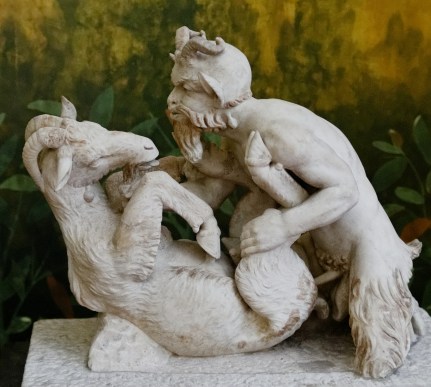
Io Pan!
Io Pan!
In an effort to find something other than our present pandemic to talk about I’d like to have a serious conversation about asses.

No, not those ones. These asses:
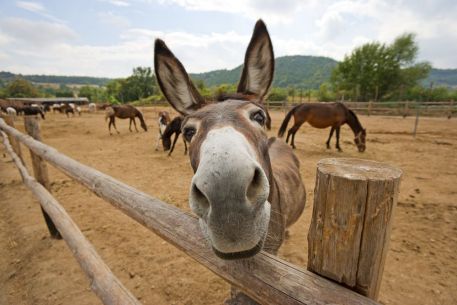
Specifically the asses that Dionysos and his Satyr army rode into battle:
When the Gods were marching against the Giants, it is said that Dionysos, Hephaistos and the Satyrs traveled by donkey. When they were near the Giants, who, however, were not yet visible, the donkeys brayed and the Giants, hearing the noise, fled. For this reason the donkeys were honored, being placed on the western side of the Crab. (Eratosthenes, Katasterismoi 11)
This is generally regarded as an attempt by Eratosthenes to take the piss out of the Ptolemies, the patron God of their dynasty and an underpinning ideology of Sacred King as Conqueror and Bestower of Civilization that hearkens back to Alexander the Great and his triumphal processions. At least that’s the argument I made in my article The Politics of Myth – but something I read tonight has me reconsidering that position.
The Saracori (Greek Saragouri, Syriac Šarağurs) were a fierce nomadic tribe who originated in the Siberian steppes before being pushed down into Crimea and the Caucasus by the Sabir and other Iranian and central Asian populations. Concerning them Claudius Aelianus writes:
The Saracori keep asses, not to carry burdens, nor to grind corn but to ride in war, and mounted on them they brave the dangers of battle, just as the Greeks do on horseback. And any ass of theirs that appears to be more given to braying than others they offer as a sacrifice to the God of War. (De Natura Animalium 12.34)
Similar remarks were made by Strabo concerning the Karmanioi, a Turkic people who lived near the Zagros mountain range:
Because of scarcity of horses most of the Carmanians use asses, even for war; and they sacrifice an ass to Ares, the only God they worship, and they are a warlike people. No one marries before he has cut off the head of an enemy and brought it to the king; and the king stores the skull in the royal palace; and he then minces the tongue, mixes it with flour, tastes it himself, and gives it to the man who brought it to him, to be eaten by himself and family; and that king is held in the highest repute to whom the most heads have been brought. (Geographika, 2.14.24-33)
At least on the periphery of the Greek world the donkey was not an object of ridicule nor would riding one into battle be considered “mock-heroic” – for the barbarian populations and their neighbors these were fearsome creatures worthy of being sacrificed to the God of War.
Indeed, Herodotos relates that braying donkeys helped the Persians finally defeat the previously indomitable Skythians in a scenario much like the one described by Eratosthenes:
The Skythian horse always routed the Persian horse, and when the Persian cavalry would fall back in flight on their infantry, the infantry would come up to their aid; and the Skythians, once they had driven in the horse, turned back for fear of the infantry. The Skythians attacked in this fashion by night as well as by day.
Very strange to say, what aided the Persians and thwarted the Skythians in their attacks on Darius’ army was the braying of the asses and the appearance of the mules. For, as I have before indicated, Skythia produces no asses or mules; and there is not in most of Skythia an ass or a mule, because of the cold. Therefore the asses frightened the Skythian horses when they brayed loudly; and often, when they were in the act of charging the Persians, the horses would shy in fear if they heard the asses bray or would stand still with ears erect, never having heard a noise like it or seen a like creature. (Histories 4.128-129)
So this has me not only reconsidering how Eratosthenes’ myth should be interpreted but whether Dionysos’ association with these animals significantly predates the Ptolemies, and possibly is a holdover from his days in the Pontic-Caucasian region, one of the places where I believe his worship originated (along with viticulture, nearly 8,000 years ago.)
Is it too soon to start wearing Mad Max fetish gear and resorting to cannibalism?
I’m, uh, asking for a friend.
Apparently the next plague had to be cancelled because a pharmaceutical company was dumping chemicals in the water and all the frogs died off.
Authorities with the Food and Agriculture division of the United Nations are warning that a plague of locusts larger than anything we’ve seen in over 30 years is descending upon Africa and the Middle East just in time for Passover.
Hannibal Lecter: And what did you see, Clarice? What did you see?
Clarice Starling: Lambs. The lambs were screaming.
In case it’s not clear from the posts I’ve been making this week I firmly believe in the efficacy of prayer. As an Orpheotelest I’m also down with protective charms, the healing properties of plants and stones as well as a host of customs which are not inaccurately classed as superstitions.
But I’m not a stupid man – these things work best in conjunction with pragmatic and proactive measures. “Praise the Lord and pass the ammunition,” as it says in the Bible.
Which is why I am frankly baffled by the response of Mexican President Andrés Manuel López Obrador to our present pandemic, as reported by Kate Linthicum of the Los Angeles Times:
“Pandemics won’t do anything to us,” he said on Monday while accusing the media and his political opponents of exaggerating the threat of the virus.
He has declined to close his borders or ban travel from particularly afflicted countries and has brazenly ignored recommendations from his own deputy health minister that Mexicans refrain from greeting each other with a customary hug and kiss.
At a large rally over the weekend, Lopez Obrador waded proudly into the crowd, kissing children and embracing supporters. He has made a show of waving off offerings of antibacterial gel. And on Wednesday, before appearing at another large event, he showcased a collection of good-luck charms that he carries with him, including Catholic scapulars and a $2 bill.
“They are my bodyguards,” he said, smiling.
This laissez-faire approach has led to increased tensions with El Salvador and other Latin American countries, with some even speculating that we could soon see armed conflict in the region.
In what is certainly unrelated news, CNN reported that a 5.7-magnitude earthquake ravaged Utah on Wednesday, dislodging the trumpet of the Angel Moroni from the iconic Latter-Day Saints Temple in Salt Lake City.
Strange behavior has also been witnessed among the world’s sea creatures.
Couple of interesting articles to share with you guys today. Here’s one on the cats of Freyja. Here’s one on the Jews of Loki. And here’s one on Apollon, Dionysos, and the Multivalent Birds of Euripides’ Ion.
My wife shared prayers to the Healing Gods Apollon and Eir, and then offered sets of prayer cards to her readers. To be eligible for the giveaway, however, you must write prayers to the Healers. Do consider contributing – the deadline is March 31st.
Sophokles, Choral Ode from the Antigone
God of the many names, Semele’s golden child,
child of Olympian thunder, all Italy’s Lord.
Lord of Eleusis, where all men come
to mother Demeter’s plain.
Bacchus, who dwell in Thebes,
by Ismenus’ running water,
where wild Bacchic women are at home,
on the soil of the dragon seed.
Seen in the glaring flame, high on the double mount,
with the Nymphs of Parnassus at play on the hill,
seen by Kastalia’s flowing stream.
You come from the ivied heights,
from green Euboea’s shore.
In immortal words we cry
your name, Lord, who watch the ways,
the many ways of Thebes.
This is your city, honored beyond the rest,
the town of your mother’s miracle-death.
Now, as we wrestle our grim disease,
come with healing step from Parnassus’ slope
or over the moaning sea.
Leader in the dance of the fire-pulsing stars
overseer of the voices of night,
child of Zeus, be manifest,
with due companionship of Maenad maids
whose cry is but your name.
Philodamos’ Paian to Dionysos
I. Come here, Lord Dithyrambos, Bakchos, God of jubilation, Bull, with a crown of ivy in your hair, Roarer, oh come in this holy season of spring – euhoi, o io Bakchos, o ie Paian! Once upon a time, in ecstatic Thebes, Thyona bore you to Zeus and became mother of a beautiful son. All immortals started dancing, all mortals rejoicing at your birth, o Bacchic God. – Ie Paian, come o Saviour, and kindly keep this city in happy prosperity.
II. On that day Kadmos’ famous country jumped up in Bacchic revelry, the vale of the Minyans, too, and fertile Euboia – euhoi, o io Bakchos, o ie Paian! Brimful with hymns, the holy and blessed country of Delphi was dancing. And you yourself, you revealed you starry shape, taking position on the crags of Parnassos, accompanied by Delphic maidens. – Ie Paian, come o Saviour, and kindly keep this city in happy prosperity.
III. Swinging your firebrand in your hand – light in the darkness of night – you arrived in your enthusiastic frenzy in the flower-covered vale of Eleusis – euhoi, o io Bakchos, o ie Paian! There the entire Greek nation, surrounding the indigenous witnesses of the holy Mysteries, invokes you as Iakchos: you have opened for mankind a haven, relief from suffering. – Ie Paian, come o Saviour, and kindly keep this city in happy prosperity.
IV…….
V. From that blessed country you came to the cities of Thessaly, to the sacred domain of Olympos and famous Pieria – euhoi, o io Bakchos, o ie Paian! and forthwith did the Muses crown themselves with ivy; they all sang and danced around you, proclaiming you to be ‘Forever immortal and famous Paian’! Apollo had taken the lead in this dance. – Ie Paian, come o Saviour, and kindly keep this city in happy prosperity.
VI….VII….VIII…..
IX. The God commands the Amphiktyons to execute the action with speed, so that he who shoots from afar may restrain his anger – euhoi, o io Bakchos, o ie Paian! – and to present this hymn for his brother to the family of the Gods, on the occasion of the annual feast of hospitality, and to make a public sacrifice on the occasion of the Panhellenic supplications of blessed Hellas. – Ie Paian, come o Saviour, and kindly keep this city in happy prosperity.
X. O blessed and fortunate the generation of those mortals who build for Lord Apollo, a never-decaying, never-to-be-defiled temple – euhoi, o io Bakchos, o ie Paian! – a golden temple with golden sculptures where the Goddesses encircle Paian, his hair shining in ivory, adorned with an indigenous wreath. – Ie Paian, come o Saviour, and kindly keep this city in happy prosperity.
XI. To the organizers of his quadrennial Pythian Festival the God has given the command to establish in honour of Bakchos a sacrifice and a competition of many dithyrambs – euhoi, o io Bakchos, o ie Paian! – and to erect an attractive statue of Bakchos like the bright beams of the rising sun, standing on a chariot drawn by golden lions and to furnish a grotto suitable to the holy God. – Ie Paian, come o Saviour, and kindly keep this city in happy prosperity.
XII. Come on then, and welcome Dionysos, God of the Bakchants, and call upon him in your streets with dances performed by people with ivy in their hair who sing ‘Euhoi, o io Bakchos, o ie Paian!’ All over blessed Hellas…dithyrambs. Hail thou, Lord of Health. – Ie Paian, come o Saviour, and kindly keep this city in happy prosperity.
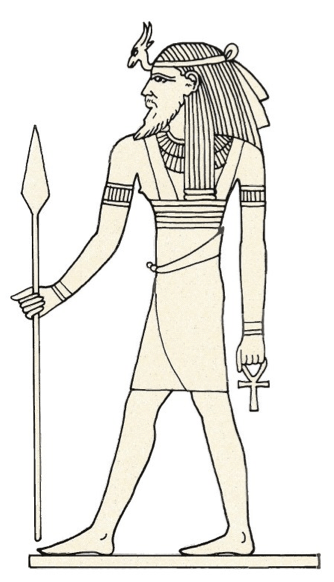
TurningTides wrote:
Thank you for this prayer to Lord Reshep! May He aid those who wade in front of this pandemic tide–the health care workers, the doctors who must see those already suffering with symptoms and/or fear. For this pandemic is affecting all of us, so may we learn what tools we need to make, so that we come out of this time prepared to live closer on the Gods’ paths for us.
To which I responded:
Beautifully said. And I think during this we especially need to be praying for the doctors, nurses and EMTs who aren’t just putting their lives at risk to help us all, but their psychological well-being too from witnessing both what this is doing to their patients, and to their colleagues.
May Rešeph, Ešmoun, Nintinugga, Sekhmet, Anāhitā, Kamrušepa, Yahweh, Babalu Aye, Sukunabhikona-no-Kami, Parṇaśabarī, Sheetala Devi, Apollon, Asklepios, Hygeia, Eir, Živena and all of the other Healing Deities great and small be with them and with us during this crisis.
Lucian, How to Write History
There is a story of a curious epidemic at Abdera, just after the accession of King Lysimachus. It began with the whole population’s exhibiting feverish symptoms, strongly marked and consistent from the very first attack. About the seventh day, the fever was relieved, in some cases by a violent flow of blood from the nose, in others by perspiration no less violent. The mental effects, however, were most ridiculous; they were all stage-struck, mouthing blank verse and ranting at the top of their voices. Their favourite recitation was the Andromeda of Euripides; one after another would go through the great speech of Perseus; the whole place was full of pale ghosts, who were our seventh-day tragedians vociferating: ‘O Love, who lord’st it over Gods and men…’ and the rest of it. This continued for some time, till the coming of winter put an end to their madness with a sharp frost. I find the explanation of the form the madness took in this fact: Archelaus was then the great tragic actor, and in the middle of the summer, during some very hot weather, he had played the Andromeda in Abdera; most of them took the fever in the theatre, and convalescence was followed by a relapse – into tragedy, the Andromeda haunting their memories.
Antonin Artaud, The Theatre and its Double
For if theatre is like the plague, this is not just because it acts on large groups and disturbs them in one and the same way. There is both something victorious and vengeful in theatre just as in the plague, for we clearly feel that the spontaneous fire the plague lights as it passes by is nothing but a gigantic liquidation. The plague takes dormant images, latent disorder and suddenly carries them to the point of the most extreme gestures. Theatre also takes gestures and develops them to the limit. Just like the plague, it reforges the links between what does and does not exist, between the virtual nature of the possible and the material nature of existence. It rediscovers the idea of figures and archetypal symbols which act like sudden silences, fermatas, heart stops, adrenaline calls, incendiary images surging into our abruptly woken minds. It restores all our dormant conflicts and their powers, giving these powers names we acknowledge as signs. Here a bitter clash of symbols takes place before us, hurled one against the other in an inconceivable riot. For theatre can only happen the moment the inconceivable really begins, where poetry taking place on stage nourishes and superheats created symbols. These symbols are symbols of full-blown powers held in bondage until that moment and unusable in real life, exploding in the guise of incredible images giving existence and the freedom of the city to acts naturally opposed to social life. A real stage play disturbs our peace of mind, releases our repressed subconscious, drives us to a kind of potential rebellion (since it retains its full value only if it remains potential), calling for a difficult heroic attitude on the part of the assembled groups.

Back on 02/17/2020 Maya Margit reported that archaeologists had unearthed a 3,000 year old temple to the Canaanite God Rešeph:
Led by Prof. Yosef Garfinkel of the Hebrew University of Jerusalem and Prof. Michael Hasel of Southern Adventist University in Tennessee, the team published their findings in the Levant journal last month following years of excavations.
Located in south-central Israel, Tel Lachish is the site of the biblical Lachish, a major Canaanite city during the Middle and Late Bronze Ages that was later conquered by the Israelites. It was one of the only Canaanite cities to survive into the 12th century BCE.
“We excavated a new temple in the northeast corner of the site that dates to the 12th century BCE,” Garfinkel told The Media Line. “It was extremely rich with objects and also [had] an inscription, which is very, very rare. The last time a Canaanite inscription was found was about 40 years ago.” The aforementioned inscription was found on a pottery shard and features the oldest-known example of the letter “samekh.”
“In general, temples in the ancient Near East were not like churches or synagogues that you could enter,” Weissbein said. “It’s a different type of cultic activity. Only a few elites – priests or maybe kings – entered to do some rituals there because it was a house of gods, not a house of worship in a way… We found two figurines of male deities,” Weissbein stated. “They probably represent Baal, one of the main deities of the Canaanites, like a storm god or a fertility god … and another deity called Resheph, more of a warlike deity.”
Well, not quite Weissbein. Although Rešeph is unquestionably a mighty warrior, he is also the Hurler of Thunder, the Lord of Fire and Destruction and God of Fever, Illness and Pestilence. He was worshiped in Ugarit, Syro-Palestine, Phoenicia, Egypt and the Eastern Mediterranean and has a growing cult among contemporary polytheists from different traditions. Our household maintains a shrine for him, and I have a strong suspicion that there’s history between Rešeph and Dionysos (though I’ll save that for another post.) Needless to say, when I caught the story about the unearthing of Rešeph’s temple on the Wild Hunt, my interest was piqued.
Especially when I read the bit about the Samekh inscription.
Samekh has a numerical value of 60, and is the 15th letter in the Hebrew, Aramaic and Phoenician alphabets – where in the latter it is called sāmek, and has the following shape 𐤎, thought to represent a tent-peg, a tree or something like the djed-pillar.
Now I am not going to go into the mysteries of this Phoenician letter as they are not mine to share – but Hebrew gematria is totally up for grabs!
In discussing the significance of this letter Rabbi Aaron L. Raskin of Chabad.org begins by telling the following anecdote:
Yaakov had been terribly ill for weeks. He finally decided to ask R. Mordechai of Neshchiz for advice. “Rebbe,” he sobbed, “please help me. I am extremely sick. I have gone to every doctor in town, but none of them has a cure for me.”
“It seems that you haven’t gone to the right doctor,” replied R. Mordechai. “Go immediately to Anipoli and talk to the specialist there. Then you will be cured.”
Yaakov thanked the Rebbe for his advice, hired a wagon, and set out for Anipoli. When he arrived there, he rushed over to the first person he saw and asked, “Please, tell me where the great specialist lives. I am very ill and must see him right away.”
The person was puzzled. “You came to Anipoli for a specialist?! This is such a small village, we don’t even have a doctor here.”
[…]
Disappointed and frustrated, Yaakov returned to R. Mordechai of Neshchiz. “Rebbe,” he said, “I don’t understand. You sent me to Anipoli, but the people told me that not only is there no specialist there, there is not even a doctor.”
“Hmm. They don’t even have a doctor?” questioned the Rebbe. “So did you ask the people what they do when someone is sick?”
“I did,” Yaakov replied. “They told me that when someone is sick, they pray to G‑d and rely on Him to cure them.”
“Now do you understand?” R. Mordechai explained. “The people in Anipoli go to the greatest specialist in the world. They pray to G‑d. He is the one Who cures us all.”
And then informs us:
The numerical value of the samech, the fifteenth letter of the alef-beis, is sixty. In the Priestly Blessing recited every morning there are fifteen words and sixty letters. When the kohen blesses the people, he must put his two hands together. According to the Mishnah there are thirty bones in each hand, sixty when the hands are joined. What is unique about the Priestly Blessing? The results of such blessings are swift and without interruption, similar to the strength of a current of mighty water that no dam can stop. The Priestly Blessings embody the concept of the samech: infinite light and power.
Rabbi Raskin goes on to note:
The circular aspect of the samech represents support, like the rings that encircle and hold together all the elements of the lulav. The ring also symbolizes a couple’s commitment to each other. A woman symbolizes her uncompromising support of her husband by circling him seven times under the chuppah. Similarly, the man’s commitment is symbolized by the giving of a ring. When you pick up someone who has fallen, you support and encircle him or her. With the wedding ring we are saying in effect, “This ring has no beginning or end, no highs or lows. The characteristic of encircling is constant. So, too, will my commitment to you be constant, encompassing your whole being, regardless of the highs and lows of the relationship.”
So in other words Samekh is about a circular disease – a coronavirus, if you will – which we will only survive by loving and supporting one another as well as priestly prayer to the Healing Gods.
Got it.
*clears throat*
Hail Rešeph, may your protection and restoration be upon all those whose lips are sweet from tirelessly praising your precious name! Rešeph! Rešeph! Rešeph!
It would seem that the latest casualty of the coronavirus is the U.S. Constitution.
From Florida:
“Late-night revelry simply will not be allowed” in St. Petersburg as long as the COVID-19 coronavirus is a threat, Mayor Rick Kriseman said Monday.
The mayor’s comments came while he was announcing a state of emergency for the city of St. Pete. His order, which goes into effect immediately, means no public events, weddings, sporting events, or any other gatherings that draw more than 50 people will be permitted on public or private property.
From Illinois:
The mayor of Champaign, Illinois, gave herself the power to ban the sale of guns and alcohol after declaring a citywide emergency to address the coronavirus.
Mayor Deborah Frank Feinen signed the executive order on Thursday declaring a state of emergency for the city. That executive order, which is in line with municipal code, comes with extraordinary powers for the mayor to enact over a short period of time as the city combats the spread of the coronavirus.
Among the powers Feinen gained after signing the executive order was the power to ban the sale of guns, ammunition, alcohol, and gasoline. Feinen could also cut off access to individuals’ gas, water, or electricity. The city also has the ability to “take possession of private property” or order the temporary closing of all bars or liquor stores.
Just two examples from two states, and that’s already half the amendments broken. I could go on, but I’m guessing your Twitter and Facebook feeds have been a constant barrage and you don’t need me adding to it.
But I wonder how long until you’ll be able to watch from your window as tanks and heavily armed National Guard troops march down our deserted streets. Not long, it would seem.
Don’t worry, the government has everything under control – and they are doing this only with the public good in mind.
As fond as I am of Ovid’s treatment of Liberalia in the Fasti, I think Augustine’s description below really takes the cake:
Now as to the rites of Liber, whom they have set over liquid seeds, and therefore not only over the liquors of fruits, among which wine holds, so to speak, the primacy, but also over the seeds of animals:— as to these rites, I am unwilling to undertake to show to what excess of turpitude they had reached, because that would entail a lengthened discourse, though I am not unwilling to do so as a demonstration of the proud stupidity of those who practice them. Varro says that certain rites of Liber were celebrated in Italy which were of such unrestrained wickedness that the shameful parts of the male were worshipped at crossroads in his honour. Nor was this abomination transacted in secret that some regard at least might be paid to modesty, but was openly and wantonly displayed.
For during the festival of Liber this obscene member, placed on a little wagon, was first exhibited with great honour at the crossroads in the countryside, and then conveyed into the city itself. But in the town of Lavinium a whole month was devoted to Liber alone, during the days of which all the people gave themselves up to the must dissolute conversation, until that member had been carried through the forum and brought to rest in its own place; on which unseemly member it was necessary that the most honorable matron should place a wreath in the presence of all the people. Thus, forsooth, was the God Liber to be appeased in order for the growth of seeds. Thus was enchantment (fascinatio) to be driven away from fields, even by a matron’s being compelled to do in public what not even a harlot ought to be permitted to do in a theatre, if there were matrons among the spectators. (De Civitate Dei 7.21)
And that cake (or liba) is penis-shaped, just like the giant phalloi that were trotted around the city and countryside in their little wagons, imbuing the land with fertility and driving off winter sterility and malignant enchantment.
This naturally reminds one of similar Bacchic rites carried out during Anthesteria and Dionysia, but also of a Vanic ceremony recorded in Chapter 40 of Tacitus’ Germania:
The Langobardi, by contrast, are distinguished by the fewness of their numbers. Ringed round as they are by many mighty peoples, they find safety not in obsequiousness but in battle and its perils. After them come the Reudingi, Aviones, Anglii, Varini, Eudoses, Suarini and Nuitones, behind their ramparts of rivers and woods. There is nothing noteworthy about these peoples individually, but they are distinguished by a common worship of Nerthus, or Mother Earth. They believe that she interests herself in human affairs and rides among their peoples. In an island of the Ocean stands a sacred grove, and in the grove a consecrated cart, draped with cloth, which none but the priest may touch. The priest perceives the presence of the Goddess in this holy of holies and attends her, in deepest reverence, as her cart is drawn by heifers. Then follow days of rejoicing and merry-making in every place that she deigns to visit and be entertained. No one goes to war, no one takes up arms; every object of iron is locked away; then, and only then, are peace and quiet known and loved, until the priest again restores the Goddess to her temple, when she has had her fill of human company. After that the cart, the cloth and, if you care to believe it, the Goddess herself are washed in clean in a secluded lake.
Then there’s the Völsi, a magically preserved horse’s penis that was used in household cultus. You can read the original account from the Völsa þáttr, as well as some potent analysis here (which goes into some of the herbs that may have been used to preserve the phallos, among other fascinating details) and this page, which also has some pics of the sacred dicks and related ritual implements – which, like the tools in Liber’s ceremony, are primarily handled by respected, pious Matrons.
Here are 6 Gnossiennes by French composer Erik Satie:
The term is a neologism coined by Satie in the late 19th century for “compositions with a dance-like quality.” Later, to honor his mentor Francis Poulenc also wrote some.
According to Wikipedia:
The word appears to derive from gnosis. Satie was involved in gnostic sects and movements at the time that he began to compose the Gnossiennes. However, some published versions claim that the word derives from Cretan “knossos” or “gnossus”; this interpretation supports the theory linking the Gnossiennes to the myth of Theseus, Ariadne and the Minotaur. Several archeological sites relating to that theme were famously excavated around the time that Satie composed the Gnossiennes.
However, I prefer the Dictionary of Obscure Sorrows’ definition:
gnossienne
n. a moment of awareness that someone you’ve known for years still has a private and mysterious inner life, and somewhere in the hallways of their personality is a door locked from the inside, a stairway leading to a wing of the house that you’ve never fully explored—an unfinished attic that will remain maddeningly unknowable to you, because ultimately neither of you has a map, or a master key, or any way of knowing exactly where you stand.
In 1891 Satie published Le Fils des étoiles (The Son of the Stars) for Joséphin Péladan’s Rosicrucian play of the same name, which includes what many consider the 7th Gnossienne despite its different tone and subject matter.
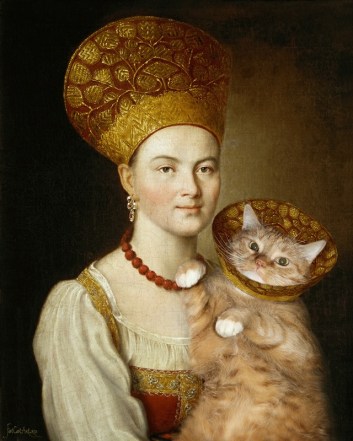
Freyja’s cats are mentioned twice in the Gylfaginning, first in his general description of the Goddess:
Sessrumir, her hall, is large and beautiful. And when she travels, she drives two cats and sits in a chariot. (24)
And again when Snorri describes the Gods attending Baldr’s funeral:
…Freyr drove in a chariot with a boar called Gullinbursti or Slíðrugtanni. But Heimdallr rode a horse called Gulltoppr, and Freyia her cats. (50)
Additionally in the Skaldskaparmal we are told:
How shall Freyja be referred to? By calling her daughter of Njörðr, sister of Freyr, wife of Óðr, mother of Hnoss, possessor of the fallen slain and of Sessrumir and tom-cats…
And that’s pretty much it until the Romantics.
Nowhere are their names given, which has led Neopagans into some rather fanciful speculation.
Most people are probably familiar with the names Diana L. Paxson provides in her fantasy novel Brisingamen: “Tregul” (Tree-gold, or Amber) and “Bygul” (Bee-gold, or Honey.)
Cute. Doesn’t really resonate with me, but one could certainly do worse.
Amy Sey’s suggestion, for instance, that they are named after her daughters Hnoss and Gersemi.
No. Just no.
Someone who so loves her daughters that she names them both “Treasure” isn’t going to turn around and give that to her cats, no matter how fond she is of them.
Unless Amy was suggesting that Freyja’s daughters were her cats which … again, just no. Besides, Skaldskaparmal calls them toms so they’d at least have the male form of the word. Though I suppose she could have more than just two cats, but I doubt any of them were named after her children, even Komos. Plus that would mean she yokes her children to her wagon or chariot, and that seems out of character to me.
 The House of Vines