Evaluating literature
To do polytheism right requires well-honed critical faculties and an appreciation for differentiation. Reading isn’t enough; you need to know how to properly evaluate what you’re reading or you’ll wind up meandering through mad and fruitless passages.

This is a significant problem within mainstream contemporary Hellenic polytheism and I think it stems primarily from an inability to distinguish between types of religious literature as a result of the priority given to the Christian scriptures in our society. That is to say, Christians have one Bible and how they treat this book has influenced our understanding of what it means for something to be a piece of religious writing, whereas the ancient view was far more nuanced and complex. Plus, they’re a people of the Book; we’re the people of the Library!

Take Orpheus, Homer and Diodoros Sikeliotes as an example. (Note that I am simplifying things greatly by positing a single “Homer” and “Orpheus” as authors of the works attributed to them, but I don’t want to get too side-tracked in this discussion.) All of these men wrote about Gods, mythological events and cultus and as such their work could be classed as “religious” but there’s a wide gulf between the type of writing they did and their intent in doing so. Consequently we should evaluate them differently and give their words varying degrees of authority.

Diodoros, for instance, was writing primarily as an historian – his discussion of Gods and their rites comes in a work intended to chronicle the totality of human culture and accomplishment from its start up to his own times. There’s a great deal of mythological material and accounts of variant local traditions, but it’s because this serves his narrative needs or he’s relaying the beliefs and words of others, not because he’s laying out his own understanding of things. Indeed he frequently expresses skepticism about his subject matter or offers his own rationalistic (often euhemerizing) interpretation as a counterpoint.

This is very different from Homer who is consciously working within an established, albeit localized and divergent, mythological tradition which he is using to provide a contextual background for the stories he wants to tell about the heroes of Troy. His intent is to praise these men (and flatter his audience by emphasizing their own connection to great events and figures from the past) and add to the tradition he has inherited from his oral predecessors.

Homer’s words become invested with authority over time, recited at festivals and scrupulously studied, so that they come to shape a Pan-Hellenic consciousness of myth, tradition and the Gods and heroes. There wasn’t universal agreement with him, but all discussion was carried out with reference to his epic poems.

Different again are the works of Orpheus – they represent a unique revelation and a specific tradition with Orpheus as its head and final arbiter. They are not concerned with the products of human culture and the Gods as important peripherals to that – their intent is to bring about an understanding of these powerful personages and set forth the science of ritual engagement with them.

(At least that’s what those who ascribed religious weight to writings and ceremonies attached to name-famous Orpheus – as Ibycus put it – held, no matter how much the different threads of Orphic tradition diverged, which is to be expected considering the heterogeneous populations which promulgated it – itinerant religious specialists, discount magicians, oracle-peddlers, poets, philosophers, aristocrats, athletes, soldiers and similar marginal figures.)

As such, we need to evaluate each of these forms of religious literature differently, regardless of whether we accept the claims made within them and in particular we must avoid assigning greater authority to them than was intended by the writer – or at least be conscious that we are doing so.

For instance, I find a lot of valuable information in the works of early Christian apologists such as Clement of Alexandria, Hippolytos of Rome and Origen – but these are very problematic sources, since they are often intentionally distorting what they discuss for aggressive rhetorical purposes, all the way down to outright fabrication. This hostility, in addition to the biases all authors possess, need to be factored into any conclusions one makes about ancient polytheist religion based on them.

Think about this the next time someone flings a quote at you – especially when it’s so easy to manufacture false ones. The truth will set you free, as Charles Manson said.
Dionysos is a badass God
A portion of this piece was recycled into the last post. As it is pertinent to the discussion I’m going to share it in its entirety.

During the Classical period there was a pretty broad repertoire of Dionysiac depictions, many of which cast the God in a hardly favorable light. The comic poet Aristophanes, for instance, made him a bumbling fool in The Frogs who has to ask directions to the underworld and pisses all over himself when confronted by Empousa (288 ff).
Certainly this is the sort of thing that one expects from Aristophanes (who regularly included jabs at the audience in his plays, calling them cock-suckers, parricides, and greedy cowards) but Dionysos isn’t treated much better by the respectable authors.
Euripides called him “effeminate” (Bakkhai 350), Aiskhylos a “womanly man” and a “weakling” (Edonoi frag. 30-31). Stories were told of Dionysos being dressed in the clothing of little girls or changed into a goat to escape the wrath of Hera, and eventually he was said to have been driven insane when she inevitably caught up with him. (Apollodoros 3.28)
But perhaps the most embarrassing tale of all was the one that Homer told:
“I will not fight against any God of the heaven, since even the son of Dryas, Lykourgos the powerful, did not live long; he who tried to fight with the Gods of the bright sky, who once drove the fosterers of Mainomenos Dionysos headlong down the sacred Nyseian hill, and all of them shed and scattered their wands on the ground, stricken with an ox-goad by murderous Lykourgos, while Dionysos in terror dived into the salt surf, and Thetis took him to her bosom, frightened, with the strong shivers upon him at the man’s blustering. But the Gods who live at their ease were angered with Lykourgos and the son of Kronos struck him to blindness, nor did he live long afterwards, since he was hated by all the immortals.” (Iliad 6.129)
Nor, unfortunately, was this the only such fable that circulated in the Greek mainland.
Pausanias relates (2.20.4) that in Argos there was a tomb “which they claim belongs to the maenad Khorea, saying that she was one of the women who joined Dionysos in his expedition against Argos, and that Perseus, being victorious in the battle, put most of the women to the sword. To the rest they gave a common grave, but to Khorea they gave burial apart because of her high rank.” Both Pausanias (2.23.7-8) and Nonnos (25.104) maintain that during this battle Perseus slew the beloved bride of Dionysos who was powerless to save her.
What a different situation we find in Egypt! This Dionysos is a mighty God who more than knows how to handle his enemies.
Consider the following passage from a 3rd century epic poem about the conflict between Dionysos and Lykourgos. Our fragment picks up in the middle, after Lykourgos and Dionysos have been going at it for some time. The God has just wrought a terrible miracle, transforming the lush countryside into a barren desert wasteland:
No longer flowed the spring beside the elm, nor were there ways of watering, nor paths nor fences nor trees, but all had vanished. Only the empty plain was visible. Where a meadow was before, close came Lykourgos, heart-stricken with mighty fear and speechlessness. For irresistibly, beyond mortal defense, all their works were upset and turned about before their eyes. But when Lykourgos knew him for the glorious son of Zeus, pale terror fell upon his spirit; the ox-goad, wherewith he had been at labor smiting, fell from his hand before his feet. He had no will to utter or to ask a word. Now might that poor wretch have escaped his gloomy fate: but he besought not then the divinity to abate his wrath. In his heart he foresaw that doom was nigh to him, when he saw Dionysos come to assail him amid lightnings that flashed manifold with repeated thunderclaps, while Zeus did great honor to his son’s destructive deeds.
So Dionysos urged his ministers, and they together sped against Lykourgos and scourged him with rods of foliage. Unflinching he stood, like a rock that juts into the marble sea and groans when a wind arises and blows, and abides the smiting of the seas: even so abode Lykourgos steadfast, and recked not of their smiting. But ever more unceasing wrath went deep into the heart of Thyone’s son: he was minded not at all to take his victim with a sudden death, that still alive he might repay a grievous penalty. He sent madness upon him, and spread about the phantom shapes of serpents, that he might spend the time fending away, til baneful Rumor of his madness should arrive at Thebes on wings and summon Ardys and Astakios, his two sons, and Kytis who married him and was subdued to his embrace.
Then, when led by Rumor’s many tongues they came, found Lykourgos just now released from suffering, worn out by madness. They cast their arms around him as he lay in the dust – fools! They were destined to perish at their father’s hand before their mother’s eyes! For not long after, madness, at the command of Dionysos, aroused Lykourgos yet again, but this time with real frenzy. He thought that he was smiting serpents; but they were his children from whom he stole the spirit. And now would Kytis have fallen about them, but in compassion Dionysos snatched her forth and set her beyond the reach of doom, because she had warned her lord constantly in his storms of evil passion. Yet she could not persuade her master, too stubborn; he, when his sudden madness was undone, recognized the God through experience of suffering. Still Dionysos abated not his wrath: as Lykourgos stood unflinching, yet frenzied by distress, the God spread vines about him and fettered all his limbs. His neck and both ankles imprisoned, he suffered the most pitiable doom of all men on earth: and now in the land of Sinners his phantom endures that endless labor – drawing water into a broken pitcher: the stream is poured forth into Haides.
Such is the penalty which the loud-thundering son of Kronos ordained for men that fight against the Gods; that retribution may pursue them both while living and again in death.
We aren’t dealing with the weak and impotent Dionysos of Homer here, who flees to the bosom of Thetis and can’t protect those near and dear to him. The Greco-Egyptian Dionysos is a potent force of nature and master of all vegetative life. He is also harsh and cruel when provoked, and the punishment he metes out to Lykourgos is nothing compared to what he has in store for an Indian spy in the Bassarika of the Greco-Egyptian poet Dionysios. There is some speculation that Dionysios may have lived in Panopolis: he certainly influenced the epic school that flourished there a couple centuries later. Not only does Nonnos continue the theme of the Indian War, but he even borrowed the names Deriades and Modaios for his Dionysiaka.
In the Bassarika fragment that has come down to us a spy sent into the camp of Dionysos by the Indian king Deriades has just been discovered. The God orders several of his soldiers to go out and hunt a stag. That’s when the fun starts.
They slew it and flayed it, and stripping off the skin, arrayed the wretched man from head and shoulders down. The new-flayed hide clave to his body, moulded to the flesh; above, the horns gleamed to be seen afar; to one that beheld him, he wanted nothing of the wild beast’s form. Thus had they transformed a man into a counterfeit animal … The Bacchanal God leapt into the midst of the enemy army, where most of all the Kethaians were rushing to the flame of battle. Standing there he cried aloud to Dereiades and the rest: ‘Slaves of women, Indians, consider now this way: to Deriades above all I speak this from knowledge. You shall not, in your present straits, withstand the onslaught of the gleaming wine and escape your evil fate, before in the swift night you tear apart the raw flesh of a living animal and eat it. Behold this tall stag straight of horn, the finest that followed us from holy Hellas, a marvel to behold! Come, hasten to rend it in good conflict for its flesh.’ So he spoke, and they of their own accord were fain to fall upon human flesh, and to appease their boundless desire, smitten by eager madness. And Deriades answered the son of Zeus, saying: ‘Would that I might cut your body limb from limb and swallow the flesh raw ….’
And that, unfortunately, is where the fragment cuts off. You just know that Dionysos had some witty retort, perhaps even revealing the horrendous sparagmos and cannibalistic omophagia that he had compelled the Indians to unwittingly commit upon their kinsman. Perhaps it even ended with him saying something along the lines of, “Bitch, this is what happens when you send spies into my camp. Don’t try it again or you will know that I am the Lord Dionysos!”
We find this sort of reveling in the raw power and ferocity of the God in other Greco-Egyptian poets as well. One thinks especially of the great Alexandrian Theokritos who composed a cult-hymn that recounted the conflict between Dionysos and the insolent king Pentheus. I won’t bother to cite The Bacchanals in full – though it is a lovely poem, subject-matter notwithstanding – and instead cut to the climax, which is very relevant to our discussion:
“His mother took her son’s head and roared like a lioness with cubs; and Ino, setting her foot upon his stomach, tore off the great shoulder with the shoulder-blade, and in like fashion wrought Autonoa, while the other women parted among them piecemeal what was left of him: and to Thebes they came all blood-bedrabbled, bringing from the hill not Pentheus but tribulation. I care not. And let not another care for an enemy of Dionysos – not though he suffer a fate more grievous than this and be in his ninth year or entering on his tenth. But for myself may I be pure and pleasing in the eyes of the pure, like the eagle which is honored by aegis-bearing Zeus. To the children of the righteous, not of the unrighteous, comes the better fate. Farewell to Dionysos, whom Lord Zeus set down on snowy Drakanos when he had opened his mighty thigh. Farewell to comely Semele and her sisters, Kadmean dames honored as heroines, who, at Dionysos’ instigation, did this deed, wherein is no blame. At the acts of the Gods let no man cavil.”
Word.
Dionysos is a God
A reader commented with regard to my Amazons post that these female warriors seemed so “nasty” and “violent” and so he couldn’t conceive of them being part of the Retinue since Dionysos’ conquest of the East was “peaceful” and “bloodless.”

Oh, have I got news for you buddy.
As it turns out, I’ve had this conversation several times before, most notably with a prominent Tumblrite to which I wrote the following reply. Their response was to delete their account. Hopefully you will not behave in such an histrionic fashion as I’ve enjoyed our exchanges, most especially when you’ve had critical feedback.
To begin with, let me just reiterate a point of supreme importance, which is why I flog it constantly: you cannot derive an accurate understanding of what the ancients did or believed from only a single source.
We have no idea how widely representative such a view may have been or often even what the author’s intent in making it was. What are our source’s biases? Is he describing something contemporary with him or something he thinks happened in the remote past? It’s also important to keep in mind that each community gave a local spin to the myths and were not really bothered when they encountered regional variations, even quite drastic ones. Context is everything when interpreting the ancients.
Now, to bring it back around to your objections — it is true that there are sources that claim Dionysos won a bloodless victory over the East either as a result of his powers of persuasion or when Pan came to his aid and frightened all of his opponents, but this was only ever a minority view.
Classical literature is filled with far more anecdotes such as these:
It is related, anyhow, that Herakles of Egypt and Dionysos after they had overrun the Indian people with their arms, constructed engines of war, and tried to take the place by assault; but the sages, instead of taking the field against them, lay quiet and passive, as it seemed to the enemy; but as soon as the latter approached they were driven off by rockets of fire and thunderbolts which were hurled obliquely from above and fell upon their armour. (Philostratos, Life of Apollonius of Tyana 2.33)
Inachos was witness to both, when the heavy bronze pikes of Mykenai resisted the ivy and deadly fennel, when Perseus sickle in hand gave way to Bakchos with his wand, and fled before the fury of Satyrs cyring Euoi; Perseus cast a raging spear, and hit frail Ariadne unarmed instead of Lyaios the warrior. I do not admire Perseus for killing one woman, in her bridal dress still breathing of love. (Nonnos, Dionysiaka 25.104)
On its rich stream has Lydian Pactolus borne thee, leading along its burning banks the golden waters; the Massgetan who mingles blood with milk in his goblets has unstrung his vanquished bow and given up his Getan arrows; the realms of axe-wielding Lycurgus have felt the dominion of Bacchus; the fierce lands of the Zalaces have felt it, and those wandering tribes whom neighbouring Boreas smites, and the nations which Maeotis’ cold water washes, and they on whom the Arcadian constellation looks down from the zenith and the wagons twain. He has subdued the scattered Gelonians; he has wrested their arms form the warrior maidens; with downcast face they fell to earth, those Thermodontian hordes, gave up at length their light arrows, and became maenads. Sacred Cithaeron has flowed with the blood of Ophionian slaughter; the Proetides fled to the woods, and Argos, in his stepdame’s very presence, paid homage to Bacchus. (Seneca, Oedipus 401 ff)
And then there’s the fragment from the Greco-Egyptian poet Dionysios’ Bassarika. The fragment begins with the discovery of a spy who has been sent into the camp of Dionysos by the Indian king Deriades. The God orders several of his soldiers to go out and hunt a stag. That’s when the fun starts.
They slew it and flayed it, and stripping off the skin, arrayed the wretched man from head and shoulders down. The new-flayed hide clave to his body, moulded to the flesh; above, the horns gleamed to be seen afar; to one that beheld him, he wanted nothing of the wild beast’s form. Thus had they transformed a man into a counterfeit animal … The Bacchanal God leapt into the midst of the enemy army, where most of all the Kethaians were rushing to the flame of battle. Standing there he cried aloud to Dereiades and the rest: ‘Slaves of women, Indians, consider now this way: to Deriades above all I speak this from knowledge. You shall not, in your present straits, withstand the onslaught of the gleaming wine and escape your evil fate, before in the swift night you tear apart the raw flesh of a living animal and eat it. Behold this tall stag straight of horn, the finest that followed us from holy Hellas, a marvel to behold! Come, hasten to rend it in good conflict for its flesh.’ So he spoke, and they of their own accord were fain to fall upon human flesh, and to appease their boundless desire, smitten by eager madness. And Deriades answered the son of Zeus, saying: ‘Would that I might cut your body limb from limb and swallow the flesh raw ….’
And you know, even the komos of Alexander the Great which helped solidify this legend in the Hellenistic mind, was not without violence and drunken mayhem:
Alexander held games in honor of his victories. He performed costly sacrifices to the Gods and entertained his friends bountifully. While they were feasting and the drinking was far advanced, as they began to be drunken a madness took possession of the minds of the intoxicated guests. At this point one of the women present, Thais by name and Attic by origin, said that for Alexander it would be the finest of all his feats in Asia if he joined them in a triumphal procession, set fire to the palaces, and permitted women’s hands in a minute to extinguish the famed accomplishments of the Persians. This was said to men who were still young and giddy with wine, and so, as would be expected, someone shouted out to form the komos and to light torches, and urged all to take vengeance for the destruction of the Greek temples. Others took up the cry and said that this was a deed worthy of Alexander alone. When the king had caught fire at their words, all leaped up from their couches and passed the word along to form a victory procession in honor of Dionysos. Promptly many torches were gathered. Female musicians were present at the banquet, so the king led them all out for the komos to the sound of voices and flutes and pipes, Thais the courtesan leading the whole performance. She was the first, after the king, to hurl her blazing torch into the palace. As the others all did the same, immediately the entire palace area was consumed, so great was the conflagration. It was most remarkable that the impious act of Xerxes, king of the Persians, against the acropolis at Athens should have been repaid in kind after many years by one woman, a citizen of the land which had suffered it, and in sport.” (Diodoros Sikeliotes, Library of History 17.72.1-6)
This should surprise no one. After all the God was hailed by the names Savage, Man-Killer, He Who Tears Apart, He Who Devours Raw Flesh. The ancients understood this about him even if many today have forgotten or would prefer not to contemplate the implications of it.
And of course to do so they must consciously ignore about two-thirds of his mythology.
Lykourgos. Pentheus. Perseus. The daughters of Kadmos. The daughters of Proitos. The daughters of Minyas.
Need I go on?
If these names do not fill you with fear, you should probably crack open a book. Might I suggest you begin with Euripides’ Bakchai? By the end you will see why the playwright refers to him as most tender and most terrible of Gods.
Dionysos is a God of extremes, the paradox personified. He blurs all boundaries and enjoys crossing no line more than the arbitrary one of sexuality. To put it in the modern parlance, Dionysos is the God of genderfuck. He turns brash kings into simpering queens and bored housewives into frenzied soldiers driving back the settled folk of the valley with their deadly ivy-twined spears. Dionysos is soft, sensual, womanly — and also hirsute and hungry, virile as a hundred bulls. He spans everything in between, a whirlwind of form, a clever shape-shifter.
Now hold on to your seat, because this shit’s going to blow your mind.
Dionysos is a God.
Even the smallest God is beyond man’s full comprehension — and Dionysos is immense.
You know what that means? Dionysos is more than just some handsome bearded dude with a crown of ivy, come hither eyes and lips wet with wine.
He may show himself to you like that but he’s not limited to just that one mask, that one form. When you can see a dozen such masks, a hundred simultaneously then you’ll get at something of the truth of what Dionysos is.
But you still won’t know him completely. No mortal possibly can. For Dionysos exists beyond what is known. He is a God of mystery, as all true Gods are.
And art is man’s imperfect means of expressing the ineffable. Art points the way, it alludes and suggests. It can do no more.
When that is understood about art, art is a profound ally to religion. We are sensual creatures — there is nothing wrong with engaging the senses in worship. This makes for the most powerful kind of worship in fact.
But the object is not the subject.
The Gods are more than our conceptions of them.
When you mistake the image for what inspired it, when you accept only the surface reading of a text and go no further — you do a grave disservice to art and to religion.
Yes, the myths are true and what art depicts is real — but don’t stop there. He is more than that, always more than we can imagine. And if you try to box him in you’ll miss the really special stuff about him, the stuff you can only learn by opening yourself up to him completely. And you’ll piss him off. He doesn’t do well in cramped spaces — unless those spaces happen to be bottles.
Apomatton
Here’s another interesting bit from Harpokration’s Lexicon of the Ten Orators:
§ a193 Apomatton (wiping off): Demosthenes in For Ktesiphon. Some understand it plainly for ‘wiping away’ and ‘cleaning oneself,’ but others more elaborately, as ‘plastering clay and bran on those being initiated,’ as we say ‘to wipe the statue with clay’: for they used to anoint with clay and bran the initiates, imitating the stories told in myths according to some, that the Titans hurt Dionysos by plastering themselves with gypsum to avoid being recognized. They say that then this custom has ceased, but that later people smeared themselves with mud for tradition’s sake. Sophocles in Aichmalotides: ‘purifier of the army and experienced in rites of cleaning’ and again: ‘and most skilled wiper-off of great misfortunes.’
Very interesting
Another name for the Kerkopes – the mischievous, hairy forest creatures Herakles chased to Ephesos – is Koboloi, a portion of the Retinue of Dionysos which are still active in parts of modern Greece under the guise of Kalikántzaroi. Reading Harpokration’s Lexicon of the Ten Orators (as one does for fun at 4:00 in the morning) I came across the following, which adds an interesting dimension:
§ k67 Kobaleia: Deinarchos in the impeachment Against Pytheas. Childishness affected with deceit used to be called ‘kobaleia,’ and the one who employs this is a ‘kobalos.’ It seems to be synonymous with bomolochos (one who lurks by the altar): Philochoros in book 2 of Atthis: ‘One mustn’t believe, as some say, that Dionysos was some kind of bomolochos and kobalos.’ And Aristotle in book 8 of the History of Animals says that the horned owl, being a kobalos and a mimic, captures prey by imitating their dance.
Interesting. Very interesting.
The More You Know!
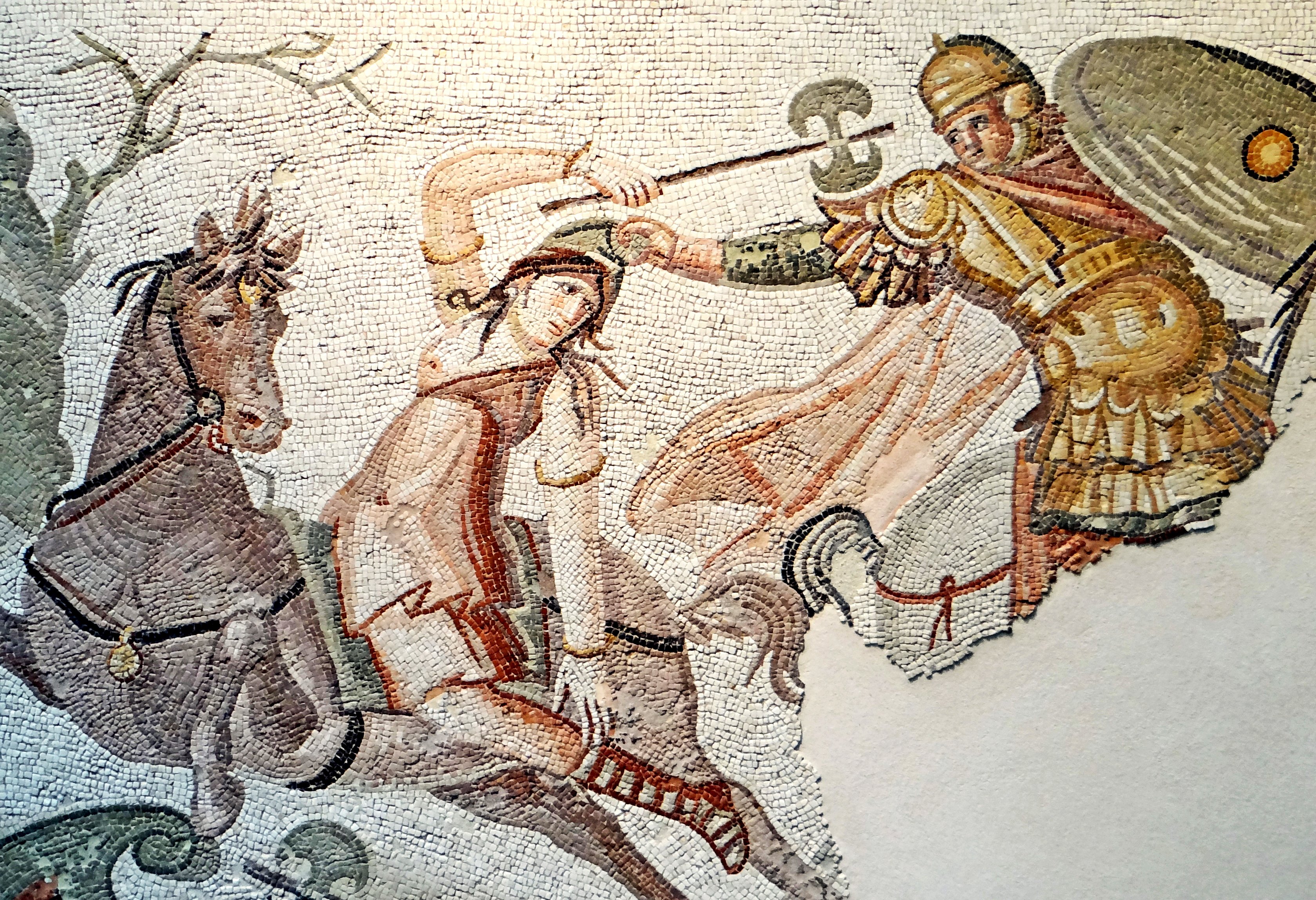
Did you know pants were invented by a woman?
According to Adrienne Mayor’s Amazons in the Iranian world:
Another legendary warrior queen was said to be the first to invent trousers. According to a lost history by Hellanikos (5th century BCE), Atossa, whose ethnic origin is not clear, was raised as a boy by her father King Ariaspes (the names are Persian but their origins and dates are shrouded in mystery).After she inherited her father’s kingdom, this Atossa “ruled over many tribes and was most warlike and brave in all deeds” (Jacoby, frag. in Gera, p. 8). She created a new style of dress to be worn by men and women alike, long sleeves and trousers that blurred gender differences (Gera, pp. 8, 141-58). Amazons in ancient Greek art are depicted wearing trousers.
Amazons weren’t just figures of myth and legend. From the Wiley Encyclopedia of Ancient History:
In the 1950s, Soviet archaeologists excavated burial mounds of Sarmatian-Saka-Scythian nomads who had traded with the Greeks in Herodotus’ time. Similar fieldwork continued in the 1990s in Kazakhstan by Jeannine Davis-Kimball; she was the first to use DNA analysis to determine that some of the armed skeletons were females. Since then, other archaeologists have identified about 300 graves of female warriors on the steppes. Of tombs containing warriors’ weapons, armor, and horse trappings, nearly a quarter belonged to women,some showing evidence of battle wounds, skull injuries, and arrowheads embedded in bone. These archaeological finds and grave goods that match Amazons’ clothing and equipment depicted in Greek vase paintings, suggest that there may have been some historical basis to the Greek stories of Amazons.
For a deeper dive on the subject, might I recommend Martine Diepenbroek’s Searching for Amazons? And if you want to learn about the affair Alexander the Great had with an Amazon, check out Elizabeth Baynham’s Alexander and the Amazons.
Dionysos in the city of Artemis
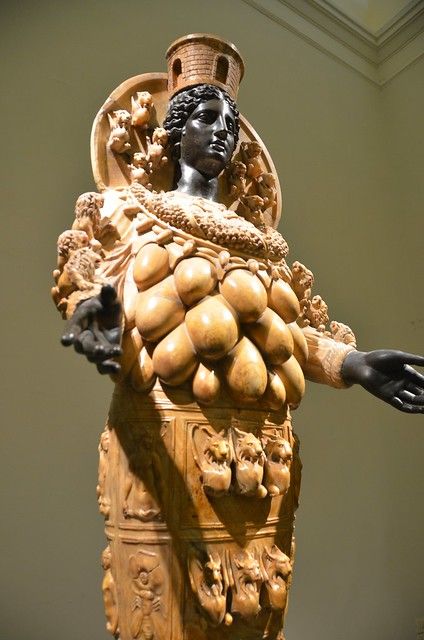
The Amazons also played a role in the early history of Ephesos, with its famous temple of Artemis, either founding it or arriving there as suppliants during their conflict with Dionysos:
Pindar, however, it seems to me, did not learn everything about the Goddess, for he says that this sanctuary was founded by the Amazons during their campaign against Athens and Theseus. It is a fact that the women from the Thermodon, as they knew the sanctuary from of old, sacrificed to the Ephesian Goddess both on this occasion and when they had fled from Heracles; some of them earlier still, when they had fled from Dionysos, having come to the sanctuary as suppliants. However, it was not by the Amazons that the sanctuary was founded, but by Koresos, an aboriginal, and Ephesos, who is thought to have been a son of the river Kayster, and from Ephesos the city received its name. (Pausanias, Description of Greece 7.2.7)
Ephesos has some significance in our tradition. It is where Herakles finally caught and bound the Kerkopes (a race of mischievous, hairy forest creatures) and the philosopher Herakleitos observed a Lenaia celebration:
Lenai are habitually associated with the Lenaia, which included, according to this testimonium, a procession in Ephesus dedicated to the God accompanied by the hymn to the phallus, and it also records that ‘Hades is the same as Dionysos, in whose honour they go mad (μαίνονται) and ‘celebrate the Lenaia’ or ‘become lenai’ (ληναΐζουσιν). This latter phrase provides, in our view, very valuable information about the archaic festival in Ephesus. Firstly the reference to Dionysos, identifed with Hades, indicates the God’s contact with death in the festival; secondly the verb ληναΐζω may refer to the presence and importance of the women celebrating Dionysos in the festival, possibly with ‘ecstatic’ dancing and singing, if the verb is translated as ‘becoming lenai’ (Heraclitus uses it as a synonym for βακχεύουσι), as the scholia indicate. In fact, in another fragment, also recorded by Clement, Heraclitus alludes, amongst other groups traditionally associated with the cult of Dionysos (and the night), to the Λῆναι. The scholium ad loc. equates ληναΐζω with βακχεύουσιν, and the lenai with the Bacchants; and in a gloss of Hesychius the lenai are also equated with the Bacchants. In later literature the lenai are the maenads of Dionysos. Theocritus (Idyll. 26), for example, refers to the bacchants Agave, Ino and Autonoe as lenai or bacchai, and speaks of their rites at ‘the 12 altars.’ In a third-century BCE inscription found in Halicarnassus, Dionysos ‘leads’ the bacchants (θοᾶν ληναγέ – τα Βακχᾶν). The fragment of Heraclitus referred to above appears to indicate both the important part played by women who ‘become Λῆναι,’ at least in Ephesus in the Archaic period, and Dionysos’ link with death in this ancient festival shared with the Ionians. We think that the Λῆναι have and/or had a major role in the Athenian festival, in awakening, invoking or calling the God from death. This rite, in the Archaic era, should be understood in the context of the agrarian cycle, even when the festival is celebrated in the month Gamelion (January-February), barren from the agricultural point of view. It may be one of the rites that contribute to propitiating the awakening of nature, and in this particular case, that specifically associated with the God: vines and the production of wine, the element with which Dionysos himself tends to be identified – as Natale Spineto has said – from the time of Homer and throughout the Archaic period. This was not the time of the grape harvest, but it was, as this author points out, that when the vines were pruned (which could be evoked by the ‘violent act’ of crushing in the wine press), and the first opening of the πίθοι. (Miriam Valdés Guía, Redefining Dionysos in Athens from the Written Sources: The Lenaia, Iacchos and Attic Women)
And it is also where Marcus Antonius made his triumphal procession, according to Plutarch, Antonios 24.4:
At any rate, when he entered Ephesos, women arrayed as Bakchai, men and boys as satyrs and Pans, led the way, the city was full of ivy and thyrsos-wands and harps and pipes and flutes, while they invoked him as Dionysos the ‘Giver of Joy’ (Charidotes) and ‘Gentle’ (Meilichios); for he was indeed such to some, but to most, he was the ‘Eater of Raw Flesh’ (Omestes) and the ‘Wild’ (Agrionios).
The hard-drinking Amazon
A while back I posted a number of quotes pertinent to the celebration of Anthesteria in Northern lands from Katerina Amanatidou’s The cult of Dionysos in the Black Sea region, including this passage on Sinope:
Apart from the terracotta figurines, the excavations brought to light a marble statue of Dionysos and coins bearing his image. The statue, which is based on an altar, is dated to the Roman period and depicts the god naked, but not barefoot, crowned with a garland made of ivy leaves and flower buds and accompanied most probably by a panther. Additionally, in some figurines Dionysos is depicted wearing a diadem of ivy leafs and flowers and a band, tainia, on his forehead. Lastly, his function as the patron deity especially of viticulture and of fertility of nature generally is also evident in Sinopean numismatics. In several coins is represented the head of Dionysos in his youth along with some of his attributes such as the thyrsos and the cista mystica.
Sinope’s an interesting place, especially the aition of its founding as recorded in the Scholion on Apollonios of Rhodes, Argonautika 2.946-54c:
Sinope is a city on the Black Sea, named after Sinope, the daughter of Asopos, whom Apollo abducted from Hyria and brought to the Black Sea; and through intercourse with her, he sired Syros, name-giver of the Syrians. In the genealogy of the Orphika (F 366 Bernabé 2.1 p. 295 = F 45 Kern) she is the offspring of Ares and Aigina; according to others, of Ares and Parnasse; according to Eumelos (BNJ 451 F 5 = F 10 Bernabé = F 7 Davies) and Aristotle (F 540 Rose = F 599 Gigon), of Asopos. Apollonios says that she tricked the river god Halys and Apollo and Zeus; that by asking them first to give her whatever she desired, then saying that she desired virginity, virginity is what she received, as they were bound by oath. Philostephanos (FHG 3.29 F 3), on the contrary, says that Apollo had intercourse with her and made her pregnant with the son called Syros. But Andron of Teos says that one of the Amazons, having fled to the Black Sea, married the king of that region; and that because she drank copious amounts of wine, she received the name Sanape [since this metaphrastically means ‘she who drinks much’], since drunk women are called sanapai among the Thracians, whose dialect is also used by the Amazons; and that the city was called then through corruption, Sinope. And the hard-drinking Amazon went from this city to Lytidas, as Hekataios reports (BNJ 1 F 34).
According to Diodoros Sikeliotes the Amazons were originally enemies of Dionysos, but after being subdued by him, they joined his army under the command of Athene and fought valiantly in his war against the Titans.

The End
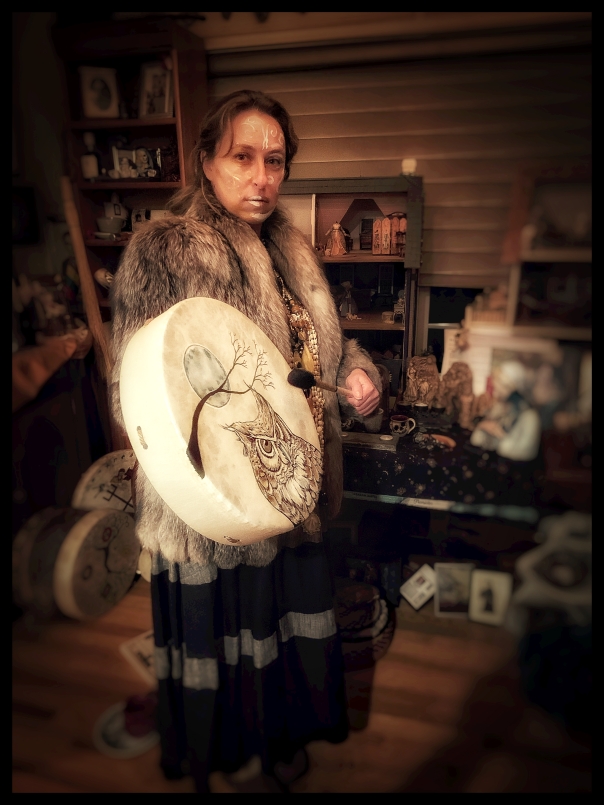
Tonight our household brought our Yuletide observances to a close with masking, drumming, and a mighty fire in honor of Perchta, and the divinities of winter. Afterwards we got the first snow of the season.
Good stuff
If you haven’t already, be sure to check out Dver’s post on the Perchtenlauf she celebrated with a bunch of folks on New Year’s Eve.
Our household has similar plans, albeit on a much humbler scale, for tomorrow (which happens to be Epiphany or Three Kings Day) closing out our Yuletide observances, which began with Oski’s Day and have continued pretty much non-stop with Lucy’s Night, Modranacht, the Solstice itself, Christmas, the Kalends, etc. (Not to mention the 6 weeks of Sunwait leading up to it.) I’ve mostly been talking about Foundation Day here at the House of Vines, but there’s been a lot of sacrifices, feasting, gift-giving, reveling with the Gods and Spirits, and general festivities going on in our little home in the Hudson Valley during this season – to the point I’m almost ready for it to be over with. Almost being the operative word.
I hope you had a great time with whatever you celebrated. And if you’ve got the energy, check out Horn and Hearth’s posts on the house of Mundilfari and sacred time. Good stuff.

Hail to the Widower and his lost Bride
Ironically enough, two years ago around this time I posted the piece Dionysos and the Jews, which discusses his history with this people and emphatically denounces anti-Semitism in all its forms. I guess New Years is the time to honor Yahweh at the House of Vines.
I’m tempted to write more about Beit She’an (otherwise known as Nysa or Scythopolis) the Judaean city said to be founded by Dionysos and settled by a contingent of his Ukrainian troops (which would be a nice nod to the Starry Bear side of things) as well as the final resting place of one of his Nurses.
However, if I were to write more on this theme I’d probably discuss Asherah, the wife of Yahweh who was stolen from him when the Israelites slid into the error of monotheism, as she does not receive nearly enough attention or honors these days. (Something that causes him great sorrow, from the impressions I’ve gotten from Yahweh in ritual.)
Instead I’ve got other writing projects clamoring for my attention, including some stuff on Lenaia which is fast approaching. Still, I’d encourage my readers to take a moment and reflect on the Widower and his lost Bride. May they one day – soon – be reunited!
And here’s a hymn I wrote for him
Hail to you Yahweh,
Lord of the high mountain,
mighty bull who thunders in heaven
and shatters the chains of your pious people.
You have an honored place
among the assembly of the Gods,
and command countless hosts of angelic armies.
Your prophets are wild men of the desert
who speak with tongues of flame,
and you raise up just kings
to oversee your righteous laws
and care for the poor and dispossessed.
You walk with your people as they wander in exile,
sheltering them from violence and unjust persecution.
You smote Behemoth and wrestled with Leviathan,
and chained your Adversary in gloomy Sheol.
Wisdom hearkens to you like a lover,
and Victory sits upon your shoulder.
Your face shines from behind the veil,
and the earth melts wherever your foot falls.
You are a holy God, whose name is known in every land,
and your spirit watches over all the sons of Adam
and daughters of Eve who do good
and show kindness to their fellows.
Though I belong to other Gods I have respect for you,
and shall reserve a place for Israel’s God in my temple
should you ever want a polytheist’s worship.
The Jewish God in Alexandria
Years ago I ran a group devoted to Greco-Egyptian polytheism called Neos Alexandria. Although the choice to honor Hellenic and Kemetic deities together was controversial at the time (massive understatement!) that was nothing compared to my decision to include Iao Sabaoth (otherwise known as Yahweh) into the pantheon. Here’s a piece I wrote in defense of that decision.
Contemporary Greco-Egyptian polytheism honors all of the Gods that were known to have been worshiped in Ptolemaic and Roman Egypt, especially those Gods that were given a prominent place in Alexandria, the capital of the country during those periods. Our pantheon consists primarily of the major Gods of Greece and Egypt, with a few additional deities from neighboring regions who found their way in via trade and cultural contacts. Some of these foreign deities include the Persian Mithras who had a temple in Alexandria (Sokrates Scholasticus, Ecclesiastical History 5.16), Sumerian Ereshkigal who was commonly invoked in the Greek magical papyri both on her own and syncretized with Hekate (VII.370-3), Anath who was made a daughter of Ptah and consort of Seth in the 16th Dynasty (Victory Stella of Ramesses II), and Antinous, a Roman youth who was deified after drowning in the Nile river in the 2nd century CE (Athenaios, Deipnosophistai 15).
Another foreign deity that was admitted into the Alexandrian pantheon was the God of the Jews (Theos Ioudaios), who was first honored by the founder of the city, Alexander the Great, during his conquest of Persia (Josephus, Antiquities of the Jews 11.332, 336-8).
The decision to include this deity in our pantheon may strike some as peculiar and even controversial. This is perhaps one of the most misunderstood deities that has ever existed; he seems to be especially disliked by many in the neo-pagan and recon communities, who will likely have a very difficult time understanding why we would bother to include him at all. I have set out to answer some of these questions in the following pages.
Q. What basis is there for including this deity in your pantheon?
As already stated, the first Alexandrian to honor the Jewish God was Alexander the Great. He had defeated the Persian satrap and claimed the lands of Judea as his due. As he was journeying to the capital to meet with the High Priest and officials, he had a dream in which the Jewish God appeared and promised him victory in return for treating his people with kindness and justice. The next day Alexander met the officials, vowed that their ancestral traditions would be kept intact, and offered them great rewards if they would join his side against Darius. The High Priest, who had also had a divine dream, escorted the King to the temple, where Alexander sacrificed to the Jewish God in the traditional manner – a remarkable act, since foreigners were not normally permitted inside the temple – and afterwards a host of Jews followed him as he marched against Darius. These men served both in the military and as guides and translators, since the Jews of the diaspora had extensive knowledge and contacts within the former Persian territory.
After the death of Alexander the Great his Empire was split up into several different factions, each presided over by one of the Diadokhoi or Successors. Ptolemy would claim Egypt and much of its neighbors as his spear-won prize; although Judea originally lay outside of his territory, he fought several battles to claim and hold onto it.
According to Josephus (Antiquities 12.3–5) Ptolemy brought Jerusalem under his control through deception: knowing that the Jews would not defend themselves on the Sabbath, he marched against them on that day and took the city with minimal bloodshed.
Afterwards, he made offerings to the Jewish God and exported a sizeable portion of the captives to Alexandria, where they served as bureaucratic officials and part of the developing intelligentsia of the city. Ptolemy gave a whole quarter of the city, the Delta quadrant, to his Jewish settlers, and had synagogues built for them. He also took a keen interest in their religious practices and under his patronage several ethnographies of the Jewish people were written, with special emphasis on their history, religious practices, and philosophical ideas. Although only fragments of these books have come down to us, they helped bring exposure of the Jews to the wider Greek world. This curiosity about Jewish matters led the King to gather together 70 scholars to translate the Scriptures from Hebrew into Greek so that he could read them himself (Letter of Aristeas). This translation, the Septuagint, became the standard text in the Jewish diaspora, to the point where some Jewish communities even forgot how to read Hebrew.
The Jews found Egypt to be a very receptive home for their God. Under the Persians, they had built a temple to Yahu (an alternate form of the Divine Name) in the military outpost of Elephantine (PE 13495), and offered the traditional sacrifices there even though the authorities in Jerusalem had asserted the Solomonic temple was the only valid house of their God. Later on, under Ptolemy Philometor Onias, the High Priest built a temple similarly modeled after the Jerusalem one at Leontopolis in the ruins of an old Bast shrine. (Josephus, Antiquities 3.1-4) From Philo we learn that in the deserts of Egypt the Jews set up small monastic communities of men and women, similar to the one at Qumran, with daily prayers, offerings, and the singing of choral hymns during which the people would work themselves up into a Bacchic frenzy (On the Contemplative Life 2.32-33).
Nor were the Jews entirely insular in Egypt. They were involved in all levels of society, and had a great fondness for Greek culture, especially that surrounding the gymnasia. Several Jewish scholars worked in the Library or wrote books that were immensely popular, such as the tragedian Ezekiel, the ‘Jewish Homer’ Sosates, the historians Eupolemus and Aristoboulos, or the apocryphal author of Pseudo-Orpheus. We have letters from high-ranking Jewish citizens to the dioketes or Administrative Office in Alexandria as well as dedications of synagogues which mention participating in ceremonies for the deified Ptolemies and the other Gods including Zeus, Gaia and Helios (CPJ 1:125-6; 2.1440; 1: 690). The philosopher Philo was a Platonist and tried to reconcile Judaism with elements of Greek culture, going so far as to say that Orpheus had been a pupil of Moses, from whom he had learned the mystic arts and philosophy. Nor was this the only instance where that sort of reconciliation was attempted. The Jewish author Artapanus in his book On the Jews equated Moses with Musaeus and Thoth, and claimed that he was the originator of Egyptian civilization by teaching people to worship the Apis bull and the sacred Ibis bird.
Cleodemus claimed that two sons of Abraham accompanied Herakles in his expedition through Africa, and that the divine hero even married one of their daughters. Under Ptolemy IV many Jews participated in the worship of Dionysos, even having his ivy-leaf symbol tattooed on them, and Seleukid collaborators attempted to have an image of Zeus placed alongside that of Yahweh in the Jerusalem temple.
This adoption of Greek ways proved very troubling to some of the more conservative elements in Jerusalem. The author of Maccabees rails against those Hellenizers who worship Greek Gods, study Greek philosophy, spend all of their time in the gymnasia or libraries, and even refuse to have their children circumcised. Philo chastises those Jews who take the Bible too literally and scoff at its teachings which they regard as antiquated, and who observe nothing of their ancestral traditions except the holiday of Yom Kippur. The fact that so much time was spent attacking the Hellenizers shows just how popular this approach was, and that not all Jews recognized the absolute distinction between their culture and that of their neighbors.
Nor was the interest entirely one-sided, either. There were plenty of Greeks and Romans who showed a keen interest in Jewish ways. The most obvious example of this was the Theoseboi or ‘God-fearers’ who were Gentiles that were attracted to elements of Judaism – usually its strict ethical codes and its monotheism – supported the synagogues, celebrated the Sabbath and the important festivals, but didn’t go all the way in converting, usually stopping just short of circumcision. We also have evidence that individuals were strongly attracted to the Jewish God, but did not wish to abandon their ancestral faith, and therefore simply worshiped him alongside the others. In Asia Minor we find significant signs of this, where the deity is hailed as Hypistos Theos ‘The Highest God’ or Ta Hen ‘The One’ and is invoked in concert with a host of lesser divinities and angels who are subordinate to him and must carry out his will. Paul of Tarsus wrote vehemently against these individuals in his letters to the Collassians and Galatians. Another option was to equate the Jewish God with different pagan divinities. For instance, Tacitus claimed that the Jews had originally worshiped Father Liber (Histories 5); Celsus that he was the same as Zeus and Ammon (in Origen’s Contra Celsus 5.41); and Plutarch that the Jewish God was actually Typhon (On Isis and Osiris 363d).
Another area where we find the Jewish God in a pagan context is in the various magical papyri. The authors of these papyri were highly eclectic in their theology, and invoked whatever powerful names they could to aid them in their workings. Thus one will often find Greek, Egyptian, Persian, Babylonian and Semitic deities called upon in rapid succession. It’s questionable how much the magicians actually knew about the deity – often it sounds as if they had merely heard from the Jews that he was a powerful God, the king of the universe, and therefore figured that it couldn’t hurt to toss this mighty name in alongside all of the others. Though there are also instances that clearly imply a knowledge of Jewish cult practice and mythology, especially those that call upon Moses as the prototype of the magician and prophet.
Considering all of that, there seems to be a solid basis for his inclusion in the pantheon.
Q. Doesn’t Judaism frown on this kind of thing?
Judaism has never been a monolithic faith – flip through the Talmud some time and you’ll find dozens of different respected opinions on even the simplest point of tradition – but I think it’s pretty safe to say that most Jews today wouldn’t approve of what we’re doing, however else the Orthodox, Conservative, and Reform communities may disagree with each other. And that’s fine. We’re not pretending to be Jews, and therefore do not have to abide by the Mosaic code. The Hebrew Scriptures make that pretty clear – at Sinai Yahweh made a covenant with the Israelites. He would make them his Chosen People, and in return they would forsake all other Gods and abide by his Torah, the oral and written laws handed down by Moses. These laws were binding only to the Jewish people, and were intended as a means of setting them apart from the rest of the world. According to Talmudic scholars, God had given different laws to different nations. Nethanel ibn Fayyumi said, “God permitted to every people something he forbade to others… God sends a prophet to every people according to their own language.”
The Gentiles were not expected to uphold the 613 mitzvot found in the Tanakh – only the seven universal or Noachide laws (refrain from murder, refrain from blasphemy, theft and adultery, establish just laws, etc.) which existed long before the Sinaitic revelation and could be found in various forms among all civilized people. As long as one upheld these, they would be considered righteous and “the righteous of all nations have a share in the world to come” (Tosefta, Sanhedrin 13).
Jewish tradition also makes it clear that one does not have to be a Jew to worship the Jewish God. For instance, there was Jethro, the Medianite priest (Exodus 18:1); Naaman the Syrian (II Kings 5:15), the Egyptian Pharaoh who received Abram and Sarai (Genesis 41:57) and the Ammonite Balaam who was even made a prophet of the Jewish God (Deuteronomy 23:3-6). Or, as it says in Numbers 27:16 God is “the lord of the spirits of all flesh.”
Q. If you are rejecting Judaism, then why are you doing this, and more importantly how are you doing this?
We are not rejecting Judaism in any way. It is a fine, noble, and beautiful spiritual tradition with thousands of years behind it. Anything that has lasted that long – especially under the extreme forms of persecution that it has suffered – isn’t something to be dismissed lightly. All that we are saying is that we do not regard the tenets of Judaism as having absolute authority over our lives, as we have our own customs and ancestral traditions. Part of our nomoi (to use the Greek phrase) include being respectful to all of the Gods and extending hospitality to them when they ask it. Our tradition is full of accounts of what happened to individuals such as Pentheus (Euripides’ Bacchae), Lycurgos (Homer’s Iliad 7), Akhenaten, and Kambyses (Herodotos 3. 2-4; 10-37) who spurned the Gods. In keeping with that, we thought it wise to offer the Jewish God a place in our pantheon if he should so desire it.
And there are other reasons, too. Religious exclusiveness – the belief that there is only one truth, one path to that truth, and everyone else is a damnable infidel – has caused untold heartache in the world. One has only to look at the headlines from the West Bank, Kabul, Darfur, and Iraq to see the bloody fruit wrought by that divisiveness. While you don’t generally hear about pagans strapping dynamite under their ritual garments and walking into a crowded night-club to wipe out the godless infidels, there is often an undercurrent of dislike and mistrust for the Abrahamic religions, which can even erupt into outright hate speech and anti-Semitism when left unchecked. I have joined plenty of e-mail lists I thought were intended to discuss pagan theology and practice only to find the conversations constantly focused on a deconstruction of Judeo-Christian beliefs and endless diatribes about how these people are responsible for every atrocity that has occurred in human history, often with our own Gods and religious practices treated as a mere afterthought. Individuals who go on about the equality of all people and the need for tolerance and acceptance will, with the next breath, spew vile rhetoric about their perceived enemies and dismiss the Jewish God as nothing but an evil, oppressive, patriarchal demon out to enslave the masses.
By our decision to include him in our pantheon we stand in direct opposition to these views. We are seeking to build a bridge between different faith communities, to establish a dialogue between people regarding the sacred. We are engaged in a process of questioning our own assumptions and rooting out our all-too-often subconscious prejudices. By claiming this God as one of our own, it demands that we look at things in different ways, to never be content with surface appearances but always seek the hidden, complex truth beneath.
But this process of radical wall-breaking and boundary-crossing does not necessitate a wholesale acceptance of Judaism. We approach it as interested outsiders, as friendly neighbors. We look at what it has to say and see what is compatible with our own tradition. Obviously, as polytheists we cannot accept monotheism – nor do we feel a need to maintain a strict adherence to halakha and kashrut in our everyday lives. However, when we are honoring this deity, we feel that it is only proper to observe the forms of worship which are traditional for him, and have been a part of Judaism down through the centuries. Thus, we may make offerings to this God on the festivals and holy days which the Jews have set aside for him.
The offerings that we give to him are those which are set down in Leviticus such as first fruits, incense, wine, and so forth. On the days that we are honoring him we try to maintain his codes of ritual purity – i.e., we abstain from eating pork or seafood, we avoid sexual contact, we pray with our heads covered, and so forth. An individual may choose to recite some of the traditional Jewish prayers, either in English or Hebrew, or compose some of their own. Some individuals may choose to attend their local synagogue if it is open to outsiders as a way to honor this deity, or include contemplative practices drawn from the Qaballah and other forms of Jewish mysticism, or research some of the ecstatic and agrarian traditions associated with primitive and folk Judaism. There are many ways to be engaged with Judaism without having to convert outright.
Q. But doesn’t the Jewish God deny all other Gods?
Absolutely not. The commandment to have no other Gods before me (Exodus 20:3) is a special case – it affirms the unique relationship between Yahweh and his Chosen People (Solomon and other authors would later describe it in terms resonant of the love of a groom for his bride) and served to distinguish the tribal Israelites from their neighbors, thus preserving their unique social identity. If Yahweh was the only God, why would he need to insist on this injunction? The mere act of doing so affirms the existence of other Gods. The philosopher Porphyry of Tyre (Against the Christians 4.20) offers some great insight on this:
“Let us explore completely this matter of the monarchy of the only God and the manifold rule of those who are revered as Gods. Your idea of the single rule is amiss, for a monarch is not the only man alive but the only man who rules… Take for example the emperor Hadrian: he was a monarch because he ruled over those who were like him by race and nature — not because he existed alone somewhere or lorded it over oxen and sheep… In the same way, the supreme God would not be supreme unless he ruled over other Gods. Only this sort of power would do justice to the greatness of God and redound to his honor.”
While Judaism may have eventually developed into a monotheistic religion, it’s clear that in its earliest forms it might more accurately be described as a henotheistic one, wherein a single divinity is worshiped to the exclusion of all others, without necessarily denying their existence. There are countless references in the Hebrew Scriptures which suggest that this was the view of the early Patriarchs, and which testify to the existence of other divinities. For instance, the term elohim (Genesis 1:1) is actually in the plural form and suggests a multitude of divine beings active in the creation of the world. Later on, when the Biblical author wishes to refer to a singular deity, he uses the name Yahweh (Genesis 2:4) This elohim or plurality of Gods was organized into a governing body or divine council, with Yahweh at its head, as one finds in Babylonian, Egyptian, and Greek religion as well. We find this notion most clearly elaborated in the Psalms of King David:
“God will stand in the assembly of Gods, he will judge in the midst of the Gods” – Psalms 82:1
“The heavens praise thy wonders, 0 Yahweh, thy faithfulness in the assembly of the holy ones. For who in the skies can be compared to Yahweh? Who among the sons of Gods is like Yahweh, a God feared in the council of the holy ones, mighty and terrible above all that are round about him? Thou dost rule the raging of the sea; when its waves rise, thou stillest them. Righteousness and justice are the foundations of thy throne; grace and faithfulness go before thee.” – Psalms 89:5-7;9;14
But that is not the only place where we find it:
“Great is our God above all Gods” – 2 Chronicles 2:5
“God of Gods and lord of lords, a great God” – Deuteronomy 10:17
Yahweh even explicitly states that the other Gods are to be respected:
“Thou shalt not revile the Gods, nor curse the ruler of thy people.” – Exodus 22:28
Q. Does the inclusion of this God in your pantheon mean that everyone has to like and worship him?
Absolutely not! Greco-Egyptian polytheists are free – and encouraged! – to make up their own minds about issues such as theology and cult practice. All that we are doing by this is recognizing that Yahweh is a God and that he is to be counted as one of the official deities of our pantheon. This act in no way implies that every member is obligated to pay cultus to this divinity, or that they necessarily have to change their personal views on him simply because we have decided to give him a place. Most people have a select core of deities that they are close to and honor regularly through their devotions – the rest of the pantheon pretty much goes ignored by them, except perhaps on special occasions such as a festival they wish to participate in, or if the God has done something to get their attention. This was certainly the case in antiquity – with somewhere around 30,000 Gods running around, there’s no way you’d be able to remember every single one of them, let alone pay proper cultus to them all – and we see no reason why it should be any different today.
Similarly, there are Gods that may cause one some discomfort, e.g., a person who is especially devoted to Osiris may not have fond feelings for his murderer Seth; someone whose devotion to Athene inspires them to lead a life of balance, restraint, and intellectual pursuits may be ill-at-ease with the wild, ecstatic, liberating and orgiastic worship of Dionysos. Some people may have had bad experiences with Yahweh in the past or simply may not be able to get over how he is presented in modern Judaism and Christianity, and therefore will have no desire whatsoever to have any contact with him. And that is perfectly fine. The only thing that we ask of all of our members is that they show a basic respect, both to the other members of the group and to the Gods that they are devoted to. It is fine to say, “I don’t like Yahweh, and want nothing to do with him.” It’s quite another thing to say, “Yahweh is evil and malicious, and anyone who honors him is foolish and immoral.” This is blasphemy and a violation of Ma’at – order, harmony, piety – and when you offend one God in this way, it is as if you have offended them all. When we stand before the Judgment Seat in Amenti, we will have to proclaim, “I have not cursed any God or Goddess,” “I have not used evil thoughts, words or deeds,” and “I have not destroyed the property of any God or Goddess.” This is incompatible with such hateful words and actions.
Plans are meant to be changed
Oh, that reminds me! The renovation of the Bakcheion is about 90% finished. (I just have to complete the divination and cleansing stations, and two of the major shrines.) I had hoped to have everything ready by Foundation Day, but I had a massive pain flare that lasted about a week and a half, which completely derailed my plans. However I like how the rest turned out.
While in the midst of it my plan to have separate shrines representing how Dionysos manifests during each of the festivals got revamped. Instead I have shrines to Dionysos Lusios and Bakcheios along one wall, an oracular throne covered in animal pelts (with a taxidermy fox standing guard), I converted the top of a bookshelf into a large shrine for the various Gods and Spirits who comprise Dionysos’ Retinue, hung a bunch of framed pictures and set up a number of small stand-alone shrines throughout the temple space. The two large shrines that still require tweaking are to Dionysos as Asterios, the Starry Bull (which will also contain the first editions of all my books) and the second one will be for the Green Way. I have all of my entheogens neatly organized (including a couple I’d forgotten I possessed) but I just haven’t found the right eidolon of Dionysos to complete it. All in due time, I suppose.
Once everything is ready I’ll take some pics and share.
Begin with gratitude

Can I just say– you guys are awesome? Cause you are.
My health has been pretty abysmal, which has impacted my mental well-being, and even my faith. But through it all I’m still here, and so are you – and your affection and support mean so much to me. I know I’m not a very good person, but I love our Gods, and I want to do extraordinary things for them, and so do you guys, and we’re doing it together, and man, that’s really cool and inspires me, particularly on the bad days.
So thank you. And let’s fill this year with beauty and devotion to the point of bursting – and beyond!
Io Dionysos! Io io evohe!
Looking forward
Of course, just because I’m not currently running any online groups, offering Boukoloi training, or performing initiations and empowerments doesn’t mean that there’s no way to be involved with the Starry Bull tradition. In addition to the 9 festivals of our cycle I’m going to be doing a weekly offering rite which folks can either participate in from home or else submit prayer requests I’ll recite during the rite, and I intend to bring back the regular oracular sessions with Dionysos (though I may make them quarterly instead of monthly this time around.) Additionally I’m going to sponsor a bunch of artistic agones and other devotional activities to honor Dionysos and the Gods and Spirits of his Retinue. Year 4 of the Bakcheion is going to be our biggest and best yet – and I’m looking forward to participating in all of this stuff with you guys.

