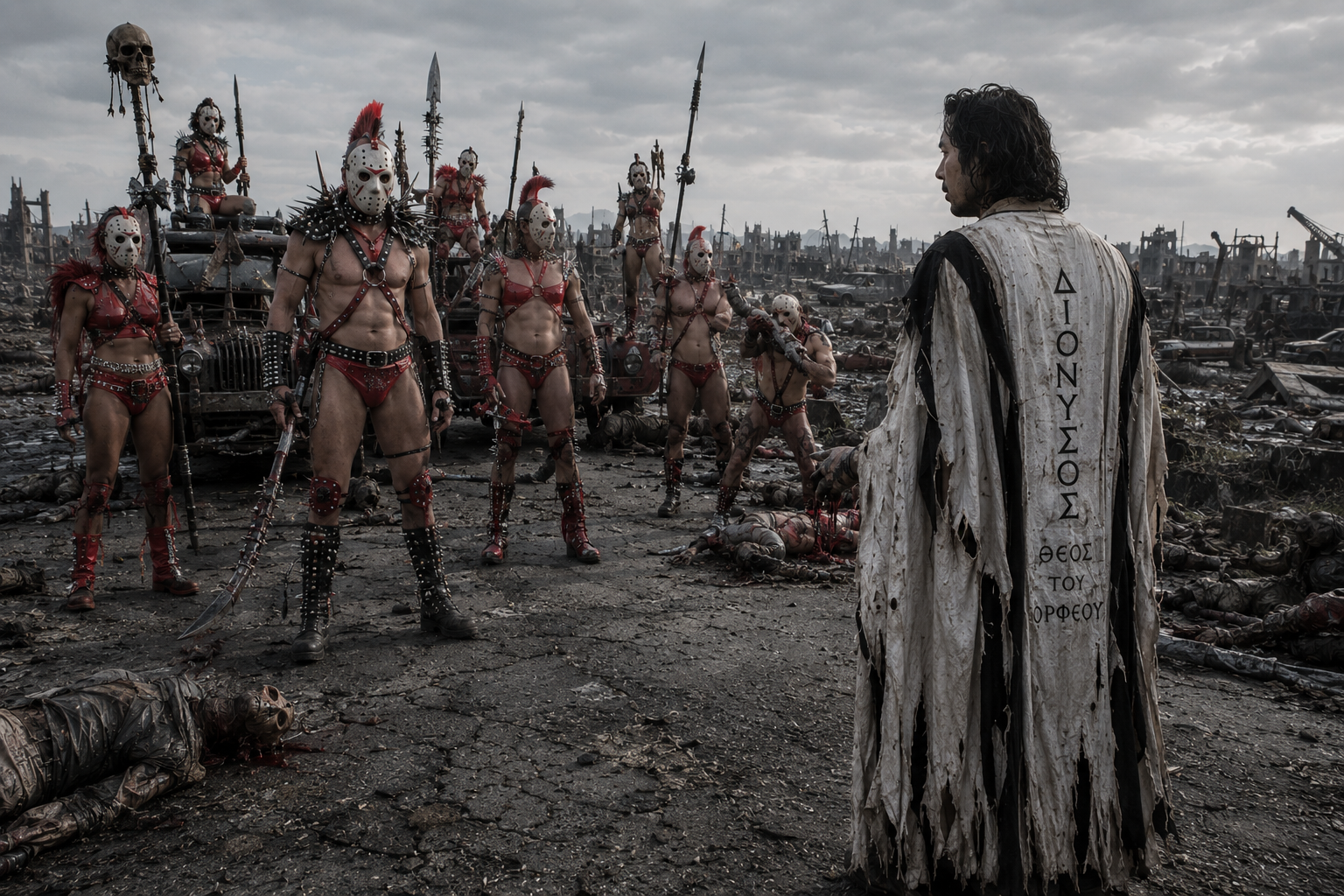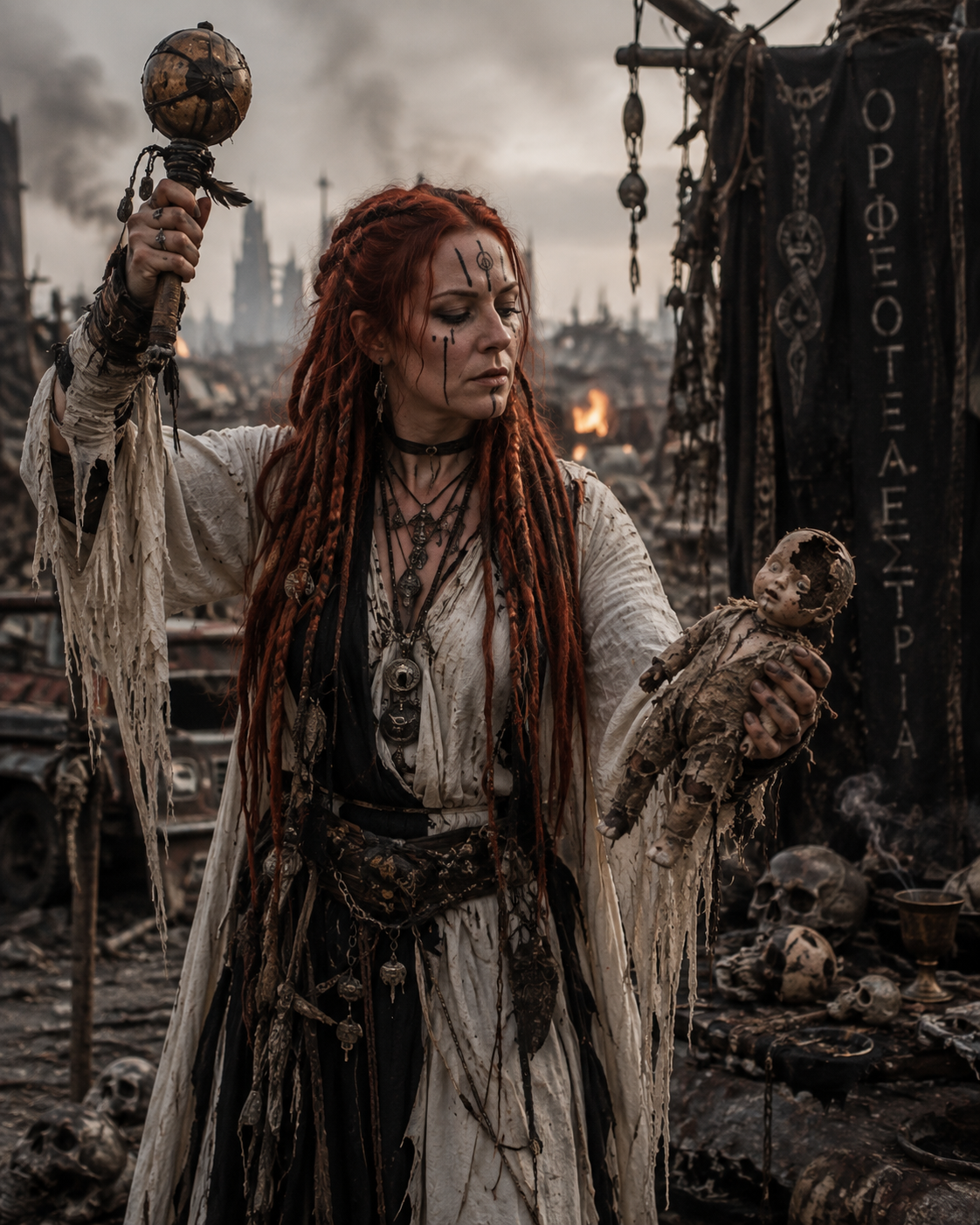
The joke actually exposes something serious about the vocation: the worse the world gets, the more relevant the Orpheotelest becomes.
A zombie apocalypse is practically an Orpheotelest’s nightmare client list scaled up to civilization: innumerable unburied dead; violently disturbed ancestors; places saturated with death and pollution; survivors carrying extreme grief, guilt, terror, and trauma; communities needing purification and reconciliation; malignant spiritual phenomena flourishing amid chaos; ordinary rites of mourning and burial becoming impossible; and desperate people asking for protection, healing, fertility, food, luck, and some assurance that the world still possesses order and meaning.
And unlike a priesthood whose usefulness depends heavily on intact temples and institutions, the itinerant character suddenly becomes an enormous advantage. The Orpheotelest already expects to travel to where the trouble is, diagnose an unusual situation, improvise within a body of traditional techniques, perform specialized rites, counsel people, and then move along. Civilization can disappear without making the craft obsolete. If anything, civilization had been insulating people from many of the circumstances for which such specialists historically existed.
There’s also something wonderfully funny about the economics. Currency has collapsed, but the Orpheotelest has one of the few genuinely marketable professions left:
“Can you fix an alternator?”
“No.”
“Can you grow corn?”
“Not especially.”
“Can you make Grandma stop appearing at the foot of my bed every night since we had to leave her body at the interstate rest stop?”
“Absolutely! This is my wheelhouse.”
And that makes the image even better for me. Those ridiculous bastards don’t realize it yet, but the most professionally employable person in the picture is the Japanese guy in the shredded robes.
It also brings up an important theological point. The post-apocalypse could produce a spiritual crisis for the faithful of various Monotheist and Neopagan traditions. Not only is there a pessimistic strain in Orphism which inoculates one against that— the expectation that things will fall apart, the decline from the golden to iron age rather than positive evolution and the “myth of progress,” the idea that physical incarnation in this plane is punishment for crimes committed as a daimōn or as Sokrates succinctly put it “dead is better”— within the Starry Bull tradition we have an eschatological explanation that would account for the calamity. The forces allied with the unmaker, from bottom feeding spirits to Giants and Titans that will break their bonds and go rampaging, will temporarily gain control, until the coalition from different pantheons encountered during his travels that Dionysos has spent millennia putting together eventually triumphs, crowning him as the new cosmic ruler. So there’s no, “How could a good God allow this? Does that mean that God is not all-powerful, or that this is his will and he permitted it? If I am allowed to suffer this, does that mean that I’m not among the elect and missed out on the rapture? Wait— my God came back from the dead and encouraged his followers to eat his flesh and drink his blood, and with his resurrection the dead, including the “dry bones” of Ezekiel’s vision, shambled toward Jerusalem per Matthew 27:52–53: does that mean he is the cause of the Zombie uprising?” Instead the Orpheotelest just shrugs, rubs their hands, and says, “Better get to work. This crisis isn’t going to resolve itself.”
Starry Bull eschatology would make such a catastrophe horrifying without making it theologically surprising. The apocalypse would constitute a practical and pastoral crisis, but not necessarily a crisis of theodicy.
The tradition already possesses a cosmology in which this event fits an existing mythic grammar.
That’s especially important because our eschatology doesn’t amount to “Dionysos will prevent the catastrophe.” Quite the contrary: catastrophe is part of the sequence. Dionysos’ victory comes through the conflict. His wanderings acquire an eschatological dimension because all those encounters with foreign Gods and pantheons cease to look episodic: over immense stretches of mythic and historical time, he has been assembling relationships and alliances that ultimately matter when cosmic order itself is threatened. The wandering God turns out to have been building a coalition. His eventual sovereignty is therefore not simply Zeus handing his son the keys to Olympos; it is something demonstrated and achieved through Dionysos’ capacity to unite radically different powers against the unmaker.
That gives the individual Orpheotelest a wonderfully grounded place within an enormous myth. They aren’t standing around waiting for Dionysos to win the cosmic battle. Dionysos has his work; they have theirs. If the great powers are fighting Titans, somebody still has to bury the dead. Somebody has to purify the contaminated house, settle the furious ancestor, recognize the predatory spirit taking advantage of everyone’s terror, counsel the survivor who watched their family die, protect the settlement, restore ritual relations with the local Gods and spirits, and remind frightened people that chaos having the upper hand today doesn’t mean chaos is the ultimate victor.
And that fits beautifully with the craft orientation I’ve been discussing. The important question isn’t primarily, “Why did Dionysos allow this?” It’s “how do I fulfill my God’s expectations of me in these changed circumstances?” Theology supplies orientation; vocation supplies action.
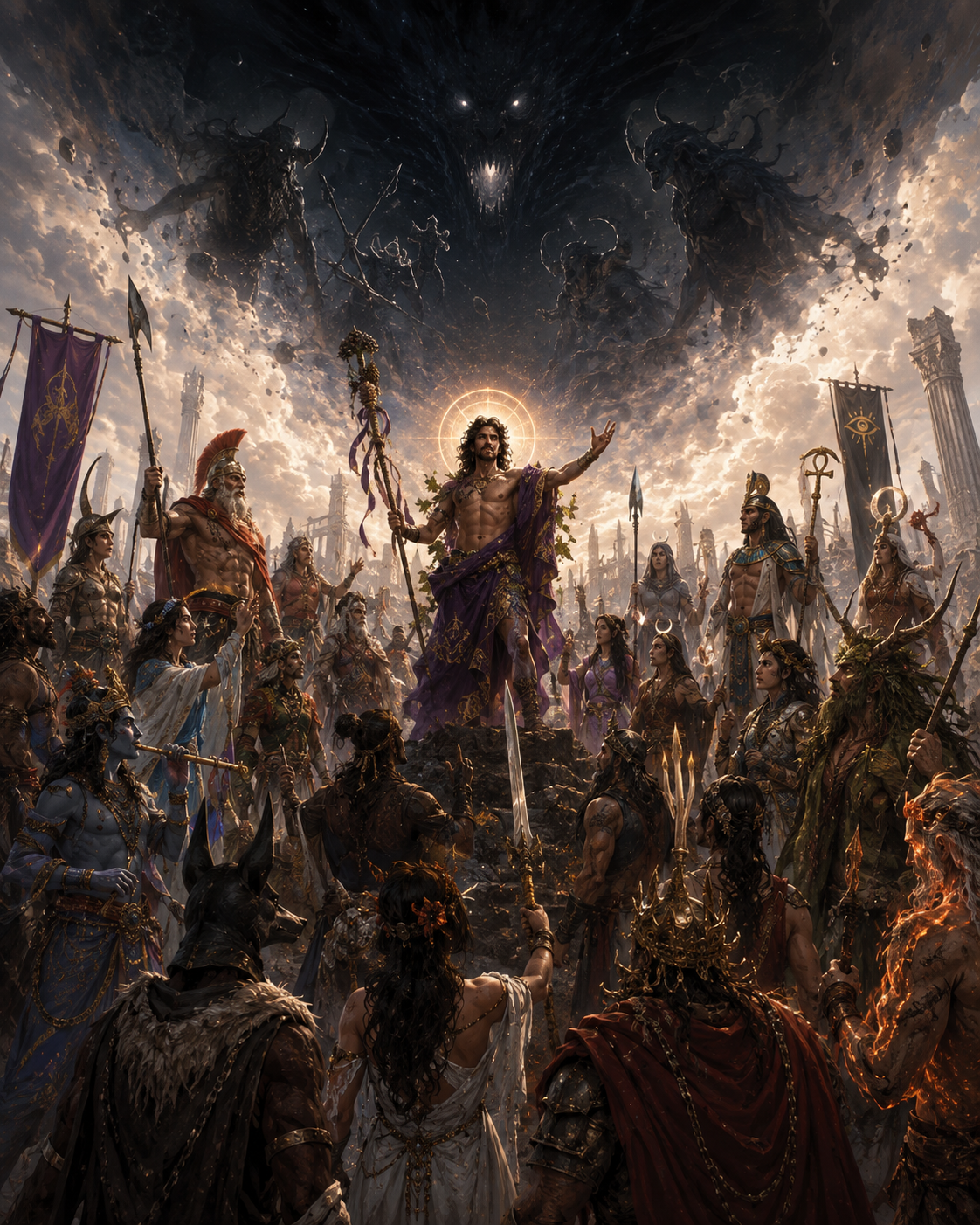
Which makes the final image genuinely theological rather than merely comic:
Zombie apocalypse. Titans loose. Civilization collapsed. The dead won’t stay dead.
The Orpheotelest surveys the situation.
“Well, shit.”
Rolls up their sleeves.
“Better get to work.”
This is an extraordinarily Dionysian eschatology: not optimism, because terrible things really can happen; not nihilism, because their happening does not make action meaningless; and not passive apocalypticism, because knowing how the story ultimately ends doesn’t excuse anyone from doing their appointed work in the chapter they’re actually living through.
I don’t normally provide a deep discussion of Starry Bull eschatology because it isn’t the point of the tradition. Our goal is to serve Dionysos and his Retinue as best we can, within the structures of the Starry Bull, and fulfilling our particular vocation. We do our part, the Gods do theirs and we’ll make the best of how things work out. That’s true whether you’re discussing the treatment of a client or grand eschatological themes.
But I’ve smoked a lot of marijuana, so here goes…
Zeus doesn’t pass the keys to Dionysos because he isn’t around to do that. Long ago Dionysos had a vision of the unmaker dissolving and destroying divine order, and the Titans and Giants breaking their bonds. Most of the Olympians did not believe him, attributing his visions to madness. This is why Dionysos sets out to find allies among other pantheons. When Ragnarök occurs the Olympians are not prepared, and most fall in the battle. What is especially tragic is that there are some who genuinely believe Dionysos but cannot join his coalition because they would consider that a violation of their loyalty to Zeus and Hera. Others— most notably Hermes, Apollon and Athena —side with Dionysos. Even so, not everyone who joins the coalition will survive. Normally Olympian Gods are Immortal, and the world goes through cycles of birth, death, and rebirth. But the unmaker seeks to interrupt that process, to annihilate everything. Even the forces allied with the unmaker know its intention but through greed and pursuit of power believe that they can capitalize on the chaos and rule until their domain too gets absorbed by the unmaker. Basically think Egyptian isfet or the nothing from Neverending Story.
Dionysos isn’t the designated heir who eventually receives an orderly succession. He is the disregarded prophet who prepares for a catastrophe the existing order refuses to believe is coming. That makes his madness extraordinarily important. The Olympians’ mistake isn’t necessarily stupidity or wickedness: they have perfectly understandable reasons for discounting catastrophic visions coming from the God of Madness. Unfortunately, this time the Mad God is right.
There’s considerable tragedy in that, especially with the Gods who believe him but remain with Zeus and Hera. Their refusal isn’t cowardice or blindness. On the contrary it’s virtue. But their virtue destroys them. Loyalty, which ordinarily maintains divine order, prevents them from taking the action necessary to survive the destruction of that order. That makes the conflict much richer than dividing the pantheons into enlightened supporters of Dionysos and fools who rejected him. Hermes, Apollon, and Athena make one choice; others make an equally comprehensible choice and perish because of it. And Dionysos presumably has to live with having foreseen precisely that, and not being able to stop it.
The unmaker also clarifies the stakes enormously. It isn’t another claimant to cosmic sovereignty. Titans and Giants can want dominion. Gods can fight Gods. Ages can end. Worlds can die and be born again. All of that still occurs inside the kosmos. The unmaker threatens the process itself. That’s why I make the comparison with Egyptian isfet and the nothing from the Neverending Story. Ordinary destruction can paradoxically belong to life: decomposition produces fertility; death precedes rebirth; Dionysos himself embodies dissolution and return. The unmaker represents something categorically different—not Thanatos within the sequence Bios–Thanatos–Bios, but the attempt to prevent the second Bios from ever arriving. It wants no next turn of the wheel. In fact it wants both Thanatos and the wheel gone.
And that makes the forces knowingly serving it particularly interesting. They’re committing what amounts to the ultimate metaphysical error: mistaking temporary advantage within a collapsing order for victory, even though their victory necessarily creates the conditions of their own annihilation. The Giant thinks, “When Olympos falls, I shall rule its ruins.” The unmaker’s answer is brutally succinct: “What ruins?”
It also explains why Dionysos’ wandering matters so much. Something that can appear almost incidental in mythology—this extraordinarily mobile God appearing in Greece, Anatolia, Egypt, India, the Far North and elsewhere—becomes strategic preparation. The Olympian order is insufficiently broad to survive what is coming, so the wandering stranger does what the established cosmic powers cannot: he builds relationships across boundaries. His apparent marginality becomes his strength. He knows foreigners because he has been the foreigner.
Which makes his eventual kingship profoundly different from ordinary conquest. If most of the established rulers are dead and survivors from numerous divine orders have fought together under his coalition, Dionysos isn’t simply becoming “Zeus 2.0.” Whatever order follows must somehow accommodate the plurality that made survival possible.
And my final point may be the most important theologically: this isn’t what Starry Bull is about.
That prevents eschatology from swallowing religion. The believer doesn’t need to decode current events looking for Giants, determine whether Ragnarök has secretly begun, or obsess over when the unmaker will arrive. In fact, doing so could become a distraction from the obligations immediately in front of them.
The Boukolos has Boukolos work. The Hymnōdos has Hymnōdos work. The Orpheotelest has Orpheotelest work. The ordinary devotee has obligations appropriate to their station. If cosmic dissolution begins tomorrow, those vocations remain meaningful; their circumstances simply become radically different.
I repeat:
We do our part. The Gods do theirs. We make the best of how things work out.
And that produces an unexpectedly modest eschatology despite its enormous scale.
The Orpheotelest doesn’t need to defeat the unmaker. That’s above their pay grade.
There’s a corpse that needs burying, a traumatized survivor who needs tending, an angry ghost that needs placating, and Lord Humongous apparently wants a consultation.
“Better get to work.”
But for me personally the most interesting aspect of this eschatology is twofold: Dionysos creates a new pantheon from the fragments of the world’s diverse pantheons. And that good and evil entities will fight side by side against the unmaker and its allies.
Let’s break that down.
This may be one of the strongest ideas in the eschatology, because it makes the final conflict orthogonal to the ordinary conflict between good and evil. Good and evil are disagreements about what existence should be like. The unmaker represents the abolition of the arena in which that disagreement can occur. A benevolent God wants a flourishing kosmos justly governed. A tyrant wants a kosmos under his domination. A predatory spirit wants victims. A Giant wants territory and power. Even something genuinely monstrous still possesses desires, and desire presupposes that there will be something left to desire. The unmaker offers none of them victory. It offers the eventual extinction of victor and victim alike.
So the question— “What do they govern if nothing exists?” —isn’t merely pragmatic. It’s the metaphysical argument capable of assembling Dionysos’ otherwise impossible coalition.
And importantly, fighting beside Dionysos doesn’t redeem the evil powers. The Giant doesn’t suddenly discover compassion. The demon doesn’t become nice. All remain precisely what they were. They simply recognize that their interests temporarily coincide with those of beings they ordinarily despise.
That provides something much more interesting than the familiar fantasy trope in which everybody puts aside their differences and discovers that deep down they’re basically decent. Some simply aren’t. After the victory, some members of the coalition may immediately become enemies again. The alliance means only: first there must be a world. Then we can fight over what sort of world it will be.
And that makes Dionysos uniquely suited to lead it.
Dionysos doesn’t create unity by creating sameness
Which is deeply Dionysian. Dionysos doesn’t need Athena to become Freyja, an Egyptian God to become Hindu, or a dangerous daimōn to become morally good before they can stand together. He creates a choros out of irreducibly different beings.
That resembles his Retinue on a cosmic scale.
The Bacchic procession has never been composed of respectable, interchangeable citizens marching neatly in formation. Gods, Daimōnes, Heroes, mortals, Satyrs, Seilenoi, Mainades, animals, foreigners, monsters—the heterogeneous multitude itself becomes Dionysian order.
The new pantheon he creates therefore needn’t represent the restoration of the old order after Ragnarök. It is something the catastrophe makes possible that could not have existed beforehand.
The old pantheons were organized substantially through kinship, geography, inherited sovereignty, cult, and historical relationships. Dionysos’ pantheon is assembled through encounter. He has wandered through their worlds, formed relationships, recognized powers the established Olympian order regarded as foreign, and eventually called those relationships in.
So when Olympos falls, Dionysos doesn’t rebuild Olympos.
He builds something Olympos could never have become.
That also gives his wandering retroactive significance without reducing it to a secret master plan. He can genuinely have encountered other Gods for all the ordinary mythological reasons—desire, conquest, initiation, curiosity, exile, madness, revelation—and nevertheless discover that those accumulated relationships are precisely what enables resistance when the old structures collapse.
And the tragedy gets better
The Gods who remain loyal to Zeus and Hera become even more poignant against this background. They aren’t choosing evil over good. They’re choosing order as they understand it over an unprecedented coalition whose legitimacy may appear extremely dubious.
Imagine what Dionysos’ proposal must sound like before the catastrophe.
The mad younger God announces that he has foreseen the destruction of the cosmic order. He wants Olympians to cooperate with foreign Gods, perhaps ancient enemies and morally repellent beings, because he claims an entity beyond ordinary divine conflict, who comes from outside the kosmos itself, is going to annihilate everything.
From the perspective of a conservative Olympian, refusing him might be the responsible choice.
And some believe him but cannot abandon their loyalties anyway.
That is tragedy rather than stupidity.
It also changes what “evil” means without relativizing it. I especially like this because you don’t need to conclude that good and evil are illusions. They’re real distinctions—but they aren’t the most fundamental distinction imaginable.
Beneath the ethical opposition lies another:
Being / Unbeing.
Or perhaps, more appropriately for Starry Bull theology:
Bios → Thanatos → Bios
versus
Bios → Thanatos → —
The second is what the unmaker wants. Death isn’t the enemy because death belongs to the cycle. But nothingness does not. Dionysos himself guarantees that. The horror is death from which nothing can emerge: no decomposition becoming fertility, no descent followed by ascent, no memory, no rebirth, no transformation, no next generation, no next world.
That makes the unmaker almost the perfect theological antithesis of Dionysos.
Dionysos destroys forms constantly. He tears apart boundaries, identities, bodies, kingdoms, sanity, sometimes even himself— but something comes through the rupture. His destruction is fecund.
The unmaker’s destruction is sterile.
Dionysos dissolves so that becoming can continue.
The unmaker dissolves becoming itself.
And suddenly the strange coalition makes complete sense. Even monsters have a stake in becoming.
Which brings us back to the Orpheotelest. The cosmic story and the treatment of one client express the same religious posture at radically different scales.
Dionysos doesn’t sit around contemplating the philosophical implications of the unmaker. He gathers whoever can be gathered and does what his circumstances require.
The Orpheotelest doesn’t need to spend Tuesday afternoon worrying whether Ragnarök begins this Thursday.
There is a client in front of them.
“How do I fulfill my God’s expectations of me in these changed circumstances?”
That question works when the changed circumstance is bereavement, illness, haunting, pollution, community breakdown—or the collapse of divine order itself.
And perhaps that’s why the eschatology doesn’t need to be central. If the tradition has formed someone properly, they already know what to do when the end of the world comes.
Not necessarily how to win.
But how to remain what they are while the world changes around them.