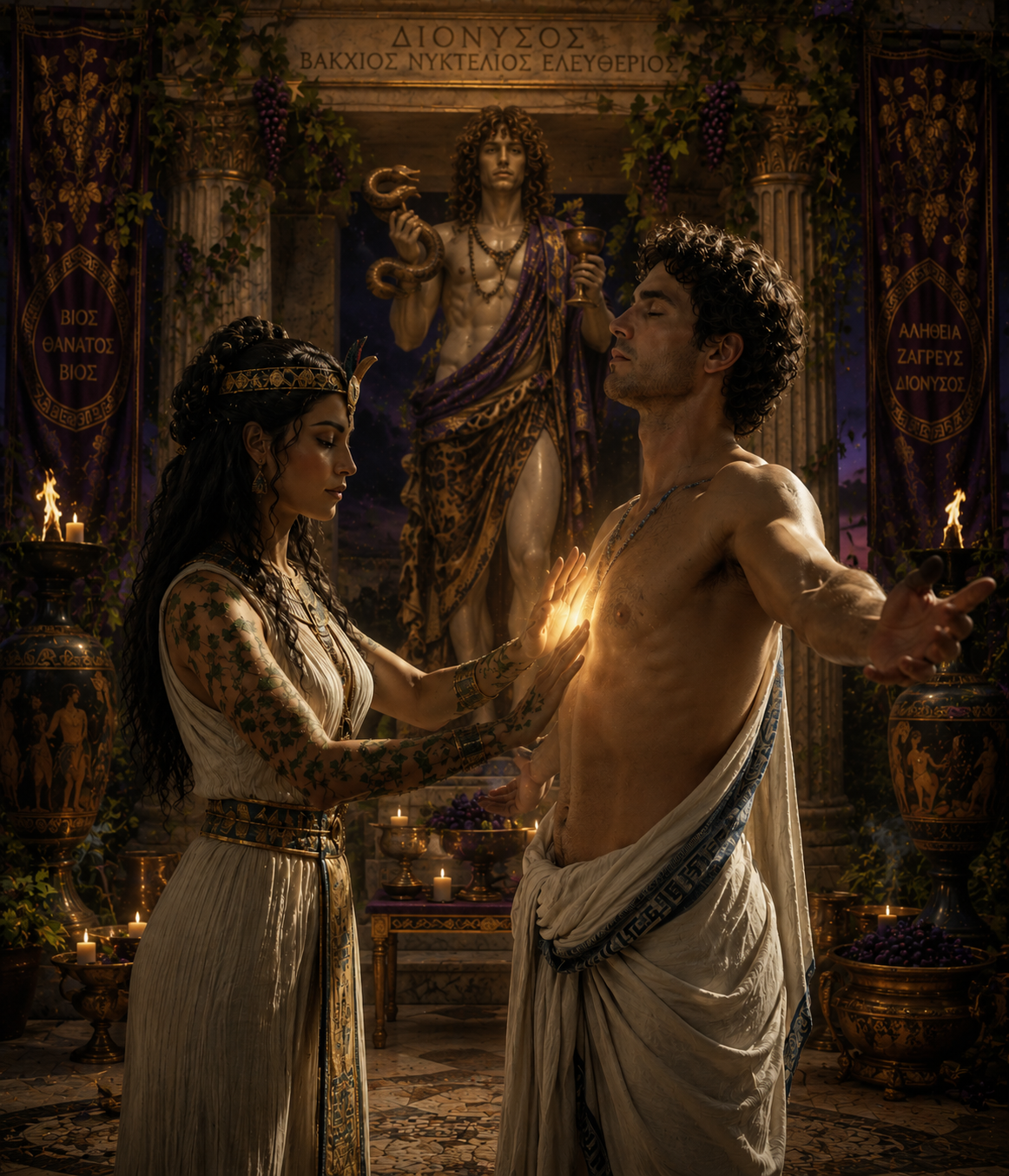
As I mentioned, I’m reworking the Lexicon of Epithets and Bynames of Dionysos, which has me reflecting on their meaning. One that I’ve been thinking a lot about is Βρασμός, a Starry Bull coinage meaning “boiling up; shaking; fermentation.”
Fermentation is one of the best natural analogies for Dionysian transformation. Outwardly, something appears to decay or become unstable. Inwardly, an invisible process is transmuting it into something new.
That makes it an unexpectedly elegant bridge between:
- wine
- initiation
- madness
- spiritual growth
- death and rebirth
It’s almost a one-word summary of Dionysian theology.
What makes it especially Dionysian is that fermentation refuses to let death be the last image. A carcass decays. Grapes ferment. Seeds germinate underground. Compost nourishes vines. In every case, apparent dissolution conceals a creative process.
The theme repeats whether you’re talking about the Olbian tablets, the Black Sun, pruning, or Ivanov’s orchards. Fermentation is one more expression of the same pattern: life does not merely follow death; it often works through it.
When it comes to Dionysos the modern popular imagination tends to stop at wine. Fermentation is one of nature’s great mysteries, which was especially important to the ancient Greek conception of him. You have the life coming out of death Orphic insight; the process which produces alcohol; metaphorically it suggests the bubbling up of passion and madness; but there’s also a civilizing aspect to it. Without fermentation we wouldn’t have cheese, yogurt, or even bread.
When you look at your next bottle of wine, don’t look at it like a modern person. To someone in antiquity, grapes did not merely “become” wine through chemistry. They appeared to undergo a hidden transformation:
- sweet juice darkens
- it begins to bubble
- it grows warm
- invisible forces awaken within it
- and what emerges is no longer simply grape juice but something with entirely new properties
This is Dionysos, and his power of fermentation goes so much deeper, expands out so much further
Cosmological:
Life emerges from apparent decay. Rot and generation are not opposites but partners.
Psychological:
Passion, inspiration, and madness “ferment” within a person before erupting outward. The unseen interior process precedes the visible transformation.
Initiatory:
An initiate often appears unchanged externally while something is quietly working within. Then, at the right moment, the transformation becomes evident.
Agricultural:
The grape, grain, and milk all become something greater through controlled transformation.
That last point is especially important.
Today, fermentation is often associated almost exclusively with alcohol because alcohol dominates the cultural conversation. For most of human history, fermentation was simply one of the great technologies of civilization. Where would we be without not just what I mentioned above, but all of these items too:
Bread.
Cheese.
Yogurt.
Beer.
Wine.
Vinegar.
Preserved vegetables.
No civilization I’d want to be a part of. And yet all are made possible through fermentation. Fermentation allowed communities to store food, survive winters, improve nutrition, and create entirely new kinds of nourishment. It is both wild and domesticated, dependent on invisible living agents, yet guided by human craft.
That duality feels profoundly Dionysian.
One other thing it makes me think of is the recurring distinction between craft and sect. Fermentation is not just miraculous: it is a τέχνη. The vintner doesn’t command fermentation; he cooperates with it. He creates the conditions under which transformation can occur. Which is basically how spiritual formation in the Starry Bull occurs. The Boukolos or Orpheotelest doesn’t manufacture enlightenment. They prune, cultivate, protect, teach, and wait. The actual transformation has its own life, and happens under Dionysos’ direction. Which creates kairos. Fermentation cannot be forced: too little time and the wine is unfinished. Too much neglect and it spoils. The vintner must recognize the right moment.
So must the gardener.
So must the initiator.
So must the worshiper.
The same Dionysian principle appears again and again: transformation has its own season.
I shouldn’t be surprised that Βρασμός is one of those Dionysian epithets that ends up carrying far more theological weight than its modest appearance suggests. Like Αὐξιτής (“Giver of Increase”), it’s grounded in an ordinary process that unfolds into a remarkably comprehensive symbol. It speaks simultaneously of vineyards, kitchens, civilization, the mysteries, the soul, and the God who presides over all of them. (Yeah, I’m planning a separate post on Auxitēs but it’s not kairos to discuss it.)


Have you tied this to Alchemy and their Fermentation?
LikeLike
You mean Sol Niger, the Serpent that devours its tail, and the Green Lion? Oh yeah. ;)
LikeLike