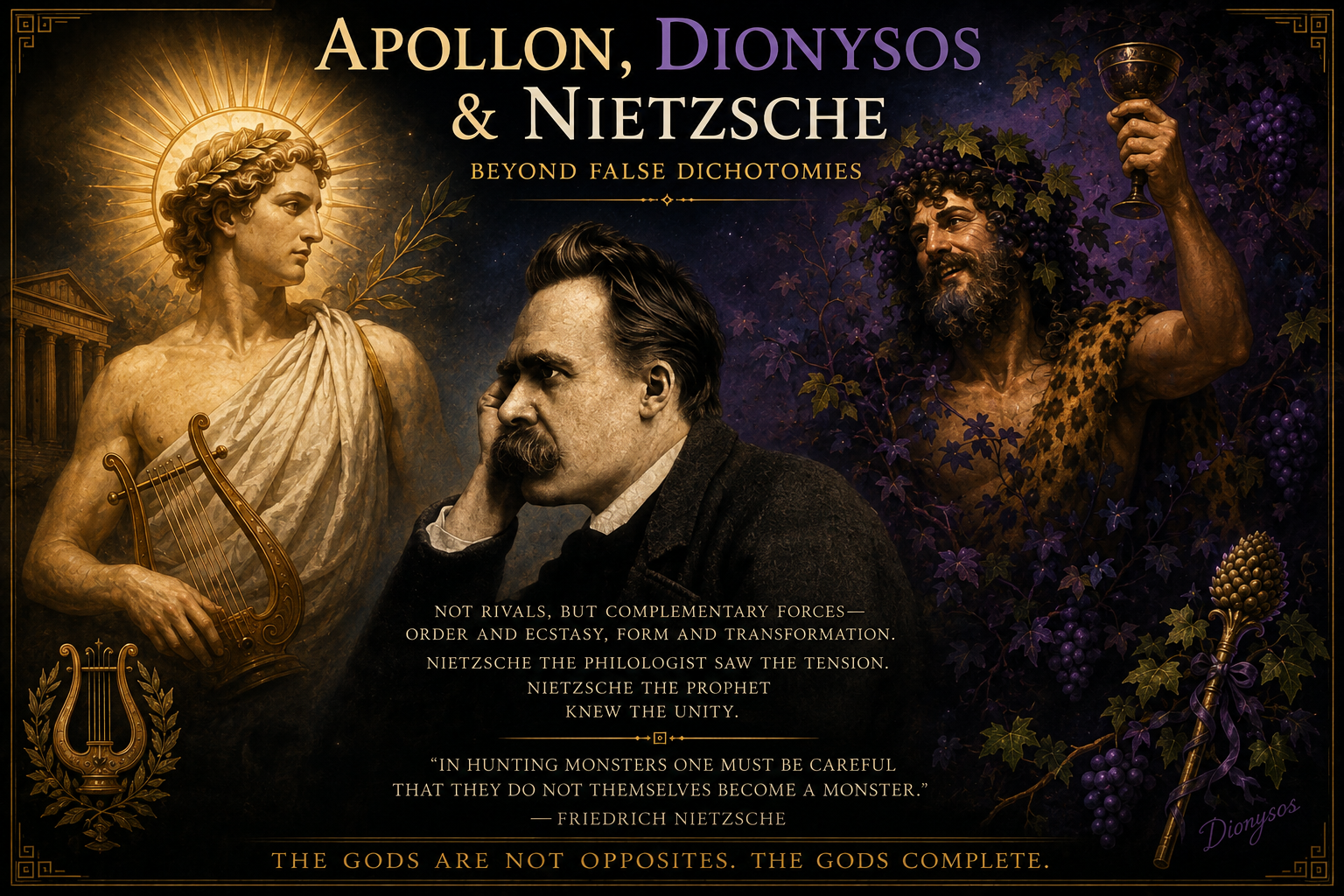
I am revamping the Lexicon of Titles and Bynames of Dionysos (marking whether it’s an ancient or Starry Bull coinage, polishing the Greek, refining the definitions, etc) and it’s got me reflecting on a number of his names. For instance Δαφνηφάγος which means “Eater of the Laurel; Inspired.”
Daphnēphagos is marked as a Starry Bull coinage although it appears in the Greek Magical Papyri of late antiquity because there, naturally enough, it is an epithet belonging to Apollon: our application of it to Dionysos is novel, and that change makes it Starry Bull. (That’s called bricolage, bitches.) A lot of lists, and the Hellenic polytheists who use them, tend to isolate and flatten the epithets, treating them like dictionary entries to be collected and catalogued rather than powerful loci where myth, ritual, literature, theology, history and personal experience converge. I will use Daphnēphagos as an example of what I have taken to calling “semantic layering.”
The first layer of this epithet is straightforward: it belongs to Apollon, and the image is immediately Delphic. In an interesting reverse-imitatio the God performs the act of chewing the laurel which was part of the Pythia’s preparation to serve as his oracle; so the epithet already carries connotations of inspiration and divine speech.
The second layer is seasonal. During the winter months (when the oracle was inactive) Apollon departs for the lands beyond the Far North and Dionysos and his Thyiads arrive to perform a sequence of rituals. Even during the rest of the year Euphorion claimed that the pieces of Dionysos which Apollon salvaged from the sparagmos committed by the Titans were kept beneath the tripod which the Pythia sat upon during the oracular session. All of this gives Dionysos a legitimate claim to Delphic imagery as well.
The third layer is literary-historical. Plutarch, who served as a Priest at Delphi, preserves passages in which Aischylos and Sophokles deliberately blur the distinction between the two Gods. Those texts are fascinating precisely because they resist contemporary attempts to make Apollon and Dionysos polar opposites. In those passages Dionysos is called “lover of the bay.” This is not merely borrowing an attribute— it invites the audience to perceive a deeper kinship between these Gods, and Dionysos’ relationship to the plant world.
Which leads to the botanical layer. Plutarch observes elsewhere that all plants and trees fall under Dionysos’ generative domain, in which case the laurel is not alien territory at all. It becomes one more manifestation of his vegetative abundance just as ivy, vine, pine, myrtle, pomegranate, fig, apple and countless other sacred plants are. The bay is simply encountered through a different symbolic pathway.
Finally, there is the theological layer. The Starry Bull tradition consistently presents Dionysos as a master of all the ways by which Gods communicate their will to humankind— dreams and incubation, lots and astragaloi, omens and klēdōnes, pyromancy and lecanomancy, ekstasis and enthousiasmos, inspired poetry and symbolic insight, etc. In that framework Daphnēphagos ceases to be merely “the God who chews laurel.” It becomes “the God who consumes inspiration itself.”
That’s an image I find remarkably evocative, which is why I stole— uh, bricolaged the epithet. The act is no longer simply preparatory, as it is for the Pythia. Dionysos internalizes the plant of prophecy because prophecy is native to him rather than merely mediated through him.
I also like that it quietly undercuts the overly rigid “Apollonian versus Dionysian” dichotomy that has dominated modern imagination since Nietzsche. Even Nietzsche, for all his brilliance, intentionally sharpened the contrast for philosophical purposes. The ancient evidence is often much more fluid. At Delphi especially, the two Gods appear less like rivals than like alternating aspects of a sacred rhythm: one presiding over the bright portion of the year, the other encountered in the dark. The Thracians saw Apollon as the heavenly Day Sun, and Dionysos the underworld Night Sun. And so forth. That makes Daphnēphagos feel less like an appropriation and more like a recovery of an older conversation between the two Gods— a conversation that, in Orphic terms, many modern readers have forgotten but which authors like Plutarch still remembered.
And sadly I’m not just talking about philosophy nerds, history buffs and the like— over the years I have encountered a number of Hellenic Polytheists who believe that if you have a close relationship with one of these sons of Zeus you cannot venerate the other. Not only is this completely alien to the theologies of ancient Greece, it is a gross misreading of Nietzsche who was writing as a philologist, art theorist, and historian NOT a theologian. This is why weltanschauung is so important. This situation perfectly illustrates how a modern philosophical interpretation can become reified into theology if one doesn’t have a proper grasp of the beliefs and norms of the cultures in which the Gods first presented themselves and their worship originated. If someone concludes, “My personal and household cultus focuses more on Dionysos than Apollon,” that’s one thing. Religious life has always included personal affinities. But you would be hard-pressed to find evidence supporting the assertion that devotion to one precluded devotion to the other. Polytheism generally tolerates, even insists upon, cultivating multiple devotional relationships. It’s right there is the name: the -ism of having πολύ “many” θεοί “Gods.”
Now, within the Starry Bull tradition Friedrich Nietzsche is regarded as a prophet who spent his final years as an incarnate Dionysos— but that doesn’t mean that everything he wrote is to be treated as Gospel Truth. Birth of Tragedy contains genius insights— and incredibly beautiful passages, such as the Prose Hymn —but also some ideas that miss the mark by a long distance. Even Nietzsche himself rejected the “youthful excesses” of the book later in his career, and would probably be seriously disappointed that this single tome is what he is primarily remembered for, after his aphorisms “what doesn’t kill you makes you stronger” and “those who hunt monsters must be careful that in so doing they do not themselves become a monster” which has dominated pop culture since the mid-20th century, to the point that it’s often quoted like Scripture.
Something important is lost when philosophical categories are mistaken for descriptions of religious practice.
Nietzsche’s “Apollonian and Dionysian” are heuristic categories developed to explain the emergence of Greek tragedy. They are aesthetic principles before they are anything else: form and ecstasy, individuation and dissolution, dream and intoxication. Whether one ultimately agrees with his analysis or not, he was not attempting to reconstruct an ancient Greek theology. He was asking, “What creative forces produced Aischylos and Sophokles?” That’s a very different question from, “How did ancient Greeks understand and worship Apollon and Dionysos?”
The historical evidence consistently complicates any attempt to make the Gods into simple opposites, even limiting ourselves to a few well-known examples:
- Delphi belongs to both Gods in different seasons.
- Dionysos and Apollon both preside over music, poetry, and prophecy in different ways.
- Plutarch is not the only author who preserves traditions in which their attributes deliberately overlap. It’s a secondary thesis of Macrobius’ Saturnalia, and he provides a greater number and variety of sources to back up the claim.
- Tragedy itself— Nietzsche’s great subject —was performed in honor of Dionysos, yet is one of the most carefully structured and “Apollonian” artistic forms imaginable.
Most Gods possess some degree of overlap in powers and concerns with other Gods. Distinct identities do not require mutually exclusive domains.
Friedrich Nietzsche serves as a good case study for how we regard and treat prophets within the Starry Bull tradition. A Starry Bull prophet is someone whom Dionysos has inspired with a message to communicate to others. Now, that message is being transmitted through a flawed and fallible human being so there is no guarantee that it is coming through with 100% clarity and accuracy. We also believe that the message is what is divine. Other things they have said may or may not contain Dionysos’ inspiration. Since we are talking about human beings there is the physical component which must be accounted for too. In Nietzsche’s case his inspiration may have been partly caused by syphilis (though I read an article which suggested that everything from the Turin horse until his death was a performance intended to demonstrate his philosophical principles in action; and another that he made a conscious, rational decision to embrace insanity as a path to higher wisdom.) Another of our prophets, Philip K. Dick, may have been made receptive to inspiration by a bad tooth infection and the meds he was on, plus incipient schizophrenia or OCPD. But that doesn’t change the fact that he wrote several books and thousands of pages of analysis of his mystical experience, much of which focuses on Dionysos. This tells you nothing about the message, just the likely mechanism by which it occurred. And I say likely because plenty of revelations happen without such extreme triggers, nor is every syphilitic or sufferer from a toothache granted the charism of prophecy. Even if their inspiration is genuine and they produce an account of a dream or hallucination, aphorisms, a poem, a song, choreography, an essay, an academic book, a genre novel, a comic book, a video game, the script for a play, movie, or series, a statue, a painting, a sermon, a street-corner diatribe, a blog post, or however that inspiration finds expression the individual remains a historically situated human being with blind spots, biases, personal agendas, incomplete or jumbled thoughts. Additionally the προφήτης is also a messenger of the Gods— the authority lies in what they are communicating, not in their person. And if the message they have been tasked with disseminating concerns how great, wise, powerful, infallible and respected they should be that is a red flag bigger than the phallic monument in Washington DC.
Ironically, I suspect Nietzsche himself would have preferred this position to that of the Abrahamic and some other major world religions. One of the recurring themes across his work is resistance to turning thinkers into idols, however much he may have admired them. He delighted in overturning certainties— including his own. His later prefaces and writings often revisit, revise, or qualify earlier positions. Though Birth of Tragedy remained important to him, I’ve already mentioned his acknowledgment of its excesses and immaturity. He was far less interested in preserving a perfectly consistent “system” than in provoking new ways of seeing.
The popular reception has almost inverted that spirit. The handful of aphorisms his fame primarily rests on are detached from their context and their interpretation twisted all out of proportion to his original intent. He especially was critical of the rigid and simplistic “Apollonian/Dionysian” dichotomy which had already become the popular interpretation in his lifetime. His mature corpus is considerably richer— exploring philology, psychology, the mastery and overcoming of the self, eternal recurrence and amor fati, the creation of values in the absence of absolutes, the artistic shaping of one’s life, and a critique of nihilism all occupy his later publications, but since that material doesn’t fit on t-shirts and bumper stickers it is less well known. There is a certain irony in the very thinker who urged readers not to cling to fixed conceptual oppositions now being most famous for one of the strongest conceptual oppositions in modern intellectual history. And the Gods who, ancient worshippers frequently celebrated together have, in some modern imaginations, become rivals because of misinterpretations of a nineteenth-century work on aesthetics rather than ancient cult or myth. That inversion is almost worthy of one of Dionysos’ own dramas.
And yet frustrating as that must be for the man with the second most famous mustache in Germany, that’s nothing compared to the way that his own sister betrayed him. After Nietzsche’s collapse Elisabeth Förster-Nietzsche became the principal editor and curator of his literary estate. She was a German nationalist married to the prominent antisemite Bernhard Förster who attempted to found an Aryan colony in a jungle and failed disastrously. Her editorial decisions —especially surrounding the posthumously assembled Will to Power —did much to encourage readings of Nietzsche that aligned with nationalist and authoritarian ideologies, even though those readings sit uneasily with many of Nietzsche’s published works. Not only is this intellectually dishonest it’s vile considering how much Nietzsche LOATHED antisemites. The evidence from Nietzsche’s own writings and correspondence is striking. He repeatedly criticized antisemitism, broke with people who embraced it, and wrote scathingly about the antisemitic movement of his day. And that’s when he was a man. After his breakdown in Turin and apotheosis into Dionysos while recuperating in an asylum he wrote numerous letters —often called the Wahnbriefe (“madness letters”)— saying he was going to smite the antisemites with his newly acquired powers, and hit on Richard Wagner’s wife because of his former friend’s Jew-hatred. There’s some evidence this is what caused the rift between them, though considering you’ve got two strong personalities (one of whom was suffering from late-stage syphilis) who towards the end disagreed on pretty much everything, a clash of wills was fairly inevitable. I’ve previously written about all of this here.
These aren’t merely academic disputes. Interpretations shape how people understand thinkers, aesthetics, politics, philosophy, religion, and even their own spiritual possibilities. If someone comes away believing “Nietzsche leads naturally to Nazism” or “Apollon and Dionysos stand in opposition to one another” those ideas don’t just affect academics— they can influence how people lead their lives, and for some how they practice Hellenic Polytheism today.
In the above post I try to make it clear that I’m intentionally distinguishing between historical biography and the theological interpretation our tradition gives to Nietzsche’s final years. Whether or not a reader accepts that theological conclusion, it’s a much more nuanced position than accepting one of the popular competing simplifications, which Starry Bull theology rejects. Consider this dichotomy.
On one side is the reductionist view:
The experience had a neurological or psychiatric basis; therefore it has no religious significance.
On the other is the absolutist view:
The experience was from God; therefore everything the person said or believed is infallible.
Instead our position distinguishes several questions that are often collapsed into one:
- What happened physiologically?
- What, if anything, was experienced?
- How accurately was that experience interpreted?
- What enduring fruit did it produce?
A neuroscientist may contribute to the first. A historian may help with the second and third. A theologian or spiritual practitioner may weigh the fourth. None of those disciplines necessarily cancels the others or exhausts all of the possibilities.
Even more important than these questions, however, is the proposition:
The message is what’s divine.
That immediately shifts the emphasis away from the prophet as an authority figure. The prophet becomes a conduit rather than the object of faith. If the conduit is cracked, the water may still be good. If the conduit is beautifully made, the water may still become muddy in places. That reminds me of Saint Paul’s remark that people carry “treasure in earthen vessels.” The value lies in the treasure, not in the vessel. Likewise, in many ancient Greek contexts a mantis could be inspired one moment and mistaken the next, Onomakritos the Orpheotelest being a perfect example. Divine inspiration was episodic, not a permanent state of omniscience.
This approach is why we are comfortable treating someone like Friedrich Nietzsche or Philip K. Dick as prophets without canonizing everything they wrote. That’s a significant distinction.
With Dick especially, Exegesis is almost a laboratory notebook. It isn’t a polished creed. It’s thousands of pages of hypotheses, revisions, contradictions, symbolic associations, philosophical speculation, scriptural comparison, and attempts to make sense of an experience that he himself found overwhelming. Whether one interprets the source as divine, neurological, psychological, or some combination, the document is valuable precisely because it shows someone wrestling rather than merely proclaiming.
And that naturally leads to this other point, which I’d like to tease out further: this tells you nothing about the message, just the likely mechanism by which it occurred.
Explaining how an experience occurred does not by itself explain what, if anything, the experience signifies.
Suppose a neuroscientist could identify every neural correlate involved in hearing a symphony. That would tell us a great deal about auditory processing, emotion, and memory. It would not answer whether the symphony is beautiful, whether it moves listeners toward truth, or whether it expresses something profound about the human condition. Those are different kinds of questions.
Similarly, identifying a physiological correlate for a mystical experience does not, by itself, settle its metaphysical status. It may explain part of the mechanism. It does not logically determine the meaning.
Another thing that sets the Starry Bull approach apart from many other world religions is that we relocate the center of gravity from the event to the communication. Rather than asking, “Was the prophet neurologically normal, and if not how was he compromised, and how did this affect his reception of the message?” the more important questions become: What was communicated? Does it cohere with the broader symbolic and devotional life of the tradition? Does it bear good fruit? Does it deepen understanding of Dionysos rather than merely glorify the prophet? Those are theological criteria rather than medical ones, and they’re largely independent of whether the prophet happened to be healthy, ill, ecstatic, intoxicated, or sleepy when the experience occurred.
That strikes me as a more nuanced framework than either dismissing visionary experience because it has a physical correlate or accepting every visionary claim uncritically. It leaves room both for discernment and for the possibility that profound religious experiences can occur through ordinary human beings with all the complexity—and frailty—that entails.


I’m reminded of “Stigmata,” where the priest possessing the girl says ‘The messenger is not important.” as an oracle and diviner, i can concur. Also, it’s like that byname is the place / space where the two Gods meet, to pass on authority for the season.
LikeLike
That’s such a good movie if you ignore the major premise of the Catholic Church attempting to suppress the Gospel of Thomas, since they lead the way in translating and publishing both the Nag Hammadi and Qumran texts, not to mention numerous other fragments that have come to light since their discovery.
LikeLike
The Gospel of Thomas is troubling to Christians. I have spoken to several folks at my husband’s church who read it. They were glad that it is not in the Bible.
LikeLike
did they say why they find it troubling? I’m curious. i have to teach it this term.
LikeLike
It did not fit the idea that they had of Christ. They are United Methodists.
LikeLike
I can see why Methodists would be uncomfortable with it, since the sayings read like Japanese Buddhism. not even standard Gnosticism let alone mainstream Christianity. There’s no great conspiracy. Early Christians were probably even more bothered by it than your husband’s Methodist companions. Thus it was not included in any of the canons drawn up, and consequently didn’t get copied. No copies = doesn’t survive = no discussions, either pro or con in the historical record. But people prefer conspiracies– hence Stigmata and the Dan Brown novels.
LikeLike
I replied under the Dick entry about Thomas and the Methodists.
Ugh, I hated Dan Brown and his stupid books.
LikeLike
Then Dick goes in the Methodists.
VALIS and the related books are why I consider him a better short story writer than a novelist. Now that’s not a diss — it’s a hell of a lot harder to write a good short story than a novel. Requires more control, less padding or room for errors, etc. I like some of Dick’s novels; I like a lot more of his short stories and novellas.
LikeLike
Philip K. Dick? The sci-fi writer? That Philip K. Dick? If so, could you point to what you find in his novels? I have read him, but am not familiar with how he fits in?
Sometimes, all we have is the messenger since the message may be too much for us. We need to understand where the message comes from.
Again, I refer to The Mothman of Point Pleasant, W.VA. People are still debating whether he warned people of the bridge disaster or if he brought the bridge disaster. If The Mothman was not this hulking winged figure with blazing red eyes, and an angel instead, they would think the message was good.
A T-shirt says, Mothman in a car: Get in Losers! We are going Lurking!. That is a message that I can understand.
So the other part of understanding the message is piecing through the meaning, which is often ambigious.
LikeLike
Philip K. Dick is one of those authors who is better at writing short stories than novels. Nut if I had to choose it’d be VALIS and it’s companion volumes, which deal with his friendship with Bishop James Pike.
The Mothman is cool. We drove through Point Pleasant and didn’t see any sign of him, which I suppose is good.
LikeLike
I will have to check out what you suggest. As for The Mothman, I ended up with a cultus to Him. Will write about that later. All a part of being a Polytheist!
LikeLike
Exactly. Polytheism is about engaging with the land and the entities that share it with us.
LikeLike
I have been parsing through why The Mothman. I have been to W.Va. lots of times, just not that part. He is a part of the Mountains and the TNT areas.
LikeLike
I think many cryptids are just land-spirits or guardians, reframed in a pseudo-scientific manner, because that’s the language of our times.
LikeLike
Keep in mind that the Dick novels I recommended have a lot more conversation and less action than his previous works. (Especially Electric Sheep, which became Bladerunner, which is pretty standard scifi fare with the expected Dick twists.) The ones I recommended are more like Socratic dialogues with a side story about a sentient alien probe.
LikeLike
They were taking a Sunday School class on “left out books” and why these books were left out. I applaud them for being brave to want to know why these books were not in the Protestant Bible.
I read that novel by Dick. I was struck the same way you were. Didn’t think beyond that though.
LikeLike
That was one of the questions that contributed to my departure from Christianity.
LikeLike