Here are some follow-up thoughts I have on the Orphic fragments from Sinai. Throughout I am going to limit myself to just the portion that Boris Kayachev has called “Fragments 1 & 2” concerning Aphrodite and Persephone. I’ll analyze “Fragments 3 & 4” about the Giants and Korybantes in a separate post.
To begin I respectfully disagree with the translators (and most scholars I’ve seen discuss them so far) that the fragments come from the Sacred Discourses in 24 Rhapsodies. Despite this I strongly suspect that it is going to end up becoming the consensus attribution. And there are a couple really good arguments they have in their favor.
The 24 Rhapsodies were compiled during the Hellenistic period, likely from older material dating back to the 5th or even 6th century BCE. Most later authors, especially those in Neoplatonic circles for whom this collection was on a par with the Chaldaean Oracles and the Books of Hermes Trismegistos as part of a class of sacred, revealed literature, quote from the 24 Rhapsodies whenever they are citing Orphika, the teachings of Orpheus and Mousaios, or even just “the theologians.” This strongly suggests that while there had been a flourishing Orphic literature in previous generations, by the 3rd or 4th century CE and certainly after that, most of this material had disappeared. Since the Sinai manuscript dates from the 5th or 6th century CE that could be a strong indicator that the fragment comes from that collection. Another point in their favor is that one of the fragments has a header containing the letter Ψ possibly indicating that this was the start of Book 23, or Song 23, using the same alphanumerical system as was applied to the Homeric corpus. Scholars assume that if the 24 Rhapsodies dealt with the sparagmos of Dionysos (and that’s a pretty big if) it probably came towards the end of the collection, about where our fragment seems to belong. It’s also unlikely that another Orphic text would treat incidents from the youth of the God at the end rather than the beginning, assuming that is in fact a header and not just a random Ψ. (Some of the fragments are in such a poor state that they contain isolated words, or even just strings of letters.)
So far so good. The problem is that since so many authors cited the 24 Rhapsodies we have a fairly decent idea of their overarching structure and contents and the Sinai fragments not only contain incidents not attested in our sources, it’s pretty difficult to reconcile the timeline. Certainly not impossible — there are large gaps, and some of the reconstructions in the collections of Kern and Bernabé are, shall we say tentative — but I just don’t see how it’s possible. And on stylistic grounds alone the Sinai fragments would appear to come from another work, unless the 24 Rhapsodies was truly an anthology rather than a sustained narrative from the appearance of the Egg through the different dynastic transitions, culminating in Dionysos reclaiming his father’s throne. (Or Zeus resuming his rule, and Dionysos establishing his own domain within it.) Keep in mind that I’m strictly an amateur with a sizable Greek vocabulary but little practical knowledge of even basic things like how to put together a sentence, let alone the skills to properly evaluate genre and stylistic elements. That said, they just feel like they come from very different works to me, and my gut’s rarely wrong. (Not that I’d expect anyone to accept that as an argument.) While it would be exciting to recover such a large fragment from such a well known piece of literature — and to be able to read it directly, rather than through commentaries and quotations we have no way of verifying the authenticity of — I think it’s equally as exciting to be able to read a different piece of Orphic literature, possibly even one of the works attributed by the Suda to Orpheus. (Many of which were penned by Pythagoreans.) That would mean either that this work survived from the Classical or early Hellenistic period on up to the close of late antiquity. Or maybe we’re dealing with an archaizing work of a Hellenistic or Imperial poet, one that may have been drawing on local tradition or riffing on some unknown Orphic text.
And the subject matter of the Sinai fragments is really intriguing. To begin with we have Aphrodite traveling over Earth, Sky, Sea and even daring to descend into the Underworld in search of Dionysos. This creates a nice parallel with Dionysos’ own katabasis to recover the soul of his mother Semele — especially since Aphrodite doesn’t just act as a Nurse of Dionysos but speaks to him with clear maternal affection, calling him “divine child” and “my sweet son” and smothering him with hugs and kisses. Now normally Aphrodite and Dionysos have a very different sort of relationship — either fellow-feasters at the symposion, their marriage was widely (and wildly) celebrated throughout Asia Minor and the Near East, or Dionysos is paired with Goddesses and Heroines who have been syncretized with Aphrodite, such as Isis-Aphrodite, Aphrodite-Astarte, Ariadne-Aphrodite, and various Ptolemaic and Seleukid Queens. And via interpretatio Germanica Freyja is frequently identified with Venus and Aphrodite. This gives added significance to Aphrodite’s frantic search, since both Freyja and Isis wandered the world in various disguises looking for their lost husbands. Obviously not enough material remains to speculate but I’m wondering if Dionysos and Aphrodite’s relationship goes from nurturing, protective and motherly to romantic (appropriate since Aphrodite presides over many different kinds of love and deviant sexuality is a constant theme that runs through Orphism) or if the author drew on different strains of tradition where it never evolved in that direction. There’s similar ambiguity in the relationship between Aphrodite and Hermes who, at least in Southern Italy and on the shores of the Black Sea are paired as a committed but non-married couple though in the Orphic Hymn to Chthonic Hermes he is presented as the child of Aphrodite and Dionysos. (Of course the other hymn in that collection dedicated to Hermes gives his more conventional parentage i.e. as the offspring of Zeus and Maia.)
There’s an even more direct parallel with Aphrodite’s katabasis — though her relationship with Persephone is much better in the Sinai fragments:
Because of Adonis’ beauty Aphrodite secreted him away in a chest, keeping it from the Gods, and left him with Persephone. But when Persephone got a glimpse of Adonis, she refused to return him. When the matter was brought to Zeus for arbitration, he divided the year into three parts and decreed that Adonis would spend one third of the year by himself, one third with Persephone, and the rest with Aphrodite. But Adonis added his own portion to Aphrodite’s. (Apollodoros, Library 1.184-5)
In a version cited by Hyginus Zeus actually brings Orpheus’ mother in to arbitrate between the feuding Goddesses, with tragic consequences:
Some also have said that Venus and Proserpina came to Jove for his decision, asking him to which of them he would grant Adonis. Calliope, the judge appointed by Jove, decided that each should possess him half of the year. But Venus, angry because she had not been granted what she thought was her right, stirred the women in Thrace by love, each to seek Orpheus for herself, so that they tore him limb from limb. His head, carried down from the mountain into the sea, was cast by the waves upon the island of Lesbos. It was taken up and buried by the people of Lesbos, and in return for this kindness, they have the reputation of being exceedingly skilled in the art of music. The lyre, as we have said, was put by the Muses among the stars. (Astronomica 2.7)
This makes me wonder if the poet of the Orphic hexameters engaged in bricolage, taking this myth about Adonis and repurposing it for Dionysos, with the presence of Dionysos subtly shifting the relationship between the two Goddesses. Instead of rivals at each other’s throats they are united in their mutual love of the Divine Child, and also united in fierce opposition to whatever lured him away from Aphrodite. (Assuming baby Dionysos didn’t wander off on his own.) Did our bricoleur have the Empedoklean flux of Love (φιλότης) and Strife (νεῖκος) in mind or the parade of polarities found in the Olbian Bone Tablets (βίος θάνατος, εἰρήνη πόλεμος, ἀλήθεια ψεῦδος, σῶμα ψυχή [Life Death, Peace War, True False, Body Soul]) I wonder?
And, of course, the relationship between Adonis and Dionysos is similarly dynamic. Sometimes the two are paired as “dying and rising” Gods with Oriental roots and orgiastic rites. Sometimes they are syncretized, representing different facets of one another. And according to the poet Phanokles (“the glory of Phanês,” a name with strong Orphic associations — unless it means “Manifest Glory”) there was another kind of penetration too:
Bakchos on hills the fair Adonis saw, and ravished him, and reaped a wondrous joy.
In fact, Dionysos’ alter ego Óðr is even entangled with Adonis:
Against this theory, Falk raised the objections that the name of Óðr is not instanced in early Old Norse and that any transition Adonis>Óðr would call for etymological justification; also, that the meaning ‘raging, mad’ ill agrees with the character of Baldr. To account, then, for the name of Óðr, Falk calls attention to a passage in Martianus Capella’s (early 5th century) poem De nuptiis Philologie et Mercurii, translated into Old High German by Notker Labeo. There, in the hymn to the Sun God, the Sun God is celebrated under his various names; last, as Biblius Adon. This is glossed by Notker as Biblius cantans. In other words, Notker interprets Adon as αδων, present participle of Attic αιδω ‘to sing.’ This, Falk surmises, may have been the common medieval interpretation of the name of Adonis; which, then, translated into Old Norse, would be Óðr; which as a noun also signifies ‘song, poetry.’ (L. M. Hollander, The Old Norse God Óðr)
Although I’m sure that the author was punning when he changed Aphrodite’s epiklesis from φιλομμειδής (“laughter-loving”) to φιλ̣ο̣μ̣μη̣δοῦc (“penis-loving”), the Derveni commentator accurately noted:
People are wrong to think that Orpheus did not compose a hymn that says wholesome and lawful things; for they say that he utters riddles by means of his composition, and it is impossible to state the solution to his words even though they have been spoken. But his composition is strange and riddling for human beings. Orpheus did not wish to say in it disputable riddles, but important things in riddles. For he tells a holy tale even from the first word right through to the last, as he shows even in the well-known verse: for by bidding them ‘put doors on their ears’ he is saying that he is not legislating for the many, but is addressing those who are pure in hearing … (Derveni Papyrus col. 7)
First, in conventional Greek mythology Aphrodite was born from the foam that rose on the Ocean when the severed genitals of Ouranos were cast into them by the usurper Kronos:
Ouranos came, bringing on night and longing for love, and he lay about Gaia spreading himself full upon her. Then the son from his ambush stretched forth his left hand and in his right took the great long sickle with jagged teeth, and swiftly lopped off his own father’s members and cast them away to fall behind him. And not vainly did they fall from his hand; for all the bloody drops that gushed forth Gaia received, and as the seasons moved round she bare the strong Erinyes and the great Giants with gleaming armor, holding long spears in their hands and the Nymphai whom they call Meliai all over the boundless earth. And so soon as he had cut off the members with flint and cast them from the land into the surging sea, they were swept away over the main a long time: and a white foam spread around them from the immortal flesh, and in it there grew a maiden. First she drew near holy Kythera, and from there, afterwards, she came to sea-girt Kypros, and came forth an awful and lovely Goddess, and grass grew up about her beneath her shapely feet. (Hesiod, Theogony 147–187)
Notably, this is also the origin of mankind who are crafted from the ash-trees of the Meliai:
Zeus the father made a third age of mortals, this time of bronze, not at all like the silver one. Fashioned from ash trees, they were dreadful and mighty and bent on the harsh deeds of war and violence; they ate no bread and their hearts were strong as adamant. (Hesiod, Works and Days 143–147)
Not content with one mythological castration, Orphism has Kronos suffer the same fate that he inflicted on his father, as related by Porphyry in On the Cave of the Nymphs:
In Orpheus, likewise, Kronos is ensnared by Zeus through honey. For Kronos, being filled with honey, is intoxicated, his senses are darkened, as if from the effects of wine, and he sleeps; just as Porus, in the banquet of Plato, is filled with nectar; for wine, he says, was not yet known. The Goddess Night, too, in Orpheus, advises Zeus to make use of honey as an artifice. For she says to him:—
When stretch’d beneath the lofty oaks you view
Kronos, with honey by the bees produc’d
Sunk in ebriety, fast bind the God.
This therefore, takes place, and Kronos being bound is emasculated in the same manner as Ouranos. Kronos receives the powers of Ouranos and Zeus Kronos.
And in the Orphic Theogony that the Dreveni commentator was commenting on Zeus swallows the αἰδοῖον of Phanês, the progenitor of all:
The phallos of the First-born King, onto which all
the Immortals grew (or: clung fast), blessed Gods and Goddesses
and rivers and lovely springs and everything else
that had been born then; and he himself became solitary.
Who, at least according to the 24 Rhapsodies, is none other than Dionysos. And Dionysos has his own castration stories, for instance this one related by Arnobius of Sicca which begins with Zeus trying to rape his mother (a common occurrence in Orphic myth) and prematurely jizzing on a rock:
This the rock received, and with many groanings Acdestis is born in the tenth month, being named from his mother rock. In him there had been resistless might, and a fierceness of disposition beyond control, a lust made furious, and derived from both sexes. He violently plundered and laid waste; he scattered destruction wherever the ferocity of his disposition had led him; he regarded not Gods nor men, nor did he think anything more powerful than himself; he contemned Earth, Heaven, and the Stars. Now, when it had been often considered in the councils of the Gods, by what means it might be possible either to weaken or to curb his audacity; Liber, the rest hanging back, takes upon himself this task. With the strongest wine he drugs a spring much resorted to by Acdestis where he had been wont to assuage the heat and burning thirst roused in him by sport and hunting. Hither runs Acdestis to drink when he felt the need; he gulps down the draught too greedily into his gaping veins. Overcome by what he is quite unaccustomed to, he is in consequence sent fast asleep. Liber is near the snare which he had set; over his foot he throws one end of a halter formed of hairs, woven together very skilfully; with the other end he lays hold of his privy members. When the fumes of the wine passed off, Acdestis starts up furiously, and his foot dragging the noose, by his own strength he robs himself of his sex; with the tearing asunder of these parts there is an immense flow of blood; both are carried off and swallowed up by the earth; from them there suddenly springs up, covered with fruit, a pomegranate tree. (Against the Heathen 5.5-6)
And in turn Dionysos suffers the loss of his phallos in a story recounted by Clement of Alexandria in the second book of his Exhortation to the Greeks:
If you wish to inspect the orgies of the Korybantes, then know that, having killed their third brother, they covered the head of the dead body with a purple cloth, crowned it, and carrying it on the point of a spear, buried it under the roots of Olympos. These mysteries are, in short, murders and funerals. And the priests of these rites, who are called Kings of the Sacred Rites by those whose business it is to name them, give additional strangeness to the tragic occurrence, by forbidding parsley with the roots from being placed on the table, for they think that parsley grew from the Korybantic blood that flowed forth; just as the women, in celebrating the Thesmophoria, abstain from eating the seeds of the pomegranate which have fallen on the ground, from the idea that pomegranates sprang from the drops of the blood of Dionysos. Those Korybantes also they call Kabeiroi; and the ceremony itself they announce as the Kabeiric mystery. For those two identical fratricides, having abstracted the box in which the phallos of Bakchos was deposited, took it to Etruria–dealers in honourable wares truly. They lived there as exiles, employing themselves in communicating the precious teaching of their superstition, and presenting phallic symbols and the box for the Tyrrhenians to worship. And some will have it, not improbably, that for this reason Dionysos was called Attis, because he was mutilated. And what is surprising at the Tyrrhenians, who were barbarians, being thus initiated into these foul indignities, when among the Athenians, and in the whole of Greece–I blush to say it–the shameful legend about Demeter holds its ground?
Note that both of these latter castrations result in the drops of blood becoming pomegranates, the fruit of marriage which Haides used to bind Persephone to him, and note as well that the Korybantes — who will show up in Fragments 3 & 4 of the Orphic hexameters from Sinai — place the virilia of Dionysos in a box or chest (the Greek could signify either), just as Persephone places him in one at the start of Fragment 1:
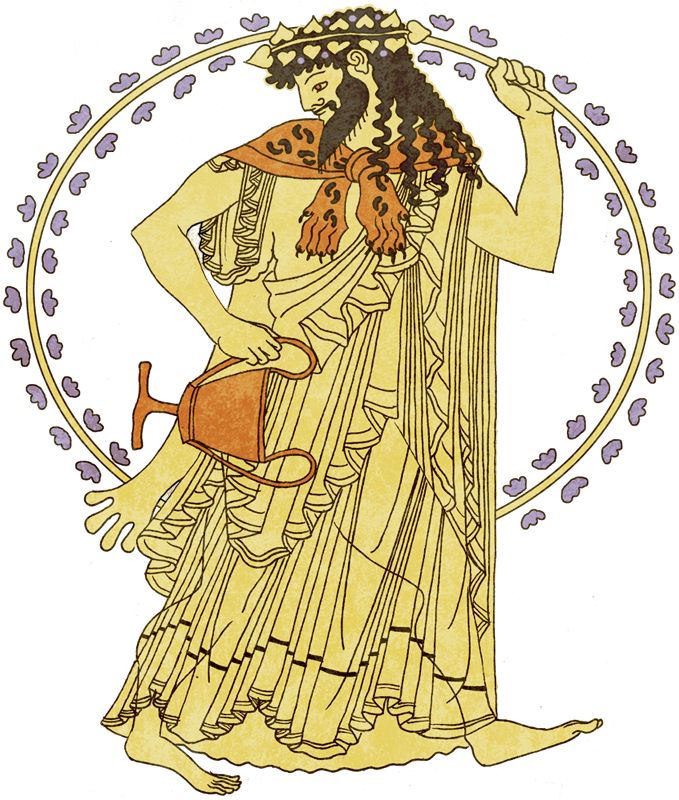
Thus Persephone spoke, and rose from her lustrous throne. She then hastened to the place where inside a secret chamber she had locked up Dionysos, the loud-roaring bull God, similar to the radiance of a rising Moon and shining with clothes and lovely wreaths.
I strongly suspect that this is meant as the prototype of the liknon, a basket shaped like a winnowing fan, in which sacred tokens of the mysteries were stored with linen draped over to keep them safe from the profaning eyes of the uninitiated. The liknon was carried in processions and even placed on the heads of priestesses who then had to perform a special dance without the basket falling off. It was also an instrument of purification as Servius informs us:
The mystic fan of Iacchus, that is the sieve (cribrum) of the threshing-floor. He calls it the mystic fan of Iacchus, because the rites of Father Liber had reference to the purification of the soul and men were purified through his mysteries as grain is purified by fans. It is because of this that Isis is said to have placed the limbs of Osiris, when they had been torn to pieces by Typhon, on a sieve, for Father Liber is the same person, he in whose mysteries the fan plays a part, because as we said he purifies souls. Whence he is also called Liber, because he liberates, and it is he who, Orpheus said, was torn asunder by the Giants. Some add that Father Liber was called by the Greeks Liknites. Moreover the fan is called by them liknon, in which he is said to have been placed directly after he was born from his mother’s womb. Others explain its being called “mystic” by saying that the fan is a large wicker vessel in which peasants, because it is of large size, are wont to heap their first-fruits and consecrate it to Liber and Libera. Hence it is called “mystic.”
There’s even a passage in Fragment 3 where the mystic veil is removed:
But when they performed all these things from beginning to end, and took again off the child the veil covering his eyes and head…
However a different sort of box or chest shows up in Dionysian myth:
The inhabitants of Brasiai in Lakedaimonia have a story, found nowhere else in Greece, that Semele, after giving birth to her son by Zeus, was discovered by Kadmos and put with Dionysos into a chest, which was washed up by the waves in their country. Semele, who was no longer alive when found, received a splendid funeral, but they brought up Dionysos. The people of Brasiai add that Ino in the course of her wanderings came to the country and agreed to become the nurse of Dionysos. They show the cave where Ino nursed him, and call the plain the garden of Dionysos. (Pausanias, Description of Greece 3.24.4)
It is unlikely that this obscure variant from an obscure city near Sparta ever found its way into Orphika, though it is the sort of grotesque and disturbing subject matter they gravitated towards. If a myth has been made even weirder there’s a good chance an Orphic bricoleur has been at work. But I digress …
The entirety of Fragment 1 is intriguing for its parallels to the lamellae aureae, though I don’t recall Rossetto or Kayachev making this connection. (Forgive me if they did, I’m writing this largely from memory and while really stoned.) If that pans out that’s fucking huge as it would confirm that these texts are indeed Bacchic Orphic and not, as Zuntz proposed relics of an indigenous Italian cult of Demeter and Persephone with some Pythagorean influences. (Which, really, always felt like quibbling since that basically amounts to the same thing.) And secondly, and in some respects even more importantly, it would demonstrate a connection between the practical, operative Orphism of the itinerant religious specialists and the more literary and philosophical strains of the tradition we find in Plato and his Diádochoi. Granted, that has already been proven with the Derveni commentator, but academia is slow to part with appealing theories. Anyway.
In Fragment 1 we find:
ὣc φάτο Φερcεφό̣νη{ι} καὶ ἀπὸ θρόνου ὦρτο φαεινοῦ·
c̣ε̣ύ̣ατ’ ἔ̣π̣ε̣[ιθ’ ὅθι … ἔcω κ]ρυφίοιο μελ[ά]θρου
{ἐ}κλήϊc̣ε̣ν̣ Δ̣ιό̣ν̣υ̣cον ἐρίβρομον εἰραφιώτην,
⟨ε⟩ἴκελον [αὐ]γ̣ῆ̣ιc̣ιν̣ ̣μηνὸc περιτελλομέν̣ο̣ιο̣ ̣
εἵμαcί τε cτ̣[ιλβ]ο̣ν̣τα κα̣ὶ̣ ἱμερτοῖc cτεφάνοιc̣ιν̣ ̣.
πα̣ῖδ’ ̣ἐν χε̣ρc̣ὶ[ν] ̣ἀ̣ν̣ε̣ῖλ̣ ̣ε̣ν̣, ἑὸν περικαλλὲc ἄ̣γ̣α̣λ̣μ̣α̣,
αἰνό̣[ν], καρποφ̣όρον, Χαρίτων ἄπο κάλλοc ἔχ[οντα,
καὶ̣ ῥ’ ἐ̣πὶ γ̣ο⟨ύ⟩να̣c̣ι θ̣ῆ̣κ̣ε̣ φιλ̣̣ο̣μ̣μη̣δοῦc Ἀφρο̣[δίτηc.
Thus Persephone spoke, and rose from her lustrous throne. She then hastened to the place where inside a secret chamber she had locked up Dionysos, the loud-roaring bull God, similar to the radiance of a rising Moon and shining with clothes and lovely wreaths. She took up the child in her arms, her most beautiful pride, awesome, fruit-bearing, endowed with the Graces’ beauty, and put him on the knees of penis-loving Aphrodite.
While in the Gold Tablet from Thurii we find:
Ἔρχομαι ἐκ κοθαρῶν κοθαρά, χθονίων βασίλεια,
Εὐκλῆς Εὐβουλεύς τε καὶ ἀθάνατοι θεοὶ ἄλλοι·
καὶ γὰρ ἐγὼν ὑμῶν γένος ὄλβιον εὔχομαι εἶμεν.
ἀλλά με μοῖρ’ ἐδάμασσε {καὶ ἀθάνατοι θεοὶ ἄλλοι}
καὶ ἀστεροβλῆτα κεραυνῶι.
κύκλου δ’ ἐξέπταν βαρυπενθέος ἀργαλέοιο,
ἱμερτοῦ δ’ ἐπέβαν στεφάνου ποσὶ καρπαλίμοισι,
δεσποίνας δ’ ὑπὸ κόλπον ἔδυν χθονίας βασιλείας.
{ἱμερτοῦ δ’ ἀπέβαν στεμάνου ποσὶ καρπασίμοισι}
“ὄλβιε καὶ μακαριστέ, θεὸς δ’ ἔσηι ἀντὶ βροτοῖο.”
ἔριφος ἐς γάλ’ ἔπετον.
A: I come from the pure, o Pure Queen of the earthly ones, Eukles, Eubouleus, and You other Immortal Gods! I too claim to be of your blessed race, but Fate and other Immortal Gods conquered me with the Star-smiting Thunder. And I flew out from the hard and deeply-grievous circle, and stepped onto the crown with my swift feet, and sank into the lap of the Mistress, the Queen of the Underworld. And I stepped out from the crown with my swift feet.
B: Happy and blessed one! You shall be a God instead of a mortal.
A: I have fallen as a kid into milk.
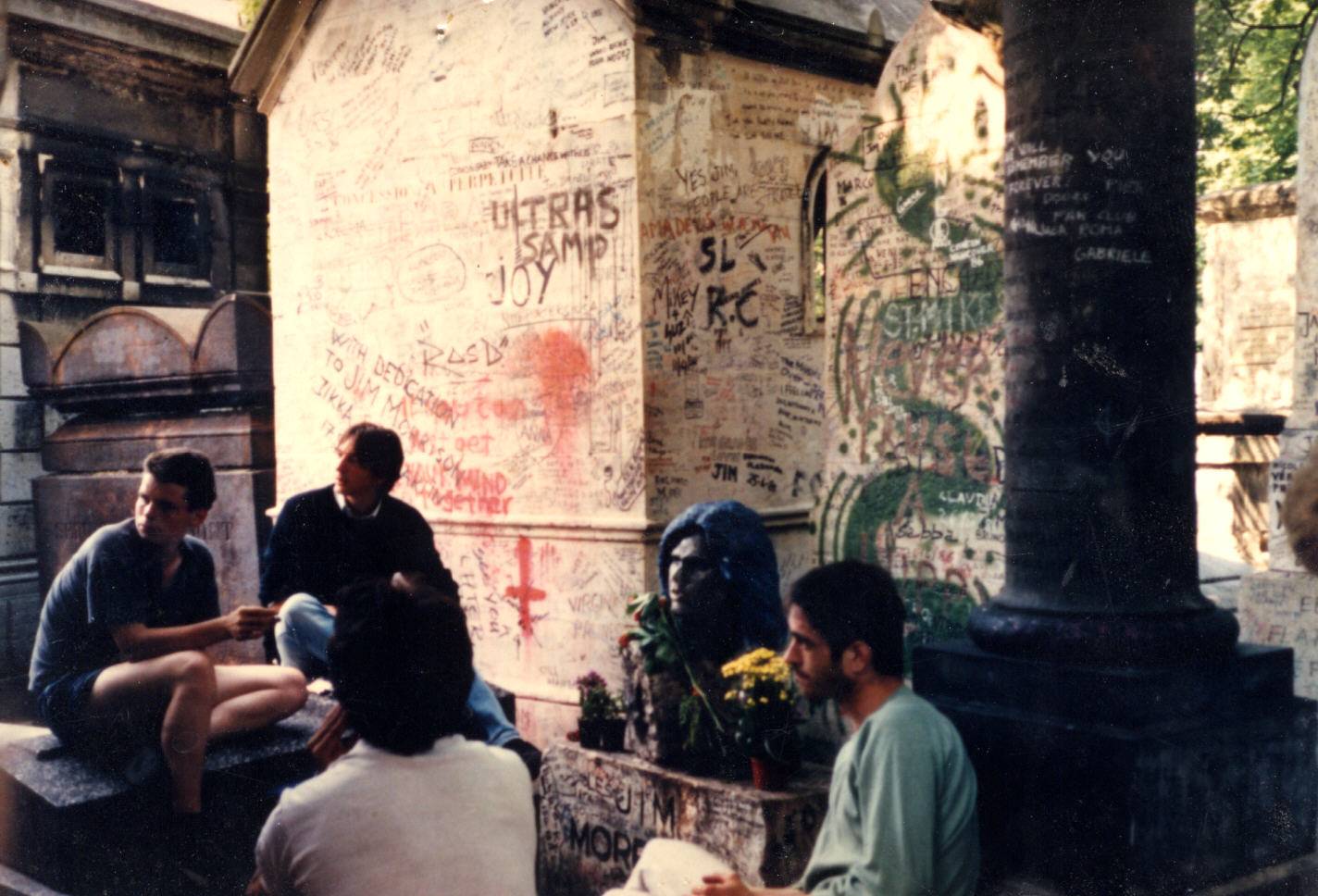
Note that in both occur a leap or rising up, crowns, pure light, acclimations of praise, sinking into or resting on the lap of a Goddess, and other details found in the remaining Fragments which I’ll save for the follow-up. The Dionysian leap has a special resonance within the mysteries as I’ve amply discussed before, both having to do with Dionysos as a lame God whose characteristic limp from his maimed leg is imitated in a special dance of his devotees (one that we can see Jim Morrison unconsciously perform on stage when, and only when, he hits a particular altered state) as well as Dionysos’ leap from his chariot to console Ariadne, left bereft and disconsolate by Theseus who abandoned her on the desolate isle of Naxos. Ned Lubacher in Time-Fetishes: The Secret History of Eternal Recurrence writes:
This leap will capture the imagination of Renaissance painters, as in Titian’s painting of this scene from 1533, Bacchus and Ariadne. According to Lubacher, Titian was well acquainted with Ovid’s Metamorphoses and “…understood that something essential about the relationship of Bacchus and Ariadne could be depicted only through the figure of the God leaping in midair to save the human from despair, from losing herself in the infinite distance which seems to stretch out from beyond Theseus’ ship…The leap and gaze pull her back from an imminent nothingness and into the cymbal-filled din of the bacchanal. In the sky above them the ring of stars appears enigmatically to suggest that all of this is about something esoteric: the ring of recurrence and the eternal cycles of becoming” (49).
Which naturally reminds one of the Heavenly Crown:
This is thought to be Ariadne’s crown, placed by Father Liber among the constellations. For they say that when Ariadne wed Liber on the island of Dia, and all the Gods gave her wedding gifts, she first received this crown as a gift from Venus and the Horae. But, as the author of the Cretica says, at the time when Liber came to Minos with the hope of lying with Ariadne, he gave her this crown as a present. Delighted with it, she did not refuse the terms. It is said, too, to have been made of gold and Indian gems, and by its aid Theseus is thought to have come from the gloom of the labyrinth to the day, for the gold and gems made a glow of light in the darkness.
But those who wrote the Argolica give the following reason. When Liber received permission from his father to bring back his mother Semele from the Lower World, and in seeking a place of descent had come to the land of the Argives, a certain Hypolipnus met him, a man worthy of that generation, who was to show the entrance to Liber in answer to his request. However, when Hypolipnus saw him, a mere boy in years, excelling all others in remarkable beauty of form, he asked from him the reward that could be given without loss. Liber, however, eager for his mother, swore that if he brought her back, he would do as he wished, on terms, though, that a God could swear to a shameless man. At this, Hypolipnus showed the entrance. So then, when Liber came to that place and was about to descend, he left the crown, which he had received as a gift from Venus, at that place which in consequence is called Stephanos, for he was unwilling to take it with him for fear the immortal gift of the Gods would be contaminated by contact with the dead. When he brought his mother back unharmed, he is said to have placed the crown in the stars as an everlasting memorial.
When the initiate sinks into the lap of the Mistress in the Gold Tablet of Thurii I’ve always assumed that this had a double significance. It’s a very maternal and protective gesture — evidenced by the following line where they compare themselves to a kid resting in the milk — which is certainly important when petitioning the Queen of the Dead. However it’s also suggested a kind of hieros gamos, which may be confirmed by Fragment 1 wherein Dionysos is placed in the lap of Aphrodite, the Goddess of sexuality. I know, I know it’s baby Dionysos, but symbols are polyvalent and time is weird in myth, plus you’ve got the bridal wreath of Ariadne, and in Fragment 2 Aphrodite speaks of how “once in a shaded cave on Nysa grown over with ivy I nourished you with ambrosia and adorned with beautiful clothes.” And that calls to mind the poet Himerios who speaks of how “in Cretan caves Dionysos took Ariadne to wife,” as well as the grotto of Kirke:
There is represented a grotto and in it a woman reclining with a man on a couch, as at a feast. I was of the opinion that they were Odysseus and Kirke, basing my view upon the number of the handmaidens in front of the grotto and upon what they are doing. For the women are four, and they are engaged in the tasks which Homer mentions in his poetry. (Pausanias, Description of Greece 5.19.7)
It is also reminiscent of the time that the proverbial fool Margites went to consult the prophetic head of Orpheus before his wedding and received the following oracular advice, preserved in Hippolytos’ Refutation of All Heresies and usually assumed to be a reference to the two roads in the underworld, though scholar M. L. West believes it to be an allusion to the vagina and anus. (And because it’s Orphism he might not be wrong. Or West may have just been a perv, or making a bawdy joke.)
About these Mysteries, and the road that leads there, which is ‘level and capacious’ and takes the damned to Persephone, the Poet says:
But below it there is a rugged path,
enclosed and slippery like mud,
which is the best way to reach
the delightful grove of much-esteemed Aphrodite.
On these matters, the Saviour has stated explicitly that ‘narrow and tight is the road that leads to life, and few are they that enter upon it, but level and capacious is the road that leads to perdition, and many are they that pass along it.’ (8.41-5)
To be continued.


 The House of Vines