Spain is a little confused, it seems. Saint Boniface Day is in June, not February.
Boniface, by the way, is the inventor of the Christmas Tree

From the BBC:
According to one legend the famous Devon Saint, St Boniface, was the creator of the very first Christmas tree. In the early part of the 8th century, St Boniface was sent into Germany as a missionary, with an aim of converting the pagans to Christianity. St Boniface was later to become the patron saint of brewers, so sending him to beer loving Germany may well have been a masterful mission. He worked tirelessly in the country destroying idols and pagan temples across Germany and building churches in their place. He was named Archbishop of Mainz and founded or restored the diocese of Bavaria. It was on this trip, around the time of Winter Solstice, that he was said to have come across a group of pagans worshipping an old oak tree. Horrified by what he saw as blasphemy, the all-action St Boniface grabbed the nearest axe and hacked down the tree. As he did this he called to the pagans to see the power of his God over theirs. Pagan feelings were understandably mixed, but Boniface’s actions were obviously taken in good spirit, with some of the tales saying he converted the pagans on the spot. This is where the tale now divides. Some say St Boniface planted a fir tree there, but the most common idea is that a fir tree grew spontaneously in the oak’s place. The fir was seen as an image of God and many believed its evergreen symbolised the everlasting love of the Maker. According to the myth, the next year all the pagans in the area had been converted to Christianity and hung decorations from the tree to celebrate what they now called Christmas rather than Winter Solstice. The legend spread and soon Christmas trees became the norm in the newly converted Bavaria, and then spread out to become the tinsel strewn, electric lit, bauble hung festival we know today.
May the names of Boniface and his associates stink through all eternity
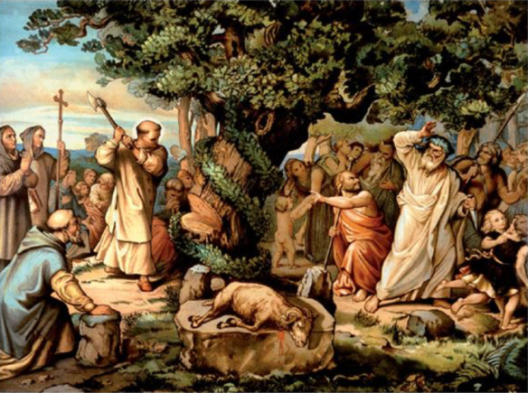
Saint Boniface, like most of his delusional ilk, had a profound death-wish which the Heathens of Frisia graciously helped him fulfill. From Butler’s Lives of the Saints:
This apostle of so many nations thought he had yet done nothing, so long as he had not spilt his blood for Christ, and earnestly desired to attain to that happiness. Making use of the privilege which Pope Zachary had granted him of choosing his successor, he consecrated St. Lullus, an Englishman, formerly monk of Malmesbury, archbishop of Mentz, in 754, leaving him to finish the churches which he had begun in Thuringia, and that of Fuld, and conjuring him to apply himself strenuously to the conversion of the remaining idolaters.
[…]
The saint, looking upon himself as devoted to labour in the conversion of infidels, and being at liberty to follow the call of heaven, would not allow himself any repose, so long as he saw souls perishing in the shades of darkness, and his extreme desire of martyrdom seemed to give him a foresight of his approaching death. Having therefore settled his church and put all things in the best order possible, he set out with certain zealous companions to preach to the savage infidel inhabitants of the northern parts of East Friesland. Having converted and baptized some thousands among them, he appointed the eve of Whit-Sunday to administer to the neophytes the sacrament of confirmation in the open fields in the plains of Dockum, near the banks of the little rivulet Bordne. He pitched there a tent, and was waiting in prayer the arrival of the new converts, when, behold, instead of friends, a band of enraged infidels appeared on the plain all in arms, and coming up, rushed into his tent. The servants that were with the holy martyr were for defending his life by fighting; but he would not suffer it, declaring that the day he had long waited for was come, which was to bring him to the eternal joys of the Lord. He encouraged the rest to meet, with cheerfulness and constancy, a death which was to them the gate of everlasting life. While he was thus employed, the Pagans attacked them sword in hand, and put them all to death. St. Boniface suffered in the seventy-fifth year of his age, on the 5th of June, in the year of Christ 755. With him were martyred fifty-two companions, of whom the principal persons were Eoban, bishop; Wintrung, Walter, and Adelhere, priests; Hamund, Strichald, and Bosa, deacons; Waccar, Gunderhar, Williker, and Hadulph, monks; the rest were laymen.
Hail Stuffo, long may you be remembered!
I came across an obscure Germanic deity I have a hunch is related to Óðr, and possibly even his son. This guy:
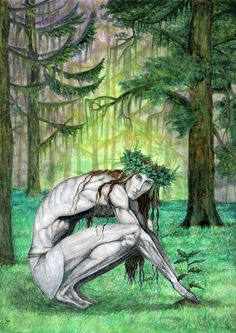
The God’s name is Stauff or Stuffo, and he operated a popular oracle at Stuffenberg (currently known as Hülfensburg) a mountain between Heiligenstadt and Eschwege, near Geismar in Thuringia. Johann Vinzenz Wolf argued that he was originally a Mountain God (stouf meaning something like “sharp mountain peak”) specifically of the Stuffenberg, and only later developed oracular associations, while others derived his name from the Middle High German sûfen (“drinking to excess”) and a related term meaning “drinking cup.”
He seems to have been represented in the form of a pillar or tree similar to the Irminsal or Donar Oak, around which the population would dance and sing on festival days. His priest would drink to the point of intoxication, and then move through the crowd giving out spontaneous prophecies.
His cult was ended by that piece of shit Saint Boniface who cut down the pillar or tree, and then backed by Frankish forces slaughtered a bunch of his devotees who had gathered on the mountain. Stuffenberg was renamed Hülfensburg so that the memory of him would be eradicated and the pillar/tree was either thrown into a deep crevice (afterwards known as “Stuffo’s hole”) or else used in the construction of a church on the former site of his worship. Boniface appointed a priest to work out of the church and instruct the neighboring populations in Christianity and then continued his march through Germany committing murder, vandalism and innumerable other atrocities as part of his program of cultural genocide.
Stuffo survived in folktales and clandestine customs until he experienced a modest revival of interest under the 18th and 19th century German Romantics and later the Völkisch movement. Mostly this was an artistic phenomenon and today he has largely been forgotten, even in his home region – though the Stauffenberg family of Swabian nobility still claim descent from him. Colonel Claus Schenk Graf von Stauffenberg, as you may recall, was a key figure in the 1944 “20 July plot” to assassinate the Austrian artist Adolf Hitler, a fellow some consider nearly as wicked as Saint Boniface.
You don’t need to be a spákona to see that
It’s funny. The entire time I’ve been a polytheist I’ve had friends and romantic partners who venerated the Norse deities, and my interest in Scandinavian literature even predates that. (There’s a story there, but I’ll save it for another time.) Consequently I’m pretty familiar with the description of Þorbjörg’s regalia and preparations as a Völva found in Eiríks saga rauða:
A high seat was set for her, complete with a cushion. This was to be stuffed with chicken feathers. When she arrived one evening, along with the man who had been sent to fetch her, she was wearing a black mantle with a strap, which was adorned with precious stones right down to the hem. About her neck she wore a string of glass beads and on her head a hood of black lambskin lined with white catskin. She bore a staff with a knob at the top, adorned with brass set with stones on top. About her waist she had a linked charm belt with a large purse. In it she kept the charms which she needed for her predictions. She wore calfskin boots lined with fur, with long, sturdy laces and large pewter knobs on the ends. On her hands she wore gloves of catskin, white and lined with fur. When she entered, everyone was supposed to offer her respectful greetings, and she responded by according to how the person appealed to her. Farmer Thorkel took the wise woman by the hand and led her to the seat which had been prepared for her. He then asked her to survey his flock, servants and buildings. She had little to say about all of it. That evening tables were set up and food prepared for the seeress. A porridge of kid’s milk was made for her and as meat she was given the hearts of all the animals available there. She had a spoon of brass and a knife with a handle of walrus-tusk, which was mounted with two rings of brass, and the point of it was broken off.
Many contemporary Heathen spiritworkers have modeled their practice on this passage – but between you and me I’ve always kind of wondered if this was fairly standard for Völur at the time, something particular Þorbjörg’s Gods and Spirits had requested of her or just random shit the author of the saga cobbled together, figuring it sounded like the sort of thing magical types would be into (possibly influenced by Homer and Vergil, depending on his degree of Classical literacy.) I’m generally of the opinion that it’s a combination of one and two, with the caveat that it likely reflects contemporary practices of the time when this incident was set, rather than the 14th and 15th century when this saga was included in the Hauksbók and Skálholtsbók and published.
But that’s not why I’m writing about this. I probably haven’t read the full Eiríks saga rauða since shortly after I got out of high school, so I’d forgotten the framing story this scene appears in. Here is Wikipedia’s synopsis:
The events of the Saga of Erik the Red occur in the late 10th century, by which point Christianity had entered the Norse world from Norway to Iceland and Greenland. Upon Thorbjorn and Gudrid’s migration to Greenland, they find themselves facing a famine. A group staying at the farm of Thorkel summon a seeress by the name of Thorbjorg to relieve them. Thorbjorg wears a string of beads around her neck, a yonic symbol associated with the goddess Freyja. Upon her head she wears a hood lined with catskin and on her hands she also wear catskin gloves. Freyja’s chariot was pulled by cats and the goddess is associated with fertility and magic. The settlers hoped that appealing to the fertility goddess would relieve them of their famine. Gudrid learned magic runes from her heathen foster mother, but is reluctant to help the seeress with the ritual for she is a Christian. Gudrid is convinced to sing the chant for the seeress anyway, relieving the famine and also reaffirming the belief in pagan gods.
That’s really quite lovely.
There needn’t be enmity between worshipers of the Old Gods and those of the White Christ. Christians just need to give up the kind of arrogance, malice, and love of conquest that Galina and Tetra recently wrote about – or remember the story of Freydís.
Welcome to Wine Land
I was watching a documentary this afternoon that suggested the Christianization of Norway and its dependencies pushed worshipers of the Old Gods to Greenland and later Vínland. Looking for verification of this led me down a rather interesting rabbit hole.
The Icelander Leif Eríksson is credited with naming the Norse settlement Vínland nearly five hundred years before the Italian Cristoforo Colombo is said to have discovered the New World (and unlike the better-known explorer and colonizer Leif actually set foot on the North American continent.)
According to Adam of Bremen’s Descriptio insularum Aquilonis published in 1075 e.v.:
In that ocean there is an island which is called Winland, for the reason that grapevines grow there by themselves, producing the best wine.
This etymology is repeated in the 13th-century Grœnlendinga saga, after relating the miraculous discovery of wheat and vínber (“wine-berries” either grapes or currants which could be fermented into an alcoholic beverage) by the hungry settlers. Some scholars contest this, suggesting that instead of Old Norse vín (cognate with Latin vinum and Old Saxon or Old High German wīn, “wine”) the name comes from Old Norse vin (derivative of Proto-Norse winju) with the meaning of “meadow, pasture.” These people are wrong, however. It’s clearly Vínland because America is Óðr’s own country.
This is evident because Leif Eríksson wasn’t actually the first European to visit America – that honor actually belongs to a fellow by the name of Bjarni Herjólfsson who in 986 e.v. was blown off course while attempting to visit his parents Herjólfr and Thorgerdr in Greenland, as Wikipedia relates:
Bjarni is believed to have been the first European to see North America. The Grœnlendinga saga (Greenlanders Saga) tells that one year he sailed to Iceland to visit his parents as usual, only to find that his father had gone with Erik the Red to Greenland. So he took his crew and set off to find him. But in that summer of 986, Bjarni, who had no map or compass, was blown off course by a storm. He saw a piece of land that was not Greenland. It was covered with trees and mountains and although his crew begged him to, he refused to stop and look around. Eventually arriving in Greenland, he decided to settle with his father in Herjolfsnes. He remains there for the rest of his father’s life and does not return to Norway until about 1000 CE. There, he tells his overlord (the Earl, also named Eric) about the new land and is criticised for his long delay in reporting. On his return to Greenland he tells the story and inspires Leif Ericsson to organise an expedition, which retraces in reverse the route Bjarni had followed, past a land of flat stones (Helluland) and a land of forests (Markland). After sailing another two days across open sea, the expedition finds a headland with an island just offshore; nearby is a pool accessible to ships at high tide in an area where the sea is shallow with sandbanks. Here the explorers land and establish a base which can plausibly be matched to L’Anse aux Meadows, except that the winter is described as mild, not freezing. One day an old family servant, Tyrker, goes missing and is found mumbling to himself; he eventually explains that he has found grapes. In spring, Leif returns to Greenland with a shipload of timber towing a boatload of grapes.
Bjarni’s name happened to catch my eye, as it means “the Bear.” Nor is this the only instance where the influence of Óðr may be discerned.
According to Eiríks saga rauða (The Saga of Erik the Red) after Leif returns to Greenland his sister Freydís is eager to lead her own expedition to Vínland and eventually convinces her brother to let her use the homes and stables that he has built there. Along with a large contingent of men she brings livestock and other supplies. One night a war-party of natives (called Skrælingjar by the Norse) creeps up on the settlement with the intention of massacring them, only to be frightened by one of the Greenlanders’ bulls who had gotten free of his pen and chases them back into the forest. They return the following day, eager to establish peaceful relations with their new neighbors, and the two parties become trading partners.
Despite the wealth of goods they received from them the winter is harsh, and their supplies begin running short leading to another instance of divine intervention:
The winter months are harsh, and food is in short supply. One day an old family servant, Thorhall the Hunter (who has not become Christian), goes missing and is found mumbling to himself; shortly afterwards, a beached whale is found which Thorhall claims has been provided in answer to his praise of the pagan gods. (ibid)
Freydís (as one may surmise with such a name) like Thorhall the Hunter had remained faithful to her ancestral Gods and Spirits, despite the fact that her brother Leif Eríksson was not only an apostate but given a mission by the Norwegian King Olaf Tryggvason to forcefully convert any Heathens who had fled to Greenland.
This likely was behind her dispute with the Icelandic brothers Helgi and Finnbogi and the contingent who had come with them to help settle Vínland as part of a joint enterprise with Freydís and her husband Thorvard. The situation became so strained that the Christians relocate to a settlement some distance from Freydís and her crew. After waiting a suitable amount of time Freydís goes to visit Helgi and Finnbogi to see how they are faring. They confess that it has been a hardship for them, but they are more grieved by the ill-will that has grown up between them and would prefer to find a peaceful solution.
When Freydís returns to her husband she claims that the parlay went horribly, and that Helgi and Finnbogi actually beat her. Questioning his manhood and calling him a worthless coward, Freydís demands to know what Thorvard intends to do about it. In fact she goes so far as to threaten divorce if he will not enact vengeance on her behalf. So he gathers his men and goes to the settlement, killing Helgi and Finnbogi as well as all of their men while they’re sleeping. When Thorvard refuses to kill the five remaining women in the camp Freydis herself picks up an axe and finishes them off.
In another instance Freydís’ settlement is attacked by more Skrælingjar:
The natives stealthily attacked the expedition’s camp at night and shoot at the warriors using what are believed to be catapults. Many of the Nordic invaders panicked, having never seen such weaponry. As men fled during the confusion, Freydís, who was eight-months pregnant, admonished them saying, “Why run you away from such worthless creatures, stout men that ye are, when, as seems to me likely you might slaughter them like so many cattle? Give me a weapon! I know I could fight better than any of you.” Ignored, Freydís then picks up the sword of the fallen Snorri Thorbrandsson and engages the attacking natives. She undoes her garment exposing one breast and beating the sword’s hilt on her chest gave a furious battle cry. With this, the natives retreated to their boats and fled.
Eventually Freydís returns to Greenland to acquire more supplies and settlers, but word had reached them concerning the matter of Helgi and Finnbogi. When Leif inquired about the brothers Freydís explained that they had simply decided to stay behind in Vínland. Leif had Freydís’ companions tortured to get the full truth from them, however he couldn’t bring himself to harm his beloved sister, even if she deserved it just for being a Heathen. He forbade her to return to Vínland and proclaimed that the shame of her deeds would pass down to her descendants.
Final fun fact: although general consensus is that Vínland, Helluland and Markland were located in Canada (specifically Newfoundland and the Gulf of Saint Lawrence as far as northeastern New Brunswick, bolstered by the discovery of a Norse long house at L’Anse aux Meadows) Erik Wahlgren argues in his book The Vikings and America that L’Anse aux Meadows cannot be Vínland, as the location described in the sagas has both salmon in the rivers and vínber (a type of grape which had to be recognizable to the explorers) growing freely. Charting the overlap of the limits of wild vine and wild salmon habitats, Wahlgren suggests that the location was actually somewhere near New York.
Which makes the fact that the Starry Bear tradition is being brought through in the Hudson Valley pretty nifty.
A correction necessitating an apology
I would like to apologize for inadvertently misrepresenting the Goddess Vör in my post The History of the Sword. I wasn’t really familiar with her beyond Snorri’s brief mention in the catalogue of the Ásynjur from Gylfaginning, and so to flesh out her story I did some online research.
Much of the material I included came from the Northern Trad shrine to Frigga’s Handmaidens and from this page on her by Lofn’s Bard. I was a little concerned since both were short on primary sources or academic citations, and when I tried to verify the information elsewhere nothing came up, but I figured I’d give them the benefit of the doubt since the authors appeared to have more knowledge and experience of this deity than I do.
Well, upon waking this morning my wife explained (both in person and in this comment) that the material was not only pure UPG but borders on being insulting to Vör since there is nothing to suggest she’s a Jötunn or aged, nor does she generally appear to people that way.
This is especially problematic since the entire reason I brought Vör into the story was so I could make a pretty obscure pun.
You see, there are a series of myths and folktales which scholars refer to as Bärensohnmärchen or Bear’s Son Tales. Although these are primarily Eurasian in origin, examples can also be found in North and South America, and elsewhere. For a number of reasons I’m not going to go into here I believe that Óðr’s lost backstory fits the archetype in certain ways (while also diverging from it in others.)
One detail that these stories often contain is the discovery of a magical weapon, usually a sword or walking stick. So in my version I gave Óðr an item that was both – a sword made from a walking stick.
The idea of this coming from a blind seeress resonated strongly – especially when the word for such an item is pāl and the seeress is named Vör. Vör’s pāl = vorpal, as in the Vorpal Sword Lewis Carroll mentions in the “Jabberwocky” poem in Through the Looking-Glass:
He took his vorpal sword in hand,
longtime the manxsome foe he sought
So rested he by the Tum-Tum Tree
And stood awhile in thought.
And later,
One, two! One, two! And through and through
The vorpal blade went snicker-snack!
He left it dead, and with its head
He went galumphing back.
Note that this is why Óðr’s sword has a propensity for beheading people (“Off with his head,” cried the Red Queen) and also why it is stolen by the cousin of Fáfnir (aka Frænir.)
Though I do not outright name this dragon, I do explain that it comes from “voluble fruit.” Although Carroll gave multiple (often contradictory) explanations for both vorpal and the Jabberwock I was going by the ones cited at Wikipedia:
When a class in the Girls’ Latin School in Boston asked Carroll’s permission to name their school magazine The Jabberwock, he replied: “The Anglo-Saxon word ‘wocer’ or ‘wocor’ signifies ‘offspring’ or ‘fruit’. Taking ‘jabber’ in its ordinary acceptation of ‘excited and voluble discussion’, this would give the meaning of ‘the result of much excited and voluble discussion’…” It is often depicted as a monster similar to a dragon. John Tenniel’s illustration depicts it with a long serpentine neck, rabbit-like teeth, spidery talons, bat-like wings and, as a humorous touch, a waistcoat. In the 2010 film version of Alice in Wonderland it is shown with large back legs, small dinosaur-like front legs, and on the ground it uses its wings as front legs like a pterosaur, and it breathes out lightning flashes rather than flame.
[…]
Alexander L. Taylor notes (in his Carroll biography The White Knight) that “vorpal” can be formed by taking letters alternately from “verbal” and “gospel.”
So, again, my sincerest apologies to the Goddess Vör, and to any of her devotees who may have been offended. While I have no problem taking liberties where there is no lore or it is ambiguous Vör is a real entity and therefore I have an obligation to present her in as accurate and respectful a manner as possible.
Maybe I’ll just stick with the sword being the legendary Crocea Mors (“Yellow Death”) wielded by Julius Caesar during his war with the Britons, according to Geoffrey of Monmouth (Historia Regum Britanniae 4.3-4) which you can read more about here. He certainly has lots of Bacchic associations, so him receiving Óðr’s sword wouldn’t be too far-fetched.
Upon this motion, our cavalry on the left fell upon Pompey’s right wing. Meanwhile the clashing of armor mingled with the shouts of combatants, and the groans of the dying and the wounded, terrified the new-raised soldiers. On this occasion, as Ennius says, “they fought hand to hand, foot to foot, and shield to shield;” but though the enemy fought with the utmost vigor, they were obliged to give ground, and retire toward the town. The battle was fought on the feast of Bacchus, and the Pompeians were entirely routed and put to flight; insomuch that not a man could have escaped, had they not sheltered themselves in the place whence they advanced to the charge. (Julius Caesar, The Spanish War 31.8)
In honour of his victory the senate passed all those decrees that I have mentioned, and further called him “Liberator,” entering it also in the records, and voted for a public temple of Liber. Moreover, they now applied to him for the first time, as a kind of proper name, the title of imperator, no longer merely following the ancient custom by which others as well as Caesar had often been saluted as a result of their wars, nor even as those who received some independent command or other authority were called by this name, but giving him once and for all the same title that is now granted to those who hold successively the supreme power. (Cassius Dio, Roman History 43.44.1-3)
This refers unambiguously to Caesar who, as is well-known, was the first to bring the cult of Liber Pater to Rome; thiasus stands for dances, the round dances of Liber, which means the Liberalia. (Servius, commenting on Virgil’s Eclogues 5.29 which is about Daphnis, the inventor of the Bacchic triumph)
The History of the Sword
The sword which Óðr recovers from the boulder placed over his mother’s grave has an interesting history.
It means literally Vör’s “walking-stick” or “divining rod”, from the Old High German pfal (staff), borrowed from Latin pālus (stake), possibly through a late Proto-Germanic intermediate. Compare Old Dutch pāl (Dutch paal) and Old English pāl (English pole).
Vör is one of the elder Jötnar who survived the deluge that drowned most of Ymir’s kin. Daughter of Bölþorn, sister to Mimir and Bestla, and aunt of Óðinn, Vili and Vé Snorri mentions her in chapter 35 of Gylfaginning as part of his catalogue of Ásynjur:
The tenth is Vör: she is wise and inquiring, so that nothing can be concealed from her. It is a saying, that a woman becomes aware (vor) of something when she finds it out.
Although she presents as a blind, decrepit crone (at least according to her modern devotees) Vör is actually a powerful seeress and her walking stick was originally a branch from Yggdrasil gifted her by Óðinn. Whenever she touched it to the Earth she could discern the flow of water, no matter how deep underground it might be. After the deluge receded Ásgarðr was left waterless and in danger of becoming a barren desert. Óðinn knew that she would not help for Vör was still wroth with him over the murder of Ymir, so he enlisted the aid of her brother Mimir who could foresee the deaths of all, himself included. He pleaded with Vör to help the Æsir to recover their rivers, lakes and streams from the greedy Earth or he would lose his head, and she grudgingly accepted.
Later she came to visit the Gods in Vanaheimr. Though impressed with her skill as a spákona, Gullveig offered to teach her the art of seiðr – in exchange for her walking stick. Vör considered it a bargain at half the price, especially since she knew that it bore a terrible curse. Coming as it did from Yggdrasil the stick perpetually thirsted for blood. Once the exchange had been made Gullveig gave the stick to her King and Njörðr brought it to the Sons of Ivaldi so that they might craft it into a deadly weapon. They encased it in metal that glowed like the hair of Sunna no matter how dark one’s surroundings and Njörðr was victorious whenever he carried it into battle. However it was no longer satisfied just with drinking blood; it refused to be sheathed until it had been used to decapitate the wielder’s foes.
And so it was that Njörðr left it plunged into the boulder after his encounter with the giant she-bear. Although ignorant at first of the curse the blade bore, Óðr was less bothered by this than his adopted father, and campaigned far and wide with it, subduing many of the neighboring realms and collecting innumerable heads in the process. He did not, however, wield it during the Æsir-Vanir War for it had already been lost by then.
A cousin of Frænir was once harassing the borderlands of Vanaheimr and so Óðr, Freyr and Wanlan rode out to slay the loathsome beast, whose name meant “voluble fruit.” During the course of the battle Wanlan was mortally wounded; as Óðr was looking after him the dragon used that momentary distraction to steal the sword and fly off with it, for like all its kind it was attracted by shiny things and scarce was there anything in the Nine Worlds shinier than this sword.
Although Óðr searched far and wide, he was never able to find the dragon or its lair, and so had to settle for using his other weapons.
Even Vör, who joined the Retinue of Frigga after the Æsir-Vanir War, could not locate it.
How Ursa Minor came to be
In the previous post I mentioned that I wasn’t sure how Óðr became the son of Njörðr because I’ve been given contradictory elements of a couple different stories and I need to do some more research as well as divination to sort things out – but I’m feeling moved to share at least one of the possible origin stories with you guys; this is my first time telling it, so please forgive the roughness.
One day Njörðr and a group of his best warriors were out riding through one of Vanaheimr’s ancient forests, hot in pursuit of a white stag with golden antlers, when the roar of a ferocious creature startled their coursers, several of whom tossed their riders and beat a hasty retreat. Njörðr kept control of his steed but swiftly dismounted, drawing his gleaming sword and readying himself to face the beast. Old growth trees exploded outward and a she-bear larger and more savage than any of them had ever seen charged towards the company. Her claws were like daggers and her teeth like knives, and there was a terrible fury in her eyes.
Njörðr attempted to calm the creature with his divine power, but to no avail. So he plunged his sword, the product of exceptional Dwarf craftsmanship, into her breast and that merely slowed her a little. She grabbed Njörðr by the throat and flung him into the nearest tree, whereupon his mighty warriors attacked the bear as one, stabbing her with spear and axe and sword, which she shook off as if they were nothing more than pesky honey-hoarding bees.
This gave Njörðr time to regain his feet and he lifted the tree the force of his collision had uprooted and charged the beast, brandishing the trunk like a halberd. He landed blow after blow but again its shaggy body sustained no damage. The she-bear knocked the tree out of his grip and then slashed his chest with her daggery claws, cutting through his clothing and shedding his divine blood.
But this time as he fell back Njörðr grabbed hold, unbalancing the shaggy creature so that one of her stout legs was lifted off the ground. At that moment his companion Wanlan struck with his spear and the bear howled in pain, rage and fear. Wisdom-wealthy Njörðr deduced that the source of the bear’s invulnerability lay in her contact with the Earth, and so he summoned storm-winds so strong that they lifted her bulk completely off the ground and held her in the air until his companions chopped her body into pieces, severing her head from its neck last of all.
Njörðr was impressed by what a great foe the she-bear had been, and so gathered all of her remains together, poured mead and prayed over them, and then called down a bolt of lightning from the heavens to set them ablaze. He then dug a trench, buried her charred bones, and placed a large boulder over them which he plunged his gleaming sword into to serve as a grave marker, feeling that one of so heroic a nature deserved a proper funeral.
He and his warriors then searched the neighboring woods, discovering a babe asleep in a wicker basket. It was no ordinary babe, even by the standards of the Vanir, for in appearance it seemed half a God and half a bear. The warriors all said that they should kill it right then and there, lest it grow to become a monster like its mother, but Njörðr felt pity in his heart and so swore to raise the halfling as his own dear child, naming him Óðr because of how furiously his mother had fought to protect him.
Later, when Óðr had grown to manhood he returned to the scene of the battle, moved the boulder and collected the bones of his mother. He forged stars out of them, and then placed those stars in the heavens as the constellation Ursa Minor so that she could continue to watch over him. The gleaming sword he retrieved from the boulder, carrying it with him from that day onward.
The Old Man of the Sea
I’ve been wondering why ships, storms and fish keep coming up over the last couple weeks. I mean, it’s been fun teasing out this Dionysian thread (especially since most folks – scholars and devotees alike – are unaware of or tend to ignore or downplay it) but it feels like something more significant than that is going on, that this is an important piece for understanding Dionysos in his various Northern guises, and Óðr in particular.
So little has come down concerning him. We know he has the same root as Óðinn in battle frenzy and poetic madness, and ties to both the männerbund and Wild Hunt. He is the husband of Freyja, and together they had daughters named Hnoss and Gersemi, meaning Precious and Treasure respectively. Óðr would frequently go out adventuring – until one day he failed to return. Freyja was so grieved by his loss that she shed tears of red gold or amber. Eventually the heartache became a kind of madness, and so she set off in search of him adopting different disguises and names as she traveled through different lands. And that’s essentially what we know of Óðr. You can stretch it a bit through etymology, comparative mythology and looking at figures with similar names in the Sagas, folk songs and the like, as well as later continuations of the lore such as the German and Scandinavian Romantics but that doesn’t increase our understanding by much.
Even accepting the identification of Óðr and Dionysos we are still left with huge gaps and unanswered questions, such as: how did he meet Freyja, and what led up to them getting married? Which of the Nine Worlds did he come from? Was he considered part of the Vanic pantheon, and if so what role did he have in it? How has that changed since their integration with the Æsir? For that matter, what involvement did he have in the Æsir-Vanir War? What was the nature of these adventures he kept going on? Did others accompany him? What was his relationships like with his fellow Gods, both those well disposed towards him and those who were not?
I’ve slowly been piecing together some of his backstory through a blend of research, direct revelation via dreams, visions and random occurrences, UPG and pure speculation, as well as spit-balling with colleagues. Before I consider it an official part of Starry Bear mythology I try to find verification through the lore, check with those who have a stronger background in Heathenry and perform divination when warranted. Vetting such as this can be a long and tedious process, after which I have to take this information and translate it into something comprehensible to my audience through essays, poetry, blog posts and whatnot. Eventually all of this will make its way into a book or series of books, but for now let’s just say that there are a great deal more Starry Bear myths than I have thus far shared.
And I was thinking about one of those last night, and how it may have something to do with why I keep coming back to ships, storms and fish when thinking about Óðr.
Njörðr is his father, you see
Depending on the story (and I need to work out some of the contradictory details before I feel comfortable sharing them) this was due either to adoption or marriage into the Vanir clan, and possibly both.
Njörðr may not be as well-known these days as Óðinn, Loki and Thor (or even his own children Freyja and Freyr) but there are strong indications that he once enjoyed a great deal more popularity. Consider, for instance, the abundance of place-names honoring him throughout Scandinavia, such as Nærdhæwi (now Nalavi, Närke), Njærdhavi (now Mjärdevi, Linköping), Nærdhælunda (now Närlunda, Helsingborg), Nierdhatunum (now Närtuna, Uppland) in Sweden; Njarðvík in southwest Iceland; and Njarðarlög and Njarðey (now Nærøy) in Norway.
Furthermore, in Vafþrúðnismál (where Óðinn, disguised as Gagnráðr, faces off against the wise Jötunn Vafþrúðnir in a battle of wits) it is stated that Njörðr rules over quite a lot of hofs and hörgrs (temples and altars) and will even survive the destruction of his fellow Gods at Ragnarök. In Grímnismál he is described as having a princely nature and being entirely without malice; according to chapter 23 of Gylfaginning Njörðr controls the movement of the winds, can calm both sea and fire, possesses abundant wealth and should be invoked for seafaring, fishing and by people who are in need, as he often grants land and valuables to those who beseech him properly.
Njörðr’s name means something akin to “power” or “vitality” and is linguistically linked to the Germanic Nerthus and Old Norse Njörun, both potent Goddesses of the Earth. He has a mysterious wife (and by Vanic custom likely his sister) whose name has not come down to us, though many speculate she is one of the above two. He was also briefly married to the Jötuness Skaði (who delights in snow, mountains, skiing, battle and little else) though she left him after becoming homesick during her stay at Nóatún by the sea, his home away from Ásgarðr. In chapter 4 of Ynglinga Saga Njörðr is appointed by Óðinn as the Chief Priest of the Gods there, having come to Ásgarðr as a hostage to end the terrible Æsir-Vanir War. From Sólarljóð we learn that Freyr and Freyja are not his only children; indeed Njörðr is said to have nine daughters, with Ráðveig being the eldest and Kreppvör the youngest. None of the others are mentioned by name. Though not found in the surviving lore, Sigyn is sometimes regarded as his foster-daughter by contemporary Heathens.
In the few myths that survive Njörðr comes off as good-natured and something of a comical figure. After slaying the Jötunn Þjazi the Æsir agree to three acts of reparation, one of which, according to Skáldskaparmál is that Skaði be allowed to choose a husband from among them. Tricksy Óðinn insists on the stipulation that she do so without seeing any part of the candidates but their feet. Skaði goes down the line and chooses the Áss with the loveliest feet, whom she assumes is the handsome and vigorous Baldr – only to discover that she’s picked the aged Njörðr instead. (Scholars suggest that here “feet” is to be taken as a euphemism for penis, adding extra humor to the scene.) Although they try to make the best of it, Skaði wants to live in the abandoned hall of her father Þjazi, especially after a night in Nóatún where, according to the Codex Regius manuscript, she bitterly complains:
Sleep I could not
on the sea beds
for the screeching of the bird.
That gull wakes me
when from the wide sea
he comes each morning.
Now Njörðr could have simply dismissed these words as the precociousness of a new bride, demanded she remain with him and attempt to break her will until the marriage could be properly consummated – but he doesn’t. In fact, I suspect he saw through her proud ruse. The Jötuness wasn’t just dissatisfied with her new lodgings and spouse, Skaði was grieving the loss of her father and wanted to be surrounded by the things that held her memories of him, but couldn’t because she needed to save face and look tough before her former enemies the Æsir. So Njörðr brings her back to Þrymheimr and releases her from the contract.
Furthermore, in the Lokasenna he shrugs off and deftly deflects the poisonous words of Laufey’s son, demonstrating confidence, cleverness, grace and a biting wit of his own. For instance when Loki mocks him for being sent as a hostage to Ásgarðr and suggests that the daughters of Hymir attempted to sexually humiliate him by using him as a chamber pot and pissing in his mouth Njörðr responds that though the circumstances were far from ideal his gain was greater than what he suffered, for he ended up with a son loved by all and regarded as a prince among the Æsir. Loki then changes his approach, attacking Njörðr’s children. Concerning Freyja, he accuses her of being a sorceress, claims that she’s slept with all of the Gods and Elves in attendance, and even brings up that time she was caught by the Gods in flagrante delicto with Freyr and let loose a noisy fart in surprise. To which Njörðr replies that it’s not really a big deal if a woman has lovers in addition to her husband and anyway who is Loki to pronounce moral judgments since he’s a faggot who gave birth to a horse. At which point Loki says that that noble son of Njörðr’s was the bastard product of a secret incestuous union, so he shouldn’t expect anything too good from him – prompting Tyr to step in and proclaim:
37. “Of the heroes brave | is Freyr the best
Here in the home of the Gods;
He harms not maids | nor the wives of men,
And the bound from their fetters he frees.”
Although no myths have been transmitted regarding his martial prowess, we can be sure that they existed, for the Skáldskaparmál numerous times gives Njörðr as a kenning for “warrior” and hails him as “God of chariots” and “benefactor of heroes.” According to the Ynglinga Saga Njörðr succeeds Óðinn as King of the Gods, and his reign is conspicuous for its piety, peace and prosperity. He establishes rites for those who perish during Ragnarök and oversees the blóts himself until Freyja eventually takes over for him.
Considering all of that, we can see the strong impression he must have made on Óðr, especially if what I’ve been shown is correct and the latter arrived at the court of Vanaheimr as a feral child or a haughty youth, to be raised alongside the numerous children of Njörðr. Desperate to win the approval of his surrogate father, Óðr must have excelled as a fighter, a seaman, and a farmer and later, when he reached an age of maturity, volunteered to go on quests and raiding parties. The culture and values of Njörðr’s people must have become dearer to him than those he was born into, for they correspond a great deal with what we find at Nysa and among the Bacchants. Personality-wise it is almost as if Óðr becomes a second Njörðr, treating those he encounters with wisdom, grace and good humor. Indeed, one might even say that he is more like him than Njörðr’s own birth-son Freyr – and considering what a daddy’s girl Freyja is (how often is she referred to simply by the heiti “Njörðr’s daughter”?) this may go a long way towards explaining her initial attraction to Óðr.
This applies both to his positive and negative traits – note that Njörðr and Skaði spend much of their brief marriage apart, and his other wives are rarely in the picture. Njörðr prefers the quiet and isolation of the sea to the hustle and bustle of Ásgarðr, only attending state functions and festivities such as the fateful drinking-party at Ægir’s when he has to. He is not generally involved in the plots and schemes of the Ásgardian court, except to clean up the messes others (and especially Óðinn) have made. He has no problem throwing down when needed (note that he successfully leads the Vanir in their bloody and ultimately destructive war against the Æsir) but his reign is characterized by its peaceful and drama-free nature. It should be pointed out, however, that these same attributes in Óðr bring about tremendous suffering.
Anyway, these are just some of the thoughts I was having last night, which I felt like sharing with you guys.
Olbian Iatros
His face is pale, like fish belly
and bone, and the moon reflected in a well,
like mushrooms that grow in a ring.
His hair falls in yellow braids,
run through with black feathers and bird bones
tiny, white and sharp bones.
His eyes are ice, and something colder still
– he has been among the long-lived ones,
the people beyond the North Wind.
He is lean as a winter wolf,
spare and knife-sharp.
His movement is controlled,
methodical yet with grace,
like a snake about to strike,
a dancer poised, a prophet sinking into a trance.
He watches, unblinking, can see beneath the skin,
knows all your fears and pains,
and how to draw the poison out of you.
It’s going to hurt. This healer god is not gentle.
Pain is a reminder that you yet live,
a searing blade that cuts through dream and delusion.
And his speech is just as cutting.
“False son of lovely Tyro and windy Kretheus,
doom limps toward you with one sandle,
like a worthy bull rising from the white-capped river;
the abandoned shall abandon and it will destroy him.
Through your line an ancient grief will be worked out.
All this is the Will of Zeus, who designed it.”
Fortunate Healer
Funny. I was just talking about fish, and I come across this inscription from Olbia:
Those belonging to the group of seven who take care of the offering receptacle (thēsauros): Herodotos son of Pantakleus, Epichares son of Dionysophanes, Poseidonios son of Eukrates, Ademantos son of Apatourios, Histikon son of Metrodoros, Leontomenes son fo Heroson, and Herakleides son of Eubios.
Those who offer sacrifice are to contribute into the offering receptacle: 1200 for a bull, 300 for a victim or a goat, and 60 for a fish. (IOlbiaD 88)
Now I’m wondering what kind of fish was sacrificed, and what procedure was employed. Sturgeon, perhaps?
According to Philip Harland:
It is not clear whether this group of people in charge of the offering receptacle are an official board of a temple or a sub-group of an association. Offering receptacles are attested in connection with associations on Delos and elsewhere.
Speaking of fish, in that post fish are associated with Anthesteria. I’d always interpreted that as the fish coming out to honor the dead along with the celebrants, but Tetra of Stone Pillar just wrote with the following comment which has me completely rethinking that:
Didn’t think this was appropriate to comment on your post so I thought I’d ask.
So I’m guessing fish are dead people? Because if that city’s Anthesteria coincided with the large presence of fish (just like how it tends to coincide with flowers blooming) then I can only presume that these fish are the souls of the dead emerging from a watery Underworld. Which would explain why you can’t eat them. You can’t eat grandma!
A theme touched on by Eric Csapo in The Dolphins of Dionysus.
.
The Little Bear brings Wealth to his people
In nearby Kyzikos in ancient Mysia there was an especially relevant Bacchic association:
To Good Fortune. Auxanon, banker of the city and secretary of the foremost Bacchic Kynosoureites, set up the enclosure (cancelli). (CIG 3679)
The των Βάκχων Κυνοσουρειτῶν is literally “the Dionysiac group of the Dog’s Tail” which scholars take to be a reference to the constellation Ursa Minor.
In other words, there literally was an ancient Bacchic Starry Bear cult.
It’s kind of amusing that the name of the banker and benefactor was Auxanon for Αυξιτης (Auxitês) is an epithet of Dionysos meaning “Giver of Increase.”
Dionysos who casts his net
Speaking of Byzantion, a couple interesting inscriptions have been found dating from the period of Emperor Hadrian. The first (IByzantion 37) reads:
When Hadrian Caesar was official of the sacred (i.e. eponymous official of Byzantion) for the first time, the members of the society (thiasitai) dedicated this to Dionysos Parabolos on behalf of the gymnasium-director, Potamon Menodotos, an honor on account of his benefaction. This was done when Menios son of Alexandros was priest (hiereus), Timogenes son of Timogenes was treasurer (tamias), Menodotos son of Timogenes was leader (prostatēs; or: patron), Chrysion son of Menios was benefactor, and Potamon son of Potamon was secretary (grammateus).
This was inscribed on a slab, which contained a relief described by Philip Harland in Associations of the Greco-Roman World in the following manner:
The relief depicts Dionysos on the right holding a wand (thyrsos) in one hand and a jug in the other, pouring out something into a container held by a boy on the left over a burning altar with a panther beside the altar.
Παραβόλως is an otherwise unattested epithet for Dionysos, although in another inscription (IByzantion 38) we find:
When Hadrian Caesar was official of the sacred (i.e. eponymous official of Byzantion) for the second time, decree (?) of the Dionysoboleitans (Dionysoboleitai): Volusia Claudiane, wife . . . . (remainder missing).
Two proposals have been suggested. First that this form of Dionysos was somehow associated with Lake Parabolos or that the thiasos (or thiasoi if they are referring to separate groups) consisted of fishermen dedicated to Dionysos, as the Greek term bolos was used in reference to casting a net.
This would certainly be unique since most of the time when fish come up in a Dionysiac setting it’s as part of a list of prohibited foods. For instance, fish were forbidden to those being initiated into the mysteries at Eleusis, in which Dionysos had a part:
In the Eleusinian mysteries, likewise, the initiated are ordered to abstain from domestic birds, from fishes and beans, pomegranates and apples, which fruits are as equally defiling to the touch, as a woman recently delivered, and a dead body But whoever is acquainted with the nature of divinely-luminous appearances knows also on what account it is requisite to abstain from all birds, and especially for him who hastens to be liberated from terrestrial concerns, and to be established with the celestial Gods. (Porphyry, On Abstinence From Animal Food 4.16)
In a fragment of the Commentaries preserved in Athenaios Hegesander relates a curious tradition among the natives of Apollonia in Chalkis linking fish and the Anthesteria festival:
Around Apollonia of Chalkidike there flow two rivers, the Ammites and the Olynthiacus and both fall into the lake Bolbe. And on the river Olynthiacus stands a monument of Olynthus, son of Herakles and Bolbe. And the natives say that in the months of Elaphebolion and Anthesterion the river rises because Bolbe sends the fish apopyris to Olynthus, and at that season an immense shoal of fish passes from the lake to the river Olynthus. The river is a shallow one, scarcely overpassing the ankles, but nevertheless so great a shoal of the fish arrives that the inhabitants round about can all of them lay up sufficient store of salt fish for their needs. And it is a wonderful fact that they never pass by the monument of Olynthus. They say that formerly the people of Apollonia used to perform the accustomed rites to the dead in the month of Elaphebolion, but now they do them in Anthesterion, and that on this account the fish come up in those months only in which they are wont to do honour to the dead.
And fish were forbidden within Pythagoreanism:
Above all, Pythagoras forbade as food red mullet and blacktail, and he enjoined abstinence from the hearts of animals and from beans, and sometimes, according to Aristotle, even from paunch and gurnard. (Diogenes Laertios, Lives of Eminent Philosophers 8.19)
A tradition that overlapped considerably with Bacchic Orphism, as Herodotos notes:
The Egyptians wear linen tunics with fringes hanging about the legs, called ‘calasiris’ and loose white woolen mantles over these. But nothing of wool is brought into the temples, or buried with them; that is forbidden. In this they follow the same rules as the ritual called Orphic and Bacchic, but which is in truth Egyptian and Pythagorean; for neither may those initiated into these rites be buried in woolen wrappings. There is a sacred legend about this. (The Histories 2.81)
However the net is more promising, and one wonders if there is Orphic influence at work here. After all weaving and nets are a prominent feature of Orphism. Orpheus, according to the Suidas, authored a book entitled Diktyon or ‘The Net’ which likely discussed the generative weaving of Persephone. Indeed, Aristotle in his treatise On the Generation of Animals writes:
In the verse ascribed to Orpheus the various organs – heart, lungs, liver, eyes, etc. – were formed successively, for he says that animals come into being in the same way as a net is woven. (734a)
A more detailed and quite lovely account is given by Porphyry:
Let the stony bowls, then, and the amphorae be symbols of the aquatic Nymphs. For these are, indeed, the symbols of Dionysos, but their composition is fictile, i.e., consists of baked earth, and these are friendly to the vine, the gift of God; since the fruit of the vine is brought to a proper maturity by the celestial fire of the sun. But the stony bowls and amphorae are in the most eminent degree adapted to the Nymphs who preside over the water that flows from rocks. And to souls that descend into generation and are occupied in corporeal energies, what symbol can be more appropriate than those instruments pertaining to weaving? Hence, also, the poet ventures to say, “that on these, the Nymphs weave purple webs, admirable to the view.” For the formation of the flesh is on and about the bones, which in the bodies of animals resemble stones. Hence these instruments of weaving consist of stone, and not of any other matter. But the purple webs will evidently be the flesh which is woven from the blood. For purple woollen garments are tinged from blood and wool is dyed from animal juice. The generation of flesh, also, is through and from blood. Add, too, that the body is a garment with which the soul is invested, a thing wonderful to the sight, whether this refers to the composition of the soul, or contributes to the colligation of the soul (to the whole of a visible essence). Thus, also, Persephone, who is the inspective guardian of everything produced from seed, is represented by Orpheus as weaving a web and the heavens are called by the ancients a veil, in consequence of being, as it were, the vestment of the celestial Gods. (On the Cave of the Nymphs 6)
Her son Dionysos (whom Nonnos calls Zagreus) inherited his mother’s skill in weaving:
In him there had been resistless might, and a fierceness of disposition beyond control, a lust made furious, and derived from both sexes. He violently plundered and laid waste; he scattered destruction wherever the ferocity of his disposition had led him; he regarded not Gods nor men, nor did he think anything more powerful than himself; he contemned earth, heaven, and the stars. Now, when it had been often considered in the councils of the Gods, by what means it might be possible either to weaken or to curb his audacity, Liber, the rest hanging back, takes upon himself this task. With the strongest wine he drugs a spring much resorted to by Acdestis where he had been wont to assuage the heat and burning thirst roused in him by sport and hunting. Hither runs Acdestis to drink when he felt the need; he gulps down the draught too greedily into his gaping veins. Overcome by what he is quite unaccustomed to, he is in consequence sent fast asleep. Liber is near the snare which he had set; over his foot he throws one end of a halter formed of hairs, woven together very skilfully; with the other end he lays hold of his privy members. When the fumes of the wine passed off, Acdestis starts up furiously, and his foot dragging the noose, by his own strength he robs himself of his sex; with the tearing asunder of these parts there is an immense flow of blood; both are carried off and swallowed up by the earth; from them there suddenly springs up, covered with fruit, a pomegranate tree. (Arnobius of Sicca, Against the Heathen 5.5-6)
Zagreus in Crete had a special relationship with the net, which he used to capture animals and then set them free according to Carl Kerényi. Indeed while most derive this allonym of Dionysos from za agrios “the Great Hunter” as, for instance, the Etymologicum Gudianum does:
The one who greatly hunts, as the writer of the Alcmeonis said Mistress Earth, and Zagreus highest of all the Gods. That is, Dionysos. (s.v. Zagreus)
Hesychios proposed that it came from zagre, a “pit for the capture of live animals.” with nets being used to retrieve them.
This naturally reminds one of a certain Cretan Nymph:
Britomartis was born at Kaino in Crete of Zeus and Karme, the daughter of Euboulos who was the son of Demeter; she invented the nets which are used in hunting, whence she has been called Diktynna, and she passed her time in the company of Artemis, this being the reason why some men think Diktynna and Artemis are one and the same Goddess; and the Cretans have instituted sacrifices and built temples in honor of this Goddess. But those men who tell the tale that she has been named Diktynna because she fled into some fishermen’s nets when she was pursued by Minos, who would have ravished her, have missed the truth; for its is not a probable story that the Goddess should ever have got into so helpless a state that she would have required the aid that men can give, being as she is the daughter of the greatest one of the Gods. (Diodoros Sikeliotes, Library of History 5.76.3)
While Diodoros credits Euboulos’ daughter with the invention of nets, in Pliny that honor goes to Arachne:
The use of the spindle in the manufacture of woolen was invented by Closter son of Arachne, linen and nets by Arachne. (Natural History 7.196)
Incidentally, this is why the eighth month on our calendar (roughly August/September) is called Diktya (Δίκτυα) = the Net, and why we count this among the Sacred Weapons of our God.
Back to Black Sea History Month
Near the site where the Black Sea and the Aegean meet (often considered the boundary between Asia and Europe) grew up the polis of Perinthos, originally a Samian colony. Many roads met here, and it had a prosperous harbor making it a strong rival of Byzantion – which would eventually be rechristened Constantinople and become the capital of the Eastern Roman Empire, until it fell to the marauding Turks and was named something else.
Among the most important Gods in the pantheon of Perinthos was Dionysos. The establishment of his cult here had Sibyline sanction:
Greetings! Oracle of the Sibyl: “When Bakchos, after having shouted euai, is beaten, then blood, fire, and ash will be united.” Set up by Spellios Euethis, archiboukolos, Herakleides son of Alexander being archimystos, Alexandros being speirarchos, Arrianos son of Agathias, Heroxenos son of Magnus, Soterichos son of Dadas, Meniphilos son of Menophilos. (IPerinthos 57)
Would that more of the text had survived!
It is notable that the religious association was referred to as a speira rather than the more common thiasos, as there were some minor but significant differences as Thayer’s Greek Lexicon notes:
σπεῖρα speîra, spi’-rah; of immediate Latin origin, but ultimately a derivative of αἱρέω (to take for oneself, to prefer, choose, to choose by vote, elect to office) in the sense of its cognate εἱλίσσω (to roll up or together).
1. anything rolled into a circle or ball, anything wound, rolled up, folded together
2. a military cohort
3. a division of a legion
4. any band, company, or detachment of soldiers
5. a squad of Levitical janitors
6. a religious guild
They were not the only game in town, for there was another association attached to a temple of Dionysos:
For good fortune! For the health, victory, and eternal duration of our lord emperor Lucius Septimius Severus Pertinax Arabicus Adiabenicus, of Marcus Aurelius Antonius Caesar, of his entire household, of the sacred Senate, and of the People of Perinthos, which oversees the temple. Marcus son of Horos has dedicated the pillar to the Bakcheion of Asians (Asianoi) from his own resources, for the eternal honor and goodwill towards him. This was done when Statilius Barbaros was governor, Pomponius Justinianus was in charge of the sacred things (hieromnemon), Maximus son of Claudius was chief initiate, and Eutychos son of Epiktetos was priest. Prosper. (IPerinthos 56)
And even a third group called the Sparganiōtai, mentioned in a metrical inscription on the grave of one of its members:
. . . and for Sophrosyne. Now if anyone buries someone here, that person will pay to my company (speirē), whose members are named Sparganiōtai … What should the greeting be, oh passers-by? This–what you see here–is life: The sounds of the cicada stop suddenly, the rose blooms but withers quickly, the shelter was tied but it loosens and the wind returns. As a mortal man, he speaks; as a corpse, he stiffens. The soul is carried away and I have been released. (IPerinthos 146)
Which naturally calls to mind the words of Damaskios and Orpheus:
Dionysos is the cause of release, whence the God is also called Lusios. And Orpheus says: “Men performing rituals will send hekatombs in every season throughout the year and celebrate festivals, seeking release from lawless ancestors. You, having power over them, whomever you wish you will release from harsh toil and the unending goad.” (Commentary on the Phaido 1.11)
And Proklos and Orpheus:
The happy life, far from the roaming of generation, that is desired by those who, in Orpheus, are made initiates of Dionysos and Kore in order to ‘cease from the circle and enjoy respite from disgrace.’ (Commentary on the Timaios 3.296.7)
Perinthos went through its own παλιγγενεσία or rebirth.
The city was sacked by barbarians, lay dormant for a while and then in the 4th century e.v. was rebranded as Herakleia, becoming a favorite getaway and summer resort of the Byzantine nobility. According to Procopius de Aed. 4.9 Justinian built a stunning imperial palace there and restored the aqueducts as a benefaction to its citizens.
The Patron Saint of Actors, Magicians and Epileptics

The danger of wearing a mask, of course, is that in time you may end up becoming that which you pretend to be. This truth of the theater is perfectly illustrated in the tale of Saint Genesius of Rome, as recounted on the Orthodox Wiki:
Genesius was a gifted actor, comedian, playwright and the leader of a troupe of actors in Rome. When Diocletian initiated his great persecution, Genesius, who was a pagan, hatched a grand scheme to construct a play parodying the Christian Sacraments, to expose them to the ridicule of the audience. Thus he resolved one day to represent Baptism, with all its ceremonies, as ludicrously as possible. To this effect he became well acquainted with all that takes place at holy Baptism, he appointed the parts for the play, and instructed the actors as to what they were to do.
On the day of the performance Emperor Diocletian and his court were present. The comedy began, with Genesius acting the principal part. Feigning to be sick, he lay down, calling to his friends to bring him something to relieve his suffering. When they had done this, he said that he felt that he was soon to die, and wanted to become a Christian, and that they should “baptize” him. Everything was brought upon the stage that was used at Baptism, and an actor playing a priest came on stage in order to “baptize” the ailing catechumen. All the questions were put to him which are made to those who are to be baptized. The ceremony was performed in so ludicrous a manner, that the Emperor and all the people shouted with laughter.
At the moment when the pagan actors scoffed and blasphemed the Holy Sacrament of the true Church, as the actor poured the water over his head, the Almighty touched the heart of Genesius and illumined it with a ray of His divine Grace. Seeing the truth of Christianity, suddenly an entire change took place in the actor, and he loudly and earnestly proclaimed his faith in Jesus Christ.
His companions, not knowing what had happened, continued the blasphemous mockery. When the whole ceremony was performed, they threw a white robe over Genesius in derision of the garment usually given to the newly-converted and baptized; thus clothed, they presented him to the people amidst great hilarity. But Genesius, already a true believer in Christ, turned to the Emperor and other spectators and confessed to them with great dignity what had taken place within him. He declared solemnly that until that day, blinded by idolatry, he had scoffed and derided Christianity, and therefore had proposed to represent baptism on the stage, for the amusement of the people. But during the sacrilegious performance, his heart had suddenly changed, and he desired to become a Christian. He said that he had seen the heavens open, and perceived a hand that touched him, when the baptismal water was poured over him. He further stated that before they had baptized him, he had seen an angel, with a book in which all his past iniquities had been recorded, who assured him that they would all be washed away by holy baptism, and that he had in fact seen that all his vices had been obliterated from its pages. After relating this, he added that he renounced idolatry, and believing that Jesus Christ was the Son of God, and the Redeemer of the world, he would henceforth live and die a Christian.
This was the manner of his death:
It soon became clear to the Emperor and the audience that he was no longer acting. The Emperor then became enraged at his noble and frank confession, and gave immediate orders that his garments should be torn from him, and that he should he whipped with scourges and clubs before all the people, and then be cast into prison. Plautian, the prefect, received orders to renew this punishment daily until Genesius would abandon his new faith and sacrifice to the pagan gods. The holy confessor was stretched upon the rack, torn with iron hooks, and burned with torches. As the prefect urged him to submit to the imperial command and sacrifice to the pagan gods.
Plautian, provoked at his fearlessness, reported his words to the Emperor, who ordered him beheaded, which sentence was executed in year of our Lord 303. Thus St. Genesius, who from an idolater became a Christian, and from a scoffer of Christianity a fearless confessor of the Saviour, received the crown of martyrdom.
Hearing of his death, the Christians realized that Genesius had been converted and put to death for the faith. They managed to secure his body and buried him in the Cemetery of St Hippolytus on the Via Tiburtina with other Christian martyrs. When the persecution ended and following the Christianisation of Rome, his remains were exhumed and later solemnly enshrined in the Church of San Giovanni della Pigna near the Pantheon in Rome. The church at Rome which was dedicated in his honour from ancient times, was restored and beautified by Gregory III in A.D. 741. In 1591 his relics were transferred to a tomb in the Church of Santa Susanna where they lie to this day.
Since early times Genesius has been considered the patron saint of actors, actresses, comedians and those who work in the theatrical arts; with the advent of cinema, he is also regarded as its patron. More recently he has also been adopted as a patron of converts, dancers, and epileptics.
Were someone so inclined to pay their respects to Genesius they needn’t visit the bolded locations above; indeed, as it turns out the Patron Saint of Actors, Magicians and Epileptics has a strong cult presence here in New York, according to the regular Wiki. Specifically:
Genesius is said to have been buried in the Cemetery of St. Hippolytus on the Via Tiburtina. His relics are claimed to be kept in San Giovanni della Pigna, Santa Susanna di Termini, and the chapel of St. Lawrence. His legend was dramatized in the fifteenth century. It was embodied later in the oratorio “Polus Atella” of Löwe, and more recently in a play by Weingartner. The accuracy of the Acts, dating from the seventh century, is very questionable, though it was defended by Tillemont (Mémoires, IV s. v. Genesius). Nevertheless, Genesius was venerated at Rome as early as the Fourth Century. A church was built in his honor, and it was repaired and beautified by Pope Gregory III in 741. A gold glass portrait of him dating to the Fourth Century also exists.
The veneration of St Genesius continues today, and the actor-martyr is considered the patron of actors and acting societies, including those that assist actors. The British Catholic Stage Guild regards him as their patron saint, and the Shrine of St. Genesius in Saint Malachy’s Roman Catholic Church in the New York City Borough of Manhattan, serves as a spiritual landmark for the city’s acting community. As the patron saint of epilepsy, many thus afflicted turn to him for his help. Because he is associated with stagecraft, Genesius is also venerated by stage magicians and illusionists. He is one of the patrons of the Catholic Magicians’ Guild.
A Genesian Theatre in Sydney, Australia hosts six seasons each year and is the centre of a vibrant amateur acting community. Other amateur companies around the world also use his name, including the Genesius Guild of Hammond, Indiana, which hosts an average of four productions each year and an annual children’s theater camp, the Genesius Theater of Reading, Pennsylvania, basis for the Lincoln Center production of Douglas Carter Beane’s “Shows for Days” starring Patti LuPone. Genesius Studios, a film production company in New York, New York founded by a group of traveling actors, whose slogan is “Freedom of Thought” and whose focus is producing motion pictures with wayward, lost protagonists and anti-heroes who often find something inside themselves worth standing for in tales of self-discovery, hubris and redemption, among other notably relative themes, and the Genesius Guild and Foundation in the Quad Cities in the United States, which focuses on classical Greek Drama.
A new association in the Roman Catholic Church, The Fraternity of St Genesius, has been founded under this Saint’s patronage. It aims to support men and women who work in theatre and cinema.
Wow, Patti LuPone. That’s pretty cool.
And Hippolytus, eh?
Say, when is his Feast Day again? Oh yeah. August 25th.
an Orphic mask
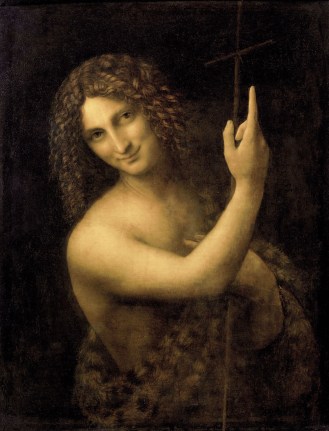
Pssst. The “me” in that last post is Dionysos-Óðr. He wears the oracular severed head of John the Baptist/Ivan Kupela/Jean de l’Ours like an Orphic mask when he wanders through Christianized lands. (And isn’t pretending to be some other bloody Martyr or Saint, such as Genesius or Trifon Zarazan.)
 The House of Vines