a new expletive

Hey guys, I have a new expletive – Saint Fuck! 

He’s one of the Phallic Saints of the Catholic Church.

Specifically Saint Foutin, the former Pothin or Pothinus, first bishop of Lyon. Over time the pronunciation of his name shifted and through folk etymology became linked to the verb foutre (“to fuck”). 

Regarding these Phallic Saints Gordon Rattray Taylor writes in Sex In History:

The statues of these saints were usually equipped with large phalli: when the Protestants took Embrun in 1585, they found the people worshipping the phallus of St. Foutin and pouring wine on it, whence his sobriquet, le saint vinaigre. Women wishing to conceive would make use of the phallus in the same way that Roman wives would, before entering the marriage bed, make use of the wooden phallus of Mutunus Tutunus. A large wooden phallus covered with leather was found in 1562 when the Protestants destroyed the church at Orange, which was doubtless used for similar purposes. 

It is easy to fall into the error of thinking of all these ceremonies as having been simply quaint survivals, as we should now regard them today. But it cannot be doubted that they were perfectly real and extremely important at the time. Only if we accept the fact that there was a persistent conviction that phallic religion was the true religion, and that, in the last resort, the phallic deities were more powerful and more beneficent than the upstart Christian god, can we understand such things as the belief that one could avoid the plague by committing incest on the altar: for this was evidently an act which asserted in the strongest imaginable form one’s adherence to phallicism and mother worship, and at the same time one’s contempt for the cruel father-deity who had sent the plague.

Phallic practices continued long after the end of the Middle Ages. In 1786, the British Minister in Naples wrote to the president of the Royal Society explaining how, in a little explored part of Isernia, he had found the peasants worshipping “the great toe of St. Cosmo” (i.e. the phallus) with appropriate rites. During the three-day feast, peasants, chiefly women, would present waxen ex votos, kissing them before giving them to the priest and saying “Santo Cosimo benedetto, cosi lo voglio” (Blessed St. Cosmo, that’s how I want it to be). Men would present their afflicted members to the priest to be anointed with oil, and 1,400 flasks of oil were consumed every year for this purpose.

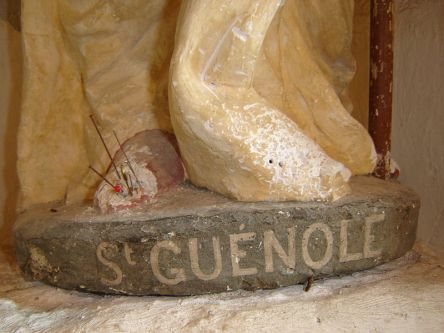
There was also Saint Guignolé (Winwaloe), first Abbot of Landévennec, who acquired his priapic status by confusion of his name with gignere (Fr. engendrer, “to beget.”) Though immensely popular with the people, his shrine was destroyed in 1793.

Here’s a picture of his statue from the chapel of Prigny in Loire-Atlantique:

800px-Chapelle-du-prigny-Pieds-St-Guenole

Local girls would pierce Saint Guignolé’s feet, believing that this ceremony would help them find their soul-mate. 

Which reminds me of the squilling of Pan:

Theocritus, a native of Syracuse, preserved local traditions in his writings and recorded the oldest known reference to squilling in the third century BCE. “This do, sweet Pan, and never, when slices be too few/ May the leeks of the lads of Arcady beat thee black and blue.” (VIII 106-109) If the kill was small, or worse yet, the hunters returned empty handed, the young men of the village would ceremonially circle around a statue of Pan and use large bulbous onions attached to their stalks, “squills,” to whip Pan around the shoulders and genital area. 

When considered out of context, whipping one’s God into helping seems a crude and bizarre rite. However, it gave the young hunters an outlet for their fears and anxieties, reminded them of their society’s understanding that sustenance and life itself are gifts of the Gods, and aligned them as the sons of Pan who, like them, was a hunter and so must be invulnerable to pain, hardship and loneliness. “Wilhelm Mannhardt put forth the theory that the scapegoat is ‘originally’ the vegetation spirit, who must be whipped, chased, and even killed in order to be invigorated, to be born afresh.” (Walter Burkert, Structure and History in Greek Mythology and Ritual p. 68) Whipping was understood to stimulate life-giving power when performed with fertilizing boughs, as are those of the squill. Lewis Richard Farnell writes: “The object of this discipline was not punishment and insult, but stimulative magic whereby the life-giving power of the deity might be restored.” (Sukey Fontelieu, The Archetypal Pan in America: Hypermasculinity and Terror)

There were many others as well, such as St. Guerlichon, or Greluchon, at Bourg Dieu — whose name has become a synonym for prostitute; St. Gilles at Cotentin; St. Rene in Anjou (by a confusion with reins, kidneys — the supposed seat of sexual power) and so forth.

So hail Saint Fuck, and may the blessings of fertility and renewal be yours!

Apocalypse bingo

So far we’ve had a global pandemic, locusts ravaging Africa and the Middle East, numerous earthquakes, volcanic eruptions, and devastating storms, economic collapse and a sharp turn towards authoritarianism in many countries, increased international tensions, skyrocketing levels of unemployment, suicide and homelessness, a looming famine the likes of which we’ve never seen before and the Pentagon confirmed that UFOs are real. 

Did I leave anything out? 

Oh yes, murder hornets is currently trending on Twitter, right behind #noahschnappisoverparty. 

This is because Asian murder hornets have invaded Washington state and begun decimating the local honeybee population.

The Asian hornets are reportedly enormous, with queens growing as long as two inches. According to the Times, the hornets utilize their mandibles, which are shaped like spiked shark fins, to decapitate worker bees, clearing hives within hours and feeding honeybee thoraxes to their offspring. The hornet’s venom causes unbearable pain for larger victims who are stung, which reportedly feels like hot metal being driven through one’s skin. They also can break through beekeeper suits, presenting a real threat to not only honeybees but also their keepers.

That’s some real nightmare fodder there, huh? 

But wait, they’re just getting started:

Scientists say the Asian giant hornet’s life cycle begins in April. Researchers told WSU that is when the queen wakes up from hibernation and scouts out spots to build underground nests and grow colonies. Todd Murray, WSU Extension entomologist and invasive species specialist, told WSU Insider the “shockingly large hornet” is a “health hazard, and more importantly, a significant predator of honey bees.”

But murder hornets become most dangerous from late summer to early fall, when they ravage through honey bee populations. WSU researchers said the hornets attack the bee hives, decapitating and killing the adults and eating the larvae and pupae. Just a few of the hornets can completely destroy a hive in a matter of hours.

We are so fucked.

Fun fact, though – did you know that hornets are sacred to Dionysos?

From Marianna Scapini’s The Symbolism of the Hornet in the Greek World:

The ancient sources, to summarise, clearly describe the behaviour of the hornet as very similar to that of Maenads–and above all of the murderous Maenads in rage. According to the ancients the hornet twists and twirls around, lives in the mountains, does not move in hierarchical groups, is without (male)-“kings”, and acts in a somewhat aggressive way, as it searches for raw meat. The detail of the cut off heads of other larger insects recalled by Pliny is particularly “Maenadic”, since decapitation was a typical act of the frenzied Maenads: it is sufficient to recall the Euripidean Agave with the head of her son Pentheus fixed on the top of her thyrsus (Eur. Bacch. 1139-43). 

Lots more interesting stuff in there, definitely worth a read. Which you should have plenty of time for, since we are apparently never leaving our homes again, no matter how much work frees. (Despite being critical of the quarantine myself I would have loved to see the murder hornets descend on that crowd of cringey motherfuckers.)

But seriously, what new horror awaits us? My money’s on bloody rain, an attack on the electrical grid or jihadi tomfoolery. What’s your prediction?

Edited to add: No, wait. I’m changing my vote to hypnotoads.

Vínland History X

Here is a documentary clip about Thomas Morton that Tetra posted with the following commentary:

Here’s an interesting low-budget film on Thomas Morton and his prosperous Bacchic colony that flourished right here in Massachusetts until those Puritan bastards decided to make a nuisance of themselves yet again. It’s a shame the education system of the United States doesn’t teach about this wonderful man who embodied the American spirit of camaraderie and freedom more than dour Protestant rejects ever could.

Couldn’t agree more.

It’s especially cool to see what Merrymount looks like today.

And note that Morton wasn’t the only early American Dionysian. There was also Ephraim Lyon who in 1820 founded the Church of Bacchus in Eastford, Connecticut as well as his contemporary John Chapman, better known to history as “Johnny Appleseed.”

Hail Father Freedom!

mortons-maypole

Read something interesting this morning by Anthony Comegna:

In 1627, Thomas Morton and the residents, friends, and allies of Merrymount gathered together for a celebration of life and leisure. The settlement was a bustling little burgh, pleasantly situated on the fringes of Puritan Massachusetts Bay. Having prior felled one of New England’s many mighty pines, the revelers marked their New World holy day by building a grand Maypole. In a very conscious imitation of the ancient, pagan world, the crowd decked their construction in garlands and intertwined ribbons, topping the whole with a formidable set of antlers. Morton constructed what historian Peter Linebaugh claims were “the first lyric verses penned in America,” and he nailed the infamous (and excerpted) “Bacchanalian song” to the Maypole itself, in proud defiance of the Puritan norms prevailing elsewhere in Massachusetts.

In Merrymount, Native Americans and English lived alongside one another peacefully, they traded, they enjoyed mutual and consensual romantic and sexual relationships, and they intermixed philosophies and perspectives in convivial atmospheres like the Mayday festival. The Puritans viewed all of the above with nothing short of horror and contempt. Where the Merrymounters saw Natives as brothers and sisters, the Puritans saw Satan’s minions inhabiting the darkest corners of their New Israel. They called the Maypole “an Idoll,” and the free settlement “Mount Dagon.” As Linebaugh notes, in its short life, Merrymount had become “a refuge for Indians, the discontented, gay people, runaway servants, and what [Governor Bradford] called ‘all the scume of the countrie.’” Convinced that the free settlers and Mayday revelers were devils in human skins, Miles Standish and a Puritan contingent destroyed the settlement with fire, and the Maypole got the axe.

Bolded for emphasis.

That’s right. What may have been the first lyric verses penned in America were in honor of Dionysos!

That makes my heart all warm and tingly. 

You can find more, including excerpts from Morton’s New English Canaan, here.

Happy Thomas Morton day!

tumblr_lnsiccVgGa1qb4enoo1_500
From the Wikipedia article on Thomas Morton

Morton’s religious beliefs were strongly condemned by the Puritans of the nearby Plymouth Colony as little more than a thinly disguised form of heathenism, and they suspected him of “going native”. Scandalous rumours spread of debauchery at Merrymount, which they claimed included immoral sexual liaisons with native women during what amounted to drunken orgies in honour of Bacchus and Aphrodite, or as the Puritan Governor William Bradford wrote in his History of Plymouth Plantation, “They … set up a May-pole, drinking and dancing about it many days together, inviting the Indian women for their consorts, dancing and frisking together (like so many fairies, or furies rather) and worse practices. As if they had anew revived & celebrated the feasts of ye Roman Goddess Flora, or ye beastly practices of ye mad Bacchanalians.”

Morton had transplanted traditional West Country May Day customs to the colony, and combined them with fashionable classical myth, couched according to his own libertine tastes and fueled by the enthusiasm of his newly freed fellow colonists. On a practical level the annual May Day festival was not only a reward for his hardworking colonists but also a joint celebration with the Native Tribes who also marked the day, and a chance for the mostly male colonists to find brides amongst the native population. Puritan ire was no doubt also fueled by the fact that Merrymount was the fastest-growing colony in New England and rapidly becoming the most prosperous, both as an agricultural producer and in the fur trade, in which the Plymouth Colony was trying to build a monopoly.

The Puritan account of this was very different, regarding the colony as a decadent nest of good-for-nothings that annually attracted “all the scum of the country” to the area, or as Peter Lamborn Wilson more romantically puts it, “a Comus-crew of disaffected fur traders, antinomians, loose women, Indians and bon-vivants”. The second 1628 Mayday, “Revels of New Canaan”, inspired by “Cupid’s mother” — with its “pagan odes” to Neptune and Triton (as well as Venus and her lustful children, Cupid, Hymen and Priapus), its drinking song, and its erection of a huge 80-foot (24 m) Maypole, topped with deer antlers — that proved too much for the “Princes of Limbo”, as Morton referred to his Puritan neighbours.

The Plymouth militia under Myles Standish took the town the following June with little resistance, chopped down the Maypole and arrested Morton for “supplying guns to the Indians”. He was put in stocks in Plymouth, given a trial and finally marooned on the deserted Isles of Shoals, off the coast of New Hampshire, until an “English ship could take him home”, as he was believed too well connected to be imprisoned or executed (as later became the penalty for blasphemy in the colony). He was essentially left to starve on the island, but was supplied with food by friendly natives from the mainland, who were said to be bemused by the events, and he eventually gained enough strength to escape to England under his own volition.

The Merrymount community survived without Morton for another year, but was renamed Mount Dagon by the Puritans, after the Semitic sea god, and they pledged to make it a place of woe. During the severe winter famine of 1629 residents of New Salem under John Endecott raided Mount Dagon’s plentiful corn supplies and destroyed what was left of the Maypole, denouncing it as a pagan idol and calling it the “Calf of Horeb”. Morton returned to the colony soon after and, after finding that most of the inhabitants had been scattered, was rearrested, again put on trial and banished from the colonies. The following year the colony of Mount Dagon was burned to the ground and Morton shipped back to England.

seeds of hope

Two posts from my wonderful wife you should read.

First up, Galina shares what it’s like living with chronic pain.

And then there’s an update on our household’s effort to transform our land. I’m really proud and excited about how this is coming together. 

To Columbia in tatters

Oh Columbia, Goddess of this wine-rich land, have mercy on us,
you who inspired the weak and scattered colonies to throw off
the yoke of British tyranny because the bastards proposed
a three per cent tax increase on tea, and forged from the ashy remnants
one of the mightiest nations Earth has ever known,
breathing sweet concord upon our founding Fathers
that they might draft an eminently wise, just, humane and stabilizing
set of documents to guide our youthful polity
in avoiding the excesses and errors of old Europe
who sent their best across the perilous seas
in search of wealth, liberty, opportunity
and everything else required to create a happy life
for themselves and those who would come after.
Oh Columbia, Goddess of this land where all men have equal standing
before the law, and wealthy women too, forgive the fool and coward
who would trade these precious gifts of yours for the illusion of safety
because the sophist, the politician, and the quack doctor
have pumped their brains so full of fear that they piss themselves
when someone near goes “achoo!”
Oh Columbia, who has sent her brave sons and daughters out
to fight the Nazi, Commie and Islamofascist,
turn your gaze from those now who are begging
the tech companies to surveil them,

who long to lick the jackboots of the cop
they were protesting just months before,

and who will eagerly snitch on their neighbors for the greater good,
all the while seeing no irony in calling themselves
proud and decent Americans.

To Apollon who smashes the crown

Hail to you indomitable Archer God
whose flaming arrows never miss their mark,
Healer who comes on the swift black wing of ravens,
Leader of the wolf-pack that hunts stealthily by Night
Ie ie Paian, Lord Apollon who smashes the crown.
Once you guided the long-haired Ionians beyond
even Alexandria Eschate, to the wastes of Serike
and its hundred kingdoms, where this strong and doughty
people distinguished themselves in the arts of Enyalios,
in the production of fine grape-wine and the breeding
of horses who ran like the winds, and just as tirelessly
Ie ie Paian, Lord Apollon who smashes the crown.
As you then protected them, I pray, protect our people today
dispensing blessings of wisdom, fortitude and immunity
so that neither the virus nor the moronic measures of the ruling class
can do our nation any more harm than they have already
Ie ie Paian, Lord Apollon who smashes the crown.

A myth in miniature

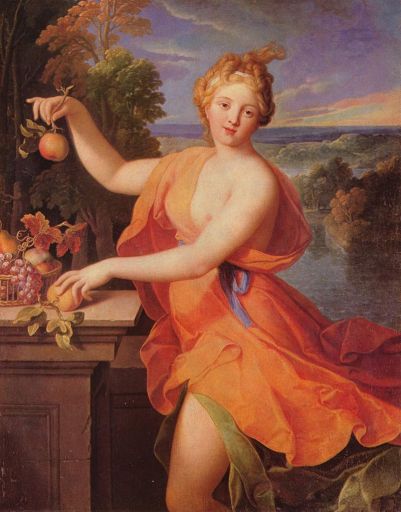
800px-Nicolas_Fouché_001

I’ve mentioned the Etruscan Goddess Esia a number of times recently (here in connection with Mount Aetna for instance, and here in connection with Óðinn.)

She is the counterpart of Cretan Ariadne, with some fascinating local additions:

Another specimen, of a Praenestine pear-shaped mirror but with Etruscan inscription, has the theme of the fate of Esia, a name unknown in Greco-Roman myth. E. H. Richardson argued that she was the equivalent of Ariadne, in a story of the latter’s death as caused by Artemis, and many have accepted her suggestion. She is held wrapped up like a dead soul by Artumes, who displays the arrows with which the goddess is accustomed to end the lives of young girls. Next to her stand Fufluns, the Etruscan Dionysos, a bearded male with a drinking cup, and a winged Menrva. Below, coming up from the ground, appears an oracular head. We do not know its message, but most likely it relates to the fate of Esia. It may be that Fufluns will receive her and bestow immortality upon her. Whatever the message, Fufluns and Menrva seem to react strongly: Menrva throws up both hands in a gesture of surprise (or dismay?) and Fufluns also raises one hand. We shall observe these gestures again in other scenes of individuals who are receiving a prophecy. (Nancy de Grummond, Mirrors, Marriage and Mystery)

Discussing this mirror I mentioned that I’d like to know more about the story depicted on it, and last night while reading about the Runes I stumbled across the following:

The Greek geographer Strabo informs us that the peoples of north-western Italy venerated Artemis most among all the gods and the inscriptions left behind there seem to corroborate his report. Among them is an inscription on an oddly, apparently fish-shaped, figurine cast in bronze with a hole in it for hanging, found by archaeologists among the remains of a religious sanctuary near the Alpine town of Sanzeno, near Trent. Probably an amulet rather than a votive, it features the names of four ancient mythological figures: Diana, Esia, Liber and Vesuna. Diana is of course the ancient Italian name for Artemis and the grouping on the amulet appears to be similar to that found on two ancient Italian mirrors where the mythological figures Minerva, Fufluns, Artemis and Esia are depicted in a scene together. The mirrors depict Esia as a shade brought by Artemis to Fufluns in the company of the goddess Minerva. Liber and Fufluns are both archaic Italian names for the Greek god Dionysus and Esia is the Etruscan name for Ariadne, the daughter of Minos of Theseus and the Minotaur fame. Greek mythology also tells us that Artemis killed Ariadne, but that Dionysus (Artemis’ brother) later married her; so the Sanzeno sequence of names appears to be an attempt to represent this scene (or perhaps rather this relationship) in a highly abbreviated manner. It too, then, appears to represent some sort of divine narrative charm concerning Artemis, albeit a highly abbreviated one, used to make an item holy or powerful. Given space is usually in short supply with the loose items typically used as amulets, the inscriptions that they carry are often abbreviated; so the possibility that any listing of divine figures on a runic amulet is part of a divine charm of some sort should not be dismissed lightly. (Mindy MacLeod and Bernard Mees, Runic Amulets and Magic Objects)

This brings up so many questions.

Who is Vesuna, for one, and what role did she play in Esia’s story?

If the inscription is a kind of shorthand for a magical spell, what was it’s purpose?

Why was the figurine fish-shaped?

A quick google revealed that Vesuna is an indigenous Italic Goddess venerated by the Marsi, Volscians and Umbrians who was originally partnered with Pomonus Popdicus, the protector of fruit trees and gardens. (She is described as being “of” or “belonging to” him – Vesune Puemunes Pupřikes – implying a hierarchical relationship with this male double of Pomona the orchard Goddess.) Later during the Roman period dedications were made to Vesuna alongside Ceres and Juno Lucina.

There is some speculation that she is the Celtic Vesunna worshipped in Roman Gaul (and particularly the area surrounding the city Périgueux, which she was the patron of.) She seems to be a Goddess of abundance and good luck, as well as lakes and other bodies of water, with her symbols being the cornucopia and sistrum, on account of which she was syncretized with Isis.

Though important enough to be mentioned in the Tabulae Iguvinae no myths have come down concerning Vesuna (or Vesunna) so we can only speculate about the role she played in Esia’s story as found on the bronze fish figurine.

However it suggests to me an encounter with Mêla the Golden Apples among the Toys of Dionysos.

And since the findsight of the inscription was in the territory of Rhaetia, my mind drifts to things Germanic and especially Iðunn, and because of the bronze fish Loki. But I could just be reaching. 

The Apples of the West

The penultimate Toy (mentioned in the Orphic poet, Clement and Arnobius) is in Greek Μῆλα and Latin mālum, the apple. This is – after the grape, fig and pomegranate – perhaps the fruit most commonly associated with Dionysos:

That Dionysos is also the discoverer of the apple is attested by Theokritos of Syracuse, in words something like these: ‘Storing the apples of Dionysos in the folds at my bosom, and wearing on my head white poplar, sacred bough of Herakles.’ And Neoptolemos the Parian, in the Dionysiad, records on his own authority that apples as well as all other fruits were discovered by Dionysos. (Athenaios, Deipnosophistai 3.82d)

For Jane Ellen Harrison, Dionysos was more than just the God of the vine, he was “Dendrites, Tree-God, and a plant God in a far wider sense. He is God of the fig-tree, Sykites; he is Kissos, God of the ivy; he is Anthios, God of all blossoming things; he is Phytalmios, God of growth” (Prolegomena page 426). 

In short, he is the God of the impulse of life in nature, a God of growth and the green earth:

Now as to the rites of Liber, whom they have set over liquid seeds, and therefore not only over the liquors of fruits, among which wine holds, so to speak, the primacy, but also over the seeds of animals:— as to these rites, I am unwilling to undertake to show to what excess of turpitude they had reached, because that would entail a lengthened discourse, though I am not unwilling to do so as a demonstration of the proud stupidity of those who practice them. Varro says that certain rites of Liber were celebrated in Italy which were of such unrestrained wickedness that the shameful parts of the male were worshipped at crossroads in his honour. Nor was this abomination transacted in secret that some regard at least might be paid to modesty, but was openly and wantonly displayed. For during the festival of Liber this obscene member, placed on a little trolley, was first exhibited with great honour at the crossroads in the countryside, and then conveyed into the city itself. But in the town of Lavinium a whole month was devoted to Liber alone, during the days of which all the people gave themselves up to the must dissolute conversation, until that member had been carried through the forum and brought to rest in its own place; on which unseemly member it was necessary that the most honorable matron should place a wreath in the presence of all the people. Thus, forsooth, was the God Liber to be appeased in order for the growth of seeds. Thus was enchantment (fascinatio) to be driven away from fields, even by a matron’s being compelled to do in public what not even a harlot ought to be permitted to do in a theatre, if there were matrons among the spectators. (Augustine, De Civitate Dei 7.21) 

Whenever Dionysos appears, he does so attended by wild vegetation, whether it is with the vines of ivy and lush grapes he wears in his hair (Orphic Hymn 30), or that entwines itself around pillars and altars (Euripides’ Antiope 203), a face appearing in a plane tree that has been split asunder (Kern’s Inschr. von M. 215), or in a burst of beautiful flowers (Pindar fr.75). When Dionysos finally reveals himself in fullness to the Tyrrhenian pirates, it is through vegetation:

Then in an instant a vine, running along the topmost edge of the sail, sprang up and sent out its branches in every direction heavy with thick-hanging clusters of grapes, and around the mast cloud dark-leaved ivy, rich in blossoms and bright with ripe berries, and garlands crowned every tholepin. (Homeric Hymn 7)

Carl Kerényi believed that intoxication was not the essential core of the religion of Dionysos, but rather the “quiet, powerful, vegetative element which ultimately engulfed even the ancient theaters, as at Cumae” (Dionysos, page xxiv) – as if there was a difference between the two. 

It was through the apple that Dionysos entered the American mythic consciousness by way of the guise of John Chapman, a disciple of Emanuel Swedenborg who held strongly mystical and pantheistic beliefs and felt an abhorrence for modern civilization. Better known to history as Johnny Appleseed, culture-bringer and savior of the pioneers, in truth he shunned the company of his fellow humans, preferring animals and trees like all proper Orphics; as soon as settlements encroached upon his territory he’d pick up and move on to the next site, leaving his orchards behind for the hungry settlers. Of course, what those settlers were hungry for wasn’t fruit but alcohol, since the apples Johnny planted were so small and bitter that their only use was in brewing strong cider or applejack, a necessary substitute in a land where the vine initially did not thrive:

Teaching men how to ferment the juice of the grape, Dionysus had brought civilization the gift of wine. This was more or less the same gift Johnny Appleseed was bringing to the frontier: because American grapes weren’t sweet enough to be fermented successfully, the apple served as the American grape, cider the American wine. But as I delved deeper into the myth of Dionysus, I realized there was much more to his story, and the strangely changeable God who began to come into focus bore a remarkable resemblance to John Chapman. Or at least to Johnny Appleseed, who, I became convinced, is Dionysus’s American son. Like Johnny Appleseed, Dionysus was a figure of the fluid margins, slipping back and forth between the realms of wildness and civilization, man and woman, man and God, beast and man … The flight from civilization back to nature in America tends to be a solitary and ascetic pursuit, having more to do with wilderness than wildness. Johnny Appleseed was very much an American Dionysus – innocent and mild. In this he may have helped establish the benign, see-no-evil mood that characterizes the Dionysian strain in American culture, from transcendentalist Concord to the Summer of Love. (Michael Pollan, The Botany of Desire)

In Johnny’s old New England stomping grounds, a young H. P. Lovecraft had his first brush with the supernatural:

When about seven or eight I was a genuine pagan, so intoxicated with the beauty of Greece that I acquired a belief in the old Gods and nature sprits. I have in literal truth built altars to Pan, Apollo, and Athena, and have watched for dryads and satyrs in the woods and fields at dusk.  Once I firmly thought I beheld some kind of sylvan creatures dancing under autumnal oaks; a kind of ‘religious experience’ as true in its way as the subjective ecstasies of a Christian. If a Christian tell me he has felt the reality of his Jesus or Jahveh, I can reply that I have seen hoofed Pan and the sisters of the Hesperian Phaëthusa. (Confession of Unfaith)

Dionysos’ apples, after all, aren’t just any apples, as W. K. C. Guthrie reminds us: 

Nothing, we admit, is more likely to attract a child than the present of golden apples, yet it seems a little extravagant to send to the farthest confines of the world for a mythical treasure when the same purpose, it seems, could be accomplished with dolls and knucklebones. Perhaps then we may allow ourselves to remember that the apples of the Hesperides were symbols of immortality, and that Dionysos was to be born again after his murder, and by his death was to ensure the hope of immortality for the race of human beings which was to follow him. (Orpheus and Greek Religion pg 123)

Servius preserves the tradition, first found in Hesiod, that the Hesperides were children of Night:

Hesiod says that these Hesperides, daughters of Nyx, guarded the golden apples beyond Okeanos, ‘Aigle and Erytheia and ox-eyed Hesperethoosa.’ (Commentary on Vergil’s Aeneid 4. 484)

While Diodoros Sikeliotes preserves a contrary tradition, first found in Pherekydes of Syros, that made them daughters of the Titan Atlas:

Now Hesperos begat a daughter named Hesperis, who he gave in marriage to his brother Atlas and after whom the land was given the name Hesperitis; and Atlas begat by her seven daughters, who were named after their father Atlantides, and after their mother Hesperides. (Library of History 4.26.2)

According to Pherekydes there was something so dangerously alluring about these golden apples that even the Hesperides who had been charged with their protection could not resist plucking them:

The constellation Serpens is Ladon, said to have guarded the golden apples of the Hesperides, and after Hercules killed him, to have been put by Juno among the stars, because at her instigation Hercules set out for him. He is considered the usual watchman of the gardens of Juno. Pherecydes says that when Jupiter wed Juno, Terra came, bearing branches with golden apples, and Juno, in admiration, asked Terra to plant them in her gardens near distant Mount Atlas. When Atlas’ daughters kept picking the apples from the trees, Juno is said to have placed this guardian there. (Hyginus, Astronomica 2. 3)

Which makes their involvement in the conception of Dionysos’ mother rather interesting:

There, as they say, by the Tritonian Lake, Kadmos the wanderer lay with rosycheek Harmonia, and the Nymphai Hesperides made a song for them, and Kypris together with the Erotes decked out a fine bed for the wedding, hanging in the bridal chamber golden fruit from the Nymphai’s garden, a worthy lovegift for the bride; rich clusters of their leaves Harmonia and Kadmos twined through their hair, amid the abundance of their bridechamber, in place of the wedding-roses. Still more dainty the bride appeared wearing these golden gifts, the boon of golden Aphrodite. Her mother’s father the stooping Libyan Atlas awoke a tune of the heavenly harp to join the revels, and with tripping foot he twirled the heavens round like a ball, while he sang a stave of harmony himself not far away. (Nonnos, Dionysiaka 13.333 ff)

For one of Semele’s defining characteristics was her exceptional beauty, as Diodoros relates:

Semele was loved by Zeus because of her beauty, but since he had his intercourse with her secretly and without speech she thought that the God despised her; consequently she made the request of him that he come to her embraces in the same manner as in his approaches to Hera. Accordingly, Zeus visited her in a way befitting a God, accompanied by thundering and lightning, revealing himself to her as he embraced her; but Semele, who was pregnant and unable to endure the majesty of the divine presence, brought forth the babe untimely and was herself slain by the fire. Thereupon Zeus, taking up the child, handed it over to the care of Hermes, and ordered him to take it to the cave in Nysa where he should deliver it to the Nymphai. (4.2.1)

A beauty that was not only responsible for her own destruction, but that of her nephew as well:

Aktaion was later eaten up on Kithairon by his own dogs. According to Akousilaos he met his end in this manner because he enraged Zeus by courting the fair Semele. (Apollodoros, Bibliotheka 3.31)

Which naturally calls to mind the devastation wrought by Eris:

Eris was enraged at being turned away from the wedding of Peleus and Thetis, and now she bethought her of the golden apples of the Hesperides. Thence Eris took the fruit that would become a harbinger of war, even the apple, and devised a scheme of signal woes. Whirling her arm she hurled into the banquet the primal seed of turmoil and disturbed the choir of Goddesses. Hera, glorying to be the spouse and to share the bed of Zeus, rose up amazed, and would fain have seized it. And Kypris, as being more excellent than all, desired to have the apple, for that it is the treasure of the Erotes. But Hera would not give it up and Athena would not yield. (Colluthus, Rape of Helen 58 ff) 

And also the serpent in the garden who offered Eve the tempting apple, as Clement exhorted the Greeks:

The Bakchai hold their orgies in honour of the mad Dionysos, celebrating their sacred frenzy by the eating of raw flesh, and go through the distribution of the parts of butchered victims crowned with snakes, shrieking out the name of that Eva by whom error came into the world. The symbol of the Bacchic orgies is a consecrated serpent. Moreover, according to the strict interpretation of the Hebrew term, the name Hevia, aspirated, signifies a female serpent. 

The forbidden fruit of the serpent probably wasn’t our apple, unknown in Palestine at the time of the Bible’s composition, but it became so in the popular imagination because of a play on the Latin words mālum (an apple) and mălum (an evil): the Latin of Genesis 2:17 “But of the tree of the knowledge of good and evil you shall not eat,” is De ligno autem scientiæ bonum et malum ne comedas.

Olympiodoros, one of the last philosophers of antiquity, gives the final quest of Herakles an almost Judeo-Christian interpretation in his Commentary on Plato’s Gorgias:

And on this account Herakles is said to have accomplished his last labor in the Hesperian regions; signifying by this, that having vanquished a dark and earthly life he afterward lived in day, that is, in truth and light.

It’s interesting to compare this and the relationship Jews and Christians have to their wisdom-bringing serpent with his counterpart in earlier Greek, and especially Bacchic Orphic, myth: 

The Argonauts found the sacred plot where, till the day before, the serpent Ladon, a son of the Libyan soil, had kept watch over the golden apples in the Garden of Atlas, while close at hand and busy at their tasks the Hesperides sang their lovely song. But now the snake, struck down by Herakles, lay by the trunk of the apple-tree. Only the tip of his tail was still twitching; from the head down, his dark spine showed not a sign of life. His blood had been poisoned by arrows steeped in the gall of the Hydra Lernaia, and flies perished in the festering wounds.

Close by, with their white arms flung over their golden heads, the Hesperides were wailing as the Argonauts approached. The whole company came on them suddenly, and in a trice the Nymphai turned to dust and earth on the spot where they had stood. Orpheus, seeing the hand of Heaven in this, addressed a prayer to them on behalf of his comrades : ‘Beautiful and beatific Powers, Queens indeed, be kind to us, whether Olympos or the underworld counts you among its Goddesses, or whether you prefer the name of Solitary Nymphai. Come, blessed Spirits, Daughters of Okeanos, make yourselves manifest to our expectant eyes and lead us to a place where we can quench this burning, never-ending thirst with fresh water springing from a rock or gushing from the ground. And if ever we bring home our ship into an Achaian port, we will treat you as we treat the greatest Goddesses, showing our gratitude with innumberable gifts of wine and offerings at the festal board.’

Orpheus sobbed as he prayed. But the Nymphai were still at hand, and they took pity on the suffering men. They wrought a miracle. First, grass sprung up from the ground, then long shoots appeared above the grass, and in a moment three saplings, tall, straight and in full leaf, were growing there. Hespere became a poplar; Erytheis an elm; Aigle a sacred willow. Yet they were still themselves; the trees could not conceal their former shapes–that was the greatest wonder of all. And now the Argonauts heard Aigle in her gentle voice tell them what they wished to know. 

‘You have indeed been fortunate,’ she said. ‘There was a man here yesterday, an evil man, who killed the watching Snake, stole our golden apples, and is gone. To us he brought unspeakable sorrow; to you release from suffering. He was a savage brute, hideous to look at; a cruel man, with glaring eyes and scowling face. He wore the skin of an enormous lion and carried a great club of olive-wood and the bow and arrows with which he shot our monster here. It appeared that he, like you, had come on foot and was parched with thirst. For he rushed about the place in search of water; but with no success, till he found the rock that you see over there near to the Tritonian lagoon. Then it occurred to him, or he was prompted by a God, to tap the base of the rock. He struck it with his foot, water gushed out, and he fell on his hands and chest and drank greedily from the cleft till, with his head down like a beast in the fields, he had filled his mighty paunch.’

The Minyai were delighted. They ran off in happy haste towards the place where Aigle had pointed out the spring. (Apollonios Rhodios, Argonautika 4.1390ff)

Part of what I love about Apollonios’ treatment of this myth is that it places the focus peripheral to what would conventionally be considered the action, as his contemporary Kallimachos also does in the Hekale. The great heroic deed is done and Herakles lumbers off to commence a life of adventure and that’d be it as far as most people are concerned. But that wasn’t it for the Hesperides: no, it’s just the start of the story of their life without Ladon, who had been both their protector and companion. How differently they must have seen this “monster,” daily interacting with and depending on him. To them it is Herakles who is the villain! For with Ladon’s death their land has been deprived of its source of supernatural vitality. When the Argonauts first meet the Nymphs of the West, land of the Sun’s Descent, they were in the process of dissolving into dust and barren earth and it was only Orpheus’ song that brought them back to some semblance of themselves. 

In fact, in another myth it’s said that Herakles even returned to pay restitution for the slaying of the serpent by gifting the Hesperides the horn of a bull-God:

When Achelous fought with Hercules to win Dejanira in marriage, he changed himself into a bull. Hercules tore off his horn, presenting it to the Hesperides or the Nymphae, and the Goddesses filled it with fruits and called it Horn of Plenty (cornucopia). (Hyginus, Fabulae 31)

This Deïaneira, by the way, was the fruit of an adulterous affair:

When Liber had come as a guest to Oeneus, son of Parthaon, he fell in love with the man’s wife Althaea, daughter of Thestius. When Oeneus realized this, he voluntarily left the city and pretended to be performing sacred rites. But Liber lay with Althaea, who became mother of Dejanira. To Oeneus, because of his generous hospitality, he gave the vine as a gift, and showed him how to plant it, and decreed that its fruit should be called ‘oinos’ from the name of his host. (Hyginus, Fabulae 129)

Dionysos is the embodiment of the life-force – ζωή as Carl Kerényi termed it – which knows only its own self-perpetuation and nothing of morality. Dionysos is the always dying, always regenerating God, as a Tarentine poet so eloquently put it:

If any one asks who narrates this, then we shall quote the well-known senarian verse of a Tarentine poet which the ancients used to sing, ”Taurus draconem genuit, et taurum draco.” [“The bull begot the dragon, and the dragon a bull.”] (Arnobius of Sicca, Adversus Nationes 5.20)

A person’s father may be a complete mystery, but we always know our mothers. And yet with Dionysos the reverse is true – Kore-Persephone (Diodoros 5.75.4) Semele (Hesiod, Theogony 940) Demeter (Diodoros 3.62), Dione (Scholiast on Pind. Pyth. 3.177), Amaltheia (Diodoros 3.67), Isis (Alexarchos, FGrH 3.324), Indus (Philostratos, Life of Apollonios 2.9) Lethe (Plutarch, Symposiacs 7.5) and Zeus among numerous others have carried the God in their wombs – like the seed at the core of an apple:

But the Hesperian golden-apples signify the pure and incorruptible nature of that intellect or Dionysus, which is possessed by the world; for a golden-apple, according to Sallust, is a symbol of the world; and this doubtless, both on account of its external figure, and the incorruptible intellect which it contains, and with the illuminations of which it is externally adorned; since gold, on account of never being subject to rust, aptly denotes an incorruptible and immaterial nature. (Thomas Taylor, A Dissertation on the Eleusinian and Bacchic Mysteries page 209)

To be possessed by the world, such a grand and horrifying concept: 

If we add to this horror the ecstatic rapture, which rises up out of the same collapse of the principium individuationis from the innermost depths of human beings, yes, from the innermost depths of nature, then we have a glimpse into the essence of the Dionysian, which is presented to us most closely through the analogy to intoxication. Either through the influence of narcotic drink, of which all primitive men and peoples speak, or through the powerful coming on of spring, which drives joyfully through all of nature, that Dionysian excitement arises. As its power increases, the subjective fades into complete forgetfulness of self. In the German Middle Ages under the same power of Dionysus constantly growing hordes waltzed from place to place, singing and dancing. In that St. John’s and St. Vitus’s dancing we recognize the Bacchic chorus of the Greeks once again, and its precursors in Asia Minor, right back to Babylon and the orgiastic Sacaea. (Friedrich Nietzsche, The Birth of Tragedy)

We get a glimpse of this collapse in Carl Gustav Jung’s study of the paintings of Pablo Picasso:

And just as Faust is embroiled in murderous happenings and reappears in changed form, so Picasso changes shape and reappears in the underworld form of the tragic Harlequin – a motif that runs through numerous paintings. It may be remarked in passing that Harlequin is an ancient chthonic God. The descent into ancient times has been associated ever since Homer’s day with the Nekyia. Faust turns back to the crazy primitive world of the witches’ sabbath and to a chimerical vision of classical antiquity. Picasso conjures up crude, earthy shapes, grotesque and primitive, and resurrects the soullessness of ancient Pompeii in a cold, glittering light – even Giulio Romano could not have done worse! Seldom or never have I had a patient who did not go back to neolithic art forms or revel in evocations of Dionysian orgies. Harlequin wanders like Faust through all these forms, though sometimes nothing betrays his presence but his wine, his lute, or the bright lozenges of his jester’s costume. And what does he learn on his wild journey through man’s millennial history? What quintessence will he distil from this accumulation of rubbish and decay, from these half-born or aborted possibilities of form and colour? What symbol will appear as the final cause and meaning of all this. In view of the dazzling versatility of Picasso, one hardly dares to hazard a guess, so for the present I would rather speak of what I have found in my patients’ material. The Nekyia is no aimless and purely destructive fall into the abyss, but a meaningful katabasis eis antron, a descent into the cave of initiation and secret knowledge. The journey through the psychic history of mankind has as its object the restoration of the whole man, by awakening the memories in the blood. The descent to the Mothers enabled Faust to raise up the sinfully whole human being – Paris united with Helen – that homo totus who was forgotten when contemporary man lost himself in one-sidedness. It is he who at all times of upheaval has caused the tremor of the upper world, and always will. This man stands opposed to the man of the present, because he is the one who ever is as he was, whereas the other is what he is only for the moment. With my patients, accordingly, the katabasis and katalysis are followed by a recognition of the bipolarity of human nature and of the necessity of conflicting pairs of opposites. After the symbols of madness experienced during the period of disintegration there follow images which represent the coming together of the opposites: light/dark, above/below, white/black, male/female, etc. In Picasso’s latest paintings, the motif of the union of opposites is seen very clearly in their direct juxtaposition. One painting (although traversed by numerous lines of fracture) even contains the conjunction of the light and dark anima. The strident, uncompromising, even brutal colours of the latest period reflect the tendency of the unconscious to master the conflict by violence (colour = feeling). This state of things in the psychic development of a patient is neither the end nor the goal. It represents only a broadening of his outlook, which now embraces the whole of man’s moral, bestial, and spiritual nature without as yet shaping it into a living unity. Picasso’s drame interieur has developed up to this last point before the denouement. As to the future Picasso, I would rather not try my hand at prophecy, for this inner adventure is a hazardous affair and can lead at any moment to a standstill or to a catastrophic bursting asunder of the conjoined opposites. Harlequin is a tragically ambiguous figure, even though – as the initiated may discern – he already bears on his costume the symbols of the next stage of development. He is indeed the hero who must pass through the perils of Hades, but will he succeed? That is a question I cannot answer. Harlequin gives me the creeps – he is too reminiscent of that ‘motley fellow, like a buffoon’ in Zarathustra, who jumped over the unsuspecting rope-dancer (another Pagliacci) and thereby brought about his death. Zarathustra then spoke the words that were to prove so horrifyingly true of Nietzsche himself: ‘Your soul will be dead even sooner than your body: fear nothing more than I.’ Who the buffoon is, is made plain as he cries out to the rope-dancer, his weaker alter ego: ‘To one better than yourself you bar the way.’ He is the greater personality who bursts the shell, and this shell is sometimes – the brain. (Neue Zürcher Zeitung 1932)

But even more clearly in the Dionysian dreams of his patients:

I saw a beautiful youth with golden cymbals, dancing and leaping in joy and abandonment… Finally he fell to the ground and buried his face in the flowers. Then he sank into the lap of a very old mother. After a time he got up and jumped into the water, where he sported like a dolphin… I saw that his hair was golden. Now we were leaping together, hand in hand. So we came to a gorge… In leaping the gorge the youth falls into the chasm. X is left alone and comes to a river where a white sea-horse is waiting for her with a golden boat. X found the youth in the lap of the mother so impressive that she painted a picture of it. The figure is the same as in item i; only, instead of the grain of wheat in her hand, there is the body of the youth lying completely exhausted in the lap of the gigantic mother. There now follows a sacrifice of sheep, during which a game of ball is likewise played with the sacrificial animal. The participants smear themselves with the sacrificial blood, and afterwards bathe in the pulsing gore. X is thereupon transformed into a plant. After that X comes to a den of snakes, and the snakes wind all round her. In a den of snakes beneath the sea there is a divine woman, asleep. She is shown in the picture as much larger than the others. She is wearing a blood-red garment that covers only the lower half of her body. She has dark skin, full red lips, and seems to be of great physical strength. She kisses X, who is obviously in the role of the young girl, and hands her as a present to the many men who are standing by, etc. As X emerged from the depths and saw the light again, she experienced a kind of illumination: white flames played about her head as she walked through waving fields of grain. (The Archetypes and the Collective Unconscious p. 188-189)

It is death that makes possible the great abundance of life, as D. H. Lawrence reflects on in Medlars and Sorb-Apples:

I love you, rotten,
Delicious rottenness.

I love to suck you out from your skins
So brown and soft and coming suave,
So morbid, as the Italians say.

What a rare, powerful, reminiscent flavour
Comes out of your falling through the stages of decay:
Stream within stream.

Something of the same flavour as Syracusan muscat wine
Or vulgar Marsala.

Though even the word Marsala will smack of preciosity
Soon in the pussy-foot West.

What is it?
What is it, in the grape turning raisin,
In the medlar, in the sorb-apple.
Wineskins of brown morbidity,
Autumnal excrementa;
What is it that reminds us of white Gods?

Gods nude as blanched nut-kernels.
Strangely, half-sinisterly flesh-fragrant
As if with sweat,
And drenched with mystery.

Sorb-apples, medlars with dead crowns.

I say, wonderful are the hellish experiences
Orphic, delicate
Dionysos of the Underworld.

A kiss, and a vivid spasm of farewell, a moment’s orgasm of rupture.
Then along the damp road alone, till the next turning.
And there, a new partner, a new parting, a new unfusing into twain,
A new gasp of further isolation,
A new intoxication of loneliness, among decaying, frost-cold leaves.

Going down the strange lanes of hell, more and more intensely alone,
The fibres of the heart parting one after the other
And yet the soul continuing, naked-footed, ever more vividly embodied
Like a flame blown whiter and whiter
In a deeper and deeper darkness
Ever more exquisite, distilled in separation.

So, in the strange retorts of medlars and sorb-apples
The distilled essence of hell.
The exquisite odour of leave-taking.
   Jamque vale!
Orpheus, and the winding, leaf-clogged, silent lanes of hell.

Each soul departing with its own isolation,
Strangest of all strange companions,
And best.

Medlars, sorb-apples
More than sweet
Flux of autumn
Sucked out of your empty bladders
And sipped down, perhaps, with a sip of Marsala
So that the rambling, sky-dropped grape can add its music to yours,
Orphic farewell, and farewell, and farewell
And the ego sum of Dionysos
The sono io of perfect drunkenness
Intoxication of final loneliness.

Yet.

I’ve not been following the news closely (because it tends to range from depressing to infuriating) but apparently back on the 21st Mount Aetna erupted

volcano-etna

The blast was described as “brief but intense” complete with lava flow and a column of ash that affected the Bove Valley and nearby Zafferana where residents are still on COVID-19 lockdown.

No reports of a hundred-headed, snake-limbed, fire-spewing Giant rising from his ancient prison beneath the Sicilian volcano to wreak havoc and herald the end of existence as we know it have been recorded — yet. Experts, however, say that it’s just a matter of time. 

A Prayer for Wunjô’s Master

High says:

I am strong.
There is no mercy in me.
My travels wore that away long ago;
it is why I undertook them.
I have seen ages pass
like the currents of a raging, restless river.
All must eventually fall,
but the best will remain standing the longest.
I was there at the beginning,
a breath of fury from the chasm.
All that there was then was ice and fire and the gap.
Eventually all shall return to that primordial state.
The gap is hungry.
So hungry that it shall gnaw through the roots of the tree on which hang the worlds nine.
But that day is not today.
I shall expend my last breath keeping that day off.
I fell and shall fall again.
From my ashes will come new worlds,
as this world was carved from the body of my father.
I have been fighting for so long that I have forgotten much of who I was before the fight.
But this I remember.
This day is sweet,
full of sunlight and vineyards and swarming bees and strange maidens
for the wooing.
It is full of joy and hunger and new experiences to be had, this day.
That is why I fight.
Life is sweet,
and I will give mine to defend the day for as long as I can,
as long as I can.
Satiate yourself on life’s joys.
They are not mine to taste any longer.
Through you I can,
through you these joys become my bread and my wine,
the only nourishment left to me.
This work makes one so hungry.
This work makes one so thirsty.
Feast and keep my cup always full.

Nine Songs for the Gallows God

“But some occasions for these names arose in his wanderings; and that matter is recorded in tales. Nor canst thou ever be called a wise man if thou shalt not be able to tell of those great events.” — Gylfaginning, XX

Gangleri
Black the forest,
black the evening sky overhead
and black the clouds that hung low,
promising a storm was near.
Once the traveler’s cloak had been black too,
finely spun and chased along the border
with marvelous designs in thread of gold
as befits a cloak worn by a high-born king.
But the road wearies and wears down;
filthy with dust, patched in many places,
frayed and color leeched to grey
– such was the cloak of the wanderer,
that strange, one-eyed man who came from the woods
amid the cries of a murder of crows
the night the city fell to the spears of the invaders
and its walls burned to smoky rubble.

Grímnir
The head in the well
whose water feeds the roots of the tree
from which the nine worlds grow
that bore the weight of a god making the ultimate sacrifice
for power and for wisdom
– oh the things that head has seen,
the mysteries it contains.
The head is a mask
that must be worn to speak words of true prophecy.

Bölverkr
He rides out on a steed with eight legs
like a black spider weaving sinister plots,
like a coffin carried on four men’s backs,
like a hideous nightmare that has hold of you,
and will not let go.
Its hooves are claps of thunder,
rolling across the heavens.
Its panting the gusts of wind
that strike your cheek
and fills your bones with icy dread.
And if you hear the sound of the rider’s horn
calling the restless ghosts to the hunt
they say that you will never laugh again.

Hjarrandi
A voice in the darkness
swirling through the trees
like the smoke of a traveler’s fire
lit to keep the cold at bay.
Whispering weird words,
myths of a distant time and land
and birth amid fire and blood.
Eyes uplifted,
soul roaming abroad frenzied and drunken,
body trembling from the weight of revelation
– this is how real poetry is made,
the wine of the god and his raven’s bread.

Biflindi 
Sharp as desire,
strong as a will tested in flame,
piercing hearts and rending flesh,
cruel and uncaring
– the only thing that brings peace
and keeps utter chaos from descending.
Would you expect the god of the spear to be any other way?

Njótr
His face is harsh
from battles and scheming
and endless wandering of roads.
You don’t come back from death unmarked
and his body is a map of the ordeals that have made him mighty.
But when he smiles and lifts his cup in silent salute
she sees none of that.
He is handsome in the fading light,
and her bed is cold and oh so empty.
She wants the warmth this vagabond king offers
and he wants to give her everything she needs.
It is good to have allies in all the realms.

Rúnatýr 
The runes are screams
born of blood and madness
and a need for knowledge at any price.
They are spirits hungry for use,
old and dark and wise.
They will show you what lies hidden to your sight
– but sacrifices must first be made
before the runes can be taken up.

Jolfr 
The king of the forest,
hairy and savage,
feasts on golden honey,
the tribute of the lesser beasts,
and slumbers in the cave of death,
dreaming of the shining realms
during the cold, barren months of winter.
But he comes forth with the flowers of spring
to revel with the trooping hosts
amid songs of joy and gay feasting.

Óski 
Be careful what you want,
choose your words carefully;
for the old man hears all
and even grants wishes from time to time.
Like King Harald who longed more than anything
for the glory of the battlefield,
for his name to echo down through the ages
like the clash of arms, the shriek of a broadsword
splintering a wooden shield.
Pleased with his offerings the fruit of the gallows came with his bear-shirt on
and tutored Harald in the ways of war,
made him a mighty fighter and leader of men.
He trampled many a foe into the ground,
sacked and plundered all his neighbors’ lands.
His name inspired fear in all who heard it
for he seemed invincible,
like one of the gods of old and hardly a man any longer.
But no matter how strong we mortals become,
there are those stronger still
and they scheme in ways we will never fully comprehend.
Óski lifted Harald high
so that his fall would seem all the more splendid.
He had no clue when his time came
– he did not notice that the man who drove his chariot that fateful day
had but one eye.
Still, Harald received everything he had been promised,
and then some.
Men still remember his name to this day
on account of what the grey god did for him.

Looking forward by looking back

One of the most important functions of tradition is that it serves as a point of reference which allows us to make sense of our own all-too-often chaotic and confusing lives by furnishing us with a rich vocabulary and a storehouse of symbols and stories from the past that can be used to explain and make sense of our contemporary situations so that we are able to safely navigate its perilous terrain.

This is something that Plutarch of Chaironeia knew well. He was a man of astounding intellect and ambition who had it in him to be one of Greece’s greatest political or military figures. And perhaps we would remember him today in the company of Leonidas and Pericles had he not had the grave misfortune of being born into the time and place that he was. By the first century of the common era Greece’s golden days of glory and power were long behind her. Though Alexander the Great had succeeded in forging the quarrelsome city-states of Hellas into a tight-knit confederation that established its dominion to the edges of the known world and beyond, this vast empire was already coming apart at the seams before the son of Zeus succumbed to grief and illness in Babylon. It wasn’t long before his creation fragmented irreparably into a series of geographically determined kingdoms ruled by Alexander’s former Generals. For the next two hundred years or so these Successors waged constant warfare by land and sea, jockeying for prestige and expanded territory regardless of the cost to themselves or their subjects. The brunt of this conflict was borne by the cities of the Greek mainland since the Hellenistic Dynasts had come from there and control of Greece was a way of establishing legitimacy in the eyes of their neighbors. Whole regions were utterly despoiled, forests cut down to build naval vessels and machines of war, hills plundered of mineral resources, fields burnt and salted or left fallow when the farmers were massacred or carried off into slavery. After such a prolonged period of conflict the Successor Kingdoms exhausted their strength and had difficulty repulsing foreign invasions. First came the Gauls who managed to cut a swath through Greece all the way to Delphi where they sacked the temple of Apollon before being driven out through a collective effort and forced to settle in Anatolia. But this was nothing compared to Rome. One after another of the Successor Kingdoms fell to the superior organization and military might of the Romans until the whole of Greece and the Hellenistic East were swallowed up and made part of the Imperium – save only Ptolemaic Egypt, which had long been a dependent ally. Then, with the forced suicides of Marcus Antonius and Kleopatra Philopator one of the bloodiest periods of history was brought to a close and Rome was left the undisputed master of the Mediterranean.

Many Greeks undoubtedly welcomed their Roman overlords with great fondness for it meant an end to all that conflict and chaos. Indeed under Roman rule they experienced peace, prosperity, law and order and all the good things associated with the empire such as her justly famed roads, aqueducts, and efficient bureaucracy. Such things were not without a price, however. Greece was forced to give up her autonomy and longstanding institutions such as direct democracy and city councils. They still existed in some places, but without any genuine power or influence. In fact in the first few generations after Octavian cemented his sole rule of Rome there was very little for a politically-minded Greek to do. You got nowhere without extensive social contacts in Rome – and the wealth to travel in such circles – and even then there were limits on how high one could aspire. Many Romans looked down their noses at their Greek subjects, except when it came to the arts and philosophy where they were grudgingly accepted as their superiors. Thus many cities such as Athens, Alexandria and Antioch became little more than college towns where wealthy Romans sent their sons for proper education, deeming them worthy of little else.

This is the era into which Plutarch was born. At one point he even moved to Rome seeking a promising career. Though he made many close friends and met with modest success he eventually bumped into the glass ceiling and grew frustrated with the realization that he could progress no further. So he returned to his hometown, once the shining star of Boiotia but now a pitiful backwater, and spent the remainder of his days active in small-time local politics, serving as a priest at Delphi and pursuing antiquarian and philosophical studies. Plutarch devoted much of his writing to showing his countrymen how to get by in this drastically changed environment. Even if they could no longer aspire to the greatness and might of their ancestors, like him they could devote their efforts to serving their local communities and keeping their beloved cities running smoothly. More, in the few arenas where the Romans allowed them to participate they had an obligation to excel and prove that some greatness still dwelt within them.

Towards that end Plutarch set himself the task of preserving and popularizing the noble accomplishments and wise sayings of his people so that they would serve as reminders for the generations yet to come. Though Plutarch produced a staggeringly large body of work on a variety of historical, ethical, religious, philosophical and even scientific and mathematical subjects he is perhaps best remembered today for his Parallel Lives which is a collection of biographies of important Greeks and Romans. His intention with these, as the title suggests, was to show similarities between the two groups, emphasizing continuity between their respective cultures and demonstrating that greatness is not a respecter of race. Though the Romans were now on top of the world the Greeks once had been and might be again if they could learn how to get by in this changed environment. His writing is fundamentally didactic, not historical – though it does a good job in that regard too. Each of these Lives was chosen to highlight the values that made the men such outstanding examples and also to warn against the vices that had brought so many of them low, not merely to relate a bunch of trivial facts and figures. The morals of these tales were meant to be taken to heart and put into practice through daily life. Even if one could not accomplish the sort of things that a Theseus or a Scipio Africanus had, one could certainly apply the same principles and lessons to one’s own goals and aspirations.

And this is one of the many (many, many) things that I agree with Plutarch on. No matter how much our external circumstances may seem to change the fundamentals of human experience do not. Our needs and desires, the way our brains function, how we respond to external stimuli, what works, what doesn’t and why – all of this has remained essentially the same since the early Paleolithic. We benefit greatly, then, from understanding what has come before us, how others have dealt with such things and what happened when they failed to. There’s no need to reinvent the wheel nor should we ever delude ourselves into believing that we are the first and only ones to feel such things or face such obstacles. In fact we can draw moral strength merely by realizing that another person has faced the same crisis that looms before us, whether or not they ultimately proved successful against it. A keen familiarity provides countless blessings, but certainly this must be among its foremost.

Thalusia hymn

Welcome to our plentiful feast O august Deo,
grandmother of the vine and wet-nurse of mountain-fostered Bakcheios,
you who love the season of autumn when the golden wheat is threshed
and the leaves on the fair trees burn brightest before they fall
and the last of the produce is brought to market by the industrious farmers,
those holy toilers in the fields who keep your traditions alive with their tireless labor
feeding the city of the well-born ones in this fertile valley
nourished by the pure waters of the Willamette and McKenzie rivers.
O frenzied Chloê, accept this offering we gathered for you
and carried home in the liknon-basket, all the best fruits, grains and vegetables we could find.
May the fragrance of fresh-baked bread be pleasing to you O mistress Demeter,
you who first taught man to cultivate the earth and make food from plants
instead of the flesh of beasts; you who caused us to put aside our savage ways
and embrace just laws and the harmonious existence of civilized city-life.
You with eyes like blue camas flowers and hair green as hops, crowned with poppies,
you who hold barley in your hands to remind us of that wonderful beverage, dear to your heart,
that you first quenched your thirst with when you searched for your beautiful daughter over the whole earth.
Rejoice O bountiful Ceres in our celebration,
as we rejoice in all that you have graciously bestowed upon us
and we will remember you again next year!

Hymn to the Lord of the Faiyum

Hail to you Petesouchos,
chief of the gods of in the district of Arsinoë,
double-plumed lord of abundance,
green king of the fishes who dwells in peace within his lake,
master of the floodwaters that cause life to prosper,
mysterious lord who knows every secret thing
that transpires beneath the surface.
Men travel from distant lands to consult your venerable oracle
and hear the future foretold through your thunderous roar
that shakes the earth and sends the noisy geese to flight.
Though your countenance is terrifying,
and your wrath justly feared,
since you have sword-like teeth for the rending of flesh
and jaws powerful enough to drag the river-horse down to death,
you are named the ally of man,
and when kindly disposed one can find in the whole world
no greater protector than you.
You come to the aid of those in distress
like the mighty egg-born Dioskouroi,
and consume those who would do your favored harm
like ferocious Kronos devouring his own children.
My heart trembles at the thought of your majesty,
and I am overcome with awe for you
many-times great crocodile-god!
Your altar shall never be bare of sacrifices,
nor your praises go unsung,
so long as I continue to draw breath and walk upon the earth.

The Eye of Horus

Whenever offerings are presented to the Egyptian gods it is customary to say “I give to you the Eye of Horus,” which refers to a very ancient myth. Once, long before men inhabited the earth, the gods called Egypt their home. Originally Rē had governed the gods with goodness and wisdom as their king, but as time passed he grew old and feeble and tired of listening to the quarrels and complaints of his divine subjects. So one day Rē left the earth to reside forever in the peaceful solitude of the heavens, but unfortunately Rē had not chosen his successor before he went away. Thus the gods fell to fighting amongst themselves in order to determine who would be king. Eventually only two contenders remained – the strongest, fiercest and most courageous of all the gods, the brothers Horus and Seth, each of whom was the equal of the other in every way imaginable. Because they were so evenly matched it seemed as if their battle would rage on forever and the gods and the land were suffering terribly as a result. Then one day while the two of them were wrestling Seth grabbed the eye of Horus and plucked it out, maiming and making impotent his brother. Before his power completely left him, however, Horus reached out and crushed the testicles of Seth. As the two gods lay there weak and bleeding out their lives Thoth appeared and said, “I am Thoth strong-in-magic, and I can heal your wounds with a single word! But if I do so then your hearts must be purified of anger, with peace between you and flourishing once more in the land.” They had no choice but to agree and it has been that way ever since.

The word that Thoth spoke to restore the gods was hotep which can mean either an offering, a blessing, wholeness or peace – sometimes it can even mean all of these at once. Thus every time that we sacrifice to the gods we are reenacting what Thoth did for Horus and Seth. Hence sacrifices are called “The Eye of Horus” and “The Testicles of Seth” in Egyptian sources. These sacrifices restored the gods, made them whole, healthy, powerful and peaceful hearted. 

Consequently they became kindly disposed towards us and cause the earth to be fruitful with blessings. Thus sacrificing to the gods is the single most important thing that a person can do, for when the gods are deprived and angry the whole world suffers.

What sort of things constitute the Eye of Horus? Well, to begin with we find this label – or rather irt-Hr W3dt ”The Green Eye of Horus” – most commonly applied to alcoholic offerings, with various types of beer, wine and other beverages indicated. These libations were made to both the gods and the ancestors – indeed having plenty to drink was one of the signs of an especially blessed afterlife, with numerous spells created for that purpose alone. Though libations were given to all of the gods we find them associated with none as frequently as we do Horus, to the point where his fondness for alcohol led some late authors to speculate on the identity of Horus and Dionysos. And by all accounts Horus’ fondness for drink has persisted into modern times. A variety of contemporary Kemetic websites suggest vodka, whiskey, gin and rum in addition to beer and wine. I’ve had the greatest success with rum which he seems to be especially fond of.

But alcohol is not the only substance we find described as The Green Eye of Horus – as one might guess it encompassed all forms of fruit and vegetables, anything that was green, growing and fertile. In fact offering scenes often depict tables piled high with produce, particularly grapes, dates, figs, onions, lettuce and the like.

Additionally we find many different kinds of grain, loaves of bread and special sacrificial cakes on the offering table as well. The commonest of these cakes – called a shat-cake – was shaped like an isosceles triangle and had to be laid on its side and stacked head to tail. These cakes were so important that we find baking scenes depicted on temple and mortuary walls. There are a number of recipes available for a variety of sacrificial cakes – but in my experience Horus is just as happy with a good crusty loaf of bread, especially if it’s multigrain with lots of seeds on top.

Frequently one also finds beef, fowl and other forms of meat offered to Horus. The notable exception is pig’s flesh which was only given to a select few Egyptian gods and under no circumstances was ever offered to Horus. This is because the pig was generally considered a ritually impure animal and Horus is definitely a stickler for the rules. Secondly, and more importantly, Seth took on the shape of a boar during their battle so offering the animal’s flesh to him is just going to be a reminder of their original animosity.

Incense is frequently described as the Eye of Horus or is said to purify and restore his Eye, so you should definitely consider offering this to him. A good Egyptian temple blend or Kyphi would work, as would strong, masculine or solar scents.

There were lots of other non-food related items presented to Horus in antiquity. These included images of hawks, representations of the Horus Eye, ankhs, winged solar discs, jewelry, gold, silver, votive figurines, etc. Since the sun and moon are his right and left eyes respectively you can offer him representations of these. Also, Horus wore the White Crown of Upper Egypt, so anything in this color makes for an appropriate offering, as does solar colors like gold, yellow, bronze, etc. One color to avoid would be red since this belonged to Seth and had certain dangerous and unpleasant connotations for the ancients. Blue as the color of the heavens or green because of its ritual connotations would also be acceptable. Some totally modern offerings that many Kemetics give to Horus today include: tobacco, metal, fire and spicy foods.

In my experience Horus enjoys very physical activities carried out in his honor – dancing, running, martial arts training, mountain climbing and so forth. Anything that gets the blood bumping and sweat flowing. Best of all, though, he appreciates when we fight for what we believe in, live justly and help those who are less fortunate than us.

Who is Óðr?

He is the wanderer and stranger, a God of madness and poetic frenzy, master of magic and shapeshifting. He is the Bear King and the Black Sun. Periodically he forgets that he is a God and becomes a suffering hero. Once the lands of the North had been his home; Óðr his name was then, an adopted member of the tribe of Vanir, husband of Freyja, blood-brother of Freyr (and of Loki), and champion of Óðinn’s warband. But during an important quest on behalf of Ásgarðr he was struck down by a nameless foe, poisoned, corrupted, and made to serve the force of uncreation. And so he would have remained, had an ancient Witch Goddess not cured and restored him. He returned to find Loki bound beneath the poisonous serpent and his wife missing. Freyja went in search of him and never returned. Óðinn will not set Loki free, so Óðr refuses to resume his position within the warband and goes to bring his wife home. Before he leaves, however, he gives Óðinn valuable information about the coming war. When Óðr breaks Loki’s bonds Óðinn forbids any of the Æsir to stop him or retaliate. As the two Gods seek the lost Freyja they plot how to win the war, collect friends from among the diverse pantheons of the world, and preemptively strike against the allies of their nameless foe. Shortly before the end Óðr and Freyja are reunited.

“a famine of biblical proportions”

Because of the global quarantine COVID-19’s death toll sits around 183,424. 

Also because of the quarantine we have created massive food shortages and related conditions that the UN predicts could result in close to a billion deaths. 

When a cowardly leftist posts to Twitter that the patriots marching in the streets demanding an end to the quarantine care more about the economy than safety – this is why.

But hey, on the plus side since everyone’s been staying home the environment has significantly recovered. Just think how much better it’ll do with nearly a 1/8th reduction in the population. There you go Greta – now you can stop your crocodile tears. Assuming you make it through.