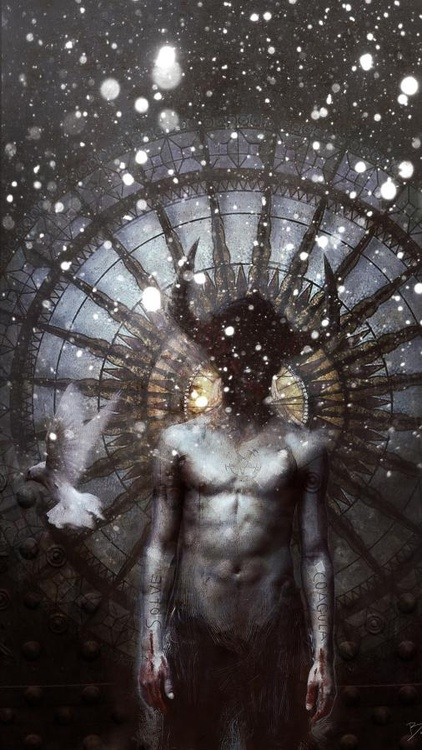
This image by Bastien Lecouffe-Deharme really conveys something of the Black Sun experience:
As does this video by Sigur Rós:
This image by Bastien Lecouffe-Deharme really conveys something of the Black Sun experience:
As does this video by Sigur Rós:
And I’m hardly the only one to suggest a connection between Dionysos and the Black Sun. There’s also this dude:

Vyacheslav Ivanovich Ivanov. Also not a Nazi.
He wrote in The Vineyard Of Dionysus:
Dionysus walks his vineyard, his beloved;
Two women in dark clothing – two vintagers – follow him.
Dionysus tells the two mournful guards – the vintagers:
“Take your sharp knife, my vintners, Grief and Torment;
Harvest, Grief and Torment, my beloved grapes!
Gather the blood of scarlet bunches, the tears of my golden clusters –
Take the victim of bliss to the whetstone of grief,
The purple of suffering to the whetstone of bliss;
Pour the fervent liquid of scarlet delights into my ardent Grail!”
For Vyacheslav Ivanovich Ivanov Dionysos was more than just a poetic trope. In Dancing Maenads in Early 20th-Century Britain Fiona Macintosh remarks:
In Germany and Russia there were followers of Dionysus, who shunned the modern world altogether and lived in quasi-Bacchic settings and practiced Dionysian rituals.*
* Blom (2008), 200-2. In Russia, for example, Vyacheslav Ivanov (1866-1949), classical scholar and author of The Hellenic Religion of the Suffering God (1904), lived in ‘The Tower’ believing he was Dionysus from 1905 onwards. In Germany there were numerous bearded and naturist followers of Dionysus, including the young Herman Hesse.
He was quite the interesting fellow, according to James H. Billington:
‘Viacheslav the Magnificent’ was the crown prince and chef de salon of the new society, which met in his seventh floor apartment ‘The Tower,’ overlooking the gardens of the Tauride Palace in St. Petersburg. Walls and partitions were torn down to accommodate the increasing numbers of talented and disputatious people who flocked to the Wednesday soirees, which were rarely in full swing until after supper had been served at 2 A.M.
Acclaimed poet Maria Skobtsova recalled the symposiastic paradise created by Ivanov decades later, as a White émigré in Paris:
We lived in the middle of a vast country as if on an uninhabited island. Russia was illiterate, whereas in our milieu was concentrated all the culture of the world: the Greeks were quoted by heart, we welcomed the French symbolists, we thought of Scandinavian literature as our own, we were familiar with the philosophy, theology, poetry and history of the whole wide world, in this sense we were citizens of the universe, the keepers of mankind’s cultural museum. This was Rome in the time of its decline… We played out the last act of the tragedy concerned with the rift between the intelligentsia and the people. Beyond us stretched out the Russian Empire’s snowy desert, a country in fetters: it was as ignorant of our delights as of our anguish, while its own delights and anguish had no effect on us.
Jesús Ángel Espinós writes in The realm of Hades and its symbols in Mandel’štam’s Tristia: a transparent path to redemption:
So, through the mediation of bees and their honey Persephone softens her gloomy character and takes on a new redeemer aspect through which the bees, probably a metaphor of the souls of the dead, transmute their honey into sun, and consequently transcend their earthly existence, as can be observed in the final verses of poem I, 208:
Take for joy my wild gift,
A homely and dry necklace
Of dead bees who transformed
honey into sun.
The last word of the poem, “sun”, inserts itself into a fundamental network where metaphors pertaining to “black sun” and to “night sun” claim attention. In both epithets it has been observed as an Orphic influence that refers to Dionysus Nyktelios, the “Dionysus of the night sun”. Broadly speaking, the imagery of both suns, particularly that of the “night sun”, has to be related to Vjačeslav Ivanov, classical philologist and erudite Symbolist poet, who exerted a great sway on Mandel’štam, especially in his youthful years. Ivanov employs the image of “night sun” in several works such as in the articles ‘Мысли о символизме’ (‘Thoughts about Symbolism’), ‘Орфей’ (‘Orpheus’), in the essay ‘Взгляд Скрябина на искусство’ (‘Skrjabin’s View of Art’), and in the poems ‘Ночное солнце’ (‘Night Sun’) and ‘Сердце Диониса’ (‘Dionysus’ Heart’) among others. Orphic rituals enable us to expiate the guilt inherited from the Titans, and consequently avoid the pu-nishments of afterlife and the cycle of reincarnations. In addition, Plutarch suggests that there must have been a work dedicated to Dionysus Nyktelios, which probably described the mourning for the god’s death and the orgiastic rites in honor of his rebirth. Nevertheless, in spite of Plutarch’s witness, the existence of such a work, perhaps an epic poem called Νυκτέλια, cannot be proved. In this hypothetical poem the initiates would be instructed in the symbolic meaning of the night, which should be explained by the opposition night/day, shadow/light, an opposition that can be observed in the Mandel’štamian oxymora “night sun”, and to a lesser extent “black sun”. On the other hand, this interrelation of opposite qualities can be traced back to Ivanov, who closes his poem ‘Ночное солнце’ (‘ Night Sun’) with the following command: “В полночь зови незакатный свет!” (“At midnight call the never setting light!”; v. 7). In sum, from this point of view, the Orphic sun of poem I, 208 (v. 15), created by the honey of dead bees, should be understood as a sun of salvation that, under the appearance of a Dionysus reborn, would set us free from the continuous and numerous gloomy metaphors that dot Mandel’štam’s Tristia. On the other hand, the bees were a symbol of poetic talent in classical Antiquity as must be inferred from the recurrent scene of bees that perch on the lips of future poets when they are still in the cradle or that, in the case of the young Pindar, even build a honeycomb on his lips according to Pausanias (Description of Greece IX, 23, 2), or feed him with honey as Philostratus (Images II, 12, 2, 4) states. So, I might venture that the bees, by means of their poetic force, defy death, which is the same as saying that poetry, incarnated in the honey, reveals itself as immortal.
Regarding this imagery, Terras remarks: “We know that precisely at the time of Mandelstam’s intensive contact with Ivanov, the latter was lecturing on Novalis and translating his poetry and, in particular, his Hymnen an die Nacht. In the very first of these hymns we find a ‘liebliche Sonne der Nacht,’ translated as Mne solntsem ty polunochnym siiaesh’, ‘You shine for me as a midnight sun’ […]. The not inconsiderable role played by Novalis in Mandelstam’s thought […] is surely due to Ivanov’s mediation.” (The Black Sun: Orphic Imagery in the Poetry of Osip Mandelstam. SEEJ, 45, No. 1, 45-60.)
It kind of amuses me that they’re making such a big deal about the whole Black Sun thing now. I mean, I’ve used the pics in a bunch of posts, and written quite extensively on the subject. If I thought this was something shameful and to be kept secret I’m doing rather a shitty job of it, don’t you think?
Here’s some real ammunition, folks, rather than gossip and insinuation to go by.
Read and judge for yourself.
That’s why I use the symbol. That’s what it means to me. Not Nazism.
And of course folks are free to disagree with my interpretation and usage and disassociate or push back however they please. Anyone who says otherwise is wrong and stupid.
Though your argument that Scarlet Magdalene gets to decide what’s antisemitic because she’s Jewish, well, that’s just bullshit. And disappointing, because I’ve come to expect better of you.
I mean, I asked five Jews and they all said it was cool. Granted five isn’t a minyan, but it’s bigger than one. If we’re going by your metric, shouldn’t that carry more weight?
And unlike a certain someone these were observant Jews, albeit like her at least three of them had broken the Mosaic commandment against having other Gods. One is also an adulterer, but I respect his opinion on religious and magical matters because people are complex and complicated. Just because you know one fact about someone doesn’t mean you know anything about who they are or what their life and world are like.
I just question your timing and tenacity and dishonesty.
Why, it’s almost like you’re trying to smokescreen folks.

The responses to my explanation for why I use the Sonnenrad have been rather interesting. There has been concern that I’m trying to force others to use it, tirades about UPG and going beyond the sources, worry about blindly accepting whatever a God happens to tell us, theoreticals about all the horrible things a God might command one to do, whether it’s even possible for the Gods to act contrary to the good, etc.
I really wonder how many of these people even bothered to read my explanation before weighing in. If you need a refresher, here you go:
This image was given to me in a dream by Dionysos. Initially I was uncomfortable with that since I was aware of its Nazi associations. But it kept showing up in visions and meditations over the course of a couple months. And then the God showed me what it means, how it’s one of the symbols of his mysteries and more importantly what can be done with it. And that’s all I needed. I will never stop wearing it, talking about it, or using it.
The first thing you’ll notice is that at no point was there discussion about other people using this symbol or not. Not in the account, and not in any of the subsequent posts I’ve made. Not only have I not encouraged others to adopt it, I haven’t attempted to argue anyone down from their positions.
Look, I get it. Nazis bad. Anything they touched is going to be forever stained for you. Not only can’t these symbols ever be redeemed, but anyone who uses them is a jerk or worse, and you want to stay as far away from that as possible.
Cool.
You can stop reading now.
I’m not going to try to convince you of anything, but I’m also not going to engage with your kneejerk arguments because they aren’t based in anything other than emotion. May you lead a happy and fulfilled life – preferably as far away from me and mine as possible.
Now on to the theological points.
I didn’t take on the Sonnenrad because Dionysos told me to. There was no blind acceptance of anything, no threats or compulsion.
It began simply with a dream in which I was given the symbol. He didn’t explain anything, including why he wanted me to have it. We were just hanging out in the Labyrinth talking and suddenly he extended his hand and there was a black disc with moving tendrils resembling Sig-runes around the circumference. I held it in my hands and felt this vibrating power that made me kind of dizzy and the next thing I knew I was awake.
I felt disoriented, but got up and went to my lap-top to confirm that he had indeed given me what I thought he had. I spent a half hour or so checking out a smattering of sites, most of which repeated the same bare bones information. I said, “Hmm, that’s weird. Wonder if it means anything.” And then I went back to bed.
A couple days later my mind returned to the symbol. It made me really uncomfortable because of its Nazi associations. Why had he given it to me? What did he intend for me to do with it? How did I personally feel about it, for that matter.
Mostly it made me uncomfortable. It’s not just that I don’t like Nazis and anything associated with them was tainted – but as someone who had already gotten plenty of flak for my conservative and Right-leaning views, well, adopting this symbol would have some pretty severe ramifications. To the point that it could destroy all of my community-building efforts which I had undertaken expressly for him.
So I filed it away in the back of my mind, and went about organizing the Polytheist Leadership Conference. And for the next six months or so, that was that. There were no further dreams, no whispered messages or visions, I was swamped with work both during the Conference and in its immediate aftermath, and I got involved in some esoteric work involving next level stuff with the Toys, opening up the Green Way thread of the tradition, working more closely with Orpheus, Medeia and Melampous, and generally growing the Starry Bull community with close to a dozen initiates made over the next couple years.
Then the Sonnenrad started showing up more and more for me. People would mention it in books and articles I was reading, it’d pop up in videos and movies, I began seeing it in dreams and visions, it filtered subconsciously into my writing and then David Bowie released his final album ★ and went to join the heroes. At this point I felt I needed to understand the symbol and its occult significance better so I hit the books. Most writings were either full of incomprehensible jargon, or veered off into crazy land often with heaping helpings of delusional racism, antisemitism and messianiac Hitlerism. The alchemical literature proved more useful – and overlapped significantly with what I had been calling the Bull-Wolf ritual combat strain of the tradition – but a lot of it was also unproductive or way over my head, since my knowledge of the subject is fairly minimal. Nevertheless I was able to piece together some significant stuff from these disparate sources but also felt that I had taken things as far as I could through the research route.
So I went back and prayed for Dionysos to send me another dream, perhaps one with a little more clarity. And I got zilch. Nada. Nothingburger. A couple weeks straight of prayer, bedtime ritual, entheogens, etc. netted the same results. So I figured that was that, and it would remain a closed mystery to me. I’ve encountered plenty of other strains within the Starry Bull that were like that, so it didn’t surprise me overmuch.
Then, as I prepared to take another class through the Toys course the Sonnenrad started aggressively showing up again – not just via the exercises, but whenever I’d meditate and occasionally in dreams too. I begged Dionysos to reveal its meaning, and though he communicated very little to me directly more and more of it started opening up for me until I had a pretty good sense of what it was, what processes it oversaw, and once mastered how its energy could be utilized.
At which point Dionysos and I needed to have another heart-to-heart because I was very uncomfortable making what amounted to Nazi spiritual tech part of the Starry Bull tradition. I knew enough by then that I was convinced it was so much more than that and the Nazis and related Occultists had only scratched the surface – but it’d be a really fucking hard sell for others. The couple of times I’d brought it up in the group people freaked and threatened to leave. These were my people, who trusted and spent years working with me. If they had that reaction, I could just imagine how others would take this.
So Dionysos and I talked. He didn’t try to convince me of anything, beyond the fact that I was on the right track and if I could get over my inhibitions I would make some serious breakthroughs. He assured me that although I would one day share this with others, that was a ways off and I needed to spend time learning and mastering it just for myself. He gave me glimpses of how he’d come by it, what it meant to him beyond the extensive lore surrounding it, and what I might one day be able to do with it – including stuff none of the literature had touched on.
And that’s where things have remained the last couple years. It’s only been twelve months or so since I’ve felt comfortable and confident enough to begin wearing it around or using it in ritual.
No divine commandments. No bullying, intimidation or danger of him retreating. No grand mission. No problem with my hesitancy and oodles of questions, which were all handled by him with patience and grace. No grand conversations about morality, cosmology and the place of man and the Gods in such things. I was merely presented with options and choices, and what follows naturally from them.
Your experience with your Gods may be different than this, leading to the anxieties inherent in your question – but this is Dionysos we’re talking about, and one of the things he values above nearly all else in his interactions with humans is consent and things happening in the right way, in the right place, at the right time.
And for that I am infinitely grateful.
More from Scarlet Magdalene:
Ironically enough, his own signature was also removed for reasons just as serious and well before his blog posts I’m afraid.
1) You are lying. You removed my signature after the posts, because I checked as I was making them in case I needed to change the language.
2) Are you seriously claiming that wearing a Nazi necklace* is on the same level as raping a child? Fucking seriously?!?
I wonder how long it’ll take her to do anything about the second sexual predator she has on her list. I just checked, and yup, they’re still there.
I also love the dude who is white knighting for her.
“OMG, like, he’s cultural appropriating from Nazis!!!”
Yeah, buddy. Maybe I am.
I walked up, punched a Nazi right in the nose, stole all his symbols and now I’m gonna repurpose them for my queer, disabled, foreign God. Fight me if you want them back.
Gods these people are ridiculous and have some truly fucked up priorities.
* Which isn’t, but that’s irrelevant to the argument.
If you are seriously interested in learning about the history and meaning of the Sonnenrad I would recommend starting with James Pontolillo’s The Black Sun Unveiled: Genesis and Development of a Modern National Socialist Mythos and Stanton Marlan’s The Black Sun: The Alchemy and Art of Darkness. The first consists largely of primary source material (photographs as well as documents) much of which is obscure and difficult to track down elsewhere – and the second really delves into its esoteric significance. Both have some points I’d quibble with, but are infinitely to be preferred to the sort of info that’s likely circulating on Twitter.
The Black Sun is a Nazi symbol!
What did it represent?
Nazism. Duh.
Then why wasn’t it in wider use?
Because the Swastika!
Right. So when they used it, it was for other purposes. What were they?
Nazis killed 6 million.
They did. In fact they were responsible for many more deaths than that. A lot of Nazis were very wicked men.
Nazi bad.
On that we can certainly agree.
Black Sun is Nazi.
Well, the symbol actually predates the–
Black Sun bad!
Some believe that symbols are neutral vessels into which we pour meaning and our assorted personal associations. I’m not sure I buy that, but–
NAZIS BAD. BLACK SUN BAD.
Now, now. Enough of that. We’re having a civil conversation here–
YOU BLACK SUN. YOU NAZI. YOU BAD!!!
Death Cab For Cutie is a Nazi band!
The Cult is a Nazi band!
Dead Can Dance is a Nazi band!
Kadavar is a Nazi band!
GUNSHIP is a Nazi band!
Arditi is a Nazi band!
(Ok, I’ll give ya that one.)
Carbon Airways is a Nazi band!
Soundgarden is a Nazi band, if you take out the hole!
I find it very strange that Scarlet Magdalene and people like her insist on calling me a Nazi. When asked for evidence she posted links to 4 or 5 older pieces of mine – every one of which consisted of me not only denouncing Nazi ideology (beyond just “they killed a bunch of people” – like, even if that hadn’t happened I’d still oppose Nazis) but condemning all forms of racism, sexism, etc. When this was pointed out she doubled down with I hate Jews (curious, since three of my romantic partners have been of Jewish extraction; I’d say that rather proves the opposite, especially since I’m still on good terms with two of them) and then started ranting about the pics. Oh, the pics!
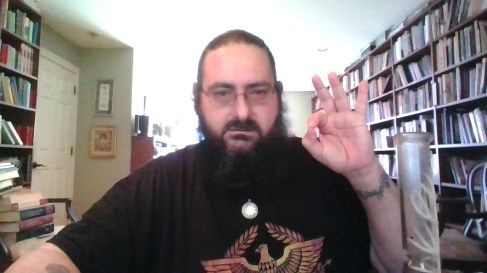
One of which was taken at a largely Black production of Euripides’ Bakchai by the historical Classical Theatre of Harlem and the other taken here in my office. In both I’m wearing a Sonnenrad necklace; in the second I’ve got on my SPQR t-shirt with the Roman eagle, and I’m flashing an “OK” hand sign. Plus my cool glow-in-the-dark vine bong is visible, though no one ever remarks on that even though it’s clearly proof that I’m a Nazi – Hitler was born on 4/20 after all!
Except, you know, it isn’t proof. None of it is.
Sure, the Nazis culturally appropriated the Roman eagle – but so did the United States of America before them, and the Russian Empire before them, and the Holy Roman Empire (which was neither holy, Roman nor an empire) before them, and the Byzantines before them, and probably a dozen other polities over the centuries I’m forgetting, all of whom wanted to foster some connection with my people, even if only on a symbolic level. Hell, truth be told, we weren’t even the first nation in antiquity to adopt the eagle but like Johnny Cash once we took something over ours became the definitive version everyone wants to emulate. (Sorry Trent, but it’s true.)
So yes, I wear my SPQR shirt as an expression of Italian pride and support for the values that made Rome such an exceptional world power. Our Imperium lasted more than a thousand years, and has cast a long shadow over subsequent European history. How long was the German Reich around for – a little more than a decade?
And you know what helped bring the fuckers down? My people.
Specifically, my grandfather and about five or six of his cousins – all of whom enlisted in the American Armed Forces even though they were first and second generation immigrants and treated like shit for it because America was pretty damn racist at the time. That didn’t matter, however, when their newly adopted country was attacked; all those boys went out to fight against their former homeland and its fascist allies, and several never returned. That’s one reason I wear the SPQR – to honor my ancestors and the hard sacrifices they made for the freedoms we all so casually enjoy – including your freedom to call me a Nazi.
And I’m sorry, I don’t care if the ADL and SPLC claim that the “OK” hand gesture is a White Supremacist symbol – it’s been around for decades in contexts as diverse as scuba-diving to baseball to rock’n’roll to American sign language. Just because some trolls at 4chan started a meme and the conspiratorial lefties went nuts over it does not change its fundamental meaning and history. When I flash it I am not signifying that I’m a racist – I’m mocking your gullibility, libtards. And that should be obvious from context, since it usually appears in posts where I am denouncing racism. Why the fuck would I do that if I’m a Nazi?
Now, the Black Sun.
This symbol and variations on it go back not only to migration-era Germany, but to pictographs and related imagery from the Neolithic found throughout continental Europe. True, for a few short years it was also employed by a select group of Nazis interested in the Occult; also true, the form I favor was designed by Himmler for the Wewelsburg castle – but do you know why they used it?
Yeah, I didn’t think so.
But I do, and that’s why I continue to even though I’ve gotten all kinds of shit for it. I’m not going to go into the historical, mythical, Occult and Runic significance of the Sonnenrad, nor what it means to us within the Starry Bull tradition. That’s a topic for another day. Instead I’m going to say one thing, and one thing only – my personal reason for wearing it.
This image was given to me in a dream by Dionysos. Initially I was uncomfortable with that since I was aware of its Nazi associations. But it kept showing up in visions and meditations over the course of a couple months. And then the God showed me what it means, how it’s one of the symbols of his mysteries and more importantly what can be done with it. And that’s all I needed. I will never stop wearing it, talking about it, or using it.
And you’re welcome to disagree all you want. You can run around calling me Nazi til you’re blue in the face. You can maintain that belief no matter how often folks point to my anti-racist writings, the fact that every ritual group I’ve been involved in since my Wiccan days has had members of color, that no one can point to any racist groups I’ve been a member of, no racist events I’ve attended, no racist activities I’ve engaged in, and so on and so forth until the cows come home.
Eventually people are going to see through your bullshit, that you’ve got nothing more than empty “Nazi!” and “Racist!” insults to lob.
And then what?
Will you reflect on all that time you’ve wasted hating on me instead of getting out there and fighting actual Nazis like my grandfather and his cousins did? Okay, technically most of them were deployed to the Pacific theater rather than Europe but Imperial Japan was no less evil than the Nazis, and in some respects much worse. Just ask the Chinese, Filipinos, POWs, etc. But my point stands – your keyboard crusades will accomplish nothing. They will consume everything decent, vital and meaningful about you until you die worthless and forgotten.
And I’ll still be over here, worshiping my Gods and making lasting friendships with interesting and diverse people who care more about my words and deeds than the necklaces and t-shirts I wear. (And if they have questions about my accessories we’ll have an honest conversation like human beings, not neurotic online twits.)
Incidentally, you may want to take another look at your Xenia Declaration, Scarlet Magdalene. While you’ve been trying to besmirch my reputation (something I do far better than you ever could) you let another sexual predator sign up. Wow, you have no knowledge of your so-called community and don’t do any sort of vetting, do you? Unless you do know and are actually ok with that sort of thing. Once is an accident, twice a coincidence – but any more and it will start to seem to like a pattern …
Damn, I am so glad you removed me because of my t-shirt and necklace, since I have zero desire to be associated with you people.
Anyway, it’s 11/11 now. Take a few moments to reflect on and honor those who were truly Anti-Fascist, and gave their lives up in the great fight against tyranny.
There is a lot of curiosity about my political beliefs for some reason, so here’s where I’d come down on a number of issues if I was in charge. If you want to know my thoughts on other matters feel free to post your questions in the comments section below.
Abortion: I do not believe that a pregnancy should be terminated unless the mother’s life is in danger or there are diseases or defects that will severely compromise the quality of life of the fetus. However I do not believe that it is the government’s place to restrict access to abortion. This inevitably makes the situation worse and more dangerous; it also violates the bodily autonomy of women. Instead of focusing on the ballot box and courts, I would direct efforts and resources towards decreasing the need for abortions. This means better sex ed, access to contraception, counseling and support not only during pregnancy but through childhood (including increased funding for healthcare, welfare, housing, childcare, education, etc.) streamlining adoption, and similar initiatives on both a private and governmental level. If life is truly precious then we as a society need to act accordingly.
Citizenship: No distinction should be made based on ethnicity, gender or country of origin. Instead I would divide the population into two classes – metics (or resident aliens) and citizens. Metics do not enjoy the benefits of citizenship, nor the responsibilities. Citizenship is only granted after a period of two years’ service to the State. This could be in military, medical, engineering, education, agriculture, public works and infrastructure, as well as similar fields. In return the citizen will receive voting rights, access to free education and healthcare, etc. Although I would encourage social stigma towards metics, under the law they will be treated equally with citizens. Citizenship must be renewed every ten years, with another two year period of service.
Drugs: By all metrics prohibition has not only proven ineffective, it has created untold problems which disproportionately affect minority and impoverished communities. I would legalize everything, tax and regulate the industry, and redirect funds towards education, rehabilitation, and facilities where addicts can get safe and clean fixes.
Economy: I would like to see a mixed model. While capitalism and private enterprise will be encouraged, a number of industries and resources will be nationalized, and much will be handled through public service programs. Even when there is a government option private alternatives will be available to ensure healthy competition.
Education: Provided free to all citizens. After basic education (which not only covers literacy, history and the humanities, STEM, essential life skills, etc. but is also designed to inculcate civic virtues) students will be tested to determine their aptitudes and then enrolled in trade schools which will also help with job placement upon graduation, should they so desire. Higher education will be cheaply available, but if debt is incurred they will have the option of enrolling in a public service program to pay it off.
Environment: There is no nation without its land and resources. Conservation, responsible management, the development of clean and renewable energy sources, etc. will all be strongly encouraged, with various public service programs directed towards that end. Violators will be severely punished as traitors to the State.
Guns: All citizens should be encouraged to carry, provided they’ve gone through thorough training and background checks. I do not believe that the government can be trusted with a monopoly on violence, especially since attempts to restrict access to firearms always target vulnerable, marginalized and minority communities. The epidemic of mass shootings we’ve experienced since the 1990s is the result of complex societal issues that need to be addressed and will not stop until they are. Besides, criminals by definition do not obey the law so how is a gun grab going to help?
Healthcare: Provided free to all citizens. Metics should have access to cheap and quality medical care; if they incur debt as a consequence and cannot pay, they may enroll in a public service program where they can work it off.
Marriage: I believe that the foundation of society is the family, but that it is not the government’s job to determine the makeup of individual family units. Furthermore it should not be in the business of sanctioning marriage, which is a religious institution and therefore should be left to individual religions to determine its nature and legitimacy. If same-sex couples, multiple partners, platonic friends or whatever wish to have their unions formalized that’s between them and their clergy. Likewise if religious institutions do not wish to recognize the legitimacy of such unions they should not be forced to. Matters of inheritance, medical advocacy, benefits, etc. should be disentangled from marriage and people permitted to come up with their own personal arrangements.
Military: I am largely anti-interventionist and so would reduce the armed forces to just what is needed to protect our borders, scrapping the majority of our overseas bases. (While increasing funding for espionage, black ops, cyberterrorism, etc.)
Prisons: I would abolish for-profit prisons and mandatory minimum sentences, especially for non-violent offences. (Many of which would be decriminalized anyway.) I would place greater emphasis on reforming the character of criminals rather than simply punishing them. While incarcerated they would undergo therapy, education and for those who are eligible work-training, the latter under an apprenticeship program that would help them find employment upon release. Other programs would be in place to help them successfully reintegrate into society. Those with life sentences may volunteer to be the subjects of scientific experiments or dangerous and undesirable labor; if they happen to survive they may be eligible for parole.
Prostitution: Essentially the same as my drug policy, however I would require the prostitutes be licensed and undergo regular medical check-ups, whether they work out of a state-run brothel or are private entrepreneurs. In the brothels they would receive the same benefits as other government employees.
Religion: Although officially Polytheist with State-run temples and priesthoods, the population will enjoy the freedom to practice whatever religion they please, or none at all. However tax exemption will be given only to those religious institutions who help conduct the festivals and rites of the Gods of the State. We possess a very open pantheon; the requirements are to bless and protect the people and land of the State, and to do the opposite towards our enemies.
Update to my post Disgusting – it seems that the organizers of the Xenia Declaration have looked into the allegations against Pyrokanthos and finally removed him from the list of signatories. Credit where credit is due; I’m sure this was not an easy decision on their part considering his history, contributions and extensive connections both online and in the Bay Area within the Hellenic polytheist, Heathen and Neopagan communities (not to mention the SCA and scifi/fantasy fandoms.) And I will stand by them when the inevitable backlash from Pyrokanthos, his wife Diana Paxson and their cronies and supporters comes, as it did for Ár nDraíocht Féin in the wake of their repudiation of founder and alleged child-raper Isaac Bonewits (who was part of Pyrokanthos and Paxson’s circle back in the day, per the Wild Hunt.) Stopping the abuse and intimidation of the most vulnerable within our communities is vastly more important than personal squabbles and politics. Now is the time to act. If you’ve seen something, say something – as the brave Thenea did. Even more importantly, when warranted consider saying something to the cops, not just social media. I understand that there may be a myriad reasons why you cannot (including concerns for your own safety and well-being) but the only way we’re going to remove this rot and filth from our communities is by exposing it to the light of day and drawing some very hard lines. For instance: no means no, and don’t fuck the kiddies.
And:
Both are great, but I think I like the second slightly more.
So both my individual and group signatures to the Xenia Declaration have been removed after the post I made about Pyrokanthos. He, however, remains. I guess covering for pedophiles and consent violators is considered a Hellenic value by these people.
Yeeesh. They’ll let anyone sign this thing:
Pyrokanthos says:
November 7, 2019 at 2:33 pm
Pyrokanthos, Hiereys Basileys of Thiasos Olympikos, endorses the Xenia Declaration, which is in full accord with the principals to which we have adhered for the past thirty years.
I mean, I hate Nazis as much as the next red-blooded American but that dude is Pyrokanthos aka Don Studebaker aka Ramfis Firethorn aka Jon DeCles. As in the dude who gropes mediums while they are carrying deities. As in the spouse of Diana Paxson, at whose home children were molested, also known as the adopted brother of Marion Zimmer Bradley.
I feel dirty having my name on that list now.
And I signed the Declaration as an individual.
Sannion says:
November 7, 2019 at 12:11 pm
Your comment is awaiting moderation.
It’s Hellenismos, not Hateismos. I stand in support of xenia.
I have signed the Xenia Declaration on behalf of The Bakcheion.
I mean, technically we’re Starry Bull rather than Hellenic polytheist but I’m sure they won’t mind us standing with them against those fucking xenophobes and haters.
Online activism is so cool.
Here’s a couple good posts discussing the interstices of politics, culture and polytheism.
First up from Sacred Blasphemies, A Screed On Society and Culture:
I feel like our diversity is our strength. It is not the Left that is causing us to lose culture. If anything, it is our society itself. We often don’t cook our own meals. Food is culture. We sit and listen to radio, watch TV, or read websites, which insulates us from our neighbors. This is a form of separating ourselves from culture. And I’m guilty of it as well.
I share the critiques of modernism that many people on the far right have. I agree with Radical Traditionalists on many issues, just disagree strongly on the emphasis on ethnic homogeneity and on traditional gender roles. (Also, many of them are super racist…which I just have no tolerance for.)
And then from Sarenth comes this Reflection on Polytheism, Tribalism, and Politics:
Generally, Pagan and polytheist communities I am not personally part of take far more than anything they give back. Part of this is due to a lack of coherent theology most Pagan groups have. Why? A coherent theology gives structure to a religion, and in organizing and structuring its religion, gives structure to its adherents. Without clear structures within and for understanding one’s religion, let alone one’s place in it, one’s political and/or personal proclivities become the deciding factor on what behaviors and views are correct for one’s religion and conduct. In other words, the religion and all structures change to fit individuals rather than individuals fitting a religion when theology lacks, or when religious structures are ignored or eschewed. From religious structure comes the basis for how we live in the world, and every single religion that I know of sets up in its basic foundation what right relationship with the Holy Powers, and from that with one another, looks like. When theology and resulting religious structures do not form coherent narratives, structures, or stories, I often see that non-religious elements are incorporated, whether that is from politics, science, or whatever interest the group or person holds.
Gipt fá gipt (gift for a gift in ON) exists as a given with the basic structure of Heathenry. It is in how we conduct ourselves with our Gods, Ancestors, vaettir, and with one another in communities. It is how we understand and set up all our relationships. When someone lacks this basic understanding it becomes painfully clear how one-sided a relationship is, and unless the other party is willing to do some values-adjusting, there can be no useful relationship.
Sarenth also wrote this striking piece Visions of Dionysus you should check out.
In case you haven’t noticed I’m a bit– “oppositionally defiant” is, I believe, the clinical term. Growing up, most of the things I was really into – heavy metal, horror movies, fantasy novels, neopaganism, homosexuality – were introduced to me by concerned teachers or youth ministers decrying their dangerous and corrupting influence; the greater their moral panic, the more intrigued I became. Now their disfavor wasn’t a guarantee I’d like something, but the allure of the forbidden and suppressed was usually enough for me to at least give it a shot. It’s quite astounding, really, that I didn’t discover my fondness for drugs and alcohol until my late twenties.
Incidentally, this is also how my political evolution occurred. The first (and only) presidential election I voted in was for Bill Clinton’s second term. I had already begun to sour on the man since he hadn’t delivered on his promises with regard to gay rights and the environment, but I figured he was still better than Bob Dole, whom the Republicans were running for some inexplicable reason. Not that I would have ever voted Republican back then – this was the 90s, man; my favorite band was Rage Against the Machine and I wore a Free Tibet patch on my jacket. A couple years before I’d even delivered speeches to the school board peppered with Marxist slogans, that’s how woke I was.
I was working at a used book store then, and occasionally controversial titles would come in. My boss would jack the price up and put them on a special shelf behind the glass counter. Anarchist Cookbook. Complete Works of the Marquis de Sade. The Turner Diaries. Stuff by Crowley and LaVey. That Sex book by Madonna. It was an eclectic mix, but all were somehow guilty of wrongthink. So of course I’d check at the start of each shift for any new arrivals, and stash the interesting ones in my cubby until payday. Increasingly that came to mean conservative and Right-wing titles. The more out there their ideas were the more I engaged, trying to refute them with my infallible liberal logic; except the longer this went on, the more I started having this sinking feeling that the Right might be right after all. At least their worldview better aligned with what I saw happening around me all the time and their explanations, hard as they could be to initially accept, better explained this phenomena than the mainstream narrative I was getting fed. (Until they went off the deep end into delusional paranoia and idiotic racism, that is.)
And then I stopped caring about anything that wasn’t ancient Greece or Rome related. I put all of my energy into researching and writing about and worshiping Dionysos and his fellow Olympians (branching even further out later on,) moved cross country a couple times for the sake of polytheist community, taught classes, organized events, had my fifteen minutes as a minor internet celebrity and now I’m doing this, whatever this is.
With such a focus, my interest in Right-wing political theory faded to nothingness. It had always been fairly utopian; I’m one of those Romantic, pessimistic Right-wingers after all. (Where can I find a glacier to gaze upon until dreadful existential shuddering seizes me?) Dig deep enough and all political parties and figures prove disappointing. If they aren’t riddled with hypocrisy and moral failings than they usually lack the fortitude or intelligence to manifest their vision.
Which is why even when my interest was rekindled by the rise of the “intellectual dark web” and related cliques I remained politically uninvolved. True to form nearly all of them have been revealed to be liars, grifters, degenerates and imbeciles too concerned with tearing each other to shreds to enact any kind of mass conservative reform in the country. Plus, so many of their ideas are just so fucking dull and obvious. Say what you will about the books on the controversy shelf but they were never boring!
In the fifth Ennead he even compared it to the effects of drugs. But Plotinus’ most compelling metaphor of the Nous was of “a richly varied sphere, a globe of faces radiant with living faces, all the pure souls running together into the same place.” […] The noetic faces are described as radiant, covering the whole of a sphere, and probably looking out from it. The faces need not be pictured as joyful since the Nous is not a particularly benevolent entity. (Theodore Sabo, The Nous: A Globe of Faces)
 The House of Vines