And now it gets weird. Let’s consult the text, Apollodoros’ Bibliotheka 3.3.1–2:
Γλαῦκος δὲ ἔτι νήπιος ὑπάρχων, μῦν διώκων εἰς μέλιτος πίθον πεσὼν ἀπέθανεν. ἀφανοῦς δὲ ὄντος αὐτοῦ Μίνως πολλὴν ζήτησιν ποιούμενος περὶ τῆς εὑρέσεως ἐμαντεύετο.
Κούρητες δὲ εἶπον αὐτῷ τριχρώματον ἐν ταῖς ἀγέλαις ἔχειν βοῦν, τὸν δὲ τὴν ταύτης χρόαν ἄριστα εἰκάσαι δυνηθέντα καὶ ζῶντα τὸν παῖδα ἀποδώσειν. συγκληθέντων δὲ τῶν μάντεων Πολύιδος ὁ Κοιρανοῦ τὴν χρόαν τῆς βοὸς εἴκασε βάτου καρπῷ, καὶ ζητεῖν τὸν παῖδα ἀναγκασθεὶς διά τινος μαντείας ἀνεῦρε.
λέγοντος δὲ Μίνωος, ὅτι δεῖ καὶ ζῶντα ἀπολαβεῖν αὐτόν, ἀπεκλείσθη σὺν τῷ νεκρῷ. ἐν ἀμηχανίᾳ δὲ πολλῇ τυγχάνων εἶδε δράκοντα ἐπὶ τὸν νεκρὸν ἰόντα· τοῦτον βαλὼν λίθῳ ἀπέκτεινε, δείσας μὴ κἂν αὐτὸς τελευτήσῃ, εἴ τι τὸ σῶμα πάθοι.
ἔρχεται δὲ ἕτερος δράκων, καὶ θεασάμενος νεκρὸν τὸν πρότερον ἄπεισιν, εἶτα ὑποστρέφει πόαν κομίζων, καὶ ταύτην ἐπιτίθησιν ἐπὶ πᾶν τὸ τοῦ ἑτέρου σῶμα· ἐπιτεθείσης δὲ τῆς πόας ἀνέστη.
θεασάμενος δὲ Πολύιδος καὶ θαυμάσας, τὴν αὐτὴν πόαν προσενεγκὼν τῷ τοῦ Γλαύκου σώματι ἀνέστησεν.
ἀπολαβὼν δὲ Μίνως τὸν παῖδα οὐδ᾽ οὕτως εἰς Ἄργος ἀπιέναι τὸν Πολύιδον εἴα, πρὶν ἢ τὴν μαντείαν διδάξαι τὸν Γλαῦκον· ἀναγκασθεὶς δὲ Πολύιδος διδάσκει. καὶ ἐπειδὴ ἀπέπλει, κελεύει τὸν Γλαῦκον εἰς τὸ στόμα ἐμπτύσαι· καὶ τοῦτο ποιήσας Γλαῦκος τῆς μαντείας ἐπελάθετο.
But while Glaukos was still a small child, he chased a mouse, fell into a jar of honey, and died. When he disappeared, Minos made a great search for him and consulted divination concerning how he might be found.
The Kouretes told him that among his herds he had a cow of three colors, and that whoever could best describe the color of this cow would also restore his son to him alive. When the diviners had been assembled, Polyidos son of Koiranos compared the color of the cow to the fruit of the bramble; and, when compelled to search for the child, he found him by means of a certain divination.
But when Minos declared that he must receive the child back alive, Polyidos was shut in with the corpse. While he was in great perplexity, he saw a serpent approaching the dead body. He struck it with a stone and killed it, fearing that he himself would be put to death if anything should happen to the body.
Then another serpent came. Seeing the first one dead, it went away, and afterward returned carrying an herb, which it laid over the entire body of the other. When the herb had been laid upon it, the serpent rose.
Polyidos, seeing this and marveling, applied the same herb to the body of Glaukos and raised him up.
After Minos had received his son back, even then he would not allow Polyidos to depart for Argos until he had taught Glaukos the art of divination. Under compulsion, Polyidos taught him. But when he was about to sail away, he instructed Glaukos to spit into his mouth. Glaukos did so, and forgot the art of divination.
Hey Heathens— notice something?
Yup. After Polyidos restores Glaukos, Minos does not simply release him. He compels Polyidos to teach Glaukos his μαντική, his divinatory art. Polyidos does so— but, when departing, instructs Glaukos to spit into his mouth, whereupon Glaukos forgets what he has learned.
That is an extraordinary ending after everything we’ve just been discussing.
And of course from an Orphic perspective nothing could be worse than forgetting wisdom. Especially since Polyidos’ mantike consists of the ability to see things as they truly are. βίος. θάνατος. βίος. ἀλήθεια. Ζαγρεύς. Διόνυσος. Ὀρφικ-
That completes the pattern. Because once Polyidos’ mantikē is understood not merely as “predicting the future” but as the capacity to perceive the reality concealed by appearances, Minos’ demand and Polyidos’ response become much more profound.
The cow presents the first lesson. Everyone sees a color and tries to name the thing according to its present appearance. Polyidos sees the mulberry and recognizes the whole process:
λευκόν → ἐρυθρόν → μέλαν
white → red → black
The answer is not one moment. The truth is the transformation.
Then Glaukos presents the same problem at a higher order. Everyone sees:
θάνατος.
Polyidos perceives:
βίος → θάνατος → βίος.
Death is real— nothing about the story requires pretending otherwise —but it isn’t the whole truth about Glaukos. The diviner sees beyond the apparent finality of the condition before him.
And then Minos demands that Polyidos transmit that way of seeing.
That makes the spitting episode almost horrifying from the Orphic perspective. Glaukos has passed through death and returned; he has subsequently been taught the mantikē capable of seeing through appearances— and then he forgets.
Not death, finally, but λήθη.
And that is the disaster an Orphic reader understands immediately. The opposite of salvation isn’t simply dying. Everyone dies. The catastrophe is passing through death without retaining the knowledge necessary to understand what is happening.
Hence the force of:
ἀλήθεια / truth
μνήμη / memory
λήθη / forgetting
And ἀλήθεια becomes almost irresistible here— not because we should commit the old etymological sin of treating it straightforwardly as historically derived “un-forgetting,” but because Greek poetic/philosophical thought can exploit precisely that resonance between λήθη and ἀλήθεια. The mantis reveals what is concealed; Orphic eschatological knowledge prevents the soul from losing its orientation when appearances become most deceptive.
So the Olbian sequence—
βίος. θάνατος. βίος. ἀλήθεια. Ζαγρεύς. Διόνυσος. Ὀρφικ-
—almost doesn’t need finishing.
Because Zagreus/Dionysos is himself the cosmic version of the pattern Polyidos perceives in Glaukos:
whole → destroyed → restored
βίος → θάνατος → βίος
And Orpheus becomes the singer who teaches people how to recognize that pattern.
Which suddenly makes the orphninos cow much more consequential than an amusing display of Polyidos’ cleverness. It is the tiny riddle placed at the entrance to the larger mystery. Can you recognize one reality persisting through apparently contradictory states?
White.
Red.
Black.
Living.
Dead.
Living.
Zagreus.
Dionysos.
And, returning to our earlier Pangaion story:
Dionysos Zōē
Helios-Apollon.
Dionysos Nyktelios.
Polyidos enters because he correctly interprets the changing colors of the cow. He finds Glaukos dead in honey. Through the episode of the snakes he acquires the knowledge by which the dead can be restored. He resurrects the boy. Minos then forces him to transmit his specialist knowledge to that resurrected boy. Finally, mouth meets mouth, liquid passes between them, and knowledge is removed again.
Now put that morphologically beside Kvasir.
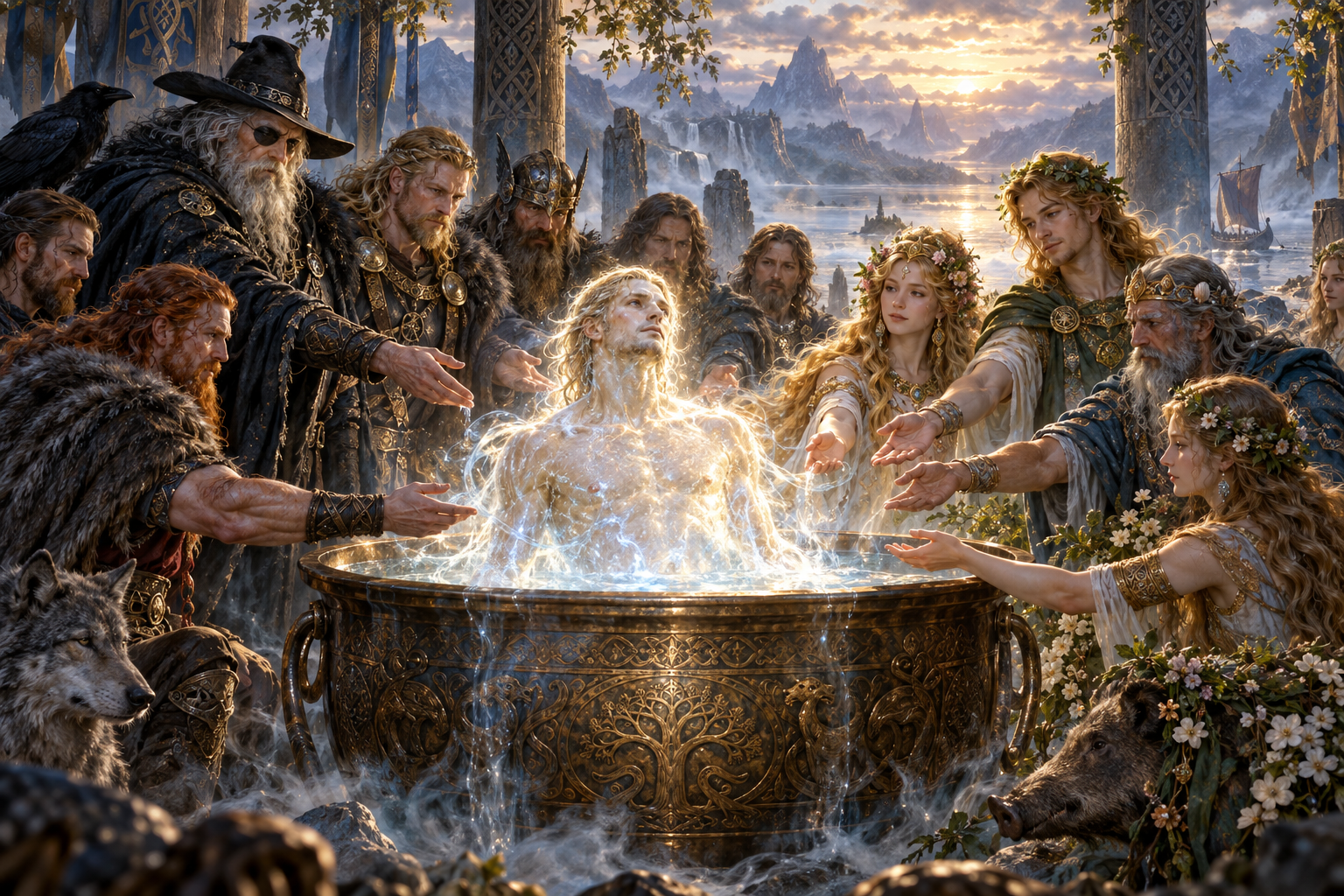
Kvasir originates from communal spittle: the Æsir and Vanir spit into a vessel at the conclusion of their settlement, and from that substance Kvasir is created, extraordinarily wise. Later his blood is mixed with honey to produce the mead of poetry, according to Skáldskaparmál:
When the Æsir and Vanir made peace, each side spat into a vessel. At parting, the Gods would not allow this token of their peace to perish, so from it they made a man named Kvasir. He was so wise that no one could ask him a question he could not answer, and he travelled through the world teaching people.
The dwarves Fjalar and Galar invited Kvasir into their home, took him aside, and killed him. They drained his blood into two vats, Són and Boðn, and a cauldron, Óðrerir. Mixing the blood with honey, they made a mead that turns anyone who drinks it into a poet or a learned person. They told the Æsir that Kvasir had choked on his own wisdom, because no one had been wise enough to question him.
Skáldskaparmál goes on to relate how the Mead of Poetry becomes the object of Óðinn’s acquisition:
Óðinn came upon nine men cutting hay and offered to sharpen their scythes. His whetstone worked so well that each wanted to buy it. He tossed it into the air; in their scramble to catch it, the men struck one another in the neck with their scythes.
Óðinn then went to Baugi, Suttungr’s brother, and called himself Bölverkr. Baugi had lost all nine of his workers. Bölverkr offered to do their work for the summer in exchange for a drink of Suttungr’s mead. Baugi agreed to seek it for him, but when the work was done Suttungr refused them even a drop.
Bölverkr gave Baugi the auger Rati and had him bore into Hnitbjörg. Once the hole went through the rock, Bölverkr took the shape of a serpent and slipped inside. He spent three nights with Gunnlöð, who granted him three drinks of the mead. With the first he emptied Óðrerir; with the second, Boðn; with the third, Són.
Having swallowed all the mead, Óðinn became an eagle and flew toward Ásgarðr. Suttungr took eagle shape and pursued him. The Æsir set out vessels, and Óðinn brought up the mead into them. In the urgency of his escape, however, he let some pass out behind him. That portion was left for anyone who wanted it—the share of bad poets. Óðinn gave the rest to the Æsir and to people with the gift of poetry.
So without proposing the slightest historical connection, look at the constellation:
Polyidos:
diviner → death → honey → snake → restored life → transmission of sacred/specialist knowledge → spittle → loss of knowledge
Kvasir/Óðinn:
spittle → extraordinary wisdom → death → blood + honey → poetic inspiration/wisdom → snake → Óðinn’s acquisition → transmission through drink
That’s genuinely marvelous.
And the reversal makes it better. Spittle creates wisdom in one story and removes wisdom in the other. Honey surrounds the dead Glaukos before the restoration of life; honey mixed with the dead Kvasir’s blood becomes the substance through which his wisdom survives him. Snakes reveal the mystery of resurrection; Óðinn transforms into a snake to acquire a drink of mead.
Which returns us immediately to the dead bees:
Death does not destroy the precious substance. It changes its vehicle.
Glaukos lies dead in honey.
Kvasir dies and becomes honeyed mead.
Dead bees leave honey that becomes Sun.
Orpheus dies and leaves the Lyre that becomes stars.
And Óðinn’s acquisition adds another feature we’ve repeatedly encountered: knowledge is not obtained cleanly. It requires crossing boundaries, entering dangerous enclosed spaces, transformations, deception, bodily substances, ingestion, escape. Knowledge isn’t information downloaded into the intellect; it is something acquired through an ordeal and then incorporated.
And we have another story of Minos and cattle.
We started with Taurus, Pasiphaë and the Minotaur; Asterios; the Bull generating the Dragon and the Dragon the Bull—and here is Minos again, with a cow whose impossible color must be interpreted by a mantis before the hidden/dead child can be found.
The cattle surrounding Minos repeatedly aren’t merely livestock. They generate problems of interpretation.
What is this creature?
What color is this cow?
What does the sign mean?
Where is the missing child?
What does this transformation signify?
And in the Glaukos story, the person capable of solving the bovine riddle earns admission to an even deeper riddle: death itself.
Orpheus breaks because he cannot initially do what Polyidos can. He mistakes an apparent opposition for an ultimate one. Polyidos’ gift is precisely the opposite: he sees the continuity concealed beneath transformation.
Which also gives an unexpectedly sharp meaning to “Remember: you have been here before.”
The initiate doesn’t merely need information.
He needs not to forget what the transformations mean.
And everything dies. Including Dionysos. Which is why I think the sequence Ζαγρεύς. Διόνυσος appears on the Olbian bone tablet. He is the Ἀρχέβακχος, the prototype of the Bakchoi and Bakchai. He opened the way, and clasped arms with the Lord of the Underworld, ensuring that his mystai were exempt from the normal conditions of death. I believe that we have a multi-part soul, which is bound together in life. After drinking from Lethe, during the Underworld journey the person begins to come apart, the different portions returning to their place of origin until only the shade remains and enters the kingdom of Haides. But those who belong to Dionysos eschew Lethe and drink instead from Mnemosyne so remain whole and travel instead to Nysa, where they experience eternal bliss and intoxication.
Ζαγρεύς → Διόνυσος isn’t merely a succession of divine names; it expresses the decisive fact that even the God undergoes death before becoming the one who can lead others through it. That makes Ἀρχέβακχος especially potent: the first/prototypical Bakchos is not exempt from the path his mystai must travel. He traverses it first.
Lethe isn’t merely loss of autobiographical memory. It is an agent of dissolution. If embodied life temporarily binds several soul-components into the person, drinking from Lethe removes what maintains their coherence. The Underworld journey then progressively unbinds the composite: each element returns to its proper origin, until the attenuated remainder—the shade—passes into Haides.
So the lamellae’s prohibition acquires an almost technical meaning:
Do not drink from Lethe.
Not simply because you will forget the password, nor even merely because you will forget who you are, but because forgetting is the beginning of ceasing to be the integrated person who remembers.
Mnemosyne consequently does much more than provide information. Her water preserves continuity of being. Memory holds together what death ordinarily separates.
That gives our eschatology a beautiful symmetry:
ordinary dead:
βίος → θάνατος → λήθη → dissolution → shade → Haides
mystēs:
βίος → θάνατος → Μνημοσύνη → integrity → Nysa → blessed Dionysian existence
And Dionysos can guarantee that alternative precisely because he possesses experiential authority over it. He isn’t standing safely on the living side of the boundary issuing promises about something he has never undergone. He died. He has crossed the boundary, entered into relationship with the Lord beyond it, and returned/transformed. Ἀρχέβακχος therefore means something much stronger than “first worshipper”: he is the one who accomplished the pattern first and thereby made it traversable by the Bakchoi after him.
That also makes the image we see on South Italian vases of Dionysos clasping arms with the Lord of the Underworld important. It isn’t conquest of Haides. Death hasn’t been abolished, and Haides hasn’t been defeated. Rather, an accommodation has been established within the cosmic order: Dionysos’ people still die, but they need not undergo the ordinary consequences of death.
And now Polyidos becomes even more interesting.
Glaukos undergoes:
βίος → θάνατος → βίος → μαντική → λήθη.
He gets almost everything.
He crosses death.
He returns whole.
He receives the knowledge that sees reality truly.
And then he loses the knowledge.
From the perspective of our theology, that’s almost a deliberately frustrating anti-initiation. Glaukos has undergone the experience that should make him exemplary— and yet the final act removes precisely what would allow him to retain its meaning.
Which brings us back to Orpheus and the Mousai. His body is literally διασπασμένον, separated into pieces; the Mousai συνάγουσιν those pieces. Our eschatological model makes that image unexpectedly exact: the ordinary destiny of the human being is disaggregation, while salvation consists in somehow remaining gathered.
And then mnēmosynon appears at the end of the Eratosthenes story.
The Mousai gather Orpheus.
His Lyre becomes a μνημόσυνον.
Mnemosyne prevents the dead mystēs from coming apart.
Whether or not those texts historically encode the same doctrine— and we absolutely shouldn’t claim they do —the symbolic grammar is remarkably consistent:
Ἡ Μνημοσύνη συνάγει· ἡ Λήθη διασπείρει.
“Memory gathers; Lethe scatters.”
Which echoes Eratosthenes—
αἱ δὲ Μοῦσαι συναγαγοῦσαι
“but the Mousai, having gathered [his limbs] together…”


Sannion, I know this is a bit off-topic, but have you heard of Charles Baudelaire? And if so, what do you think of his *Flowers of Evil*? I’ve been reading it, and it contains a lot of polytheistic imagery mixed with a bit of Christianity. If you haven’t read it yet, I highly recommend it.
LikeLiked by 1 person
He’s a venerated figure in the Starry Bull tradition whose feast day is August 31.
LikeLike