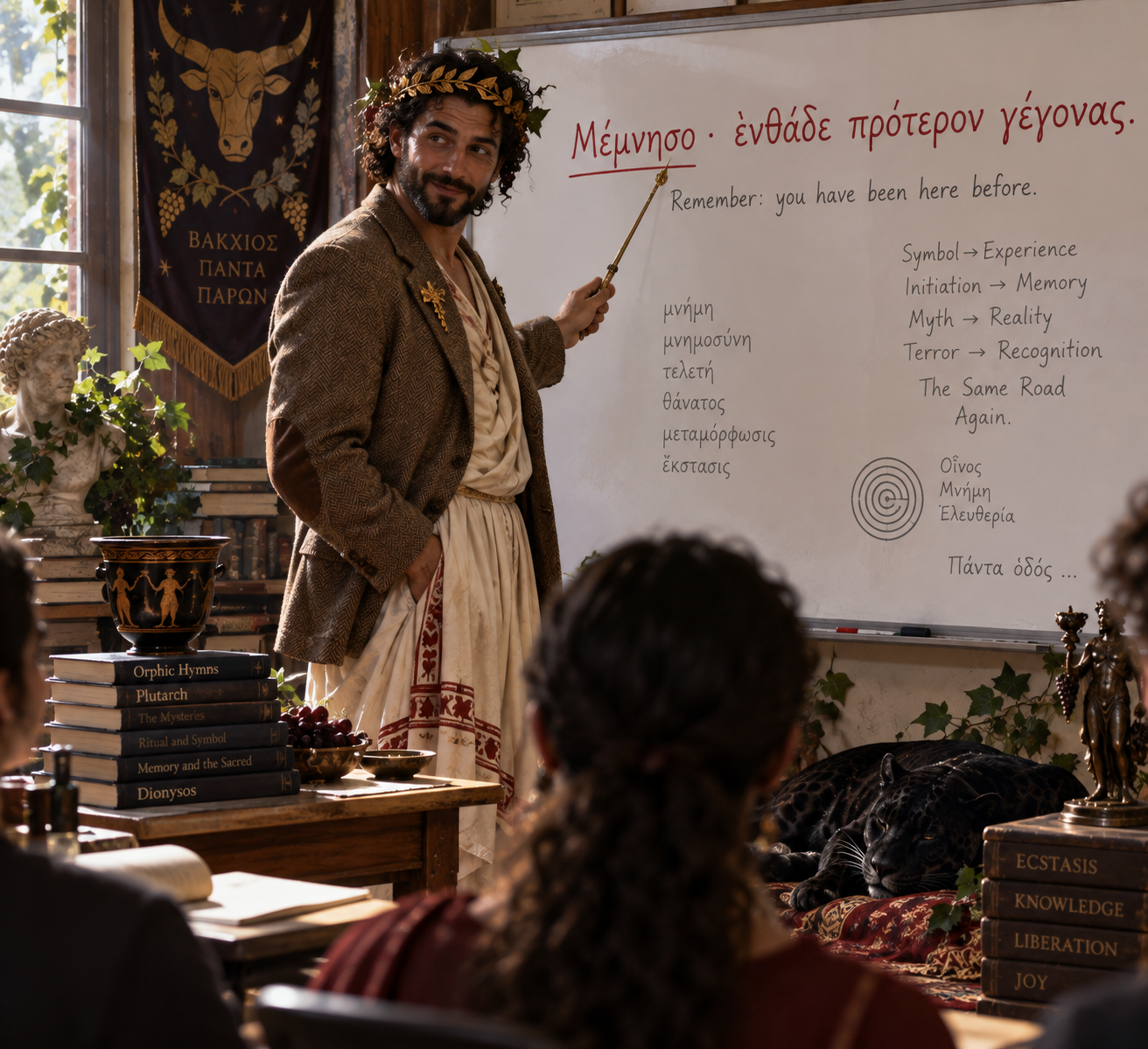
Μέμνησο· ἐνθάδε πρότερον γέγονας.
“Remember: you have been here before.”
The image from the last post is going to be the cover of one of my upcoming books.
What makes it work is the split between the girl’s outward composure and what the mirror reveals: externally she is sitting calmly within the rite; internally—or initiatically—she is terrified, trapped, pounding against the threshold while the Minotaur stands behind her. The priest isn’t rescuing her from the image. He’s deliberately holding up the boukranion so that she has to encounter it. The Minotaur isn’t simply “the monster.” He is what the symbol enables her to encounter.
The presence of ΜΕΜΝΗΣΟ on the wall ties it together beautifully: Remember.
I’m thinking the book will be about mystery initiation and the technology of symbols— how myth, ritual environment, symbola, synthemata, altered states, memory, terror, theophany, and interpretation combine to produce transformation.
The title will be taken from the above aphorism:
REMEMBER: YOU HAVE BEEN HERE BEFORE
Initiation, Memory, and the Experience of Mystery
The title isn’t merely evocative— it contains the thesis:
The initiate enters the mystery so that death will not be wholly unprecedented. The symbol makes the experience intelligible; the experience makes the symbol real; memory binds the two together. Then, at the final threshold, the instruction is not learn, believe, or even obey.
Remember.
And the cover already tells the story: the calm initiate, the terrified experiential self, the Minotaur, the boukranion, the specialist orchestrating the encounter, and the mirror as the boundary between ordinary perception and mystery.
The mural isn’t background decoration at all. It makes the whole scene recursive.
Dionysos undergoes the primordial pattern: madness → encounter with Kybele → purification/initiation → restoration/transformation, while the Korybantes surround that passage with armed, ecstatic ritual. In front of that image, the girl undergoes her own patterned encounter: preparation → symbolic confrontation → terror → recognition → transformation. And behind her stands the specialist who has already learned how to reproduce the pattern for another person.
So the composition contains three temporal layers simultaneously:
Mythic time: Dionysos underwent this.
Ritual time: you are undergoing this.
Eschatological time: you will undergo this again.
And suddenly:
Μέμνησο· ἐνθάδε πρότερον γέγονας.
becomes even richer. You have been here before doesn’t merely refer to the initiate’s earlier rehearsal. She is entering a pattern that Dionysos himself has already traversed.
That’s very mystery-religion-like conceptually: the God doesn’t merely command the path from outside. The God is the prototype of the path.
Which also gives Βάκχιος αὐτὸς ἔλυσε another dimension. Bakchios can liberate because Bakchios knows liberation from within the mythic pattern. The initiate’s ordeal isn’t merely witnessed by him; it participates in his.
And look at what the image is doing with the boukranion and Minotaur. The priest holds up the dead material symbol; the mirror reveals its living experiential reality. The symbol doesn’t merely represent something. It enables something.
The boukranion is the symbolon.
The Minotaur is the encounter.
The mural is the mythic precedent.
The priest provides the ritual technology.
The girl supplies the embodied experience.
The mirror is the threshold.
And Μέμνησο is what binds all of them across time.


Time is many things in quantum physics. We no longer live in a Newtonian world where time moves like an arrow always forwards. We experience time in all its forms at one time. A flat circle – that I have not considered. Flat and circle are an oxymoron since circles are flat two-dimensional shapes. A rounded circle (another oxymoron) which is three-dimensional would be the sphere.
Is time the sphere or the circle or both or neither. Quantum physics would answer – yes.
As for me and my brain injury – I live in the eternal now – a point in the center of the sphere or circle or both or none. Probably in my case, an isosceles triangle square.
LikeLike
“Time is a flat circle,” is one of my favorite lines by Friedrich Nietzsche, though I find the concept bordering on horrific. It’s connected to his teaching amor fati, which is that you must come to love your fate. Not accept it, not endure it— but love it. Because it’s going to repeat over and over again. (You can see why I find it so horrifying.) It was most recently popularized in the show True Detective, as part of Rusty Cohle’s cosmic pessimism. (Which may or may not have reflected the character’s actual beliefs— it’s a beautiful, sad, and very labyrinthine story whose ending is pretty ambiguous. Plus it has the King in Yellow, who is my favorite character in the whole Cthulhu Mythos, though he predates the development of that by a good 50 or so years, having appeared first in Bierce and later Chambers’ writings before being taken up by Lovecraft’s circle.)
LikeLike