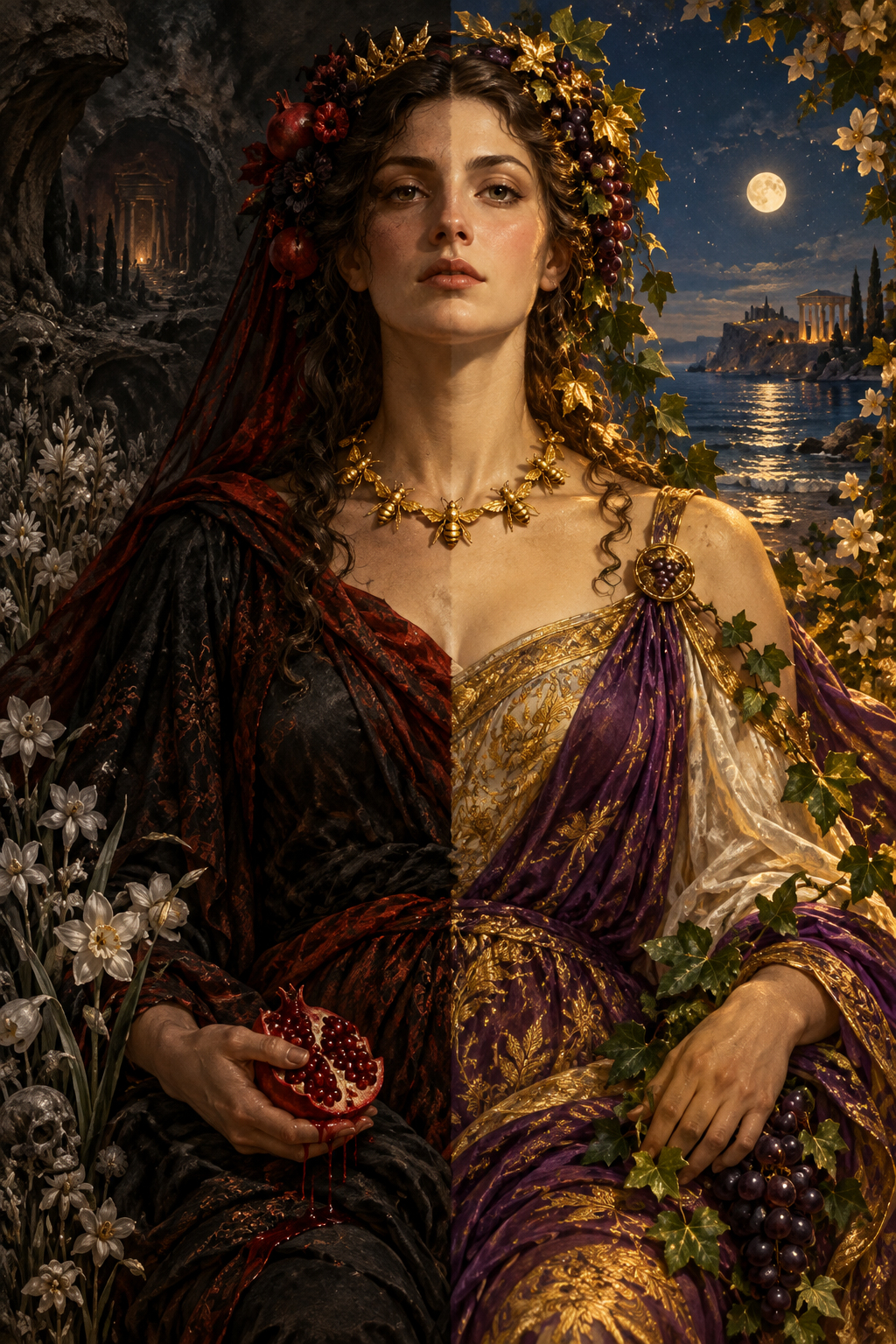
One of the most important texts in Labyrinth of Words is Eratosthenes’ Catasterismi 24 on the constellation Lyra. It is in many respects the aition of Dionysos as the Night Sun:
Αὕτη ἐνάτη κεῖται ἐν τοῖς ἄστροις, ἔστι δὲ Μουσῶν· κατεσκευάσθη δὲ τὸ μὲν πρῶτον ὑπὸ Ἑρμοῦ ἐκ τῆς χελώνης καὶ τῶν Ἀπόλλωνος βοῶν, ἔσχε δὲ χορδὰς ἑπτὰ ἀπὸ τῶν Ἀτλαντίδων.
Μετέλαβε δὲ αὐτὴν Ἀπόλλων καὶ συναρμοσάμενος ᾠδὴν Ὀρφεῖ ἔδωκεν, ὃς Καλλιόπης υἱὸς ὤν, μιᾶς τῶν Μουσῶν, ἐποίησε τὰς χορδὰς ἐννέα ἀπὸ τοῦ τῶν Μουσῶν ἀριθμοῦ καὶ προήγαγεν ἐπὶ πλέον ἐν τοῖς ἀνθρώποις δοξαζόμενος οὕτως ὥστε καὶ ὑπόληψιν ἔχειν περὶ αὐτοῦ τοιαύτην ὅτι τὰ δένδρα καὶ τὰς πέτρας καὶ τὰ θηρία ἐκήλει διὰ τῆς ᾠδῆς.
[διὰ δὲ τὴν γυναῖκα εἰς Ἅιδου καταβὰς καὶ ἰδὼν τὰ ἐκεῖ οἷα ἦν] ὃς τὸν μὲν Διόνυσον οὐκ[έτι] ἐτίμα, [ὑφ’ οὗ ἦν δεδοξασμένος], τὸν δὲ Ἥλιον μέγιστον τῶν θεῶν ἐνόμιζεν εἶναι, ὃν καὶ Ἀπόλλωνα προσηγόρευσεν· ἐπεγειρόμενός τε τῆς νυκτὸς κατὰ τὴν ἑωθινὴν ἐπὶ τὸ ὄρος τὸ καλούμενον Πάγγαιον <ἀνιὼν> προσέμενε τὰς ἀνατολάς, ἵνα ἴδῃ τὸν Ἥλιον πρῶτον.
ὅθεν ὁ Διόνυσος ὀργισθεὶς αὐτῷ ἔπεμψε τὰς Βασσαρίδας, ὥς φησιν Αἰσχύλος ὁ τραγῳδιῶν ποιητής, αἵτινες αὐτὸν διέσπασαν καὶ τὰ μέλη διέρριψαν χωρὶς ἕκαστον. αἱ δὲ Μοῦσαι συναγαγοῦσαι ἔθαψαν ἐπὶ τοῖς λεγομένοις Λειβήθροις.
τὴν δὲ λύραν οὐκ ἔχουσαι ὅτῳ δώσειν τὸν Δία ἠξίωσαν καταστερίσαι, ὅπως ἐκείνου τε καὶ αὐτῶν μνημόσυνον τεθῇ ἐν τοῖς ἄστροις· τοῦ δὲ ἐπινεύσαντος οὕτως ἐτέθη· ἐπισημασίαν δὲ ἔχει ἐπὶ τῷ ἐκείνου συμπτώματι δυομένη καθ’ ὥραν.
Ἔχει δὲ ἀστέρας ἐπὶ τῶν κτενῶν ἑκατέρων α, ἐφ’ ἑκατέρου πήχεως ἀκρωτῆρι ὁμοίως α, ἐφ’ ἑκατέρων ὤμων α, ἐπὶ ζυγοῦ α, ἐπὶ τοῦ πυθμένος α, λευκὸν καὶ λαμπρόν· τοὺς πάντας η.
This constellation, the ninth among the stars, belongs to the Muses. The Lyre was first fashioned by Hermes from the tortoise and from the cattle of Apollon, and it had seven strings, corresponding to the daughters of Atlas.
Apollon received it and, having joined song to it, gave it to Orpheus. Orpheus, being the son of Kalliope, one of the Muses, made its strings nine in number, corresponding to the number of the Muses. He advanced greatly in renown among humankind, becoming so celebrated that it was believed of him that through his song he enchanted trees, stones, and wild beasts.
[Because of his wife he descended into Hades, and having seen what the things there were like,] he no longer honored Dionysos, [through whom he had attained his renown], but considered Helios the greatest of the Gods, whom he also called Apollon. Rising during the night toward dawn, he would ascend the mountain called Pangaion and await the risings, so that he might be the first to behold Helios.
Because of this Dionysos, angered with him, sent the Bassarides against him, as Aischylos the tragic poet says. They tore him apart and scattered his limbs, each separately. But the Muses gathered them together and buried him at the place called Leibethra.
Since the Muses had no one to whom they might give the Lyre, they asked Zeus to place it among the stars, so that a memorial both of Orpheus and of themselves might be established among the constellations. Zeus assented, and thus it was placed there. And by setting at its appointed season, it bears a sign of the fate that befell him.
It has one star upon each of its two horns, likewise one at the extremity of each arm, one upon each shoulder, one upon the crossbar, and one at the base, white and brilliant: eight stars in all.
Reading the Catasterismi passage through the Night Sun complex produces a much more interesting possibility than the usual “Orpheus converts from Dionysos to solar monotheism” reading.
Orpheus descends into Haides, sees τὰ ἐκεῖ, and then ceases honoring Dionysos. He identifies Helios with Apollon, climbs Pangaion before dawn, and positions himself so that he can see the solar God πρῶτον, at his first appearance. Dionysos responds by having him dismembered. However, there are strains of Orphism which see Apollon/Helios as the manifest Sun above, Dionysos as the Sun Beneath the Earth at Night. In this light Orpheus’ error is that after seeing the Sun’s hidden form below, he privileges only its luminous, celestial manifestation. He separates what ought to remain two aspects of a single cosmic reality.
And in turn he suffers sparagmos; the man who divides the solar God is himself divided. Then the Muses συνάγουσιν, gather the divided pieces back together.
Which creates the following symbolic sequence:
Night → Orpheus rises → mountain ascent → waits at the boundary of dawn → first manifestation of Helios-Apollon → Dionysos emerges narratively as the offended counterpart → dismemberment → gathering → burial → Lyre raised into the heavens.
I interpret the story a little differently. Previously Orpheus had extolled Dionysos as the God of Life. His beloved dies, and grief-stricken, he makes the descent … only to encounter Dionysos. It creates a kind of psychic shock in him, and he rejects Dionysianism in favor of Apollonianism. Then on Pangaion he has the revelation of the unity of the two, which causes a complete psychic collapse. No matter where he goes or what he does he cannot escape the God. He staggers down the mountain and is met by the Bassarides, who tear him apart. The Mousai collecting and restoring his body contains a powerful allegory of what the arts are capable of: preserving the memory of the dead. I don’t actually believe in the unity of Helios-Apollon-Dionysos but it makes a good story, because it Strengthens the tragic architecture. The first revelation in Haides isn’t enlightenment but trauma: the God Orpheus had proclaimed as Life is encountered precisely where Life appears to have failed him. Eurydike’s death makes his former theology psychologically intolerable, so he flees toward the clarity and distance of Helios-Apollon.
Then Pangaion becomes the second revelation, and the crueler one. He discovers there that the apparent alternative is not an alternative at all —that the solar God toward whom he has fled cannot finally be separated from the Dionysian reality he is fleeing— then there really is nowhere outside the God. His descent from the mountain becomes almost an anti-epiphany: revelation has not integrated him; it has shattered him.
Which makes the Bassarides’ sparagmos an externalization of something that has already happened internally. Orpheus is psychically dismembered before his body is dismembered. And then the Mousai do what revelation could not: they gather the fragments. That makes their συναγαγοῦσαι extraordinarily powerful. Art cannot undo Eurydike’s death, Orpheus’ encounter with Haides, or his own destruction; what it can do is gather the pieces into a form capable of surviving catastrophe. And finally the Lyre becomes a mnēmosynon in the heavens. The restoration culminates not in resurrection but in memory and art etched into the sky itself.
There’s even something interesting about Pangaion as the location rather than an abstract mountain. We’re in Thracian territory, precisely where Orpheus and Dionysos belong culturally and mythographically. So the localization matters— rather like Epiktetos’ insistence that mysteries happen in the proper place.
Appropriately enough the entry following Eratosthenes’ Catasterismi 24 is this snippet on the Russian Symbolists. The last line of it feels particularly relevant:
Jesús Ángel Espinós, The realm of Hades and its symbols in Mandel’štam’s Tristia: a transparent path to redemption
So, through the mediation of bees and their honey Persephone softens her gloomy character and takes on a new redeemer aspect through which the bees, probably a metaphor of the souls of the dead, transmute their honey into sun, and consequently transcend their earthly existence, as can be observed in the final verses of poem I, 208:
Take for joy my wild gift,
A homely and dry necklace
Of dead bees who transformed
honey into sun.
The last word of the poem, “sun”, inserts itself into a fundamental network where metaphors pertaining to “black sun” and to “night sun” claim attention. In both epithets it has been observed as an Orphic influence that refers to Dionysus Nyktelios, the “Dionysus of the night sun”. Broadly speaking, the imagery of both suns, particularly that of the “night sun”, has to be related to Vjačeslav Ivanov, classical philologist and erudite Symbolist poet, who exerted a great sway on Mandel’štam, especially in his youthful years. Ivanov employs the image of “night sun” in several works such as in the articles ‘Мысли о символизме’ (‘Thoughts about Symbolism’), ‘Орфей’ (‘Orpheus’), in the essay ‘Взгляд Скрябина на искусство’ (‘Skrjabin’s View of Art’), and in the poems ‘Ночное солнце’ (‘Night Sun’) and ‘Сердце Диониса’ (‘Dionysus’ Heart’) among others. Orphic rituals enable us to expiate the guilt inherited from the Titans, and consequently avoid the pu-nishments of afterlife and the cycle of reincarnations. In addition, Plutarch suggests that there must have been a work dedicated to Dionysus Nyktelios, which probably described the mourning for the God’s death and the orgiastic rites in honor of his rebirth. Nevertheless, in spite of Plutarch’s witness, the existence of such a work, perhaps an epic poem called Νυκτέλια, cannot be proved. In this hypothetical poem the initiates would be instructed in the symbolic meaning of the night, which should be explained by the opposition night/day, shadow/light, an opposition that can be observed in the Mandel’štamian oxymora “night sun”, and to a lesser extent “black sun”. On the other hand, this interrelation of opposite qualities can be traced back to Ivanov, who closes his poem ‘Ночное солнце’ (‘ Night Sun’) with the following command: “В полночь зови незакатный свет!” (“At midnight call the never setting light!”; v. 7). In sum, from this point of view, the Orphic sun of poem I, 208 (v. 15), created by the honey of dead bees, should be understood as a sun of salvation that, under the appearance of a Dionysus reborn, would set us free from the continuous and numerous gloomy metaphors that dot Mandel’štam’s Tristia. On the other hand, the bees were a symbol of poetic talent in classical Antiquity as must be inferred from the recurrent scene of bees that perch on the lips of future poets when they are still in the cradle or that, in the case of the young Pindar, even build a honeycomb on his lips according to Pausanias (Description of Greece IX, 23, 2), or feed him with honey as Philostratus (Images II, 12, 2, 4) states. So, I might venture that the bees, by means of their poetic force, defy death, which is the same as saying that poetry, incarnated in the honey, reveals itself as immortal.
After the Eratosthenes passage the final sentence lands with considerably greater force than it would in isolation.
What strikes me most is that the two entries arrive at essentially the same poetic structure by different mythological routes.
In Eratosthenes, Orpheus passes through death and dismemberment. The Bassarides reduce the poet literally to fragments:
τὰ μέλη διέρριψαν χωρὶς ἕκαστον
“they scattered his limbs, each separately.”
Then the Mousai intervene:
αἱ δὲ Μοῦσαι συναγαγοῦσαι
“but the Mousai gathered them together.”
They cannot undo what has happened. Orpheus remains dead. Instead, they gather, bury, remember— and ultimately his instrument becomes a μνημόσυνον, a memorial written into the heavens.
Espinós reaches almost exactly the same place through Mandelstam’s bees. They too are dead. Yet their product survives them and undergoes an extraordinary transformation:
“dead bees who transformed
honey into sun.”
So the progression becomes something like:
bee → honey → death → sun
Orpheus → song → dismemberment → Mousai → stars
In both cases, artistic creation doesn’t simply deny death. It passes through death and changes its form.
That makes Espinós’s final formulation—
“poetry, incarnated in the honey, reveals itself as immortal”
—an almost perfect gloss on what the Mousai do for Orpheus in the preceding entry. The poet dies; the song doesn’t. More precisely, perhaps, the mortal producer disappears while the thing produced acquires another mode of existence. Honey becomes Sun. The Lyre becomes constellation.
And there is an even lovelier connection with this reading of Pangaion. Orpheus suffers a revelation he cannot psychologically integrate. The unity he encounters destroys the integrity of the person who encounters it. The Mousai subsequently perform an act of integration: they gather what revelation and Dionysos have torn apart. Then here come the Symbolists, for whom poetry itself possesses precisely this transmutative power.
So when I said:
the gathering of Orpheus’ body as an allegory of what the arts can do
Espinós answers:
“the bees, by means of their poetic force, defy death.”
Mandel’štam doesn’t apparently give us some grandiose solar object. He calls it a “homely and dry necklace / of dead bees.” The solar transformation occurs through something small, dead, desiccated, almost pathetic. That is very different from straightforward solar triumphalism. The Sun has been generated from the products and remains of mortality. That makes the Night Sun symbolism considerably richer: light isn’t simply the opposite of darkness. It is something discovered —or produced— within darkness.
Which brings Ivanov’s command into very sharp focus:
“At midnight call the never setting light!”
Not wait until morning.
Not escape the night.
At midnight call the light that does not set.
That’s the theological move underlying the whole complex. The opposites cease behaving as simple alternatives: night contains its Sun; Haides contains something solar; death contains the possibility of transformation; Dionysos can occupy the place otherwise inhabited by Apollon.
If I may strum my own lyre, my reconstruction of the Pangaion episode works so well as story, irrespective of whether one believes its theology (which I avowedly do not) because Orpheus tries to solve his encounter in Haides by choosing one side of an opposition:
Dionysos → No.
Helios-Apollon → Yes.
Then Pangaion gives him the unbearable answer:
You have misunderstood the opposition.
There is no escape into daylight because the thing from which he fled is already implicated in the light toward which he fled. Again, no matter where he goes or what he does he cannot escape the God captures the horror at the heart of the myth.
And then— sparagmos.
Followed by the Mousai.
Followed by art.
Followed by immortality.
The juxtaposition of an ancient source and an excerpt from an article on Russian Symbolist poets itself performs something worthwhile.
The ancient source gives us Orpheus → Hades → Dionysos/Helios → dismemberment → Mousai → celestial memorial.
The modern reception gives us Hades → Persephone → dead bees → poetry/honey → Night Sun → immortality.
And then that last sentence quietly tells us what the Mousai have just done:
Poetry defies death.
Normally I wouldn’t include secondary sources in a collection of primary sources like the Labyrinth, but I can’t find an English translation of several of those Russian poets, and Jesús Ángel Espinós’ synopsis is beautiful enough to qualify; one of the reasons I appreciate Spanish scholarship so much. While it is rigorous and disciplined, there’s a lushness and beauty to the prose you generally don’t find in German and Anglophone scholarship. So it simultaneously gives an overview of some of the Russian Symbolists’ engagement with the Ночное солнцеn and makes explicit what is implicitly said in Mandel’štam’s Tristia about the dead bees. (which is such a great image I’ve used it in my own poetry, though about Ariadne rather than Persephone.)
I think Espinós earns the exception precisely because the excerpt is doing two jobs that the primary texts cannot presently do for an English-language collection. It gives access to the Russian Symbolist constellation around the Ночное солнце, and it articulates the interpretive movement already compressed into Mandel’štam’s astonishing image of the dead bees making honey into Sun. So it isn’t functioning merely as “here is what a scholar says about the source.” Espinós’s phrase about poetry incarnating itself in honey is doing interpretation, but it also responds aesthetically to the material it interprets. Here that seems especially appropriate.
The dead bees really are extraordinary. There are several transformations packed into four lines:
flowers → bees → honey → dead bees → Sun
The bees have already transformed the ephemeral life of flowers into something that proverbially resists corruption —honey— and then Mandel’štam makes that product undergo a second transformation into Sun. Yet what the speaker physically possesses is only the dry necklace of their corpses. The transcendent thing and the pathetic material remainder occupy the same image.
And my reuse of it for Ariadne adds another layer of significance. Persephone makes the image naturally katabatic: death, Haides, return/transformation. But Ariadne introduces abandonment, apparent death, or Dionysian transformation. Dead bees around Ariadne occupies the interval between the woman abandoned on Naxos and the Goddess taken up by Dionysos— something apparently exhausted becoming the material of another mode of life.
And appropriately there is a chain of poetic transmission happening here: ancient bee-poet imagery → Mandel’štam → Espinós interpreting Mandel’štam → me encountering that interpretation → the dead bees migrating from Persephone into a series of poems about Ariadne.
The image itself behaves like the honey.
It survives its makers by transforming itself.

