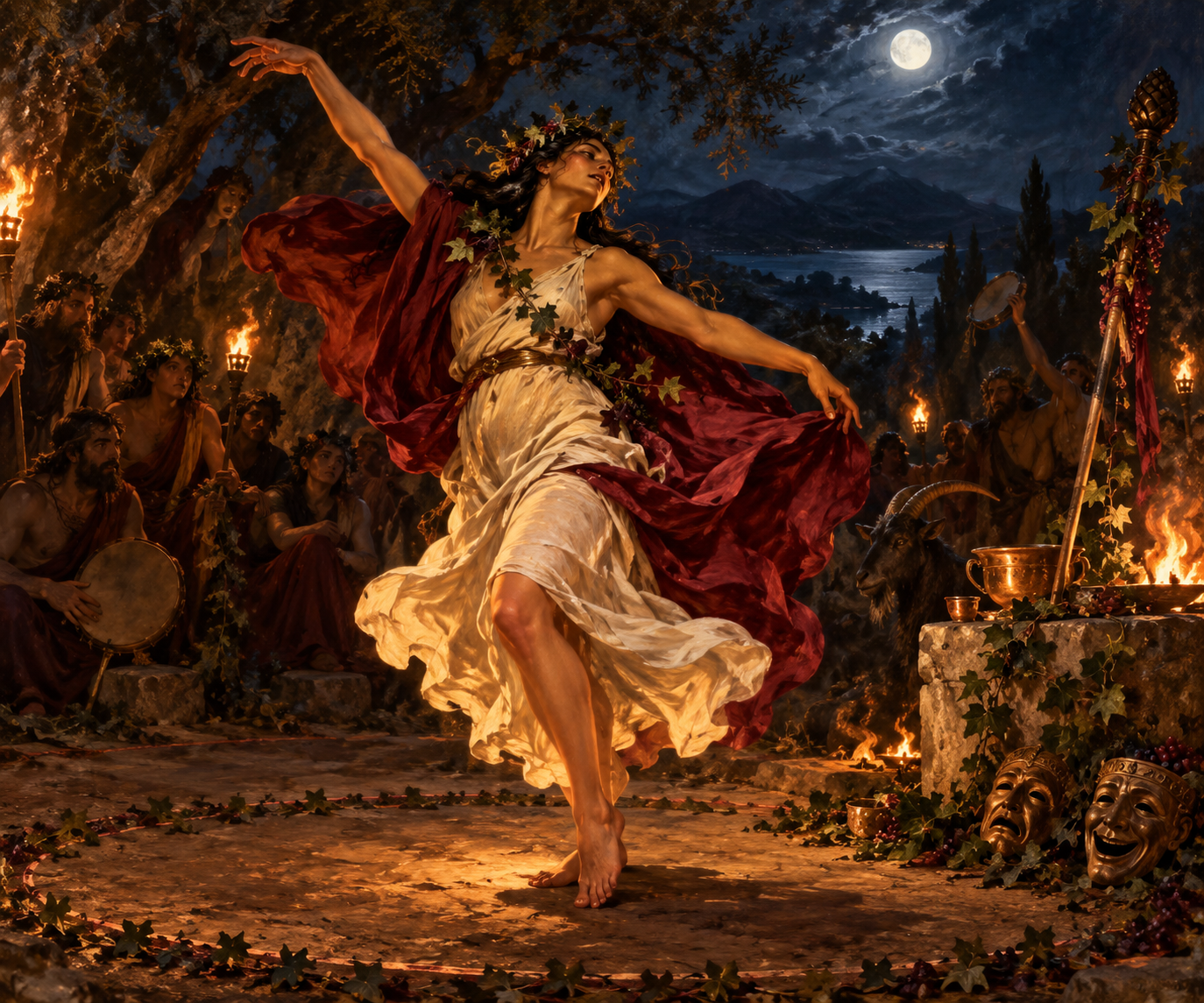
Just as Asterios is unable to transform the Phasis into the Amnisos and instead becomes transformed by drinking the foreign waters, so is it impossible to transport the mysteries of one place to another, argues Epiktetos in Discourses 3.21.12–17:
ἀλλ᾽ ἀπὸ λιμένος μὲν οὐδεὶς ἀνάγεται μὴ θύσας τοῖς θεοῖς καὶ παρακαλέσας αὐτοὺς βοηθοὺς οὐδὲ σπείρουσιν ἄλλως οἱ ἄνθρωποι εἰ μὴ τὴν Δήμητρα ἐπικαλεσάμενοι· τηλικούτου δ᾽ ἔργου ἁψάμενός τις ἄνευ θεῶν ἀσφαλῶς ἅψεται καὶ οἱ τούτῳ προσιόντες εὐτυχῶς προσελεύσονται;
τί ἄλλο ποιεῖς, ἄνθρωπε, ἢ τὰ μυστήρια ἐξορχῇ καὶ λέγεις· οἴκημά ἐστι καὶ ἐν Ἐλευσῖνι, ἰδοὺ καὶ ἐνθάδε. ἐκεῖ ἱεροφάντης· καὶ ἐγὼ ποιήσω ἱεροφάντην. ἐκεῖ κῆρυξ· κἀγὼ κήρυκα καταστήσω. ἐκεῖ δᾳδοῦχος· κἀγὼ δᾳδοῦχον. ἐκεῖ δᾷδες· καὶ ἐνθάδε. αἱ φωναὶ αἱ αὐταί· τὰ γινόμενα τί διαφέρει ταῦτα ἐκείνων;
ἀσεβέστατε ἄνθρωπε, οὐδὲν διαφέρει; καὶ παρὰ τόπον ταῦτα ὠφελεῖ καὶ παρὰ καιρόν; καὶ μετὰ θυσίας δὲ καὶ μετ᾽ εὐχῶν καὶ προηγνευκότα καὶ προδιακείμενον τῇ γνώμῃ, ὅτι ἱεροῖς προσελεύσεται καὶ ἱεροῖς παλαιοῖς. οὕτως ὠφέλιμα γίνεται τὰ μυστήρια,
οὕτως εἰς φαντασίαν ἐρχόμεθα, ὅτι ἐπὶ παιδείᾳ καὶ ἐπανορθώσει τοῦ βίου κατεστάθη πάντα ταῦτα ὑπὸ τῶν παλαιῶν.
σὺ δ᾽ ἐξαγγέλλεις αὐτὰ καὶ ἐξορχῇ παρὰ καιρόν, παρὰ τόπον, ἄνευ θυμάτων, ἄνευ ἁγνείας· οὐκ ἐσθῆτα ἔχεις ἣν δεῖ τὸν ἱεροφάντην, οὐ κόμην, οὐ στρόφιον οἷον δεῖ, οὐ φωνήν, οὐχ ἡλικίαν, οὐχ ἥγνευκας ὡς ἐκεῖνος, ἀλλ᾽ αὐτὰς μόνας τὰς φωνὰς ἀνειληφὼς λέγεις· ἱεραί εἰσιν αἱ φωναὶ αὐταὶ καθ᾽ αὑτάς;
ἄλλον τρόπον δεῖ ἐπὶ ταῦτα ἐλθεῖν· μέγα ἐστὶ τὸ πρᾶγμα, μυστικόν ἐστιν, οὐχ ὡς ἔτυχεν οὐδὲ τῷ τυχόντι δεδομένον.
No one sails out of harbor without first sacrificing to the Gods and calling upon them for aid; nor do people sow without invoking Demeter. And will someone who undertakes so great a work undertake it safely without the Gods? Will those who approach such a man approach him to their benefit?
What else are you doing, man, but dancing out the Mysteries? You say: “There is a sanctuary at Eleusis—look, there is one here too. There is a Hierophant there, and I too shall make a Hierophant. There is a Herald there, and I shall appoint a Herald. There is a Torchbearer there, and I too shall appoint a Torchbearer. There are torches there, and here as well. The utterances are the same. How do the things done here differ from those done there?”
Most impious man! Is there no difference? Are these things beneficial when performed outside their proper place and outside their proper time? They must be accompanied by sacrifices and prayers; one must first have purified oneself and prepared one’s mind beforehand, knowing that one is about to approach sacred things—and sacred things of ancient tradition.
In this way the Mysteries become beneficial. In this way we come to understand that all these things were established by the ancients for the formation and setting-right of life.
But you proclaim them openly and dance them out, outside the proper time, outside the proper place, without sacrifices, without purity. You do not have the garments that the Hierophant ought to have, nor the proper hair, nor the headband, nor the voice, nor the age. You have not purified yourself as he has. Instead, you have merely learned the utterances themselves and say: “Are not the utterances sacred in and of themselves?”
One must approach these matters in another way. The matter is great. It is mystic. It is not something to be undertaken casually, nor is it given to just anyone.
People often translate ἐξορχῇ in this passage as “divulging the Mysteries” from the verb ἐξορχεῖσθαι which more literally means dancing out. LSJ gives the specialized sense of “divulge by dancing”, hence to reveal or profane Mysteries.
So Epiktetos says it twice:
τὰ μυστήρια ἐξορχῇ
“you dance out the Mysteries”
And:
σὺ δ᾽ ἐξαγγέλλεις αὐτὰ καὶ ἐξορχῇ
“you proclaim them openly and dance them out.”
A point that’s relevant for contemporary polytheists, especially those who rely on reconstructionism and similar methodologies, is that a tradition needs living words; Epiktetos says αἱ φωναὶ αἱ αὐταί, “the utterances are the same,” but asks what of it? Then at 16 he repeats φωναί emphatically:
αὐτὰς μόνας τὰς φωνὰς ἀνειληφώς
“having learned only the utterances”
ἱεραί εἰσιν αἱ φωναὶ αὐταὶ καθ᾽ αὑτάς;
“Are the utterances sacred in and of themselves?”
Mere verbal replication does not reproduce the rite.
It’s not even possible.
The old rite is missing, broken, dead.
So we must come up with new rites, new songs, new dances. We need lived religions, rooted in our experiences, engaging with the Gods and spirits of the place where we live. Those can be indigenous or émigré Gods and spirits— they aren’t frozen in amber, aloof and unchanging. They manifest differently in different places— with myriads of faces and myriads of names. And as it says in the New Wine:
Πᾶν θεοῦ ὄνομα θύρα.
Every name of a God is a door.
The Gods and spirits are living beings, and only when a relationship has been forged with them can we hope to be entrusted with Mysteries. Not the ancient Mysteries. Those are gone, lost to the world forever. But real Mysteries, true Mysteries, new Mysteries await manifestation. We just have to make ourselves ready to dance out the Mysteries.
Which reminds me of one of my favorite epithets of Dionysos— Ἀρχέβακχος.
Ἀρχέβακχος hints at an archetypal role: the first one who entered Bacchic ecstasy and thereby opened the path for all who followed. There’s an ambiguity inherent in that— is the one the God or the first human to worship Dionysos that way, to receive his teletē? That’s a remarkably rich image to compress into a single compound. Every living tradition has its Ἀρχέβακχος— not because the founder is perfect, but because someone has to be the first to step onto the dance floor.
It’s a title found in a lot of inscriptions from the Imperial period, which saw a dramatic increase in offices and functions. I’d always understood it as Chief Bacchant, or Person Responsible for training those performing the Bacchic dances. (We’re a world away from the frenzied worshipers depicted in myth and Euripides.) But then I saw it used in a Byzantine anthology of Dionysos, and it became Dionysos acting as the prototype of his votaries. Which is such a beautiful image: the Bacchant from whom all Bacchants take their pattern.
It’s rather like the difference between calling Christ “High Priest” in the sense of holding an office, and understanding him as the archetype from whom every priesthood derives. The office is still there, but now it has an ontological center.
Dionysos as Ἀρχέβακχος means that the Bacchants do not merely imitate him.
They participate in him.
He is the first ecstatic because he is ecstasy itself.
He is the first dancer because every sacred dance is ultimately participation in his dance.
He is the first initiate because every mystery is, in a sense, entry into his own life.
Ritual isn’t theater or historical reenactment. It’s participation. When the initiate recites “I am a child of Earth and Starry Heaven. My name is Starry,” the myth isn’t being remembered from a distance— it is becoming present.
So Ἀρχέβακχος as “Prototype of the Bacchants” feels entirely at home within that framework.
I also have to admit that I love the irony of the historical development. An administrative title that may once have designated the person organizing dances in a local association eventually becomes one of the most theologically evocative names of Dionysos himself. That’s exactly the sort of semantic evolution that makes the history of religion so rewarding to study.
A title that begins as an office ends as a revelation.
And perhaps there’s a quiet lesson in that.
The office says:
“Lead the dance.”
The epithet says:
“He danced first.”
That second statement has a mythic force that the first never quite reaches. The leader is not inventing the dance; he is following the steps of the First Bacchant, even when it is a completely new dance.


I don’t know as I believe the Old Mysteries are gone. Less gone forever. I do believe they are functionally thus, functionally inaccessible. Can they be tapped? Maybe. I hope do. I doubt I’ll see it. I don’t need to.
I otherwise agree that the principle remains, equally functionally, to generate new mysteries. What lies with me, lingering, is the question: how? I have attended groups where force is employed, to replicate or authenticate with the Old, so-called. Christian and Pagan alike.
It strikes me now we’re waiting for Godot. That mysteries unfold, but more like for the man who is understanding of when to grasp the puckerbrush with thistle and thorn and thicket, and when to step back and observe. It’s a lost art I think we’re finding.
I try and follow Odin, and He had brought me to strange houses. Far from where I felt I’d be. Away from Ásatrú and towards the Greeks, through the Greek Church to the seedbed of something being bred for New Englanders. I see through a Christian veneer into something else. And I wonder if that was how Woden felt switching skins as he walked between worlds. A new face for every place.
LikeLike
The Gods and spirits are the ultimate source of mysteries, be they ancient or modern. And the Gods are, and always have been, with us— so that means that it is absolutely possible for them to bring back the ancient mysteries. But why would they do that? Using Greek examples, Eleusis centered on agricultural themes; Samothrace offered protection to sailors; Andania overlapped with Eleusis, but with some regional elements thrown into the mix; Abonoteichos involved a giant snake wearing a mask; Klaros and Didyma required katabasis and initiation before consulting the Oracle in either location. Does any of this speak to the lives, hopes, fears, etc. of modern people? How many people even know how to sacrifice a piglet, let alone the other preliminary offerings that had to be made, such as the special “many-knobbed” cakes? All of those sites are ruins today, most of them under the control of staunchly Orthodox Christian or Moslem governments. They certainly aren’t going to allow us to rebuild the sanctuaries, since a lot of those places depend on tourism to those ruins. Other sites that were important spots along the processional route have been built over. I don’t think the people living there are going to be ok giving up their property or allowing roads and parks and such to be demolished. And suppose we did, what about the infrastructure? Each of those sites had dozens of offices with very specific functions which required years if not decades of training. Everyone from the Hierophant and Herald and the Purifiers and the Sacrificial Priests, on down to the humble Neokoroi who cleaned up after all the pilgrims left and maintained the sites in the off seasons. Where do we find these people (let alone the people to train them) and where is the money to pay them? Or the fortunes that were spent each year to fund the production of the mysteries and the weeks of associated rituals that had to be performed in preparation for the full revelation? I could go on and on and on, because this is a subject near and dear to my heart, but there’s a reason why institutional paganism died when the temples and sanctuaries stopped receiving state funding and were later forcibly closed or destroyed— and why non-institutional forms survived, in some cases for hundreds of years after Justinian and Theodosios. And also why, for instance, you keep finding resurgences of Bacchic worship, often with mysteries of their own. You don’t need all that infrastructure and institutions— just a handful of people who want to go mad for him in the woods or on a mountain. Bacchic mysteries not only still speak the needs and hopes of people today, because there’s so much societal pressure and dysfunction they are more needed than ever. This is why I was able to receive multiple strains of lineaged mysteries for him. But I was also only able to do that after decades of intense worship, study, and engagement with Dionysos. I didn’t even properly understand what a mystery was for part of that time, let alone what makes a proper lineaged tradition.
LikeLiked by 1 person
I understand and agree. I don’t even have a contention. If I did, it would be that (not you) folks talk about the gone and foreverness of the mysteries it therefore excuses a plethora of obtuse novelties with no bearing on precedential worship. So. I tend to believe that the line is drawn between then and now like an umbilical cord at an extremely crooked angle. Without it, the root, it’s just noise. The clanging gongs and noisy prayers Jesus I think rightly decries.
LikeLike
Oh, I couldn’t agree more. New doesn’t mean “not traditional” or even worse “anything goes” (heaven forfend!) Our ancient religions had mechanisms for evaluating and incorporating adaptations, innovations, foreign material (especially important for the colonies and their settlers) and so forth. These mechanisms are wise and needed today even more than in antiquity since most contemporary polytheisms and neopaganisms are only a couple generations old, with a few perhaps going back to the Romantic period, and filled with people who have thoroughly modern mindsets. Replacing that with traditionalism is the first and in many respects most important step to having a legitimate religiosity. (And that’s true of Christian, Polytheist, Jew, whatever.) Any changes or novelties that I adopt must be consistent with my tradition and put through that rigorous process before being accepted— I’m probably much stricter in that regard than a lot of reconstructionists, because you have to be when your place, like mine is, lies on the fringes, pushing at the boundaries of norms and consciousness. It is my job to challenge, to explore, to bring back— not to abolish, however.
LikeLiked by 1 person
I appreciate your candour. And I say it all as one without a proper venue. I am in an Orthodox Greek community, which is in the throes of generating it’s own American subculture. I have an opportunity to ingratiate myself to both sides and have some clout. But everyone would likely be appalled to know my inner workings.
Irregardless. There are many traditions I wish to see reevaluated. I’m sure you know some. I am a broken record. And, I suppose I have my own fringes.
I can almost feel in the air the nearness of unseen strands, bits of thread the Nornir and Moirai leave, like Wōden and his breadcrumbs. But, then, I remember I’m likely quite mad.
LikeLike
Nothing great was ever brought into this world without a little madness. ;)
LikeLike
I suppose this is true.
I’ll be off to bring Tryphe back to the Greeklings, then. ;p
LikeLike
My prevailing hope is that when I finally die and offer myself as meal to Mother Earth, in Her round, that She acknowledge I tried to remember Her in my dealings even as I prayed to Starry Eyed Ouranos.
LikeLike
I have no doubt that she will.
LikeLiked by 1 person
Long may She feast, wide may She grow.
LikeLike
Ginesthō!
LikeLiked by 1 person
🍰
LikeLike