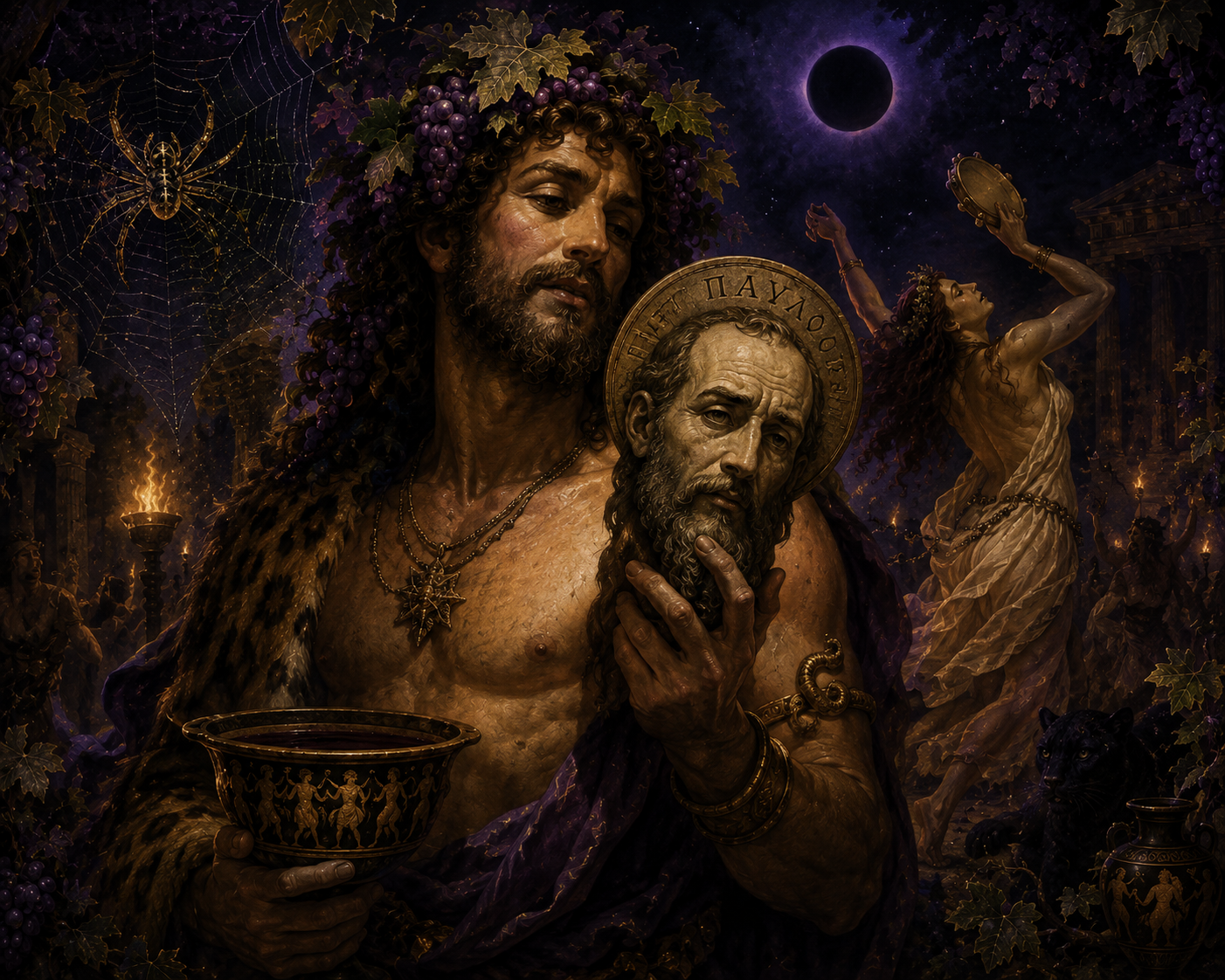
In addition to being the Apostle to the Gentiles, and a Saint and Martyr venerated within most branches of Christianity, Paul is one of the Heroes of the Starry Bull tradition of Bacchic Orphism.
I’m sure that this is a confusing statement for a lot of readers, especially since for many people today a hero is the main character of the story (often a fictional or heavily fictionalized account) who battles bad guys, solves puzzles, gets the girl, grows from a naive novice through a series of character-building adventures into a mass murderer, wise teacher, or trustworthy leader (depending on genre) and usually dies in an act of noble self-sacrifice which preserves others and ensures that the hero’s memory (and ability to generate merchandise) will endure, at least until Hollywood retcons, reboots and engages in “creative” recasting enough to irreparably damage the hero’s legacy. Ask yourself why studios and their shareholders are willing to lose billions and risk alienating their fanbase to degrade the cultural icons of past generations, and you’ll probably have your answer. One may hold differing spiritual taxonomies, values and politics, theories about why this is happening, and even whether this deconstruction may ultimately prove to be a positive thing— but few would argue that these heroes are devoid of ethical value and cultural significance, and since Hollywood is offering no memorable replacements this is having an effect on the collective psyche and society at large. Heroes of this sort teach us who we are, who we want to become, what a good person and good life look like, and they struggle with or triumph through the culture’s values and norms. When a culture loses its heroes, so too is an important piece of personal formation lost.
But the Starry Bull understanding of what such beings are, do, and mean is strongly influenced by the ancient Greek conception of the ἥρως; basically a dead person who remains powerfully active in the world of the living through dreams, visions, oracles, healing, promotion of fertility, protection of the community and other miraculous demonstrations of their posthumous δύναμις and κλέος. Their power is usually geographically limited to the area around their grave, cenotaph, underground chamber, cave, grove, or temple— with notable exceptions such as Heraklēs, Odysseus, Achilles, Alexander or Antinous who had various cult-centers throughout the Mediterranean, Near East and Asia Minor. Bacchic Heroes are not tied to a particular locale either. They don’t necessarily have to be paragons of virtue. Nor do they necessarily have to have been confessional Dionysians in life— though they do have to be active within the domain of Dionysos. Starry Bull Heroes can be broken down into the following three categories:
- Confessional Dionysians whose earthly lives were already devoted to Dionysos. Some of them suffered or died because of this devotion.
- Those who joined the Retinue after death because of the beauty of his domain, the quality of afterlife experienced by its residents, or their belief in the cause for which he is collecting souls.
- Figures whose image Dionysos appropriated, especially where cultural circumstances made direct engagement impossible.
Some of the souls who reside with Dionysos in Nysa do not leave the awe-inspiring Mountain or its flower-rich meadow, or the feasting hall within the Mountain; others go on special missions to our world and ride with the Furious Host to combat monsters, assist living Dionysians, or engage in diplomatic missions to other parts of the supernatural realms and their inhabitants. These spirits are granted the status of Bacchic Heroes and revered by adherents of the Starry Bull tradition in a variety of ways, many of them modeled on the practices of ancient Greek hero cultus, especially the unique rites and customs of Bacchic Orphic religious associations (thiasoi, speira, orgeones, and collegia are the commonest names for these groups) and their wider communities, if they existed. There are several categories among the Bacchic Heroes, though it is uncertain if there are more categories than these, as our knowledge is based on a combination of tradition and direct, experiential engagement with them:
- The Phylakitai: Warriors who have pledged their loyalty to Dionysos, and the defense of Nysa and its inhabitants.
- Technitēs: Artists who bring inspiration and skill to those using their gifts to honor Dionysos and his Retinue.
- The Prophētai: Gifted diviners and seers who help ward the space and assist the mantis who calls on them.
- Architelestai: Master ritualists who protect and assist Bacchic spiritworkers who call on them.
- The Mystai: Initiates who are committed to helping those who have, or are currently undergoing the process of initiation.
- The Anaktes: Elders of the tradition, who are entrusted with its protection and flourishing. Must be consulted on any important matters or changes being considered.
Since status as a Hero in the Starry Bull tradition does not imply doctrinal perfection (but someone having embodied, transmitted, or revealed something genuinely valuable within the larger Dionysian story) that leaves room for figures from very different traditions to stand alongside one another without erasing their differences or requiring that everything they taught be adopted wholesale. It’s a surprisingly flexible model, and consistent with our broader conviction that Dionysos’ activity is not confined to one geography, ethnicity, time period or even religious institution, which is how Paul and a number of other Jewish and Christian figures found their way to Nysa, among them:
- John the Baptist
- Marcus the Magician
- Saint Genesios
- Saint Tryphon
- Ex-Saint Margaret of Antioch
- Saint Denys
We’re not saying Paul and the others were part of a secret Bacchic Orphic sect, or that Christianity is simply Dionysianism under a different name. Rather, we’re looking at places where traditions intersect, symbols migrate, and individuals become part of a much larger religious vocabulary and history.
Paul is especially interesting in that regard because he lived and wrote in a thoroughly Hellenistic world. Whether one approaches his letters as scripture, literature, or historical documents, they employ imagery and vocabulary that audiences steeped in Greek culture would have recognized. This recognition in part is because of his extensive use of Bacchic Orphic and general mystery technical language, but also the role he plays in folk Christianity beginning with the Paul and Thecla literature which has strong parallels to Euripides’ portrayal of Dionysos in the Bakchai. Even ignoring the linguistic and thematic borrowings, The Acts of Paul and Thecla is certainly an unusual work within early Christian literature: dramatic, itinerant, full of reversals, miraculous escapes, charismatic authority, challenges to civic expectations and a prominent position given to women, especially Thecla who is the true star of the story. Then there’s Paul’s involvement in Tarantism, which I’ve discussed here and here. Tarantism has long fascinated historians because it occupies that liminal space between medicine, religion, music, dance, folk practice, and ecstatic healing.
In different regions Tarantism could be associated with different Saints — John the Baptist, Saint Rocco, the Apostle Peter, etc — but I don’t think it’s accidental that Saint Paul has such strong associations with the phenomena.
Paul’s canonical Epistles and the book of Acts present his reports of visionary and ecstatic experiences such as his ascent to the “third heaven” (2 Corinthians 12) and exercising charismatic gifts (1 Corinthians 13) such as healing, gnōsis, and glossolalia.
In one of his most memorable adventures (Acts 28:3-6) Paul acquired passage on a ship that was wrecked during a terrible storm. Paul and several of his compatriots survived, washing ashore on a Maltese beach. While adding some wood to keep the fire going, a viper who’d been hiding in the stack latched onto his arm. His compatriots were certain that this proved he had incurred the disfavor of the Gods and would soon die, but after praying Paul shook the snake loose and was perfectly fine, demonstrating supernatural immunity to the creature’s venom.
And a little known fact about Paul that’s often obscured in English translations is that he’s said to have supported his mission for a number of years by working with his hands as a σκηνοποιός. Traditionally this is translated as “tentmaker” but the exact meaning has been debated. The word is rare, and scholars have proposed leatherworking, awning-making, sail-making, or related crafts. However the obvious interpretation is what the Greek straightforwardly says: someone who makes the σκηνή.
This is a theatrical term for the backdrop of the stage, which concealed the actors’ dressing-room. Considering the parts of the Roman Empire he was traveling through there’s a good chance Paul was working for the Technitai Dionysou, an international network of guilds consisting of performers, playwrights, craftsmen and others who not only put on theatrical performances but staged festivals, music, public ritual and civic spectacles. These guilds became immensely popular during the Hellenistic period when monarchs employed visual propaganda to legitimize their rule and create national identities. The guilds gained not only prestige but wealth, prerogatives and political power; they survived the absorption of the Hellenistic kingdoms and city-states into Rome, and either merged with the Imperial Cult or received patronage by the Emperors and their households.
Although professional associations to some degree, the guilds were often organized like thiasoi with priests and other religious functionaries. So even if Paul wasn’t a member he likely traveled in the same circles as the Technitai Dionysou (both figuratively and literally) and one can imagine the sorts of conversations they had after hours or while they were putting up or breaking down the stage and set-pieces. I suspect this is how Paul became conversant in Dionysian literary and mystery terminology, rather than him necessarily being a secret convert to Bacchic Orphism considering that his writings— especially Romans and Galatians —show him to be a pious (albeit heterodox) diasporan Jew and member of the nascent Jesus movement. Then again Paul traveled thousands of miles through ports, market towns, sanctuaries, colonies, and major urban centers. He lodged with artisans, merchants, patrons, householders, synagogue communities, and converts. He preached in public spaces and private homes. He spent time imprisoned. He sailed with merchants and soldiers. He debated philosophers in Athens and spoke before governors. The overall picture we get from Acts is of someone constantly crossing social boundaries. In fact it’s probable that he also interacted and communicated with even more marginal figures than the New Testament portrays, considering his occasional subject matter and language— itinerant religious specialists, magicians, pilgrims, and temple functionaries or holy men. Precisely the sort of people Paul was trying to reach, people of other religious, class, social and ethnic backgrounds— the outcast and despised —despite limited agreement with those people’s beliefs and practices. However, the more time you spend among and talking with such fellow travelers the more you pick up their lingo, consciously or not. It’s not like they had Keeping up with the Kardashians or Dancing With the Stars so they discussed mystic and sacred things over the campfire. Or probably argued. But Paul remembered those conversations later on when he sat down to compose his Epistles, especially to cities which had a strong Dionysian culture such as Corinth or Thyateira.
Hmm. Who does that sound like? Hint: his name rhymes with raucous.
It’s also fitting for Paul himself. Whatever else he was, he was a communicator. Good communicators don’t merely transmit ideas— they learn the language, assumptions, metaphors, and concerns of the people in front of them. They are assimilative, becoming whatever or whomever they are currently communicating with. Whether he was speaking to synagogue-goers, philosophers, artisans, or devotees of local cults, it would have been almost impossible not to absorb something of their vocabulary along the way.
Or as Paul explicitly tells us, in order to make converts he adapted himself rhetorically:
“I have become all things to all people…”
Whatever one thinks of that statement theologically, it demonstrates a remarkable awareness of audience and communication.
I suspect that’s one reason Paul’s letters still feel so alive. They don’t read like someone writing from an ivory tower. They read like someone who has spent years on dusty roads, in workshops, on ships, and around campfires, talking late into the night with anyone willing to listen. That image seems entirely consistent with the historical Paul, regardless of where one ultimately lands on the theological questions surrounding him.
Another was Paul’s liminal traits which were probably a factor in his becoming associated with Tarantism rather than the thousands of other Saints recognized by Christendom in both the East and West.
Saint Paul was:
- a visionary
- a traveler
- a miracle worker
- someone associated with snakes
- someone who survived poison
- someone who mediates between cultures
- someone who undergoes a radical transformation, and causes radical transformations in others through dance and ecstasy, especially women
Dionys— sorry, Saint Paul is unusually adaptable within folk religion because of these motifs. A folklorist might answer by tracing local traditions, regional symbolism, healing rituals, and the interaction between official Christianity and vernacular practice. Our methodology and conclusions are much simpler: perhaps the Saint’s symbolically compatible image became a vessel through which Dionysos continued to act, in parts of Italy that were profoundly Catholic (though in Greek and Roman times they had been centers of Bacchic cult, often with a strong Orphic influence.). That isn’t a historical hypothesis in the ordinary sense. It’s a hermeneutic— a way of understanding the religious meaning of the tradition.
This is not a declarative statement. There is simply no way to meet academic standards of certainty regarding the assertion that Dionysos traveled around visiting his old cult centers in 16th century Italy wearing the face of Saint Paul, spreading collective madness in his wake which caused portions of the populace to dance compulsively— but when said Saint abducts a woman from her oppressive and violent family, seduces her, makes passionate love to her, marries her, and periodically forces her to dance along with the crowd until she reaches an ecstatic state, well … that doesn’t sound like the behavior of one of the most prolific Biblical authors to me. Especially since this was not an isolated incident but a pattern repeated thousands of times from Tarantism’s origin around the 12th-13th centuries to its decline and eventual demise in the 1950s and ‘60s.
That distinction matters because it allows people to engage with the idea without requiring them to accept it as a conclusion of historical scholarship. That scholarship may help elucidate the circumstances which contributed to the emergence of Tarantism— either as a cult of collective mania that spontaneously erupted in impoverished and often war-torn communities in Spain, Italy, France and Germany or atavistic expressions of Bacchic cults dating back to the period of Greek colonization which occurred because of the activity of Dionysos. Whichever way you choose, historical discoveries do not usually alter things. For instance, suppose that next week a document definitively proving that σκηνοποιός meant “tent-maker” was discovered in a trash heap dating from the 2nd century BCE to the 1st century CE. It removes a pillar of proof, but doesn’t change a thing, regardless of which position you take.
Though this does bring up a principle I’ve repeatedly stressed in discussions about the Starry Bull tradition: the importance of transparency regarding sources and levels of certainty. We’re not saying, “This is an established, incontrovertible fact,” but rather, “This is how our tradition understands these recurring patterns.” And while these categories are given different weight within the tradition we’re completely up front about whether something is based on an ancient source, and what kind of source it was; or if it’s something we were given during ritual or a dream or in a vision; if it’s something we deduced through careful study and reflection or in conversation with colleagues; and even if it’s pure speculation or a pun or nerdy joke that you need to be familiar with a dozen sources spread over a thousand years to truly get. All of these are considered legitimate sources of knowledge and have served as grounds for consideration when it comes to possibly including something as part of the Starry Bull tradition. The words “consideration” and “possible inclusion” are important since that alone is not sufficient grounds for adopting something into the tradition. It’s a first step which triggers analysis, debate by members, consultation of Boukoloi and Orpheotelestai and other elders of the tradition, as well as prayer, offerings and divination or an oracular session with Dionysos; as well as experimentation, testing its efficacy and longevity, and that the novel element fits within the complex network of symbols, metaphors, ritual vocabulary, and the overarching conceptual framework of the tradition. All of these are pathways to truth which should ideally be considered or traversed before that important decision is reached, unless there are sufficient grounds for skipping steps. We did not rush into accepting Tarantism as one of the strains that formed the Starry Bull tradition, and “Saint Paul” as a πρόσωπον adopted by Dionysos when he spent time in Southern Italy and other locations where Tarantism and related outbreaks of collective madness occurred from the expulsion of the Kalbid Dynasty who ruled on behalf of the Fatimid Caliphate to attempts to modernize and assimilate the rural parts of Sicily and Southern Italy, ranging from increased access to psychiatric treatment to widespread use of pesticides to eliminate the spiders whose bite brought on the healing crisis of Tarantism.


It seems Bible scholars have been reaching a consensus that Paul never even existed historically.
LikeLiked by 1 person
It seems Bible scholars have been reaching a consensus that Paul never even existed historically.
LikeLiked by 1 person
I think that’s bullshit. There’s less evidence proving Sokrates existed than Paul or Jesus, yet how many scholars doubt Sokrates lived? Or Empedokles, where you’ve got even less than Sokrates? They just have a problem with the teachings of Jesus and Paul, or how people use their teachings.
LikeLike
yeah, that is bullshit. and i work with bible scholars..not anything any of them are saying in my neck of the woods.
LikeLike
You lost me. I am not sure if it is because your language is dense or specialized or my brain is having an off day. I am still trying to figure it all out.
LikeLiked by 1 person
I did bounce around a bit, and included less explanation because I’d already done that in the pieces I linked to. Where did things go off the tracks for you?
LikeLike
I think my brain is wonky. I do have problem with bouncing around. I am trying to understand how you fill in your jigsaw puzzle for the tradition. The methods involved. I think that it is important in recreating our religions.
LikeLike
I do have a tendency to bounce around and use odd verbiage and talk over many of my readers. Which is fine with some things, but when I’m discussing important things like gap-filling I need to be clearer and more careful with my style.
LikeLiked by 1 person
Please keep explaining things at your level. It’s a good exercise for “the little grey cells” to parse out what is being communicated. You’ve always been good with rewinding to explain in simpler terms when asked to.
Concerning Paul – it sounds like he’d qualify as a Trickster. He was able to enter places that were not meant for him and was able to encourage change that would not have happened without his entry and action.
LikeLike
Oh, my Gods. Have you read the Paul and Thecla literature? He’s 100% a trickster figure. He shows up, awakens Thecla from her dreary life as a pampered wealthy daughter, and instead of running off with her, but poofs away as her parents show up and finds them in the nearby forest. They have a conversation, then Thecla gets poofed away. She goes on some adventures, which she either figures out through her own cleverness, or else Paul shows up like a deus ex machina and then poofs her away again. This pattern repeats a couple times, until the mercenaries Thecla’s parents hired catch up with her. She’s interrogated, tortured, and interrogated some more, and then it’s decided to just kill the stubborn girl. Paul is in the audience, and carries her soul away when she finally dies, transporting her to heaven where she immediately becomes a Saint.
My recollection may be a bit off since it’s been about 2 decades since I read the text. But Paul and Thecla literature was so popular in antiquity (especially in North Africa and the Churches of the Levant and Asia) that it almost made it into the canon. Some in the West, however, didn’t like the portrayal of Paul which is more trickstery than classically heroic. The rest of the Churches were like, “Fine. Fuck you. We’ll just read it on our own and worsjip Thecla” and sure enough she became one of, if not the most popular Saint in the East, where she performed a ton of healing and other miracles.
LikeLiked by 1 person
No, I am totally unfamiliar with Paul and Thecla. If you recall the titles, please post them.
LikeLike
I searched Amazon.com for Saint Paul and Saint Thecla and found several books in print. If there is a title or author you recomment, please let me know.
LikeLike
The Wikipedia article I linked to is a decent introduction:
https://en.wikipedia.org/wiki/Acts_of_Paul_and_Thecla
Here’s a translation of the text:
https://www.newadvent.org/fathers/0816.htm
Here’s something from the Church of Saint Thecla:
https://stthecla.com/about-us/saint-thecla/
There’s a ton of sites by feminists and biblical skeptics, but I can’t stand to skim them to see if they contain any decent information along with the inevitable invective. I’d search on Academia.edu if you want to see what the scholars have to say, and only afterwards consider purchasing any books.
LikeLiked by 1 person
Thank you.
LikeLike
ignore the feminist crap. …i’d buy Jeremy Barrier’s translation. it’s becoming an academic standard.
LikeLike
it’s been awhile sinceI read it, but Paul exits early on. Thekla goes around as a miracle worker until she disappears into a mountain ora stone, escaping men who want to rape her. she is bad ass. you don’t hear her voice until chapter ten or somethingo the story, but once she takes a stand, she carries it through and Paul is very much an instigator and then gone…even refuses to baptise her so shedoes it herself.
LikeLike
I have so many questions that I peppered about various posts. Sorry about that.
LikeLike
No, I love it! Keep ’em coming if you want. Engagement is the whole point of blogging. I can sit in my office, getting high and thinking deep thoughts, all on my own. If I’m posting it’s because I want to have a conversation.
LikeLike