
I’m listening to Marilyn Manson’s Speed Of Pain, and the opening lyrics remind me of Saint John’s Eve:
They slit our throats
Like we were flowers
And our milk has been
Devoured
I’m listening to Marilyn Manson’s Speed Of Pain, and the opening lyrics remind me of Saint John’s Eve:
They slit our throats
Like we were flowers
And our milk has been
Devoured
From the 38th Book of Nonnos of Panopolis’ Dionysiaka:
The Satyrs dived into a bear’s cave, and hollowed their little bed in the rock with sharp finger-nails in place of cutting steel; until the lightbringing morning shone, and the brightness of Dawn newly risen showed itself peacefully to both Indians and Satyrs. There was no carnage among them then, no conflict, and the shield which Bacchos had borne for six years lay far from the battle covered with spiders’ webs.
[…]
A foreboding sign was shown to winefaced Bacchos in the sky, an incredible wonder. For at midday, a sudden darkness was spread abroad, and a midday obscurity covered Phaethon with its black pall, and the hills were overshadowed as his beams were stolen away.
[…]
Then a happy omen was seen by impatient Bacchos, an eagle flying high through the air, holding a horned snake in his sharp talons. The snake twisted his bold neck, and slipt away of itself diving into the river Hydaspes. Trembling silence held all that innumerable host. Idmon alone stood untrembling, Idmon the treasury of learned lore, for he had been taught the secrets of Urania, the Muse who knows the round circuit of the stars: he had been taught by his learned art the shades on the Moon’s orb when in union with the Sun, and the ruddy flame of Phaethon stolen out of sight from his course behind the cone of darkness, and the clap of thunder, the heavenly bellow of the bursting clouds, and the shining comet, and the flame of meteors, and the fiery leap of the thunderbolt.
Uhm … really? I shouldn’t be surprised, but really? Bears, Spiders, the Shield of Dionysos, a Black Sun, an Eagle carrying off a Serpent, and Thunderstrike. Literally everything I’ve been posting about for the last week or so, all in one passage.
The Phrygian prophet then goes on to interpret these as auspicious omens indicating that he will triumph over his adversaries.
Evening rises, darkness threatens to engulf us all
But there’s a moon above it’s shining and I think I hear a call
It’s just a whisper through the trees, my ears can hardly make it out
But I can hear it in my heart, vibrating strong as if she shouts
Oh Ariadne, I am coming, I just need to work this maze inside my head
I came here like you asked, I killed the beast, that part of me is dead
Oh Ariadne, I just need to work this maze inside my head
If only I’d have listened to you when you offered me that thread
At least that’s what scholars think the Neolithic Spiderweb Stones in Denmark signify:
FROM ANCIENT NATIVE AMERICANS TO the classical Greeks to today, spiders and their webs have long had symbolic and religious meaning. Now, archaeologists digging at a Neolithic site on Bornholm, Denmark’s easternmost island, have unearthed some mysterious 5,000-year-old stones engraved with what appear to be spiderwebs. But they may not have had anything to do with arachnids.
Their patterns are not vastly different than those on the roughly 300 “sun stones” found since the 1990s at the site of Vasagard, on the same island, which appears to have been a ceremonial center for Neolithic sun worship. (Bornholm is the place in Denmark with the most hours of sunlight per year—so perhaps it is no surprise that prehistoric sun-lovers gathered there.) However, as explained by Finn Ole Son Nielsen, chief archaeologist at the Bornholm Museum, sun stones usually have a simpler set of radiating lines—while the new finds have more intricate lines in between, giving them a distinctly arachnoid look. Researchers have found at least four so far, including one that is somewhere between a sun stone and a spiderweb stone.
The hypothesis is that spiderweb stones may, in fact, just be another way to represent the sun. So Nielsen looked to the symbolic use of spiderweb-like designs across Europe, and found one depicted on the ceiling of medieval church in France. In that case it probably represented heaven or the space between life and death. He suspects the Neolithic stones held some kind of similar purpose, but there’s no way to know.
This interesting story came across my newsfeed:
The universe is permeated by a vast, invisible web, its tendrils weaving through space. But despite organizing the matter we see in space, this dark web is invisible. That’s because it is made up of dark matter, which exerts a gravitational pull but emits no light. That is, the web was invisible until now. For the first time, researchers have illuminated some of the darkest corners of the universe.
How wyrd.
I mean, isn’t it funny how science is just now starting to catch up to shit our ancestors grasped thousands of years ago?
Relatedly, a spider’s web is part of its mind, new research suggests:
Spiders, it turns out, appear to possess an extraordinary form of consciousness that we’re only beginning to understand, and it has to do with their webs, reports New Scientist. Researchers are slowly coming around to the idea that spider webbing is an essential part of these creatures’ cognitive apparatus. The animals don’t just use their webs to sense with; they use them to think. It’s part of a theory of mind known as “extended cognition,” and humans utilize it too.
The instinct to take the last post down after getting up from my nap was strong, and only got stronger as the evening wore on.
I don’t like showing vulnerability to begin with, and when you consider how many enemies I’ve accumulated over the years it can be a serious liability. (Especially with how many of them are magicians of some talent and could use this to strike against me.)
Beyond that, I admitted some things I don’t particularly like about myself, like how it’s affected me that my influence has waned and the role I’ve played in driving folks away. I can rationalize it by saying that the involvement of others is necessary for the work I’ve been given to do for my Gods and Spirits and the string of failed groups I’ve started is just another way I’ve let them down – but there’s more to it than that.
I crave the respect of others, I want to accomplish meaningful and extraordinary things that will live on beyond me, I want to have people who excite and inspire me that I can collaborate with and who will help pick up the slack when I’m hurting, exhausted and stretched too thin as I often am these days, and – fuck, this is hard – I even want to be liked for who I am, not just what I can do for other people.
And I’m keenly aware that I don’t make that easy. I’m strange and off-putting, I take hard and controversial stances, I don’t care about the things most people do and won’t bother faking it, I don’t let folks in easily or reach out, it takes a lot to get back in my good graces once someone disappoints me, and I have a tremendous capacity for ruthlessness and cruelty when I am wronged.
To compound things, I’m going through a really rough period health-wise. It’s not necessary to go into all of that, but let’s just say that I count the hours I’m not sick or suffering high levels of pain, and there aren’t many of them in a given day. That’s affecting everything from my general outlook on life to my fraying relationships with friends and loved ones to the state of my religious practice, which requires serious effort to do even the simplest of things like pray and make offerings, let alone the types of ecstatic and magical practices that used to be second nature to me.
I have a sense of what I need to do to dig myself out of this, but most days I find it challenging to manage self-care and household chores, let alone higher level functions such as traversing the abyss, confronting the empty husks of dead selves, transmuting poison into the elixir of life, and harnessing the rays of the Black Sun. Especially since I’m figuring shit out as I go, there’s no guarantee I’m going to succeed and I don’t exactly have any living lineage elders or even a community I can turn to for advice and support.
But I know that if I don’t do something, and soon, this situation is not just going to get worse – it will destroy me.
And so that’s why I made the previous post and this one. I needed a good, hard look in the mirror, an unflinching inventory of where I’m at, what’s going on in my head and in my life, and to unburden my soul through public confession so that I can begin to move forward. I do this all the time, internally, as part of my practice of discernment – but there are minimal consequences when it’s just in your head, or something shared with someone who’s going to accept and love you no matter what.
I needed to put this stuff out there because I didn’t want to, so even the folks who hate me could see it, so that both the truths and the lies of it can no longer hold power over me. I had to declare, “this is who I am” so that I could move past that and become something else.
And now it’s time to do that.
And there goes another long-time online acquaintanceship up in flames. Man, I’m really shitty at this whole “playing well with others” thing.
I’ve got around 600 people still subscribed to House of Vines, maybe 20 of which engage with any kind of regularity. And the active ones, well, that number shrinks down to about 5 or 6.
I get it.
I’m arrogant, myopic, opaque, uncompromising and bellicose. And those are my positive traits.
Worse, everything I write is basically this:
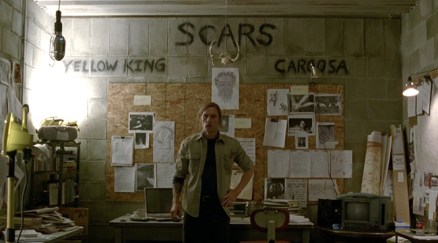
Unless you happen to share my obsessions or enjoy a good rabbit hole, there’s no point following along. Even then, you’re probably only going to understand 1/3 of my posts. Especially since I rely so heavily on breadcrumbs, parallelism, repetition, etc. To understand one post you need to keep in mind shit I wrote 10-20 posts back. A lot of the time I don’t even necessarily know what the point is myself until it all coalesces.
Then I struggle to find a way to communicate it to others, if that’s even possible. When I try to write relatable things it comes off flat and insincere. Projects, contests and other interactive shit just gets crickets. I’m basically writing for myself at this point, and some theoretical community of kindred spirits I despair of ever meeting. People I considered closer than family won’t speak to me, and the rest I pushed away either actively or through neglect.
Hell, I used to receive a dozen or more e-mails a day; now maybe 3 or 4 trickle in a week, and half of those I lose or can’t get to until they’re irrelevant because my life is a constant whirlwind of chaos and craziness. I’m an Orpheotelest without any clients, which is an oxymoron.
Am I gonna change? Probably not. Because I feel bone deep that I’m on the right track and a huge breakthrough is just around the corner.
And I recognize how utterly insane that sounds, and not the good or fun kind either.
But what choice have I got? I know the answer to that question: there is nothing but choice. Every second of every day we are choosing, and the shape of our life is determined by that.
And right now I choose to post this with the comments off (since I don’t need any ego-stroking) and go take a nap, hoping my outlook will be a little less bleak when I wake. (And knowing that it won’t.)
.
“Durp durp. A bunch of Neopaganish blather. I don’t like what you’re doing to Dionysius or Asatru by mixing them all up like this.”
I have no affiliation with Ásatrú, which is a particular religion under the Heathen umbrella, along with Theodism, Forn Siðr, Northern Trad, etc. You are free to criticize my methods and contest my right to apply the Heathen label to what I’m doing. But as I’ve abundantly demonstrated there is more evidence (both in sheer quantity and kinds of material) for Dionysos-worship in Germanic and Slavic lands than you’ve got for 80% of your pantheon. (And I’m being generous; it’s probably closer to 95%.) So as The Dude once said, “Yeah? Well, you know, that’s just like uh, your opinion, man.“
“And what’s this nonsense about him slaying Giants? He’s a peaceful, fun-loving God – during the Gigantomachia all he did was ride in on the back of a donkey. The animal brayed and it frightened the sons of Gaia. His ass is more valorous than he is.”
You need to read more, friend. Start here.
Apollodoros, Bibliotheca 1.37
In the War of the Giants Dionysos slew the Giant Eurytos with his thyrsos.
Arnobius of Sicca, Against the Heathen 5.5-6
In him there had been resistless might, and a fierceness of disposition beyond control, a lust made furious, and derived from both sexes. He violently plundered and laid waste; he scattered destruction wherever the ferocity of his disposition had led him; he regarded not Gods nor men, nor did he think anything more powerful than himself; he contemned earth, heaven, and the stars. Now, when it had been often considered in the councils of the Gods, by what means it might be possible either to weaken or to curb his audacity, Liber, the rest hanging back, takes upon himself this task. With the strongest wine he drugs a spring much resorted to by Acdestis where he had been wont to assuage the heat and burning thirst roused in him by sport and hunting. Hither runs Acdestis to drink when he felt the need; he gulps down the draught too greedily into his gaping veins. Overcome by what he is quite unaccustomed to, he is in consequence sent fast asleep. Liber is near the snare which he had set; over his foot he throws one end of a halter formed of hairs, woven together very skilfully; with the other end he lays hold of his privy members. When the fumes of the wine passed off, Acdestis starts up furiously, and his foot dragging the noose, by his own strength he robs himself of his sex; with the tearing asunder of these parts there is an immense flow of blood; both are carried off and swallowed up by the earth; from them there suddenly springs up, covered with fruit, a pomegranate tree.
Diodoros Sikeliotes, Library of History
[3.71.3] As for Kronos, the myth relates, after his victory he ruled harshly over these regions which had formerly been Ammon’s, and set out with a great force against Nysa and Dionysos. Now Dionysos, on learning both of the reverses suffered by his father and of the uprising of the Titans against himself, gathered soldiers from Nysa, two hundred of whom were foster-brothers of his and were distinguished for their courage and their loyalty to him; and to these he added from neighbouring peoples both the Libyans and the Amazons, regarding the latter of whom we have already observed that it is reputed that they were distinguished for their courage and first of all campaigned beyond the borders of their country and subdued with arms a large part of the inhabited world.
[3.71.4] These women, they say, were urged on to the alliance especially by Athena, because their zeal for their ideal of life was like her own, seeing that the Amazons clung tenaciously to manly courage and virginity. The force was divided into two parts, the men having Dionysos as their general and the women being under the command of Athena, and coming with their army upon the Titans they joined battle. The struggle having proved sharp and many having fallen on both sides, Kronos finally was wounded and victory lay with Dionysos, who had distinguished himself in the battle.
[3.71.5] Thereupon the Titans fled to the regions which had once been possessed by Ammon, and Dionysos gathered up a multitude of captives and returned to Nysa. Here, drawing up his force in arms about the prisoners, he brought a formal accusation against the Titans and gave them every reason to suspect that he was going to execute the captives. But when he got them free from the charges and allowed them to make their choice either to join him in his campaign or to go scot free, they all chose to join him, and because their lives had been spared contrary to their expectation they venerated him like a God.
[3.71.6] Dionysos, then, taking the captives singly and giving them a libation (spondê) of wine, required of all of them an oath that they would join in the campaign without treachery and fight manfully until death; consequently, these captives being the first to be designated as “freed under a truce” (hypospondoi), men of later times, imitating the ceremony which had been performed at that time, speak of the truces in wars as spondai.
[3.72.3] Near this city an earth-born monster called Campê, which was destroying many of the natives, was slain by him, whereby Dionysos won great fame among the natives for valour. Over the monster which he had killed he also erected an enormous mound, wishing to leave behind him an immortal memorial of his personal bravery, and this mound remained until comparatively recent times.
[3.72.4] Then Dionysos advanced against the Titans, maintaining strict discipline on his journeyings, treating all the inhabitants kindly, and, in a word, making it clear that his campaign was for the purpose of punishing the impious and of conferring benefits upon the entire human race. The Libyans, admiring his strict discipline and high-mindedness, provided his followers with supplies in abundance and joined in the campaign with the greatest eagerness.
[3.72.5] As the army approached the city of the Ammonians, Kronos, who had been defeated in a pitched battle before the walls, set fire to the city in the night, intending to destroy utterly the ancestral palace of Dionysos, and himself taking with him his wife Rhea and some of his friends who had aided him in the struggle, he stole unobserved out of the city. Dionysos, however, showed no such a temper as this; for though he took both Kronos and Rhea captive, not only did he waive the charges against them because of his kinship to them, but he entreated them for the future to maintain both the good-will and the position of parents towards him and to live in a common home with him, held in honour above all others.
Diodoros Sikeliotes, Library of History 4.15.1
Zeus gave the name of Olympian only to those Gods who had fought by his side, in order that the courageous, by being adorned by so honourable a title, might be distinguished by this designation from the coward; and of those who were born of mortal women he considered only Dionysos and Herakles worthy of this name.
Harpokration, Lexicon of the Ten Orators
Apomatton (wiping off): Demosthenes in For Ktesiphon. Some understand it plainly for ‘wiping away’ and ‘cleaning oneself,’ but others more elaborately, as ‘plastering clay and bran on those being initiated,’ as we say ‘to wipe the statue with clay’: for they used to anoint with clay and bran the initiates, imitating the stories told in myths according to some, that the Titans hurt Dionysos by plastering themselves with gypsum to avoid being recognized. (They say) that then this custom has ceased, but that later people smeared themselves with mud for tradition’s sake. Sophokles in Aichmalotides: ‘purifier of the army and experienced in rites of cleaning’ and again: ‘and most skilled wiper-off of great misfortunes.’
Horace, Odes 2.19
I saw Bacchus on distant cliffs – believe me,
O posterity – he was teaching songs there,
and the Nymphs were learning them, and all
the goat-footed Satyrs with pointed ears.
Evoe! My mind fills with fresh fear, my heart
filled with Bacchus, is troubled, and violently
rejoices. Evoe! Spare me, Liber,
dreaded for your mighty thyrsus, spare me.
It’s right to sing of the willful Bacchantes,
the fountain of wine, and the rivers of milk,
to sing of the honey that’s welling,
and sliding down from the hollow tree-trunks:
It’s right to sing of your bride turned Goddess, your
Ariadne, crowned among stars: the palace
of Pentheus, shattered in ruins,
and the ending of Thracian Lycurgus.
You direct the streams, and the barbarous sea,
and on distant summits, you drunkenly tie
the hair of the Bistonian women,
with harmless knots made of venomous snakes.
When the impious army of Giants tried
to climb through the sky to Jupiter’s kingdom,
you hurled back Rhoetus, with the claws
and teeth of the terrifying lion.
Though you’re said to be more suited to dancing,
laughter, and games, and not equipped to suffer
the fighting, nevertheless you shared
the thick of battle as well as the peace.
Cerberus saw you, unharmed, and adorned
with your golden horn, and, stroking you gently,
with his tail, as you departed, licked
your ankles and feet with his triple tongue.
Hyginus, Astronomica 2.23.2;4
In one part of the constellation are certain stars called Asses, pictured on the shell of the Crab by Liber with two stars only. For Liber, when madness was sent upon him by Juno, is said to have fled wildly through Thesprotia intending to reach the oracle of Dodonaean Jove to ask how he might recover his former sanity. When he came to a certain large swamp which he couldn’t cross, it is said two asses met him. He caught one of them and in this way was carried across, not touching the water at all. So when he came to the temple of Dodonaean Jove, freed at once from his madness, he acknowledged his thanks to the asses and placed them among the constellations.
According to Eratosthenes, another story is told about the Asses. After Jupiter had declared war on the Giants, he summoned all the Gods to combat them, and Father Liber, Vulcan, the Satyrs, and the Sileni came riding on asses. Since they were not far from the enemy, the asses were terrified, and individually let out a braying such as the Giants had never heard. At the noise the enemy took hastily to flight, and thus were defeated.
Lucian, On the Dance 79
The Bacchic dance, practiced mainly in Ionia and the Pontic region, although it is a Satyr dance, has taken possession of the people there to such an extent that at the appointed time everyone comes, forgetting everything else, and spends all day sitting watching Titans, Corybantes, Satyrs, and Boukoloi.
Maximus of Tyre, Philosophumena 4.4.5
But consider also the work of the man from Syros: Zen and Chthonie and Eros between them, and the birth of Ophioneus and the battle of the Gods and the Tree and the Robe.
Nonnos, Dionysiaka 1.18
With ivy-wreathed spear Dionysos destroyed the horrid hosts of serpent-haired Giants.
Nonnos, Dionysiaka 6.155 ff
Zagreus the horned baby, who by himself climbed upon the heavenly throne of Zeus and brandished lightning in his little hand, and newly born, lifted and carried thunderbolts in his tender fingers for Zeus meant him to be king of the universe. But he did not hold the throne of Zeus for long. By the fierce resentment of implacable Hera, the Titans cunningly smeared their round faces with disguising chalk (titanos), and while he contemplated his changeling countenance reflected in a mirror they destroyed him with an infernal knife. There where his limbs had been cut piecemeal by the Titan steel, the end of his life was the beginning of a new life as Dionysos. He appeared in another shape, and changed into many forms: now young like crafty Kronides shaking the aegis-cape, now as ancient Kronos heavy-kneed, pouring rain. Sometimes he was a curiously formed baby, sometimes like a mad youth with the flower of the first down marking his rounded chin with black. Again, a mimic lion he uttered a horrible roar in furious rage from a wild snarling throat, as he lifted a neck shadowed by a thick mane, marking his body on both sides with the self-striking whip of a tail which flickered about over his hairy back. Next, he left the shape of a lion’s looks and let out a ringing neigh, now like an unbroken horse that lifts his neck on high to shake out the imperious tooth of the bit, and rubbing, whitened his cheek with hoary foam. Sometimes he poured out a whistling hiss from his mouth, a curling horned serpent covered with scales, darting out his tongue from his gaping throat, and leaping upon the grim head of some Titan encircled his neck in snaky spiral coils. Then he left the shape of the restless crawler and became a tiger with gay stripes on his body; or again like a bull emitting a counterfeit roar from his mouth he butted the Titans with sharp horn. So he fought for his life, until Hera with jealous throat bellowed harshly through the air–that heavy-resentful step-mother! And the gates of Olympos rattled in echo to her jealous throat from high heaven. Then the bold bull collapsed: the murderers each eager for his turn with the knife chopt piecemeal the bull-shaped Dionysos.
After the first Dionysos had been slaughtered, Father Zeus learnt the trick of the mirror with its reflected image. He attacked the mother of the Titans with avenging brand, and shut up the murderers of horned Dionysos within the gate of Tartaros, the trees blazed, the hair of suffering Gaia was scorched with heat … Now Okeanos poured rivers of tears from his watery eyes, a libation of suppliant prayer. Then Zeus calmed his wrath at the sight of the scorched earth; he pitied her, and wished to wash with water the ashes of ruin and the fiery wounds of the land. Then Rainy Zeus covered the whole sky with clouds and flooded all the earth.
Nonnos, Dionysiaka 25.85
Bakchos cast the battling ivy against Porphyrion, he buffelted Enkelados and drove Alkyoneus to flight with a volley of leaves: then the wands flew in showers, and brought the Earthborn down in defence of Olympos, when the coiling sons of Gaia with two hundred hands, who pressed the starry vault with manynecked heads, bent the knee before flimsy javelins of vineleaves or spears of ivy. Not so great a swarm fell to the fiery thunderbolt as fell to the manbreaking thyrsos.
Nonnos, Dionysiaka 25.206
Euios, wand in hand cut down the snaky sons of Gaia alone – that champion of Zeus! He attacked them all, with huge serpents flowing over their shoulders equally on both sides much bigger than the Inachian snake, while they went hissing restlessly about among the stars of heaven.
Nonnos, Dionysiaka 48.6 ff
Hera addressed her deceitful prayers to Allmother Gaia, crying out upon the doings of Zeus and the valour of Dionysos.
Then Gaia armed all around Bakchos the mountainranging tribes of Giants, Gaia’s own brood, and goaded her sons to battle, “My sons, make your attack with hightowering rocks against clustergarlanded Dionysos–catch this Indianslayer, this destroyer of my family, this son of Zeus. Bring Dionysos to me, that I may enrage the Kronion when he sees Lyaios a slave and the captive of my spear. Or wound him with cutting steel and kill him for me like Zagreus, that one may say, God or mortal, Gaia in her anger has twice armed her slayers against the breed of Kronides–the older Titans against the former Dionysos Zagreus, the younger Giants against Dionysos later born.”
With these words she excited all the host of the Giants, and the battalions of the Earthborn set forth to war, one bearing a bulwark of Nysa, one who had sliced off with steel the flank of a cloudhigh precipice, each with these rocks for missiles armed him against Dionysos; one hastened to the conflict bearing the rocky hill of some land with its base in the brine, another with a reef torn from a brinegirt isthmus. Peloreus took up Pelion with hightowering peak as a missile in his innumberable arms. But Bakchos held a bunch of giantsbane vine, and ran at Alkyoneus with the mountain upraised in his hands: he wielded no furious lance, no deadly sword, but he struck with this bunch of tendrils and shore off the multitudinous hands of the Giants; the terrible swarms of groundbred serpents were shorn off by those tippling leaves, the Giants’ heads with those viper tresses were cut off and the severed necks danced in the dust. Tribes innumerable were destroyed; from the slain Giants ran everflowing rivers of blood, crimson torrents newly poured coloured the ravines red. The swarms of earthbred snakes ran wild with fear before the tresses of Dionysos viperwreathed.
Fire was also a weapon of Bakchos. He cast a torch in the air to destroy his adversaries: through the high paths ran the Bakkhic flame leaping and curling over itself and shooting down corrosive sparks on the Gigante’s limbs; and there was a serpent with a blaze in his threatening mouth, half-burnt and whistling with a firescorched throat, spitting out smoke instead of a spurt of deadly poison.
There was infinite tumult. Bakchos raised himself and lifted his fighting torch over the heads of his adversaries, and roasted the Giants’ bodies with a great conflagration, an image on earth of the thunderbolt cast by Zeus. The torches blazed: fire was rolling all over the head of Enkelados and making the air hot, but it did not vanquish him–Enkelados bent not his knee in the steam of the earthly fire, since he was reserved for the thunderbolt. Vast Alkyoneus leapt upon Lyaios armed with his Thracian crags; he lifted over Bakchos a cloudhigh peak of wintry Haimos– useless against that mark, Dionysos the invulnerable. He there the cliff, but when the rocks touched the fawnskin of Lyaios, they could not tear it, and burst into splinters themselves. Typhoeus towering high had stript the mountains of Emathia (a younger Typhoeus in all parts like the older, who once had lifted many a rugged strip of his mother Earth), and cast the rocky missiles at Dionysos. Lord Bakchos pulled away the sword of one that was gasping on the ground and attacked the Giants’ heads, cutting the snaky crop of poison-spitting hair; even without weapon he destroyed the selfmarshalled host, fighting furiously, and using the treeclimbing longleaf ivy to strike the Giants. Indeed he would have slain all with his manbreaking thyrsos, if he had not retired of his own will out of the fray and left enemies alive for his Father.
Origen, Contra Celsum 4.17
Dionysos was deceived by the Titans, and expelled from the throne of Zeus, and torn in pieces by them, and his remains being afterwards put together again, he returned as it were once more to life, and ascended to heaven
Orphic Argonautica 17-20
And the offspring of powerful Brimo,
and the destructive deeds of the Earthborn,
who dripped painfully as gore from Heaven,
the seed of a generation of old, out of which arose
the race of mortals, who exist forever throughout the boundless earth.
Ovid, Metamorphoses 5.319-331
It was shameful to compete with them, but it seemed more shameful to concede. The nymphs were elected, and swore on their streams to judge fairly, and sat on platforms of natural rock. Then, without drawing lots, the one who had first declared the contest sang, of the war with the gods, granting false honours to the giants, and diminishing the actions of the mighty deities. How Typhoeus, issued forth from his abode in the depths of the earth, filling the heavenly gods with fear, and how they all turned their backs in flight, until Egypt received them, and the Nile with its seven mouths. She told how earth-born Typhoeus came there as well, and the gods concealed themselves in disguised forms. “Jupiter” she said, “turned himself into a ram, the head of the flock, and even now Libyan Ammon is shown with curving horns. Delian Apollo hid as a crow, Bacchus, Semele’s child, as a goat, Diana, the sister of Phoebus, a cat, Saturnian Juno a white cow, Venus a fish, and Cyllenian Mercury the winged ibis.
Pausanias, Description of Greece 7.19.4
The stories told of Dionysos by the people of Patrai, that he was reared in Mesatis in Achaia and incurred there all sorts of perils through the plots of the Titans.
Pausanias, Description of Greece 8.37.5
Those about the sanctuary say that the Mistress was brought up by Anytos, who was one of the Titans, as they are called. The first to introduce Titans into poetry was Homer, representing them as Gods down in what is called Tartaros; the lines are in the passage about Hera’s oath. From Homer the name of the Titans was taken by Onomakritos, who in the orgies he composed for Dionysos made the Titans the authors of the God’s sufferings.
IPerinthos 57
Greetings! Oracle of the Sibyl: “When Bakchos, after having shouted euai, is beaten, then blood, fire, and ash will be united.” Set up by Spellios Euethis, archiboukolos, Herakleides son of Alexander being archimystos, Alexandros being speirarchos, Arrianos son of Agathias, Heroxenos son of Magnus, Soterichos son of Dadas, Meniphilos son of Menophilos.
Plutarch, Life of M. Antonius 60.2
In Patrae, while Antony was staying there, the Heracleium was destroyed by lightning; and at Athens the Dionysos in the Battle of the Giants was dislodged by the winds and carried down into the theatre. Now, Antony associated himself with Heracles in lineage, and with Dionysos in the mode of life which he adopted, as I have said, and he was called the New Dionysos.
Suidas s.v. Osiris
Some say he was Dionysos (others say another) who was dismembered by the daimon Typhon and became a great sorrow for the Egyptians, and they kept the memory of his dismemberment for all time.
The Third Vatican Mythographer 12.5
Furthermore the story says that the Giants found Bacchus inebriated. After they tore him to pieces limb by limb, they buried the bits, and a little while later he arose alive and whole. We read that the disciples of Orpheus interpreted this fiction philosophically and that they represent this story in his sacred rites.
Valerius Flaccus, Argonautica 4. 235
Typhoeus, boasting that already the kingdom of the sky and already the stars were won, felt aggrieved that Bacchus in his chariot and Pallas with her goatskin adorned with maidenly snakes confronted him.
“Pfffft! But Sannion, your last post is just ridiculous. Dionysos is the wine-God, not a storm-God.”
Well, someone should probably tell him that – cause the acorn sure didn’t fall far from the old oak tree.
Here’s a selection of quotes I happen to have on hand. Given more time I’m sure I could dig plenty of others up.
Photios, Lexicon s.v. Hyês
‘Rain-bringer’. An epithet of Dionysos, as Kleidemos says. Since we perform sacrifices to him during the time when the God makes it rain; but Pherekydes says that Semele is called ‘rain-bringer’ and that the children of Dionysos are the Hyades. Aristophanes lists Hyês with the foreign Gods.
Scholiast on Homer, Iliad 18.486
They say that the stars in the forehead of the constellation of Taurus are called the Hyades, but those on the (animal’s) half flank are called the Pleiades. For as Mousaios says, Atlas son of Iapetos and Aithra daughter of Okeanos had twelve daughters and a son, Hyas. A serpent killed him during a hunt in Libya, and five of the girls died while mourning their brother. The rest? Zeus placed among the stars and named the Hyades, taking their name from their brother. Most say the seven are slowly, † (text corrupt) the ones that died are called the Pleiades. And Pherekydes, as was noted previously, says that the Hyades are the Dodonian nymphs and Dionysos’s nurses, who entrusted Dionysos to Ino for fear of Hera, during which time Lykourgos also chased them … And Hellanikos in the first book of the Atlantidai says that the six joined with Gods, Taygete with Zeus, from whom was born Lakedaimon; Maia with Zeus, from whom was born Hermes; Elektra with Zeus, from whom was born Dardan; Alkyone with Poseidon, from whom was Hyrieus; Kelaino with Poseidon, from whom was Lykos; Sterope with Ares, from whom was Oinomaos; Merope with the mortal Sisyphos, from whom was Glaukos—for this reason she was faint.
Nonnos, Dionysiaka 6.155 ff
Zeus changed his face and came, rolling in many a loving coil through the dark to the corner of the maiden’s chamber, and shaking his hairy chaps he lulled to sleep as he crept the eyes of those creatures of his own shape who guarded the door. He licked the girl’s form gently with wooing lips. By this marriage with the heavenly dragon, the womb of Persephone swelled with living fruit, and she bore Zagreus the horned baby, who by himself climbed upon the heavenly throne of Zeus and brandished lightning in his little hand, and newly born, lifted and carried thunderbolts in his tender fingers for Zeus meant him to be king of the universe. But he did not hold the throne of Zeus for long. By the fierce resentment of implacable Hera, the Titanes cunningly smeared their round faces with disguising chalk (titanos), and while he contemplated his changeling countenance reflected in a mirror they destroyed him with an infernal knife. There where his limbs had been cut piecemeal by the Titan steel, the end of his life was the beginning of a new life as Dionysos. He appeared in another shape, and changed into many forms: now young like crafty Kronides shaking the aegis-cape, now as ancient Kronos heavy-kneed, pouring rain.
Philostratos the Elder, Imagines 1. 14
In Naples you may see the following in a painting: Bronte (Thunder), stern of face, and Astrape (Lightning) flashing light from her eyes, and raging fire from heaven that has laid hold of a king’s house, suggest the following tale, if it is one you know. A cloud of fire encompassing Thebes breaks into the dwelling of Kadmos as Zeus comes wooing Semele; and Semele apparently is destroyed, but Dionysos is born, by Zeus, so I believe, in the presence of the fire. And the form of Semele is dimly seen as she goes to the heavens, where the Mousai will hymn her praises : but Dionysos leaps forth as his mother’s womb is rent apart and he makes the flame look dim, so brilliantly does he shine like a radiant star. The flame, dividing, dimly outlines a cave for Dionysos more charming than any in Assyria and Lydia; for sprays of ivy grow luxuriantly about it and clusters of ivy berries and now grape-vines and stalks of thyrsos which spring up from the willing earth, so that some grow in the very fire. We must not be surprised if in honour of Dionysos the Fire is crowned by the Earth, for the Earth will take part with the Fire in the Bacchic revel and will make it possible for the revelers to take wine from springs and to draw milk from clods of earth or from a rock as from living breasts. Listen to Pan, how he seems to be hymning Dionysos on the crests of Kithairon, as he dances an Euian fling. And Kithairon in the form of a man laments the woes soon to occur on his slopes, and he wears an ivy crown aslant on his head–for he accepts the crown most unwillingly–and Megaira causes a fir to shoot up beside him and brings to light a spring of water, in token, I fancy, of the blood of Aktaion and of Pentheus.
Plutarch, Life of Alexander 2.1.6
And we are told that Philip, after being initiated into the mysteries of Samothrace at the same time with Olympias, he himself being still a youth and she an orphan child, fell in love with her and betrothed himself to her at once with the consent of her brother, Arymbas. Well, then, the night before that on which the marriage was consummated, the bride dreamed that there was a peal of thunder and that a thunder-bolt fell upon her womb, and that thereby much fire was kindled, which broke into flames that travelled all about, and then was extinguished.
The Gurôb Papyrus
O Eubouleus, Erikepaios, save me! Phanes!
Hurler of Lightning!
THERE IS ONE DIONYSOS.
Tokens … God through the bosom.
Having drunk … ass cowboy …
Password: up and down to the … and what has been given to you.
Consume it, put it into the basket …
… cone, bull-roarer, knucklebones, mirror.
Pausanias, Description of Greece 9.30.5
There are some who say that Orpheus met his end after being struck by a thunderbolt sent by the God because of the discourses which he taught in the mysteries to men who had not heard them before.
Herodotos, The Histories 4.79
Skyles conceived a desire to be initiated into the rites of Dionysos Bakcheios; and when he was about to begin the sacred mysteries, he saw the greatest vision. He had in the city of the Borysthenites a spacious house, grand and costly (the same house I just mentioned), all surrounded by sphinxes and griffins worked in white marble; this house was struck by a thunderbolt. And though the house burnt to the ground, Skyles none the less performed the rite to the end.
Plutarch, Life of M. Antonius 60.2
In Patrae, while Antony was staying there, the Heracleium was destroyed by lightning; and at Athens the Dionysos in the Battle of the Giants was dislodged by the winds and carried down into the theatre. Now, Antony associated himself with Heracles in lineage, and with Dionysos in the mode of life which he adopted, as I have said, and he was called the New Dionysos.
Archilochos fr. 120
And I know how to lead off the sprightly dance
of the Lord Dionysos, the dithyramb,
I do it thunderstruck with wine.
Euripides, Cretans fragment 472
Son of the Phoenician princess, child of Tyrian Europa and great Zeus, ruler over hundred-fortressed Crete—here am I, come from the sanctity of temples roofed with cut beam of our native wood, its true joints of cypress welded together with Chalybean axe and cement from the bull. Pure has my life been since the day when I became an initiate of Idaean Zeus. Where midnight Zagreus roves, I rove; I have endured his thunder-cry; fulfilled his red and bleeding feasts; held the Great Mother’s mountain flame; I am set free and named by name a Bakchos of the Mailed Priests. Having all-white garments, I flee the birth of mortals and, not nearing the place of corpses, I guard myself against the eating of ensouled flesh.
Aischylos, Edonoi frag 27
… even the sound that wakes to frenzy. Another, with brass-bound cymbals, raises a clang … the twang shrills; the unseen, unknown, bull-voiced mimes in answer bellow fearfully, while the timbrel’s echo, like that of subterranean thunder, rolls along inspiring a mighty terror.
Gold Tablet from Thurii A1
Pure I come from the pure, Queen of those below the earth,
and Eukles and Eubouleus and the other immortal Gods;
For I also claim that I am of your blessed race.
But Fate mastered me and the Thunderer, striking with his lightning.
I flew out of the circle of wearying heavy grief;
I came on with swift feet to the desired crown;
I passed beneath the bosom of the Mistress, Queen of the Underworld,
“Happy and most blessed one, a God you shall be instead of a mortal.”
A kid I fell into milk.
PGM IV.1716-1870
I call upon you, author of all creation who spread your own wings over the whole world, you, the unapproachable and unmeasurable who breathe into every soul life-giving reasoning, who fitted all things together by your power, firstborn, founder of the universe, golden-winged, whose light is darkness, who shroud reasonable thoughts and breathe forth dark frenzy, clandestine one who secretly inhabit every soul. You engender an unseen fire as you carry off every living thing without growing weary of torturing it, rather having with pleasure delighted in pain from the time when the world came into being. You also come and bring pain, who are sometimes reasonable, sometimes irrational, because of whom men dare beyond what is fitting and take refuge in your light which is darkness. Most headstrong, lawless, implacable, inexorable, invisible, bodiless, generator of frenzy, archer, torch-carrier, master of all living sensation and of everything clandestine, dispenser of forgetfulness, creator of silence, through whom the light and to whom the light travels, infantile when you have been engendered within the heart, wisest when you have succeeded; I call upon you, unmoved by prayer, by your great name: AZARACHTHARAZA LATHA IATHAL Y Y Y LATHAI ATHA LLALAPH IOIOIO AI AI AI OUERIEU OIAI LEGETA RAMAI AMA RATAGEL, first-shining, night-shining, night rejoicing, night-engendering, witness, EREKISITHPHE ARARACHARARA EPHTHISIKERE IABEZEBYTH IT, you in the depth, BERIAMBO BERIAMBEBO, you in the sea, MERMERGO U, clandestine and wisest, ACHAPA ADONAIE MASMA CHARAKO IAKOB IAO CHAROUER AROUER LAILAM SEMESILAM SOUMARTA MARBA KARBA MENABOTH EIIA.
Orphic Hymn 47. Perikionios
Incense: Aromatic Herbs
I call upon Bacchos Perikionios, giver of wine,
Who enveloped all of Kadmos’ house and with his might,
Checked and calmed the heaving earth when the blazing thunderbolt,
And the raging gale stirred all the land.
Then everyone’s bonds sprang loose.
Blessed reveler, come with joyous heart.
Plutarch, Greek and Roman Parallel Stories 19
When the Bacchanalian revels were being celebrated at Rome, Aruntius, who had been from birth a water-drinker, set at naught the power of the God. So much so that in a fit of drunkenness he violated his daughter Medullina to insult Liber. But she recognized from a ring his relationship and devised a plan wiser than her years; making her father drunk, and crowning him with garlands, she led him to the altar of Divine Lightning, and there, dissolved in tears, she slew the man who had plotted against her virginity. So Aristeides in the third book of his Italian History.
So yesterday I make the post about Dionysos and wind-storms and Odysseus’ ship being driven off course – and this morning I’m scrolling through my newsfeed and see a story about a ghost ship that washed ashore in Ireland because of winter storm Dennis after a year of being lost at sea. Cool.
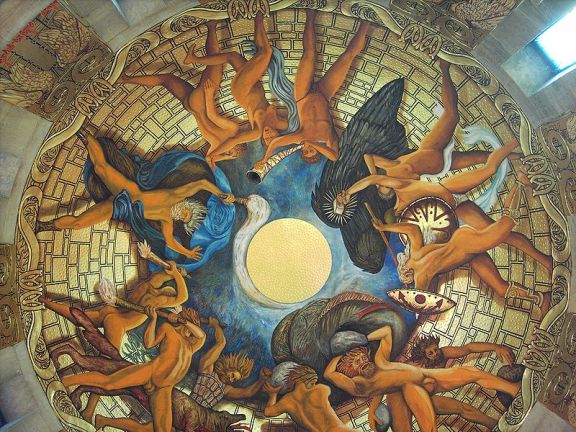
I think the magical restorative flower depicted on the Shield of Dionysos is the one that Óðr (either alone or with his comrades) went searching for when the Gods of Ásgarðr were suffering from the theft of Iðunn’s golden apples, as well as the μῶλυ flower which Hermes gives to Odysseus. What we’re seeing are different stages of an underlying myth, scattered through diverse and seemingly unrelated sources.
And I think another stage of this myth involves a confrontation with a Giant, before the long sought for flower can be recovered. This Giant is either one-eyed or three-headed, and can change its shape into that of various animals – most commonly an eagle or a snake.
Note that Nonnos recounts Ganymedes’ abduction by the giant golden eagle as a prelude to the story of Moria, Damasen and Tylos; Ganymedes represents youthful vitality, just like Hebe did before he replaced her as cup-bearer of the Gods. While in the Norse it is her fruit rather than Iðunn herself that is stolen, that theft is performed by Þjazi, a Giant who turns himself into an eagle. And Odysseus has to face off against the Laistrygones and Polyphemos (both terrible, uncivilized, maneating offspring of Poseidon of immense size) before he can make it to Aiaíā and receive Hermes’ benefaction. (Kírkē’s fabled abode is called “Eagle Island” by the way, from the Greek aietos, eagle.)
This is what I had in mind when I mentioned the possibility of a lost myth in connection with the dolphin coins of Olbia. It’s also possible I’m making this myth up as I go, or that there is a myth but I’m forging connections that don’t exist or are tenuous at best. Remember what I said about biases? Don’t think I’m immune to that, just because I’m clever!
However, if I’m right I believe that a great deal of this myth has been depicted on the Golden Horns of Gallehus. I’m not going to bombard you with a ton of links (though man have I researched the hell out of these things) but I will suggest you start with these four here, here, here and especially here. Obviously I don’t agree with all of the ideas expressed therein but a rough picture should start to emerge by the time you’re finished with them.

So, you know my whole theory that Freyja is Kírkē and Óðr is Odysseus, who has forgotten that he is Dionysos?
Well, I found something that could be interpreted as further confirmation.
And I don’t mean this statue of a Bacchic Freyja whose staff is topped by a little dancing Satyr, which Tetra recently posted about:

Though that is pretty fucking cool.
Our household actually has one of these, though I use a different eidolon in my personal devotional practice. My mouth hung open like a gasping fish (or dolphin) when I first saw it.
No, what I’m referring to is a passage from George Hinge’s Dionysos and Herakles in Scythia ‒ The Eschatological String of Herodotos’ Book 4, which I was rereading to mine for ideas for the play. Specifically, this passage:
A fragment of a black-glazed kylix found in Olbia carries the very beginning of Odysseus’ own tale in the Odyssey (9.39): Ἰλιο[θεν] µε φ[ερων] ἄνεµ[ος Κικ]ονεσσι [πελ]ασσεν “a wind brought me from Troy to the Kikonians” (= SEG XXX, 933); given that the concept of the wind carrying the soul to and fro was ascribed to Orpheus (Arist. De an. 410b = Orph. fr. 27 Kern), and the Thracian Kikonians and their king Ismaros were connected not only with wine (Od. 9.196-7, Archil. fr. 2.2 West), but also with Dionysos (cf. Ps.-Hes. fr.238 Merkelbach-West), the inscription may be yet another testimony to the character of the Olbian cult of Dionysos.
The Winds or Anemoi were really important in certain strains of Orphism, as Renaud Gagné makes clear in Winds and Ancestors: The Physika of Orpheus. Ditto the more Apollonian/Pythagorean side of the tradition, as Leonid Zhmud shows in Pythagoras’ Northern Connections: Zalmoxis, Abaris, Aristeas (and you yourself may have noticed with how frequently Boreas in particular has been showing up.)
Troy, by the way, is the Labyrinth – and labyrinths are important both in Russia and Scandinavia. Indeed, Snorri Sturluson relates in the Prologue to the Prose Edda (3-4) that the Æsir were originally neighbors and allies of the Trojans:
Near the earth’s centre was made that goodliest of homes and haunts that ever have been, which is called Troy, even that which we call Turkland. This abode was much more gloriously made than others, and fashioned with more skill of craftsmanship in manifold wise, both in luxury and in the wealth which was there in abundance. There were twelve kingdoms and one High King, and many sovereignties belonged to each kingdom; in the stronghold were twelve chieftains. These chieftains were in every manly part greatly above other men that have ever been in the world. One king among them was called Múnón or Mennón; and he was wedded to the daughter of the High King Priam, her who was called Tróán; they had a child named Trór, whom we call Thor. He was fostered in Thrace by a certain war-duke called Lóríkus; but when he was ten winters old he took unto him the weapons of his father. He was as goodly to look upon, when he came among other men, as the ivory that is inlaid in oak; his hair was fairer than gold. When he was twelve winters old he had his full measure of strength; then he lifted clear of the earth ten bear-skins all at one time; and then he slew Duke Lóríkus, his foster-father, and with him his wife Lórá, or Glórá, and took into his own hands the realm of Thrace, which we call Thrúdheim. Then he went forth far and wide over the lands, and sought out every quarter of the earth, overcoming alone all berserks and giants, and one dragon, greatest of all dragons, and many beasts. In the northern half of his kingdom he found the prophetess that is called Síbil, whom we call Sif, and wedded her. The lineage of Sif I cannot tell; she was fairest of all women, and her hair was like gold. […] He who is named Vóden, whom we call Odin: he was a man far-famed for wisdom and every accomplishment. His wife was Frígídá, whom we call Frigg. Odin had second sight, and his wife also; and from their foreknowledge he found that his name should be exalted in the northern part of the world and glorified above the fame of all other kings. Therefore, he made ready to journey out of Turkland, and was accompanied by a great multitude of people, young folk and old, men and women; and they had with them much goods of great price. And wherever they went over the lands of the earth, many glorious things were spoken of them, so that they were held more like gods than men. They made no end to their journeying till they were come north into the land that is now called Saxland; there Odin tarried for a long space, and took the land into his own hand, far and wide.
Which may be where they first met Óðrysseus, before he was carried away by a terrible storm.
Possibly even a Typhoon.
It’s important to read lots of different scholars on a subject and to keep in mind 1) they are only as good as the sources they’re working from and 2) everyone has biases, which shape how they interpret information.
Case in point: G. M. Hirst’s The Cults of Olbia was published in 1903. She brings together a wealth of material (some of which more contemporary scholars fail to cite) but that material is limited to what was available at the time, primarily literary citations and numismatics. Serious excavation didn’t even begin at the archaeological site until 1902, with its heyday being the 1920s when they were able to return to the field post-WWI. Some of the most significant discoveries weren’t made, however, until the 1980s and as late as the 2010s when efforts were intensified due to concerns over erosion from the Black Sea and damage from pollution and climate change. None of this is reflected in Hirst’s study, obviously, so if you relied solely on that you’d have a pretty skewed perception of, say, Dionysos’ place in the Olbian pantheon (since many of those discoveries have had to do with him.)
And for point two I simply want to remind folks that biases shape how we perceive things both large and small, significant and not. It’s easy to recognize bias when the scholar is postulating out-dated or faulty theories, especially if they’ve been thoroughly debunked or it’s something we’re familiar with and happen to care about – but other errors can slip right by without us realizing.
For instance, there is much debate about whether the Olbian dolphin coins are actually dolphins – or rather sturgeons. Sturgeons don’t mean anything to me, so I’m inclined to agree with the dolphin camp. That doesn’t make them right, however. After all, while it’s unlikely that an eagle could carry off a dolphin in its claws (not impossible, just extremely unlikely) there is nothing extraordinary about it doing that to a sturgeon.
While I applaud the scholar who was first able to look past the communis opinio and see a sturgeon one reason I side with the dolphiners is that no one I’ve read has satisfactorily explained why the Olbiapolitians would mint coinage with sturgeons on them, whereas it’s self-evident why they’d do so with dolphins, considering the animals’ associations with Dionysos and Apollon. In fact, one of Olbia’s major trading partners was the polis of Taras (or Tarentum) in Magna Graecia which minted its own dolphin coins, associated originally with their eponymous hero and Poseidon, though later on Dionysiac attributes were added via Taras’ blending with Iakchos (or Kloster.)
In other words, question everything – especially the things you are certain of.
The Olbians really liked dolphins, and minted many types of coins with them on it.
There are the famous “dolphin coins” themselves:
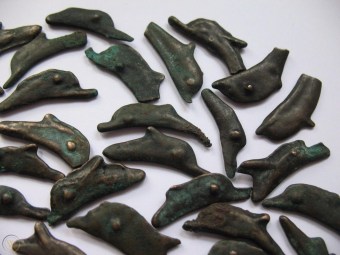
A more detailed example of which you can see here:

As well as more normal coins, such as this one which has a Gorgoneion on the obverse:

You’ll note that the dolphin is being carried off by an eagle. This is a common motif, and I’m not sure if it refers to some myth I’m not familiar with or an everyday occurrence. In which case, fuck, they must have big eagles in the Ukraine.
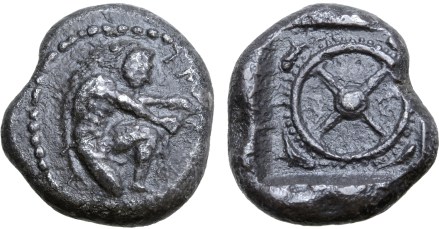
On this coin (with a kneeling Herakles on the obverse) we find a wheel with dolphins in the cardinal directions, for reasons.
Dolphins also appear in conjunction with some kind of flower and an eight-rayed star, as well as by themselves.
I wonder if these are the dolphins of Dionysos or of Apollon. I’ve seen good arguments either way, as well as scholars put forth that they have some association with Poseidon. While certainly possible, the other two are much more prominent members of the Olbian pantheon so I think it unlikely.
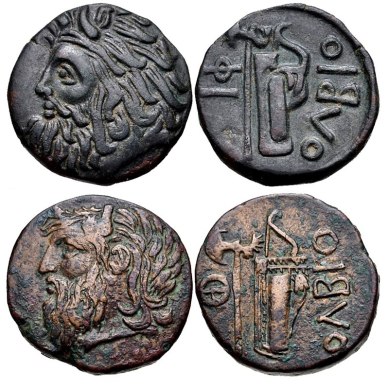
I rather like these coins from Olbia, depicting Borysthenes the river-God of the Dneiper. In earlier mints his bovine attributes are more pronounced, including one with super cute bull ears to go with the horns. On the reverse are his sacred weapons, an axe and a Skythian bow with arrows.
The election is now over and the votes have all been tallied. Since none of our candidates broke the minimum threshold (Mithridates Eupator came the closest) that means the play will be going to Herakles!
Exciting news!
I got my hands on a PDF of G. M. Hirst’s “The Cults of Olbia,” originally published in The Journal of Hellenic Studies in 1903. Pretty much everyone working on the polis cites this monumental study, and now I get to read it for myself.
Expect much geekery to follow.
Oh, by the way – G. M. Hirst was Gertrude Mary Hirst, a lady-scholar back when it was pretty much just her and Jane Ellen Harrison. She taught at Barnard College from 1901 until retiring in 1943, and died in Croton, New York in 1962. She was “a demanding teacher and a well-known eccentric but was loved and respected” by her students, whom she would often invite back to her quarters in the college dormitory for tea and conversation. She was also notorious for flouting the law by “riding her bicycle down the centre of Broadway.” You can learn more about her at the Database of Classical Scholars.
I may have to visit her grave at some point, cause she sounds like a pretty interesting person.
 The House of Vines