Isn’t it interesting that “Apis” means both the Mighty Bull of Two Lands and bee? It is!
The Golden Calf

Hyginus, Fabulae 150: postquam Iuno vidit Epapho ex pellice nato tantam regni potestatem esse, curat in venatu, ut Epaphus necetur, Titanosque hortatur, Iovem ut regno pellant et Saturno restituant.
‘After Juno saw that Epaphus, born of a concubine, ruled such a great kingdom, she saw to it that he should be killed while hunting, and encouraged the Titans to drive Jove from the kingdom and restore it to Saturn.
Orphic Hymn to Lusios-Lenaios:
A sorrow-hating joy to mortals, O lovely-haired Epaphian, you are a redeemer and a reveler whose thyrsus drives to frenzyand who is kind-hearted to all, gods and mortals, who see his light.I call upon you now to come, a sweet bringer of fruit.
Orphic Hymn 52.9:
‘You burst forth from the earth in a blaze, Epaphian, O son of two mothers.’
Diodoros Sikeliotes, Library of History 3.74.1: Dionysos, as men say, was born to Zeus by Io, the daughter of Inachus, became king of Egypt and appointed the initiatory rites of that land.
Scholiast. Euripides’ Phoenician Women 678: ἀπόγονος Ἐπάφου Κάδμος, ἐπεὶ Ἀγήνορός ἐστιν υἱὸς τοῦ Βήλου τοῦ Λιβύης τῆς Ἐπάφου τοῦ Ἰοῦς.
‘Kadmos is the descendant of Epaphos, since Agenor is the son of Belus, son of Libya, daughter of Epaphos, son of Io.’
Phld. Piet. 44 = fr. 36 Kern = OF 59 I: 〈πρώτην τούτ〉ων τὴν ἐκ μ〈ητρός〉, ἑτέραν δὲ τ〈ὴν ἐκ〉 τοῦ μηροῦ, 〈τρί〉την δὲ τὴ〈ν ὅτε δι〉ασπασθεὶς ὑπὸ τῶν Τιτάνων Ῥέ〈ας τὰ〉 μέλη συνθεί〈σης〉 ἀνεβίω[ι]. κἀν̣ 〈τῆι〉 Μοψοπίαι δ᾽ Εὐ〈φορί〉ω〈ν ὁ〉μολογεῖ 〈τού〉τοις, 〈οἱ〉 δ’ Ὀρ〈φικοὶ〉 καὶ παντά〈πασιν〉 ἐνδιατρε〈ίβουσιν〉.
‘The first of these was the birth from the mother, the second the one from the thigh, and the third birth was when having been dismembered by the Titans, he came back to life afterRhea gathered together his limbs. And in his Mopsopoiai Euphorion is in agreement with these accounts, and the Orphics also absolutely go on about it.’
Apollodoros, The Library 2.1.3: τελευταῖον ἧκεν εἰς Αἴγυπτον, ὅπου τὴν ἀρχαίαν μορφὴν ἀπολαβοῦσα γεννᾷ παρὰ τῷ Νείλῳ ποταμῷ Ἔπαφον παῖδα. τοῦτον δὲ Ἥρα δεῖται Κουρήτων ἀφανῆ ποιῆσαι· οἱ δὲ ἠφάνισαν αὐτόν. καὶ Ζεὺς μὲν αἰσθόμενος κτείνει Κούρητας, Ἰὼ δὲ ἐπὶ ζήτησιν τοῦ παιδὸς ἐτράπετο. πλανωμένη δὲ κατὰ τὴν Συρίαν ἅπασαν (ἐκεῖ γὰρ ἐμηνύετο 〈ὅτι ἡ〉 τοῦ Βυβλίων βασιλέως 〈γυνὴ〉 ἐτιθήνει τὸν υἱόν) καὶ τὸν Ἔπαφον εὑροῦσα, εἰς Αἴγυπτον ἐλθοῦσα ἐγαμήθη Τηλεγόνῳ τῷ βασιλεύοντι τότε Αἰγυπτίων.
At last she came to Egypt, where she recovered her original form and gave birth to a son Epaphus beside the river Nile. Him Hera besought the Curetes to make away with [Epaphus], and make away with him they did. When Zeus learned of it, he slew the Curetes; but Io set out in search of the child. She roamed all over Syria, because there it was revealed to her that the wife of the king of Byblus was nursing her son; and having found Epaphus she came to Egypt and was married to Telegonus, who then reigned over the Egyptians.
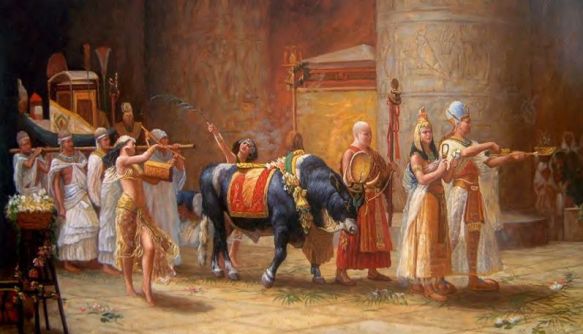
Plutarch, On Isis and Osiris 364E. ἃ δ’ ἐμφανῶς δρῶσι θάπτοντες τὸν Ἆπιν οἱ ἱερεῖς, ὅταν παρακομίζωσιν ἐπὶ σχεδίας τὸ σῶμα, βακχείας οὐδὲν ἀποδεῖ· καὶ γὰρ νεβρίδας περικαθάπτονται καὶ θύρσους φοροῦσι καὶ βοαῖς χρῶνται καὶ κινήσεσιν ὥσπερ οἱ κάτοχοι τοῖς περὶ τὸν Διόνυσον ὀργιασμοῖς.
The public ceremonies which the priests perform in the burial of the Apis, when they convey his body on an improvised bier, do not in any way come short of a Bacchic procession; for they fasten skins of fawns about themselves, and carry Bacchic wands and indulge in shoutings and movements exactly as do those who are under the spell of the Dionysiac ecstasies.
Servius, Commentary on Vergil’s Georgics 1.165: id est cribrum areale. mystica autem Iacchi ideo ait quod Liberi Patris sacra ad purgationem animae pertinebant: et sic homines eius Mysteriis purgabantur, sicut vannis frumenta purgantur. hinc est quod dicitur Osiridis membra a Typhone dilaniata Isis cribro superposuisse: nam idem est Liber Pater in cuius Mysteriis vannus est: quia ut diximus animas purgat.unde et Liber ab eo quod liberet dictus, quem Orpheus a gigantibus dicit esse discerptum. nonnulli Liberum Patrem apud Graecos Λικνίτην dici adferunt; vannus autem apud eos λίκνον nuncupatur; ubi deinde positus esse dicitur postquam est utero matris editus. alii mysticam sic accipiunt ut vannum vas vimineum latum dicant, in quod ipsi propter capacitatem congere rustici primitias frugum soleant et Libero et Liberae sacrum facere Inde mystica.
‘The mystic fan of Iacchus, that is the sieve (cribrum) of the threshing-floor. He calls it the mystic fan of Iacchus, because the rites of Father Liber had reference to the purification of the soul and men were purified through his mysteries as grain is purified by fans. It is because of this that Isis is said to have placed the limbs of Osiris, when they had been torn to pieces by Typhon, on a sieve, for Father Liber is the same person, he in whose mysteries the fan plays a part, because as we said he purifies souls. Whence he is also called Liber, because he liberates, and it is he who, Orpheus said, was torn asunder by the Giants. Some add that Father Liber was called by the Greeks Liknites. Moreover the fan is called by them liknon, in which he is said to have been placed directly after he was born from his mother’s womb. Others explain its being called “mystic” by saying that the fan is a large wicker vessel in which peasants, because it is of large size, are wont to heap their first-fruits and consecrate it to Liber and Libera. Hence it is called “mystic”.’
Plutarch, On Isis and Osiris 364F: ὁμολογεῖ δὲ καὶ τὰ Τιτανικὰ καὶ Νυκτέλια τοῖς λεγομένοις Ὀσίριδος διασπασμοῖς καὶ ταῖς ἀναβιώσεσι καὶ παλιγγενεσίαις.
‘Furthermore, the Titanika and the Nyktelia agree with the accounts of the dismemberment of Osiris and his revivification and regenesis.’
Plutarch, Greek Questions 716F–717A: οὐ φαύλως οὖν καὶ παρ’ ἡμῖν ἐν τοῖς Ἀγριωνίοις τὸν Διόνυσον αἱ γυναῖκες ὡς ἀποδεδρακότα ζητοῦσιν, εἶτα παύονται καὶ λέγουσιν ὅτι πρὸς τὰς Μούσας κατα-πέφευγεν καὶ κέκρυπται παρ’ ἐκείναις.
‘It is not an accident that in the Agrionia, as it is celebrated here, the women search for Dionysos as though he had run away, then desist and say that he has taken refuge with the Muses and is hidden among them.’
Athenaios, Deipnosophistai 14.618c–620a and Pollux, Onomastikon 4.52–53 list terms for many kinds of working songs, such as the harvest οὖλος or ἴουλος and those named after Βώριμος, Μανέρως, Λιτυέρσης and Ἠριγόνη (Ἀλῆτις); winnowing songs (πτιστικόν or πτισμός); vintage songs (ἐπιλήνια). Sch. Clem. Al. Prot. 1.2.2, p. 297.4–8. Note that the Aletis song was defined as a lament for the death of Erigone, who wandered in search of her murdered father, but also as Persephone, cp. EM s.v. Ἀλῆτις (62.9).
Details

I don’t know if you caught it when I initially posted about the Bacchic Fairies & Goblins but the Dwarf King who invites Herla to attend his wedding beneath the Earth in Walter Map’s De Nugis Curiallium is wearing a nebris – and King Herla, of course, is an early form of the Erlkönig, the Elf King who carries off the wife of Orpheus, King of the Britons in Sir Orfeo.
The symptoms she suffers after the snakebite are very much like what we find in certain types of Mainadism and Tarantism:
She slept until the sun had passed its height. And when she woke – God! She screamed and started doing some terrible things! She beat with her hands and her feet and scratched her face with her fingernails so badly that the blood ran down her cheeks. She tore at her frock, ripping the costly material into shreds, and behaving for all the world as though she had gone stark staring mad. Her two maidens were frightened out of their wits! They ran to the palace and urged everyone to go and restrain her. Knights made their way as quickly as they could to the orchard, and ladies and damsels also, more than sixty I think. They arrived at the orchard, took the Queen up in their arms and brought her into the palace and to her bed, where they kept a tight hold on her to prevent her from injuring herself further.
Which we commemorate during the Agrionia and Aletideia, festivals celebrated during the Gold Season.
Although Sir Orfeo gives Heurodis as the name of his wife, Vergil in Georgics IV names her Eurydice and makes the one responsible for her untimely katabasis Aristaeus, who was taught rustic arts by the Nymphs:
Now Apollon begat by Kyrene in that land a son Aristaios and gave him while yet a babe into the hands of the Nymphai to nurture, and the latter bestowed upon him three different names, calling him, that is, Nomios (the Shepherd), Aristaios, and Argeus (the Hunter). He learned from the Nymphai how to curdle milk [i.e. how to make cheese], to make bee-hives, and to cultivate olive-trees, and was the first to instruct men in these matters. And because of the advantage which came to them from these discoveries the men who had received his benefactions rendered to Aristaios honours equal to those offered to the Gods. (Diodoros Sikeliotes, Library of History 4.81.1)

In retaliation, Orpheus curses the bees of Aristaeus and Vergil has the griefstruck demigod consult the Egyptian oracular God Proteus, who instructs him to carry out propitiatory sacrifices:
Choose four bulls of outstanding physique,
that graze on your summits of green Lycaeus,
and as many heifers, with necks free of the yoke.
Set up four altars for them by the high shrines of the goddesses,
and drain the sacred blood from their throats
leaving the bodies of the steers in the leafy grove.
Then when the ninth dawn shows her light
send funeral gifts of Lethean poppies to Orpheus,
and sacrifice a black ewe, and revisit the grove:
worship Eurydice, placate her with the death of a calf.’
Without delay he immediately does as his mother ordered:
he comes to the shrines, raises the altars as required,
and leads four chosen bulls there of outstanding physique,
and as many heifers with necks free of the yoke.
Then when the ninth dawn brings her light,
he sends funeral gifts to Orpheus, and revisits the grove.
Here a sudden wonder appears, marvellous to tell,
bees buzzing and swarming from the broken flanks
among the liquefied flesh of the cattle,
and trailing along in vast clouds, and flowing together
on a tree top, and hanging in a cluster from the bowed branches.
The rebirth of the gold-rich bees from the carcass of cattle reminds one of the Liberalia. Note also that Vergil has Orpheus leave Greece to wander through the Ukraine and Russia:
He wandered the Northern ice, and snowy Tanais,
and the fields that are never free of Rhipaean frost,
mourning his lost Eurydice, and Dis’s vain gift:
the Ciconian women, spurned by his devotion,
tore the youth apart, in their divine rites and midnight
Bacchic revels, and scattered him over the fields.
Although most sources mention that Thracian women were responsible for the martyrdom of Orpheus, Vergil’s making them Kikones is a nice touch considering this people’s connection with Dionysos and the Winds.

Winds also feature in another myth involving Aristaeus – who by the way, is the father of Aktaion mentioned in the nebris post above.
Diodoros’ narrative continues from where we left off:
After this, they say, Aristaios went to Boiotia, where he married one of the daughters of Kadmos, Autonoë to whom was born Aktaion, who, as the myths relate, was torn to pieces by his own dogs . . . After the death of Aktaion Aristaios went to the oracle of his father Apollon, who prophesied to him that he was to change his home to the island of Keos.
To this island he sailed, but since a plague prevailed throughout Greece the sacrifice he offered there was on behalf of all the Greeks. And since the sacrifice was made at the time of the rising of the star Seirios, which is the period when the Etesian winds customarily blow, the pestilential diseases, we are told, came to an end.
Now the man who ponders upon this event may reasonably marvel at the strange turn which fortune took; for the same man who saw his son done to death by the dogs likewise put an end to the influence of the star which, of all the stars of heaven, bears the same name and is thought to bring destruction upon mankind, and by so doing was responsible for saving the lives of the rest.
Which has added resonance this year because of the coronavirus. Maybe President Trump needs to sacrifice some bulls to the Winds and Dog Star if he wants to rejuvenate the economy on Easter – or things could get beary serious.
Anyway, just some of the feta crumbs folks may have missed. I’m a little in awe of how deep and rich the symbolism of our Bakcheion calendar is, and how rewarding a serious study of this material is proving. Seriously, I hope you’re enjoying this as much as I am.

Shaken, not stirred
Oh my. *fans self*
So I’m mulling over the etymology of óðr and specifically this bit:
Ultimately these Germanic words are derived from the Proto-Indo-European word *wāt-, which meant “to blow (on), to fan (flames)”, fig. “to inspire”. The same root also appears in Latin vātēs (“seer”, “singer”), which is considered to be a Celtic loanword, compare to Irish fāith (“poet”, but originally “excited”, “inspired”). The root has also been said to appear in Sanskrit vāt– “to fan.”
When I remembered something about Odysseus.
He carries the Mystica Vannus Iacchi.
And Odysseus of many wiles answered her, and said: “Strange lady! why dost thou now so urgently bid me tell thee? Yet I will declare it, and will hide nothing. Verily thy heart shall have no joy of it, even as I myself have none; for Teiresias bade me go forth to full many cities of men, bearing a shapely oar in my hands, till I should come to men that know naught of the sea, and eat not of food mingled with salt; aye, and they know naught of ships with purple cheeks, or of shapely oars that serve as wings to ships. And he told me this sign, right manifest; nor will I hide it from thee. When another wayfarer, on meeting me, should say that I had a winnowing fan on my stout shoulder, then he bade me fix my oar in the earth, and make goodly offerings to Lord Poseidon—a ram and a bull and a boar, that mates with sows—and depart for my home, and offer sacred hecatombs to the immortal Gods, who hold broad heaven, to each one in due order. And death shall come to me myself far from the sea, a death so gentle, that shall lay me low, when I am overcome with sleek old age, and my people shall dwell in prosperity around me. All this, he said, should I see fulfilled.” (Homer, Odyssey 23.263-284)
Particularly relevant in light of this post, winnowing is a method of separating the wheat from the chaff, as Wikipedia discusses here:
Wind winnowing is an agricultural method developed by ancient cultures for separating grain from straw. It can also be used to remove pests from stored grain. Winnowing usually follows threshing in grain preparation. In its simplest form it involves throwing the mixture into the air so that the wind blows away the lighter chaff, while the heavier grains fall back down for recovery. Techniques included using a winnowing fan (a shaped basket shaken to raise the chaff) or using a tool (a winnowing fork or shovel) on a pile of harvested grain.
Regarding the winnowing fan, Servius (in his commentary on Vergil’s Georgics 1.65) writes:
The mystic fan of Iacchus, that is the sieve of the threshing-floor. He calls it the mystic fan of Iacchus because the rites of Father Liber had reference to the purification of the soul, and men are purified in his mysteries as grain is purified by fans. It is because of this that Isis is said to have placed the limbs of Osiris, when they had been torn to pieces by Typhon, on a sieve, for Father Liber is the same person. Whence also he is called Liber, because he liberates, and it is he whom Orpheus said was torn asunder by the Giants. Some add that Father Liber was called by the Greeks Liknites. Moreover the fan is called by them liknon, in which he was placed after being delivered from his mother’s womb. Others explain its being called ‘mystic’ by saying that the liknon is a wicker vessel in which peasants, because it was of large size, used to heap their first-fruits and consecrate it to Liber and Libera.
Jane Ellen Harrison had a good deal more to say about this object in an article published in the Journal of Hellenic Studies vol. 23, available here; here is an alternative hypothesis worth considering.
God of the Summer Sun

Speaking of Óðr, I’ve encountered some interesting theories about him in my studies recently.
Most scholars tend to view him as a strange double or Vanic counterpart of Óðinn associated with creative and battle frenzy, shapeshifting, shamanic ordeals and otherworldly journeys.
However a number of Neopagan authors apparently regard him as the God of the Summer Sun, and specifically heat, vitality, fertility and rejuvenation, with his absence in Winter prompting Freyja to go in search of him.
Something about that really resonates, although I’m not sure their arguments necessarily hold up to scrutiny. Then again, so little has come down in the lore concerning Óðr that most arguments end up being fairly speculative, mine included. (This is where being an Orpheotelest and mantis really comes in handy.)
Vonlenska
I have always loved this song by Sigur Rós:
The aural world it conjures is just … *shivers* Ah, yeah.
And because of the stunning visuals I included the video on numerous playlists for Dionysos, even before I started tapping into the Black Sun current. (It has obviously taken on added significance since then.) But I don’t think I ever bothered looking up the lyrics – which, as it turns out, are just as relevant.
Brennisteinn
Við skerum á
Augnaráð
Nú stingur í
Ofbirta
Nú bræða óf
Endalok
Svo flæðir inn
Dagsbirta
Nú teygir sig og togar
Og togna út við örmunum [Vonlenska]
Reyna að móttaka [Vonlenska]
Og brestu yfir hrapa stað
Rennur blóð í æðum
Í skinninu
Yðar á
Krækir klónum í
Og klórar í
Nú teygir sig og togar
Og togna út við örmunum [Vonlenska]
Reyna að móttaka [Vonlenska]
Og brestu yfir hrapa stað
Reisum mér búkinn
Hryggjasúlan æðu
Rennur blóð í æðum
Ekki segja neinum frá
Nú teygir sig og togar
Og togna út við örmunum [Vonlenska]
Reyna að móttaka [Vonlenska]
Og brestu yfir hrapa stað
Reisum mér búkinn
Hryggjasúlan æðu
Rennur blóð í æðum
Which, when Englished, becomes:
Sulfur
We plunge in
A glance
Then strikes
A blinding light
Then they melt
The end
And flows in
The daylight
Now it drags and pulls
And tears out every particle
Joints ache
And crack, they are dislocated
Blood runs in the veins
In the skin
Your (skin)
It digs its claws
And lacerates
Now it drags and pulls
And tears out every particle
Joints ache
And crack, they are dislocated
We raise our bowed bodies
The spine we straighten
Blood runs in the veins
Don’t tell anyone
Don’t tell anyone
Don’t tell anyone
Don’t tell anyone
Don’t tell anyone
Don’t tell anyone
Now it drags and pulls
And tears out every particle
Joints ache
And crack, they are dislocated
We raise our bowed bodies
The spine we straighten
Blood runs in the veins
Pure gold, man.
And the word Vonlenska? It means:
Vonlenska (Eng: Hopelandic) is a term coined by the band to refer to the vocalizations that Jónsi sings in lieu of lyrics in Icelandic or English. It takes its name from “Von”, a song on Sigur Rós’s debut album Von where it was first used. However, not all Sigur Rós songs are in Hopelandic; many are sung in Icelandic.
Vonlenska differs from both natural and constructed languages used for human communication. It consists of strings of meaningless syllables containing non-lexical vocables and phonemes. There is no grammatical relation between or among syllables, nor are they accompanied by clearly defined word boundaries. Vonlenska emphasizes the phonological and emotive qualities of human vocalizations, and it uses the melodic and rhythmic elements of singing without the conceptual content of language. In this way, it is similar to the use of scat singing in vocal jazz and puirt à beul in traditional Scottish and Irish folk music. The band’s website describes it as “a form of gibberish vocals that fits to the music”. It is similar in concept to the ethereal vocals used by Cocteau Twins singer Elizabeth Fraser in the 1980s and 1990s. Many of the syllable strings sung by Jónsi are repeated many times throughout each song, and sometimes throughout the whole album.
Óðr’s poetry.
The answer revealed

Ονομα Βάκχος
“I am Bakchos.”
equal pebbles

893
800 + 90 + 3
8/93
A clue

2 = Beta
1 = Alpha
20 = Kappa
600 = Chi
70 = Omicron
200 = Sigma
A riddle

The Etruscan trembled before the Stranger, saying “Who are you? How are you called?”
And he replied:
Who I am is a mystery, but how I am called is easy enough to discern.
Begin with the bountiful dyad, the union of male and female.
And add another one in the shape of a bull’s head or tripod.
Kindly, then, place ten and ten more rods in the bundle.
CHoicest hekatombs offer six times over, giving back to the givers.
Of gleaming honey-wine seven measures should be poured out, ten times.
See the sacrificial blade, that resembles the number two hundred.
Put these all together and you have 893, the value of my name.
I want to be ready

PALACE OF EXILE
by Jim Morrison
For seven years I dwelt in the loose palace of exile
Playing strange games with the girls of the island
Now I have come again to the land of the fair
And the strong, and the wise
Brothers and sisters of the pale forest, children of night
Who among you will run with the hunt?
Now night arrives with her purple legion
Retire now to your tents and to your dreams
Tomorrow we enter the town of my birth
I want to be ready
Polyvalent
If a fawn-skin can be so polyvalent, why assume that an earthquake or a viral pandemic can mean just one thing and one thing only?
The stories we share, and what we believe about them, matter.
Be careful, folks. The China virus isn’t the only one circulating.