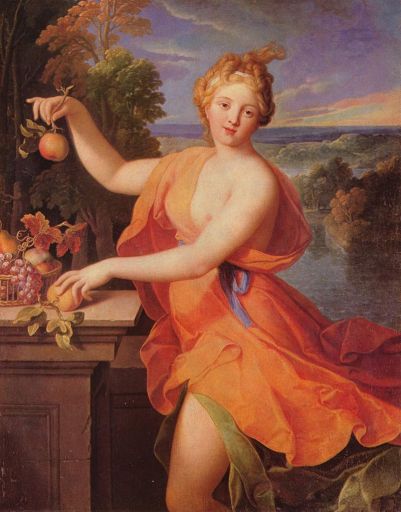
The penultimate Toy (mentioned in the Orphic poet, Clement and Arnobius) is in Greek Μῆλα and Latin mālum, the apple. This is – after the grape, fig and pomegranate – perhaps the fruit most commonly associated with Dionysos:
That Dionysos is also the discoverer of the apple is attested by Theokritos of Syracuse, in words something like these: ‘Storing the apples of Dionysos in the folds at my bosom, and wearing on my head white poplar, sacred bough of Herakles.’ And Neoptolemos the Parian, in the Dionysiad, records on his own authority that apples as well as all other fruits were discovered by Dionysos. (Athenaios, Deipnosophistai 3.82d)
For Jane Ellen Harrison, Dionysos was more than just the God of the vine, he was “Dendrites, Tree-God, and a plant God in a far wider sense. He is God of the fig-tree, Sykites; he is Kissos, God of the ivy; he is Anthios, God of all blossoming things; he is Phytalmios, God of growth” (Prolegomena page 426).
In short, he is the God of the impulse of life in nature, a God of growth and the green earth:
Now as to the rites of Liber, whom they have set over liquid seeds, and therefore not only over the liquors of fruits, among which wine holds, so to speak, the primacy, but also over the seeds of animals:— as to these rites, I am unwilling to undertake to show to what excess of turpitude they had reached, because that would entail a lengthened discourse, though I am not unwilling to do so as a demonstration of the proud stupidity of those who practice them. Varro says that certain rites of Liber were celebrated in Italy which were of such unrestrained wickedness that the shameful parts of the male were worshipped at crossroads in his honour. Nor was this abomination transacted in secret that some regard at least might be paid to modesty, but was openly and wantonly displayed. For during the festival of Liber this obscene member, placed on a little trolley, was first exhibited with great honour at the crossroads in the countryside, and then conveyed into the city itself. But in the town of Lavinium a whole month was devoted to Liber alone, during the days of which all the people gave themselves up to the must dissolute conversation, until that member had been carried through the forum and brought to rest in its own place; on which unseemly member it was necessary that the most honorable matron should place a wreath in the presence of all the people. Thus, forsooth, was the God Liber to be appeased in order for the growth of seeds. Thus was enchantment (fascinatio) to be driven away from fields, even by a matron’s being compelled to do in public what not even a harlot ought to be permitted to do in a theatre, if there were matrons among the spectators. (Augustine, De Civitate Dei 7.21)
Whenever Dionysos appears, he does so attended by wild vegetation, whether it is with the vines of ivy and lush grapes he wears in his hair (Orphic Hymn 30), or that entwines itself around pillars and altars (Euripides’ Antiope 203), a face appearing in a plane tree that has been split asunder (Kern’s Inschr. von M. 215), or in a burst of beautiful flowers (Pindar fr.75). When Dionysos finally reveals himself in fullness to the Tyrrhenian pirates, it is through vegetation:
Then in an instant a vine, running along the topmost edge of the sail, sprang up and sent out its branches in every direction heavy with thick-hanging clusters of grapes, and around the mast cloud dark-leaved ivy, rich in blossoms and bright with ripe berries, and garlands crowned every tholepin. (Homeric Hymn 7)
Carl Kerényi believed that intoxication was not the essential core of the religion of Dionysos, but rather the “quiet, powerful, vegetative element which ultimately engulfed even the ancient theaters, as at Cumae” (Dionysos, page xxiv) – as if there was a difference between the two.
It was through the apple that Dionysos entered the American mythic consciousness by way of the guise of John Chapman, a disciple of Emanuel Swedenborg who held strongly mystical and pantheistic beliefs and felt an abhorrence for modern civilization. Better known to history as Johnny Appleseed, culture-bringer and savior of the pioneers, in truth he shunned the company of his fellow humans, preferring animals and trees like all proper Orphics; as soon as settlements encroached upon his territory he’d pick up and move on to the next site, leaving his orchards behind for the hungry settlers. Of course, what those settlers were hungry for wasn’t fruit but alcohol, since the apples Johnny planted were so small and bitter that their only use was in brewing strong cider or applejack, a necessary substitute in a land where the vine initially did not thrive:
Teaching men how to ferment the juice of the grape, Dionysus had brought civilization the gift of wine. This was more or less the same gift Johnny Appleseed was bringing to the frontier: because American grapes weren’t sweet enough to be fermented successfully, the apple served as the American grape, cider the American wine. But as I delved deeper into the myth of Dionysus, I realized there was much more to his story, and the strangely changeable God who began to come into focus bore a remarkable resemblance to John Chapman. Or at least to Johnny Appleseed, who, I became convinced, is Dionysus’s American son. Like Johnny Appleseed, Dionysus was a figure of the fluid margins, slipping back and forth between the realms of wildness and civilization, man and woman, man and God, beast and man … The flight from civilization back to nature in America tends to be a solitary and ascetic pursuit, having more to do with wilderness than wildness. Johnny Appleseed was very much an American Dionysus – innocent and mild. In this he may have helped establish the benign, see-no-evil mood that characterizes the Dionysian strain in American culture, from transcendentalist Concord to the Summer of Love. (Michael Pollan, The Botany of Desire)
In Johnny’s old New England stomping grounds, a young H. P. Lovecraft had his first brush with the supernatural:
When about seven or eight I was a genuine pagan, so intoxicated with the beauty of Greece that I acquired a belief in the old Gods and nature sprits. I have in literal truth built altars to Pan, Apollo, and Athena, and have watched for dryads and satyrs in the woods and fields at dusk. Once I firmly thought I beheld some kind of sylvan creatures dancing under autumnal oaks; a kind of ‘religious experience’ as true in its way as the subjective ecstasies of a Christian. If a Christian tell me he has felt the reality of his Jesus or Jahveh, I can reply that I have seen hoofed Pan and the sisters of the Hesperian Phaëthusa. (Confession of Unfaith)
Dionysos’ apples, after all, aren’t just any apples, as W. K. C. Guthrie reminds us:
Nothing, we admit, is more likely to attract a child than the present of golden apples, yet it seems a little extravagant to send to the farthest confines of the world for a mythical treasure when the same purpose, it seems, could be accomplished with dolls and knucklebones. Perhaps then we may allow ourselves to remember that the apples of the Hesperides were symbols of immortality, and that Dionysos was to be born again after his murder, and by his death was to ensure the hope of immortality for the race of human beings which was to follow him. (Orpheus and Greek Religion pg 123)
Servius preserves the tradition, first found in Hesiod, that the Hesperides were children of Night:
Hesiod says that these Hesperides, daughters of Nyx, guarded the golden apples beyond Okeanos, ‘Aigle and Erytheia and ox-eyed Hesperethoosa.’ (Commentary on Vergil’s Aeneid 4. 484)
While Diodoros Sikeliotes preserves a contrary tradition, first found in Pherekydes of Syros, that made them daughters of the Titan Atlas:
Now Hesperos begat a daughter named Hesperis, who he gave in marriage to his brother Atlas and after whom the land was given the name Hesperitis; and Atlas begat by her seven daughters, who were named after their father Atlantides, and after their mother Hesperides. (Library of History 4.26.2)
According to Pherekydes there was something so dangerously alluring about these golden apples that even the Hesperides who had been charged with their protection could not resist plucking them:
The constellation Serpens is Ladon, said to have guarded the golden apples of the Hesperides, and after Hercules killed him, to have been put by Juno among the stars, because at her instigation Hercules set out for him. He is considered the usual watchman of the gardens of Juno. Pherecydes says that when Jupiter wed Juno, Terra came, bearing branches with golden apples, and Juno, in admiration, asked Terra to plant them in her gardens near distant Mount Atlas. When Atlas’ daughters kept picking the apples from the trees, Juno is said to have placed this guardian there. (Hyginus, Astronomica 2. 3)
Which makes their involvement in the conception of Dionysos’ mother rather interesting:
There, as they say, by the Tritonian Lake, Kadmos the wanderer lay with rosycheek Harmonia, and the Nymphai Hesperides made a song for them, and Kypris together with the Erotes decked out a fine bed for the wedding, hanging in the bridal chamber golden fruit from the Nymphai’s garden, a worthy lovegift for the bride; rich clusters of their leaves Harmonia and Kadmos twined through their hair, amid the abundance of their bridechamber, in place of the wedding-roses. Still more dainty the bride appeared wearing these golden gifts, the boon of golden Aphrodite. Her mother’s father the stooping Libyan Atlas awoke a tune of the heavenly harp to join the revels, and with tripping foot he twirled the heavens round like a ball, while he sang a stave of harmony himself not far away. (Nonnos, Dionysiaka 13.333 ff)
For one of Semele’s defining characteristics was her exceptional beauty, as Diodoros relates:
Semele was loved by Zeus because of her beauty, but since he had his intercourse with her secretly and without speech she thought that the God despised her; consequently she made the request of him that he come to her embraces in the same manner as in his approaches to Hera. Accordingly, Zeus visited her in a way befitting a God, accompanied by thundering and lightning, revealing himself to her as he embraced her; but Semele, who was pregnant and unable to endure the majesty of the divine presence, brought forth the babe untimely and was herself slain by the fire. Thereupon Zeus, taking up the child, handed it over to the care of Hermes, and ordered him to take it to the cave in Nysa where he should deliver it to the Nymphai. (4.2.1)
A beauty that was not only responsible for her own destruction, but that of her nephew as well:
Aktaion was later eaten up on Kithairon by his own dogs. According to Akousilaos he met his end in this manner because he enraged Zeus by courting the fair Semele. (Apollodoros, Bibliotheka 3.31)
Which naturally calls to mind the devastation wrought by Eris:
Eris was enraged at being turned away from the wedding of Peleus and Thetis, and now she bethought her of the golden apples of the Hesperides. Thence Eris took the fruit that would become a harbinger of war, even the apple, and devised a scheme of signal woes. Whirling her arm she hurled into the banquet the primal seed of turmoil and disturbed the choir of Goddesses. Hera, glorying to be the spouse and to share the bed of Zeus, rose up amazed, and would fain have seized it. And Kypris, as being more excellent than all, desired to have the apple, for that it is the treasure of the Erotes. But Hera would not give it up and Athena would not yield. (Colluthus, Rape of Helen 58 ff)
And also the serpent in the garden who offered Eve the tempting apple, as Clement exhorted the Greeks:
The Bakchai hold their orgies in honour of the mad Dionysos, celebrating their sacred frenzy by the eating of raw flesh, and go through the distribution of the parts of butchered victims crowned with snakes, shrieking out the name of that Eva by whom error came into the world. The symbol of the Bacchic orgies is a consecrated serpent. Moreover, according to the strict interpretation of the Hebrew term, the name Hevia, aspirated, signifies a female serpent.
The forbidden fruit of the serpent probably wasn’t our apple, unknown in Palestine at the time of the Bible’s composition, but it became so in the popular imagination because of a play on the Latin words mālum (an apple) and mălum (an evil): the Latin of Genesis 2:17 “But of the tree of the knowledge of good and evil you shall not eat,” is De ligno autem scientiæ bonum et malum ne comedas.
Olympiodoros, one of the last philosophers of antiquity, gives the final quest of Herakles an almost Judeo-Christian interpretation in his Commentary on Plato’s Gorgias:
And on this account Herakles is said to have accomplished his last labor in the Hesperian regions; signifying by this, that having vanquished a dark and earthly life he afterward lived in day, that is, in truth and light.
It’s interesting to compare this and the relationship Jews and Christians have to their wisdom-bringing serpent with his counterpart in earlier Greek, and especially Bacchic Orphic, myth:
The Argonauts found the sacred plot where, till the day before, the serpent Ladon, a son of the Libyan soil, had kept watch over the golden apples in the Garden of Atlas, while close at hand and busy at their tasks the Hesperides sang their lovely song. But now the snake, struck down by Herakles, lay by the trunk of the apple-tree. Only the tip of his tail was still twitching; from the head down, his dark spine showed not a sign of life. His blood had been poisoned by arrows steeped in the gall of the Hydra Lernaia, and flies perished in the festering wounds.
Close by, with their white arms flung over their golden heads, the Hesperides were wailing as the Argonauts approached. The whole company came on them suddenly, and in a trice the Nymphai turned to dust and earth on the spot where they had stood. Orpheus, seeing the hand of Heaven in this, addressed a prayer to them on behalf of his comrades : ‘Beautiful and beatific Powers, Queens indeed, be kind to us, whether Olympos or the underworld counts you among its Goddesses, or whether you prefer the name of Solitary Nymphai. Come, blessed Spirits, Daughters of Okeanos, make yourselves manifest to our expectant eyes and lead us to a place where we can quench this burning, never-ending thirst with fresh water springing from a rock or gushing from the ground. And if ever we bring home our ship into an Achaian port, we will treat you as we treat the greatest Goddesses, showing our gratitude with innumberable gifts of wine and offerings at the festal board.’
Orpheus sobbed as he prayed. But the Nymphai were still at hand, and they took pity on the suffering men. They wrought a miracle. First, grass sprung up from the ground, then long shoots appeared above the grass, and in a moment three saplings, tall, straight and in full leaf, were growing there. Hespere became a poplar; Erytheis an elm; Aigle a sacred willow. Yet they were still themselves; the trees could not conceal their former shapes–that was the greatest wonder of all. And now the Argonauts heard Aigle in her gentle voice tell them what they wished to know.
‘You have indeed been fortunate,’ she said. ‘There was a man here yesterday, an evil man, who killed the watching Snake, stole our golden apples, and is gone. To us he brought unspeakable sorrow; to you release from suffering. He was a savage brute, hideous to look at; a cruel man, with glaring eyes and scowling face. He wore the skin of an enormous lion and carried a great club of olive-wood and the bow and arrows with which he shot our monster here. It appeared that he, like you, had come on foot and was parched with thirst. For he rushed about the place in search of water; but with no success, till he found the rock that you see over there near to the Tritonian lagoon. Then it occurred to him, or he was prompted by a God, to tap the base of the rock. He struck it with his foot, water gushed out, and he fell on his hands and chest and drank greedily from the cleft till, with his head down like a beast in the fields, he had filled his mighty paunch.’
The Minyai were delighted. They ran off in happy haste towards the place where Aigle had pointed out the spring. (Apollonios Rhodios, Argonautika 4.1390ff)
Part of what I love about Apollonios’ treatment of this myth is that it places the focus peripheral to what would conventionally be considered the action, as his contemporary Kallimachos also does in the Hekale. The great heroic deed is done and Herakles lumbers off to commence a life of adventure and that’d be it as far as most people are concerned. But that wasn’t it for the Hesperides: no, it’s just the start of the story of their life without Ladon, who had been both their protector and companion. How differently they must have seen this “monster,” daily interacting with and depending on him. To them it is Herakles who is the villain! For with Ladon’s death their land has been deprived of its source of supernatural vitality. When the Argonauts first meet the Nymphs of the West, land of the Sun’s Descent, they were in the process of dissolving into dust and barren earth and it was only Orpheus’ song that brought them back to some semblance of themselves.
In fact, in another myth it’s said that Herakles even returned to pay restitution for the slaying of the serpent by gifting the Hesperides the horn of a bull-God:
When Achelous fought with Hercules to win Dejanira in marriage, he changed himself into a bull. Hercules tore off his horn, presenting it to the Hesperides or the Nymphae, and the Goddesses filled it with fruits and called it Horn of Plenty (cornucopia). (Hyginus, Fabulae 31)
This Deïaneira, by the way, was the fruit of an adulterous affair:
When Liber had come as a guest to Oeneus, son of Parthaon, he fell in love with the man’s wife Althaea, daughter of Thestius. When Oeneus realized this, he voluntarily left the city and pretended to be performing sacred rites. But Liber lay with Althaea, who became mother of Dejanira. To Oeneus, because of his generous hospitality, he gave the vine as a gift, and showed him how to plant it, and decreed that its fruit should be called ‘oinos’ from the name of his host. (Hyginus, Fabulae 129)
Dionysos is the embodiment of the life-force – ζωή as Carl Kerényi termed it – which knows only its own self-perpetuation and nothing of morality. Dionysos is the always dying, always regenerating God, as a Tarentine poet so eloquently put it:
If any one asks who narrates this, then we shall quote the well-known senarian verse of a Tarentine poet which the ancients used to sing, ”Taurus draconem genuit, et taurum draco.” [“The bull begot the dragon, and the dragon a bull.”] (Arnobius of Sicca, Adversus Nationes 5.20)
A person’s father may be a complete mystery, but we always know our mothers. And yet with Dionysos the reverse is true – Kore-Persephone (Diodoros 5.75.4) Semele (Hesiod, Theogony 940) Demeter (Diodoros 3.62), Dione (Scholiast on Pind. Pyth. 3.177), Amaltheia (Diodoros 3.67), Isis (Alexarchos, FGrH 3.324), Indus (Philostratos, Life of Apollonios 2.9) Lethe (Plutarch, Symposiacs 7.5) and Zeus among numerous others have carried the God in their wombs – like the seed at the core of an apple:
But the Hesperian golden-apples signify the pure and incorruptible nature of that intellect or Dionysus, which is possessed by the world; for a golden-apple, according to Sallust, is a symbol of the world; and this doubtless, both on account of its external figure, and the incorruptible intellect which it contains, and with the illuminations of which it is externally adorned; since gold, on account of never being subject to rust, aptly denotes an incorruptible and immaterial nature. (Thomas Taylor, A Dissertation on the Eleusinian and Bacchic Mysteries page 209)
To be possessed by the world, such a grand and horrifying concept:
If we add to this horror the ecstatic rapture, which rises up out of the same collapse of the principium individuationis from the innermost depths of human beings, yes, from the innermost depths of nature, then we have a glimpse into the essence of the Dionysian, which is presented to us most closely through the analogy to intoxication. Either through the influence of narcotic drink, of which all primitive men and peoples speak, or through the powerful coming on of spring, which drives joyfully through all of nature, that Dionysian excitement arises. As its power increases, the subjective fades into complete forgetfulness of self. In the German Middle Ages under the same power of Dionysus constantly growing hordes waltzed from place to place, singing and dancing. In that St. John’s and St. Vitus’s dancing we recognize the Bacchic chorus of the Greeks once again, and its precursors in Asia Minor, right back to Babylon and the orgiastic Sacaea. (Friedrich Nietzsche, The Birth of Tragedy)
We get a glimpse of this collapse in Carl Gustav Jung’s study of the paintings of Pablo Picasso:
And just as Faust is embroiled in murderous happenings and reappears in changed form, so Picasso changes shape and reappears in the underworld form of the tragic Harlequin – a motif that runs through numerous paintings. It may be remarked in passing that Harlequin is an ancient chthonic God. The descent into ancient times has been associated ever since Homer’s day with the Nekyia. Faust turns back to the crazy primitive world of the witches’ sabbath and to a chimerical vision of classical antiquity. Picasso conjures up crude, earthy shapes, grotesque and primitive, and resurrects the soullessness of ancient Pompeii in a cold, glittering light – even Giulio Romano could not have done worse! Seldom or never have I had a patient who did not go back to neolithic art forms or revel in evocations of Dionysian orgies. Harlequin wanders like Faust through all these forms, though sometimes nothing betrays his presence but his wine, his lute, or the bright lozenges of his jester’s costume. And what does he learn on his wild journey through man’s millennial history? What quintessence will he distil from this accumulation of rubbish and decay, from these half-born or aborted possibilities of form and colour? What symbol will appear as the final cause and meaning of all this. In view of the dazzling versatility of Picasso, one hardly dares to hazard a guess, so for the present I would rather speak of what I have found in my patients’ material. The Nekyia is no aimless and purely destructive fall into the abyss, but a meaningful katabasis eis antron, a descent into the cave of initiation and secret knowledge. The journey through the psychic history of mankind has as its object the restoration of the whole man, by awakening the memories in the blood. The descent to the Mothers enabled Faust to raise up the sinfully whole human being – Paris united with Helen – that homo totus who was forgotten when contemporary man lost himself in one-sidedness. It is he who at all times of upheaval has caused the tremor of the upper world, and always will. This man stands opposed to the man of the present, because he is the one who ever is as he was, whereas the other is what he is only for the moment. With my patients, accordingly, the katabasis and katalysis are followed by a recognition of the bipolarity of human nature and of the necessity of conflicting pairs of opposites. After the symbols of madness experienced during the period of disintegration there follow images which represent the coming together of the opposites: light/dark, above/below, white/black, male/female, etc. In Picasso’s latest paintings, the motif of the union of opposites is seen very clearly in their direct juxtaposition. One painting (although traversed by numerous lines of fracture) even contains the conjunction of the light and dark anima. The strident, uncompromising, even brutal colours of the latest period reflect the tendency of the unconscious to master the conflict by violence (colour = feeling). This state of things in the psychic development of a patient is neither the end nor the goal. It represents only a broadening of his outlook, which now embraces the whole of man’s moral, bestial, and spiritual nature without as yet shaping it into a living unity. Picasso’s drame interieur has developed up to this last point before the denouement. As to the future Picasso, I would rather not try my hand at prophecy, for this inner adventure is a hazardous affair and can lead at any moment to a standstill or to a catastrophic bursting asunder of the conjoined opposites. Harlequin is a tragically ambiguous figure, even though – as the initiated may discern – he already bears on his costume the symbols of the next stage of development. He is indeed the hero who must pass through the perils of Hades, but will he succeed? That is a question I cannot answer. Harlequin gives me the creeps – he is too reminiscent of that ‘motley fellow, like a buffoon’ in Zarathustra, who jumped over the unsuspecting rope-dancer (another Pagliacci) and thereby brought about his death. Zarathustra then spoke the words that were to prove so horrifyingly true of Nietzsche himself: ‘Your soul will be dead even sooner than your body: fear nothing more than I.’ Who the buffoon is, is made plain as he cries out to the rope-dancer, his weaker alter ego: ‘To one better than yourself you bar the way.’ He is the greater personality who bursts the shell, and this shell is sometimes – the brain. (Neue Zürcher Zeitung 1932)
But even more clearly in the Dionysian dreams of his patients:
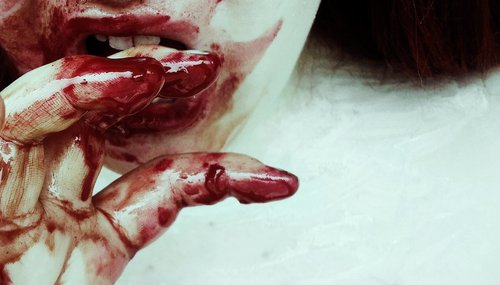
I saw a beautiful youth with golden cymbals, dancing and leaping in joy and abandonment… Finally he fell to the ground and buried his face in the flowers. Then he sank into the lap of a very old mother. After a time he got up and jumped into the water, where he sported like a dolphin… I saw that his hair was golden. Now we were leaping together, hand in hand. So we came to a gorge… In leaping the gorge the youth falls into the chasm. X is left alone and comes to a river where a white sea-horse is waiting for her with a golden boat. X found the youth in the lap of the mother so impressive that she painted a picture of it. The figure is the same as in item i; only, instead of the grain of wheat in her hand, there is the body of the youth lying completely exhausted in the lap of the gigantic mother. There now follows a sacrifice of sheep, during which a game of ball is likewise played with the sacrificial animal. The participants smear themselves with the sacrificial blood, and afterwards bathe in the pulsing gore. X is thereupon transformed into a plant. After that X comes to a den of snakes, and the snakes wind all round her. In a den of snakes beneath the sea there is a divine woman, asleep. She is shown in the picture as much larger than the others. She is wearing a blood-red garment that covers only the lower half of her body. She has dark skin, full red lips, and seems to be of great physical strength. She kisses X, who is obviously in the role of the young girl, and hands her as a present to the many men who are standing by, etc. As X emerged from the depths and saw the light again, she experienced a kind of illumination: white flames played about her head as she walked through waving fields of grain. (The Archetypes and the Collective Unconscious p. 188-189)
It is death that makes possible the great abundance of life, as D. H. Lawrence reflects on in Medlars and Sorb-Apples:
I love you, rotten,
Delicious rottenness.
I love to suck you out from your skins
So brown and soft and coming suave,
So morbid, as the Italians say.
What a rare, powerful, reminiscent flavour
Comes out of your falling through the stages of decay:
Stream within stream.
Something of the same flavour as Syracusan muscat wine
Or vulgar Marsala.
Though even the word Marsala will smack of preciosity
Soon in the pussy-foot West.
What is it?
What is it, in the grape turning raisin,
In the medlar, in the sorb-apple.
Wineskins of brown morbidity,
Autumnal excrementa;
What is it that reminds us of white Gods?
Gods nude as blanched nut-kernels.
Strangely, half-sinisterly flesh-fragrant
As if with sweat,
And drenched with mystery.
Sorb-apples, medlars with dead crowns.
I say, wonderful are the hellish experiences
Orphic, delicate
Dionysos of the Underworld.
A kiss, and a vivid spasm of farewell, a moment’s orgasm of rupture.
Then along the damp road alone, till the next turning.
And there, a new partner, a new parting, a new unfusing into twain,
A new gasp of further isolation,
A new intoxication of loneliness, among decaying, frost-cold leaves.
Going down the strange lanes of hell, more and more intensely alone,
The fibres of the heart parting one after the other
And yet the soul continuing, naked-footed, ever more vividly embodied
Like a flame blown whiter and whiter
In a deeper and deeper darkness
Ever more exquisite, distilled in separation.
So, in the strange retorts of medlars and sorb-apples
The distilled essence of hell.
The exquisite odour of leave-taking.
Jamque vale!
Orpheus, and the winding, leaf-clogged, silent lanes of hell.
Each soul departing with its own isolation,
Strangest of all strange companions,
And best.
Medlars, sorb-apples
More than sweet
Flux of autumn
Sucked out of your empty bladders
And sipped down, perhaps, with a sip of Marsala
So that the rambling, sky-dropped grape can add its music to yours,
Orphic farewell, and farewell, and farewell
And the ego sum of Dionysos
The sono io of perfect drunkenness
Intoxication of final loneliness.


 The House of Vines