Raise a glass in honor of the mistress of the feast
wine-loving and frenzied Goddess of wet grace
who revels with Nymphs in river-fed grottoes
whose dancing feet excite the pulse of life in all creation
who leads the wild beasts as they roam through primordial forests
who laughs in the darkness and can bring to completion with just a smile.
Heart-render, tomb-haunter, hunger and fire
and the fathomless depths of the sea, maenadic Aphrodite
who wields the scourge of the mysteries, hail to thee!
Author: thehouseofvines
To Aphrodite of surpassing beauty
Aphrodite of surpassing beauty,
golden lady of love and joy,
please share your blessings with me.
Kindle the flames of passion within my breast,
fill me with an aching longing for others,
delight my eyes with the awesome beauty of all creation,
make me melt with unimagined ecstasy.
On the Festival of the Charites
Let the sweet voices of the maiden-choir rise up
like the fragrance of rose petals on the fair altar of Kypris,
singing the praises of the Charites,
the dance-loving daughters of Dionysos,
who bring peace and joyful celebration to the city,
warming the hearts of all with their radiant beauty and gentle grace.
When these three who are never separated come down
from the shining heights of Olympos
to take up residence in their temple during the days of their festival,
strife is banished from the land, men forget their petty differences
and even the law-courts are closed
for everyone is too busy drinking
and enjoying each other’s company
to bother with such things.
Flowers and fine clothes and who will win the contest of beauty
is all that anyone can think of.
We Alexandrians are especially devoted to the Goddesses,
for they aided our Queen when she sailed
up river to meet the Roman general.
They made her seem the very image of Aphrodite
and put power into her charming words,
so that his grievances and thoughts of war were forgot
and all he longed to do was lay with his head in her lap
and taste the sweet fruit she offered him.
In this way our country was saved
and since that time we have been dutiful
in keeping the festival of the Charites.
So you noble girls,
chosen to sing on behalf of our city,
call the Goddesses here
and let them know we’re ready to celebrate them
in proper Alexandrian style!
Immortalis amor
Whatever the Gods touch becomes a myth, immortal.
A rock on the wave-swept beach,
a bird high up in a tree,
and yes, even the human heart.
All these the Gods can cause to exist for all time in the memory of man.
This love I feel has its origin in the Golden One,
fair Kypris who dances amid the flowers,
whose light feet cause the green grass to rise up
and whose melodious laughter coaxes the nourishing rain
from the night-dark clouds.
Even if one of the Nine Maidens of Helikon were sitting upon my lap,
stroking my cheek and whispering their honey-sweet words into my ear,
even then I could not begin to sing of the depths of my love,
the intensity with which it has laid claim to my soul.
But I recognize its twin in the stories of old,
Philemon and Baucis who sprouted leaves
so that their fingers would touch forever,
Medeia who fled her father’s home and her precious motherland
for Jason’s tender kisses,
Kleopatra who endured the serpent’s sting
to be reunited with her dear ivy-crowned Antony.
Yes, here in these ancient tales I sense an echo of what I feel for my beloved.
Will men of a future generation remember us in such illustrious company?
If Aphrodite who made all this possible wills it,
it will be so.
Hymn to Arsinoë-Aphrodite Zephyritis
Three in number were the Graces,
those beautiful Goddesses of blooming flowers and soft gowns
handmaidens of the Paphian Queen who adorned her at her birth
when she rose lovely-shaped from the waters of the primeval ocean
and stepped onto dry land,
already wielding power over the hearts of men and Gods alike.
But now they are four, since the radiant Arsinoë has come to join their ranks.
Mortal-born was she, with good blood of the Lagides in her veins.
When she came forth from her mother’s lucky womb,
no Gods stood in attendance to ease the pangs of labor
or wash the babe clean,
but none were needed for Arsinoë’s nature was so pure,
her temperament so sweet,
that the Queen was delivered of her in ease
and wept only at the sight of her beauty.
The charm of the Golden One was about her from the first,
and her nurses counted themselves uniquely blessed
to be charged with her care.
Is it any wonder then that her brother fell
under her spell even in their youth,
and followed her about like a love-sick puppy
wherever she went?
Her father, too, was wrapped around her dainty finger,
and never could say no to what she wished.
Therefore he gave his consent to let the siblings wed,
though this had never before been the custom of their people.
But they lived in Egypt now, not mountainous Makedon,
and it was common practice for the Kings of that land
to share the holy bed with their sisters.
Nor did Hera refrain to bless this happy union
– and how could she when it was her brother Zeus and no other
that she saw fit to take to her bosom in loving embrace?
Arsinoë made her Ptolemy happier than any man
who had ever walked the earth before him,
being modest and always pleasant-natured,
seeing to his every want and bearing him
many fine sons and daughters to carry on his name.
She was wise as well,
and gave him advise in running the country,
sage counsel worthy of any philosopher.
Her chief virtue, however, was that she showed
a special concern for the Gods of her country,
going out of her way to keep their solemn festivals
and build fine houses for them.
In fact, she excelled all others in her pious deeds,
like an athlete competing in the arena of religion,
and she showed especial care for the worship of love’s Goddess.
Never did a day pass by without a prayer to Aphrodite on her lips,
and always she brought costly offerings to the altar,
pleasing to the Kytherean’s heart.
More than Queen, Mother or Wife
– titles dear to Arsinoë –
did she pride herself on being the Goddess’ slave,
serving her in every way possible
and with all that she had at her disposal.
And so it was that when Arsinoë’s allotted number of days
had reached their end,
Aphrodite took it into her mind to reward this exceptional votary
for a lifetime of faithful service.
She sent the Sons of Zeus,
horse-taming Kastor and Polydeukes, strong of arm,
down from the heights of snow-capped Olympos
to snatch Arsinoë up before she could taste the bitter wine of death.
She then bathed her in the waters of the sacred river
that flows through the heavens,
removing the wrinkles that marred her face
so that once more she appeared a maiden
flush with the ripeness of youth.
And she dressed her in the gowns of her attendants,
which gleam like the fire-pulsing stars,
and she crowned Arsinoë with a crown
like that which Dionysian Ariadne wears,
making her one of the Gods in heaven
with a share of Aphrodite’s own power,
to revel in her company for all time.
And men on earth worshiped her as a Goddess too,
building a resplendent temple for her at Zephyrion
where she could watch the waves crash against the rocks
and guide sailors away from all danger.
Nor did Alexandrian wives neglect her cult,
supplicating Arsinoë often to bless their marriage
so that it might have even a small part of the happiness
that she and her Ptolemy once enjoyed.
So hear my prayer, O Arsinoë-Aphrodite,
and smile upon me for this heartfelt hymn,
composed for you out of the best that I have to offer,
like the gifts you once made for the Heavenly Queen.
And grant that my soul will not be tossed about
on the mad sea of love,
but that I always find my way safely
into the arms of the one I hold dear,
each of us experiencing unmeasured joy
in the other’s company!
Hymn to Aphrodite Rhodophoros
To you we give these hallowed offerings,
a token of our immense affection
O kind-hearted Aphrodite,
loveliest of all the Goddesses when you emerge from the pure waters
of the rushing river renewed in your power
and gleaming like the imperishable stars in heaven.
Your gentle feet tread the soft earth leaving no mark
save for the green grass and fragrant flowers that rise up in your wake
proclaiming the arrival of a mighty and revered divinity
in the fair land of the well-born ones.
All the moss-haired Nymphs who feast on the sweet honey of bees
and cavort with the trumpet-voiced geese
and cunning, food-thieving raccoons
on the shores of the Willamette
come out to greet you weaving a crown of many-colored wildflowers
to adorn your beautiful brow
which shines golden as the rays of the life-giving lord Helios
who smiles as he watches you dance with effortless grace
amid the blossoming purple irises and the plentiful grape hyacinths.
These skilled daughters of the towering trees and misty raindrops
fashion for you an elegant gown of ivy-leaves to conceal
from all profane eyes the sight of your breasts –
white as the milk that flows from motherly cows,
soft as rose petals in the garden –
and your smoothly rounded hips which sway like leaves
caught in the breeze of a warm May afternoon.
Your hair,
dark as the bedchamber of a bride on her wedding night
as she trembles in pleasure at the first exploring touches of her man,
the Nymphs gather with their sparrow-like fingers,
flying too swiftly for a mortal eye to follow
as they braid your perfumed locks and weave
shining stones, glass beads, twigs, rainbow-hued flowers,
the tiny bones of tiny animals
and other treasures that have been left for them
as pious offerings in their verdant, tree-shaded, water-fed haunts.
It was love and appreciation of nature’s beauty
that caused men to gift them such things
so the Nymphs feel it only proper
to return a portion of their yield back to you.
And so arrayed you rise from your bed of dew-moistened loam,
marvelous beyond words to describe,
and begin your grand procession through the fair land of the well-born ones
followed by a troop of Nymphs and all the birds and animals
who call this place their dear home.
Laughter echoes through the woods
and gay song that brings contentment to the heart
and smiles to the lips of all who hear it,
even if they lack the vision to behold
the old Gods walking amongst them once more.
The whole earth rouses itself with life and color wherever you pass
as the gorgeous flowers unfurl with the brilliant colors of early summer
and everything feels fresh and new, full of love’s bounty.
So for these and your countless other blessings we thank you dear Aphrodite,
and pray that you find our offerings as pleasing as we find you.
The maiden lingers
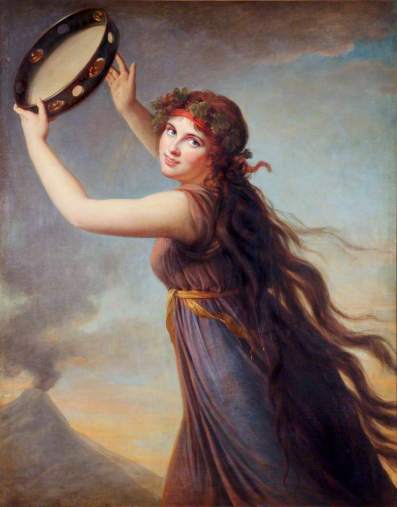
The maiden lingers at the boundary stone,
glancing wistfully behind her
at the home she is leaving.
Her hair is artfully arranged,
her pale cheeks reddened like the summer roses,
and a dress fit for a bride clings to her supple curves,
with nothing on beneath.
A ball of golden string rests at her bare feet;
her smile is joyful, expectant,
but her eyes betray more complex emotions inside her.
Sadness, and perhaps a touch of fear.
Where she goes, none may return.
The silent guide waits for her, hand outstretched
and face concealed by the shadow of his broad-brimmed hat.
The snakes twined around his staff hiss and sway
to the clamor of drums played by Satyrs in the distance.
Their music has cast a spell on her,
drawn her out of her father’s doors
with light, dancing steps to revel in the forested Italian hills
where the women of her village go to hang
ribbons and masks on the night of the spider,
where she can finally be free.
She knows that he waits for her,
the handsome youth with the kantharos and a crown of violets and ivy-leaves.
He’s the one who tossed the golden ball at her feet;
all she has to do is reach down, pick it up, and follow the thread back to him
and they will feast together in love’s banquet.
But she hesitates.
Only for a moment, but she hesitates.
She hungers for him with all her soul,
wants to lose herself in his kisses,
feel her flesh come alive for the first time
as he caresses her and claims her as his own,
aches to be filled with the frenzy of him,
that strange and beautiful youth
who she senses is so much more than he seems
– but she fears. Fears the finality of that first step,
fears that her family will forget her when she does not return,
fears that she is not worthy of his love.
But what choice does she have?
She has already closed her eyes,
let her hand fall to her side,
felt the last breath escape her lips.
All that remains is the journey into eternity
and the cup of her beloved, full of his wine.
they abandon themselves to the dance with the greatest delight

Nicola Caputo of Lecce, De Tarantulae anatomie et morsu pg. 201
They customarily adorn the bedroom dedicated to the dance of the tarantati with verdant branches outfitted with numerous ribbons and silken sashes in gaudy colors. They place similar drapery throughout the room; sometimes they prepare a sort of cauldron or tub full of water, decorated with vine leaves and green fronds from other trees; or they make pretty fountains of limpid water spout, capable of lifting the spirits, and it is near these that the tarantati perform the dance, seeming to draw the greatest delight from them, as well as the rest of the setting. They contemplate the drapes, the fronds, and the artificial rivulets, and they wet their hands and heads at the fountain. They also remove damp bands of vine leaves from the cauldron and strew them all over their bodies, or – when the vessel is large enough – they plunge themselves inside, and in this way they can more easily bear the fatigue of the dance. It often happens that those who go dancing through the towns and hamlets accompanied by the usual music are brought to an orchard, where, in the shade of a tree, near a pond or brook offered by nature or prepared through craft, they abandon themselves to the dance with the greatest delight, while groups of youths in search of pleasure and pranks gather near. Among the latter mingle more than a few who are approaching old age and who, contemplating with serious curiosity the melodic frolicking, seem to exhort the youths with unspoken admonishment.
show yourself to us
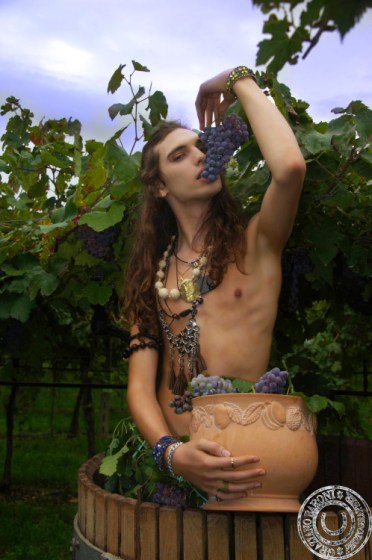
I call upon the Dionysos who shines
out of the vast gloom of the underworld,
torch-bearing, flame-haired wild redeemer
who wears the fawnskin spangled with stars,
dancing through the long Night
until greeted by Dawn’s rosy light,
he who spends the Day rushing through fields
of golden wheat and leaping over the highest cliffs
like a falcon with wide-stretched wings
or a long-maned lion who loves the hunt.
Uniter of opposites, dissolver of boundaries,
swirling polarity and equal measure Helios and Haides;
show yourself to us, you who were born again in the fire
Dionysos the Black Sun, God who creates through destruction.
A lost myth?
I just read Stephen Mitchell’s translation of the Virgilessrímur, an Icelandic poem written around 1300–1450 e.v. about the legendary exploits of Virgiles, the far-famed Italian magician and author of the Aeneis. The story is quite fascinating, and not just for the explicit BDSM scenes – I think we’ve got a pre-Christian myth passed down as a bawdy folk ballad. What do you guys think?

Sole di mezzanotte

Paulus Orosius, Historiarum Adversum Paganos Libri VII 1.13
In the five hundred and sixtieth year before the founding of the City, the Cretans and Athenians engaged in a bitter struggle in which both sides suffered disastrous losses. The Cretans were victorious and made their triumph even bloodier by cruelty, handing over some children of noble Athenian parentage to be devoured by the Minotaur. I do not know whether it would be more accurate to describe this creature as a man with the qualities of a wild beast or as a beast with the qualities of a human being. But the Cretans fattened this misshapen monster on these noble children who had been torn away from their native land.
passing through the gate

Lucius Ampelius, Liber Memorialis
There are five Libers: the first, son of Jupiter and Proserpina; he was a farmer and inventor of wine; his sister is Ceres. The second Liber, son of Melo and Flora, in whose name is the River Granicus. The third, son of Cabirus, who reigns in Asia. The fourth, son of Saturnius and Semele … they say. The fifth, the son of Nisus and Thyona.
Dream Is Destiny
Clement of Alexandria, Stromateis 5.8.49.3
So what? Does not Epigenes, in his book On the Poetry of Orpheus, in exhibiting the peculiarities found in Orpheus, say that by “the curved rods” (κερκίσι) is meant “ploughs”; and by the warp (στήμοσι), the furrows; and the woof (μίτος) is a figurative expression for the seed; and that “tears of Zeus” signify a storm; and that the “parts” (μοῖραι) are, again, the phases of the moon, the thirtieth day, and the fifteenth, and the new moon, and that Orpheus accordingly calls them “white-robed,” as being parts of the light? Again, that the Spring is called “flowery” (ἄνθιον) from its nature; and Night “still” (ἀργίς) on account of rest; and the Moon “Gorgonian,” on account of the face in it; and that the time in which it is necessary to sow is called “Aphrodite” by the theologian? In the same way, too, the Pythagoreans spoke figuratively, allegorizing the “dogs of Persephone” as the planets, the “tears of Cronus” as the sea.
Hippolytus of Rome, On Christ and Antichrist 4
For whereas the Word of God was without flesh, he took upon Himself the holy flesh by the holy Virgin, and prepared a robe which He wove for Himself, like a bridegroom, in the sufferings of the cross, in order that by uniting His own power with our mortal body and by mixing the incorruptible with the corruptible, and the strong with the weak, He might save perishing man. The web-beam (ἱστόν), therefore, is the passion of the Lord upon the cross, and the warp (στήμων) on it is the power of the Holy Spirit, and the woof (κρόκη) is the holy flesh woven by the Spirit, and the thread (μίτος) is the grace which by the love of Christ binds and unites the two in one, and the rods (κερκίς) are the Word; and the workers are the patriarchs and prophets who weave the fair, long, perfect tunic (χιτῶν) for Christ; and the Word passing through these, like the rods, completes through them the will of His Father.
through the long night

She anointed Mark Antony on the head and the hands and mouth—the head that thinks of great deeds, the hands that accomplish them and the mouth that utters words that are just, wise and true.
Hail Semachus and his Daughters!
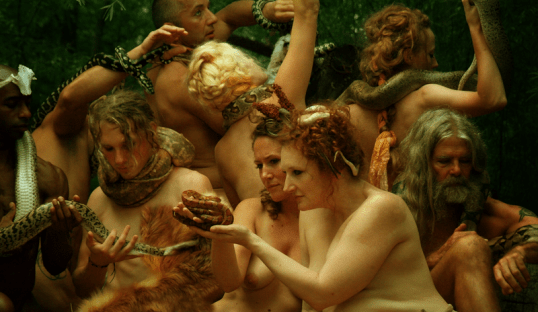
I was cleaning out my drafts in Gmail where I keep random links, quotations, snippets of peculiar phrases and title ideas for unwritten blog posts when I came across these passages on the obscure Bacchic hero Semachos:
Jerome, The Chronicle B1497
During the 10 years Moses was in charge of the Jewish nation in the desert Deucalion’s son Dionysus traveled abroad. When he arrived in Attica he was received as a guest by Semachus and gave his daughter the pelt of a goat.
Philochorus, fragment 206 (preserved in Stephanus Byzantinus)
Semachidae: a deme of Attica, named after Semachus, who with his daughters received Dionysus as a guest; the priestesses of Dionysus are descended from them. It belongs to the Antiochis tribe, and Philochorus says that the deme is in the district of Epacria.
Wanting to learn more about him and his daughters I hit the Google, turning up this:
Dionysus was welcomed by the women of Semachos’ oikos. His daughter received the gift of a deer skin (nebris), which Karl Kerenyi identified as the bestowal of the rite of maenads in rending limb from limb the animals they sacrificed to Dionysus: “nebrizein also means the rending of an animal.”
They go on to derive his name from a Northwest Semitic loanword represented by the Hebrew šimah, “made to rejoice.” Semachos, as a plural of simchah, “joyous occasion”, appears in the euphemistically titled Talmudic Tractate Semachos, which deals with customs of death and mourning.
Carl Kerenyi adds this fascinating detail:
On a sixth-century vase from Orvieto a man is leading Dionysos toward the host-hero, whose distinction is stressed by an eagle bearing a snake in its beak. Two women making dance movements and two ithyphallic sileni are also present. In all likelihood the scene represents the god’s arrival at the house of Semachos. (pg. 147)
Hmm. An eagle bearing a snake – where have I seen that before? Oh yeah, the coinage of Olbia and Shield of Dionysos.
Anyway, interesting timing that I should (re)discover this man and his daughters during the month of Νεβρίς, with Ἀγριώνια and Ἀλέτιδεια upon the horizon.
as temperate as if they had been sober
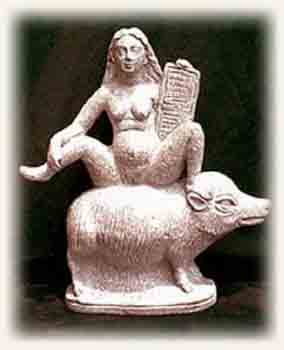
Sextus Empiricus, Adversus Mathematicos 6.8
Thus Pythagoras, when he once observed how youths who had been filled with Bacchic frenzy by alcoholic drink differed not at all from madmen, exhorted the flute-player, who was joining them in the carousal, to play his aulos for them in the spondaic melos. When he thus did what was ordered, they suddenly changed and became as temperate as if they had been sober even at the beginning.
an altar to a different God
Álvaro de Campos:
Multipliquei-me, para me sentir,
Para me sentir, precisei sentir tudo,
Transbordei, não fiz senão extravasar-me,
Despi-me, entreguei-rne,
E há em cada canto da minha alma um altar a um deus diferente.
I multiplied, to feel myself,
To feel myself, I had to feel everything,
I overflowed, I did nothing but escape,
I undressed myself, I gave it up,
And there is in every corner of my soul an altar to a different God.
He hears you; he speaks the words that heal
One of the primary forms of Dionysos venerated within the Starry Bull tradition is referred to by his epikleseis Eubouleos meaning “He of Good Counsel” and Epikoos “He who Listens.” In Bacchic Orphism Dionysos intercedes on behalf of the initiate, speaking words to soothe the ancient grief of Persephone which must otherwise be atoned for through purgation and punishment:
For from whomsoever Persephone shall accept requital for ancient grief, the souls of these she restores in the ninth year to the upper sun again; from them arise glorious kings and men of splendid might and surpassing wisdom, and for all remaining time men call them sainted heroes. (Pindar, fragment preserved in Plato’s Meno)
The happy life, far from a vagrant existence, that is desired by those who, in Orpheus, are initiated through Dionysos and Kore and told to cease from the circle and enjoy respite from disgrace. (Proklos, Commentary on Plato’s Timaeus 3.296.7)
Dionysos is the cause of release, whence the God is also called Lusios. And Orpheus says: “Men performing rituals will send hekatombs in every season throughout the year and celebrate festivals, seeking release from lawless ancestors. You, having power over them, whomever you wish you will release from harsh toil and the unending goad.” (Damascius, Commentary on the Phaedo 1.11)
Now you have died and now you have been born, thrice blessed one, on this very day. Say to Persephone that Bakchios himself set you free. A bull you rushed to milk. Quickly, you rushed to milk. A ram you fell into milk. You have wine as your fortunate honor. And rites await you beneath the earth, just as the other blessed ones. (Gold tablet from Pelinna)
Likewise he is the one who intervenes when none of the other Gods can break the cycle of violence and recrimination that Hera and Hephaistos find themselves trapped in:
Hera hurled Hephaistos down from heaven, ashamed at her son’s lameness, but he made use of his skill. Having been rescued in the ocean by sea divinities he made many glorious things – some for Eurynome, some for Thetis, by whom he had been saved – but he also built a throne with invisible chains and sent it as a gift to his mother. And she was very delighted with the gift and she sat on it and found herself trapped, and there was no one to release her. A council of the Gods was held to discuss returning Hephaistos to heaven; for as they thought he was the only one who could release her. So while the other Gods remained silent and were at a loss for a solution, Ares undertook to do something, and when he got there, he accomplished nothing, but quit in disgrace when Hephaistos threatened him with blazing torches. Since Hera was in such great distress, Dionysos came with wine and, by making Hephaistos drunk, compelled him to follow through persuasive speech. When he came and released his mother he made Dionysos Hera’s benefactor, and she, rewarding him, convinced the heavenly Gods that Dionysos, to should be one of the heavenly Gods. (Libanios, Progymnasmata Narration 7)
In the mortal realm Dionysos is the one who gives voice to those who suffer and have been deprived of all other outlets, usually resulting in the institution of a festival that makes the community that spurned them reenact their story, as he did with Erigone:
When Ikarios was slain by the relatives of those who, after drinking wine for the first time fell asleep (for as yet they did not know that what had happened was not death but a drunken stupor) the people of Attika suffered from disease, Dionysos thereby (as I think) avenging the first and the most elderly man who cultivated his plants. At any rate the Pythian oracle declared that if they wanted to be restored to health they must offer sacrifice to Ikarios and to Erigone his daughter and to her hound which was celebrated for having in its excessive love for its mistress declined to outlive her. (Aelian, On Animals 7.28)
And the Oinotrophoi:
My lord, most noble hero, you make no mistake. You saw me father of five children, now such is the fickleness of fate you see me almost childless. For what help to me is my son far away on Andros isle where in his father’s stead he reigns? Delius gave him power of prophecy and Liber gave my girls gifts greater than the prayers of their belief. For at my daughters’ touch all things were turned to corn or wine or oil of Minerva’s tree. Rich was that role of theirs! But when it was known to Atrides, plunderer of Troy, with force of arms he stole my girls, protesting, from their father’s arms and bade them victual with that gift divine the fleet of Greece. They fled, each as she could, two to Euboea, two to their brother’s isle, Andros. A force arrived and threatened war, were they not given up. Fear overcame his love and he gave up his kith and kin to punishment. And one could well forgive their frightened brother … Now fetters were made ready to secure the captured sisters’ arms: their arms still free the captives raised to heaven, crying “Help! Help, father Bacchus!” and the God who gave their gift brought help, if help it can be called in some strange way to lose one’s nature. How they lost it, that I never learnt, nor could I tell you now. The bitter end’s well known. With wings and feathers, birds your consort loves, my daughters were transformed to snow-white doves. (Ovid, Metamorphoses 13. 631 ff)
And Charilla:
The Delphians celebrate three festivals one after the other which occur every eight years, the first of which they call Septerion, the second Heroïs, and the third Charilla. The greater part of the Heroïs has a secret import which the Thyiads know; but from the portions of the rites that are performed in public one might conjecture that it represents the evocation of Semele. The story of Charilla which they relate is somewhat as follows: A famine following a drought oppressed the Delphians, and they came to the palace of their king with their wives and children and made supplication. The king gave portions of barley and legumes to the more notable citizens, for there was not enough for all. But when an orphaned girl, who was still but a small child, approached him and importuned him, he struck her with his sandal and cast the sandal in her face. But, although the girl was poverty-stricken and without protectors, she was not ignoble in character; and when she had withdrawn, she took off her girdle and hanged herself. As the famine increased and diseases also were added thereto, the prophetic priestess gave an oracle to the king that he must appease Charilla, the maiden who had slain herself. Accordingly, when they had discovered with some difficulty that this was the name of the child who had been struck, they performed a certain sacrificial rite combined with purification, which even now they continue to perform every eight years. For the king sits in state and gives a portion of barley-meal and legumes to everyone, alien and citizen alike, and a doll-like image of Charilla is brought thither. When, accordingly, all have received a portion, the king strikes the image with his sandal. The leader of the Thyiads picks up the image and bears it to a certain place which is full of chasms; there they tie a rope round the neck of the image and bury it in the place where they buried Charilla after she had hanged herself. (Plutarch, Aetia Graeca 12)
And Kyanê:
To Dionysos alone did Kyanippos, a Syracusan, omit to sacrifice. Then one day in a fit of drunkenness he violated his daughter Kyanê in a dark place. She took off his ring and gave it to her nurse to be a mark of recognition. When the Syracusans were oppressed by a plague, and the Pythian God pronounced that they should sacrifice the impious man to the Averting Deities, the rest had no understanding of the oracle; but Kyanê knew, and seized her father by the hair and dragged him forth; and when she had herself cut her father’s throat, she killed herself upon his body in the same manner. So Dositheüs in the third book of his Sicilian History. (Plutarch, Greek and Roman Parallel Stories 18)
And numerous others.
Indeed, one of the central tenets of tragedy is that μίμησις brings about κάθαρσις, as Aristotle remarks in the Poetics:
Tragedy, then, is an imitation of an action that is serious, complete, and of a certain magnitude; in language embellished with each kind of artistic ornament; in the form of action, not of narrative; through pity and fear effecting the proper purgation of these emotions.
For the Greeks language had a potent magical force to it:
Fearful shuddering and tearful pity and sorrowful longing come upon those who hear it, and the soul experiences a peculiar feeling, on account of the words, at the good and bad fortunes of other people’s affairs and bodies. But come, let me proceed from one section to another. By means of words, inspired incantations serve as bringers-on of pleasure and takers-off of pain. For the incantation’s power, communicating with the soul’s opinion, enchants and persuades and changes it, by trickery. Two distinct methods of trickery and magic are to be found: errors of soul, and deceptions of opinion. (Gorgias, Encomium of Helen)
A force that is still being felt millennia later, as Michael Meade’s use of tragic plays to heal wounded soldiers so ably demonstrates:
A soldier returns home from battle but has brought the war with him. He stares off into the distance, unable to take joy in his family or friends, still hyperalert to threats he no longer faces. Unable to heal his invisible wound, he takes his own life. This isn’t a tragic news story about a veteran coming back from Afghanistan with a case of post-traumatic stress disorder (PTSD). It’s a summary of the Greek play “Ajax,” which is more than 2,000 years old.
The Greeks didn’t call it PTSD. But they understood that war brought trauma (from the Greek word meaning “wound”), which left some warriors with a thousand-yard stare long after they returned home. Advocates and the military itself have found that ancient myths and stories like “Ajax” can help veterans and active-duty soldiers cope with the overwhelming psychological stress that the country’s longest war has put on its relatively small volunteer force.
[…]
Meade calls himself a “mythologist,” and he uses ancient stories from Ireland, Greece, India and other cultures to prod veterans into unloading their experiences and making sense of them over four-day retreats on the West Coast. Veterans in Meade’s program also sing ancient warrior chants together, take part in a “forgiveness” ceremony, and write and recite poetry. He believes that many ancient cultures did a better job of formally welcoming returning warriors home and helping to collectively shoulder some of their burdens.
“Everyone wants to tell their story,” Meade said. “Even the most wounded people, given the chance, want to tell the story of that wound. A wound is like a mouth.”
May our Lord Dionysos bring his healing and redemptive madness to all those who are in need it:
Madness can provide relief from the greatest plagues of trouble that beset certain families because of their guilt for ancient crimes: it turns up among those who need a way out; it gives prophecies and takes refuge in prayers to the Gods and in worship, discovering mystic rites and purifications that bring the man it touches through to safety for this and all time to come. So it is that the right sort of madness finds relief from present hardships for a man it has possessed. (Plato, Phaedrus 244de)
all things move and nothing remains still

I was rereading the honey, castration and aischrorrêmosunai portion of my piece on the Priapic mysteries when something about this passage from Plato caught my eye.
Take that which we call ousia (reality, essence); some people call it essia, and still others ôsia. First, then, in connection with the second of these forms, it is reasonable that the essence of things be called Hestia; and moreover, because we ourselves say of that which partakes of reality ‘it is’ (estin), the name Hestia would be correct in this connection also; for apparently we also called ousia (reality) essia in ancient times. And besides, if you consider it in connection with sacrifices, you would come to the conclusion that those who established them understood the name in that way; for those who called the essence of things essia would naturally sacrifice to Hestia first of all the Gods. Those on the other hand, who say ôsia would agree, well enough with Herakleitos that all things move and nothing remains still. So they would say the cause and ruler of things was the pushing power (ôthoun), wherefore it had been rightly named ôsia. (Kratylos 400d – 401b)
Two things, actually.
Esia is what the Etruscans called Ariadne.
And I’ve bolded the other.
 The House of Vines