Author: thehouseofvines

Remember!

In a comment left on my previous post, Galina remarked:

I also think it’s great that you’re talking about female orpheotelestai. I suspect people forget that was a thing.

Sadly, I encounter that all the time. But thankfully women are highly regarded within the Starry Bull tradition – and not just because we’re Bacchic Orphics. You find this same attitude in Egypt and Magna Graecia, two cultures that have strongly influenced us, especially in the shaping of our values.

but he cheerfully allowed an old woman to put a charm round his neck

I just came across an interesting anecdote by Diogenes Laertius:

We hear that Bion, to whom the Scythian land of Borysthenes gave birth, denied that the Gods really exist. Had he persisted in holding this opinion, it would have been right to say, “He thinks as he pleases: wrongly, to be sure, but still he does think so.” But in fact, when he fell ill of a lingering disease and feared death, he who denied the existence of the Gods, and would not even look at a temple, who often mocked at mortals for sacrificing to deities, not only over hearth and high altars and table, with sweet savour and fat and incense did he gladden the nostrils of the Gods; nor was he content to say “I have sinned, forgive the past,” but he cheerfully allowed an old woman to put a charm round his neck, and in full faith bound his arms with leather and placed the rhamnus and the laurel-branch over the door, being ready to submit to anything sooner than die. Fool for wishing that the divine favour might be purchased at a certain price, as if the Gods existed just when Bion chose to recognize them! It was then with vain wisdom that, when the driveller was all ashes, he stretched out his hand and said “Hail, Pluto, hail!” (Lives of the Eminent Philosophers 4.55-57)

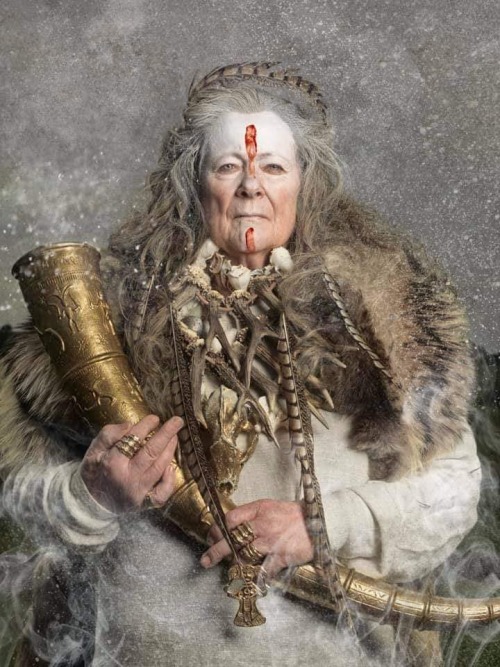
That anonymous old woman sure sounds an awful lot like an Orpheotelest, though I don’t recall seeing her mentioned in discussions of Orphism. It wouldn’t be surprising, however, since a lot of women were Orpheotelestai or otherwise participated in Orphic rites and beliefs.

Rhamnus, by the way, is buckthorn which was chewed and smeared on the lintel to banish the keres or wandering dead during Anthesteria

Image by Jim Lyngvild

Ariadne on Naxos

Ariadne sat on a rock in the cave,
watching as the sea washed past her feet
in silvery rivulets, and outside she heard
invisible maidens splashing in the surf.
She was all alone and going mad from grief
and oh how her heart longed for death.
In death she would meet her beloved
Theseus, slayer of the bull, who had set her free.
Death had claimed him, dragged him beneath the waves
while she was sleeping. That was the only explanation.
Her mind could not conceive of any other reason
why she’d been left all alone in this dark and desolate place.
Her Theseus had gone ahead to light her way into the land of shades.
And soon, she would see the torchlight and the baying of the black hounds,
as Hermes, death’s herald, came to collect her too.
But soon was not now, and the moments inched along,
each an insufferable agony, as if stones were being piled atop her,
one by one, making it impossible for her to move
or to breathe,
as she sank deeper and deeper into despair.
She had stripped herself nearly bare,
to await dread Kyllenios who would guide her beyond the land of dream,
and the castle of the Sun, to the house of Haides,
where her husband was waiting for her.
Only a white undergarment she wore as funereal wrappings,
wet and clinging to the soft curves of her dancer’s tiny frame;
the rest she’d discarded about the cave.
There were her purple robes, and there her crown with horns of the moon,
there her golden girdle and the ball of red twine she’d used to lead
gallant Theseus out of the labyrinth, and there, half submerged in the water
was a well-worked bronze mirror, upon its back
the first flowers of spring graved with wondrous realism by Daidalos.
Though she was too lost in grief to see it,
a hand was pressed against the mirror’s reflective surface
the young god desperately trying to reach through to soothe her anguish,
even as dark shapes with white faces crept slowly up behind him.

all this is passing

do not weep
all this is passing
a procession of mad and glorious images
slipping away like water through fingers
but you cannot stop the show
to hold and stroke a cherished memory
for when you stop dancing you die
so stand firm and drink in what’s before you
for tomorrow it will be gone
and so will you

everything is so 3-D

“I don’t feel anything, dude.” Tim whispered though we were alone,
words slurring, hand out waving slowly back and forth,
back and forth, back and forth. “I think these mushrooms are …”
I waited for him to finish but he was busy staring through his hand, grinning like an idiot.
I took another drag of my cigarette, cherry glowing like a star in the dark desert night,
sweet clove smoke billowing around me like fragrant incense before an ancient idol.
Sweat trickled down my neck, and my flesh was chill as corpse flesh,
despite the waves of heat still radiating off the red rocks.
I could feel the bones beneath my skin, and my heart thudding in my chest.
Hear my pulse, and the pulse of the earth beating in synch with each other.
“Wait.”
I waited some more.
“Maybe I’m tripping. Am I tripping?”
“Naw, this is just the way the world is. ‘If the doors of perception were cleansed
everything would appear to man as it is, Infinite. For man has closed himself up,
till he sees all things thro’ narrow chinks of his cavern.’”
Tim nodded sagely, almost toppled over. “That’s beautiful, dude. Did you just come up with that?”
“Sure,” I chuckled, stabbed out my cigarette and immediately lit another.
“Now shut up and enjoy the ride.”
He was about to say something indignant, but his ridiculously wide-pupiled eyes caught motion off to his side and he
got lost watching an invisible lizard or mouse scurry away.
I melted back into oceanic euphoria as milky stars danced a Cretan crane-dance overhead
and the silent music of the spheres swelled around me.
My eyes fluttered closed and I took in a deep breath of desert air, held it for several heartbeats,
and then several more, feeling it circulating through my whole body, exhaled and then sucked in another.
Lights swam and flickered behind my eyelids, throbbing sexually, as I slipped outside of time and space.
When I opened them again I sensed the eyes of Dionysos staring back at me.
I smiled and waved, though I could not see him. He was there, on the other side of the mirror, watching.
Not a man, with olive skin and black beard streaked with brown,
and wavy hair that spilled down to his broad shoulders, clad in fawnskin
and head crowned with clusters of reddish grapes and vine tendrils that coiled like green serpents.
He didn’t have massive horns and flared nostrils and tawny fur and a broad, flat tongue
and bulk that made the earth thunder.
He wasn’t lean and spotted and baring sharp teeth,
tensed to pounce on prey with swift precise grace.
But he was there. In the soil and the scrub and the stars,
in the lingering heat and the all-encompassing dark
and the slow, persistent thrum of life in this seemingly barren place.
And I breathed him into me and felt him dance all around,
felt the world dance under his spell
and all the things in the world danced

and I, too, was dancing
though I lay there gazing up into the vast heavens
and Tim giggled insanely and said, “Woa dude. Like, everything is so 3-D.”

Apokathistémi

He smiled at her,
and did not look away.
Strange.
It had been so long,
so very long since she had been seen,
that the old woman had forgotten how to respond.
Most found themselves suddenly busy as they approached,
eyes like frantic butterflies,
landing on her filthy, shapeless clothes
(too many for the summer heat, too few for frigid winter)
or her shopping cart spilling over with scavenged treasures,
before quickly moving on,
their ears deaf as stone, especially if she asked for change
or something to eat.
Many crossed the street to avoid her,
or stared down at the cracked sidewalk as they hurried by.
But he stopped.
His eyes saw beneath the grime
the years and the years of pain.
Saw the loss that had scored her flesh like sun-parched earth,
turned her eyes milky-white and made her frail limbs tremble
even when she was still.
He saw past all that, to the maiden she once had been
in the garden with the tree and the great white serpent.
She began to cry.
It had been so long, she’d forgotten his name.
“Here,” the man reached inside his long leather coat
and dug out a small golden ball. He placed it in her hands and said,
“I was given this as a child, but it is yours.”
It wasn’t a ball but an apple.
Remembering Ladon who had watched over her and her sisters
for the first time in centuries, she smiled.
Lovely ox-eyed Hesperethousa looked up to thank the man
but he was gone.

And the show must go on

My hair is slick with mud,
my beard forming stalactites,
my face unrecognizable in its pale coating.
Flesh of earth I wear,
cracks forming as I turn my head this way
and that, and grin, something other than me grinning back.
I show my teeth, sharp and gleaming white,
good for tearing loose chunks of goat’s flesh.
I take a swig from the bottle, let its black streams
carve channels in clay, a red mouth engulfing my own
and don’t wipe it away, preferring the stain.
I watch my own eyes,
note how cold and hollow they seem,
a lizard’s eyes, or a panther’s.
A killer’s eyes.
Eyes that stare back at me, stare through me.
Eyes that challenge and seduce,
eyes that laugh in the dark
that dance in the storm clouds
and the rumbling of the earth.
I am not I.
I am the grapes that are crushed,
I am the bull whose horns are twined with ivy,
I am the lava that surges within the mountain,
I am the stars that dance in the dark heaven,
I am the mask hung from the pillar,
I am the heat and the loosening and the unfolding,
I am the great dragon that begets sons of stone,
I am the man of suffering born to atone for the crimes of lawless ancestors.
I am not I. I am him.
And the show must go on.

i am asterios

i touched you, oh untouchable ariadne,
while the faces of long-dead heroes watched
from the wall of ivy, and the moon bled
and time stood still around us
and the lamps bathed us in gold
and music none other could hear swelled
and crashed
and everything danced
and fell apart
and reshaped itself anew
we were there for the birth of worlds
and are there still
fingers laced
across the aeons
as the grand procession passes by
fiery crosses and black spirals and shapes with more dimensions
than man has yet learned to count
flashes of white and red
and a curtain of stars
and i glanced your way and saw you had no face
and wear many faces
faces of all those i have loved and lost and not met and never will meet
and it’s okay because you’re here beside me
all of you
and at one point i crawled inside you
followed the flow of your blood
as it raced through the labyrinth
of veins and muscle and bone
and found your innermost emptiness
blacker than blackest night
and wept for you held nothing from me
and i did not have to pretend to be something i’m not
i too could just be
empty
and full of limitless possibility
and the waves washed against the rocks
as we lay on the beach dreaming
and sometimes you would stir
and look at me as if you had returned from a long journey
from a lifetime of being someone else
and did not yet recognize me

and i knew the question you would ask
before it left your lips
for i asked it of you
at the center of the maze
and when i found you in that other place
after cutting you down from the tree
and when i held you and tried to stop your wrists from bleeding
looking down at myself in the shard of broken mirror you used
except when you asked it there was confusion
as you stared past this man mask
at the great bull horns that rise from my head
and the shadows they cast upon the sooty and graffitied alley wall behind us

Digitalis

The hands of my god are dark and rough,
calloused and imperfect.
Fingers too long, with slight tremors
straining to maintain their man shape.
Nails lacquered black, chipped and chewed,
and everywhere smudged with ash and resin.
These hands have dug in dirt,
clawed at the walls as he howled to get out of his head;
these hands know the way to unlock doors,
how to shatter mirrors, what it is to stroke an enemy’s throat
– feel of pulse throb beneath paper-thin skin –
touch delicate as a lover’s caress, as he smiles and whispers,
“You don’t know yourself, but I do.”
His hands hold high the fennel shaft, with its streamers of ivy
and pine fruit swollen and glorious.
His hands weave spirals as he dances, caught up in ecstasy’s whirlwind,
hips swaying serpentwise, hunting boots slapping out the rhythm
the drummers follow, frenzying the forest brides
and the priestesses of the winepress.
His hands are wet with spray of the beast,
red that seems black in the half-light spilling through the leaves,
flecks of flesh and fur sticking to them.
These hands are firm when you shake, and will never let go.

the Keeper of the Gate

Plutarch, On Isis and Osiris 364f
They call Dionysos up out of the water by the sound of trumpets, at the same time casting into the depths a lamb as an offering to the Keeper of the Gate.

Hyginus, Astronomica 2.5
Those who wrote the Argolica give the following reason for the constellation Corona. When Liber received permission from his father to bring back his mother Semele from the Lower World, and in seeking a place of descent had come to the land of the Argives, a certain Hyplipnus met him, a man worthy of that generation, who was to show the entrance to Liber in answer to his request. However, when Hypolipnus saw him, a mere boy in years, excelling all others in remarkable beauty of form, he asked from him the reward that could be given without loss. Liber, however, eager for his mother, swore that if he brought her back, he would do as he wished, on terms, though, that a god could swear to a shameless man. At this, Hypolipnus showed the entrance. So then, when Liber came to that place and was about to descend, he left the crown, which he had received as a gift from Venus, at that place which in consequence is called Stephanos, for he was unwilling to take it with him for fear the immortal gift of the gods would be contaminated by contact with the dead. When he brought his mother back unharmed, he is said to have placed the crown in the stars as an everlasting memorial.

Pausanias, Description of Greece 2.37.1-3; 2.37.5-6
At this mountain begins the grove which consists chiefly of plane trees, and reaches down to the sea. Its boundaries are, on the one side the river Pantinos, on the other side another river, called Amymane, after the daughter of Danaus. Within the grove are images of Demeter Prosymne and of Dionysos. Of Demeter there is a seated image of no great size. Both are of stone, but in another temple is a seated wooden image of Dionysos Saotes (Savior), while by the sea is a stone image of Aphrodite. They say that the daughters of Danaus dedicated it, while Danaus himself made the sanctuary of Athena by the Pontinos. The mysteries of the Lernaeans were established, they say, by Philammon. Now the words which accompany the ritual are evidently of no antiquity and the inscription also, which I have heard is written on the heart made of orichalcum, was shown not to be Philammon’s by Arriphon. I saw also what is called the Spring of Amphiaraus and the Alcyonian Lake, through which the Argives say Dionysos went down to Hell to bring up Semele, adding that the descent here was shown him by Palymnos. There is no limit to the depth of the Alcyonian Lake, and I know of nobody who by any contrivance has been able to reach the bottom of it since not even Nero, who had ropes made several stades long and fastened them together, tying lead to them, and omitting nothing that might help his experiment, was able to discover any limit to its depth. This, too, I heard. The water of the lake is, to all appearance, calm and quiet but, although it is such to look at, every swimmer who ventures to cross it is dragged down, sucked into the depths, and swept away. The circumference of the lake is not great, being about one-third of a stade. Upon its banks grow grass and rushes. The nocturnal rites performed every year in honor of Dionysos I must not divulge to the world at large.

Clement of Alexandria, Exhortation to the Greeks 2.30
Dionysos was anxious to descend into Haides, but did not know the way. Thereupon a certain man, Prosymnos by name, promises to tell him; though not without reward. It was a favour of lust, this reward which Dionysos was asked for. The god is willing to grant the request; and so he promises, in the event of his return, to fulfil the wish of Prosymnos, confirming the promise with an oath. Having learnt the way he set out, and came back again. He does not find Prosymnos, for he was dead. In fulfilment of the vow to his lover Dionysos hastens to the tomb and indulges his unnatural lust. Cutting off a branch from a fig-tree which was at hand, he shaped it into the likeness of a phallos, and then made a show of fulfilling his promise to the dead man. As a mystic memorial of this passion phalloi are set up to Dionysos in cities. ‘For if it were not to Dionysos that hey held solemn procession and sang the phallic hymn, they would be acting most shamefully,’ says Herakleitos.

Everything about him is a mystery

You are a child playing with your friends on a hot summer day. Bored with your usual games you decide to go explore in the woods, a dark and scary place well away from the prying eyes of parents. After wandering through the green maze of the Nymphs for hours you come upon a tree with a corpse hanging from it. Once you get passed the terror and the urge to flee back home you children become fascinated by him. You’ve never been this close to death before. You stand there, holding your breath, staring up at him, fearful that he might suddenly move, but also kind of hoping that he does.

Eventually one of you decides that it’s not right to just leave him hanging there. He climbs the tree, draws out his knife, grabs the rope with a trembling hand and begins sawing through it.

Without warning the last strand snaps and the body falls to the earth and bursts open, releasing putrid stenches into the air. You hardly notice; everybody is staring intently at the knife still held up by the boy. You revere it like a proper object of worship for it certainly has power after coming into contact with the body like that.

It’s getting late and you grudgingly decide to go back before the adults come looking for you. The whole group swears a vow to tell no one of what they’ve seen. The dead man will be your secret so that no one will take him away from you.

Days pass, but he remains all you can think about. Everything about him is a mystery. Who was he? What was his name? Where did he come from? Why was he here? How long had he hung before you found him? Was he murdered or did he die by his own hand? You can’t stand not knowing, so you start to tell stories between chores and late at night, when the children are by themselves, out of earshot of the others. The stories swell with each telling, becoming more elaborate and fanciful and thus more entertaining to contemplate afterwards. Rival traditions emerge among the children, become more solidified through conflict, until the different sides can’t even stand to be in the presence of each other.

You dream one night after a bitter screaming match with your sister that was broken up by your confused and angry mother who beat you and sent you to bed without any supper. (But what does it matter what either of them think? They don’t know anything about the dead man so their opinion is worthless.) You dreamed that you were back in the woods and the body was just like you left it that time only now it was covered in worms and centipedes and spiders and there is a buzzing of flies so loud you fear it’s going to make you deaf. You wake screaming. The dead man is mad at you for how you and your friends have behaved!

The following day you gather everybody together and lead them back into the woods to make amends. What you didn’t notice is that you were being followed. The adults had observed the strange transformation in their children’s behavior, how withdrawn, moody and contentious they’d become of late, and it concerned them. Their worst fears were confirmed and then some when they tracked you to that old ash tree and the fruit it bore.

Horrified, they destroyed the body and brought in mendicant religious experts to perform the ceremonies of purification and ghost-laying that Orpheus invented. They interrogated you, tortured you, tried to get you to deny and forget all that you had seen. They lock you away, forbidding you to have anything to do with your friends until you learn to mimic the behaviors they expect of you. Play nice. Eat all your dinner. Smile. Smile. Smile. And never, ever bring up the dead body again, even to your friends once they let you play together after all of you have been properly re-educated.

Inwardly things were different. You nurtured the memory of that day, secretly but reverently stroking the blade that the boy had been forced to discard and you were able to retrieve from the trash heap. Time passes, but you never forget. And when you are old enough you go to a different village to tell the people there about the dead man, somewhere far away since a prophet is never believed in his own home. You’ve got so many stories to tell about the dead man; you’ve worked out this whole mythic chronology for him and it’s even more real to you than your own history.

A God’s tears

Βάκχος ἄναξ δάκρυσε, βροτῶν ἵνα δάκρυα λύσῃ.
“Lord Bakchos has wept tears, that he may wipe away man’s tears!”
(Nonnos, Dionysiaka 12.171)

Putting The Mysteries to use

I originally came up with The Mysteries as a meditation tool and writing prompt – but I just realized that it has another function, namely that it can be used as a divination system comparable to the Leaves of Dionysos. (Which can be found in Hunting Wisdom.) But this will be a system accessible only to mystai of the Starry Bull tradition since I’m not going to provide any explanations. You have to have a deep, intuitive understanding of what each symbolon means within the context of our tradition in order to use it effectively, meaning that it can also serve as a method for determining whether one qualifies for initiation.

I’ve ordered some wood slices and will be making myself a set, after which I’ll be offering readings. Since this initial batch will be a test run I’m reducing the price to $13.25. There are only ten five slots available, so if you’re interested reserve yours today by writing me at sannion@gmail.com. Readings will be done on September 1st.

Hail the Epaphian! The Golden Calf!

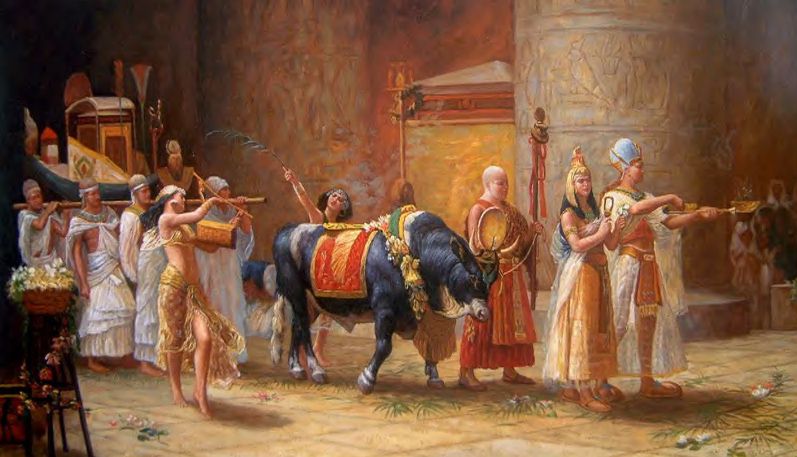
Procession-of-the-Bull-Apis

Hyginus, Fabulae 150: postquam Iuno vidit Epapho ex pellice nato tantam regni potestatem esse, curat in venatu, ut Epaphus necetur, Titanosque hortatur, Iovem ut regno pellant et Saturno restituant.
‘After Juno saw that Epaphus, born of a concubine, ruled such a great kingdom, she saw to it that he should be killed while hunting, and encouraged the Titans to drive Jove from the kingdom and restore it to Saturn.

Orphic Hymn to Lusios-Lenaios:
A sorrow-hating joy to mortals, O lovely-haired Epaphian, you are a redeemer and a reveler whose thyrsus drives to frenzyand who is kind-hearted to all, gods and mortals, who see his light.I call upon you now to come, a sweet bringer of fruit.

Orphic Hymn 52.9:
‘You burst forth from the earth in a blaze, Epaphian, O son of two mothers.’

Diodoros Sikeliotes, Library of History 3.74.1: Dionysos, as men say, was born to Zeus by Io, the daughter of Inachus, became king of Egypt and appointed the initiatory rites of that land.

Scholiast. Euripides’ Phoenician Women 678: ἀπόγονος Ἐπάφου Κάδμος, ἐπεὶ Ἀγήνορός ἐστιν υἱὸς τοῦ Βήλου τοῦ Λιβύης τῆς Ἐπάφου τοῦ Ἰοῦς.
‘Kadmos is the descendant of Epaphos, since Agenor is the son of Belus, son of Libya, daughter of Epaphos, son of Io.’

Phld. Piet. 44 = fr. 36 Kern = OF 59 I: 〈πρώτην τούτ〉ων τὴν ἐκ μ〈ητρός〉, ἑτέραν δὲ τ〈ὴν ἐκ〉 τοῦ μηροῦ, 〈τρί〉την δὲ τὴ〈ν ὅτε δι〉ασπασθεὶς ὑπὸ τῶν Τιτάνων Ῥέ〈ας τὰ〉 μέλη συνθεί〈σης〉 ἀνεβίω[ι]. κἀν̣ 〈τῆι〉 Μοψοπίαι δ᾽ Εὐ〈φορί〉ω〈ν ὁ〉μολογεῖ 〈τού〉τοις, 〈οἱ〉 δ’ Ὀρ〈φικοὶ〉 καὶ παντά〈πασιν〉 ἐνδιατρε〈ίβουσιν〉.
‘The first of these was the birth from the mother, the second the one from the thigh, and the third birth was when having been dismembered by the Titans, he came back to life afterRhea gathered together his limbs. And in his Mopsopoiai Euphorion is in agreement with these accounts, and the Orphics also absolutely go on about it.’

Apollodoros, The Library 2.1.3: τελευταῖον ἧκεν εἰς Αἴγυπτον, ὅπου τὴν ἀρχαίαν μορφὴν ἀπολαβοῦσα γεννᾷ παρὰ τῷ Νείλῳ ποταμῷ Ἔπαφον παῖδα. τοῦτον δὲ Ἥρα δεῖται Κουρήτων ἀφανῆ ποιῆσαι· οἱ δὲ ἠφάνισαν αὐτόν. καὶ Ζεὺς μὲν αἰσθόμενος κτείνει Κούρητας, Ἰὼ δὲ ἐπὶ ζήτησιν τοῦ παιδὸς ἐτράπετο. πλανωμένη δὲ κατὰ τὴν Συρίαν ἅπασαν (ἐκεῖ γὰρ ἐμηνύετο 〈ὅτι ἡ〉 τοῦ Βυβλίων βασιλέως 〈γυνὴ〉 ἐτιθήνει τὸν υἱόν) καὶ τὸν Ἔπαφον εὑροῦσα, εἰς Αἴγυπτον ἐλθοῦσα ἐγαμήθη Τηλεγόνῳ τῷ βασιλεύοντι τότε Αἰγυπτίων.
At last she came to Egypt, where she recovered her original form and gave birth to a son Epaphus beside the river Nile. Him Hera besought the Curetes to make away with [Epaphus], and make away with him they did. When Zeus learned of it, he slew the Curetes; but Io set out in search of the child. She roamed all over Syria, because there it was revealed to her that the wife of the king of Byblus was nursing her son; and having found Epaphus she came to Egypt and was married to Telegonus, who then reigned over the Egyptians.

Plutarch, On Isis and Osiris 364E. ἃ δ’ ἐμφανῶς δρῶσι θάπτοντες τὸν Ἆπιν οἱ ἱερεῖς, ὅταν παρακομίζωσιν ἐπὶ σχεδίας τὸ σῶμα, βακχείας οὐδὲν ἀποδεῖ· καὶ γὰρ νεβρίδας περικαθάπτονται καὶ θύρσους φοροῦσι καὶ βοαῖς χρῶνται καὶ κινήσεσιν ὥσπερ οἱ κάτοχοι τοῖς περὶ τὸν Διόνυσον ὀργιασμοῖς.
The public ceremonies which the priests perform in the burial of the Apis, when they convey his body on an improvised bier, do not in any way come short of a Bacchic procession; for they fasten skins of fawns about themselves, and carry Bacchic wands and indulge in shoutings and movements exactly as do those who are under the spell of the Dionysiac ecstasies.

Servius, Commentary on Vergil’s Georgics 1.165: id est cribrum areale. mystica autem Iacchi ideo ait quod Liberi Patris sacra ad purgationem animae pertinebant: et sic homines eius Mysteriis purgabantur, sicut vannis frumenta purgantur. hinc est quod dicitur Osiridis membra a Typhone dilaniata Isis cribro superposuisse: nam idem est Liber Pater in cuius Mysteriis vannus est: quia ut diximus animas purgat.unde et Liber ab eo quod liberet dictus, quem Orpheus a gigantibus dicit esse discerptum. nonnulli Liberum Patrem apud Graecos Λικνίτην dici adferunt; vannus autem apud eos λίκνον nuncupatur; ubi deinde positus esse dicitur postquam est utero matris editus. alii mysticam sic accipiunt ut vannum vas vimineum latum dicant, in quod ipsi propter capacitatem congere rustici primitias frugum soleant et Libero et Liberae sacrum facere Inde mystica.
‘The mystic fan of Iacchus, that is the sieve (cribrum) of the threshing-floor. He calls it the mystic fan of Iacchus, because the rites of Father Liber had reference to the purification of the soul and men were purified through his mysteries as grain is purified by fans. It is because of this that Isis is said to have placed the limbs of Osiris, when they had been torn to pieces by Typhon, on a sieve, for Father Liber is the same person, he in whose mysteries the fan plays a part, because as we said he purifies souls. Whence he is also called Liber, because he liberates, and it is he who, Orpheus said, was torn asunder by the Giants. Some add that Father Liber was called by the Greeks Liknites. Moreover the fan is called by them liknon, in which he is said to have been placed directly after he was born from his mother’s womb. Others explain its being called “mystic” by saying that the fan is a large wicker vessel in which peasants, because it is of large size, are wont to heap their first-fruits and consecrate it to Liber and Libera. Hence it is called “mystic”.’

Plutarch, On Isis and Osiris 364F: ὁμολογεῖ δὲ καὶ τὰ Τιτανικὰ καὶ Νυκτέλια τοῖς λεγομένοις Ὀσίριδος διασπασμοῖς καὶ ταῖς ἀναβιώσεσι καὶ παλιγγενεσίαις.
‘Furthermore, the Titanika and the Nyktelia agree with the accounts of the dismemberment of Osiris and his revivification and regenesis.’

Plutarch, Greek Questions 716F–717A: οὐ φαύλως οὖν καὶ παρ’ ἡμῖν ἐν τοῖς Ἀγριωνίοις τὸν Διόνυσον αἱ γυναῖκες ὡς ἀποδεδρακότα ζητοῦσιν, εἶτα παύονται καὶ λέγουσιν ὅτι πρὸς τὰς Μούσας κατα-πέφευγεν καὶ κέκρυπται παρ’ ἐκείναις.
‘It is not an accident that in the Agrionia, as it is celebrated here, the women search for Dionysos as though he had run away, then desist and say that he has taken refuge with the Muses and is hidden among them.’

Athenaios, Deipnosophistai 14.618c–620a and Pollux, Onomastikon 4.52–53 list terms for many kinds of working songs, such as the harvest οὖλος or ἴουλος and those named after Βώριμος, Μανέρως, Λιτυέρσης and Ἠριγόνη (Ἀλῆτις); winnowing songs (πτιστικόν or πτισμός); vintage songs (ἐπιλήνια). Sch. Clem. Al. Prot. 1.2.2, p. 297.4–8. Note that the Aletis song was defined as a lament for the death of Erigone, who wandered in search of her murdered father, but also as Persephone, cp. EM s.v. Ἀλῆτις (62.9).
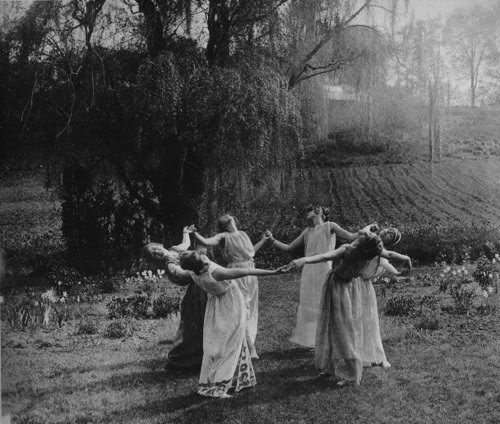
I am aching for the dances of playful Dionysus

Jumping back to Aegyptika, Herodotos felt that there was an affinity between Bacchic, Egyptian, Pythagorean and Orphic beliefs and practices:

The Egyptians wear linen tunics with fringes hanging about the legs, called ‘calasiris’ and loose white woolen mantles over these. But nothing of wool is brought into the temples, or buried with them; that is forbidden. In this they follow the same rules as the ritual called Orphic and Bacchic, but which is in truth Egyptian and Pythagorean; for neither may those initiated into these rites be buried in woolen wrappings. There is a sacred legend about this. (The Histories 2.81)

Pushkin is not the only Russian interested in this fertile intersection, as Jesús Ángel Espinós writes in The realm of Hades and its symbols in Mandel’štam’s Tristia: a transparent path to redemption:

So, through the mediation of bees and their honey Persephone softens her gloomy character and takes on a new redeemer aspect through which the bees, probably a metaphor of the souls of the dead, transmute their honey into sun, and consequently transcend their earthly existence, as can be observed in the final verses of poem I, 208:

Take for joy my wild gift,
A homely and dry necklace
Of dead bees who transformed
honey into sun.

The last word of the poem, “sun”, inserts itself into a fundamental network where metaphors pertaining to “black sun” and to “night sun” claim attention. In both epithets it has been observed as an Orphic influence that refers to Dionysus Nyktelios, the “Dionysus of the night sun”. Broadly speaking, the imagery of both suns, particularly that of the “night sun”, has to be related to Vjačeslav Ivanov, classical philologist and erudite Symbolist poet, who exerted a great sway on Mandel’štam, especially in his youthful years. Ivanov employs the image of “night sun” in several works such as in the articles ‘Мысли о символизме’ (‘Thoughts about Symbolism’), ‘Орфей’ (‘Orpheus’), in the essay ‘Взгляд Скрябина на искусство’ (‘Skrjabin’s View of Art’), and in the poems ‘Ночное солнце’ (‘Night Sun’) and ‘Сердце Диониса’ (‘Dionysus’ Heart’) among others. Orphic rituals enable us to expiate the guilt inherited from the Titans, and consequently avoid the punishments of afterlife and the cycle of reincarnations. In addition, Plutarch suggests that there must have been a work dedicated to Dionysus Nyktelios, which probably described the mourning for the god’s death and the orgiastic rites in honor of his rebirth. Nevertheless, in spite of Plutarch’s witness, the existence of such a work, perhaps an epic poem called  Νυκτέλια, cannot be proved. In this hypothetical poem the initiates would be instructed in the symbolic meaning of the night, which should be explained by the opposition night/day, shadow/light, an opposition that can be observed in the Mandel’štamian oxymora “night sun”, and to a lesser extent “black sun”. On the other hand, this interrelation of opposite qualities can be traced back to Ivanov, who closes his poem ‘Ночное солнце’ (‘ Night Sun’) with the following command: “В полночь зови незакатный свет!” (“At midnight call the never setting light!”; v. 7). In sum, from this point of view, the Orphic sun of poem I, 208 (v. 15), created by the honey of dead bees, should be understood as a sun of salvation that, under the appearance of a Dionysus reborn, would set us free from the continuous and numerous gloomy metaphors that dot Mandel’štam’s Tristia. On the other hand, the bees were a symbol of poetic talent in classical Antiquity as must be inferred from the recurrent scene of bees that perch on the lips of future poets when they are still in the cradle or that, in the case of the young Pindar, even build a honeycomb on his lips according to Pausanias (Description of Greece IX, 23, 2), or feed him with honey as Philostratus (Images II, 12, 2, 4) states. So, I might venture that the bees, by means of their poetic force, defy death, which is the same as saying that poetry, incarnated in the honey, reveals itself as immortal.

I’ve discussed the symbolism of the Bacchic Black Sun here (emphasizing its Egyptian roots) and more generally here in this collection of sources.