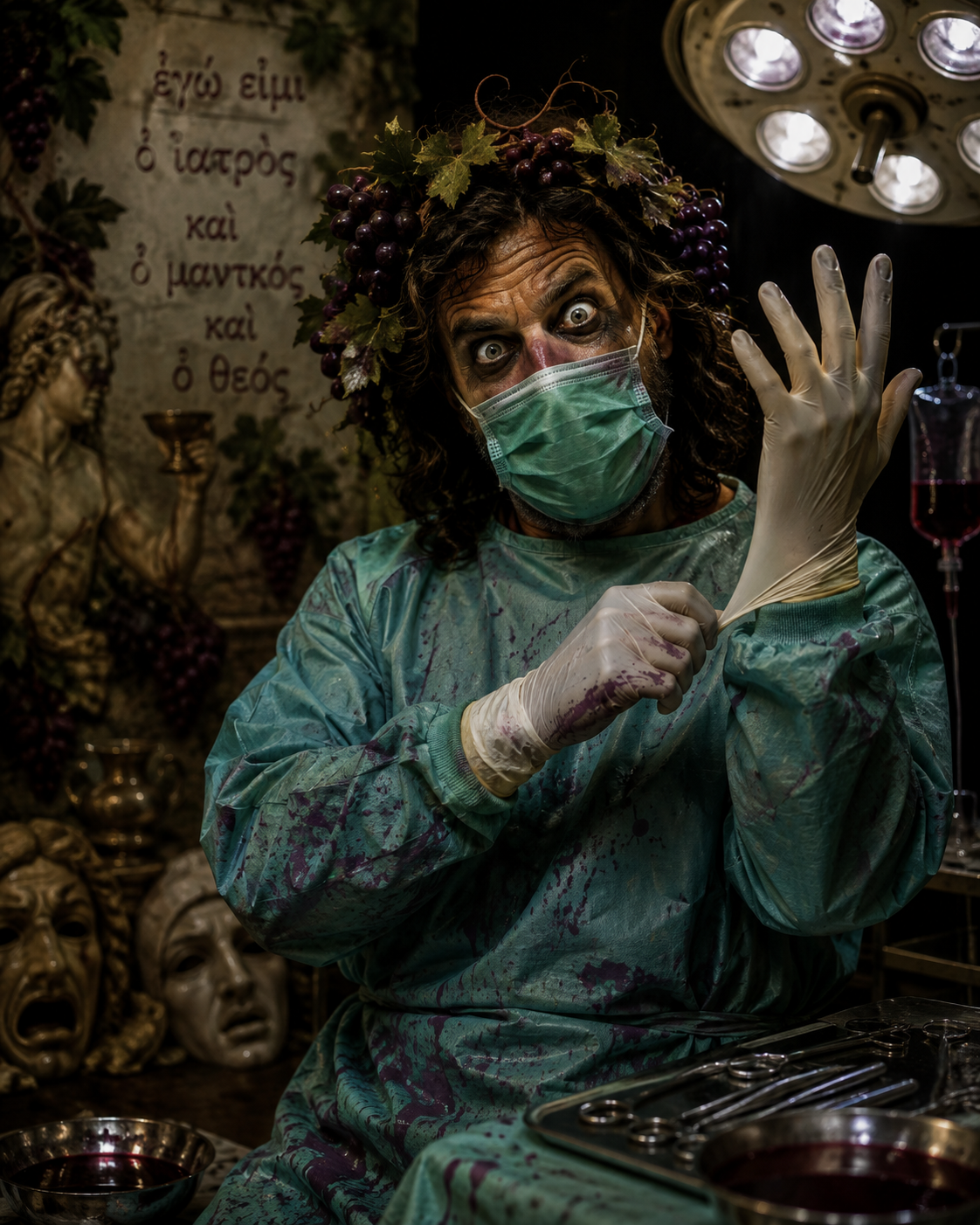
As I’ve mentioned I am currently working on Ὁ Καινὸς Οἶνος (“The New Wine“) a collection of modern Dionysian aphorisms to go with Ὁ Παλαιὸς Οἶνος (“The Old Wine”) a collection of ancient Dionysian aphorisms.
I have been thinking about one of the aphorisms included in New Wine since watching David Cronenberg’s A Dangerous Method about the productive but tumultuous relationship between Freud and Jung. Today I’d like to share some thoughts on the aphorism:
μόνος ὁ τετρωμένος θεραπευτὴς ἐλπίζειν δύναται τοὺς τετρωμένους θεραπεύειν.
“Only the wounded healer can hope to heal the wounded.”
θεραπεύειν feels especially right here rather than merely ἰᾶσθαι, because therapeuein contains a broader constellation of cultivating: to tend, attend, serve, care for, and only from there to heal. The wounded healer doesn’t necessarily cure the wounded— he knows how to tend them.
That distinction between healing and curing is supremely important.
θεραπεύειν doesn’t promise restoration to some imagined pristine condition. It begins with attendance: being present, tending, serving, caring for. Sometimes that results in recovery. Sometimes the wound remains and what changes is the person’s relationship to it.
Which makes the qualification ἐλπίζειν δύναται — “can hope” essential too.
Woundedness confers neither wisdom nor competence automatically. A wound can teach you— or consume you. The wounded healer is valuable because they may recognize terrain that someone untouched by it cannot, but they still have to learn the craft of θεραπεία.
So the maxim avoids two romanticizations simultaneously— suffering does not automatically make you wise, and healing does not necessarily mean making someone unwounded.
That feels particularly appropriate beside another of our gnōmai:
Οὐ πᾶν τὸ χωλὸν ἀτελές ἐστιν.
“Not everything that limps is incomplete.”
The goal isn’t necessarily to make the limping thing stop limping. Sometimes you learn how to tend what limps without mistaking it for incomplete.
With the wording of our aphorism you know I couldn’t escape talking about Jung, even if I hadn’t just watched A Dangerous Method.
“Only the wounded healer can hope to heal the wounded” is almost a compressed statement of the Jungian wounded-healer archetype, but the words “can hope to” protect it from one of the easiest misreadings of Jung.
Jung’s major discussion is in Fundamental Questions of Psychotherapy (1951), where he uses the figure of the wounded physician to describe what occurs in the therapeutic relationship. His point isn’t simply that therapists ought to have suffered. It’s that the analyst’s own psychic vulnerability participates in the encounter. The analyst cannot remain an untouched technician manipulating somebody else’s psyche from outside.
For Jung, genuine psychological encounter changes both people.
The wound is the point of contact
The physician’s wound matters because it creates the possibility of recognition.
Someone who has encountered their own darkness— their shadow, irrationality, fear, shame, destructiveness, dependency, grief, contradiction— cannot quite look at another wounded person as merely a defective specimen.
They know something about the territory.
But here’s the crucial Jungian qualification: having a wound does not make you a healer.
An unconscious wound can make you extraordinarily dangerous to wounded people.
If I have never confronted my own need for approval, for instance, I may unconsciously cultivate dependency in the person I’m supposedly helping. If I haven’t faced my own rage, I may condemn theirs. If I cannot bear helplessness, I may compulsively “rescue” people because their helplessness activates something intolerable in me.
That’s shadow projection and countertransference territory.
So there are really three figures:
- the unwounded healer — imagines himself above the condition he treats;
- the unconsciously wounded healer — treats his own wounds through other people without realizing it;
- the consciously wounded healer — knows that the wound is present and therefore can distinguish, imperfectly but increasingly, your wound from mine.
Only the third possesses what Jung was interested in.
For Jungians the archetypal figure is, of course, Cheiron. His mythology contains the paradox beautifully. Cheiron possesses extraordinary healing knowledge, yet suffers from a wound he cannot heal. That’s not an embarrassing contradiction in the archetype. That is the archetype.
The healer isn’t someone who has mastered suffering so completely that suffering no longer touches him. His authority comes partly from continuing to inhabit the human condition that his knowledge addresses.
A therapeutēs cannot merely stand outside the suffering and eliminate it. He tends to it.
Jungian individuation isn’t a process by which all one’s damaged, shameful, frightening, contradictory pieces get removed until only the Healthy Personality™ remains.
Quite the reverse.
It involves becoming capable of acknowledging and integrating psychic realities the ego would rather disown.
The wound can therefore become incorporated into a larger personality without ceasing to be a wound.
That gives us an important distinction.
“I am wounded.”
Is different from:
“I am nothing but my wound.”
And both differ from:
“I am no longer wounded.”
Again, that sits beautifully beside:
Οὐ πᾶν τὸ χωλὸν ἀτελές ἐστιν.
“Not everything that limps is incomplete.”
Wholeness and perfection are not synonyms.
In Jungian language, wholeness includes the wound.
And that’s why “can hope to” is so good
If I’d phrased it:
“Only the wounded healer can heal the wounded.”
It could turn suffering into spiritual credentialism:
“I’ve suffered, therefore I understand you; therefore I am qualified to heal you.”
That’s precisely where wounded-healer rhetoric becomes dangerous.
But:
“Only the wounded healer can hope to heal the wounded.”
Doesn’t grant the healer mastery.
The wound creates possibility, not entitlement.
The healer still needs knowledge, discipline, ethical boundaries, self-examination, and humility. And in Jungian terms, they must remain attentive to what the patient awakens in their own unconscious.
There’s also a beautiful reversal here. The wounded person doesn’t merely receive the healer’s gift. The patient activates the healer’s wound. Consequently, the therapeutic relationship can expose material in the healer that still requires integration.
The person who comes seeking θεραπεία can therefore become, unknowingly, part of the healer’s θεραπεία.
Not because the healer should use them therapeutically— that would be an ethical disaster —but because real encounter leaves neither participant entirely unchanged.
This is where our version moves beyond Jung.
Jung tends toward integration into psychic wholeness. Our emerging Dionysian vocabulary introduces another possibility: sometimes transformation requires not merely integrating material into the existing self, but going beyond that self.
Which returns us unexpectedly to the Sequence of Four:
- Φίλος τῶν ἐξισταμένων — Friend of Those Who Step Beyond Themselves
- Φίλος τῶν ἑαυτῶν κρατούντων — Friend of Those Who Master Themselves
- Φίλος τῶν θεραπευόντων — Friend of Those Who Care For What Is Entrusted to Them
- Φίλος τῶν ὑπομενόντων — Friend of Those Who Endure
The wounded healer needs all four.
- Ekstasis prevents the wound from becoming the boundary of identity.
- Self-mastery prevents the healer’s wound from taking control of the encounter.
- Therapeia turns attention outward toward what has been entrusted to one’s care.
- Endurance accepts that neither healing nor individuation happens according to the ego’s preferred timetable.
And that produces what may be the deepest Jungian reading of our maxim: the healer’s wound is not valuable merely because it hurt. It becomes valuable when it has been consciously suffered, tended, integrated, and transformed into a capacity to remain present before another person’s wound without fleeing from it, exploiting it, or demanding that it resemble one’s own.
And sometimes the most important thing they can offer is not:
“I know how to make this go away.”
But:
“I know how to remain here while it hurts.”
Nietzsche would probably regard the Jungian wounded-healer model with a mixture of recognition and suspicion. He knew intimately that suffering can transform a person, but he’d be deeply wary of turning the wound itself into a credential or making healing the supreme value.
The Nietzschean counterpoint might begin:
“The question is not whether you have been wounded, but what you have made from your wound.”
That changes almost everything.
Nietzsche would distrust the prestige of woundedness; Nietzsche repeatedly distinguishes between suffering that produces greater strength and suffering that produces ressentiment. Pain possesses no automatic moral or spiritual authority. A person can suffer enormously and become narrower, more vindictive, more frightened, more obsessed with assigning blame. Indeed, suffering can become the foundation of an identity whose continued existence requires the wound never to heal.
That’s where Nietzsche would attack a sentimental interpretation of the wounded healer.
“I have suffered, therefore I understand suffering.”
No.
“I have suffered, therefore I am compassionate.”
Also no.
“I have suffered, therefore I am qualified to guide others.”
Absolutely not.
The wound tells us that something happened to you. What you subsequently did with it tells us something about you.
Jung seeks integration; Nietzsche demands transformation
There’s a significant difference of emphasis here.
The Jungian question tends toward:
“How can this wound be incorporated into a greater psychic wholeness?”
Nietzsche’s question is closer to:
“What can you create from it?”
This is the territory of amor fati. Not merely enduring what happened, and certainly not pretending that terrible things were secretly good, but reaching the terrifying affirmation:
“This belongs to my life too.”
The ideal isn’t restoration to the person one was before the wound.
That person is gone.
Nor is it necessarily “healing” if healing means returning to normative functioning.
The wound becomes material.
And here Nietzsche suddenly sounds very compatible with our agricultural vocabulary.
Cultivate until it bears fruit.
The soil doesn’t justify the manure by calling it beautiful. It uses it.
This is perhaps the sharpest counterpoint.
Why assume that the wounded require healing?
Nietzsche might suspect that beneath the language of healing lurks a normative judgment:
“There is a correct condition for human beings, and suffering represents deviation from it.”
But some wounds destroy illusions that needed destroying.
Some suffering strips away inherited values.
Some breakdowns expose structures of life that were already intolerable.
Sometimes what appears to be sickness from the perspective of the herd is the painful beginning of becoming something else.
That’s why Nietzsche’s physician-philosopher imagery is so interesting. Diagnosis matters— but the “health” he seeks isn’t bland normality. Great health is something dynamic: the capacity to undergo sickness, transformation, experimentation and danger and repeatedly regain oneself— or discover another self worth becoming.
So where Jung says: integrate the wound,
Nietzsche might answer: overcome through it.
Not necessarily overcome it.
Through it.
Dionysos makes the disagreement especially interesting.
Because Nietzsche’s Dionysos isn’t principally the compassionate healer.
He is the divine affirmation of becoming.
Creation and destruction aren’t cleanly separable. Life consumes life. Forms arise, flourish, perish, and become material for new forms. The Dionysian affirmation says yes not merely to pleasure but to the whole terrible process.
That gives our maxim a harsher Nietzschean counterpart:
“The wounded healer must first prove that the wound has not become his master.”
Otherwise he may simply reproduce it.
The abused becomes an abuser.
The humiliated seeks someone beneath him to take out their frustrations on.
The excluded builds an identity around exclusion.
The betrayed becomes incapable of trust.
And then suffering masquerades as wisdom.
Nietzsche would probably be merciless about that.
But someone who has metabolized suffering— who has turned pain into insight, discipline, humor, creation, courage, greater capacity for life— possesses something altogether different.
Not authority because I suffered. Authority because you can see what I made from my suffering.
This also complicates θεραπεία. As I said earlier, the wounded healer doesn’t necessarily cure. He tends.
Nietzsche might respond:
“Good. But be careful what you tend.”
Some things should be preserved.
Some should be strengthened.
Some should be pruned.
Some should be allowed to die.
And sometimes θεραπεία becomes pathological when care means endlessly preserving a form of life that needs to be overcome.
Suddenly another New Wine maxim enters the conversation:
Τέμνε ἵνα θάλλῃ.
“Prune that life may flourish.”
That’s an extraordinarily Nietzschean complement to the wounded-healer maxim.
Compassion without discernment can preserve weakness. Pruning without compassion can become brutality. The difficult art is knowing which moment requires which excellence.
Where I think Jung and Nietzsche can actually meet— Jung supplies an indispensable warning: do not imagine yourself above the wound. Know your own darkness, because otherwise you will unconsciously inflict it upon those entrusted to you.
Nietzsche supplies an equally indispensable warning: do not worship the wound. Suffering gives you no rank. Show me what has grown from it.
Put those together and the original maxim becomes considerably stronger:
Μόνος ὁ τετρωμένος θεραπευτὴς ἐλπίζειν δύναται τοὺς τετρωμένους θεραπεύειν.
“Only the wounded healer can hope to heal the wounded.”
Jung emphasizes τετρωμένος: the healer must know woundedness from within.
Nietzsche interrogates θεραπευτής: What makes you think your wound has made you capable of tending anyone?
And the answer has to be demonstrated through character, practice and fruit.
Which brings us straight back to:
γεώργει ἕως καρπὸν φέρῃ.
“Cultivate until it bears fruit.”
Don’t show me the wound. Show me what grew there.
Greek tragedy changes the maxim substantially. Jung asks how the wound can become a site of consciousness; Nietzsche asks what one can make from the wound.
Tragedy asks a more frightening question: what if the wound gives you knowledge— and the knowledge still cannot save you?
That is profoundly tragic.
Again and again, tragedy gives special knowledge to people who have suffered. Oedipus becomes capable of seeing only after destroying his eyes. Philoctetes possesses the indispensable weapon precisely while living with an incurable, disgusting wound. Cassandra knows what everyone else cannot see, but her knowledge is inseparable from the curse that prevents others from accepting it.
Even Dionysos in Bakchai arrives carrying a history of injury: his mother’s destruction, the denial of his maternity and divinity, the persecution of his rites. And Pentheus’ refusal to recognize what stands before him eventually makes him the wound torn open at the center of the city.
Tragic knowledge is frequently expensive knowledge.
You don’t merely learn it. You are marked by having learned it.
Tragedy rejects the therapeutic fantasy.
This is where tragedy offers a powerful corrective to our word θεραπευτής.
Greek tragedy rarely gives us the comforting structure:
wound → wisdom → healing → restoration
Sometimes there is restoration. Often there isn’t.
Oedipus discovers the truth.
And?
Jocasta is still dead.
Laius is still dead.
Incest has still occurred.
The children still carry the consequences.
The truth doesn’t rewind the tragedy.
Likewise, no amount of insight can restore Agamemnon after Clytemnestra kills him. Orestes’ vengeance doesn’t restore Agamemnon either; it produces another corpse and another pollution. Apollon’s command solves one obligation by creating another catastrophe.
Tragedy understands something very uncomfortable: sometimes there is no unwounded state to which we can return.
That makes the choice of θεραπεύειν rather than simply “cure” even more appropriate. When restoration is impossible, care remains possible.
Even more than Cheiron, Philoctetes may be the purest expression of the wounded healer. Philoctetes is fascinating here because his wound is simultaneously: his suffering, his exclusion, his humiliation, and part of what makes him indispensable.
The Greeks abandon him because his wound is intolerable.
Then they discover they need him.
That is very close to:
Οὐ πᾶν τὸ χωλὸν ἀτελές ἐστιν.
“Not everything that limps is incomplete.”
From the utilitarian perspective of the army, Philoctetes initially appears defective. He cannot function properly within the expedition. He smells. He cries out. His wound disrupts ritual.
Solution: Get rid of him.
Except the supposedly defective man possesses something without which Troy cannot fall.
The community discovers that what it expelled as unacceptable suffering must be brought back into the collective.
A wound does not necessarily produce compassion. It can propagate itself.
Clytemnestra is wounded.
Medea is wounded.
Hecuba is wounded almost beyond comprehension.
Each acquires terrible insight through suffering. And each can become the agent through which suffering perpetuates itself.
That’s crucial.
In tragedy the wounded can heal the wounded. But the wounded can also wound the wounded. Frequently they do both.
That makes “can hope to” indispensable.
The wound establishes kinship with suffering. It does not determine what you will do with that kinship.
Tragedy frequently understands suffering as something larger than an individual’s psychology.
A murder creates another murder.
A violated obligation demands response.
A curse moves through generations.
Children inherit consequences produced before their birth.
The house itself becomes sick.
The οἶκος remembers.
So the tragic healer cannot merely ask:
“What is wrong with this individual?”
They must ask:
“What story is this wound part of?”
That is an enormous difference from much modern therapeutic language.
Orestes isn’t simply a traumatized young man with an unhealthy family dynamic. He’s standing inside an inherited network of kinship, murder, divine obligation, vengeance, pollution and competing claims of justice. You cannot heal Orestes without somehow addressing the House of Atreus. The wound has a genealogy.
Something most religious specialists would take a look at and say, “Sorry, but that’s way above my pay grade.”
Greek tragedy’s great mechanism is ἀναγνώρισις— recognition.
And recognition often hurts.
The decisive moment isn’t: “Now I feel better.”
It is: “Now I know what this is.”
Or worse: “Now I know who I am.”
Oedipus spends the play healing Thebes by seeking the source of its pollution.
And eventually discovers: the healer is the wound.
That’s almost unbearably relevant to our maxim.
The wounded healer cannot stand outside the wounded community and say, “I have come to fix you.”
He may be implicated in precisely what he is attempting to heal.
The investigator becomes the object of investigation.
The purifier discovers his own pollution.
The person asking where is the wound? eventually has to say: here.
And yet tragedy isn’t nihilistic.
This matters.
Tragedy doesn’t generally say that because suffering cannot be undone, nothing can be done.
The Oresteia doesn’t resurrect anybody.
Instead, something new is constructed from an irresolvable inheritance.
The Erinyes aren’t simply destroyed.
Athena doesn’t announce that their anger was pathological and must be cured.
Instead reconciliation is negotiated and they are given a new relationship to the community.
The destructive power becomes capable of another function without ceasing to possess its terrifying nature.
And when applied to the wound we’ve been discussing, the goal isn’t necessarily: remove it.
Sometimes the work is: give it another place in the order of things.
And then there is the unavoidable fact that tragedy itself belongs to Dionysos.
The audience watches people suffer.
Not because their suffering is amusing.
Not because the play gives them five practical steps for avoiding similar outcomes.
The suffering is made into form. Language, meter, masks, music, dance, plot and ritual contain something otherwise unbearable.
That suggests another meaning of the wounded healer:
The tragedian is a wounded healer.
He does not cure suffering.
He gives suffering a form in which it can be encountered.
And the audience participates.
We sit together before terror, grief, injustice, madness, death and irreconcilable obligation— and rather than fleeing, we look.
For a while, suffering becomes something that can be sung.
That’s θεραπεία of a very Dionysian sort.
Not: “This no longer hurts.”
But: “This can be borne long enough to be witnessed.”
And perhaps even: “This can become beautiful without ceasing to be terrible.”
Which suddenly makes another of our maxims relevant:
Πέρας ἑκουσίως δεχθὲν μορφὴ γίνεται.
“A limitation willingly accepted becomes a form.”
Tragedy imposes form upon suffering without pretending that form explains suffering away.
So the tragic reading of the maxim is that only the wounded healer can hope to heal the wounded because only someone marked by suffering may recognize what suffering actually demands. But the wound grants neither wisdom nor goodness. Unexamined, it reproduces itself as vengeance, pollution and inherited catastrophe. Recognized and given form, it may become knowledge, compassion, justice, art, ritual, or a new order.
And even then, healing does not mean that what happened is undone.
While the future may (or may not) have some flexibility, the past is fixed.
That’s much darker than the Jungian version. And less triumphalist than the Nietzschean one.
Jung asks: “Can the wound be integrated?”
Nietzsche asks: “Can the wound be transmuted into strength and creation?”
Tragedy asks: “Can we discover what the wound requires of us before we pass it on?”
And Dionysos sits in the theater watching all three answers, and nodding. Because at different times, in different ways, each contains a truth.
But also because tragedy knows something profoundly Bacchic: sometimes what saves us is not escaping the terrible thing. It is finding the song, mask, rite, community, or form through which we can finally witness it without looking away.


Interesting….the “little grey cells” are bubbling…recognizing pieces of this thread as insight into Northern Tradition Soul Lore.
LikeLike
that interests me. how so?
LikeLike
“…This is the territory of amor fati. Not merely enduring what happened, and certainly not pretending that terrible things were secretly good, but reaching the terrifying affirmation:
“This belongs to my life too.”…
But some wounds destroy illusions that needed destroying.
Some suffering strips away inherited values.
Some breakdowns expose structures of life that were already intolerable.
Sometimes what appears to be sickness from the perspective of the herd is the painful beginning of becoming something else.
That’s why Nietzsche’s physician-philosopher imagery is so interesting. Diagnosis matters— but the “health” he seeks isn’t bland normality. Great health is something dynamic: the capacity to undergo sickness, transformation, experimentation and danger and repeatedly regain oneself— or discover another self worth becoming…”
How do we build our luck and life force?
What triggers that process?
There’s more but it isn’t gelling enough to articulate at the moment. The “little grey cells” are still quivering.
LikeLike
I couldn’t agree more.
LikeLike