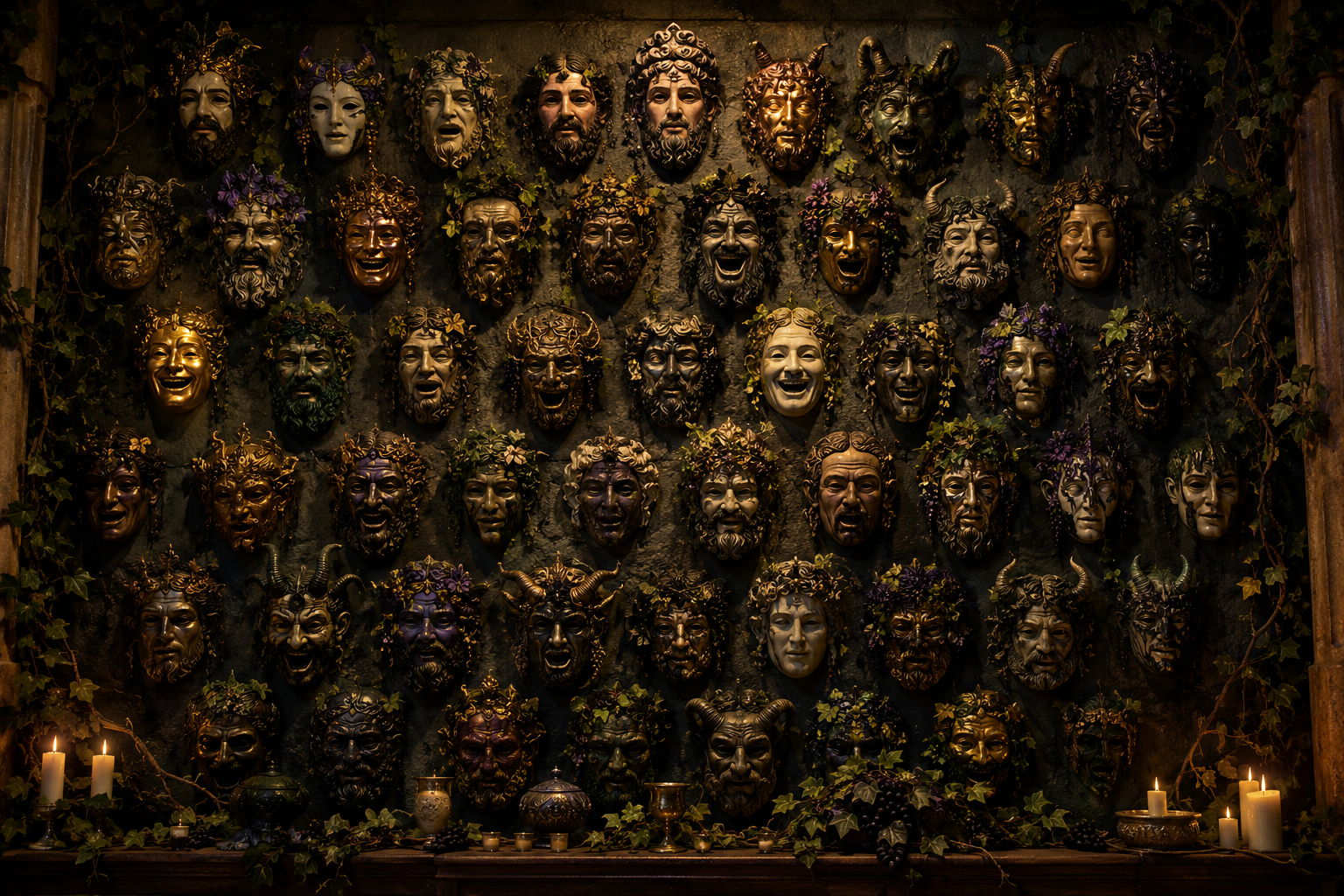
I wanted to have an image that reflected the deeper goal I’m trying to accomplish with the Lexicon, and I am quite happy with how this turned out.
The image has dozens of heads, and yet Dionysos himself has no final head.
Every mask says, Here is Dionysos.
None can say, This is the face of Dionysos.
Of course I was thinking of Bataille’s description of the Acéphale when I designed the image, to the point that they’re practically in dialogue with one another:
Beyond what I am, I meet a being who makes me laugh because he is headless, who fills me with anguish because he is made of innocence and crime. He holds a weapon of steel in his left hand, flames like a sacred heart in his right hand. He unites in one eruption birth and death. He is not a man. But he isn’t a God, either. He is not I, but he is more I than I: his belly is the Labyrinth in which he himself goes astray, led me astray, and in which I find myself being he, that is, a monster. (Georges Bataille, The Sacred Conspiracy)
The head ordinarily establishes identity: this face, this individual, this rational center from which the rest is ordered. Remove it and identity has to be located elsewhere— in Bataille’s image, extraordinarily, in the Labyrinth of the body. The wall accomplishes something similar through multiplication rather than decapitation. Give Dionysos enough faces and you eventually achieve the same effect as giving him no face.
One mask can define.
A thousand masks destroy the possibility of definition.
So Ἀκέφαλος needn’t mean merely Headless. In this constellation it can suggest:
He Who Has No Final Face.
My God—
You are this.
And this.
And this.
And also its apparent opposite.
And something for which we haven’t yet found a category.
Until language has accumulated so many predicates that the attempt to delimit him collapses.
The ancient Bacchic Orphics, as with so many things, had the solution: Εἷς Διόνυσος! (“One Dionysos!”) which was a synthēma (password, token, symbol, etc) found in several inscriptions and literary works ranging from the Gurôb Papyrus to Macrobius. While its precise meaning is debated by scholars, in this context I think it could be seen as an affirmation of unity amid radical plurality. Not a denial of the hundreds and hundreds of names, forms, and functions recorded in the Lexicon— but an assertion that beneath, and within, and outside all of these bewildering expressions there is a Dionysos.
Which makes Bataille’s line about the Labyrinth especially potent here. The answer to the proliferation of masks isn’t to tear them all away until we finally discover the One True Dionysos™ underneath.
You go through them— into the Labyrinth.
And what waits at the center?
Not the definitive mask.
Ἀκέφαλος.
No final face at all.
Just:
Εἷς Διόνυσος!
That is fucking beautiful.
Εἷς Διόνυσος!
Hundreds of doors.
Hundreds of names.
Hundreds of ways of knowing him.
But one Dionysos.
And the especially beautiful thing is that Εἷς Διόνυσος doesn’t cancel anything that preceded it. The multiplicity remains real. Unity doesn’t require sameness.
Which brings us, once again, back to the principle— Dionysos is not located at one pole of the opposition. He is the movement through the opposition.


And I find that phrase more profound than the Shema.
LikeLike
Ἀκέφαλος or Εἷς Διόνυσος!
LikeLike
“… Unity doesn’t require sameness….”
<<GASP….clutches pearls…>>
LikeLiked by 2 people
I know! Blew my mind when I realized it too. LOL
LikeLiked by 1 person