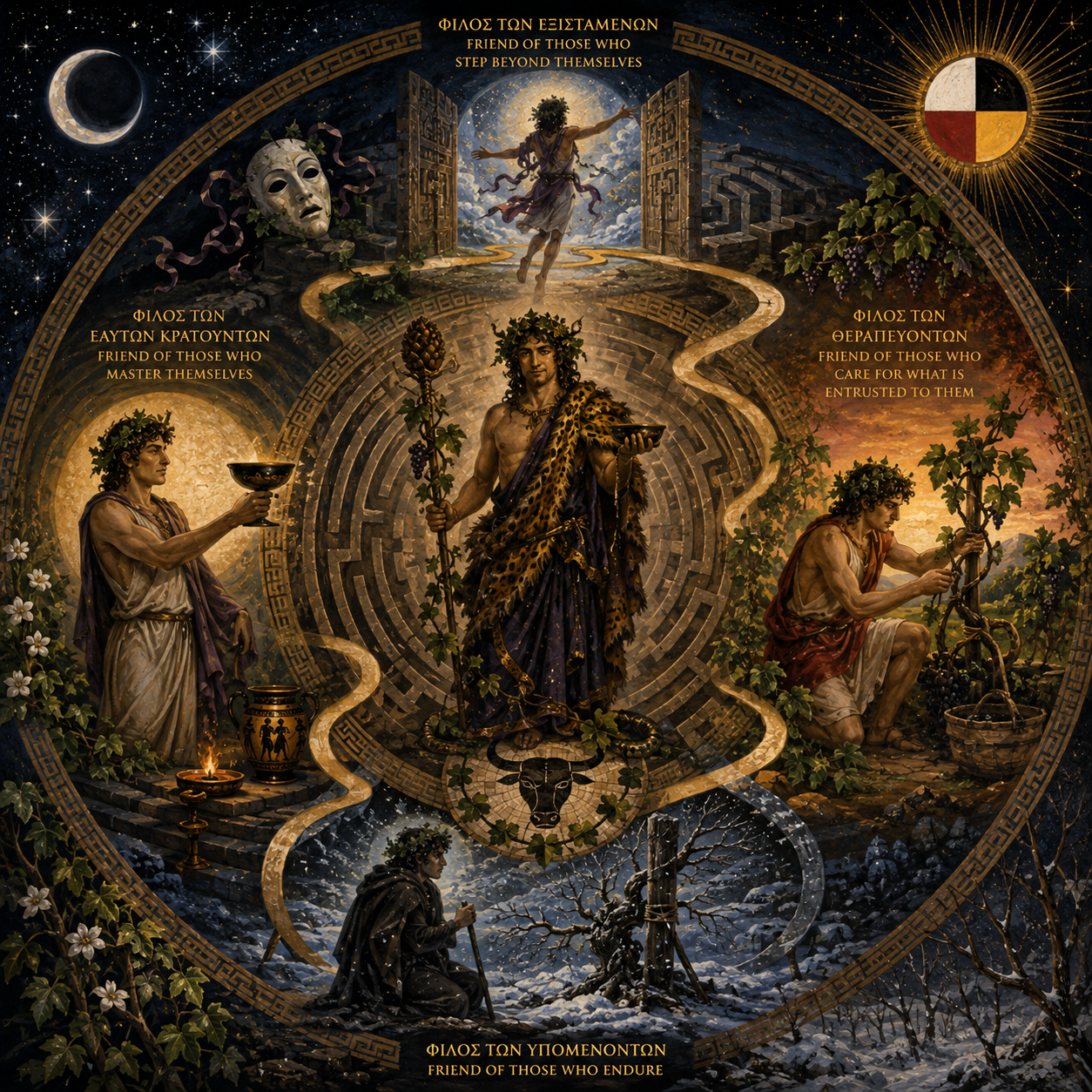
Among the various projects I’m working on currently is a substantial revision of my collection of epitheta and epiklēseis of Dionysos. Distinguishing between anciently attested material and Starry Bull coinages, correcting the grammatical and morphological errors of the latter, filling in gaps and pruning redundancies and irrelevancies that do not reflect how the God has revealed himself to us within the tradition, and other things that will make it a tighter, more informative, and all-around better resource. It’s not yet ready to share, but there are a couple things I’d like to discuss with y’all, starting with a portion of it I call the Sequence of Four.
The Sequence consists of:
- Φίλος τῶν ἐξισταμένων ✦ Friend of Those Who Step Beyond Themselves
- Φίλος τῶν ἑαυτῶν κρατούντων ✦ Friend of Those Who Master Themselves
- Φίλος τῶν θεραπευόντων ✦ Friend of Those Who Care For What Is Entrusted to Them
- Φίλος τῶν ὑπομενόντων ✦ Friend of Those Who Endure
I didn’t intend to create a character formation program— they were just titles that came to me independently as I worked on the Lexicon over the last week— but if you look closely you’ll discover that that is precisely what the Sequence does.
Go beyond yourself,
to master yourself.
Care for what has been entrusted to you,
and remain when caring becomes difficult.
The first pair governs the self:
Transcendence and Mastery
The second pair governs the relationship between self and world:
Stewardship and Perseverance
And all four are framed not as commandments, but as friendship with Dionysos.
That’s important.
They don’t say:
Dionysos commands that you…
They say:
Φίλος… Friend.
Practice these things and you are practicing qualities dear to the God. That returns the entire ethical vocabulary to one of the aphorisms found in New Wine:
Τί φίλον Διονύσῳ
What is dear to Dionysos?
Each of the Four is one of the Ἀρεταί (Virtues or Excellences) that form the foundation of our ethical teaching, united with Love, ensuring that they don’t become an impersonal checklist of pretty-sounding ideals that have no genuine impact on the practitioner’s life. What love touches is never the same again.
And there’s another beautiful structural feature that I fear could be easily overlooked. The participles make these activities, not identities:
- ἐξισταμένων — people stepping beyond
- κρατούντων — people mastering
- θεραπευόντων — people caring/tending
- ὑπομενόντων — people enduring
It doesn’t divide humanity into “the Ecstatic,” “the Self-Mastered,” “the Steward,” and “the Persevering,” as though these were permanent personality types.
They’re things people do. That fits the whole cultivation metaphor beautifully: an Excellence isn’t something you possess like an achievement badge. It’s something you practice, that you cultivate— slowly, carefully, over the span of months, years, and decades.
Sometimes successfully.
Sometimes poorly.
Sometimes after getting it right, they backslide.
Sometimes after failing over and over again, they stand when it truly matters most.
The Sequence of Four don’t just tell you what to do, they also explain— even more valuably —how to do it:
The way to master yourself is to go beyond yourself;
to properly care for what is yours you must endure.
The paradox is that self-mastery requires stepping outside the self you’re trying to master. If you’re wholly identified with an appetite, fear, anger, delusion, a role you perform, or a transitory self-conception you formed in an ephemeral moment, you cannot govern your self (ἐγώ) because there’s no experiential distance between “I” and “this thing happening within me.” Ecstasy— in the broad sense encoded by the Excellence as “the willingness to step beyond the narrow self” —creates that distance.
I am angry becomes I am experiencing anger.
I am afraid becomes fear is moving through me.
I need this becomes a powerful desire is present.
That tiny displacement can create the room in which ἐγκράτεια becomes possible. Going beyond the narrow self doesn’t necessarily mean losing control. Properly understood, it can be one of the ways we acquire greater freedom of action.
So:
Step beyond yourself → Master yourself → Stewardship.
Stewardship sounds lovely until the thing entrusted to you becomes difficult.
A garden is easy to love in bloom.
A tradition is easy to serve when everything is exciting and expanding.
A community is easy to care for when everybody gets along.
A relationship is easy to cherish when nobody is suffering.
A vocation is easy to embrace when you’re succeeding.
Winter tests stewardship.
If care disappears when its object becomes burdensome, disappointing, damaged, inconvenient, or temporarily fruitless, it wasn’t yet the full Excellence one is encouraged to cultivate within the Starry Bull tradition.
Therefore:
Care for what is entrusted to you → endure.
But I’d also encourage one to read the arrows backward:
- Master yourself → become capable of stepping beyond yourself safely.
- Endure → become capable of caring across time.
So these aren’t really linear instructions.
They’re reciprocal and cyclical:
- Ecstasy ↔ Self-Mastery
- Stewardship ↔ Perseverance
Each Excellence corrects and enables its partner.
Ecstasy without self-mastery risks dissolution.
Self-mastery without ecstasy risks imprisonment in the illusions of self.
Stewardship without perseverance lasts only through Summer.
Perseverance without something worth tending becomes mere stubbornness.
That last distinction is particularly important: ὑπομονή isn’t valuable merely because someone refuses to quit. Endurance receives its orientation from what one has undertaken to care for. Sometimes proper stewardship actually requires pruning, relinquishing, changing course, or admitting that something has died.
Subjects that are addressed by several of the aphorisms in New Wine:
Θεράπευε τὸν ἀμπελῶνα.
Tend the vineyard.
Καιρὸς καὶ τοῦ τέμνειν.
There is a season for pruning.
Οὐ πᾶν τὸ ἄγριον τέμνε.
Do not prune everything wild.
Τέμνε ἵνα θάλλῃ.
Prune that life may flourish.
The sayings behave like the epithets: one prevents another from becoming foolish and dangerous when applied arbitrarily or ad summum.
And that, I think, is one of the most important things about the ethical system of the Starry Bull— they are relational and corrective. The Excellences work best not as eighteen isolated virtues but as a web of ethical vocabulary. Their meaning emerges through conjunction, tension, mutual correction, and circumstance.
Which is an extremely appropriate ethical system for a tradition whose God is the movement through the opposition.
And now I’d like to say a couple things about the art that accompanies this post. I have started using AI to create art for this blog because I know it’s probably not going to rape children like a human artist I worked with in the past, and I can give it incredibly precise (and also vague and rambling) instructions and get the kind of thing you see above. Here’s an excerpt of the instructions I gave T-800, my pet name for the art-generator I collaborate with:
For the Sequence itself, I’d make the relationships visible rather than illustrating four virtues as four separate allegorical figures.
I think the strongest way to express that is through one person undergoing four simultaneous actions around a central axis:
-
- Step Beyond Yourself — the figure’s translucent double is stepping outward from their body, perhaps crossing the boundary of a Labyrinth.
- Master Yourself — the physical figure remains poised at the center, holding a cup of wine perfectly level despite violent movement around them.
- Care for What Is Entrusted to You — hands tending a vine climbing a trellis.
- Endure — the figure/vine passes through winter: bare branches, snow or darkness behind them, while a single new shoot or bud demonstrates that endurance is directed toward renewed life.
Actually, don’t divide the picture into four panels. That would turn them back into four independent virtues.
Instead, make it circular.
Dionysos stands in the center of the Labyrinth. Around him are four human figures— but they’re clearly the same person at different moments.
One is dancing ecstatically beyond the Labyrinth wall.
One stands composed before Dionysos holding the wine cup.
One kneels tending the vine growing around the God’s feet.
One sits vigil beside that vine in winter.
Then—and this is the crucial detail— the path doesn’t terminate.
It returns.
When we see the vine again, it has flowered.
That would let the image say something the four Greek titles alone don’t immediately disclose: you don’t complete these Excellences. You circulate through them.
And Dionysos isn’t doing any of those things for them. He’s simply present at the center of all four.
And perhaps the four manifestations of the practitioner could subtly correspond to the four colors/seasons:
-
- White — stepping beyond
- Gold — mastery
- Red — tending
- Black — endurance
Or some other arrangement if it doesn’t look good. I wouldn’t force them merely to get the colors into the image.
And the results speak for themselves.
Of course there’s a lot I couldn’t share with T-800 that I’d like to share with you, as I think it will enhance the above conversation, beginning with some notes I jotted down after smoking a lot of weed, putting on a Tool album, and staring at the picture for close to an hour.
The ecstatic double steps outward, curves around, and eventually returns toward the mastered self. The vine grows outward from the person’s care, passes through a region of winter, survives, and curves back bearing fruit.
So visually there are two circuits:
Self
Ecstasy → Self-Mastery → Ecstasy
World
Stewardship → Perseverance → Stewardship
And those circuits intertwine like a double spiral around the central figure. Each pair makes the other possible.
Since I was making art rather than a diagram, I didn’t need labels explaining any of it. Someone unfamiliar with our system sees a strange journey, possibly of initiatory significance. But someone who knows the Sequence can read the grammar.
And that’s because the Sequence holds secrets.
Like that the epithets don’t actually say:
Be ecstatic. Master yourself. Tend. Endure.
They say:
Φίλος.
Dionysos is the Friend/Beloved of the person doing these things. It is φιλία (or perhaps στοργή, ἀγάπη, or ἔρως depending on the nature of one’s relationship with Dionysos) that motivates the devotee to enter the Labyrinth, and even more importantly, to make themselves worthy of undertaking such a κατάβασις. (Compare Heraklēs’ descent to that of Perithous.)
That’s the theology of the Sequence. It begins, and ends, and is driven throughout by Love. Dionysos is placed at the center of all we do, and all we are. Because he is primeval Phanēs, Eros Prōtogonos. The First and the Last.
I really love how each image leads one into another. Though not obvious, it forms an inverted Δ with Ekstasis above, both part and apart of the sequence.
Because Ἔκστασις belongs to the Sequence by exceeding its boundary.
It is what allows us to transcend our limitations and make direct and intimate contact with the divine— an intimacy deeper and more intense than anything experienced in the flesh.
The other three form the grounded structure below while Ἔκστασις occupies the apex above— visibly connected to everything, generated from the same sequence, but standing outside the ordinary plane of relation. The artwork’s geometry therefore performs the meaning of ek-stasis: “standing outside.”
And an inverted triangle has another useful property: everything converges downward toward a point. So depending on how one reads the movement, the image can travel in either direction:
Ekstasis ↔ Self-Mastery ↔ Stewardship ↔ Endurance ↔
It can even rise from the concentrated point of endurance/care back toward ecstatic expansion.
You don’t leave the Sequence when you step beyond yourself. Your stepping-beyond is itself one of the relations constituting the Sequence, each step of which generates the one that follows.
So transcendence isn’t escape from form. It becomes one of the things that gives the form its shape.
Which brings one of my favorite New Wine aphorisms into this constellation:
Πέρας ἑκουσίως δεχθὲν μορφὴ γίνεται.
A limitation willingly accepted becomes a form.
The boundary makes Ekstasis intelligible because there is something to step beyond.
And Ekstasis prevents the boundary from becoming a prison because the boundary can be crossed.
That’s the trellis again.
The vine requires something to grow against.
But the purpose of the trellis was never to prevent the vine from growing.
An finally, in closing, I just wanted to add that Τί φίλον Διονύσῳ isn’t merely a provocative maxim buried somewhere in the pages of New Wine.
The Lexicon can actually answer it eighteen times.
- Truth is dear to Dionysos.
- Courage is dear to Dionysos.
- Becoming is dear to Dionysos.
- Self-mastery is dear to Dionysos.
- Ecstasy is dear to Dionysos.
- Compassion is dear to Dionysos.
- Freedom is dear to Dionysos.
- Generosity is dear to Dionysos.
- Reverence is dear to Dionysos.
- Wonder is dear to Dionysos.
- Perseverance is dear to Dionysos.
- Sacred madness is dear to Dionysos.
- Hospitality is dear to Dionysos.
- Stewardship is dear to Dionysos.
- Creativity is dear to Dionysos.
- Wisdom is dear to Dionysos.
- Reciprocity is dear to Dionysos.
- Joy is dear to Dionysos.
That turns the Excellences from an externally imposed ethical code into something considerably more Dionysian: these are things the God loves.
Therefore the ethical question isn’t merely, “What rule must I obey?”
It becomes:
Τί φίλον Διονύσῳ
And that is exactly the kind of question capable of generating ethical reasoning when the rulebook runs out.
What is dear to Dionysos?
Wonder. Becoming. Truth. Freedom.
Who is dear to Dionysos?
Those who endure. Those who tend.
 The House of Vines
The GOAT is back, haha. Joking aside, another great article, Sannion. I like seeing this ethical system not as rules one has to follow out of fear or anything like that, but because these things are appreciated by God, and those who cultivate these virtues are friends of God, and everything is connected and intertwined. I really like all of that. I know it has nothing to do with the topic, but I recently did some mini-research on the polytheism of Magna Graecia and some popular Catholicism, and your blog helped me a lot. Something interesting I found is that you mentioned that, in your travels worshipping Dionysus, you followed a Magna Graecia polytheism with popular Catholic elements. That caught my attention, if it’s not too much trouble and if it doesn’t sound a bit intrusive. How did you combine these Catholic elements with Magna Graecia polytheism?
LikeLike
Oh, it’s very much still ongoing. We have a large shrine to various Saints and Angels and another with around a dozen different Maries on it. Tons of medals, scapulars, holy oil, holy salt, and holy water all over the place. We have Bibles in the windows of several rooms opened to Psalm 91. We keep several Feast Days of various Saints and Maries. And Christian prayer practices and folk magic have had a strong influence on both myself and my wife, especially some of my own liturgical writing which borrows heavily from Catholic, Charismatic Evangelical, and Heretical and Gnostic works. For her and our housemate there’s a lot of ancestors who were Christian (and in our housemate’s case also Jewish) and some of their rosaries, prayer books, medals, scapulars, icons and Marian statues are on the major ancestor shrine. (Yes, we have multiple ancestor shrines.) On special occasions memorial Masses are said for of their dead. (A lot of my family are not just Catholic but clergy, however I’m pretty cut off from my family, both the living and the dead.)
LikeLike