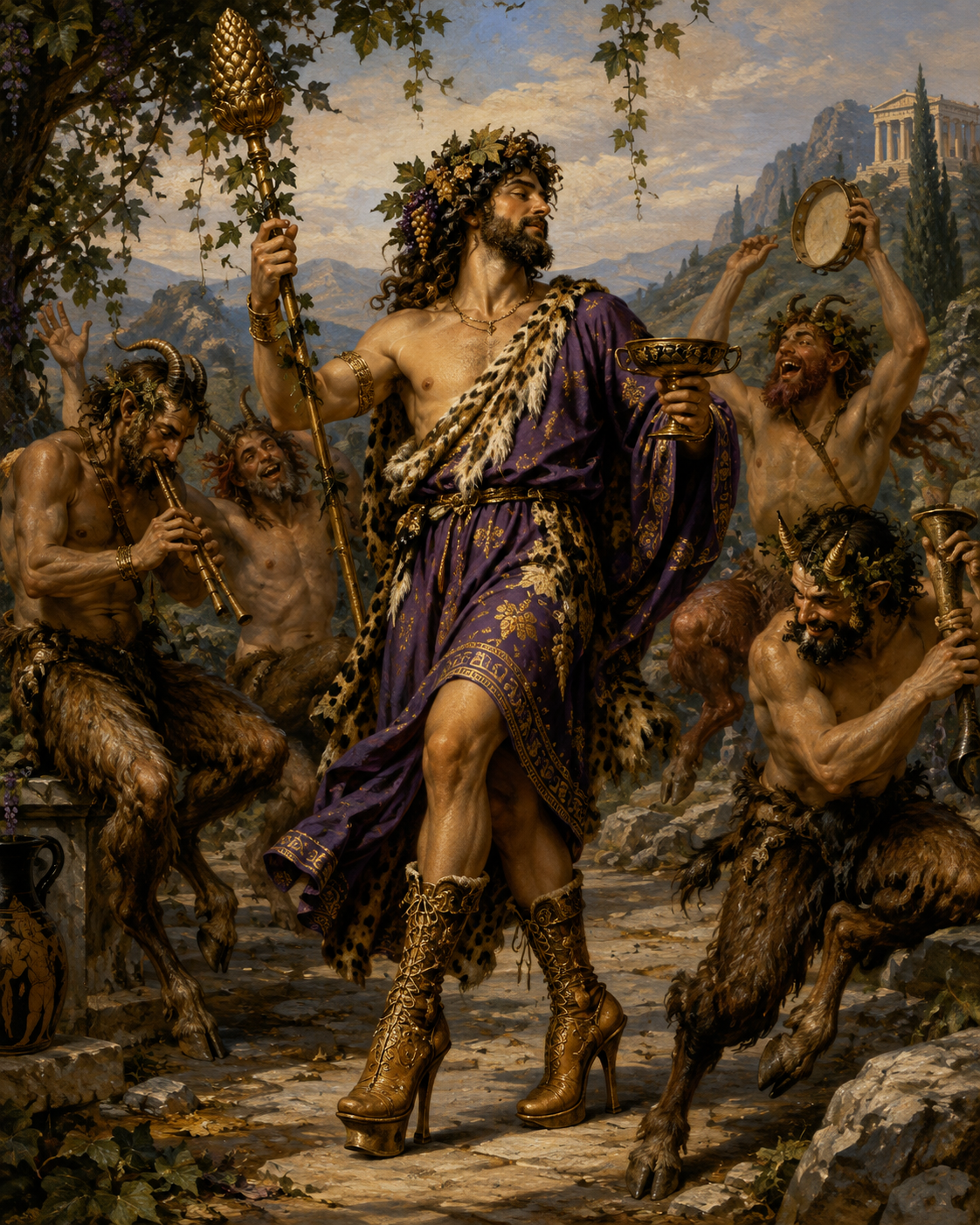
Since I’ve already quoted it a couple times, it seems only appropriate to tease out some of the threads from this gnōme from New Wine:
οὐ πᾶν τὸ χωλὸν ἀτελές ἐστιν.
“Not everything that limps is incomplete.”
The limp of Dionysos is a mystery, and something scholars have wrestled with for centuries. My favorite “explanation” is that the high-heeled Thracian hunting boots or buskins called kothornoi which Dionysos is both depicted wearing and which became emblematic of the theater since they were part of the panoply of the tragic actor was intended to disguise the God’s limp or mangled foot/leg. As someone who had a severe knee injury that caused me to walk with a limp for a while (and occasionally flares up when I’m having a bad pain jag) let me assure you that high-heeled boots ain’t gonna disguise shit, and would significantly increase my chances of taking a serious fall. The scholars who proposed that should be maimed and forced to hobble around in high heels to see how long it takes them to refine their theories.
Even leaving practical experience aside, kothornoi as concealment-device feels suspiciously like a just-so explanation generated because two Dionysian data points exist—lameness and kothornoi —and therefore somebody felt compelled to make one explain the other.
There is a remarkably rich Dionysian constellation around impaired, abnormal, or unstable locomotion: staggering, dancing, leaping, rushing, wandering, falling, being carried, processional movement, ecstatic movement, and movement between realms or conditions. A God associated with radically altered modes of movement being Χωλός is suggestive even if we cannot say why.
And a limp is particularly interesting because it produces an asymmetrical gait.
Not:
left → right → left → right
But something more like:
step → drag → step → drag
A regular progression disrupted into a different rhythm.
Given how much we’ve been discussing Dionysian zigzags rather than simple linear progression, that symbolism seems especially apt.
There’s also a distinction worth preserving: disability isn’t necessarily symbolic deficiency. Mythic bodies can bear marks that identify divine or heroic figures: scars, blindness, unusual feet, altered limbs, multiple births, dismemberment and reconstruction. The bodily irregularity can itself become part of the sacred morphology.
And Dionysos, of all Gods, hardly requires bodily regularity to establish divine perfection.
ἀτελής isn’t merely “missing something.” It can mean unfinished, incomplete, imperfect, not brought to its τέλος. And τελεῖν / τελετή / τελεστής brings the initiatory vocabulary hovering nearby whether or not the sentence explicitly invokes it.
So the maxim can speak simultaneously about bodies, works, persons, initiatory development, and traditions.
Something can move irregularly and nevertheless be whole.
Something can bear the visible marks of damage without being unfinished.
Something can fail to conform to the expected pattern and nevertheless have reached its τέλος.
And wonderfully, it doesn’t say:
τὸ χωλὸν τέλειόν ἐστιν
“The limping thing is perfect.”
That would merely replace one facile judgment with another.
It says οὐ πᾶν.
Not everything.
Discern.
That little qualification makes its presence beside the other New Wine sayings even more certain. It isn’t reassurance. It’s a tool for thought.
And part of the mystery is the symmetry that Dionysos’ lameness creates, if one accepts the Sicilian interpretation of Dionysos as the “limp of Zeus.” That makes ἀτελές hit even harder because the apparent defect becomes part of a larger completeness. Brought into conjunction with Dionysos abnormal birth from Zeus’ thigh which had caused the King of Gods and men to temporarily limp then Dionysos’ lameness isn’t merely an isolated peculiarity of his body. It creates a correspondence between father and son:
- Zeus bears Dionysos in the thigh.
- Dionysos bears the mark in his gait.
The irregularity becomes almost a birth-sign.
And there’s a beautiful reversal in it too. Ordinarily we expect the parent to transmit bodily characteristics to the child through generation. Here Dionysos’ extraordinary generation effectively marks both bodies: Zeus’ thigh becomes the site of gestation/birth, while Dionysos emerges into mythology with this mysterious constellation of lameness, unusual footwear, and abnormal gait.
So neither is quite intelligible without the other.
Which makes:
οὐ πᾶν τὸ χωλὸν ἀτελές ἐστιν.
“Not everything that limps is incomplete.”
Almost mischievously precise.
Because Dionysos’ limp may signify precisely the opposite of ἀτελής: something has been completed.
The second birth happened.
The child came forth.
The strange pregnancy of Zeus reached its τέλος.
And the God walks differently afterward.
There’s even a broader pattern here that I wouldn’t turn into historical explanation but would absolutely think with: Dionysos repeatedly emerges from transformations that ought to produce an “incomplete” being.
- Prematurely born.
- Transferred from one bearer to another.
- Sewn into Zeus.
- Born again.
- Dismemberment.
- Reconstitution.
- Masked.
- Sexually and socially ambiguous.
- The limp.
Yet the result is not ἀτελής.
Indeed, Dionysos is Τέλειος.
And a conjunction is created.
Χωλός ◈ — Limping
Τέλειος ◈ — Perfected; Completed; Fulfilled; Initiated
Those two epithets now belong in conversation.
The mystery isn’t that Dionysos somehow overcomes an imperfection and becomes complete despite it.
It’s more radical:
What if we were wrong about which features indicate completeness in the first place?
Then the maxim doesn’t merely say “don’t judge the disabled.”
It asks:
What does τέλειος actually look like?
Apparently, sometimes it limps.

