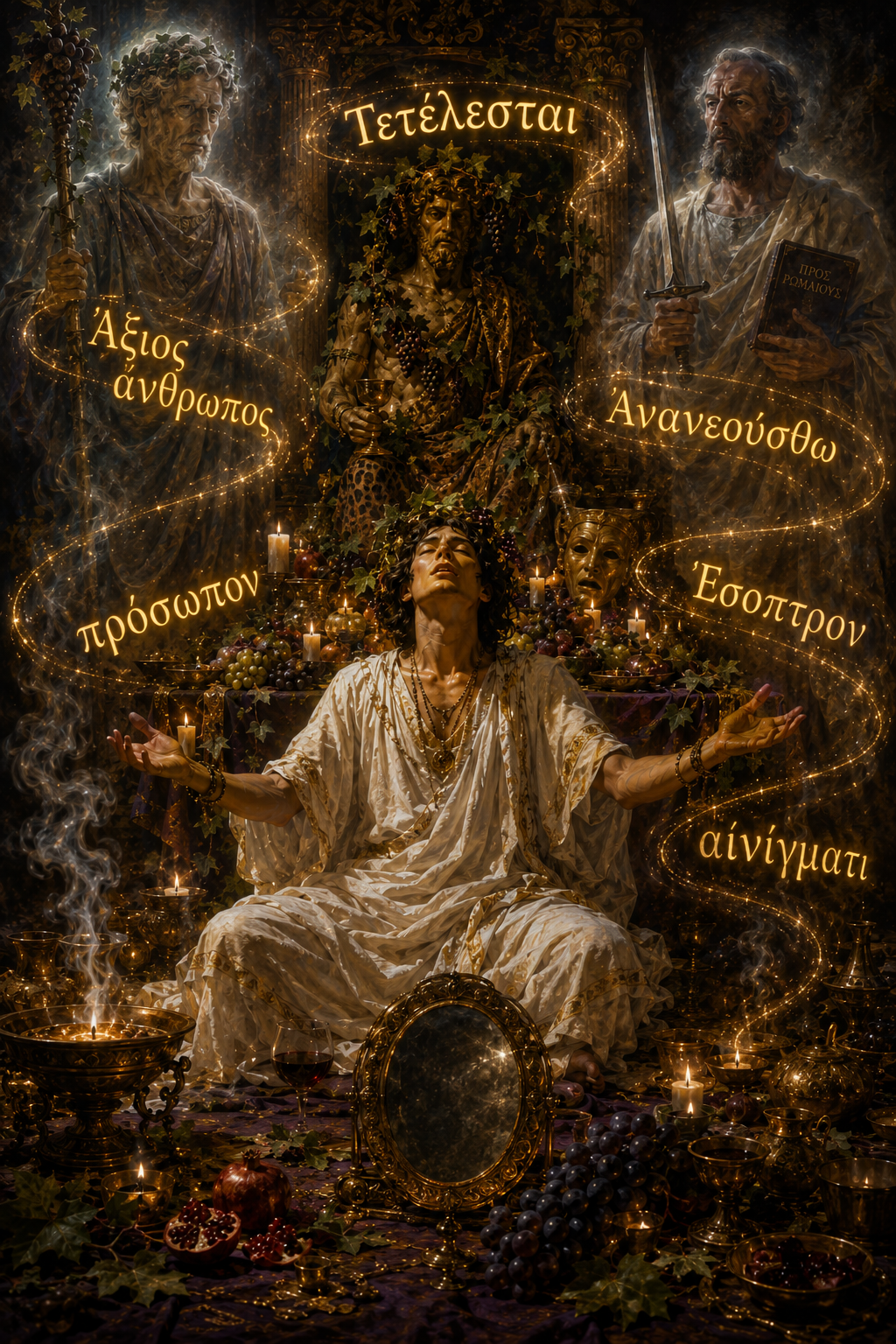
A conversation I’m having with Ignacio Silvera got me thinking, which is always a dangerous thing. Although the conversation itself is about balancing Christianity and Polytheism (which is something I know a number of y’all do; please feel free to chime in as I’m sure your thoughts and experiences will provide valuable perspectives) I have been reflecting on Saint Paul’s position within the Starry Bull tradition. Around two weeks ago I posted about his role in folk Catholicism, and specifically Tarantism, which is one of the currents that contributed to the formation of the Starry Bull. I discussed some of his more overtly Bacchic qualities such as his peripatetic lifestyle, his tricksterish behavior in the Thecla literature, his ecstatic visions and charismatic gifts including immunity to snakebite, his occupation as a σκηνοποιός, the kinds of people he likely hung out and conversed with during his travels, and his employment of the symbolism and technical language of the mysteries, particularly Orphism. Although I’ve touched on this before —most extensively in this discussion of the Άθυρματα or Toys of Dionysos— I think it’s a subject that deserves a closer philological analysis, especially because a lot of the good stuff tends to get flattened or obscured when translated into English.
Take, for instance, Saint Paul’s furious admonition from 1 Corinthians 15:36:
Ἄφρων, σὺ ὃ σπείρεις οὐ ζῳοποιεῖται ἐὰν μὴ ἀποθάνῃ.
Fool! What you sow is not brought to life unless it dies.
The first word combines the negative prefix a– (not) with phrēn (mind, heart, or understanding) meaning one who is “out of his mind”, “senseless”, or a “fool” inviting us into the domain of Dionysos, God of both insanity and comedy. Beneath the mask of this beloved stock character whose delightful schemes and topsy-turvy perspective often succeed where the cleverness of the wise proves insufficient— there lies something darker and more ominous, for it suggests the sparagmos suffered by the God and his mortal doubles, in which the organ of the intellect and seat of the passions is extracted from the victim as part of their frenzied dismemberment. It was through the preservation of Dionysos’ own heart by Athenē or Apollon (Gods of wisdom and rationality) that his παλιγγενεσία (rebirth or regeneration) was effected.
Which gives the rest of Saint Paul’s agricultural metaphor added valence.
Seed → death → life looks remarkably like the Olbian bone tablet’s βίος. θάνατος. βίος.
And the layers of symbolism pile on: τελετή (initiation), μεταμόρφωσις (transformation), ἀποκατάστασις (restoration), ἴασις (physical or spiritual healing), κατάβασις and ἄνοδος (descent into and ascent out of the underworld), or any διαβαίνω (threshold-crossing) could all be expressed through this formula.
Saint Paul’s Greek also breaks down the three stages of a thing:
σπείρεις → ζῳοποιεῖται → ἀποθάνῃ
you sow → it is made alive → it dies
This is not just limited to botanical or animal life, but paradigmatic of everything from an idea to the kosmos. It’s just that with the Wheel or the Labyrinth there’s a few more times around than normal.
Which seems less of a random comment when compared with this passage from a couple verses back:
When I was a child, I spake as a child, I understood as a child, I thought as a child: but when I became a man, I put away childish things. For now we see through a glass, darkly; but then face to face: now I know in part; but then shall I know even as also I am known. (1 Corinthians 13:11–12)
While the King James Version has an undeniable grandeur, there are things in the Greek:
Őτε ἤμην νήπιος, ἐλάλουν ὡς νήπιος, ἐφρόνουν ὡς νήπιος, ἐλογιζόμην ὡς νήπιος· ὅτε γέγονα ἀνήρ, κατήργηκα τὰ τοῦ νηπίου. βλέπομεν γὰρ ἄρτι δι’ ἐσόπτρου ἐν αἰνίγματι, τότε δὲ πρόσωπον προς πρόσωπον· ἄρτι γινώσκω ἐκ μέρους, τότε δὲ ἐπιγνώσομαι καθὼς καὶ ἐπεγνώσθην.
Better expressed by this more literal translation:
When I was a child, I spoke as a child, I thought as a child, I reasoned as a child; when I became a man, I put away the things of the child. For now we see through a mirror, in an enigma; but then face to face. Now I know in part; but then I shall know fully, even as I have been fully known.
“Childish things” sounds natural in English, but τὰ τοῦ νηπίου is stranger and more spacious, “the things of the child.” Does this refer to the state of childhood, or to the Divine Child (the bull-horned son of Zeus and Persephonē) or to an immature and incomplete grasp of truth?
Likewise, embellishing ἐν αἰνίγματι collapses its range of meaning. “In an enigma” is quite extraordinary: is Paul in the enigma? Is the enigma in the mirror? Are the “things of the child” what is enigmatic? Is it Paul’s partial understanding of spiritual realities?
This word is often applied to Orpheus and his notoriously difficult to interpret poetry, for instance in the Derveni Papyrus:
Since in his whole poetry he speaks about facts enigmatically, one has to speak about each word in turn […] People are wrong to think that Orpheus did not compose a hymn that says wholesome and lawful things; for they say that he utters riddles by means of his composition, and it is impossible to state the solution to his words even though they have been spoken. But his composition is strange and riddling for human beings. Orpheus did not wish to say in it disputable riddles, but important things in a riddling fashion. For he tells a holy tale even from the first word right through to the last, as he shows even in the well-known verse: for by bidding them ‘put doors on their ears’ he is saying that he is not legislating for the many, but is addressing those who are pure in hearing.
Paul sets up a semantic cluster that sounds awfully Bacchic Orphic: mirror + enigma + incomplete knowledge + face-to-face revelation.
To make that face-to-face (πρόσωπον προς πρόσωπον) revelation even more Dionysian, πρόσωπον can mean both face and mask. We wear many faces depending on our situation, circumstances, intent, the company we’re keeping, etc. But we cannot hide the truth from the mirror, or from the Master of Masks. In that theophany we may encounter him with a particular mask in place, or with the false masks stripped away to reveal the true face beneath— his, ours, or both together.
And then that final line hits like a sudden bolt of pure enlightenment: the more we understand ourselves, the more we will be understood in turn. Or put another way, the more we understand Dionysos the more that leads to self-understanding and mastery.
Which naturally reminds one of this passage from the playwright Aischylos, preserved in Corpus Parisinum 1225:
Κάτοπτρον είδους χαλκός εστί, οίνος δε νοός.
Bronze is the mirror of the form; wine, of the mind.
The mirror of bronze reveals the external form; the mirror of wine our interior self.
Translation also obscures another significant detail of Saint Paul’s text. The phrase κατήργηκα τὰ τοῦ νηπίου is often rendered simplistically as “I rejected childish things.” But καταργέω means to render something inactive/inoperative, to abolish, do away with, bring to an end. The KJV’s “put away childish things” is interpretive and has acquired the cultural sense “grow up and stop playing with toys.” Paul’s actual argument is about partial modes of knowing giving way to completion. That distinction matters enormously here.
The child possesses the things of the Child.
The adult encounters the mirror.
The mirror provides knowledge ἐν αἰνίγματι — in an enigma.
And beyond the mirror lies the encounter πρόσωπον προς πρόσωπον — face to face.
However, there is a detail in this sequence that is doing more work than many realize:
ἐκ μέρους γὰρ γινώσκομεν… ὅταν δὲ ἔλθῃ τὸ τέλειον, τὸ ἐκ μέρους καταργηθήσεται.
“For we know in part… but when the perfect/complete comes, that which is partial shall pass away.”
Greek keeps semantic relationships visible that an English translation forces us to choose between. The bolded term is part of the τελε- constellation that is one of the most important in ancient Greek religion: τέλος / τελεῖν / τελετή / τέλειος which signifies end, completion, fulfillment, accomplishing, initiation, mystery rite, perfection, etc. An English translation normally has to select one symbol and run with it. Keeping the Greek allows the whole symbolic root-system to remain present beneath any selection the translator chooses. Indeed this same process occurs with the word σύμβολον itself. “Symbol” in modern English encourages us to think “something representing something else.” But σύμβολον in the Greek conveys joining, matching, recognition— the broken pieces that disclose their relationship when brought together. That gives an entirely different texture to calling something a symbolon, especially within a Dionysian context. You aren’t merely asking, “What does this represent?” Instead, other questions open up, such as “What does this fit with? What becomes recognizable when that occurs? Where is its original other, missing half?”
One of my favorite examples of this in the Bible is the final exclamation of Jesus presented in John 19:30: Τετέλεσται!
The immediate grammatical sense is straightforward: “It has been completed/accomplished.” But the root refuses to stay confined to our English word “finished.” It lives inside that whole τελε- constellation:
τέλος — end, goal, fulfillment, completion
τελέω — bring to completion, accomplish; also perform a rite/initiate
τελετή — rite, initiation, mystery celebration
τελεῖν — accomplish, perform rites, initiate
τελούμενος — one undergoing initiation
τετελεσμένος — completed, perfected; in appropriate contexts, initiated
τέλειος — complete, perfected, fully developed
So Τετέλεσται stands at a semantic crossroads between ending and fulfillment. Something ends because it has reached its τέλος, but it has also been fulfilled, perfected. And in mystery language, completion and initiation become entangled because initiation is itself a teleological act: something is brought through to its proper, final state.
When John’s τετέλεσται and Paul’s το τέλειον are brought together the two passages start speaking to one another in Greek in a way an English reader could easily miss. And around that semantic field gather childhood, transformation, mystery, partial vision, direct encounter, death, and— as 1 Corinthians 15 adds —what must die in order to be made alive.
To demonstrate the full range of this whole τελε- constellation let’s bring in one of my favorite passages by the Delphic priest and Bacchic initiate, Plutarch of Chaironeia, causing our dialogue of sources to become a ménage à trois:
Οὕτω κατὰ τὴν εἰς τὸ ὅλον μεταβολὴν καὶ μετακόσμησιν ὀλωλέναι τὴν ψυχὴν λέγομενἐκεῖ γενομένην· ἐνταῦθα δ’ ἀγνοεῖ, πλὴν ὅταν ἐν τῷ τελευτᾶν ἤδη γένηται· τότε δὲ πάσχειπάθος οἷον οἱ τελεταῖς μεγάλαις κατοργιαζόμενοι. διὸ καὶ τὸ ῥῆμα τῷ ῥήματι καὶ τὸἔργον τῷ ἔργῳ τοῦ τελευτᾶν καὶ τελεῖσθαι προσέοικε. πλάναι τὰ πρῶτα καὶ περιδρομαὶκοπώδεις καὶ διὰ σκότους τινὲς ὕποπτοι πορεῖαι καὶ ἀτέλεστοι, εἶτα πρὸ τοῦ τέλους αὐτοῦτὰ δεινὰ πάντα, φρίκη καὶ τρόμος καὶ ἱδρὼς καὶ θάμβος· ἐκ δὲ τούτου φῶς τι θαυμάσιονἀπήντησεν καὶ τόποι καθαροὶ καὶ λειμῶνες ἐδέξαντο, φωνὰς καὶ χορείας καὶ σεμνότηταςἀκουσμάτων ἱερῶν καὶ φασμάτων ἁγίων ἔχοντες· ἐν αἷς ὁ παντελὴς ἤδη καὶ μεμυημένοςἐλεύθερος γεγονὼς καὶ ἄφετος περιιὼν ἐστεφανωμένος ὀργιάζει καὶ σύνεστιν ὁσίοις καὶκαθαροῖς ἀνδράσι, τὸν ἀμύητον ἐνταῦθα τῶν ζώντων καὶ ἀκάθαρτον ἐφορῶν ὄχλονἐν βορβόρῳ πολλῷ καὶ ὁμίχλῃ πατούμενον ὑφ” ἑαυτοῦ καὶ συνελαυνόμενον, φόβῳ δὲθανάτου τοῖς κακοῖς ἀπιστίᾳ τῶν ἐκεῖ ἀγαθῶν ἐμμένοντα. ἐπεὶ τό γε παρὰ φύσιν τὴνπρὸς τὸ σῶμα τῇ ψυχῇ συμπλοκὴν εἶναι καὶ σύνερξιν ἐκεῖθενἂν συνίδοις.
When the soul comes to the point of death, it suffers something like those who participate in the great initiations (teletai). Therefore the word teleutan closely resembles the word teleisthai just as the act of dying resembles the act of being initiated. At first there are wanderings and toilsome running about in circles and journeys through the dark over uncertain roads and cul-de-sacs; then, just before the end, there are all kinds of terrors, with shivering, trembling, sweating, and utter amazement. After this, a strange and wonderful light meets the wanderer; he is admitted into clean and verdant meadows, where he discerns gentle voices, and choric dances, and the majesty of holy sounds and sacred visions. Here the now fully initiated is free, and walks at liberty like a crowned and dedicated victim, joining in the revelry, and converses with pure and holy men; he surveys the uninitiated, unpurified mob here on earth, the mob of living men who, herded together in mirk and deep mire, trample one another down and in their fear of death cling to their ills, since they disbelieve in the blessings of the other world. (De Anima fragment preserved in Stobaios Florilegium 120)
Plutarch explicitly tells us that he is exploiting the τελε- constellation:
διὸ καὶ τὸ ῥῆμα τῷ ῥήματι καὶ τὸ ἔργον τῷ ἔργῳ τοῦ τελευτᾶν καὶ τελεῖσθαι προσέοικε.
Therefore the word resembles the word, and the deed the deed: dying (τελευτᾶν) and being initiated (τελεῖσθαι) resemble one another.
That’s magnificent because Plutarch isn’t merely making an etymological pun— he says explicitly:
τὸ ῥῆμα τῷ ῥήματι
τὸ ἔργον τῷ ἔργῳ
word resembles word
deed resembles deed
The linguistic resemblance discloses an experiential resemblance.
And then he constructs the entire passage around the semantic field:
τελευτᾶν — to die / come to life’s end
τελεῖσθαι — to be initiated
τελεταῖς — initiations/mystery rites
ἀτέλεστοι — incomplete/unfulfilled
πρὸ τοῦ τέλους — before the end/completion
παντελής — wholly complete, perfected
μεμυημένος — initiated
So the passage itself performs the movement encoded in its vocabulary.
At first the candidate is ἀτέλεστος— unfinished.
There is wandering:
πλάναι τὰ πρῶτα καὶ περιδρομαὶ κοπώδεις
First, wanderings and exhausting circuits…
Which is already wonderfully Labyrinthine.
Then darkness and uncertain paths: διὰ σκότους… πορεῖαι… ἀτέλεστοι.
Then, approaching the τέλος: terror, trembling, sweating, astonishment.
And finally:
φῶς τι θαυμάσιον ἀπήντησεν
A wondrous light met him.
That verb is beautiful too. The light doesn’t merely become visible. It meets him. What we have is a repetition of Orphic cosmology in which the primeval deity Φάνης manifests and reveals himself, both words in Greek that are etymologically related to the name of this primordial expression of Dionysos, whose dancing within the Cosmic Egg causes it to crack open, and the constituit elements of everything come flooding out.
Beyond that threshold are purified places and meadows, as well as: φωναί, χορεῖαι, ἀκούσματα ἱερά, φάσματα ἅγια— voices, dances, sacred things heard, holy apparitions, all things associated with Dionysian initiation.
Then look at what the initiate has become:
ὁ παντελὴς ἤδη καὶ μεμυημένος
now wholly perfected/completed and initiated.
He has gone from ἀτέλεστος → τέλος → παντελής.
And the result is:
ἐλεύθερος γεγονὼς καὶ ἄφετος
having become free and released.
There is Eleutherios hiding in the structure without Dionysos even being named.
And then the liberated initiate:
περιιὼν ἐστεφανωμένος ὀργιάζει
goes about crowned and celebrates the mysteries/revels.
So we get crown + freedom + orgia + sacred dance + vision + death/initiation + light from darkness, all concentrated into a single paragraph.
And just in case it’s not yet clear, here is Plutarch in conversation with Paul and John. (Ringo must have been out playing with the donkeys when this happened.)
Paul:
ὅταν δὲ ἔλθῃ τὸ τέλειον
When the completing comes…
Then:
δι’ ἐσόπτρου ἐν αἰνίγματι
through a mirror, in an enigma…
Then:
πρόσωπον πρὸς πρόσωπον
face to face.
And later on:
ὃ σπείρεις οὐ ζῳοποιεῖται ἐὰν μὴ ἀποθάνῃ.
What you sow is not made alive unless it dies.
To which John replies:
Τετέλεσται.
It is accomplished.
Then Plutarch provides the grammatical key:
τελευτᾶν καὶ τελεῖσθαι
to die and to be initiated.
Death, completion, initiation, perfection, revelation.
None of these quotations needs an explanatory paragraph telling the reader what doctrine to derive from them. They begin interpreting one another. An effective tradition creates a semantic initiatory environment. The reader learns certain words and images— τέλος, mirror, child, death, seed, crown, labyrinthine wandering, light, freedom, wine, truth —and eventually encounters them again somewhere else under a different configuration. And then again. And again.
Until suddenly:
Oh, fuck.
That’s precisely the kind of anagnōrisis a tradition is supposed to produce in its adherents. And while the roots of the Starry Bull tradition may be found in ancient Crete, Southern Italy and the Black Sea region we emphatically assert that revelation never ceased, and Dionysos didn’t stop traveling the world just because large swaths of it became Christian, Moslem or secular. Which is why we’re bringing a fourth voice into the choros, the Prophet Jim Morrison.
The End adds another meaning to τέλος that the ancient material alone cannot supply: not merely completion, initiation, or death, but the catastrophic dissolution of the world through which one had previously understood oneself. The song begins almost gently—“the end” as separation, particularly the end of a relationship— and then refuses to remain there. The personal ending expands until identity, family, taboo, social order, narrative coherence, and finally almost the song itself come apart. The love song undergoes its own initiation and emerges as something monstrous.
That makes the constellation remarkable:
John: Τετέλεσται — accomplishment at the moment of death.
Paul: τὸ τέλειον — the complete replacing the partial; child, mirror, enigma, then face-to-face vision.
Plutarch: τελευτᾶν / τελεῖσθαι — dying and initiation mirror one another; wandering and terror culminate in light, freedom, crowning, and revel.
The Doors: The End — τέλος experienced from inside the psychic catastrophe, where ordinary categories disintegrate before anything on the other side has become intelligible.
And Morrison’s song contributes something crucial that the other three can easily make sound too clean. Initiatory endings are terrifying while they are happening. Plutarch actually says this— darkness, wandering, dead ends, shuddering, terror, sweat —but his description is retrospective and orderly. He knows where the initiate eventually arrives. The End doesn’t give you that security. You’re still inside the Labyrinth. Which makes the inscription on Morrison’s tombstone— Κατά τον δαίμονα εαυτού —awfully relevant, don’t you think?
And there’s something wonderfully appropriate about a song beginning as one thing and transforming during its composition and performance into something its creators hadn’t planned. That’s Dionysian in a much deeper sense than simply mentioning Dionysos, wine, ecstasy, or madness. The End was different every time the Doors played it, sometimes incorporating material from other songs and poems, sometimes crescendoing in Oedipal screaming while thousands of concert goers suddenly go completely fucking nuts, for reasons they couldn’t even begin to articulate the following day.
The modern contributions to the Starry Bull tradition aren’t just decorative garnish to some antiquarian, reconstructionist project. Sometimes it supplies an experiential register that allows an ancient statement to become dangerous —and therefore meaningful— again. It also demonstrates why the tradition legitimately stretches across millennia while also being only a decade or so years old. We aren’t pretending that the historical sources somehow engaged with and influenced one another, despite coming from a melange of cultures, ethnicities, languages, religions, and time periods, with Dionysos as the only common denominator. The participants don’t even have to know they’re in conversation. The way that we stitch them together creates the conversation.
John says:
Τετέλεσται.
Plutarch asks what it means to reach the τέλος.
Paul says that what is partial gives way when τὸ τέλειον comes.
Morrison answers from somewhere in the darkness:
This is the end.
And none gets the final word. That’s a big part of how I see the lore of the Starry Bull tradition. A conversation across the centuries, by people from different cultures, languages, perspectives, and even religions, with Dionysos as the only common denominator. Sometimes he’s overtly present, sometimes disguised, sometimes lurking in the shadows grinning. Dionysos doesn’t even need to be the subject of every text because he is the principle by which the texts are brought into relationship. That’s a much richer model than assembling a canon of “texts about Dionysos.” Plutarch may be talking about initiation and death. Paul about love, knowledge, resurrection, and transformation. Herakleitos about the structure of reality. A Pythagorean about discipline. Morrison about psychic apocalypse. Someone inscribing a gold leaf is preparing the dead for what comes next. None needs to share the other’s theology. But put them around Dionysos and correspondences begin appearing:
child — Toys — play
mirror — image — knowledge — enigma
wine — truth — madness
death — initiation — completion
dismemberment — seed — rebirth
wandering — Labyrinth — recognition
mask — identity — transformation
suffering — liberation
darkness — light
madness — wisdom
stranger — host — God.
And importantly, the differences don’t have to be reconciled. Jane Ellen Harrison doesn’t become a secret Orpheotelest. Anaïs Nin needn’t have been consciously encoding Dionysian doctrine into her smut. Ella Fitzgerald isn’t suddenly an inspired theologian whose lyrics must be studied as scripture because she recorded a song called “Midnight Sun.” Their otherness is what allows them, in large or small ways, to have contributed to the formation of our weird branch of Bacchic Orphism.
That also gives real substance to the distinction between lore and dogma. Lore can preserve multiple witnesses to a mystery without requiring them to agree about what they witnessed, or even for them to have recognized it for the mystery it was. Sometimes the connection is explicit: Euripides and Nonnos were deliberately writing about the Dionysian mysteries, albeit from differing perspectives. The gold tablets belong to an identifiable Bacchic-Orphic milieu. Elsewhere the connection is something the tradition discovers by bringing a text into its own symbolic field. Those aren’t the same historical claim, and they shouldn’t be presented as though they were. But they can occupy the same conversation. And pretty much all living traditions do this with their sources. It doesn’t merely preserve old answers. It creates a table at which the dead can continue conversing with one another— and with the living. And Dionysos moves through the symposion, making sure everything is running smoothly. Sometimes speaking. Sometimes listening. Sometimes nobody recognizes the stranger reclining at the end of the couch. And sometimes he’s just sitting there in the shadows, grinning because two people separated by fifteen hundred years have accidentally completed each other’s sentence.


One question – are there folks besides you who are working on this tradition? How does that work?
LikeLike
Thank the Gods, the answer to that is an emphatic no! I mean, I have a student and a probationary student. There’s around five folks who have expressed interest in joining when it’s ready, but are currently just following along through the blog and asking me the occasional question. I haven’t started any forums or lists or anything, and don’t intend to or begin recruiting until I have all the fine-tuning worked out. In the past I’ve rushed into things thinking, “we’ll create community, and then institute structures as needed,” Well, that shit’s blown up in my face, so this time I’m perfecting the structures first (incorporating what worked in the past, and supplementing with things I’ve learned are necessary through the various failed groups I’ve run and even more the shit I’ve seen going on in other groups) before formally announcing a relaunch. If all things go according to plan (and they NEVER do: first rule of combat, “the best plans last only until the first engagement: then you have to rely on training, discipline, and adaptive leadership to get your boys home. Worse plans don’t even last that long.”) I’m aiming for a relaunch date of December 31st. But if it takes longer than that, it takes longer. If I finish sooner, then maybe I’ll take a couple weeks to just relax, smoke a shit ton of weed, and binge some of my favorite horror movies as a reward for all the hard work I’ve put in, before starting the recruitment phase.
LikeLike