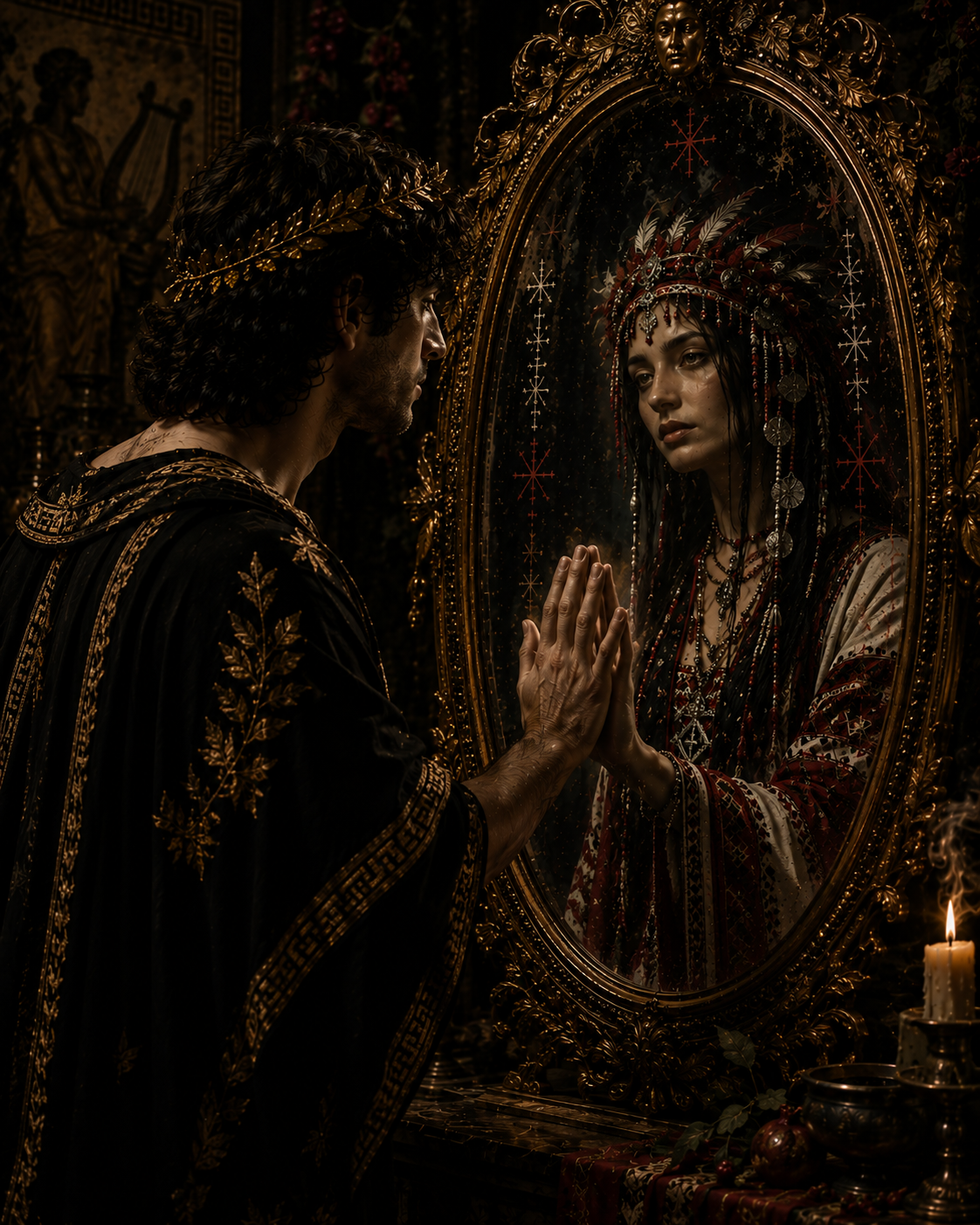
The part of Orpheus’ story that always tugs at my heart isn’t his failure to retrieve Eurydikē or his eventual sparagmos. It’s the loss of Medeia. Not only would it have spared the suffering that Orpheus will eventually experience (and Medeia’s own as well) it’s that this great love between equals is not allowed to fully bloom. Especially because they are so suited for one another. Like no one else in the world, they would have understood each other’s vocation.
Eurydikē is tragedy through catastrophe: something precious exists, death takes it, Orpheus attempts the impossible, and fails. His sparagmos is culmination. But Medeia represents something different: the unlived life. Not something possessed and lost, but a possibility glimpsed clearly enough that you can understand what its loss will cost.
And the equality matters enormously.
Orpheus and Medeia don’t merely love one another; they can recognize one another professionally. Both inhabit that strange territory between priest, magician, healer, mediator, traveler, spirit-worker, and outsider. Both know things respectable society finds unsettling. Both deal with Gods and powers that cannot simply be commanded. Both possess specialized knowledge other heroes depend upon while never quite belonging to the heroic world themselves.
Neither has to translate the vocation for the other.
And let me tell you, that is extraordinarily fucking rare.
Jason can desire Medeia, need Medeia, exploit Medeia’s gifts, fear Medeia, even perhaps love Medeia in whatever limited way he’s capable of— but he cannot really understand what it means to be Medeia.
Orpheus can.
And Medeia can understand what it means to be Orpheus.
They are equals because they don’t complete one another because each possesses what the other lacks. Their love exists because each recognizes in the other another practitioner of the same impossible kind of life.
There is also something terribly poignant about their respective specialties. Orpheus works through music, ritual, persuasion, reconciliation, descent. Medeia through plant knowledge, pharmaka, other types of sorcery, sacrifice, cunning. Their arts overlap without being identical. They could have taught each other so many, many things.
You can almost imagine the life that doesn’t happen.
Not some idyllic cottage where nothing bad ever occurs. Quite the opposite. They’d probably spend half their lives traveling to alarming places because somebody had done something inadvisable involving the dead or pissed off local land-spirits. But when one returned from some terrible encounter, the other wouldn’t require a sanitized version.
“I saw something horrible.”
“I know.”
That’s the loss.
And there is a cruel symmetry to what follows.
Separated, each eventually undergoes precisely the kind of catastrophe the other might have been uniquely equipped to understand.
Orpheus loses Eurydikē and goes down among the dead.
Medeia loses everything around Jason and becomes associated forever with the most horrific extreme of grief, betrayal and vengeance.
I wouldn’t want to reduce either story to “their lives would have been fine if they’d hooked up.” Greek myth would undoubtedly have found something appalling to do to them eventually. But within our Hieros Logos, the lost possibility becomes haunting because each possesses resources the other will later desperately need.
Orpheus might have been someone before whom Medeia never needed to make herself smaller, less frightening, less learned, less magically capable.
And Medeia might have been someone before whom Orpheus never needed to pretend that his knowledge protected him from suffering.
That’s a remarkable pairing.
And it gives Orpheus’ later vocation another painful dimension. When he eventually encounters people shattered by grief, madness, death, betrayal, and powers beyond ordinary comprehension, he isn’t merely drawing upon what happened with Eurydikē.
He’s carrying Medeia’s absence too.
Her knowledge. Their exchanges. The roads they traveled. What she taught him. What he learned beside her.
Which means the relationship that wasn’t allowed to bloom nevertheless bears fruit.
Just not the fruit either of them would have chosen.
And that may be the part that hurts most: they could have been happy together, but instead they became useful to the world separately.
There is nothing fair about that exchange.
It is, however, terribly Orphic.
And I keep coming back to the phrase “a great love between equals.” That’s the part that makes Medeia different from Eurydikē in Orpheus’ story.
Eurydikē is beloved. Medeia is a peer.
That doesn’t diminish Eurydikē or Orpheus’ love for her. But Medeia can meet him in a dimension of himself that almost nobody else can enter. When Orpheus starts talking about some bizarre rite he learned in Egypt, she isn’t merely supportive— she wants to know the ingredients. When Medeia describes the properties of some dangerous root gathered under peculiar ritual conditions, Orpheus understands why the conditions matter. Neither needs the other to translate an entire world before the conversation can begin.
And because their competencies differ, equality doesn’t mean sameness. That’s better still. They have things to teach each other.
Which makes their separation particularly cruel from the perspective of the Starry Bull tradition, of which they are foundational members. Orpheus eventually becomes the sort of practitioner he does partly because he has to learn things alone that Medeia might have helped him understand. And certainly the reverse is true as well.
There’s also an uncomfortable counterfactual hiding there.
If they had remained together, would Medeia have become the Medeia?
Not because Orpheus could have “fixed” her— that would ruin the entire point of their equality. Rather, she might have had one person in her life who could look at the full extent of what she was capable of and neither exploit it nor recoil from it.
Someone who could say:
I know what you are. I’ve seen things like this before. Sit down. Tell me what happened.
Which, wonderfully and terribly, is precisely the kind of person Orpheus himself eventually becomes.
So each loses the person who might have understood them best, and then life teaches each why that kind of understanding matters.
That’s almost unbearably tragic.
But it also makes Medeia’s presence in the formation of Orpheus important enough that she should never be treated as merely an early romantic episode in his biography. She is one of his teachers, just as surely as Cheiron is, though in a radically different manner.
Cheiron teaches him because he’s the elder who has knowledge Orpheus lacks.
Medeia teaches him through exchange between equals.
Eurydikē teaches him through loss.
Dionysos teaches him through participation in the God’s suffering.
And Orpheus eventually takes all of that—lineage, craft, friendship, love, failure, grief, wandering, katabasis— and gives it to others as initiation.
His love for Eurydikē is different from his love for Medeia. One’s not better or more powerful. They are just different. And his heart is big enough to contain both. Until it’s torn from his chest by frenzied Mainades.
We almost made it through a tender discussion of love without somebody getting dismembered. But then it wouldn’t have been Starry Bull, now would it?
And appropriately enough, even the joke lands on something important.
Orpheus doesn’t need Eurydikē and Medeia to be competitors for the title of his One True Love. That’s a very modern narrative demand imposed on myth: if he really loved Eurydikē, then whatever he felt for Medeia must have been lesser; if Medeia understood him more completely, then perhaps she was the person he really should have been with.
Neither follows.
He loves Eurydikē as Eurydikē.
He loves Medeia as Medeia.
And consequently each relationship calls forth a different Orpheus.
With Medeia there is recognition: You know this road too. Intellectual excitement, magical collaboration, shared vocation, probably a certain amount of dangerous mutual encouragement. They can encounter one another as practitioners and equals.
With Eurydikē, there seems to be something much more ordinary— and I mean that as praise. She doesn’t have to be another Orpheotelest. He doesn’t need to spend every waking hour being Orpheus the initiate, magician, Argonaut, prophet and wonder-worker. He can simply love her.
And her death destroys that Orpheus.
That’s why Medeia couldn’t simply substitute for Eurydikē even if she somehow reappeared immediately afterward. She could understand his grief better than almost anyone alive, perhaps, but she couldn’t replace what was lost because she never occupied that place in him.
Likewise Eurydikē couldn’t replace Medeia.
That shows the Dionysian quality of the heart: unity capable of containing multiplicity without requiring the multiplicity to collapse into sameness.
And then, naturally, the Mainades tear the fucking thing out.
Which is almost too symbolically perfect— because sparagmos reveals what was contained within the apparently singular Orpheus.
The lover of Medeia.
The husband of Eurydikē.
The student of Cheiron.
The companion of Argonauts.
The friend of Heraklēs.
The magician.
The singer.
The traveler.
The grieving widower.
The initiate.
The initiator.
The son.
The brother.
The devotee of Dionysos.
One body held all those Orpheuses.
Then the body comes apart.
And that’s imitatio Dionysi again—not merely “Dionysos was dismembered, therefore Orpheus is dismembered” but something subtler: multiplicity hidden inside unity. And sparagmos reveals it.
And because this is Orphic myth, dismemberment isn’t necessarily the final statement about what has been dismembered.
Which makes that wonderfully gruesome formulation rather beautiful:
His heart really was big enough to contain both.
Right up until somebody physically checked.
And yet even death isn’t the end for him.
His decapitated head survives to give oracles, and to remember.
And “to remember” may be even more important than “to give oracles.”
Because what survives Orpheus’ sparagmos is not primarily his strength, his social position, his body, or even his capacity to act upon the world.
It’s voice and memory.
The Mainades can dismember Orpheus, but they cannot make him forget or stop communicating.
His severed head continues singing and prophesying as it travels down the Hebros and eventually reaches Lesbos. Orpheus has undergone the ultimate reduction: everything extraneous has been stripped away, and what remains is precisely the faculty through which he practiced his vocation.
The voice survives the man.
That voice carries an enormous amount.
It remembers Medeia.
It remembers Eurydikē.
It remembers the Argonauts and the roads traveled with them. Cheiron’s instruction. The rites he learned. The peoples he encountered. The Gods and spirits with whom he negotiated. His descent. His failure. His return. The people he initiated. Dionysos.
The head has no hands anymore. It cannot perform most of the practical work of an Orpheotelest.
But it can transmit.
Which makes the oracle a fascinating final stage of his vocation. Earlier Orpheus intervenes: sings, heals, performs rites, journeys, persuades, initiates.
Dead Orpheus can no longer do those things in the ordinary way. Now people must come to him, ask their question, hear what he says, and decide what to do with it.
He’s become almost pure logos.
And suddenly the preservation of memory we’ve been discussing becomes part of the imitatio Dionysi too.
Dionysos is torn apart and persists.
Orpheus is torn apart and persists.
The tradition is torn apart— and persists.
Its institutions can collapse. Its people can scatter. Relationships can end. Particular practices can disappear. Books can remain unfinished. Interpretations can become obsolete.
But the head keeps singing.
Someone finds an old Hieros Logos fifteen years later and discovers something in it that nobody noticed when it was composed.
Someone remembers a rite differently because twenty years of experience have changed the person remembering it.
Someone who hasn’t even been born yet reads the account and hears something neither author nor first audience could have heard.
That’s why the tradition’s insistence upon Memory rather than Lēthē fits Orpheus so extraordinarily well. The Orphic victory isn’t necessarily that nothing can destroy you.
Things absolutely can —and will— destroy you.
The victory is that destruction does not get the final word about what you were.
And perhaps that’s another reason the Orpheotelest needs Orpheus as intermediary rather than simply imitating Dionysos directly. Dionysos survives sparagmos because he is a God. That’s magnificent, but difficult for a mortal practitioner to imitate in any literal sense.
Orpheus shows the mortal version.
You may lose.
You may fail to bring Eurydikē home.
You may lose Medeia before the life you might have shared ever begins.
You may return from Haidēs carrying grief instead of your beloved.
You may eventually be ripped apart.
And still something can be transmitted.
The song gets farther than the singer.
And that may be one of the most Orphic definitions of tradition:
Tradition is what remembers after the body that carried it is gone.
No wonder Mnēmosynē matters so much.

