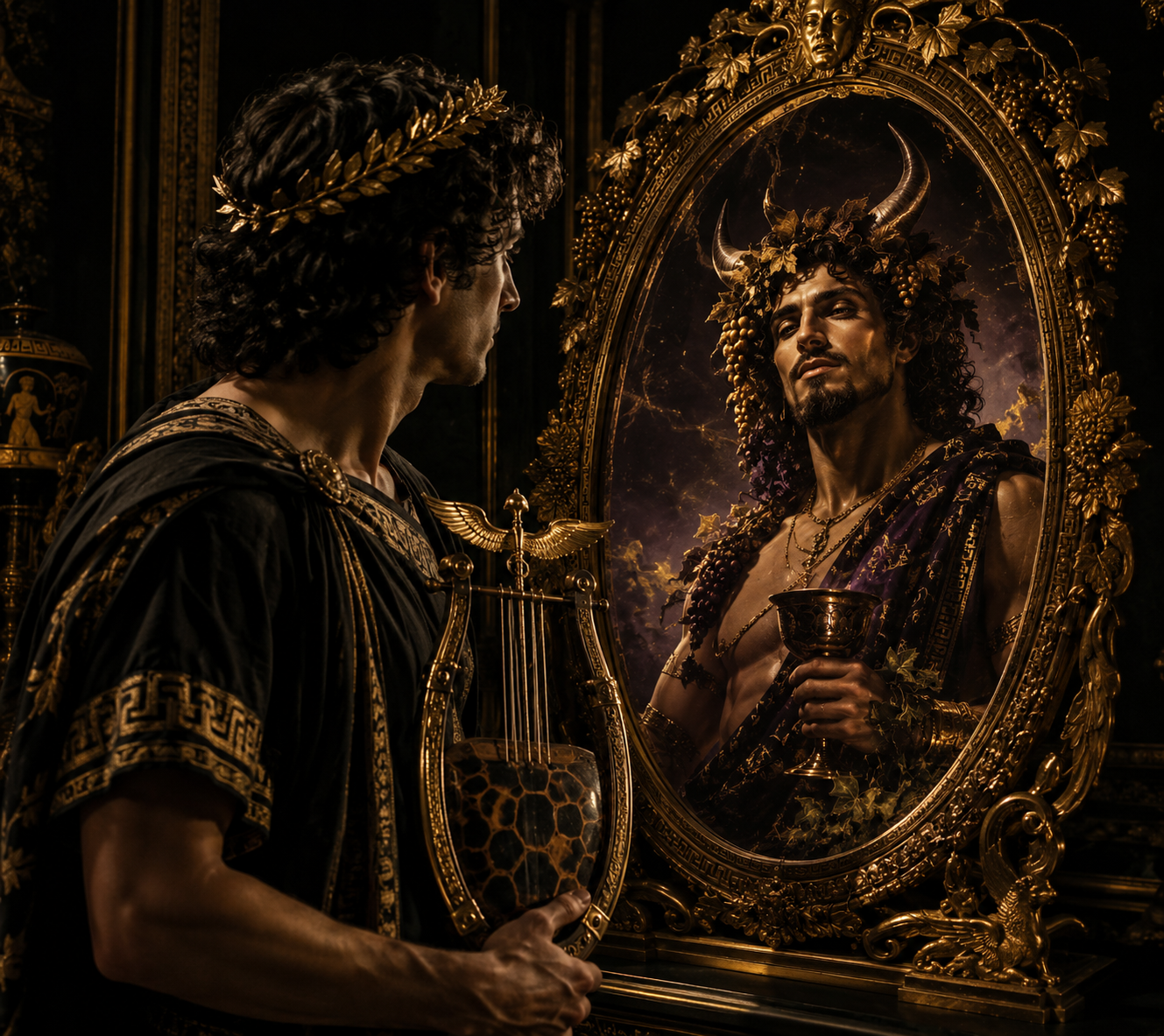
There’s a reason that the Story is followed by The Rest of the Story; Orpheus performs imitatio Dionysi, and not just in his katabasis and sparagmos, as most people think. There’s the rest of the story, which is too often forgotten. Those are the spectacular correspondences, but the lesser ones are important too.
Consider the Argonaut episode. (And not just because there are cool Harryhausen monsters.) Orpheus is explicitly not a warrior, and the other heroes ridicule him for it. Yet the expedition cannot succeed without him. What does he actually contribute? He reconciles quarreling companions, negotiates with Gods, spirits, and monsters, and devises rites of appeasement when the expedition encounters powers the warriors can’t simply overpower.
That’s already an Orpheotelest in action.
Not because Orpheus has undergone sparagmos. Not because he has visited Haidēs. But because when ordinary human competence reaches its boundary, Orpheus knows what to do next.
Heraklēs can hit something.
Phlias can go berserk and found cities.
Jason can piss off a Ukrainian witch.
Orpheus can tell you if these are good or bad ideas. (Pissing off Ukrainian witches is always a bad idea, by the way, surpassed only by Lithuanian witches. Actually I’m staying out of that one. Just don’t piss off witches in general if you want to live a long, happy and successful life. Unless they’re on Tiktok or Reddit, in which case piss all over them.)
All kidding aside, Orpheus’ interlude with Medeia is one of the most tragic episodes in a life plenty full of tragedy. Medeia is his double—the other religious specialist, magician and plant-worker, with whom he shares knowledge and who becomes alongside him a patron of the Green Way. That expands the paradigm again. His religious expertise isn’t reducible to “mysteries.” It’s a collection of crafts: ritual, spirit-work, music, drug- and plant-lore, mediation, magic, travel among different peoples and their Gods.
Then comes the wandering. Egypt, the Middle East, perhaps India, searching for wisdom, perpetually the outsider. That’s another check in the imitatio Dionysi ledger: Dionysos himself is the wandering foreign God, forever arriving from somewhere else.
But the closing now feels even more significant:
“Who can say whether his skill came from his patrimony or his grief?”
That line is key.
Orpheus inherits the bakcheia through Charops and Oiagros. He receives formation from Cheiron. He acquires practical knowledge from Medeia and through his travels. That’s tradition, training, lineage, technique.
And then life destroys him.
His brother dies. Medeia is lost to him. Eurydikē dies horribly despite Orpheus possessing precisely the arts that ought to have enabled him to save her. He descends to retrieve her, succeeds— and then loses her again through his own rashness. He wants to die and cannot. Eventually he returns to the human community and becomes an initiator.
So which produced the Orpheotelest?
Both.
And neither would have been sufficient alone.
Grief without formation can simply destroy somebody. Formation without lived encounter can produce someone who knows the correct procedures but has no idea what it is like to stand beside a person whose world has ended.
Orpheus possesses both.
That makes the sequence after the katabasis incredibly important. Popular retellings effectively end his meaningful life there: he looked back, lost Eurydikē, became miserable, then some Mainades killed him. Our version insists on the intervening movement: he comes back to the people. That’s the return from the Labyrinth. And he doesn’t come back because the katabasis “worked.” It emphatically did not. He returns carrying failure.
That may actually be more important for an Orpheotelest than a myth in which the master religious specialist always succeeds. Orpheus knows the correct rites and still cannot save Eurydikē from death. He persuades the Rulers Below and still loses her. His tremendous skill does not grant omnipotence.
That’s a vital model for someone doing pastoral or ritual work: sometimes you can do everything right, everything that should work— and still fail.
And then you have to come back to the people.
That gives his later role as initiator a completely different weight. He’s no longer merely transmitting mysteries because Charops received the bakcheia from Dionysos and they descended down his family line. He’s transmitting something he has verified through experience.
Which means that little final question could almost serve as a definition of living tradition:
Did Orpheus know because he was taught, or because he suffered?
Yes.
And now the imitatio Dionysi becomes much richer. Dionysos isn’t merely a mythic template whose dramatic events Orpheus repeats. Dionysos is the pattern of vocation that Orpheus gradually becomes capable of embodying. And then the Orpheotelest imitates Orpheus imitating Dionysos. That’s your golden chain in another sense:
Dionysos → Orpheus → Orpheotelest → Initiate.
Not the transmission of information.
The transmission of a way of going through things.
And every link changes it because every time around the circle you’re different. Or as Herakleitos put it:
Πάντα χωρεῖ καὶ οὐδὲν μένει = “everything dances and nothing remains the same.”


being half Lithuanian i was reading this with our favorite Ukainian witch. we each said, independently of each other; “We’d team up.” so um..yeah. don’t be pissing off either. lol.
LikeLiked by 1 person