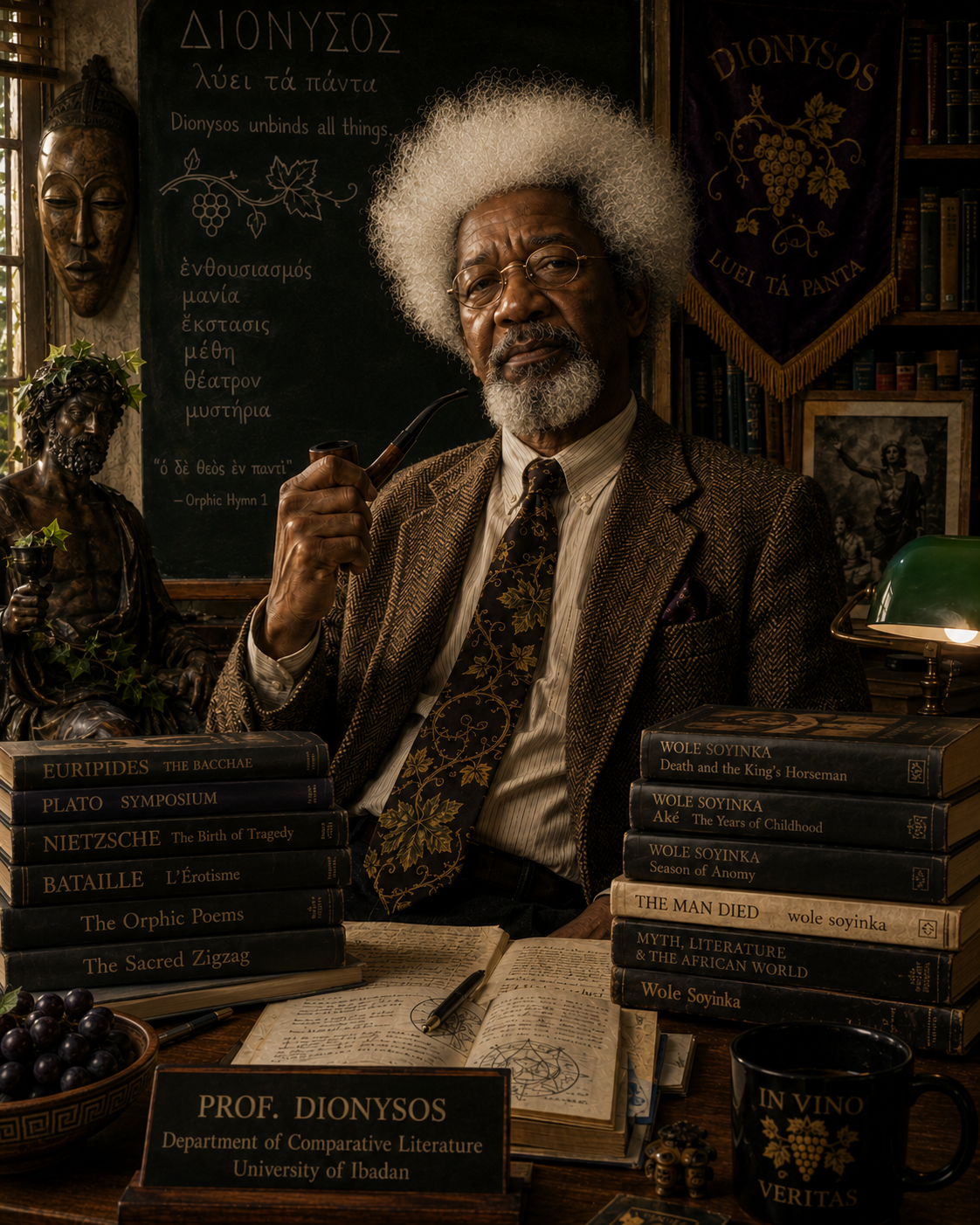
A lot of the character formation and ethical training that is a foundational part of the new curriculum for members of the Starry Bull tradition is communicated through aphorisms (called ἀκούσματα, χρεῖαι, ἀπόφθεγματα or γνῶμαι depending on their nature) some of which are harvested from antiquity (especially the Pythagoreans and other Presocratics who loved that shit, as well as enigmatic lines from an assortment of lyricists, dramatists and later ethical philosophers) and modern flowerings, some of which are intentional coinages and others sprouted up on their own from the lived experiences and culture of previous iterations of the Starry Bull.
Two examples of the latter are:
Κύκλοι, και τα λοιπά.
“Circles, etc.”
And:
Διόνυσος σοφός ἐστιν.
“Dionysos is wise.”
These were not chosen at random; indeed, they form a cohesive and complimentary pair.
One of the things that they share is being so obvious as to almost constitute tautologies, which of course conceals the depth of their true significance that can only be discovered by experience, reflection and time (ἐμπειρίᾳ, σκέψει καὶ χρόνῳ.)
The Neoplatonists, for instance, derived Dionysos’ name from Διὸς νοῦς (“the Mind of Zeus”) employing the jazz-riff method so beloved of the school, often deeply symbolic and associative and and intended to disclose profound theological and philosophical truths rather than contribute to the science of historical linguistics. (Kratylos being a perfect example; you can smell the wine from the page needed to reach some of those conclusions, and the even more difficult task of stating them with a straight face.) For Neoplatonists (and members of other contemporary philosophical schools) Zeus was the governing and organizing principle of the kosmos, from which all order and intelligence flowered— so of course the Mind of Zeus had to be sophos. How could it be otherwise?
But when the Starry Bull devotee says, “Διόνυσος σοφός ἐστιν” (or its abbreviated form “Διόνυσος σοφός”) they are communicating a great deal more than just an important cosmological doctrine cleverly disguised as fanciful etymology.
To begin with Διόνυσος σοφός ἐστιν is a confession of trust. When everything is going well, “Dionysos is wise,” sounds almost embarrassingly obvious, like saying “that fall from the cliff really hurt.” But when you’re frightened, grieving, angry, overwhelmed, or convinced your world is crumbling around you, etc. it is reassuring to remember that in the midst of all that threatening chaos when it all feels too big to handle, too scary, too out of control, etc. our God’s got it figured out. He’s a schemer, a dreamer, a deceiver, a trickster who always comes out on top, no matter how high the odds are stacked against him. Put another way, Dionysos knows the way “in and out” (εἴσω καὶ ἔξω) and the way “up and down” (ἄνω καὶ κάτω) though, of course, his path is not always a straight one.
Very often it’s a zigzag.
Even oftener it’s spiraling, circuitous, concentric.
Hence:
Κύκλοι, και τα λοιπά.
“Dionysos is wise,” explains why you’re willing to trust the process.
“Circles, etc.” describes how the process unfolds.
One keeps you from believing you’re the ultimate source.
The other keeps you from becoming discouraged when life or the work seems to wander. Because, more often than not, what feels like wandering has turned out to be another turn of the spiral.
The built-in humility of the first gnōmē is incredibly helpful, because it doesn’t say:
“I understand why this is happening.”
It doesn’t even say:
“Everything will turn out the way I want.”
It simply says:
“Dionysos is wise.”
Implicitly:
“I may not be.”
Or if you want it more emphatically, and in Greek:
Ἐγὼ οὐ σοφός.
I am not wise.
Not as self-deprecation; as the beginning of discernment. Because if Dionysos is wise, then I don’t need to pretend that I already understand everything. I need to listen, to learn, to pray, to deliberate, and sometimes simply to wait. Also, to understand that the process never ends. There’s always more to strip away, to consume, to experience, to translate, to communicate, to remember, to remember a different way.
One of the things I most appreciate about this gnōmē is that it leaves room for mystery without unraveling into uncertainty. And because it’s so short, it can actually function liturgically.
Imagine someone in the middle of a crisis.
Their prayers have collapsed into fragments.
They don’t have the composure to read three pages of pastoral literature.
But they can whisper:
“Διόνυσος σοφός.”
Again.
And again. And again.
Until their breathing slows and they remember that they’re not carrying the weight of the entire world by themselves. Dionysos is there in the darkness and mess with them, even if they’re too frazzled to feel or hear him. But they can still remember that Dionysos is sophos.
This works because the gnômai are not just short, memorable sayings but also dense and cryptic enough that they can keep the mind occupied instead of driving itself crazy.
A good gnṓmē should survive panic.
It should survive grief.
It should survive exhaustion.
You don’t want something like:
“The providential operation of the divine noetic principle…”
No one remembers that while they’re standing in a hospital corridor waiting to hear anything about their child’s condition, or after the death of a parent, or when they’ve just made a terrible mistake, or had something they put a lot of time and effort into fail for reasons beyond their control.
They remember:
Διόνυσος σοφός.
Four syllables.
Breathe.
Repeat.
Continue.
I also think there’s a lovely contrast between the two sayings.
Διόνυσος σοφός ἐστιν.
When life feels like it’s going to crush you, remember the one at the center with the answers.
Κύκλοι, και τα λοιπά.
When the world feels bewilderingly complex, remember that that is part of the pattern.
One is existential.
The other is methodological.
One steadies the heart.
The other steadies the hands.
Taken together, they’re almost a complete philosophy in six words and two jokes.
And, appropriately for a mystery tradition, neither saying tries to explain away suffering or uncertainty. They simply refuse to grant them the last word. “Dionysos is wise” is less an argument than a ferocious affirmation of trust— a reminder that even when your own mind is clouded, you need not assume that wisdom itself has disappeared.
It also banishes religious uncertainty by reminding you that the Starry Bull tradition is not about the cleverness of its founder, the brilliance of its books, or the ingenuity of its institutions. However well or poorly any of those are executed, they remain in service to something greater— something wiser. If all of that disappeared tomorrow, Dionysos would still remain. And so would your relationship with him.
Every time through the Labyrinth is different because you are different, changed by your intimacy with Dionysos.
Consider our training process. There’s a lot of repetition, which means that you keep revisiting an old idea from a different vantage point, allowing you to discern different things about it each time.
The first time we discussed the epithets, they were names.
Now they’re part of a theological vocabulary.
The first time we discussed incense, it was recipes.
Now it’s a symphony of the senses that conjures an ecology of symbols, a net of memory that contains past rituals, past encounters, past associations.
The first time we discussed virtues, they were ethical aspirations.
Now they’re the grammar of grace.
Nothing was wasted this time, however much or little you gained, because you can always go through the Labyrinth again. Each return deepens what came before. Each return gives you more of the language you need to sing songs of praise and triumph for our Lord Dionysos.


Oh, Sannion, you have been one of the greatest sources in my personal research into polytheism—even though I am Catholic. Honestly, I don’t know how to reconcile the two religions; it all comes down to my fear of hell.
LikeLiked by 1 person
Having encountered some demons, I can assure you that your fears are not misplaced. And while grace is about more than avoiding the pains of hell — it’s about God’s inexplicable and undeserved love for us — one can still use that as a tool for moral formation. To the best of your ability don’t do the things that are going to piss off your God. But more importantly, do them because they’re the right things to do, and to avoid. I think that’s applicable across traditions. Obviously having other Gods is not. And that’s a tricky one, especially because you’re a confessional Catholic. I mean, I can bring up plenty examples of Christianities that didn’t see a problem with worshiping both Jesus and other Gods and participated in Greco-Roman civic and mystery cults, as well as practiced magic, divination and other prescribed activities. I can counsel you to pray about the matter and ask your God for guidance, specifically about what he wants, and what he expects of you. But that doesn’t really resolve your dilemma since your loyalty to the Catholic Church and its teachings are at stake. If Jesus told you that he had no problem with Dionysos, Frigga, Marduk and the rest and was fine with you worshiping them as long as you maintained your unique relationship with him, you would be in conflict with the Church which emphatically opposes that. Plenty of people find ways to do it, often taking the dual faith or syncretic approach, especially in places where it’s an ingrained part of the folk culture and the parish priests either look the other way or are active practitioners themselves. I’ve got a great article about Romanian priests who instead of just performing the usual liturgical and pastoral offices basically function as Christian Orpheotelestai. It actually gave me some ideas for revamping the Starry Bull tradition. So the question isn’t can it be done, but rather is it right for you and your relationship with your God, and that’s a much harder question to answer, and one only you can answer for yourself. I can pray and make offerings for you though. Our household honors a number of Saints and Angels and Maries alongside our Gods, Spirits and Ancestors. And thank you for the kind words about my work. That means a lot.
LikeLike
Honestly, I can’t put into simple words what your writings on this blog have meant to me; they have been both educational and entertaining. They’ve given me a different perspective on polytheism and the philosophies surrounding it. I discovered your blog through my particular interest in Dionysus, and ever since then, I haven’t been able to stop reading your articles—haha. And truly, thank you for the advice. I’ve always struggled to reconcile these beliefs, even though the Holy Catholic Church disagrees with them and certain scriptural passages leave me feeling a bit disillusioned. Still, I’ve always been a curious person, and that’s why I now consider myself a sort of “Pagan Catholic”—or something along those lines. I know that might sound like outright heresy to some, but honestly, I can’t turn my back on the Hellenic Gods; they were there for me during one of the hardest times of my life, and I will always be grateful to them—even as I find beauty in Christ, the liturgy, and Catholic art. If it’s not too much trouble, I’d love for you to mention those forms of Christianity you spoke of, as well as that article about the Romanian priests. Truly, Sannion, thank you so much for the advice you’ve given me.
LikeLike
That’s really beautiful, and I think the Gods have less problems with these messy boundaries than we humans often do. Here’s the article I mentioned:
https://www.academia.edu/40438864/Curses_Incantations_and_the_Undoing_of_Spells_The_Romanian_Priest_as_Enchanter_Transylvania_19th_Century_
LikeLike