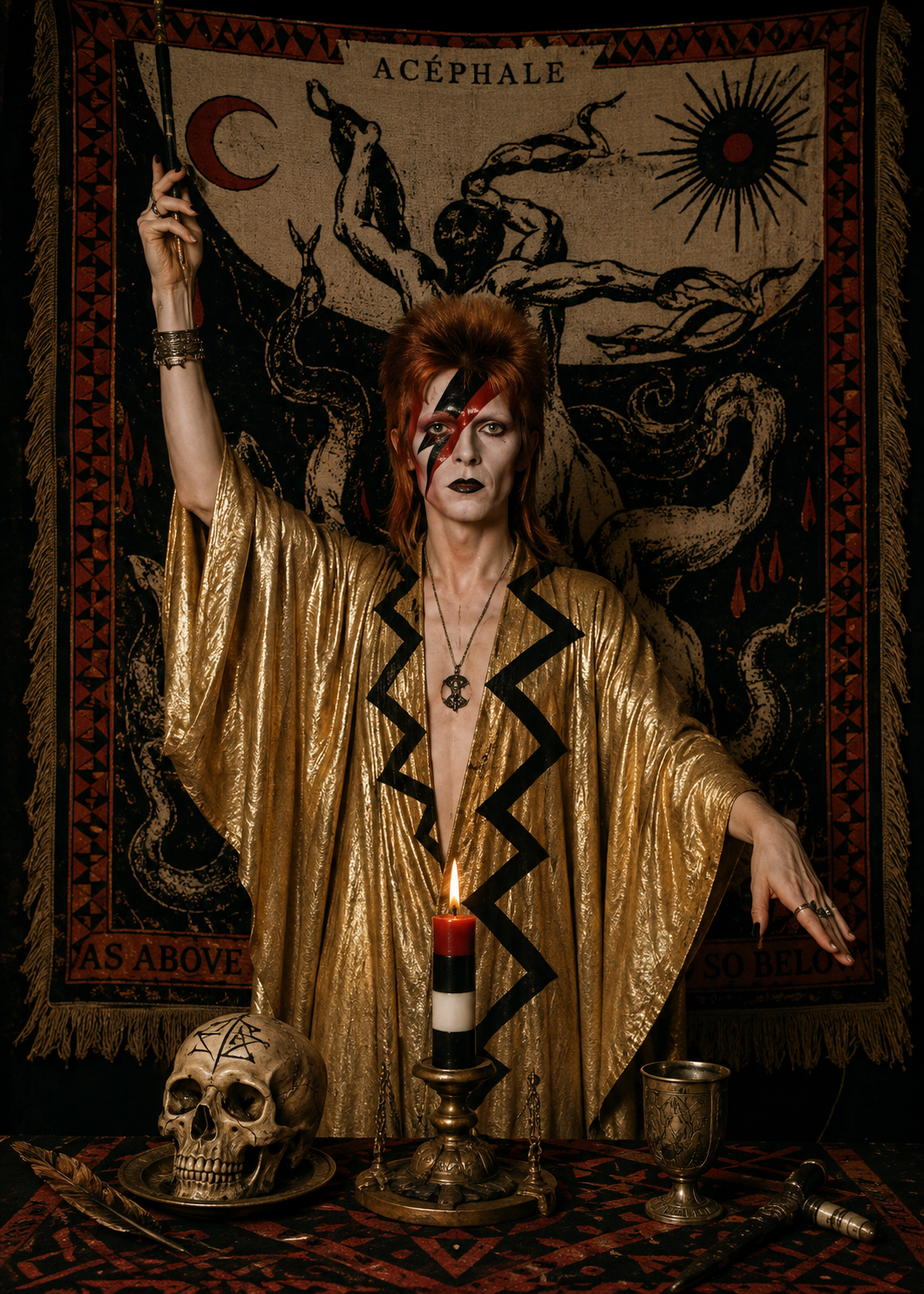
Tonight’s conversation reminded me of this earlier post about the sacred zigzag. If you haven’t read it, or only partially remember, or like pics of Bowie from his Stardust days, go and read. It’s okay, I’ll wait here pondering the aphorism “as above, so below.”
Ah, good. Welcome back! As I was saying…
What strikes me now is how much theological work that little Olbian zigzag can do precisely because it refuses to settle into a single meaning.
The post summarizes several proposed readings: snake, lightning bolt, key, letters forming Iakchos, with the surrounding plaques themselves structured around oppositions such as Eirēnē / Polemos and Alētheia / Pseudos. One interpretation even connects the seven compartments on another plaque with the dismembered Dionysos.
And suddenly the ambiguity seems almost intentional.
Snake: life that survives by transformation. It sheds itself and remains itself.
Lightning: destruction which is simultaneously generation—the thunderbolt destroys Semelē, yet Dionysos emerges from that catastrophe. The thing that kills births the God.
Key: passage between conditions that ordinarily exclude one another—life/death, above/below, mortal/divine. The initiate possesses, or is shown, the means of crossing the boundary.
Iakchos: the God himself encoded into the sign.
Interesting. Doesn’t that perfectly encapsulate everything we’ve been discussing? Or to put it another way: Dionysos is not located at one pole of the opposition. He is the movement through the opposition.
And that’s what makes the Olbian material so extraordinary. The inscriptions don’t merely give you doctrines. They give you paired impossibilities:
Bios — Thanatos — Bios.
And elsewhere:
Peace — War.
Truth — Falsehood.
The sacred thing appears in the oscillation.
The coalition Dionysos forms against the unmaker doesn’t abolish opposition. Good and evil don’t suddenly reconcile because they’ve discovered that one side was secretly correct all along, but because they are facing an existential threat. But they still remain polarities. Peace remains different from war; life from death; Gods from mortals. But all of those oppositions presuppose something more fundamental: existence. You can fight over the world only while there is a world.
And that makes the zigzag a surprisingly good symbol for the Starry Bull kosmos. A straight line has one direction. A circle eternally returns. But a zigzag advances by opposition: this way / that way / this way / that way / etc. Yet it moves ineluctably.forward— like Dionysos, like his Starry Bull.
Just as there is zigzag movement, there’s also the “whirl” as philosophy calls it. We Starry Bull folk just say, “Circles, etc…” The circle is recurrence—Bios, Thanatos, Bios. The zigzag is the path recurrence takes through history and myth: contradiction, reversal, catastrophe, recovery, transformation. The repeatedly dismembered God whose answer to annihilation is not submission, is not invulnerability— but another beginning.
Thanatos. Bios.
Again.
And again.
And again.


