Bid your blessed dead a fond farewell, remembering that we hold them always in our hearts! Appease those who drowned in the great flood! Make the porridge of all grains, all seeds and honey for Chthonic Hermes and the souls he guides! Smear pitch on your door and chew buckthorn! And don’t forget to say the words, “Thuraze Kêres, ouket’ Anthestêria!”
Some say by water, others by fire
I almost forgot: as an addendum to this post – there is a variant tradition that instead of Parnassos Deukalion and his wife sought refuge on Mount Aetna in Sicily:
When the cataclysm which we call the flood or deluge occurred, all the human race perished except Deucalion and Pyrrha, who fled to Mount Etna, which is said to be the highest mountain in Sicily. When they could not live on account of loneliness, they begged Jove either to give men, or to afflict them with a similar disaster. Then Jove bade them cast stones behind them; those Deucalion threw he ordered to become men, and those Pyrrha threw, to be women. Because of this they are called laos, ‘people,’ for stone in Greek is called las. (Hyginus, Fabulae 153)
There’s always an epilogue in Italy, at least when Dionysos is involved. It’s even been said that the place is dearer to him than his own Nysa:
This is Vesuvius, green yesterday with viny shades; here had the noble grape loaded the dripping vats; these ridges Bacchus loved more than the hills of Nysa; on this mount of late the Satyrs set afoot their dances; this was the haunt of Venus, more pleasant to her than Lacedaemon; this spot was made glorious by the fame of Hercules. All lies drowned in fire and melancholy ash; even the High Gods could have wished this had not been permitted them. (Martial, Epigrams IV.44)
You know what else Dionysos loves?
His brother.
With the posts here, here and here I don’t want to imply that Dionysos stole Hebe the immortal wife of Herakles away from him. He just borrowed her.
Not only are the two sons of Zeus really close friends who share a great deal – including the fabled lion-skin – but there’s a whole lot more to the story than you’re likely to find in Bullfinch or D’Aulaires.
For instance, did you know that in Etruscan myth it is Herakles (or rather Hercle) not Theseus who braves the Labyrinth to win the hand of Ariadne (otherwise known as Esia) facing down the terrible Minotaur (whom they call Θevrumineś) to do so? (Their version of the story of Ikarios is also radically different from that of the Athenians.)
So basically what that means is that Dionysos had history with Hebe before she was given in marriage by Zeus to Herakles (contrary to the wishes of Hera) just like Ariadne had history with Herakles before she was claimed on Naxos by Dionysos, and none were willing to let societal norms or even the machinations of other Gods get in the way of that, let alone ruin their friendship.
And that is a lovely note to end things on. (Especially since the rest of the story is deeply unsettling and not something I share in public.)
Two ships passing in the night
Anthesteria has so many densely interwoven layers that different things stand out for me each year. One of them this time around was the Black Ship of Dionysos, which is mounted on a wagon and paraded through the city on Pithoigia to open the festival:
For in the month Anthesterion a trireme raised into the air is escorted into the agora which the priest of Dionysos steers like a helmsman. (Philostratos, Lives of the Sophists 1.25.1)
In the Black Ship are contained all the blessings Dionysos dispenses to the lands and people that graciously receive him:
Hermippus in a play called Stevedores launches into a mock-Homeric hymn to Dionysus in which the god is praised as a merchant-shipper (PCG F 63): ‘Tell me now you Muses who dwell in Olympus how many good things Dionysus brings here to men in his black ship since the time he began to carry merchandise over the wine-faced sea. From Cyrene, silphium stalk and ox hide. From the Hellespont, mackerel and every sort of salted fish. From Thessaly, barley and sides of beef and the mange for the Spartans from Sitalkes, and from Perdikkas a great many ships-full of lies. The Syracusans provide pigs and cheese …’ After a lacuna the list goes on to include products that originate from cities throughout the Eastern Mediterranean, from Carthage to Phoenicia. Most modern readers fail to see the humour that such lists of food are supposed to generate. There is none really. It is mainly about sustaining the buoyancy of the audience with effervescent reminders of the festival’s blessings. […] Four Attic vases, produced at the end of the sixth century show Dionysus and satyrs riding wagons, fitted out like ships. Later antiquity’s larger and more international festival economies seem to have required the magnificence of actual wheeled ships. By contrast the images on the Attic skyphoi are very much ‘wagons’ in the shape of ships—and unlikely to be called anything other than ‘wagons’ in ancient texts. Even the Panathenaic ship was referred to as a ‘wagon’ (in Latin currus) as late as the first century AD. In the case of the Tarquinian amphora, the vehicle is mythicised as an actual ship, but incorporates features of the ritual wagon including the piper and the mysterious wicker-like object at the keel. […] Some object that Dionysus Eleuthereus did not come to Athens by ship but overland. We have to respond that the ship is a symbol, not historical reconstruction. In part it suits the Athenian Dionysus because, as we saw, he brings for his festival food and wealth from overseas. But there is something deeper. The utopic vision inspired by the Athenian carnival is one of things spontaneously appearing and spontaneously moving under the influence of Dionysus. In the first messenger speech of Euripides’ Bacchae the presence of Dionysus is revealed by the sudden appearance of springs of water, wine, milk and honey (705-11), and by the effortless coordination, energy and equilibrium of the bacchants’ movements (esp. 693, 755-8). The spontaneous springs of water, wine, milk and honey recall the αὐτόματος βίος of the Cronian Golden Age when the earth freely produced an abundance of food and drink for all men at no cost or effort. This was of course also an ideal embodied by the Dionysian festival where food and wine really were abundant and free. But effortless coordination and equilibrium are also an expression of the processional god. Dionysus sets people and things in motion, particularly in a graceful and rhythmic motion: the power of music to animate the body (even at times against one’s will) is perhaps the supreme expression of this particular aspect of the god. (Eric Csapo, The Dionysian Parade and the Poetics of Plenitude)
However, on Chytroi which closed the festival, a different ship was on people’s minds, the one that Deukalion and his wife used to escape the great deluge:
Zeus by pouring heavy rain from heaven flooded the greater part of Greece, so that all men were destroyed, except a few who fled to the high mountains in the neighborhood. It was then that the mountains in Thessalia parted, and that all the world outside the Isthmos and Peloponnese was overwhelmed. But Deukalion, floating in the chest over the sea for nine days and as many nights, drifted to Parnassos, and there, when the rain ceased, he landed and sacrificed to Zeus Phyxios (God of Escape). And Zeus sent Hermes to him and allowed him to choose what he would, and he chose to get men. And at the bidding of Zeus he took up stones and threw them over his head, and the stones which Deukalion threw became men, and the stones which Pyrrha threw became women. Hence people were called metaphorically people (laos) from laas, ‘a stone.’ (Apollodoros, Bibliotheca 1.7.2)
Note the role that Hermes plays in this myth, which is why he was honored alongside those who drowned in the flood:
Those who had survived the great deluge of Deukalion boiled pots of every kind of seed, and from this the festival gets its name. It is their custom to sacrifice to Hermes Khthonios. No one tastes the pot. The survivors did this in propitiation to Hermes on behalf of those who had died. (Theopompos, in the Scholia to Aristophanes’ Acharnians 1076)
However, those familiar with Delphic lore and the origin of the Thyiades would have extra reason to honor Deukalion and Hermes:
They say that the oldest city was founded here by Parnassos, a son of Kleodora, a Nymph. Like the other heroes, as they are called, he had two fathers; one they say was the God Poseidon, the human father being Kleopompos. After this Parnassos were named, they say, both the mountain and also the Parnassian glen. Augury from flying birds was, it is said, a discovery of Parnassos. Now this city, so the story goes on, was flooded by the rains that fell in the time of Deukalion. Such of the inhabitants as were able to escape the storm were led by the howls of wolves to safety on the top of Parnassos, being led on their way by these beasts, and on this account they called the city that they founded Lykoreia (Mountainwolf-city).
Another and different legend is current that Apollon had a son Lykoros by a Nymph, Korykia, and that after Lykoros was named the city Lykoreia, and after the Nymph the Korykian cave. It is also said that Kelaino was daughter to Hyamos, son of Lykoros, and that Delphos, from whom comes the present name of the city, was a son of Kelaino, daughter of Hyamos, by Apollon. Others maintain that Kastalios, an aboriginal, had a daughter Thyia, who was the first to be priestess of Dionysos and celebrate orgies in honor of the God. It is said that later on men called after her Thyiades all women who rave in honor of Dionysos. At any rate they hold that Delphos was a son of Apollon and Thyia. Others say that his mother was Melaina, daughter of Kephisos. (Pausanias, 10.6.1-4)
Cool, right? And something I’ve explored elsewhere in my writings on the Thyiades. But it doesn’t stop there.
Do you know why Zeus sought to destroy mankind with the storm of all storms? It was the Wolf King’s fault:
Lykaon, reigning over the Arcadians, begat by many wives fifty sons … and these exceeded all men in pride and impiety. Zeus, desirous of putting their impiety to the proof, came to them in the likeness of a day-laborer. They offered him hospitality and having slaughtered a male child of the natives, they mixed his bowels with the sacrifices, and set them before him, at the instigation of the elder brother Maenalus. But Zeus in disgust upset the table at the place which is still called Trapezus, and blasted Lykaon and his sons by thunderbolts, all but Nyktimos, the youngest; for Earth was quick enough to lay hold of the right hand of Zeus and so appease his wrath. But when Nyktimos succeeded to the kingdom, there occurred the flood in the age of Deukalion; some said that it was occasioned by the impiety of Lykaon’s sons. (Apollodoros 3.8.1-2)
Happen to know the name of that male child of the natives they butchered and tried to serve to Zeus?
Of course you do. The child he killed was Arkas, the Starry Bear:
He is said to be the son of Jove and Callisto, whom Lycaon served at a banquet, cut up with other meat, when Jupiter came to him as a guest. For Lycaon wanted to know whether the one who had asked for his hospitality was a God or not. For this deed he was punished by no slight punishment, for Jupiter, quickly overturning the table, burned the house with a thunderbolt, and turned Lycaon himself into a wolf. But the scattered limbs of the boy he put together, and gave Arcas to a certain Aetolian to care for. (Hyginus, Astronomica 2.4)
And Deukalion, too, was placed among the stars:
The constellation Aquarius or Water Bearer. Many have said he is Ganymede. Hegesianax, however, says he is Deucalion, because during his reign such quantities of water poured from the sky that the great flood resulted. (ibid 2.29)
Ganymede, as in the male double of Hebe.
Also, did you know that some folks claim that the Wagon constellation (which is also a bear) is the same one which bears the Black Ship of Dionysos as it makes the procession through cities and the countryside.
Which brings it all full circle, like a wheel.
Breaking the law for the Gods
Despite the influx of hipsters from Brooklyn and Westchester our little town is decidedly lacking in swings. There are some in a couple schools (though not as many as you might imagine) and a gated kiddy park, and that’s about it – which is very different from other places I’ve lived, unfortunately.
The housemate and I snuck into the kiddy park (while Galina and the cat remained behind to hold down the fort) so we could hang the paper dolls the three of us drew, colored and cut out earlier in the evening for Erigone and the Athenian maidens. Then we swung for a while until we saw a car pull up next to ours and the cops started searching it with a flashlight. As we approached, I loudly greeted the police and waved at them in a friendly manner to show I wasn’t carrying. They cheerfully reminded us the park was closed after dark and sent us on our way.
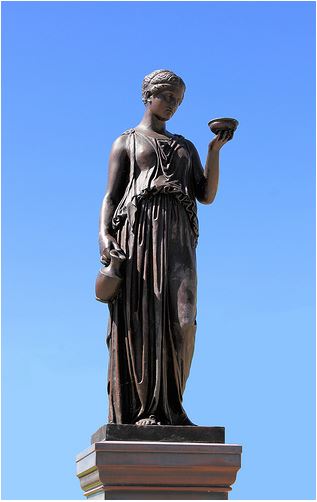
Heading home we paused by the statue of Hebe in the center of town to pay our respects, thereby bringing our Choës observance to a close. Almost as soon as we arrived there was a sudden torrential downpour reminding me of Deukalion’s flood, which seems like an auspicious start to Chytroi. This, by the by, is part of why I made the Hebe posts earlier, as she is the closest thing we have to a polis-Goddess. If you’d like to learn more about our Hebe (not depicted below) click here.

they should appease Erigone if they wanted to be free from the affliction

Hyginus, Astronomica 2.2
In the meantime in the district of the Athenians many girls without cause committed suicide by hanging, because Erigone, in dying, had prayed that Athenian girls should meet the same kind of death she was to suffer if the Athenians did not investigate the death of Icarius and avenge it. And so when these things happened as described, Apollo gave oracular response to them when they consulted him, saying that they should appease Erigone if they wanted to be free from the affliction. So since she hanged herself, they instituted a practice of swinging themselves on ropes with bars of wood attached, so that the one hanging could be moved by the wind. They instituted this as a solemn ceremony, and they perform it both privately and publicly, and call it alétis, aptly terming her mendicant who, unknown and lonely, sought for her father with the God. The Greeks call such people Alétides.
even now
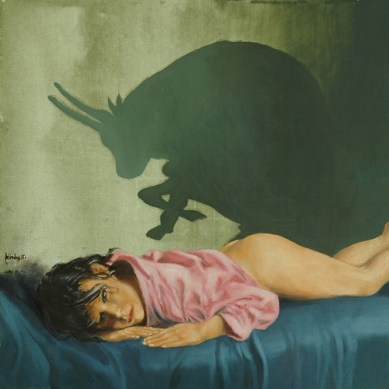
Aristotle, Constitution of the Athenians 3.5
Not all the magistrates lived together. The King kept what is now called the Boukoleion near the Prytaneion. The evidence is that even now the mating and marriage of the wife of the King with Dionysos takes place there.
Ganymeda
 Pausanias, Description of Greece 2.13.3
On the Phliasian citadel is a grove of cypress trees and a sanctuary which from ancient times has been held to be peculiarly holy. The earliest Phliasians named the goddess to whom the sanctuary belongs Ganymeda; but later authorities call her Hebe, whom Homer mentions in the duel between Menelaos and Alexandros, saying that she was the cup-bearer of the gods; and again he says, in the descent of Odysseus to Haides, that she was the wife of Herakles. Olen, in his hymn to Hera, says that Hera was reared by the Horai, and that her children were Ares and Hebe. Of the honours that the Phliasians pay to this goddess the greatest is the pardoning of suppliants. All those who seek sanctuary here receive full forgiveness, and prisoners, when set free, dedicate their fetters on the trees in the grove. The Phliasians also celebrate a yearly festival which they call Kissotomoi (Ivy-cutters). There is no image, either kept in secret of openly displayed, and the reason for this is set forth in a sacred legend of theirs though on the left as you go out is a temple of Hera with an image of Parian marble.
οἰνοχόη

Nonnos, Dionysiaka 35.333
After Dionysos was reconciled with Hera in heaven, she wished to give him Hebe’s hand in marriage, had not Zeus our Lord on High ordained that in days to come twelvelabour Herakles was fated to be her husband.
Dionysos dressed as Herakles dressed as Dionysos
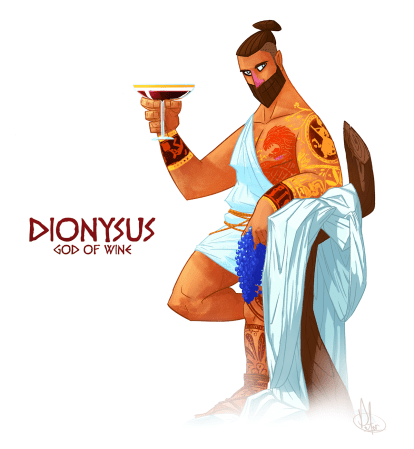
Jacquelyn Collins Clinton, A Late Antique Shrine of Liber Pater at Cosa pages 25-27
All of the above marble sculptures were reused in the late antique shrine. The statuettes probably served originally as private statuary of a decorative nature placed in house or garden, from the ruins of which the worshippers of Bacchus removed them to their shrine. […] These works do not fit into the Bacchic religious context as readily as the reused marble sculptures representing Dionysus directly, since they all were probably found purely by chance. One can only speculate on the reasons for reusing them at all. […] The small bust of Hercules is represented with grape leaves stick into the fillet around his head. He has thus a Bacchic aspect which must have had an immediate and relevant appeal. […] The Lysippean type after which the Cosa head is patterned is related to that of the Herakles Epitrapezios where Herakles is shown seated and holding out a cup of wine in an attitude of heroic repose after having attained immortality. This image of Herakles’ repose goes back to the sixth century B.C. in Greek vase painting where he is shown resting under a tree; by the end of the century, the repose came to be expressed in terms of a banquet, often celebrated with Dionysus. […] The Roman Hercules, of course, loved his wine and he is shown in works of art also engaged in a drinking contest with Dionysus. The theme of the drunken Hercules, furthermore, accounts for his inclusion in the Bacchic thiasos from Hellenistic times on. It becomes very popular in Roman times where Hercules bipax appears in representations of the Bacchic thiasos on sarcophagi. The imagery in these representations is, of course, funerary, illustrating the Bacchic concept of the afterlife as a continuing joyful revel or banquet. […] Moreover, the close connection between Hercules and Bacchus goes beyond these mythological ties, for the two were worshipped together in a common cult at least as early as the sixth century B.C. throughout Macedonia and Thrace, including the island of Thasos, and their names or images are linked in several monuments found in this region during Roman times. They are linked in various other monuments from other parts of the Roman world as well, and they were patron gods of Leptis Magna, the birthplace of Septimius Severus, who erected a temple for them in Rome and had their images included on his coinage. […] Thus, the connections between Hercules and Bacchus are so many and varied, with a long history continuing through late Roman times, that to discover an image of Hercules in a Bacchic shrine is not surprising.
Καλα Χοές!
Give the children their first taste of wine! Feast with the mad and polluted King! Swing for the Hanged Maidens! Revel throughout your city as the wife of the Sacred King mates with Dionysos in the Ox-shed! The second day is upon us and what we do will make the flowers extra pretty when Spring is in its fullness and ensure that there’s good wine to drink for next year’s Anthesteria.
Speaking of fire
One of the most important documents we have within Bacchic Orphism are a series of bone tablets inscribed with enigmatic phrases and symbols.
SEG 28.659:
Life. Death. Life. Truth. Zagreus. Dionysos. Orphikoi.
SEG 28.660:
Peace. War. Truth. Lie. Dionysos
SEG 28.661:
Dionysos. Truth. Body. Soul.
These were likely produced by an Olbian Orpheotelest and mantis who worked out of the temple of Hermes and Aphrodite by the name of Pharnabazos, known primarily because of a magical duel he had with Aristotles, a rival diviner of Hermes (and formerly of Athene) whose territory was probably near the temple of Demeter. Uniquely the defixiones both men employed against their opponent have come to light.
Well, there’s another text that was made by thiasitai Boreikoi (or members of the Society of Apollo Boreas) which I mentioned here. Rather than being written on bone it’s a circular inscription engraved on the outer and inner edges of a black lacquer vase stand.
Scholars have proposed two different readings of the text, SEG 58:772:
Bios Bios, Apollon Apollon, Helios Helios, Kosmos Kosmos, Phos Phos.
Or
Apollon Helios, Helios Kosmos, Kosmos Phos, Phos Bios, Bios Apollon.
For those not familiar the terms mean:
Apollon = “God of wolves, prophecy, fire, disease and healing”
Bios = “Life”
Helios = “Sun”
Kosmos = “Universe” or “Order”
Phos = “Light”
Both readings have deep significance. The first seems to be describing a progressive sequence of concepts or experiences, while in the second they weave in and out of each other as in a dance. I like the second better for reflection, and the first for chanting. I’m undecided whether the Greek or English is more effective.
So far I’ve just been using it as a cleansing mantra, but I suspect it may end up becoming as potent a tool as the Oration of Aristides – if I can unlock its true meaning, that is.
Oh, and one of the symbols found on a couple of the bone tablets is a Z-like shape. Various suggestions for what the symbol signifies have been put forth: snake, lightning bolt, a representation of the flow of energy or a meandering journey through the Labyrinth. I tend to accept all of these and also associate it with a pruning-knife or wolfsangel.
Fortune Cookie Wisdom #6
Catch on fire with enthusiasm and people will come for miles to watch you burn.
your cry, louder than roar of earthquake, shall rouse up living and dead together
Ángelos Sikelianós, Greek Supper for the Dead
I spoke,
and whether or not they had well understood
all I had sought, they sipped of the wine,
and I, the last of all,
drank to the last drop also, like the priest
who drains the holy chalice in the Inner Sanctum;
and then together as one we softly turned our steps
– the candles one by one had guttered out –
toward the wide-open windows, beyond which lay
the black enstarred vast ocean of night
that on its pulse upheld us in our silence.
And if no one within that darkness spoke,
from deep within us the same thought and vow
rose upward toward the vast gloom and the stars:
“Hearken, divine protector, O Dionysos-Hades,
restrain our hearts now with the brusque black wine
of your deep pain, guard them and strengthen them
and keep them still untouched until that hour
when suddenly your cry, louder than roar
of earthquake, shall rouse up living and dead
together with us at once to the divine onslaught!”

as Bacchanals dance in their worship
Tacitus, Annals 11.31.2
Messalina meanwhile, more wildly profligate than ever, was celebrating in mid-autumn a representation of the vintage in her new home. The presses were being trodden; the vats were overflowing; women girt with skins were dancing, as Bacchanals dance in their worship or their frenzy. Messalina with flowing hair shook the thyrsus, and Silius at her side, crowned with ivy and wearing the buskin, moved his head to some lascivious chorus.
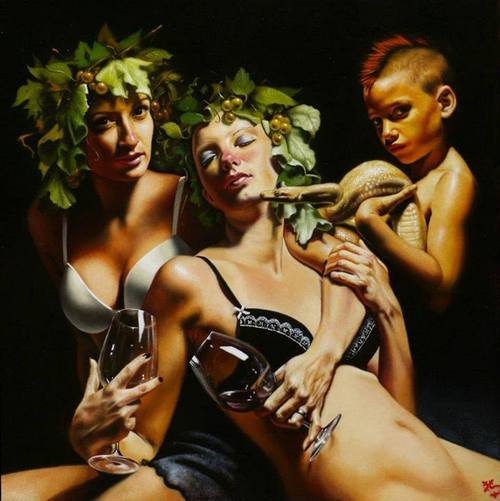
let loose from death and darkness to keep holiday
Alexis, fragment 222 from The Tarentines
Whether anybody will say that my judgement is good or bad I cannot tell you; but this, at least, I have made up my mind about on careful study: that all the doings of men are out-and-out crazy, and that we who for the time being are alive are only getting an outing, as though let loose from death and darkness to keep holiday, to amuse ourselves and to enjoy this light which we can see. And the man who laughs and drinks the most, and holds fast to Aphrodite, during the time he is set free, and to such gifts as Fortune offers, after he has had a most pleasant holiday can depart for home a well-satisfied man.
Anthesteria 2020 Soundtrack
I know I’ve got a list of songs already in the Anthesteria material at the Bakcheion, but moved by the energies of the day I put together this special soundtrack for Anthesteria 2020 that I hope will help get you in the mood. Enjoy!
Καλα Πιθοιγια!
Open the Jars! Crown your head with flowers, and feast your dead! Anthesteria has begun, so let us welcome back the God of Life, Abundance, and Ecstasy! Io! Io evohe! Io io Dionysos!
Thoughts on the Olbian calendar
Assuming that we’re given the months in their proper order the Olbian calendar breaks down as follows:
Taureon: April/May
Thargelion: May/June
Kalamaion: June/July
Panemos: July/August
Metageitnion: August/September
Boedromion: September/October
Kuanepsion: October/November
Apatourion: November/December
Poseideon: December/January
Leneon: January/February
Anthesterion: February/March
Artemision: March/April
Andokides does not provide a name for the intercalary month; if I were going to use this instead of the Bakcheion calendar I’d call it “Lykeion.”
My reasoning for this:
- Since there is a Bull Month (Taureon) it’s only fitting to have a Wolf Month.
- Apollon doesn’t have as much representation on the calendar as he probably should, considering his prominence in the Olbian pantheon. He appears on the city’s coinage, he’s mentioned in city treaties, the majority of the temples that have been uncovered thus far belong to him, he had several distinct forms i.e. Apollo Delphinios (of Delphi), Apollo Ietros (Healer), Apollo Neomenios (he who Opens the Month), Apollo Boreas (of the North Wind) etc, and there were several private religious associations dedicated to him – including one with possible Orphic ties.
- It just feels right.
Most of the names are familiar from other Greek calendars, but Kalamaion and Kúanepsion were new to me; I’m uncertain of their meaning.
There is a Púanepsion in the Attic calendar, from the Púanopsia (Bean-stewing) festival Theseus instituted in fulfillment of a vow he swore to Apollon should he prove victorious against the Minotaur. It is the seventh month.
However, I checked the Greek and it is clearly a Kappa heading that word. Assuming that the person chiseling the inscription didn’t just fuck things up Kúanepsion could come from kúanos (κῠᾰνος) “dark blue” which, ironically enough, Robert Beekes’ Etymological Dictionary of Greek says probably derives from Hittite kuwannan (precious stone, copper, blue), likely from Proto-Indo-European *ḱwey- (to shine, white, light; compare *ḱweytós, white.) Ironic because there’s that whole debate about whether the ancients could even see blue.
This begs the question of why they’d name one of their months Dark Blue – unless it’s from Kyanê (Κυανη), one of the Sicilian Nymphs who were part of Kore’s maiden companions that were out collecting flowers with her when the abduction occured:
A great fountain was made sacred to Persephone in the territory of Syrakousa and given the name Kyane or ‘Azure Font.’ For the myth relates that it was near Syrakousa that Plouton effected the rape of Kore and took her away in his chariot, and that after cleaving the earth asunder he himself descended into Haides, taking along with him the bride whom he had seized, and that he caused the fountain named Kyane to gush forth, near which the Syrakousans each year hold a notable festive gathering; and private individuals offer the lesser victims, but when the ceremony is on behalf of the community, bulls are plunged in the pool, this manner of sacrifice having been commanded by Herakles on the occasion when he made the circuit of all Sicily, while driving off the cattle of Geryones. (Diodoros Sikeliotes, Library of History 5.2.3)
While Herakles as the progenitor of the Skythians was certainly popular in the region and there was a temple to the Eleusinian deities at Olbia, the Azure Font is a local Syracusan addition to Persephone’s story. Olbia had extensive trade relations with a number of cities in Magna Graecia so it’s entirely possible that they were aware of the myth, but why enshrine it in their calendar?
I’m not sure what else it could be though.
As for Kalamaion only a couple things occur to me.
Perhaps it honors the Epiriote River God Kalamas who flows into the Ionian Sea – but what significance would that have to a Milesian colony all the way over in the Ukraine?
Now the Kala- part could come from kalós (καλός) meaning:
- beautiful, lovely
- good, quality, useful
- right, moral, virtuous, noble
I don’t know all the rules of declension and word formation so I’m not sure if that’s sufficient to explain the name, but the second half reminds me of Μαῖα the mother of Hermes as well as μαία meaning nurse or midwife.
Comparing the Olbian calendar to others in the Greek world it probably comes the closest to the Attic, despite beginning shortly after the Spring Equinox whereas in Athens this happened post Summer Solstice.
Taureon = Mounichion*
Thargelion = Thargelion
Kalamaion = Skiraphorion
Panemos = Hekatombaion
Metageitnion = Metageitnion
Boedromion = Boidromion
Kuanepsion = Puanepsion
Apatourion = Maimakterion
Poseideon = Poseideon
Leneon = Gamelion*
Anthesterion = Anthesterion
Artemision = Elaphebolion*
I’ve bolded matching months and put asterisks on ones with possible equivalences.
Mounichion, for instance, is the month in which the Mounichia took place. The festival takes its name from an epiklesis of Artemis associated with a temple in the Piraeus, Athens’ famous harbour district. The festival both celebrated the birthday of the Goddess and commemorated the Battle of Salamis, during which she favorably intervened on behalf of the Athenians. There was a procession in which young girls who played the part of Bears and served the Goddess at her sanctuary in Brauron took part. Cakes encircled with candles and other sacrifices were given on this occasion.
While Taureon most likely means the Month of the Bull (as it does in other calendars) and honors Dionysos whose bull form was especially prominent in Asia Minor (and the Pontic region in particular) it could also refer to the Taurike, a region along the southern coast of the Crimean peninsula whose capital Tauris was home to a particularly savage form of Artemis (or her Skythian equivalent) which engaged in human sacrifice. Iphigéneia became her high priestess, after nearly being sacrificed herself at Aulis. Orestes rescues his sister, and is directed to steal the xoanon or primitive wooden idol of Artemis and take it to the town of Halae, where he is to build a temple for Artemis Tauropolos (Bull-slayer.) The xoanon either ends up in Sparta where it is worshiped with rites of bloody flagellation as Artemis Orthia or Italy where the Rex Nemorensis or King of the Grove served her until his successor came along and murdered him. Iphigéneia ended her days at the Brauron sanctuary where she taught the maidens the mysteries of the Bear Dance.
Although in Attica the seventh month is Gamelion, after the hieros gamos (sacred marriage) of Zeus and Hera, in other parts of Greece the period of January/February (particularly in Asia Minor) is called some variation of Lenaeon from the Lenaia festival.
Although not called Artemision as in Olbia, the Attic Elaphebolion honors Artemis the Deer Slayer at whose festival the Elaphebolia cakes in the shape of deer were offered. This either celebrated her hunting prowess, the transformation of Iphigéneia into a deer to save her from Agamemnon’s blade or the defeat of the Thessalians by Athens and Phokis thanks to another miraculous intervention by Artemis.
Panemos and its dialectical variations are found on the calendars of Aetolia, Argolis, Boiotia, Epidauris, Laconia, Rhodes. Sicily, Thessaly and the Makedonian-derived systems, among others.
Apatourion has two possible origins. Either from the Apatouria festival, which the Wiley Online Library describes as follows:
The Apatouria, an important festival celebrated by Ionians, including Athenians, was for Herodotus one of two criteria of Ionian identity (Hdt. 1.147). In Athens the Apatouria was the central element in the ritual calendar of the phratries, the kinship organizations crucial for determining Athenian citizenship. The three‐day festival occurred in the autumn in the month Pyanepsion and was celebrated at the separate phratry shrines throughout Attica. There was a feast on the first day, and a sacrifice to Zeus Phratrios and Athena Phratria on the second. On the third day, fathers would introduce their sons for admission to the phratry (and, in effect, to Athenian citizenship). In the normal course of events this occurred during a child’s first few years. Our sources suggest that there were various athletic and intellectual literary competitions over the three days in which the children of the phrateres could demonstrate their merit. Ancient scholarship links the Apatouria to the myth of the ritual combat between the Athenian Melanthos (the “dark one”) and the Boiotian Xanthos (the “fair one”) for the kingship of Attica, which Melanthos won through a trick (apate) (Hellanikos FGrH 4 F23). Although some modern scholars have therefore seen a connection to the ephebes and to rites of passage involving social inversion, the rituals of the festival have no apparent connection to the narrative of the myth, and most modern scholars now link the Apatouria to “the control, maintenance, and affirmation of kinship and of membership in society at every level” (Lambert 1993: 151).
This trick or apate was played by none other than Dionysos:
The Athenians had a war on against the Boiotians over Kelainai, which was a place in their borderlands. Xanthios, a Boiotian, challenged the Athenian king, Thymoites to a fight. When he did not accept, Melanthos, an expatriate Messenian from the stock of Periklymenos the son of Neleus, stood up to fight for the kingdom. While they were engaged in single combat, someone wearing a black goat-skin cape appeared to Melanthos from behind Xanthios. So Melanthos said that it was not right to come two against one. Xanthios turned round and Melanthos smote and killed him. And from this was generated both the festival Apatouria and ‘of the Black Aigis’ as an epithet of Dionysos. (Suidas s.v. Apatouria)
However, it’s equally possible that the name comes from the epiklesis Mistress of Apatouron borne by Aphrodite Ourania in the Bosporus, for which Strabo gives the following aition:
There is also in Phanagoreia a notable temple of Aphrodite Apaturus. Critics derive the etymology of the epithet of the Goddess by adducing a certain myth, according to which the Giants attacked the Goddess there; but she called upon Herakles for help and hid him in a cave, and then, admitting the Giants one by one, gave them over to Herakles to be murdered through “treachery.” (11.2.10)
For more on this Goddess, check out Yulia Ustinova’s Aphrodite Ourania of the Bosporus: The Great Goddess of a Frontier Pantheon.
 The House of Vines