Welcome to our plentiful feast O august Deo,
grandmother of the vine and wet-nurse of mountain-fostered Bakcheios,
you who love the season of autumn when the golden wheat is threshed
and the leaves on the fair trees burn brightest before they fall
and the last of the produce is brought to market by the industrious farmers,
those holy toilers in the fields who keep your traditions alive with their tireless labor
feeding the city of the well-born ones in this fertile valley
nourished by the pure waters of the Willamette and McKenzie rivers.
O frenzied Chloê, accept this offering we gathered for you
and carried home in the liknon-basket, all the best fruits, grains and vegetables we could find.
May the fragrance of fresh-baked bread be pleasing to you O mistress Demeter,
you who first taught man to cultivate the earth and make food from plants
instead of the flesh of beasts; you who caused us to put aside our savage ways
and embrace just laws and the harmonious existence of civilized city-life.
You with eyes like blue camas flowers and hair green as hops, crowned with poppies,
you who hold barley in your hands to remind us of that wonderful beverage, dear to your heart,
that you first quenched your thirst with when you searched for your beautiful daughter over the whole earth.
Rejoice O bountiful Ceres in our celebration,
as we rejoice in all that you have graciously bestowed upon us
and we will remember you again next year!
Hymn to the Lord of the Faiyum
Hail to you Petesouchos,
chief of the gods of in the district of Arsinoë,
double-plumed lord of abundance,
green king of the fishes who dwells in peace within his lake,
master of the floodwaters that cause life to prosper,
mysterious lord who knows every secret thing
that transpires beneath the surface.
Men travel from distant lands to consult your venerable oracle
and hear the future foretold through your thunderous roar
that shakes the earth and sends the noisy geese to flight.
Though your countenance is terrifying,
and your wrath justly feared,
since you have sword-like teeth for the rending of flesh
and jaws powerful enough to drag the river-horse down to death,
you are named the ally of man,
and when kindly disposed one can find in the whole world
no greater protector than you.
You come to the aid of those in distress
like the mighty egg-born Dioskouroi,
and consume those who would do your favored harm
like ferocious Kronos devouring his own children.
My heart trembles at the thought of your majesty,
and I am overcome with awe for you
many-times great crocodile-god!
Your altar shall never be bare of sacrifices,
nor your praises go unsung,
so long as I continue to draw breath and walk upon the earth.
The Eye of Horus
Whenever offerings are presented to the Egyptian gods it is customary to say “I give to you the Eye of Horus,” which refers to a very ancient myth. Once, long before men inhabited the earth, the gods called Egypt their home. Originally Rē had governed the gods with goodness and wisdom as their king, but as time passed he grew old and feeble and tired of listening to the quarrels and complaints of his divine subjects. So one day Rē left the earth to reside forever in the peaceful solitude of the heavens, but unfortunately Rē had not chosen his successor before he went away. Thus the gods fell to fighting amongst themselves in order to determine who would be king. Eventually only two contenders remained – the strongest, fiercest and most courageous of all the gods, the brothers Horus and Seth, each of whom was the equal of the other in every way imaginable. Because they were so evenly matched it seemed as if their battle would rage on forever and the gods and the land were suffering terribly as a result. Then one day while the two of them were wrestling Seth grabbed the eye of Horus and plucked it out, maiming and making impotent his brother. Before his power completely left him, however, Horus reached out and crushed the testicles of Seth. As the two gods lay there weak and bleeding out their lives Thoth appeared and said, “I am Thoth strong-in-magic, and I can heal your wounds with a single word! But if I do so then your hearts must be purified of anger, with peace between you and flourishing once more in the land.” They had no choice but to agree and it has been that way ever since.
The word that Thoth spoke to restore the gods was hotep which can mean either an offering, a blessing, wholeness or peace – sometimes it can even mean all of these at once. Thus every time that we sacrifice to the gods we are reenacting what Thoth did for Horus and Seth. Hence sacrifices are called “The Eye of Horus” and “The Testicles of Seth” in Egyptian sources. These sacrifices restored the gods, made them whole, healthy, powerful and peaceful hearted.
Consequently they became kindly disposed towards us and cause the earth to be fruitful with blessings. Thus sacrificing to the gods is the single most important thing that a person can do, for when the gods are deprived and angry the whole world suffers.
What sort of things constitute the Eye of Horus? Well, to begin with we find this label – or rather irt-Hr W3dt ”The Green Eye of Horus” – most commonly applied to alcoholic offerings, with various types of beer, wine and other beverages indicated. These libations were made to both the gods and the ancestors – indeed having plenty to drink was one of the signs of an especially blessed afterlife, with numerous spells created for that purpose alone. Though libations were given to all of the gods we find them associated with none as frequently as we do Horus, to the point where his fondness for alcohol led some late authors to speculate on the identity of Horus and Dionysos. And by all accounts Horus’ fondness for drink has persisted into modern times. A variety of contemporary Kemetic websites suggest vodka, whiskey, gin and rum in addition to beer and wine. I’ve had the greatest success with rum which he seems to be especially fond of.
But alcohol is not the only substance we find described as The Green Eye of Horus – as one might guess it encompassed all forms of fruit and vegetables, anything that was green, growing and fertile. In fact offering scenes often depict tables piled high with produce, particularly grapes, dates, figs, onions, lettuce and the like.
Additionally we find many different kinds of grain, loaves of bread and special sacrificial cakes on the offering table as well. The commonest of these cakes – called a shat-cake – was shaped like an isosceles triangle and had to be laid on its side and stacked head to tail. These cakes were so important that we find baking scenes depicted on temple and mortuary walls. There are a number of recipes available for a variety of sacrificial cakes – but in my experience Horus is just as happy with a good crusty loaf of bread, especially if it’s multigrain with lots of seeds on top.
Frequently one also finds beef, fowl and other forms of meat offered to Horus. The notable exception is pig’s flesh which was only given to a select few Egyptian gods and under no circumstances was ever offered to Horus. This is because the pig was generally considered a ritually impure animal and Horus is definitely a stickler for the rules. Secondly, and more importantly, Seth took on the shape of a boar during their battle so offering the animal’s flesh to him is just going to be a reminder of their original animosity.
Incense is frequently described as the Eye of Horus or is said to purify and restore his Eye, so you should definitely consider offering this to him. A good Egyptian temple blend or Kyphi would work, as would strong, masculine or solar scents.
There were lots of other non-food related items presented to Horus in antiquity. These included images of hawks, representations of the Horus Eye, ankhs, winged solar discs, jewelry, gold, silver, votive figurines, etc. Since the sun and moon are his right and left eyes respectively you can offer him representations of these. Also, Horus wore the White Crown of Upper Egypt, so anything in this color makes for an appropriate offering, as does solar colors like gold, yellow, bronze, etc. One color to avoid would be red since this belonged to Seth and had certain dangerous and unpleasant connotations for the ancients. Blue as the color of the heavens or green because of its ritual connotations would also be acceptable. Some totally modern offerings that many Kemetics give to Horus today include: tobacco, metal, fire and spicy foods.
In my experience Horus enjoys very physical activities carried out in his honor – dancing, running, martial arts training, mountain climbing and so forth. Anything that gets the blood bumping and sweat flowing. Best of all, though, he appreciates when we fight for what we believe in, live justly and help those who are less fortunate than us.
Who is Óðr?
He is the wanderer and stranger, a God of madness and poetic frenzy, master of magic and shapeshifting. He is the Bear King and the Black Sun. Periodically he forgets that he is a God and becomes a suffering hero. Once the lands of the North had been his home; Óðr his name was then, an adopted member of the tribe of Vanir, husband of Freyja, blood-brother of Freyr (and of Loki), and champion of Óðinn’s warband. But during an important quest on behalf of Ásgarðr he was struck down by a nameless foe, poisoned, corrupted, and made to serve the force of uncreation. And so he would have remained, had an ancient Witch Goddess not cured and restored him. He returned to find Loki bound beneath the poisonous serpent and his wife missing. Freyja went in search of him and never returned. Óðinn will not set Loki free, so Óðr refuses to resume his position within the warband and goes to bring his wife home. Before he leaves, however, he gives Óðinn valuable information about the coming war. When Óðr breaks Loki’s bonds Óðinn forbids any of the Æsir to stop him or retaliate. As the two Gods seek the lost Freyja they plot how to win the war, collect friends from among the diverse pantheons of the world, and preemptively strike against the allies of their nameless foe. Shortly before the end Óðr and Freyja are reunited.
“a famine of biblical proportions”
Because of the global quarantine COVID-19’s death toll sits around 183,424.
Also because of the quarantine we have created massive food shortages and related conditions that the UN predicts could result in close to a billion deaths.
When a cowardly leftist posts to Twitter that the patriots marching in the streets demanding an end to the quarantine care more about the economy than safety – this is why.
But hey, on the plus side since everyone’s been staying home the environment has significantly recovered. Just think how much better it’ll do with nearly a 1/8th reduction in the population. There you go Greta – now you can stop your crocodile tears. Assuming you make it through.
Speaking of fiery destruction …
Dung-beetle of Etna: The big kind. Because the mountain is also big. Aristaios, the story goes, was the only Giant to survive on the Sicilian mountain called Etna; the fire of heaven did not reach him, nor did Etna crush him. (Suidas s.v. Aitnaios kantharos)
The dance of fiery destrucrion
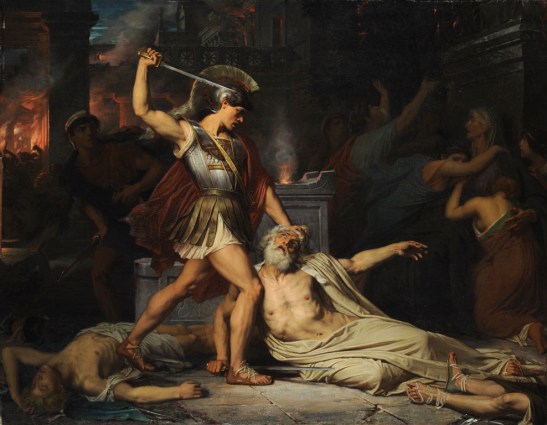
Gregory Nagy has some interesting points to add about Pyrrhos the Wolf of Wilusa, whom Snorri presents as the personification of Surtr’s flame:
The description ‘fiery’ matches the hero’s name Púrrhos, deriving from the adjective purrhós, meaning ‘fiery red’, which in turn derives from the noun pûr ‘fire’. The description matches also the association of this hero with a kind of war dance known as the purrhíkhē—a word that likewise derives from the adjective purrhós. Here is a basic definition of the purrhíkhē as we find it in the ancient lexicographical tradition attributed to Hesychius (under the entry πυρριχίζειν): τήν ἐνόπλιον ὄρχησιν καὶ σύντονον πυρρίχην ἔλεγον ‘the word for energetic dancing in armor was purrhíkhē’. In the work that I am epitomizing, I offered detailed evidence to show that this kind of war dance was a ritual dramatization of biē ‘force, violence’ in warfare. I hold back on repeating the details here, except to add that the noun purrhíkhē is appropriate to the name Púrrhos, not only to the adjective purrhós, since there are myths that derive the name of the war dance from the name of the hero. According to the poetry of Archilochus (F 304W), for example, the word purrhíkhē refers to a war dance because Púrrhos danced such a war dance for joy after he killed the hero Eurypylos in the Trojan War. According to another tradition, mentioned by Lucian (On dance 9) and by other sources, Púrrhos not only “invented” the purrhíkhē: he also captured Troy through the ignition of this war dance, since he started the fire that burned down the city when he leapt out of the Wooden Horse, already dancing his dance and thus igniting the fire.
Neat shit
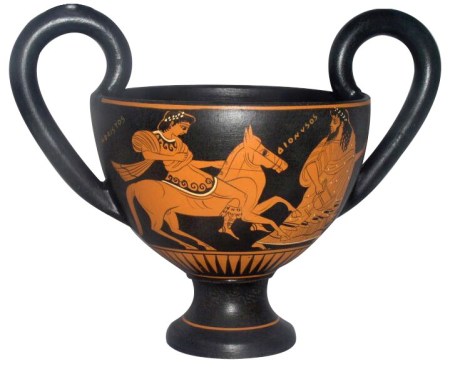
The Greek word kantharos meant dung-beetle as well as referring to Dionysos’ distinctive drinking-cup. In Egypt the God Khepri was worshiped in the form of a dung-beetle who daily pushed the morning Sun up the Mound of Creation. You can read more about him at Edward Butler’s Goddesses and Gods of the Ancient Egyptians: A Theological Encyclopedia.
On the kantharos
The kantharos was a special drinking cup said to be invented by the God himself. Unlike the skyphos, which was round, with small handles, the kantharos had a high base and projecting handles that stretched from the rim to the foot of the cup. Dionysos’ own kantharos was always full, and could never be drained – even by the great and lusty Herakles himself. The wine that it produced was unrivaled in all the world. One drop from it would make a man drunk – though without any of the negative effects of consuming large quantities of alcohol.
Some things you can do when it gets intense
In light of the previous post I thought I’d share this piece I include as part of my spiritual basics curriculum.

Establish your personal limits. One of the things that Dionysos is really big on is consent and respecting boundaries. But he takes you at your word, meaning the God and his Spirits are going to push and push and push until you say stop – and then they will. No explanation required, no judgment, just respect for you recognizing and asserting your personal limits. But it won’t let up one second before you do that and he’ll also let you take it far past what’s safe or healthy, if only to teach you the necessity of knowing yourself. I’ve seen folks get hurt real bad as a result of that, and I don’t want to see it happen to any of you. This is about self-discovery not dick measuring. The only one you’re in competition with is yourself. (Besides, I have the biggest dick of all!) Meaning that if things start getting really, really bad stop the course work and seek whatever kind of treatment you need. You might be cracking under the pressure or this may have exacerbated (or even revealed a previously undiagnosed) mental condition. I’m here and you’re wherever you are, so I can’t give you the proper care or supervision that should normally accompany work of this nature. That means you’ve got to look after yourself, okay? Don’t make any rash decisions, especially if you’re having suicidal ideation, and if you’re confused or considering something that’s really out of character for you, talk to somebody whose opinion you trust and see what their take on the situation is. They may be right, they may be wrong – but at least you’ll have another outside perspective to consider. And remember, if you’re ever in doubt about whether something is coming from the Gods and Spirits or your own craziness, there’s always divination. If you’re under major stress or don’t feel you can trust your signal clarity consult a competent diviner rather than doing the reading yourself – especially one who is completely outside the situation and has little to no knowledge of what’s going on with you. However, none of this abdicates your personal responsibility to make proper choices for yourself. Just because a friend, a diviner, or even a God or Spirit is telling you to do something that doesn’t mean you actually have to. You can argue with them, arrive at a compromise, or even flat out tell them no. You don’t just have the right, you have an obligation to decide things for yourself – and of course part of that involves accepting the consequences that come of such a decision. Every choice we make opens up certain options for us and closes off certain others. If a person (or Person) is asking you to do something and you refuse, yeah, that could remove opportunities for you or even end your relationship with them, and man that would suck – but it would suck more doing something you knew was wrong for you simply as a way of seeking external validation. (And compromising your personal integrity can have far worse, long lasting consequences so really, don’t do that shit.)
Take care of yourself. There’s a reason we refer to this kind of intense engagement with Spirits as “work” – and that’s because it can be tremendously taxing. Physically, spiritually, psychologically and interpersonally. Even if you have supportive friends and family, this is something you’re going to need to take personal responsibility for because if your needs aren’t getting met you’re the one who’s going to suffer. That involves obvious things like making sure that you are properly hydrated and fed, that you get sufficient rest, regularly performing a personal inventory of your emotional state and so forth – but also make sure that you’re giving yourself enough time to transition and recover. If you’re having to go from an intense and transformative spiritual encounter right into stressful and noisy social situations, that can be really jarring, disorienting and damaging to the psyche, as well as compromising to the work you’re doing. A lot of my practice involves altered states of consciousness so this is something that’s particularly important to me and thus I take a lot of time preparing for ritual. Often more than the actual ritual itself. For instance, about an hour before I intend to do something I’ll light candles and make offerings at my shrine, play appropriate music, put on ritual jewelry and clothing as a mental cue that I’m going into work-mode, do any purifications (of the space or myself) I feel are required, read material that helps put me in the right mindset, still and focus my thoughts on the Gods and Spirits through meditation, smoke weed and drink some alcohol as well as dance, chant, pray and adopt sacred postures and movement. This can be more or less formal as the situation requires, but I try to create this bubble of the sacred around myself meaning that if I’m talking with someone I avoid chit chat, mundane or upsetting topics, I make sure the television or radio aren’t blaring in the background, I don’t check my e-mail or fart around on the internet, I try not to think about bills, or upcoming appointments or the dumb and annoying shit someone on Tumblr may have said earlier that day. Among the offerings I give to my Gods and Spirits is space in my mind and I want that space to be worthy of and able to receive them, so all of this prep is nearly as important as the eventual worship itself. Likewise, you should put thought and care into what you do to bring yourself back after you’ve finished the work. Spend time collecting and reorienting yourself. Listen to music that’ll put you in the proper mood or watch a movie with relevant themes. Eat, even if it’s something simple, as the act of taking in nourishment can really help ground you in your body, and drink something that’s non-alcoholic, especially water or tea. Do some light reading, write in your journal, or make a piece of art. When you finally stumble forth and rejoin humanity explain that you’re in a vulnerable state and ask them to take that into consideration when talking with you. (I.e. save the heavy and emotionally wrought conversations for later, don’t get upset if it takes me a while to respond or I find it difficult to follow thought trains or otherwise act a little oddly, etc.) If possible, take a nap even if it’s just a 10 or 20 minute quicky. (Sleep can be rejuvenating, act as a buffer between different mental states and gives the Gods and Spirits a further opportunity to continue the conversation through dream.) Another thing that can help is taking a shower or bath, especially if you put herbs and other smelly stuff with cleansing and grounding properties in the water.
Be present and mindful. Stop. Breathe. Focus. Whatever’s happening is probably not going to kill you. It may hurt, it may really, really suck – but you’re going to get through this. Chances are, you’ve probably been through much worse before. Everything changes; it’s the only constant in this world. So the situation you’re facing, it’s just temporary. It could get better, it could get worse but it’s definitely not going to be like this forever. So let it pass, let it wash over you and continue on its way, just as you will. This is especially important to keep in mind when the work triggers past traumas or dredges up shit long forgotten. That was then, this is now. Everything is different. No matter how scary and painful it is, how vividly it’s presenting itself to you – you’re safe, in another place and time, and you’re not the person you were then. Go through a personal physical inventory, “these are my fingers, this is my arms, this is my shoulder, this is my head, this is my nose, etc.” which will help override the fear response as well as ground you in your body. If you can’t stop the badness, try to ride it out. For instance, tell yourself no matter how horrible this is I can endure it for a minute. It’s just sixty seconds of sensation. When you’ve gotten through that, do it for another minute, and another until it’s done. Once you have removed yourself from the situation and gotten your mind and emotions stabilized, you may want to try analyzing what happened and your responses to it. Pain, fear and the like are messengers and teachers. If we fight or run from them we just make things worse and deprive ourselves of the understanding they offer. What’s causing this, why am I responding in this way, how does this new information change the way I think about things, does it have to only change them in that way or can it mean this other thing altogether? One way to process this is to write stream-of-consciousness style in your journal. Give yourself permission to put it all out there on the page, without editing or censoring or worrying about what others will think. Once you’re done let it sit for a while and then read through it and do the same thing with whatever that stirs up in you, until you’ve reached a point where you’re okay with things, or at least okay enough to share what’s going on with someone you trust – and even then you can just share with them what you want or need to, without ever letting anyone glimpse your messy process. If it’s really sensitive and you don’t want to keep it around – either because someone might discover it or because you don’t want to be reminded of it – feel free to destroy that material. Hell, consigning the pages to the flames could be a powerful cathartic act in and of itself.
Recite a mantra. Especially if your thoughts are agitated or stuck on an endless loop, having a special phrase to repeat over and over again can really help break that. There is power in words, but even on a psychological level it distracts your conscious brain and gives it something else to focus on. Find something that’s personally meaningful to you, even if it’s just a string of Dionysian epithets or a line from one of my poems. Within the Starry Bull tradition we have a mantra that’s effective not only for this kind of mental jamming, but also works really well for cleansing, consecration and healing. Hell, it’s pretty much my go to any time I need to say something meaningful in ritual. It’s taken from the Orations of Aelius Aristides and runs:
Nothing can be so firmly bound
– by illness, by wrath or by fortune –
that cannot be released by the Lord Dionysos.
Although merely repeating the words can bring about the desired release, it really helps if you think deeply about what you’re saying and how Dionysos has acted in this capacity – in your previous experience of him, in the lives of those you know, as well as in myth. What does it mean to unbind and release? What are some of the ways that he could do that with regard to the ordeal you are presently going through?
Cool your head. Take a white linen cloth and soak it in chernips, then lay down and place the cloth over your eyes and forehead or entire face. This bit of Starry Bull ritual tech is useful in a number of situations: when your thoughts are racing or your emotions are out of whack, when you’re having a bad trip of spiritual encounter, particularly if it just keeps repeating, when you’re coming down from altered states stuff or are physically exhausted from dancing, when you’re reeling from the effects of contact with miasma, etc. The color white has a wealth of associations within our tradition (which I won’t go into here) but chief among them are purity, healing and things pertaining to the ancestors, as does linen which tended to be favored by Bacchic Orphic initiates over woolen objects because of the strong taboos attached to the latter. Chernips is made within the Starry Bull tradition by extinguishing a flaming branch or leaf in a basin of water, with or without some talky bits to give it extra oomph. (I usually use the mantra discussed above.) There’s a lot of complicated woo stuff I could get into with regard to this practice but instead I’ll point out its obvious positive practical application: doing this forces you to just lay there focusing on the damp cloth that’s sending droplets down your neck instead of the roiling mess that is the inside of your head. Breathe. Relax. Do some of the mindfulness exercises described above or recite the mantra. Visualize the badness being absorbed by the cloth and leaving you. Keep it on for as long as you feel it’s necessary, though I’d give it a good 5 to 10 minutes to do its thing. Once you’re finished submerge the cloth in the bowl of chernips to neutralize any miasma it may have picked up and let it sit overnight. Then wash and dry it (I prefer air-drying it but that’s a personal thing) then cover the cloth with some sea salt or natron and let it sit like that another night. That should clear it of any lingering gunk, at which point you can stash it with the rest of your ritual gear until your next freak out. (Although I currently just use a repurposed napkin, I want to get a cloth with magical symbols and phrases stitched on it in red and black thread. Hmm. If only I knew someone who knows how to sew …)
Egg cleanse. Most cultures have some form of healing, cleansing or divination involving eggs and unsurprisingly considering their cosmology and the frequency with which eggs were offered to Dionysos Chthonios this was a thing among the ancient Bacchic Orphics too. Within the Starry Bull tradition we have a number of different but related practices involving eggs, so I’m just going to give you a very basic, watered down version. When you’re feeling sick, emotionally frazzled or blocked by psychic gunk take an uncooked egg (or better yet have someone else do it) and, holding it about an inch above you, run it over the length of your body starting and ending at the top of your head. As this is done, open yourself up and allow all of the badness to be sucked from you up into the egg. You can do this in silence, while chanting appropriate Dionysian epithets or vibrating the Greek vowels or even while reciting the mantra mentioned above. This practice is more effective if you have some background in energy work, but that’s by no means a prerequisite. Just try to visualize or feel the grossness leaving your body and going into the egg. When you’re done either crush the egg in your hand (especially if you need to feel as if you vanquished whatever you’re trying to get rid of) or throw it as far as you can, releasing that shit into the world. Not only is this magically and psychologically effective but it’s a hell of a lot of fun. Word of warning, though: don’t do this in a hotel room, because egg is a bitch to get off the walls.
Blazing
My wife sent me this, which she got from Facebook:

I had a pretty good 4/20 though my pain levels (heightened by the inclement weather we’ve had the last couple days) made it difficult to reach any kind of significant altered state. The good thing about drugs is that even when you fail it’s still fun to try. The bad thing is how much puking is involved. Oh, so much puking …
Speaking of which we picked up some amanita muscaria recently so I can guide our housemate through her first experience with the entheogen. My last amanita trip was pretty rough so I’ve taken a break from working with old Red Cap for a while, but it’s time to get back on the proverbial horse. And by rough I mean my wife came home and found me sprawled out on the livingroom floor naked, shivering uncontrollably, covered in cold sweat with mucus and flecks of vomit in my beard, and barely responsive. To make matters worse I had spontaneously decided to commune with my fungal ally so she had no idea what she was walking into. Bad psychonaut. (In fairness I’d taken much larger doses in the past without anything like that happening so I assumed I’d be okay, but taking entheogens is a crap shoot and you never really know how the spirit is going to respond until you’re in the middle of it. If you’re not willing to take that risk you’ve got no business dancing with them. However, that doesn’t mean you can’t take sensible precautions like notifying your spouse when you’re about to trip balls.)
This is going to be a nice way to kick off Kantharos, the month of Dionysos’ cup of intoxication.
Take a journey to the bright midnight
On this day we honor Dionysos and Freyja, Orpheus and Medeia, Hebe, Herakles and Ariadne, as well as Pasithea the Green-haired daughter of Dionysos and Hera, in whose honor we take the holy smoke. As you imbibe ask for their blessing and guidance and keep your mind fully focused on these benevolent divinities who oversee the Green Way.
Hey guys! Did you know there’s an up?

“Hey guys! Did you know there’s an up?”
V For Victory
You know what else I dig? This post by my wife on learning to work the land and the efforts our household is taking to convert the lawn into a garden so we can grow our own food and magical herbs like aconite.
The Wolf of Wilusa
Neoptolemos (also known as Pyrrhos on account of his ruddy complexion, red hair and fiery temper) was the son of Achilles and a ferocious warrior in his own right. Despite being only 13 or 14 at the time he fought at Troy, slaying Priam, Eurypylus, Polyxena, Polites and Astyanax as well as other great heroes. He was among those who hid in the wooden horse (and according to Homer was the only one of them who had no fear of being discovered) leading the charge that would bring the decade-long battle to its violent climax and leave the ancient city once known as Wilusa smoldering rubble.
According to Madeline Miller he is “a person with no ability to pity or empathize with others” and “the first depiction of a sociopath in Western literature.”
Once inside the palace, Pyrrhus chases down the Trojan prince Polites, killing him in front of his father, the aged King Priam, who has taken shelter at the household alters. The old king, in one of the most moving moments in the Aeneid, rises, trembling with grief and age, to deliver a ringing speech that calls down the wrath of the gods upon Pyrrhus for his double blasphemy: killing a son in front of his father, and defiling a sanctuary. As a further reproach, he compares him to his father, unfavorably: “Not even Achilles behaved so to me. He knew how to respect the laws of the suppliant; he returned my son’s body to me, and sent me safely home again.” This is a reference to the famous scene in the Iliad where Priam goes to Achilles’ tent to beg for Hector’s body, and Achilles relents–a shining moment of mercy and hope in an otherwise bloody work.
But you cannot shame a man like Pyrrhus. His response is sneering contempt: “You can go tell my father about my disgraceful deeds yourself. Now, die!”
He seizes the old man by his hair, and drags him, slipping in the blood of his son, to the altar to dispatch him. Later we hear that Priam’s body has been left on the shore, missing its head, for the animals to eat. It is not enough for Pyrrhus to have killed him, he must also dishonor him—mutilating his body and depriving his soul of its eternal peace. The hope kindled in the meeting between Achilles and Priam is snuffed, utterly, by the son.
And that’s just the beginning of the horrors he wrought, as Miller relates:
After killing Priam, Pyrrhus goes in search of Andromache, Hector’s wife. When he finds her, he seizes from her arms her infant son, Astyanax, and smashes his brains out against the wall. (In fact, in some lurid versions of the story, he uses the baby’s body to club the grandfather Priam before killing him.) Andromache herself he takes captive, as his slave-wife. It is a horrifying cruelty: forcing her to share the bed of the man who murdered her son, and whose father murdered her husband. Then, before returning to Greece, Pyrrhus sacrifices the princess Polyxena on his father’s tomb.
Bludgeoning a man to death with his infant grandson is fucking hardcore, bro.
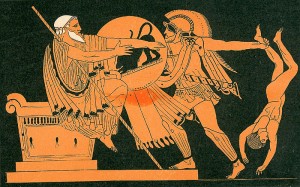
As I mentioned in my piece on Víðarr, Snorri presents Neoptolemos as an Úlfhéðnar and even the personification of the Fenris wolf who is responsible for the death of Óðinn:
Pyrrhus they compared with the Fenris-wolf. He slew Odin, and Pyrrhus might be called a wolf according to their belief, for he did not spare the peace-steads, when he slew the king in the temple before the altar of Thor. The burning of Troy they called the flame of Surt. (Prose Edda: Skáldskaparmál Epilogue 8)
This differs from the conventional Greek account, where it is the Dionysian hero Orestes who ended his wolfish rampage:
Neoptolemus, son of Achilles and Deidamia, begat Amphialus by captive Andromache, daughter of Ēëtion. But after he heard that Hermione his betrothed had been given to Orestes in marriage, he went to Lacedaemon and demanded her from Menelaus. Menelaus did not wish to go back on his word, and took Hermione from Orestes and gave her to Neoptolemus. Orestes, thus insulted, slew Neoptolemus as he was sacrificing at Delphi, and recovered Hermione. The bones of Neoptolemus were scattered through the land of Ambracia, which is in the district of Epirus. (Hyginus, Fabulae 123)
But Snorri’s take has a lot to commend it. Or at least it’s prompting some interesting thoughts, such as his comparison of the burning of Troy to the flame of Surtr.
More on that later.
 The House of Vines