Hail Petempamenti!

And for more on Dionysos in Egypt, check out my article The Mighty Bull of the Two Lands.
Running with the Apis
Marcus Antonius pushed open the door to the Queen’s private chambers, sending the startled ladies in waiting and guards scurrying off. Even had he not been the Queen’s recent husband, they wouldn’t have opposed him: there was a dangerous, mad quality to his disheveled appearance, and Marcus well knew how to use the sword he carried always belted at his hip.
Marcus stumbled in, slammed the large, ornately wrought door closed, and then slumped against it, panting.
Kleopatra glanced up from her work – she was writing a philosophical treatise on the womanly arts of persuasion and cosmetics – and took in his massive frame. Marcus’ hair was in disarray, his ivy-crown hanging in tatters from his dark head. His khiton – no longer a Roman toga – hung loose about his waist, completely exposing his battle-scarred torso. It was torn and stuffed inside his sword-belt to keep it from falling off of him entirely, and there were plenty of wine stains and muck from the streets covering the once pristine fabric. His chest heaved; he seemed scarcely able to catch his breath. Dark shadows made his face resembled a death’s mask. His normal sun-browned flesh seemed pale even in the shadows of her chamber. He frightened her.
Kleopatra rose and rushed to his side. He collapsed into her arms and with great difficulty she managed to walk him over to the bed they now shared as man and wife. He fell back and lay staring up at the ceiling. With a moment of annoyance Kleopatra noted that they would have to get new sheets, because there would be no way to get the filth and sweat out of them now. She lay down beside him, pressing her slender body against his massive frame, and tried not to inhale too deeply.
“Are you okay, my husband? It is late. Where have you been this evening?”
From the looks of him, partying with their friends and then brawls in Alexandria’s back alleys. At least he didn’t stink of whores. This time. Kleopatra stroked the dark curls out of his eyes: his expression was vacant, haunted. For a moment she worried that he had lost his speech. She sat up and prepared to call for the court physician. Then his gravelly voice boomed in his chest, sounding like a lion’s rattling roar.
“I was running with the Apis.”
Kleopatra smiled. “No wonder you look exhausted – it is quite a journey from Memphis to Alexandria.”
Marcus’ lip curled up. “Do not mock me, woman.”
Kleopatra went cold at the lethal fury that shown in his eyes.
“I do not understand, my lord.” She whispered.
Marcus heaved a sigh. “Neither do I, my love. But it happened nonetheless.”
Kleopatra rested her hand on his chest comfortingly, felt its warmth rise and fall beneath her delicate fingers, and then whispered, “Go on. Tell me. I will not laugh.”
There was silence for a long while. Neither spoke. The only sound aside from their slow breathing was the guttering of the oil lamp’s flame on her writing desk. Then, finally, Marcus spoke, his voice hoarse from thirst.
“I stayed at the dinner-party after you left. The wine was too good, and the conversation even better. We were discussing Dionysos’ conquest of India, a topic that has been close to my heart, of course, ever since Ephesos.”
“You truly are the New Dionysos, my love.” Kleopatra’s hand slid down his chest, resting fondly on the swell between his legs. Normally this would have stopped all conversation and ended with them rolling together under the sheets. Instead he seemed not to notice.
“Like your father and Philopator before him.”
“Yes.” The mention of Auletes brought a sad smile to her lips. She had genuinely loved him, a rare enough occurrence among the Lagides.
“And before them Philadelphos and Soter too?”
“Yes. We are all descendents of Dionysos – his blood has flowed stronger with some than others, however.”
“Yes, and that is why you love me – isn’t it?”
“It is one of the reasons, yes.” Marcus Antonius was not as other men. His passions dwarfed theirs. His spirit loomed larger than other men’s, doing things they only dreamed of but lacked the courage to accomplish. Marcus felt things more strongly, was more sensual and decadent than anyone she had ever met – aside from herself. He was given to great kindness and generosity – to all he met, not just his friends – but when provoked to wrath, he was terrible, crueler than anyone had a right to be. If any single mortal exemplified the contradictory excesses of her people’s ancestral God – it was this man.
“My whole life has been lived under his shadow. Unconsciously I have acted out his myths through my campaigns, my feasting, my loving, my intense joy – and my volatile wrath. Tonight I finally understand why – and what the Ephesians meant when they gave me that title. I wonder if they even understood how right they were in bestowing that half-mocking epithet.”
“I do not understand. What happened?”
“He happened – that is what. I met the God tonight, in a way I never have before. During the conversation about the Indian conquest, something stirred within my soul, something dark and ancient. The God within me awoke. I sat there for awhile, drinking, but it was not I who tasted the wine. I watched the drunken revelers, but it was not I who stared out of my eyes: it was the God, and he was wearing my body like a mask. I would speak, but it was not my words that poured out. I was merely an actor, reciting the lines scripted by another mind. The evening passed. More wine was drunk. I could not stop myself: cup after cup was drained by me and I hardly seemed to notice it. The topic changed. They began discussing the charms of the various whores down by the Pharos, and Octavian’s intrigues at Rome. I grew bored with their idle chatter. I got up, without so much as a parting word, and fled out into the night, not even stopping to grab my cloak.
“I fled into the darkness, desperate to be alone. Old friends hailed me on the street, asking where I was going. I rushed past, ignoring them. I left the familiar royal quarters of the city, the temples and shops and wealthier districts. I had no idea where I was going: my body carried me along, through dark alleyways and deserted thoroughfares. This city is different at night: it changes as the pimps and thieves and sailors come out. I don’t know if they recognized who I was, or if they feared the crazed look in my eye, but none of them hassled me. They stepped out of my way, even when the streets were narrow; they crowded together and whispered as I passed, making warding gestures against the evil that had so clearly taken possession of my soul.
“And they were wise to do so, for I was an animal in human guise, a beast hungry for blood and the crunch of bone beneath my fangs. Had any tarried across my path too long, or tried to give me trouble, I would have been on them in an instant, a ravening beast glorying in the tearing of flesh, the warmth of their blood spraying against my skin, their pitiful shrieks filling the night air. But they knew themselves to be prey and so stayed far from me.
“Finally the dreadful spirit inside me had reached its destination, alone in the night, in an empty quarter of the city, far from the prying eyes of mortals.
“I bent over, trying to catch my breath. At some point I must have been running. I had no idea where I was. Finally I glanced up – and that’s when I saw him: the bull. He was huge, his thick black frame blotting out the light around me. He was darker than night, but his eyes glowed more brightly than the moon. His hooves were made of fire, and the earth scorched wherever they touched. Plumes of smoke rose from his nostrils. He was staring directly at me: challenging me. I should have been afraid. He could have easily gored me with his massive horns or trampled me under his mighty weight. I felt no fear: my heart thundered with reckless pride to be in the presence of so majestic a creature. I met his gaze unflinchingly and accepted his challenge.
“I stood up tall, stretching my body out to its fullest. He dwarfed me, and yet I was proud of my masculine frame. I showed my teeth, giving back my own challenge. He snorted once, the sound a rumble I could feel through the earth, accepting my challenge, and then he turned and began to run. I understood immediately: I was to chase him.
“Despite his size, the bull was fast, faster than he should have been. In moments he was almost out of my sight.
“Growling like a wild beast, I gave chase. I had no idea what I would do once I caught him. I was intoxicated with the frenzy of the hunt: it impelled me on, unthinking.
“As I ran, I felt the power of the God stir once more within me. I reveled in the unbridled strength that coursed through my body; the blood pumping through my veins; my muscles stretching as my lithe limbs carried me forward. I knew myself to be a man in that moment, a great man capable of great deeds. I felt alive, in a way that made everything before seem like a pitiful dream. I have had moments where I glimpsed something of what it is to be alive – in battle or while making love – but here it was in its fullness, not just a fleeting image. This all came to me afterwards: at the time there was no room for thought, even thoughts such as these. My mind completely shut down: I was a creature of pure instinct; relying on my body to find its own way through the narrow streets, leaping automatically over rubbish in my way, darting down an alley when the bull changed its course at the last moment. I had no doubts, no troubling questions about my place in the world: I knew exactly why I existed – to catch this bull!
“Everything else fell away, vanished into the darkness, until the world consisted of nothing more than the bull and myself. All I could see was the bull before me, shining brilliantly with life in the shadows. Never before had I seen anything as beautiful as him: not a fleet of ships, not the work of Pheidias, not even you, my beloved. His hulking frame transfixed my gaze. I marveled at how his tautly muscled legs found their way unerringly through the narrow streets with a dancer’s agility; those fearful horns which existed for the sole purpose of rending flesh; those glowing eyes in whose depths all the secrets of the world are kept. And I knew that this was no ordinary bull – this was Apis, the God; Apis who contains the abundant fertility of the Nile within him; Apis who makes the grass green, the fruit to swell on the branch, the ripe corn to spring forth that men might have food for their bellies; Apis who fills the women with lust; Apis in whose movement the motion of the cosmos is manifest; Apis, power in its most primal, procreative form. Apis is life itself – and without him, no man rules. Rulership, in fact, is nothing more than harnessing the power of this God and learning to direct it outwards into the world. Without thinking about this, I understood all of it – and I knew that I had to capture the Apis bull. I had to possess him, consume him, become him.
“And so, even though my limbs were growing tired from the chase, my heart beating dangerously in my chest, my breath beginning to come with more difficulty – I dug deep and found even further resources of power within myself to continue on. I blocked out the pain. I ignored my aching body. I channeled everything I had into the race – and my focus narrowed even further, thoughts of the race and of my desire to catch Apis falling away until he and I existed alone. Just us. The Apis and I. I and the Apis. As he ran, I ran. As he breathed, I breathed. As he snorted, I too snorted. No longer was there distance between us – we were one soul in two bodies, mirror images of each other.
“And then I understood: Dionysos was the Apis, and I was Dionysos. I was chasing myself, and this race between us was an ancient ceremony, as old as time, and it had been performed many times before, and it would be performed again many times after I had completed it. This is how the King is chosen, how he shows himself worthy to rule. He must race the bull and in the process become the bull himself. The race awakens the sleeping God within him, rouses the bull and all of its bountiful powers into life. Not all who start on the path, however, succeed. They must be able to shut off their minds, trust completely in their bodies, which is where the power of the God resides. If fear or indecision or their doubting mind takes hold, they will fall and be trampled beneath the hooves of the bull. They must permit themselves to exist in the perfect moment of the chase, all else closed off to them. Only then will they discover that they are in actual fact the bull themselves, and understand how to direct the power of the bull into the land to promote fertility and to bring peaceful harmony to the realm. I understood this as I ran without understanding it, and I did not let that knowledge distract me.
“And as I chased the bull I felt the presence of others chasing the bull with me. Your father – and all of your ancestors going back to Ptolemy. And before him Alexander. And before him Theseus and Minos, and the Kings of Egypt, stretching back to the dawn of time. Each had performed this ceremony, some succeeding, others not. And I realized that in some sense, each of us was the same man, runningthis same race, in the same place, at the same time, and I could feel their thoughts in my head, and knew their experiences to be my own. How many times had I chased this bull, acting out this ancient ceremony? How many times would I do so again, in how many different forms? And then I came to realize that I was no longer chasing the bull through the streets of Alexandria – I was somewhere else, somewhere much older, much darker. I was chasing him through the labyrinth at Krete – and the bull was in reality the Minotaur. Apis was Dionysos and Dionysos was the Minotaur – and I was both the Minotaur and Theseus. And we never got out. We were still in the labyrinth, and always will be. The world is nothing more than the labyrinth and the bull chases himself around in it, dreaming sometimes that he is a monster, sometimes that he is a God, and sometimes that he is a man.
“He dreams himself many different lives, and he lives each one out fully as he dreams it. Some are joyful, some sorrowful, some full of unrivaled glory – others lived in total obscurity. But in every life there is the chasing of the bull, because he desires to know himself. It always comes back to that because all that exists is the labyrinth and the bull. Everything else is just a dream. Everything else except one other – the one who loves the bull, Ariadne, the Mistress of the Labyrinth. She is there dreaming too. And when he is not busy chasing himself through the winding passageways, he seeks her out. And when he finds her, he gives her his crown, places it in the heavens for her, and they love each other, until they fall asleep and forget who they are. But when they awake, they always find each other again, because they are the only two people in existence. Sometimes he wakes first and finds her; sometimes it is she that rouses him from slumber. She was Isis when he was Osiris; he was Haides when she was Kore. As Alexander he found her both as Olympias and Hephaistion. They were brother and sister as Philadelphos and Arsinoe, but that did not stop them from loving each other – and why should it, since they were the only real ones, and all else but a dream? He put her star-crown up in the sky as Berenike’s lock. And he has been both Auletes and Caesar – and now me, dear. He has finally reawakened as me – and you are my beloved Ariadne. I would recognize you no matter how much your form has changed. I will love you forever. And when we die and our form changes shape once more – I will seek you out in the labyrinth, no matter what new flesh you wear.”
All the while Kleopatra had sat quietly listening to her husband share his mad story at a feverish pitch, the words pouring forth like wine from an upturned vessel. Mad it must be: how could this man be both her father and Caesar, since all three were contemporaries – let alone all the rest of it? She was uncertain what to say to that, but figured that she ought to say something, that her continued silence might set him off, and she feared the madness in his eyes. She was trying to find the right words, words that would seem comforting and supportive and not provoke him, when Marcus picked up the thread of his narrative once more, oblivious to her troubled expression.
“It was then that I noticed that the bull was no longer in front of me, leading the chase. He was nowhere to be seen in fact. I was running wild through the streets, alone as I must be alone in the labyrinth. I slowed down to a trot and then a leisurely stroll and finally came to a stop altogether. I found myself somehow in Rhakotis – what winding path or twist of fate had led me here I could not say. I made my way up to the great temple of Serapis there. The forecourt was abandoned, naturally enough since the hour was so late, but I stood outside and stared up at the massive edifice and the ancient statues that lined the path up to the temple doors, a mixture of Greek and Egyptian, as everything in this city is a hybrid of the two.
“I was out of breath, my body exhausted from the run, my clothing torn and falling off of my body from stumbles I do not remember taking. My mind was reeling from all the things I had learned. And yet, despite it all, I had never felt so alive, so full of wild energy, so unabashedly a man. The pulse of life echoed in my ears – not just my life, but all life. I could feel the priests inside the temple, some sleeping, others rousing themselves in preparation for their morning duties in the sanctuary. I felt the lives of all the people nearby, safe asleep in their beds, dreaming or stumbling home from a night of revelry. And I felt you, so far away here in the royal palaces – beautiful and shining more brightly than all the other lives.
“And I felt all these individual lives, thin streams, flowing together into a single great river, and I realized that the Nile is the earthly image of the spiritual river of life. And when the spiritual river wanes or grows sluggish, the earthly Nile recedes – but when the spiritual river is strong, the Nile overflows its banks, flooding the earth and filling it with bountiful life. And it is the duty of the King to make the river strong, through his person, through his power, through his ability to direct and control others. He must do things to promote life, to enhance the lives of his subjects, to make them whole, healthy, and vibrant – communing with the Gods of life, the source of life, in order to add to the streams that flow into the great spiritual river, making it bountiful so that the earthly river, too, will become bountiful. This is the sole function of the King – he exists for no other purpose, and no other can perform this duty, for the King stands midway between Gods and mortals. He is the bridge between the worlds, uniting the two lands within himself. The running of the Apis is how he proves himself – but it is also how he channels the energy of life, making it flow and move, making the two rivers that are one race along their course and flood the earth, infusing it with life and bringing forth its material bounty in the form of the fruit and grain and newborn animals. Wherever his feet set in the race, life springs up.
“And how is this possible? Why can the King do this – and no other? Because the King is dead. (As he races with the Apis, he is racing with death. The labyrinth is just a dream too: in reality, the bull-God-man is laying in the underworld, a corpse.) The dead, too, reside midway between Gods and mortals. The King is a vessel for the dead, who dwell within him. Inside the King are all the thousands upon thousands of the dead – they direct his every thought and action. I understood this as I stood before the great Serapeion. I understood what Serapis is: he is the dead King, the King of all the dead. The spirits of every Apis bull, the spirits of all the Kings that have come before, they are united in Serapis, combined into a single living form, for Serapis is the tomb of the Apis, the living bull in death, the dead bull in life. And Serapis is the current King, whoever that is. (Which is why people’s accounts of Serapis are constantly changing – for he shifts depending on who embodies him.) And in that moment, I learned so much more about what it means to be King.
“The King is the door through which the dead can act in this world, of which they are no longer a part. He unites the world of mortals with the dead; the realm of the Gods with the material plane. He is the pivot of the wheel, upon which all things depend. Through him the prayers of people pass upwards to the Gods; through him the blessings of the Gods descend to mortals. He must make the way clear – he himself must be pure and fit – because when things are blocked, there are famines and war and suffering and death. Everything in the world is a reflection of what is going on inside the King – and everything within the King reflects what is in the world.
“And that, my beloved, is all that I can say. There was more – oh, so much more! – but I am sure that I already sound a madman raving in his delusion. I am tired, my love. So tired.”
He collapsed at that, the manic spirit that kept him animated while he poured out his tale in one long, feverish burst vanishing on the wind. His eyes closed, and moments later his breathing deepened and sleep claimed Marcus.
Kleopatra sat beside him, unmoving. She did not wish to disturb her husband – was unsure what strange thing would be unleashed upon her if she did. She felt herself to be in shock, as if a great violent storm had just passed through, uprooting and destroying everything. She wasn’t entirely sure what had just happened, how she was supposed to take the marvelous tale Marcus had just relayed to her. Was there something to it? Was he completely insane? Parts of it felt real to her – some of the things he said only a true King of Egypt might know – and a glimmer of hope stirred within her. Though her brother Ptolemy had been crowned Pharaoh, he had never been King. He was a foolish, power-mad boy, who did not understand what the office entailed. But now… she wondered. Did this strange Roman, this profligate adulterer, this violent brute whom she had seduced for power but come to love over time – did he finally understand? He seemed to. And how glorious that would be, for Egypt to have a true King once more. Together they would make the land strong again, drive out the Romans, re-conquer all the territories that her ancestors had claimed… and perhaps more. And yet… other parts of his story seemed utter foolishness to her, bizarre and jumbled ramblings, like one hears from the beggars on the street or the recluses who have spent too long in the Serapeion at Memphis.
War was brewing with Octavian. It was only a matter of time now – and she wondered how Marcus would stand up. He had proven himself on the field of battle numerous times before, in Spain, Italy, and the east. He had been Caesar’s right hand man and chosen successor before that conniving whelp of Atia had schemed his way into the succession. He was a strong, courageous man – but also a man with great weaknesses which crept up from time to time. And what she had seen tonight made her worry all the more. Was he falling apart? Had he lost his mind? How would he ever compete with Octavian, who for all his failings was a shrewd tactician and a deadly opponent to Egypt’s interests?
But what if his visions were real?
What if …?
Kleopatra worried, and morning light filled her chamber before sleep finally found her.
Antony the equally awesome
I can’t mention one without the other.

Cassius Dio, Roman History 50.1-5
For Kleopatra had enslaved him so absolutely that she persuaded him to act as gymnasiarch to the Alexandrians; and she was called ‘queen’ and ‘mistress’ by him, had Roman soldiers in her bodyguard, and all of these inscribed her name upon their shields. She used to frequent the market-place with him, joined him in the management of festivals and in the hearing of lawsuits, and rode with him even in the cities, or else was carried in a chair while Antony accompanied her on foot along with her eunuchs. He also termed his headquarters ‘the palace,’ sometimes wore an oriental dagger at his belt, dressed in a manner not in accordance with the customs of his native land, and let himself be seen even in public upon a gilded couch or a chair of that kind. He posed with her for portrait paintings and statues, he representing Osiris or Dionysos and she Selene or Isis. This more than all else made him seem to have been bewitched by her through some enchantment.
Constantine P. Cavafy, The God Abandons Antony
When suddenly, at midnight, you hear
an invisible procession going by
with exquisite music, voices,
don’t mourn your luck that’s failing now,
work gone wrong, your plans
all proving deceptive—don’t mourn them uselessly.
As one long prepared, and graced with courage,
say goodbye to her, the Alexandria that is leaving.
Above all, don’t fool yourself, don’t say
it was a dream, your ears deceived you:
don’t degrade yourself with empty hopes like these.
As one long prepared, and graced with courage,
as is right for you who were given this kind of city,
go firmly to the window
and listen with deep emotion, but not
with the whining, the pleas of a coward;
listen—your final delectation—to the voices,
to the exquisite music of that strange procession,
and say goodbye to her, to the Alexandria you are losing.
Plutarch, Life of M. Antonius 4
He had also a noble dignity of form; and a shapely beard, a broad forehead, and an aquiline nose were thought to show the virile qualities peculiar to the portraits and statues of Hercules. Moreover, there was an ancient tradition that the Antonii were Heracleidae, being descendants of Anton, a son of Heracles. And this tradition Antony thought that he confirmed, both by the shape of his body, as has been said, and by his attire. For whenever he was going to be seen by many people, he always wore his tunic girt up to his thigh, a large sword hung at his side, and a heavy cloak enveloped him. However, even what others thought offensive, namely, his jesting and boastfulness, his drinking-horn in evidence, his sitting by a comrade who was eating, or his standing to eat at a soldier’s table, — it is astonishing how much goodwill and affection for him all this produced in his soldiers. And somehow even his conduct in the field of love was not without its charm, nay, it actually won for him the favour of many; for he assisted them in their love affairs, and submitted pleasantly to their jests upon his own amours. Furthermore, his liberality, and his bestowal of favours upon friends and soldiers with no scant or sparing hand, laid a splendid foundation for his growing strength, and when he had become great, lifted his power to yet greater heights, although it was hindered by countless faults besides. One illustration of his lavish giving I will relate. To one of his friends he ordered that two hundred and fifty thousand drachmas should be given (a sum which the Romans call “decies”). His steward was amazed, and in order to show Antony the magnitude of the sum, deposited the money in full view. Antony, passing by, asked what that was; and when his steward told him it was the gift which he had ordered, he divined the man’s malice and said: “I thought the decies was more; this is a trifle; therefore add as much more to it.” And even the enemy reaped advantage from Antony’s love of distinction. For Ptolemy, as soon as he entered Pelusium, was led by wrath and hatred to institute a massacre of the Egyptians; but Antony intervened and prevented him. Moreover, in the ensuing battles and contests, which were many and great, he displayed many deeds of daring and sagacious leadership, the most conspicuous of which was his rendering the van of the army victorious by outflanking the enemy and enveloping them from the rear. For all this he received rewards of valour and fitting honours. Nor did the multitude fail to observe his humane treatment of the dead Archelaüs, for after waging war upon him by necessity while he was living, although he had been a comrade and friend, when he had fallen, Antony found his body and gave it royal adornment and burial. Thus he left among the people of Alexandria a very high reputation, and was thought by the Romans on the expedition to be a most illustrious man.
Plutarch, Life of M. Antonius 29
Kleopatra played at dice with him, drank with him, hunted with him, and watched him as he exercised himself in arms; and when by night he would station himself at the doors or windows of the common folk and scoff at those within, she would go with him on his round of mad follies, wearing the garb of a serving maiden. For Antony also would try to array himself like a servant. Therefore he always reaped a harvest of abuse, and often of blows, before coming back home; though most people suspected who he was. However, the Alexandrians took delight in their graceful and cultivated way; they liked him, and said that he used the tragic mask with the Romans, but the comic mask with them.
Plutarch, Life of M. Antonius 69-71
And now Antony forsook the city and the society of his friends, and built for himself a dwelling in the sea at Pharos, by throwing a mole out into the water. Here he lived an exile from men, and declared that he was contentedly imitating the life of Timon, since, indeed, his experiences had been like Timon’s; for he himself also had been wronged and treated with ingratitude by his friends, and therefore hated and distrusted all mankind. Now, Timon was an Athenian, and lived about the time of the Peloponnesian War, as may be gathered from the plays of Aristophanes and Plato. For he is represented in their comedies as peevish and misanthropical; but though he avoided and repelled all intercourse with men, he was glad to see Alcibiades, who was then young and headstrong, and showered kisses upon him. And when Apemantus was amazed at this and asked the reason for it, Timon said he loved the youth because he knew that he would be a cause of many ills to Athens. This Apemantus alone of all men Timon would sometimes admit into his company, since Apemantus was like him and tried sometimes to imitate his mode of life; and once, at the festival of The Pitchers, the two were feasting by themselves, and Apemantus said: “Timon, what a fine symposium ours is!” “It would be,” said Timon, “if thou wert not here.” We are told also that once when the Athenians were holding an assembly, he ascended the bema, and the strangeness of the thing caused deep silence and great expectancy; then he said: “I have a small building lot, men of Athens, and a fig-tree is growing in it, from which many of my fellow citizens have already hanged themselves. Accordingly, as I intend to build a house there, I wanted to give public notice to that effect, in order that all of you who desire to do so may hang yourselves before the fig-tree is cut down.” After he had died and been buried at Halae near the sea, the shore in front of the tomb slipped away, and the water surrounded it and made it completely inaccessible to man. The inscription on the tomb was:
“Here, after snapping the thread of a wretched life, I lie.
Ye shall not learn my name, but my curses shall follow you.”
This inscription he is said to have composed himself, but that in general circulation is by Callimachus:
“Timon, hater of men, dwells here; so pass along;
Heap many curses on me, if thou wilt, only pass along.”
These are a few things out of many concerning Timon. As for Antony, Canidius in person brought him word of the loss of his forces at Actium, and he heard that Herod the Jew, with sundry legions and cohorts, had gone over to Caesar, and that the other dynasts in like manner were deserting him and nothing longer remained of his power outside of Egypt. However, none of these things greatly disturbed him, but, as if he gladly laid aside his hopes, that so he might lay aside his anxieties also, he forsook that dwelling of his in the sea, which he called Timoneum, and after he had been received into the palace by Kleopatra, turned the city to the enjoyment of suppers and drinking-bouts and distributions of gifts, inscribing in the list of ephebi the son of Kleopatra and Caesar, and bestowing upon Antyllus the son of Fulvia the toga virilis without purple hem, in celebration of which, for many days, banquets and revels and feastings occupied Alexandria. Kleopatra and Antony now dissolved their famous society of Inimitable Livers, and founded another, not at all inferior to that in daintiness and extravagant outlay, which they called the society of Partners in Death. For their friends enrolled themselves as those who would die together, and passed the time delightfully in a round of suppers. Moreover, Kleopatra was getting together collections of all sorts of deadly poisons, and she tested the painless working of each of them by giving them to prisoners under sentence of death. But when she saw that the speedy poisons enhanced the sharpness of death by the pain they caused, while the milder poisons were not quick, she made trial of venomous animals, watching with her own eyes as they were set upon another. She did this daily, tried them almost all; and she found that the bite of the asp alone induced a sleepy torpor and sinking, where there was no spasm or groan, but a gentle perspiration on the face, while the perceptive faculties were easily relaxed and dimmed, and resisted all attempts to rouse and restore them, as is the case with those who are soundly asleep.
Kleopatra the awesome
Guasón over at Stone Pillar has been sharing his love for the Ptolemaic Dynasty, and Kleopatra in particular.
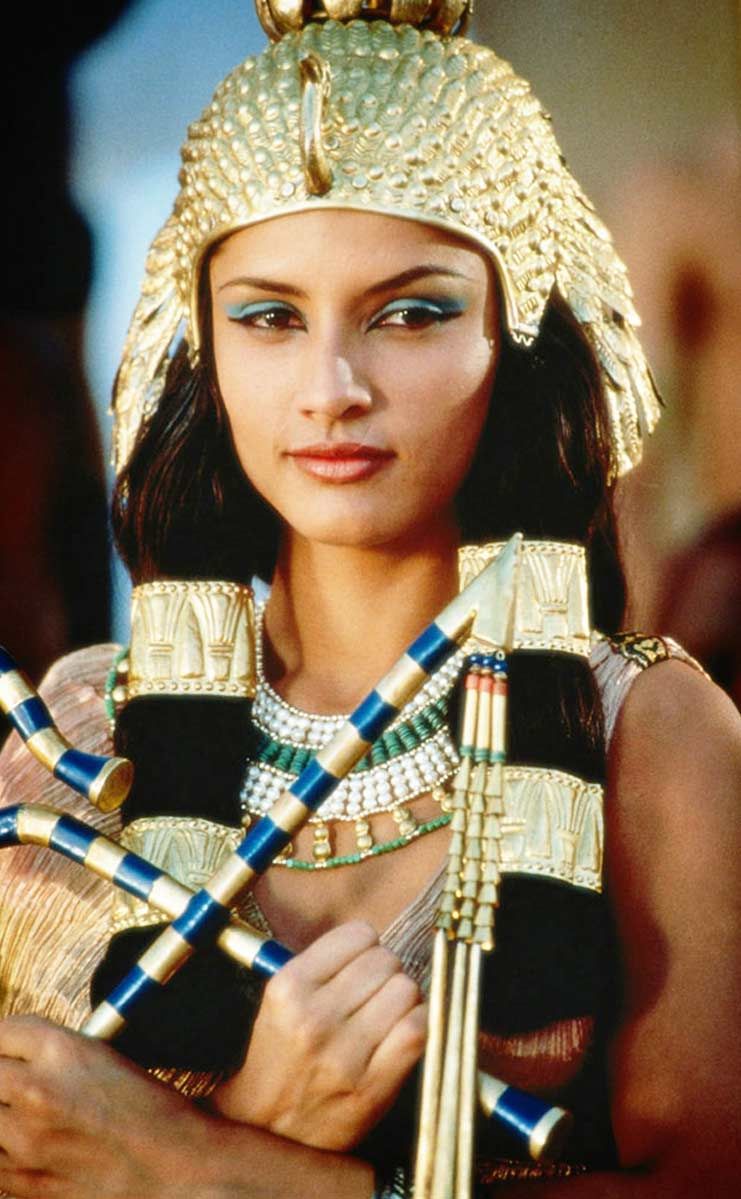
Kleopatra was indeed an awesome woman. Here are some of my favorite passages about her showing just how awesome she could be. Some of these stories are pure fabrication, but they’re still fun to read and go towards establishing the mythical persona of Kleopatra which, more than the reality (something we can never truly know) is what we revere all these centuries later.
She was charming and learned
“For her beauty, as we are told, was in itself not altogether incomparable, nor such as to strike those who saw her; but converse with her had an irresistible charm, and her presence, combined with the persuasiveness of her discourse and the character which was somehow diffused about her behavior towards others, had something stimulating about it. There was sweetness also in the tones of her voice; and her tongue, like an instrument of many strings, she could readily turn to whatever language she pleased, so that in her interviews with Barbarians she very seldom had need of an interpreter, but made her replies to most of them herself and unassisted, whether they were Ethiopians, Troglodytes, Hebrews, Arabians, Syrians, Medes or Parthians. Nay, it is said that she knew the speech of many other peoples also, although the kings of Egypt before her had not even made an effort to learn the native language, and some actually gave up their Makedonian dialect.” – Plutarch, Life of Antony 27.2-4
She was a philosopher and alchemist
“Ptolemy was succeeded by his daughter, Kleopatra. Her reign lasted twenty-two years. She was wise, tried her hand at philosophy and was a close companion to wise men. She has works, both bearing her name and ascribed to her, of medicine, magic, and science, known by those well-versed in such things. This Queen was the last of the Greek Queens, so that with her death their reign ended, their era was forgotten, the vestiges of their civilization were obliterated, and their sciences, except for what remained in the hands of their wise men, disappeared.” – Al-Mas’udi, Prairies of Gold
She worked tirelessly for the interests of her people
“And she raised a dike against the waters of the sea with stones and earth, and made the place of the waters over which they voyaged formerly in ships into dry land, and she made it passable on foot. And this stupendous and difficult achievement she wrought through the advice of a wise man named Dexiphanes. Next she constructed a canal to sea, and she brought water from the river Gihon and conducted it into the city. This made it easier for ships to come into port. And by this means she brought it about that there was great abundance and much food for the people to eat. And she executed all these works in vigilant care for the well-being of her city. And before she died she executed many noble works and created important institutions. And this woman, the most illustrious and wise amongst women, died in the fourteenth year of the reign of Caesar Augustus. Thereupon the inhabitants of Alexandria and of lower and upper Egypt submitted to the emperors of Rome, who set over them prefects and generals.” – John, Bishop of Nikiu, The Chronicle 67.5-10
She was the physical incarnation of Isis-Aphrodite
“Kleopatra, indeed, both then and at other times when she appeared in public, assumed a robe sacred to Isis, and was addressed as the New Isis.” – Plutarch, Life of Antony54.6
Venus has come to revel with Bacchus for the good of Asia
“Though Kleopatra received many letters of summons both from Antony himself and from his friends, she was so bold as to sail up the river Cydnus in a barge with gilded poop, its sails spread purple, its rowers urging it on with silver oars to the sound of the flute blended with pipes and lutes. She herself reclined beneath a canopy spangled with gold, adorned like Venus in a painting, while boys like Loves in paintings stood on either side and fanned her. Likewise also the fairest of her serving-maidens, attired like Nereïds and Graces, were stationed, some at the rudder-sweeps, and others at the reefing-ropes. Wondrous odours from countless incense-offerings diffused themselves along the river-banks. Of the inhabitants, some accompanied her on either bank of the river from its very mouth, while others went down from the city to behold the sight. The throng in the market-place gradually streamed away, until at last Antony himself, seated on his tribunal, was left alone. And a rumour spread on every hand that Venus was come to revel with Bacchus for the good of Asia.” – Plutarch, Life of Antony 26.1-3
There was a wild streak to her
“But Kleopatra, distributing her flattery, not into the four forms of which Plato speaks, but into many, and ever contributing some fresh delight and charm to Antony’s hours of seriousness or mirth, kept him in constant tutelage, and released him neither night nor day. She played at dice with him, drank with him, hunted with him, and watched him as he exercised himself in arms; and when by night he would station himself at the doors or windows of the common folk and scoff at those within, she would go with him on his round of mad follies, wearing the garb of a serving maiden. For Antony also would try to array himself like a servant. Therefore he always reaped a harvest of abuse, and often of blows, before coming back home; though most people suspected who he was. However, the Alexandrians took delight in their graceful and cultivated way; they liked him, and said that he used the tragic mask with the Romans, but the comic mask with them.” – Plutarch, Life of Antony 29
She had a wicked sense of humor
“Now, to recount the greater part of his boyish pranks would be great nonsense. One instance will suffice. He was fishing once, and had bad luck, and was vexed at it because Kleopatra was there to see. He therefore ordered his fishermen to dive down and secretly fasten to his hook some fish that had been previously caught, and pulled up two or three of them. But the Egyptian saw through the trick, and pretending to admire her lover’s skill, told her friends about it, and invited them to be spectators of it the following day. So great numbers of them got into the fishing boats, and when Antony had let down his line, she ordered one of her own attendants to get the start of him by swimming onto his hook and fastening on it a salted Pontic herring. Antony thought he had caught something, and pulled it up, whereupon there was great laughter, as was natural, and Kleopatra said: ‘Imperator, hand over thy fishing-rod to the fishermen of Pharos and Kanopos; thy sport is the hunting of cities, realms, and continents.’” – Plutarch, Life of Antony 29.3-4
They knew how to throw a party
“Antony sent, therefore, and invited her to supper; but she thought it meet that he should rather come to her. At once, then, wishing to display his complacency and friendly feelings, Antony obeyed and went. He found there a preparation that beggared description, but was most amazed at the multitude of lights. For, as we are told, so many of these were let down and displayed on all sides at once, and they were arranged and ordered with so many inclinations and adjustments to each other in the form of rectangles and circles, that few sights were so beautiful or so worthy to be seen as this…. In Alexandria, indulging in the sports and diversions of a young man of leisure, he squandered and spent upon pleasures that which Antiphon calls the most costly outlay, namely, time. For they had an association called The Inimitable Livers, and every day they feasted one another, making their expenditures of incredible profusion. At any rate, Philotas, the physician of Amphissa, used to tell my grandfather, Lamprias, that he was in Alexandria at the time, studying his profession, and that having got well acquainted with one of the royal cooks, he was easily persuaded by him (young man that he was) to take a view of the extravagant preparations for a royal supper. Accordingly, he was introduced into the kitchen, and when he saw all the other provisions in great abundance, and eight wild boars a-roasting, he expressed his amazement at what must be the number of guests. But the cook burst out laughing and said: ‘The guests are not many, only about twelve; but everything that is set before them must be at perfection, and this an instant of time reduces. For it might happen that Antony would ask for supper immediately, and after a little while, perhaps, would postpone it and call for a cup of wine, or engage in conversation with some one. Wherefore,’ he said, ‘not one, but many suppers are arranged; for the precise time is hard to hit.’” – Plutarch, Life of Antony 27,28
The incident with the pearl
“There have been two pearls that were the largest in the whole of history; both were owned by Cleopatra, the last of the Queens of Egypt–they had come down to her through the hands of the Kings of the East. When Antony was fattening himself every day at decadent banquets, she with a pride both lofty and impudent, a queenly courtesan, disparaged his elegance and sumptuous display, and when he asked what magnificence could be added on, she replied that she would spend ten million sesterces on a banquet. Antony was curious, but did not think it could be done. Consequently, with bets made, on the next day, on which the trial was carried out, she set before Antony a banquet that elsewhere would be magnificent, so that the day might not be wasted, but that was for them quite ordinary, and Antony laughed and exclaimed over its cheapness. But she, claiming that it was a gratuity, and that the banquet would complete the account and she alone would consume ten million sesterces, ordered the second course to be served. In accordance with previous instructions the servants placed in front of her only a single vessel containing vinegar, the strong rough quality of which can melt pearls. She was at the moment wearing in her ears that remarkable and truly unique work of nature. Antony was full of curiosity to see what in the world she was going to do. She took one earring off and dropped the pearl in the vinegar, and when it was melted swallowed it. Lucius Plancus, the judge of the wager, put his hand on the other pearl since she was preparing to destroy it also in a similar fashion, and declared that Antony had lost, an omen that later came true. With this goes the story that, when that queen who had won on this important issue was captured, the second of this pair of pearls was cut in two pieces, so that half a helping of the jewel might be in each of the ears of Venus in the Pantheon at Rome.” – Pliny the Elder, Natural History, 9.119-121
Men thought death a small price to pay to sleep with her
“Cleopatra was so lustful that she often prostituted herself, and so beautiful that many men bought night with her at the price of their lives.” – Sextus Aurelius Victor, De Viris Illustribus Urbis Romae 86.2
A later Russian adaptation of the above anecdote
“I swear, O mother of passion, I will serve you in unheard ways, on the couch of passionate sins I will come as a common slave. So look, powerful Cytherean, and you underground kings, O Gods of ferocious Hades; I swear to the morning sunrise the wishes of my lords I will tire with voluptuous passion and with all secrets of kisses and with wondrous nakedness those wishes I will quench. But as soon as with a morning purple the eternal Aurora will shine forth, I swear: under the deadly axe the heads of these lucky ones will fall.” – Alexander Pushkin, Egyptian Nights
She knew how to get her point across
“For in preparation for the Actian war, when Antony feared the attentiveness of the Queen herself and did not take any food unless it had been tasted beforehand, she is said to have played on his fear and dipped the tips of the flowers in his crown in poison and then put the crown on his head; soon, as the revelry proceeded, she suggested to Antony that they drink their crowns. Who would thus fear treachery? Therefore with a hand put in his way he was beginning to drink the pieces gathered into the cup she said, ‘Look, I am she, Mark Antony, of whom you are wary with your new wish for tasters. If I could live without you, this is the extent to which I lack opportunity and motive!’ She ordered a prisoner who had been led in to drink it and he promptly expired.” – Pliny the Elder, Natural History, 21.12
Beloved by the Gods of Egypt
“The young girl, Kleopatra, daughter of the ruler, created by the ruler, beloved of the Gods of Egypt, adorned by Khnum, the regent of Thoth whose might is great, who pleases the two Lands, who gives the people in perfection to the Two Ladies, who Neith, the Lady of Sais, makes strong, who Hathor praises for her popularity.” – Inscription from the Temple of Edfu
Helped install the Buchis bull
“There appeared Buchis, the living Ba of Re, the manifestation of Re, who was born of the Great Cow, Tenen united with the Eight Gods. He is Amun who goes on his four feet, the image of Monthu, Lord of Thebes, Father of the Fathers, the Mother of the Mothers, who formed the Ennead, who renews the life of every one of the Gods. He is the image of Onnophris, the justified, the sacred image of the Ba of Re, the bik n nb in … he came to Hermonthis in the goodly festival of the twentieth day of Pakhons, the festival of Monthu, Lord of Hermonthis, his seat of eternity. He reached Thebes, his place of installation, which came into existence aforetime, beside his father, Nun of Old. He was installed by the King himself in year 1, Phamenoth 19. The Queen, the Lady of the Two Lands [Kleopatra VII], the Goddess who loves her father, rowed him in the barque of Amun, together with the boats of the King, all the inhabitants of Thebes and Hermonthis and priests being with him. He reached Hermonthis, his dwelling-place on Mechir 22. The length of his life was 24 years, 1 month, and 8 days. His Ba went up to heaven as Re.” – The Buchis Stele
It was feared that she might bring about the end of the world
“And thereupon shall the whole world be governed by the hands of a woman and obedient everywhere. Then when the Widow shall o’er all the world gain the rule, and cast in the mighty sea both gold and silver, also brass and iron of short lived men into the deep shall cast, then all the elements shall be bereft of order, when the God who dwells on high shall roll the heaven, even as a scroll is rolled; and to the mighty earth and sea shall fall the entire multiform sky; and there shall flow a tireless cataract of raging fire, and it shall burn the land, and burn the sea, and heavenly sky, and night, and day, and melt creation itself together and pick out what is pure. No more laughing spheres of light, nor night, nor dawn, nor many days of care, nor spring, nor winter, nor the summer-time or autumn. And then of the mighty God the Judgment midway in a mighty age shall come, when all these things shall come to pass.” – Pseudo-Sibylline Oracles, 3.75-92
The Mysteries
The Mysteries of the Starry Bull tradition are these:
αήρ (air)
αλώπηξ (fox)
αμαξά (wagon)
ἄμπελος (vine)
αράχνες (spider)
αστράγαλοι (knucklebones)
αὐλός (pipes)
βουκράνιον (ox skull)
γάλα (milk)
γή (earth)
δένδρον (tree)
δίκτυον (net)
ἐρυθρός (red)
έσοπτρον (mirror)
ηλακάτη (distaff)
θηλιά (noose)
θύρα (door)
θύρσος (fennel staff)
κάνθαρος (cup)
καρδιά (heart)
κεραυνός (thunderbolt)
κεφαλή (head)
κισσός (ivy)
κλείς (key)
κόθορνος (hunting boot)
κρατήρ (mixing bowl)
κρόταλα (rattle)
κώνος (pinecone)
λαβύρινθος (labyrinth)
λάϊνα ἐξογκώματα (cairn)
λεόπαρδος (leopard)
λέων (lion)
λευκός (white)
λίκνον (wicker basket)
λύκος (wolf)
μαίανδρος (meander)
μάραγνα (whip)
μέλας (black)
μέλι (honey)
μελίκρατα (mead)
μήλα (apple)
νεβρίς (fawnskin)
νύκτέλιος (sonnenrad)
οίνος (wine)
όφις (snake)
παίγνια καμπεσίγυια (puppet/doll)
πάνθηρ (panther)
πέλεκυς (double-axe)
περιστερά (dove)
πλοίον (ship)
πόκος (wool)
πρόσωπον (mask)
πύρ (fire)
ρόα (pomegranate)
ρόδο (rose)
ρόμβος (bullroarer)
ῥυτόν (drinking horn)
σάλπιγξ (trumpet)
σίτος (grain)
στάφυλος (grapes)
στέφανος (crown)
στρόβιλος (top)
σύκον (fig)
σφαίρα (ball)
ταύρος (bull)
ταώς (peacock)
τράγος (goat)
τρισκέλης (triskelion)
τροχός (wheel)
τύμπανον (drum)
ύδωρ (water)
φαλλός (phallos)
φάρμακον (drug)
χρυσός (gold)
ᾠόν (egg)
Orphic Heathenry
Hey folks!
Sorry I haven’t been around much. I’ve been working on a book about Dionysos in the Northlands, which I’m nearly halfway through (155 pgs at last count.) I estimate about a third to a half of it will consist of material I’ve previously published (most of which can be found at the Bakcheion) while the rest will be entirely new.
Whilst proofing the older pieces I’ve noticed some interesting recurring themes I wasn’t previously aware of, which has been pretty cool. Can’t wait to see it all laid out together, and polished.
This is the first in a series, and while it’s fairly Dionysocentric (with some nods to Hermes, Apollon, and the Witch-Goddesses) the rest will expand to explore the intersection of Orphism with Germanic, Slavic and Baltic polytheisms, laying the foundation for the Starry Bear tradition.
After this I’m probably going to work on another poetry book (I’m three short of completing the cycle) which I’ll share significant selections from here. It’s good to be writing again, even if that means I don’t have much left over for the blog.
Anyway, figured I’d let y’all know what I’m up to and share this cover of The End by Nico. How are you doing, and give me a song in return?

Lady Stardust
By the way, happy 4/20 everyone!
Marijuana is a sacrament in both the Starry Bull and Starry Bear traditions, so be sure to light up today and offer the smoke to the Gods and Spirits, especially the ancestors.

Respect the mullet
Today I learned that the mullet is banned in Iran.

This makes me sad, since the “business in the front, party in the back” hairstyle was invented by none other than the Kouretes:
Archemachus the Euboean says that the Kouretes settled at Chalcis, but since they were continually at war for the Lelantine Plain and the enemy would catch them by the front hair and drag them down, he says, they let their hair grow long behind but cut short the part in front, and because of this they were called “Kouretes,” from the cut [koura] of their hair. (Strabo, Geography 10.3.6)
Harumph, I say. Let us honor the mailed Bakchoi with a hymn, even if the Iranians do not:
I summon to these prayers
the dancemad, hauberk-clad Lads
who slam their ashen spear butts to the ground
and scream ferociously
in time to the thunder-summoning kettledrums
and double-pipes trilling like pandaemonium
loosed upon the earth.
Everything quakes and throbs as they draw near,
these bringers of flowers and plump summer bees;
beasts and trees and everything else
are caught in the potent rapture
of their raw, unyoked masculinity which comes
crashing against the shore in foamy waves,
breaking through a well-ordered foreign phalanx,
crushing walls that would dare keep them out.
When they leap and prance upon the field
the cold winds are driven to cowardly flight by their heat,
snow trembles and pisses itself into nothingness,
ice is afraid as a child in a cage
and all rejoice for the beloved of the Nymphs,
the protectors of the grotto and defenders of the innocent,
the march-loving springtime Youths
are here to play.
He also taught them to reverence various Gods
Arrian, Indica 7.2-9
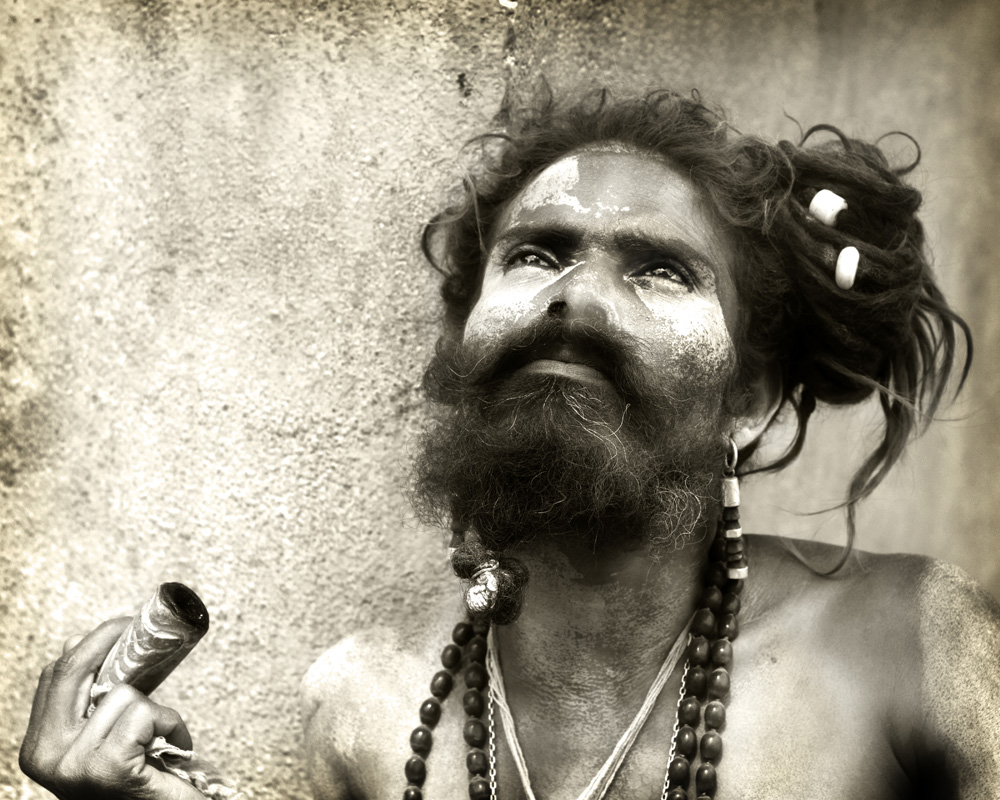
The Indians, Megasthenes says, were originally nomads, like the non-agricultural Skythians, who wander in their waggons and move from one part of Skythia to another, not dwelling in cities and not reverencing shrines of the Gods. Just so the Indians had no cities and built no temples, but were clothed with the skins of wild animals they would kill, and ate the bark of trees; these trees were called in the Indian tongue Tala, and what look like clews of wool grew on them, just as on the tops of palm trees. They also fed on what game they had captured, eating it raw, at least until Dionysos reached India. But when he arrived and became master of India, he founded cities, gave them laws, bestowed wine on the Indians as on the Greeks, and taught them to sow their land, giving them seed. (Either Triptolemos did not come this way when he was sent out by Demeter to sow the entire earth, or it was earlier than Triptolemos that this Dionysos, whoever he was, traversed India and gave the Indians seeds of domesticated plants.) Dionysos first yoked oxen to the plough and made most of the Indians agriculturalists instead of nomads, and equipped them also with the arms of warfare. He also taught them to reverence various Gods, but especially of course himself, with clashings of cymbals and beating of drums; he instructed them to dance in the Satyric fashion, the dance called among Greeks the ‘cordax’, and showed them how to wear long hair in honour of the God with the conical cap, and instructed them in the use of perfumed ointments, so that even against Alexander the Indians came to battle to the sound of cymbals and drums.
The Terror of the Threshold
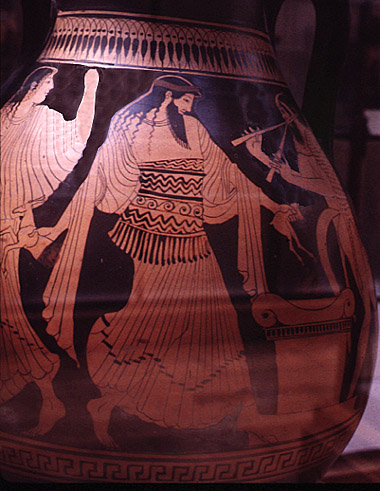
One of the greatest challenges to reconstructing an authentic Dionysian eschatology is that there wasn’t really one in antiquity.
What you find instead are a loose collection of rituals, myths, rough concepts and such that each group then fashioned into its own unique mysteries. They interpreted things differently, emphasized certain elements more than others, took on local influences and generally evolved over time if given the chance.
And yet for all of that bewildering, chaotic complexity I imagine that a Dionysian from Southern Italy in the second century could enter a dining-hall full of fellow-initiates from North Africa, the Balkans, England and the Ukraine and once they’d settled the language issue — Greek or Latin — could probably have a meaningful conversation about death and what came after, for they were all part of a seamless tapestry of tradition.
This group concerned themselves with the banquet table piled high for the feast while for that group it was the krater overflowing with wine, reflecting torchlight like dancing stars. These ones thought only of Dionysos and his bride twined in amorous congress while those ones had eyes only for the crowd of elegant dancers, faces whitened like masks. Some the bull’s horns on the altar, some the ivy winding around the column, some the maenads in the distance hunting in the woods, some the floor littered with leaves and broken cups and the bones of beautiful beasts. Others saw the maiden hesitating at her door, glancing back at the life she’s leaving behind while Eros or a boy who looks very much like him beckons to her with a ball of string in his golden hand.
Take a step back.
Do you see the picture that all of these scenes together make?
You will when you’re dead, if you’re one of us.
And that’s why I’m not opposed to modern innovations — as long as they hit all the right notes.
You see, folks, it’s all about the rhythm.
The clapping of hands.
The thunder of drums.
Stomping feet.
Hearts beating.
You hit the right notes, that’s when the screams begin.
How do you ecstasy?

Go outside. Go for a long, rambling walk, letting your legs take you wherever they want to go. Let your mind wander, but don’t focus too much on your thoughts. Be open. Try to really see and feel and smell and taste what’s around you. Be present in your body to the point where you can feel the heart in your chest swell and throb as it circulates the blood through you, the “slow, wet mechanism of muscle and bone” that allows you to stride aimlessly through the city streets. Breathe. Breathe. Empty your mind of all thoughts but thoughts of him. Remember how you’ve experienced him in the past through all of your senses: the heat of the flame kissing your fingers, the tartness of good warm wine drunk in front of his shrine, air thick with clouds of incense smoke, earthy and sweet with a musky undertone, grass brushing against your cheek as you roll in a fit of laughter, black soil caught underneath your jagged and broken nails from pounding your fist into the ground as the tears cut fiery swaths down your cheek, that warm, sexy excitement that enfolds you whenever he’s near. Breathe. Call to mind whatever reminds you of him. And then open your eyes and look for him and signs of him in the world around you.
Worship, the Sannion way

I have been doing this ritual stuff since my early teens, which means that I’ve had a lot of practice and gotten pretty good at it. I have all of the necessary steps memorized and an innate sense of flow and rhythm. I know what works, and what doesn’t, and why.
I have not imposed an official ritual style for the Starry Bull tradition; instead I’ve given folks the broad parameters of what to do and let them fill in the rest with their own unique style and if they don’t know what to do I’ve encouraged them to experiment so that they can figure out what the best method for them and for our Gods and Spirits happens to be.
Which is fine if you already have experience and some aptitude for ritual, but if you’re coming to this with a blank slate it can be really easy to get lost, overwhelmed and frustrated. Sometimes I forget how daunting all of this can be for beginners.
While some folks have expressed a desire for ritual scripts I will not be providing them. I think that builds up bad habits and can be distracting and limiting, especially when you’re in ritual space. What I will do is walk you through an example of the sort of rituals that I perform.
For me ritual begins well before it actually starts. In fact I’ve been known to spend a couple hours in prep with the ritual itself done in under thirty minutes. That slow, focused build up helps blur the boundary between ordinary and sacred time as well as enables me get into a proper headspace. I don’t know about you, but my life can be downright stressful with a ridiculous amount of distractions and it’s important to put all of that aside when you come before the Gods and Spirits.
And that, primarily, is what we are doing in ritual. Oh, there’s different types of ritual for different needs and occasions but what I’m talking about here is religious and devotional ritual. So as you’re getting ready try to focus your mind on what you’re about to do, which is celebrate and engage with one or more members of our pantheon.
Who are they?
Which of their forms are you trying to engage with?
What prior experience do you have with them?
What do you know about them and how do you know that?
What stories are told about them within our tradition?
What experiences have others described?
What are their preferences and dislikes?
Why are you doing this and what do you hope to get out of it?
These are the sorts of things you should be thinking about as you get ready. Any time that you feel yourself getting distracted or bogged down by other stuff, go over these questions and they will help you get back on track.
Music is central to a lot of what I do, both in and outside of ritual, so I like to have something appropriate playing while getting ready. Choose the music carefully so that it’s reflective of the mood you’re trying to strike and consistent with the nature of the beings you are honoring. Just because I happen to like a certain song doesn’t mean that my Gods or Spirits will and if I’m doing something somber and serious listening to theme songs from 80s cartoon shows probably isn’t a very appropriate choice. Probably.
As I’m getting ready I like to go over what I intend to do a final time, read over any prayers or hymns so that they are fresh in my brain even if I intend to read them during ritual as opposed to just reciting extemporaneously, make sure that I have all of the necessary supplies on hand and prepare the shrine if I’m doing stuff indoors. That means clearing away any offerings that may still be there from the last ritual, making sure everything like dishes and shrine cloths are clean and arranged nicely, that there’s enough room to do what I’ll need to and that fresh candles and incense are ready to go. Some people might want to purify the shrine at this stage with chernips, Florida water, sand, barley, a smudge stick, incense or whatever their preferred method happens to be – I generally don’t if it’s a permanent shrine and only do so for occasional shrines when I get a strong push that it’s necessary. I figure that the shrine becomes imbued with the power and presence of the divinity being honored and if permanent they have altered its structure to be more conducive for them and I don’t really want to fuck with that. However other people tend to be more concerned with purity than I am so it’s an entirely appropriate step to take at this time. I do generally “prime” the shrine by burning some incense and lightning candles, even though I’m not yet actively engaged in ritual. I feel that this is like switching on an “open for business” sign and is also a signal to myself that we’re getting closer to serious ritual time so nothing extraneous should be allowed to creep into my consciousness from this point forward. Likewise I may change the music I’m listening to to help hasten the transition into ritual mode.
At this point I finish preparing myself. I run through what I plan to do during the ritual a final time and I make sure that my head is screwed on appropriately i.e. I’m not distracted, in a bad place mentally or emotionally, properly open and receptive to the Gods and Spirits and so forth. If there’s something I need to do in order to get that way (such as smoke a bowl, drink some wine, read something or listen to a particular song) I do so. Then I make sure that I am physically ready, which generally consists of taking a pre-ritual bath or shower during which I recite a benediction I came up with back when I was serving as an oracular priest and spend some time meditating and setting my intent. Then I dress in clean and appropriate clothing (I am restricted to blacks, reds, whites and greys generally but also have special attire I wear for my more formal rites) and if I feel it’s necessary I may do some added purifications. Lastly I put on some of my ritual jewelry and depending on the nature and formality of the rite may wear a stephanos or garland-crown.
And now I’m ready to ritual. Though I rarely do a full pompe or procession, as I approach the shrine I am conscious of coming into the presence of the holy. I light any remaining candles and incense and then formally greet the divinity, using a variety of simple stock phrases I’ve come up with over the years. I then pour out the libations and place all of the offerings I’ve brought for them on or before the shrine, depending on how crowded it is and how much I’m giving to them. Then I either praise them with my own words or read off a hymn (either something I or another community member has written or one of the Orphic or Homeric Hymns) and then do some on the spot praying or petitioning, as seems appropriate.
Depending on the nature of the rite I may then just spend some time being open to them and basking in their presence or go into an assortment of devotional activities such as dancing, sacred movement, talking with them, listening to music, singing, a variety of ecstatic techniques, magic, divination, consuming drugs or drinking, bloodletting, reading appropriate material, doing something creative such as crafts or writing, or specific activities determined by the nature of the rite. Often I go through several of these and like to keep things open, loose, free-flowing and spontaneous. When I am finished with that I spend some more time just being in their presence and when I feel like the ritual is done I thank them for everything and begin gradually transitioning back into ordinary awareness, one of the first steps being the removal of my stephanos. I usually leave the candles and incense going until this point, and if I will be around afterwards may let them burn until they are done.
I do not have elaborate closing procedures as I generally find that rude with this sort of devotional rite – I wouldn’t make a feast for a friend and then tell them to get the fuck out once we were done eating, so why would I treat my Gods and Spirits with that level of disrespect? A simple but effective though non-offensive way to close the rite is to ring a bell (something that can be done to open it as well.)
And, with some variation depending on the nature of the rite and why I’m doing it, that’s what my style of worship consists of, at least when I’m in front of my home shrine. I have a slightly different approach when I’m doing things outdoors or with other people. I tend to be a little more formal in a group setting, for instance.
An email that became a blog post.

First I’d like to start by sharing one of my favorite quotes on the subject:
We work in the dark – we do what we can – we give what we have. Our doubt is our passion, and our passion is our task. The rest is the madness of art. (Henry James, The Middle Years)
Of course I’ve gone through what you describe, and I don’t necessarily think that’s a bad thing. I think if you never experience any doubt you’re in a very dangerous place. That leads to a mindless fundamentalism and also a sort of hollow, useless faith. Because I feel the trials and skepticism I’ve experienced have actually made my faith much stronger than when I started out.
However, as with all things, you can take it too far, and end up talking yourself out of some really good experiences.
So, the question: how do you know? How do you really know?
You don’t.
You can’t.
Fuck, you can’t even really prove that anything outside of yourself actually exists and isn’t just a figment of your imagination. I mean, for all you know, I might not exist. This e-mail could just be magically appearing to you out of nowhere, or perhaps you’ve got multiple personality disorder and one of your other selves is writing this to you.
I know that that’s not the case, because I’m sitting here typing it myself, but really, how do you know that? You don’t, but the alternatives seem rather improbable, don’t they? As Klaudios Ptolemaios once said a thousand and some years before William of Ockham was born, “We consider it a good principle to explain phenomena by the simplest hypothesis possible.”
And that’s really something that I’ve noticed. It’s much simpler to take things at face value. It requires less effort, less mental juggling, less trying to explain away all these coincidences. Because once you start down the skeptics’ path, and really start questioning everything, it all unravels, and your questions never end.
Now I’m not saying that believe everything is the best approach – as I said above a proper dose of skepticism is a good thing – but there has to be a balance. And that’s really one of the fundamentals of Hellenismos. At Delphi were inscribed a series of maxims or wise sayings and one of the foremost of these was “Everything in moderation” or “Nothing to Excess”.
Now, I could give you a bunch of theological and philosophical proofs for the existence of the Gods – the Greeks loved this shit – but really, do those work? They don’t for Christians, as you and I both know all too well, and they don’t for any other religious. People like to think that you can reduce it down to a mathematical proof, but you can’t. That’s just not how spiritual things work. They have their own laws, their own type of existence, and therefore the laws that govern our meat bodies don’t apply to them. What I’ve always found to be a much surer proof than pretty sounding words – and paradoxically, less certain – is one’s experience.
When you begin to experience the Gods, have genuine encounters with them, feel them as an intimate part of your life, the junkyard dog of doubt that lives in your heart begins to curl up and go to sleep. Not at first, of course. Especially when you’ve had to break away from your cradle faith – which can be an incredibly painful process – you get into such a habit of doubting everything that it’s natural, reflexive. But eventually, over time, you’ll begin to see that you don’t need that armor, that all these weird and wonderful things are happening, things that you can’t explain in any other way but than to assert the existence of the Gods.
So often the root of skepticism lies in fear. Fear of being hurt, fear of being taken advantage of, fear of putting your faith in something that’s going to let you down, fear of looking foolish. So, in order to combat this fear, one actively wars against faith, asserting their independence, insisting that this can’t and won’t touch their life, and thus they won’t be hurt anymore.
But what do you get when you base your life on fear?
Nothing comes out of nothing, and fear only begets fear, emptiness, and loneliness.
It takes real courage to put aside that fear and embrace life to its fullest. And to really be living, you have to take risks, you have to be willing to get your knees bruised and your heart broken.
And Hellenismos is, above all things, a religion of life. Each of our Gods presides over a particular part of it, and in experiencing that part of life to its fullest, you draw closer to them.
And really, a lot of the worries that lead to rampant skepticism don’t apply in Hellenismos. There’s no authority, no one who stands between you and the Gods. No one who’s going to take advantage of you, steal your money, tell you what to do with your life. At most, our priests lead rituals and offer advice – but even then, there’s nothing that says you have to accept what they say as the gospel truth. You are allowed – nay ENCOURAGED to argue with them, and think things out for yourself.
You’re even allowed to disagree with the Gods.
And yeah, maybe there’s still the fear of looking foolish, because from some perspectives, what we do can look a little silly. Standing in front of a table with pretty bowls and statues and pouring wine to them and scattering barley and reciting poetry – yeah, that can seem a little silly.
But really, is that the worse thing in the world?
Think about it – how foolish do you look when you dance, or when you have sex? There is nothing more absurd than two people making love – and yet, nothing more intense, more beautiful, more mindblowingly amazing than good sex. Hell, even bad sex is still sex.
So really, sometimes you’ve just got to let go and let yourself be in the moment, and accept that yup, you’re going to look silly afterwards, but that doesn’t matter, because right now it feels incredible.
And believe me, worship, real worship where you can actually feel the Gods present there with you – is the most amazing thing in the world. Yeah, it’s even better than sex – though I don’t know if I’d want to have to choose between the two of them.
So that’s really my advice – start slow and work your way up. Read about the Gods, try to get an understanding from those readings about them. Then go out into the world and see if you can find them there. Because our Gods don’t just inhabit some fairytale otherworld; they also exist right here, with us, in this world. They live in the sky and the earth, in trees and mountains, in old buildings and city streets. You can find them anywhere and everywhere. The mass of people experience them, but no longer have the vocabulary, the worldview in which to place those experiences. They have also come to doubt their senses. They think only the intellectual matters, and that what you feel with the flesh, what you smell and taste and hear is deeply suspect. Only the mind is to be trusted. Well, mind is nice, but we’re more than mind. We’re all of our senses together, and a little something else, a something that exists beyond the physical. And so is everything else in the world.
So, remember that, and remember that there are many ways to experience things. You aren’t always going to encounter the Gods as seven foot tall humanoid beings who come up and have a heart to heart with you. In fact that’s pretty rare. Sometimes it’s just a feeling of PRESENCE, perhaps accompanied by a smell or taste or some odd random occurrence. Sometimes you’ll experience them in animal form – a deer that uncharacteristically stops, looks at you, and you see in its eyes a greater than animal intelligence. Sometimes its as simple as a sudden breeze rustling the leaves to get your attention, or a phrase on a billboard that exactly matches the contents of your thoughts at that moment. Sometimes you’ll have a dream or a vision, and yes, occasionally you’ll get a burning bush, but not very often. That’s not usually how the Gods choose to act. But the thing is, they do choose to act, and they can choose to act in any number of ways. So that’s part of the religion too – mindfulness. Paying attention to the world around you, instead of contemplating your navel or dreaming of a distant heaven. It’s being here, now, and acting in the world. Which is why stuff like prayer and sacrifice is so important. Because the Gods aren’t just good feelings inside us – they have an independent existence outside of us. And in gratitude for the real things that they do for us, we offer real actions to them. And that’s something else that’ll help with doubt – finding a regular routine of worship, and doing it, no matter what.
Because you aren’t always going to feel up to doing it, sometimes you’ll downright kick and scream against it. But those are the times when you need to do something like that the most. And don’t always expect that there’ll be fireworks kind of experiences when you do that routine – sometimes it’s pretty boring, but you should still do it, because it’s a way of showing respect to the Gods.
When it comes down to it Hellenismos is about gratitude, about deepening your relationship with the Gods. It’s not about dogma, it’s not about fear, it’s not about demeaning and humiliating yourself in order to exult God – it’s about simple thankfulness. About honoring the Gods as the bestowers of all of life’s blessings, and worshipping them by sharing our food, our drink, by reciting pretty words, by making art, by dancing or racing or perfecting our bodies, by simply acknowledging that they’re there, that you recognize all that they’ve done for you, and that you deeply appreciate them.
It’s as simple – and as incredibly profound – as that.
pray with your dead
Xanthias: I have it, master: ’tis those blessed mystics, souls of those who were initiated into the mysteries in life, which we were told would be sporting in the area. They are singing the Iakchos hymn that Diagoras made. (316)
This passage from Aristophanes’ The Frogs reminds us that the deceased perform the same rituals and keep the same festivals that the living do. The point was even more forcefully driven home by Herodotos:
Moreover Dikaios the son of Theokydes, an Athenian exile who had gained great repute at the court of the Medes, reported that when he was near the city, which had been deserted when the Attic land was ravaged by Xerxes’ army, he and Demaratos the Lacedemonian saw a cloud of dust going up from Eleusis, as if made by a company of about thirty thousand men, and they wondered at the cloud of dust, by what men it was caused. Then forthwith they heard a sound of voices, and Dikaios perceived that the sound was the mystic cry Iakchos; but Demaratos, having no knowledge of the sacred rites which are done at Eleusis, asked him what this was that uttered the sound, and he said: “Demaratos, it cannot be but that some great destruction is about to come to the army of the king: for as to this, it is very manifest, seeing that Attica is deserted, that this which utters the sound is of the Gods, and that it is going from Eleusis to help the Athenians and their allies: if then it shall come down in the Peloponnese, there is danger for the king himself and for the army which is upon the mainland, but if it shall direct its course towards the ships which are at Salamis, the king will be in danger of losing his fleet. This feast the Athenians celebrate every year to the Mother and the Daughter; and he that desires it, both of them and of the other Hellenes, is initiated in the mysteries; and the sound of voices which thou hearest is the cry Iakchos which they utter at this feast.” (The Histories 8.65)
That is why tradition is so important. It binds us to all who came before through the same repetitive sacred acts. When our feet follow theirs in the dance, when we repeat the words they once said it creates an echo across the ages, a powerful reverb that amplifies the dromenon and legomenon.
One may freely step out of the stream of tradition at any time. If one is knowledgeable and masterful enough in the craft of ceremony one may even devise new modes of effective worship. If practiced diligently and with an earnest desire to please the divine, such innovations may in time accrue the depth and flow of tradition, even if it is a trickle compared to the rush of the Nile or Euphrates.
But they rarely do.
How could they with so few dead behind them?
The dead exist in the shadowy realm between men and the Gods; no longer the one nor yet the other. Because of this liminal condition they are conduits to other worlds and through them blessings flow into this world of ours. That is why during the season of the emergence of flowers when we taste the new wine for the first time, the dead roam freely about. Death and life are inseparably united, as the Orphics of Olbia recognized:
βίος. θάνατος. βίος. ἀλήθεια. Ζαγρεύς. Διόνυσος (SEG 28.659)
If an individual or a community is to prosper they must be in right relationship with their dead, and if one was not there were religious specialists such as the Orpheotelestai to facilitate that:
They adduce a hubbub of books by Musaeus and Orpheus, descendants, as they say, of the Moon and of the Muses, according to which they arrange their rites, convincing not only individuals but also cities that liberation and purification from injustice is possible, both during life and after death, by means of sacrifices and enjoyable games to the deceased which free us from the evils of the beyond, whereas something horrible awaits those who have not celebrated sacrifices. (Plato, The Republic 364e)
People often ask why Christianity succeeded in supplanting ancient Paganism. I suspect the answer is a combination of a number of complex factors, but one of the most important was definitely that Christianity from the beginning was a cult of the dead, and as Theodoret of Kyrrhos explained, their dead were very good to them:
Those who are well ask the martyrs to protect their good health, while those who are worn down by illness request release from their sufferings. The childless ask for children, infertile women call out to become mothers, and those who have received this gift request that it be kept perfectly safe for them … They do not approach them like Gods – rather they entreat them as men of God and call on them to act as ambassadors on their behalf. Those who ask with confidence gain what they request – their votive offerings clearly testify to their healing. For some offer representations of eyes, some of feet, others of hands; some are made of gold, others of wood. Their master accepts these little items of little worth, valuing the gift according to the merit of the one offering it. The display of these objects advertises deliverance from suffering – they have been left as commemorations by those who have regained their health. They proclaim the power of the martyrs laid to rest there – whose power proves the greatness of their God. (The Healing of Pagan Diseases 8.63-4)
In contrast, a generation before Theodoret’s time the emperor Julian found only one man in the city of Alexandria Troas who was still carrying out the rites of the heroes, and he was a Christian bishop of decidedly heterodox beliefs:
After rising at early dawn I came from Troas to Ilios about the middle of the morning. Bishop Pegasios came to meet me, as I wished to explore the city,—-this was my excuse for visiting the temples,—and he was my guide and showed me all the sights. So now let me tell you what he did and said, and from it one may guess that he was not lacking in right sentiments towards the Gods. Hector has a hero’s shrine there and his bronze statue stands in a tiny little temple. Opposite this they have set up a figure of the great Achilles in the unroofed court. If you have seen the spot you will certainly recognise my description of it. You can learn from the guides the story that accounts for the fact that great Achilles was set up opposite to him and takes up the whole of the unroofed court. Now I found that the altars were still alight, I might almost say still blazing, and that the statue of Hector had been anointed till it shone. So I looked at Pegasios and said: “What does this mean? Do the people of Ilios offer sacrifices?” This was to test him cautiously to find out his own views. He replied: “Is it not natural that they should worship a brave man who was their own citizen, just as we worship the martyrs?” Now the analogy was far from sound; but his point of view and intentions were those of a man of culture, if you consider the times in which we then lived. Observe what followed. “Let us go,” said he, “to the shrine of Athene of Ilios.” Thereupon with the greatest eagerness he led me there and opened the temple, and as though he were producing evidence he showed me all the statues in perfect preservation, nor did he behave at all as those impious men do usually, I mean when they make the sign on their impious foreheads, nor did he hiss to himself as they do. For these two things are the quintessence of their theology, to hiss at demons and make the sign of the cross on their foreheads. These are the two things that I promised to tell you. But a third occurs to me which I think I must not fail to mention. This same Pegasios went with me to the temple of Achilles as well and showed me the tomb in good repair; yet I had been informed that this also had been pulled to pieces by him. But he approached it with great reverence; I saw this with my own eyes. (Letter to a Priest)
Meanwhile, Julian found the piety of his fellow Pagans lacking:
Hellenismos does not yet prosper as I desire, and it is the fault of those who profess it; we have made some small progress — indeed, by Adrasteia far more than any of us could ever have hoped for a short while ago, but we should not be satisfied with this. Don’t you see that it is their benevolence to strangers, their care for the graves of the dead and the pretended holiness of their lives that have done most to increase atheism? I believe that we ought really and truly to practice every one of these virtues. And it is not enough for you alone to practice them, but so must all the priests in Galatia, without exception. Either shame or persuade them into righteousness or else remove them from their priestly office, if they do not, together with their wives, children and servants, attend the worship of the Gods and the dead they should not be considered priests. Do not allow even your servants or sons or wives to show impiety towards the Gods and honour atheism more than piety. (To Arsacius, High-priest of Galatia)
The Reformation seriously damaged the cult of the saints and martyrs and as a result the influence of Christianity has diminished throughout the world. Where it remains strongest you will usually find a proper emphasis placed on honoring the dead, something that even certain Protestant sects have learned to do.
So if we want to see Paganism and our respective polytheist communities flourish we must lay our foundation upon the dead and let them guide us in the worship of our Gods.
For when the Gods are near to us, so too are our dead, at least if your God is anything like mine:
Silenus, whom the merry maids had raised upon an ass, rode along, holding a golden goblet, which was constantly filled for him. Slowly he advanced, while behind whirled in mad eddies the reckless troop of vine-clad revelers. You, reader, who are well educated and familiar with descriptions of Bacchanalian orgies or festivals of Dionysos, would not have been astonished by this. At the utmost, you would only feel a slightly licentious thrill at seeing this assembly of delightful phantoms rise from their sarcophagi to again renew their ancient and festive rites, all rioting, reveling, hurrahing Evöe Bacche! (Heinrich Heine, Die Götter im Exil)
Even if you are inventing new rites include the dead in what you do and it will go better for you.
And also, when you’re dead — and we’re all gonna die, dearies; don’t you have any illusions about that — work to assist those who will follow.
Simple.

Nice poetry, Sannion, but I’m not an ecstatic — what can I do?
Simple. Follow the advice that Vishnu gives Arjuna in the Bhagavad Gītā:
By sacrifice will you procreate! … Foster the Gods with this, and may They foster you; by enriching one another you will achieve a higher good. Enriched by sacrifice, the Gods will give you the delights you desire; he is a thief who enjoys Their gifts without giving to Them in return. Good men eating the remnants of sacrifices are free of guilt, but evil men who cook for themselves alone eat the food of sin. Creatures depend on food, food comes from rain, rain depends on sacrifice, and sacrifice comes from action … the ever pervading infinite spirit is present in rites of sacrifice.
Ecstasy is the key
The thing you’ve got to realize
is that the polytheist and the atheist live in the same world
and are witness to the same events.
It’s just that the polytheist is sensitive enough to discern the pattern of the divine.
It has a feel, a scent. Everything goes a bit slanty when it’s near.
But you know, you recognize it.
How does the musician hear the tune?
How does the artist see what isn’t there yet?
How does the dancer move so?
Inspiration.
Intimacy with Gods and Spirits is a grace
– it does not happen unless they will it.
We are in darkness until initiation opens our eyes.
And once that happens, there’s no going back.
It’s fine to find religion from a book.
But there comes a time when you need to start doing religion
and not just being religious.
For my Ukraine
Tove, our housemate and ritual partner, reflects on what’s happening in her homeland.


The rivers and the forests of Ukraine flow through me, what happens to it happens to me. I shall lie on its soil as it will embrace and engulf me. I shall rest there as one would in their home. I am Ukraine and Ukraine is me. But even as Ukraine cries and struggles, the land is mighty and it knows itself. Its Spirits and Deities are ancient and large, and lie deep in the soil below the surface. The things that happen on the surface may wake up the anger of its Gods, but they cannot harm them. We carry Ukraine in our hearts, it is not contained in buildings of wood and stone.
Ancient Greek drinking vessels were weird
Not only were there the Greek Eye Cups, but also things like this:

 The House of Vines