Author: thehouseofvines

For my Ukraine

Tove, our housemate and ritual partner, reflects on what’s happening in her homeland.

Tove's avatarFreyja's Frenzy

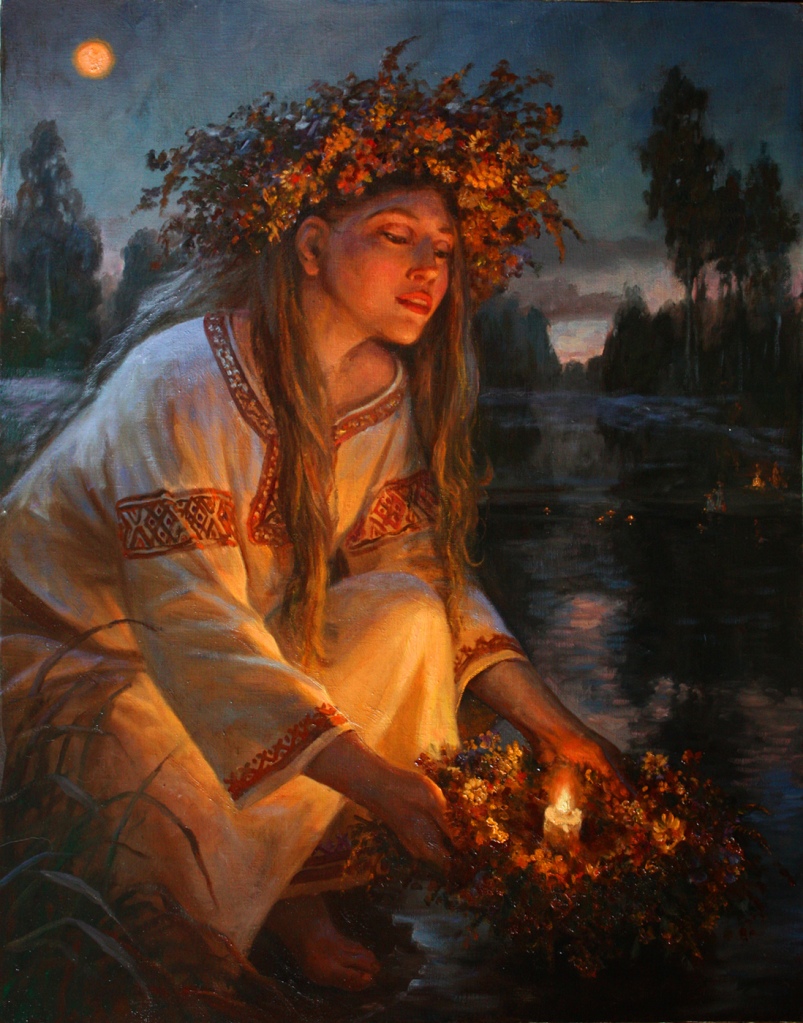
Kupala Night by Andrey Shishkin

The rivers and the forests of Ukraine flow through me, what happens to it happens to me. I shall lie on its soil as it will embrace and engulf me. I shall rest there as one would in their home. I am Ukraine and Ukraine is me. But even as Ukraine cries and struggles, the land is mighty and it knows itself. Its Spirits and Deities are ancient and large, and lie deep in the soil below the surface. The things that happen on the surface may wake up the anger of its Gods, but they cannot harm them. We carry Ukraine in our hearts, it is not contained in buildings of wood and stone.

View original post

he feels all alone in a threatening world where what lies ahead is vague and uncertain

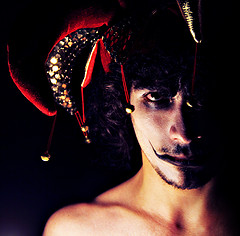
Heard joke once: Man goes to doctor. Says he’s depressed. Says life seems harsh and cruel. Says he feels all alone in a threatening world where what lies ahead is vague and uncertain. Doctor says, “Treatment is simple. Great clown Pagliacci is in town tonight. Go and see him. That should pick you up.” Man bursts into tears. Says, “But doctor…I am Pagliacci.”

― Alan Moore, Watchmen

Shifting focus

One thing that’s going to be different going forward is that I want to broaden my scope, since there’s a lot more to the Starry Bear proto-tradition than just Dionysos’ identification as Óðr and his interactions with assorted Scandinavian and Slavic deities, or the history of the Ukraine (and the city of Olbia in particular), important as these things are. And of course I will write about them as discoveries and insights warrant, or if folks have questions I can answer, but otherwise I really want to branch out and focus on underrepresented or neglected portions of the proto-tradition, and the Gods and Spirits who oversee it – Norse, Hellenic and other.

What to expect concerning the Starry Bear

When I asked for writing prompts I got two requests: more Starry Bear stuff, and more Harlequinade stuff. I’m going to start with the Starry Bear stuff. 

As many of you are aware the Starry Bear is a proto-tradition and the companion of the Starry Bull tradition, but predominantly focused on Northern Europe. In the coming months I’ll be writing about four threads of this proto-tradition, which can be divided as follows. 

The first is mythological. It focuses on the stories told about our Gods and Spirits, drawing on a diversity of sources. These sources includes archaic star-lore, Neolithic and migration-era petroglyphs and other archeological evidence, Greco-Roman ethnographies regarding the various Barbarian populations, Eddic and Skaldic poetry, Germanic and Slavic folktales, 18th through early 20th century Romantic continuations primarily by German, Scandinavian and Russian authors, as well as some modern material. 

The second concerns praxis. This consists of what can be reconstructed of the pre-Christian religious beliefs and practices of Northern Europe, combined with elements from Medieval and Early Modern Christian folk customs, superstitions and other potential “pagan survivals” and syncretic and dual tradition religions, as well as later inspired and reimagined versions of these from the Romantic period, plus Heathenry as well as contemporary Slavic and Baltic polytheisms. 

The third consists of UPG – from myself, my ritual partners, and some of our colleagues. This can encompass everything from encounters with our Gods and Spirits and what this teaches us about right engagement with these Powers, to techniques that they have taught or shown us, visions and other ecstatic revelations they’ve gifted us, attempts at reconstructing ancient mystic and esoteric practices, as well as new material we’ve come up with or been given by them. Likewise inspired poetry, modern myths and elaborations, prophecies and oracles, and the like fall into this category. 

Finally, there is an evolving culture which includes folk practices, values and norms, shared terminology, and other expectations regarding human interactions both with fellow members and outsiders, as well as similar elements pertaining to community – both that which exists now, primarily on the internet, and that which we are striving to create in the world, which will hopefully continue to exist long after us.   

Take all of this, put it in a blender for a while, and what you’ll end up with is the Starry Bear proto-tradition. 

I’m sure there’s a lot more that I’ve left out, but that should give you an idea of what to expect in the coming months here at the House of Vines.

Hopefully that will be to your liking and I won’t frighten off the remainder of my readership.  

Greece and Egypt Before the Ptolemies

Most people are probably aware that, beginning in the fourth century b.c.e. with the rise to power of the Makedonian dynasty founded by Ptolemy, son of Lagos, there were extensive contacts between Greece and Egypt, resulting in a fusion of cultures which produced the wildly popular cult of Isis and Serapis that proved a worthy competitor to Christianity for the mind and soul of the Roman Empire. What often isn’t as well known is the extent to which these contacts existed for centuries, and even millenia before then.

In fact, Egypt’s presence can be felt on Greek soil even before there were proper Greek-speaking people there. The Keftiu, whom archaeologists believe to be the Minoans, participated in the raids of the Sea Peoples that harried Egypt’s borders in the 2nd millennium bce. (Merneptah Stele 52) Many historians see in Plato’s account of the mythical Atlantis a memory of these excursions:

“…the island of Atlantis…had subjugated the parts of Libya within the Pillars of Hercules as far as Egypt, and Europe as far Tyrrhenia. This vast power, gathered into one, endeavored to subdue at a blow our country [Egypt] and yours [Greece], and the whole of the region within the straits…”(Timaeus 24d)

When they weren’t involved in piracy, the Minoans seem to have had extensive trade relations with Egypt, unsurprising since Crete is centrally located between Egypt, Cyprus, and the Levant. Numerous archaeological remains attest to these early contacts: an obsidian vessel rim fragment dating from the early Dynastic period, a worked hippopotamus tusk, and Egyptian stone vases were found in Early Minoan IIA domestic contexts at Knossos (Jacke Phillips, Aegypto-Aegean relations up to the 2nd millennium B.C. in: Interregional Contacts in the Later Prehistory of Northeastern Africa, 1986, pg. 459). Cretan goods have even been found in Egypt. Professor Flinders Petrie discovered in the lowest levels of the temple at Abydos black pottery which he concluded came from Crete on account of its close resemblance to fragments discovered by Sir Arthur Evans in the Late Neolithic deposits of Knossos. (Abydos, Vol. II, p. 38)

There are clear Egyptian influences in Cretan and Mycenean art, society, and cult practice. The earliest Minoan written language, as seen on the Phaistos disk, bears striking resemblances to Egyptian hieroglyphs, though it has yet to be deciphered in its entirety. And, as the Australian philologist Gordon Childe observed, “At least on the Mesara, the great plain of southern Crete facing Africa, Minoan Crete’s indebtedness to the Nile is disclosed in the most intimate aspects of its culture. Not only do the forms of early Minoan stone vases, the precision of the lapidaries’ technique and the aesthetic selection of variegated stones as his materials carry on the the pre-dynastic tradition, Nilotic religious customs such as the use of the sistrum, the wearing of amulets in the forms of legs, mummies and monkeys, and statuettes plainly derived from Gerzean ‘block figures’, and personal habits revealed by depilatory tweezers of the Egyptian shape and stone unguent palettes from the early tombs and, later, details of costumes such as the penis-sheath and loin-cloth betoken something deeper than the external relations of commerce.”

The Minoans apparetly learned how to work with faience from the Egyptians, and created lovely figurines of snake-handling goddesses adorned with a crown upon which rises a serpent like the Uraeus of the Egyptian Pharaohs. The Uraeus Crown was connected with the goddess Wadjyt, which makes Sir Arthur Evans’ discovery on the site of the lower part of diorite statue of a seated Egyptian figure identified from the hieroglyphic inscriptions as a priest of Wadjyt all the more striking. (The Palace of Minos, 4 vols., London: Macmillan, 1921-1935) Another statue of an Egyptian goddess, this time the hippopotamus-formed Taweret, patroness of childbirth, was also found on Knossos.

Even after the decline of Minoan civilization, contacts between Egypt and Greece flourished. There was extensive trade between the two cultures, with Egyptian goods showing up in the mound tombs of the Mycenean royalty, and Egyptian influence evident in the golden face-masks of the deceased kings, a part of the funeral arrangement that Homer appears to be ignorant of. Trading ports at Cypros, Pylos, and Myceneae arose during this period, and their wares have been found in several sites at Egypt. (Marianne Nichols, Man, Myth and Monument, William Morris, 1975)

The Roman author Flavius Josephus speaks of how these trading ventures came to influence Greek culture:

“Since, therefore, besides what we have already taken notice of, we Jews have had a peculiar way of living of our own, there was no occasion offered us in ancient ages for intermixing among the Greeks, as they had for mixing among the Egyptians, by their intercourse of exporting and importing their several goods; as they also mixed with the Phoenicians, who lived by the sea-side, by means of their love of lucre in trade and merchandise. Nor did our forefathers betake themselves, as did some others, to robbery; nor did they, in order to gain more wealth, fall into foreign wars, although our country contained many ten thousands of men of courage sufficient for that purpose. For this reason it was that the Phoenicians themselves came soon by trading and navigation to be known to the Grecians, and by their means the Egyptians became known to the Grecians also, as did all those people whence the Phoenicians in long voyages over the seas carried wares to the Grecians.” (Against Apion 1.12)

It wasn’t just by way of trading, however, that Egypt came to influence Greek culture on the mainland. Several of the royal houses of Greece claimed descent from Egypt. For instance, the Argives traced their lineage back to Danaus, the twin-brother of Aigyptos, who gave his name to the land of Egypt. While in that country the brothers had a falling out and the younger fled to Greece with his fifty daughters. (Aeschylus’ Suppliants) This was a homecoming of sorts, as the brothers were descendents of Epaphos, the first king of Egypt, whose mother Io had originally been a Greek princess whom Zeus had taken a liking to, and as a consequence of that was transformed into a heifer by Hera and driven across the ocean, where she eventually ended up in Egypt. (Apollodorus 2.5-9) Additionally, both the the Spartan royal household and the sons of Acrisius claimed descent from Egypt (Herodotus 6.53-54).

Another Greek dynasty, that of the Theban city founded by Kadmos, could also look back to Egypt for its roots. In antiquity there was disagreement about Kadmos’ origins. According to the standard account, he was the son of the Phoenician king Agenor, who came to Greece while looking for his sister Europa and decided to settle there instead of returning home. He was credited with the invention of the alphabet, called phoinikeia grammata by Herodotus (5.58) However, there was also a variant tradition that claimed that he was originally of Egyptian extraction and expelled at the time of the Hyksos:

“Now that we are about to record the war against the Jews, we consider it appropriate to give first a summary account of the establishment of the nation, from its origins, and of the practices observed among them. When in ancient times a pestilence arose in Egypt, the common people ascribed their troubles to the workings of a divine agency; for indeed with many strangers of all sorts dwelling in their midst and practicing different rites of religion and sacrifice, their own traditional observances in honour of the gods had fallen into disuse. Hence the natives of the land surmised that unless they removed the foreigners, their troubles would never be resolved. At once, therefore, the aliens were driven from the country, and the most outstanding and active among them banded together and, as some say, were cast ashore in Greece and certain other regions; their leaders were notable men, chief among them being Danaus and Cadmus. But the greater number were driven into what is now called Judaea, which is not far distant from Egypt and was at that time utterly uninhabited.” (Diodorus Siculus, 40.3.279-283)

Interestingly, fragments of Minoan fresco have been found in the Egyptian site of Avaris during the Hyksos period (1674-1566 b.c.e.) which may have been the basis for such a variant tradition.

Other important figures from Greek legend who have connections to Egypt include Herakles (Diodorus 4.18, 27), the Argonauts (Hecataeus frag. 18a), and according to Herodotos, Helen, who as the story goes was never even at Troy, but spent the whole war in Egypt (2.116).

While she may have been in Egypt at the time, one of Egypt’s neighbors was at Troy, Memnon, the beautiful and shining son of the dawn, who was one of the greatest warriors to have ever lived, and fought alongside Priam defending the city walls against the invading Greeks, according to Homer (Odyssey 11.522).

Nor was this Homer’s only reference to Egypt and her neighboring lands.

In the Ninth nook of the Iliad, Homer praises the wealth of the Egyptians. “He may promise me the wealth of Orchomenus or of Egyptian Thebes, which is the richest city in the whole world, for it has a hundred gates through each of which two hundred men may drive at once with their chariots and horses.” In the Third book of the Odyssey, he speaks of how in Egypt “Menelaus gathered much gold and substance among people of an alien speech.” In the Fourth book of the Odyssey, we learn that the Egyptians are skilled in magical drugs. “Helen drugged the wine with an herb that banishes all care, sorrow, and ill humour. Whoever drinks wine thus drugged cannot shed a single tear all the rest of the day, not even though his father and mother both of them drop down dead, or he sees a brother or a son hewn in pieces before his very eyes. This drug, of such sovereign power and virtue, had been given to Helen by Polydamna wife of Thon, a woman of Egypt, where there grow all sorts of herbs, some good to put into the mixing-bowl and others poisonous. Moreover, every one in the whole country is a skilled physician, for they are of the race of Paeeon.” Also in the Fourth book, Menelaus recounts the time that he was detained in Egypt: “I was trying to come on here, but the gods detained me in Egypt, for my hecatombs had not given them full satisfaction, and the gods are very strict about having their dues. Now off Egypt, about as far as a ship can sail in a day with a good stiff breeze behind her, there is an island called Pharos- it has a good harbour from which vessels can get out into open sea when they have taken in water- and the gods becalmed me twenty days without so much as a breath of fair wind to help me forward.” Alexander the Great used this passage in determining where to found his first city, the famous Alexandria, which would become the capital of the Ptolemaic Dynasty in Egypt.

In the first book of the Iliad, Homer has Thetis tell her son that Zeus and the other gods went to Okeanos to feast with the Ethiopians. In the opening of the Odyssey, he locates the Ethiopians at the world’s end, and says that Poseidon was among them, receiving a hecatomb in sacrifice when the other gods met in council to discuss the aftermath of Troy.

Homer would not be the last to locate the Greek gods also among the Egyptians. Herodotos even went so far as to claim that they originated there:

“In fact, the names of nearly all the gods came to Hellas from Egypt. For I am convinced by inquiry that they have come from foreign parts, and I believe that they came chiefly from Egypt. Except the names of Poseidon and the Dioscuri, as I have already said, and Hera, and Hestia, and Themis, and the Graces, and the Nereids, the names of all the gods have always existed in Egypt. I only say what the Egyptians themselves say. The gods whose names they say they do not know were, as I think, named by the Pelasgians, except Poseidon, the knowledge of whom they learned from the Libyans.” (2.50.1-2)

Hekataios of Abdera, however, claimed that it was the other way around, and that the Egyptians actually derived their culture and religion from Greek colonizers!

Of course, both men were mistaken since each culture had developed its religion independent of the other, but numerous ancient authors saw striking similarities between them. For instance, Herodotos who actually traveled through large parts of Egypt during the Persian period, observed:

“Furthermore, it was the Egyptians who first made it a matter of religious observance not to have intercourse with women in temples or to enter a temple after such intercourse without washing. Nearly all other peoples are less careful in this matter than are the Egyptians and Greeks, and consider a man to be like any other animal; for beasts and birds (they say) are seen to mate both in the temples and in the sacred precincts; now were this displeasing to the god, the beasts would not do so. This is the reason given by others for practices which I, for my part, dislike” (2.64.1)

And he also noted the similarity between the worship of Dionysos and Osiris:

“The rest of the festival of Dionysos is observed by the Egyptians much as it is by the Greeks, except for the dances; but in place of the phallus, they have invented the use of puppets two feet high moved by strings, the male member nodding and nearly as big as the rest of the body, which are carried about the villages by women; a flute-player goes ahead, the women follow behind singing of Dionysos. Why the male member is so large and is the only part of the body that moves, there is a sacred legend that explains. Now then, it seems to me that Melampos son of Amytheon was not ignorant of but was familiar with this sacrifice. For Melampos was the one who taught the Greeks the name of Dionysos and the way of sacrificing to him and the phallic procession; he did not exactly unveil the subject taking all its details into consideration, for the teachers who came after him made a fuller revelation; but it was from him that the Greeks learned to bear the phallus along in honor of Dionysos, and they got their present practice from his teaching. I say, then, that Melampos acquired the prophetic art, being a discerning man, and that, besides many other things which he learned from Egypt, he also taught the Greeks things concerning Dionysos, altering few of them; for I will not say that what is done in Egypt in connection with the god and what is done among the Greeks originated independently: for they would then be of an Hellenic character and not recently introduced. Nor again will I say that the Egyptians took either this or any other custom from the Greeks.” (2.47-49)

The Roman author Diodorus Siculus added the following to Herodotos’ observation:

“Orpheus, for instance, brought from Egypt most of his mystic ceremonies, the orgiastic rites that accompanied his wanderings, and his fabulous account of his experiences in Hades. For the rite of Osiris is the same as that of Dionysos, and that of Isis very similar to that of Demeter, the names alone having been interchanged; and the punishments in Hades of the unrighteous, the Fields of the Righteous, and the fantastic conceptions, current among the many, which are figments of the imagination – all these were introduced by Orpheus in imitation of Egyptian funeral customs.” (1.96)

There were many reasons why the Greeks might identify the Egyptian gods with their own.

They could have similar mythological stories told about them, as in the case of the wanderings, sorrows, purification of the child in fire, founding of mysteries, and reunion with their loved one which was recounted of Demeter in the Homeric Hymn and of Isis in assorted Egyptian texts and Plutarch’s prolongued account in On Isis and Osiris.

They could preside over similar realms, as in the case of Apollo and Horus, as Diodorus Siculus records:

“Moreover, they say that the name Horus, when translated, is Apollo, and that, having been instructed by his mother Isis in both medicine and divination, he is now a benefactor of the race of men through his oracular responses and his healings.” (1.25)

Or of Hermes and Thoth, as Diodorus again recounts:

“It was by Hermes, for instance, according to them, that the common language of mankind was first further articulated, and that many objects which were still nameless received an appellation, that the alphabet was invented, and that ordinances regarding the honours and offerings due to the gods were duly established; he was the first also to observe the orderly arrangement of the stars and the harmony of the musical sounds and their nature, to establish a wrestling school, and to give thought to the rhythmical movement of the human body and its proper development. He also made a lyre and gave it three strings, imitating the seasons of the year; for he adopted three tones, a high, a low, and a medium; the high from the summer, the low from the winter, and the medium from the spring. The Greeks also were taught by him how to expound (hermeneia) their thoughts, and it was for this reason that he was given the name Hermes. In a word, Osiris, taking him for his priestly scribe, communicated with him on every matter and used his counsel above that of all others. The olive tree also, they claim, was his discovery, not Athena’s, as Greeks say.” (1.16)

They could have similar festivals, as in the case of Athena and Neith:

“Next to the Makhlyes are the Auseans; these and the Makhlyes, separated by the Triton, live on the shores of Lake Tritonis. The Makhlyes wear their hair long behind, the Auseans in front. They celebrate a yearly festival of Athena, where their maidens are separated into two bands and fight each other with stones and sticks, thus, they say, honoring in the way of their ancestors that native goddess whom we call Athena. Maidens who die of their wounds are called false virgins. Before the girls are set fighting, the whole people choose the fairest maid, and arm her with a Korinthian helmet and Greek panoply, to be then mounted on a chariot and drawn all along the lake shore. With what armor they equipped their maidens before Greeks came to live near them, I cannot say; but I suppose the armor was Egyptian; for I maintain that the Greeks took their shield and helmet from Egypt..” (Herodotus 4.180)

And sometimes the prompting for this came from the Egyptian priests themselves, as Plato recounts:

“In the Egyptian Delta, at the head of which the river Nile divides, there is a certain district which is called the district of Sais, and the great city of the district is also called Sais, and is the city from which King Amasis came. The citizens have a deity for their foundress; she is called in the Egyptian tongue Neith, and is asserted by them to be the same whom the Hellenes call Athene; they are great lovers of the Athenians, and say that they are in some way related to them.” (Timaeus 21e)

But this wasn’t the only way that Greek and Egyptian religion intersected. There were plenty of instances where the Greeks adopted Egyptian gods, precisely as Egyptian gods, without necessarily identifying them with their own.

One of the most popular Egyptian gods was Ammon. According to Herodotus (1.46) the sixth century Lydian king Kroisos “sent an embassy to Libya to consult the oracle of Ammon.” The worship of Ammon was introduced into Greece itself at an early period, probably through the medium of the Greek colony in Kyrene, which must have formed a connection with the great oracle of Ammon in the Oasis soon after its establishment. Ammon had a temple and a statue at Thebes, the gift of Pindar who wrote a famous hymn in his honor (Pausanias 9.16.1), and another at Sparta, the inhabitants of which, as Pausanias (3.18.2) says, consulted the oracle of Ammon in Libya from early times more than the other Greeks. At Aphytis, Ammon was worshipped, from the time of Lysander, as zealously as in Ammonium. At Megalopolis the god was represented with the head of a ram (Paus. 8.32.1), and the Greeks of Cyrenaica dedicated at Delphi a chariot with a statue of Ammon. (10.13.3)

Thoth was known to the Athens of Socrates:

“There is a famous old god, whose name was Theuth; the bird which is called the Ibis is sacred to him, and he was the inventor of many arts, such as arithmetic and calculation and geometry and astronomy and draughts and dice, but his great discovery was the use of letters.” (Plato, Phaedrus 14.273)

And Socrates may even have reverenced Anoubis, for throughout the Republic Plato frequently has him swear “By the Dog of Egypt!”

And perhaps the most distinctly Egyptian of all the gods known to the Greeks was Neilos, the divinity of the river which gave life to the Black Land. He is found as early as the poet Hesiod who wrote, “Tethys bore to Okeanos the swirling Potamoi, Neilos, Alpheios, and deep-eddying Eridanos.” (Theogony 337) Pausanias noted that the Greeks normally made statues of the river-gods out of white stone, but for Neilos dark stone was preferred because “he flows down to the sea through Aithiopia.” (8.24.11)

Nor was this shared interest in religion entirely one-sided.

The Pharaoh Amasis (Ahmose II in Egyptian inscriptions) came to power when an uprising of soldiers removed his predecessor Apries from the throne. He established the 26th Dynasty, which governed from Sais, and was the last native ruler of Egypt before the Persian conquest. He was immensely popular with his subjects, and established friendly relations with a number of Greek states, earning him the title Philihellene or “Greek-lover”. Herodotos devotes a significant portion of Book II of his Histories to this fascinating Pharoah. He relates that under his prudent administration Egypt reached the highest pitch of prosperity; he adorned the temples of Lower Egypt especially with splendid monolithic shrines and other monuments (his activity here is proved by remains still existing).

“First in Sais he built and completed for Athene a temple-gateway which is a great marvel, and he far surpassed herein all who had done the like before, both in regard to height and greatness, so large are the stones and of such quality. Then secondly he dedicated great colossal statues and man-headed sphinxes very large, and for restoration he caused to be brought from the stone-quarries which are opposite Memphis, others of very great size from the city of Elephantine, distant a voyage of not less than twenty days from Sais: and of them all I marvel most at this, namely a monolith chamber which he brought from the city of Elephantine; and they were three years engaged in bringing this, and two thousand men were appointed to convey it, who all were of the class of boatmen. Of this house the length outside is one-and-twenty cubits, the breadth is fourteen cubits, and the height eight. These are the measures of the monolith house outside; but the length inside is eighteen cubits and five-sixths of a cubit, the breadth twelve cubits, and the height five cubits. This lies by the side of the entrance to the temple; for within the temple they did not draw it, because, as it is said, while the house was being drawn along, the chief artificer of it groaned aloud, seeing that much time had been spent and he was wearied by the work; and Amasis took it to heart as a warning and did not allow them to draw it further onwards. Some say on the other hand that a man was killed by it, of those who were heaving it with levers, and that it was not drawn in for that reason.

“Amasis also dedicated in all the other temples which were of repute, works which are worth seeing for their size, and among them also at Memphis the colossal statue which lies on its back in front of the temple of Hephaistos, whose length is five-and-seventy feet; and on the same base made of the same stone are set two colossal statues, each of twenty feet in length, one on this side and the other on that side of the large statue. There is also another of stone of the same size in Sais, lying in the same manner as that at Memphis. Moreover Amasis was he who built and finished for Isis her temple at Memphis, which is of great size and very worthy to be seen.”

He was also extremely fond of Oracles, as Herodotos relates:

“It is said however that Amasis, even when he was in a private station, was a lover of drinking and of jesting, and not at all seriously disposed; and whenever his means of livelihood failed him through his drinking and luxurious living, he would go about and steal; and they from whom he stole would charge him with having their property, and when he denied it would bring him before the judgment of an Oracle, whenever there was one in their place; and many times he was convicted by the Oracles and many times he was absolved: and then when finally he became king he did as follows:–as many of the gods as had absolved him and pronounced him not to be a thief, to their temples he paid no regard, nor gave anything for the further adornment of them, nor even visited them to offer sacrifice, considering them to be worth nothing and to possess lying Oracles; but as many as had convicted him of being a thief, to these he paid very great regard, considering them to be truly gods, and to present Oracles which did not lie.”

Amasis showed equal benefaction to the Greek temples and Oracles.

“Moreover when the Amphictyons had let out the contract for building the temple which now exists at Delphi, agreeing to pay a sum of three hundred talents (for the temple which formerly stood there had been burnt down of itself), it fell to the share of the people of Delphi to provide the fourth part of the payment; and accordingly the Delphians went about to various cities and collected contributions. And when they did this they got from Egypt as much as from any place, for Amasis gave them a thousand talents’ weight of alum, while the Hellenes who dwelt in Egypt gave them twenty pounds of silver.”

His other dedication in Greece were as follows:

“First at Kyrene an image of Athene covered over with gold and a figure of himself made like by painting; then in the temple of Athene at Lindos two images of stone and a corslet of linen worthy to be seen; and also at Samos two wooden figures of himself dedicated to Hera, which were standing even to my own time in the great temple, behind the doors. Now at Samos he dedicated offerings because of the guest-friendship between himself and Polycrates the son of Aiakes; at Lindos for no guest-friendship but because the temple of Athene at Lindos is said to have been founded by the daughters of Danaos, who had touched land there at the time when they were fleeing from the sons of Aigyptos. These offerings were dedicated by Amasis; and he was the first of men who conquered Cyprus and subdued it so that it paid him tribute.”

It was under Amasis’ reign that Thales, Solon, and Pythagoras visited Egypt. His love of all things Greek was so great that he even took a Greek woman as his wife.

“Also with the people of Kyrene Amasis made an agreement for friendship and alliance; and he resolved too to marry a wife from thence, whether because he desired to have a wife of Hellenic race, or, apart from that, on account of friendship for the people of Kyrene: however that may be, he married, some say the daughter of Battos, others of Arkesilaos, and others of Critobulos, a man of repute among the citizens; and her name was Ladike.

“Now whenever Amasis lay with her he found himself unable to have intercourse, but with his other wives he associated as he was wont; and as this happened repeatedly, Amasis said to his wife, whose name was Ladike: “Woman, thou hast given me drugs, and thou shall surely perish more miserably than any other.” Then Ladike, when by her denials Amasis was not at all appeased in his anger against her, made a vow in her soul to Aphrodite, that if Amasis on that night had intercourse with her (seeing that this was the remedy for her danger), she would send an image to be dedicated to her at Kyrene; and after the vow immediately Amasis had intercourse, and from thenceforth whenever Amasis came in to her he had intercourse with her; and after this he became very greatly attached to her. And Ladike paid the vow that she had made to the goddess; for she had an image made and sent it to Kyrene, and it is still preserved even to my own time, standing with its face turned away from the city of the Kyrenians. This Ladike Cambyses, having conquered Egypt and heard from her who she was, sent back unharmed to Kyrene.”

Another benefaction that he gave was the settlement of a Greek trading-port or emporium within the borders of Egypt.

“Moreover Amasis became a lover of the Hellenes; and besides other proofs of friendship which he gave to several among them, he also granted the city of Naukratis for those of them who came to Egypt to dwell in; and to those who did not desire to stay, but who made voyages thither, he granted portions of land to set up altars and make sacred enclosures for their gods. Their greatest enclosure and that one which has most name and is most frequented is called the Hellenion, and this was established by the following cities in common: –of the Ionians Chios, Teos, Phocaia, Clazomenai, of the Dorians Rhodes, Cnidos, Halicarnassos, Phaselis, and of the Aiolians Mytilene alone. To these belongs this enclosure and these are the cities which appoint superintendents of the port; and all other cities which claim a share in it, are making a claim without any right. Besides this the Eginetans established on their own account a sacred enclosure dedicated to Zeus, the Samians one to Hera, and the Milesians one to Apollo. Now in old times Naukratis alone was an open trading-place, and no other place in Egypt: and if any one came to any other of the Nile mouths, he was compelled to swear that he came not thither of his own free will, and when he had thus sworn his innocence he had to sail with his ship to the Canobic mouth, or if it were not possible to sail by reason of contrary winds, then he had to carry his cargo round the head of the Delta in boats to Naukratis: thus highly was Naukratis privileged.”

Naukratis continued as a settlement well into Ptolemiac times, where it was one of the three proper Greek poleis in the country, possessing a democratic constitution, a boule, a theater, a gymnasium, and all of the other features essential for Greek polity. However, as Alexandria grew in stature, Naukratis began to decline, until in the second century c.e. many of the citizens moved to the new foundation of Antinoopolis, which the Emperor Hadrian had founded on the same model as the city.

The early Egyptian archaeologist Flinders Petrie actually excevated the site of Naukratis, and described it as follows:

“These Greeks brought with them their national worship; and of the temples mentioned by Herodotos, those of Apollo, Aphrodite, and Hera, have been found, and also one to the Dioskouroi, not recorded in history. The temple of the Milesian Apollo appears to have been the oldest; it stood in the centre of town, outside of the fort, and was first built of mud-brick, plastered over, and later on, of white stone. The site had been nearly cleared out by the native diggers; and I only came in time to get fragments of the temple, and to open up the great rubbish trench, where all the temple refuse was thrown. Very precious this rubbish was to me, layer under layer of broken vases, from the innumerable small bowls to the great craters of noble size and design; and most precious of all were the hundreds of dedications inscribed on the pottery, some of them probably the oldest examples of Greek writing known. The temple of Aphrodite I found the next year and unearthed three successive buildings, one over the other. Though perhaps as old as that of Apollo, its inscriptions are not so primitive.” (Ten Years Digging in Egypt, Chapter 11)

But Greek activity in this period was not limited to the emporium of Naukratis. In fact, at various times Greeks held influential political and military positions in Egypt. The Egyptian priest and general Potasimto commanded a troop of Greek soldiers during the reign of Necho II. (Jean Yoyotte, “Potasimto de Pharbaithos et la titre grand combattantmaitre du triumphe” Chronique d’Egypte 28 (1953): 101-106) In the seventh century b.c.e. an unfortunately unnamed Egyptian city was governed by an Ionian Greek named Pedon. (Olivier Mason and Jean Yoyotte, “Une inscription ioienne mentionnant Psammatique ler” Epigraphica Anatolia I (1988): 171-179) And in a Demotic papyrus from Hermopolis we learn that a Greek named Ariston was an important Egyptian official circa 575 b.c.e. (El Hussein M. Zaghloul, “Frudemotische Urkunden aus Hermupolis”, Bulletin of the Center of Papyrological Studies 2, Cairo, 1985 23-31)

Additionally, many important Greeks came to visit Egypt, lured by its antiquity and reputation for mysterious wisdom.

“But now that we have examined these matters we must enumerate what Greeks, who have won fame for their wisdom and learning, visited Egypt in ancient times in order to become acquainted with its customs and learning. For the priests of Egypt recount from the records of their sacred books that they were visited in early times by Orpheus, Musaeus, Melampus, and Daedalus, also by the poet Homer and Lycurgus of Sparta, later by Solon of Athens and the philosopher Plato, and that there came also Pythagoras of Samos and the mathematician Eudoxus, as well as Democritus of Abdera and Oenopides of Chios. As evidence for the visits of all these men they point in some cases to their statues and in others to places or buildings which bear their names, and they offer proofs from the branch of learning which each one of these men pursued, arguing that all the things for which they were admired among the Greeks were borrowed from Egypt.” (Diodorus Siculus 1.96)

Plato (Timaeus 21-22) described the visit of Solon to Egypt in the following way:

“Solon said that, when he traveled to Sais, he was received with much honor; and further that, when he inquired about ancient times from the priests who knew most of such matters, he discovered that neither he nor any other Greek had any knowledge of antiquity worth speaking of. Once, wishing to lead them on to talk about ancient times, he set about telling them the most venerable of our legends, about Phoroneus the reputed first man and Niobe, and the story how Deucalion and Pyrrha survived the deluge. He traced the pedigree of their descendents, and tried, by reckoning the generations, to compute how many years had passed since those events.

‘Ah, Solon, Solon,’ said one of the priests, a very old man, ‘you Greeks are always children; in Greece there is no such thing as an old man.’

‘What do you mean?’ Solon asked.

‘You are all young in your minds,’ said the priest, ‘which hold no store of old belief based on long tradition, no knowledge hoary with age,'”

Plato’s own sojourn in Egypt was recorded by the geographer Strabo (17.1.29):

“At Heliopolis the houses of the priests and the schools of Plato and Eudoxus were pointed out to us; for Eudoxus went up to that place with Plato and they both passed thirteen years with the priests, as is stated by some writers; for since these priests excelled in their knowledge of the heavenly bodies, albeit secretive and slow to impart it, Plato and Eudoxus prevailed upon them in time by courting their favor to let them learn some of the principles of their doctrines; but the barbarians concealed most things.”

Diogenes Laertius (1.43, 24) records that Thales of Miletos, the famous physical scientist who predicted an eclipse in 584 b.c.e., visited “Egypt to confer with the priests and astronomers” and that he “seems to have learned geometry from them as well.”

Thales’ contemporary Pythagoras came there for a similar reason, though he found the Egyptian priests less than obliging.

“Having been received by Amasis, he obtained from him letters of recommendation to the priests of Heliopolis, who sent him to those of Memphis, since they were older – which was, at heart, only a pretext. Then, for the same reasons, he was again sent from Memphis to the priests of Diospolis. The latter, fearing the king and not daring to find false excuses to exclude the newcomer from their sanctuary, thought they would rid themselves of him by forcing him to undergo very bad treatment and to carry out very difficult orders quite foreign to a Hellenic education. All that was calculated to drive him to despair so that he would give up his mission. But since he zealously executed all that was demanded of him, the priests ended by conceiving a great admiration for him, treating him respectfully and even allowing him to sacrifice to their deities, which until then had never been permitted to a foreigner.” (Porphyry Life of Pythagoras, 7)

And so we bring our review of the contacts between Greece and Egypt before Alexander and the Ptolemies to a close. As you can see, the splendid multicultural society that they created had ample precedent and very firm foundations. For several millenia these two cultures had met, mingled, and jointly inspired each other. They would continue to do so even through Roman domination (in fact, their mutual hatred for the Romans actually solidified the bonds between Greek and Egyptian far more solidly than any Ptolemaic policy could) and through to the triumph of Christianity which saw, under Theodosius, the closing of the Egyptian temples and their destruction by rabid mobs of religious zealots.

The Libyan Account

In his universal history Diodoros of Sicily provides a number of competing accounts of the origin of Dionysos:

But since we have previously made mention, in connection with our discussion of Egypt, of the birth of Dionysus and of his deeds as they are preserved in the local histories of that country,​ we are of the opinion that it is appropriate in this place to add the myths about this god which are current among the Greeks. But since the early composers of myths and the early poets who have written about Dionysus do not agree with one another and have committed to writing many monstrous tales, it is a difficult undertaking to give a clear account of the birth and deeds of this god. For some have handed down the story that there was but one Dionysus, others that there were three,​ and there are those who state that there was never any birth of him in human form whatsoever.

After relating the various accounts that circulated in Greece, he goes on to provide a curious version from Africa in which Dionysos and Athene participate in the Titanomachy:

I am not unaware that also those inhabitants of Libya who dwell on the shore of the ocean lay claim to the birthplace of the god, and point out that Nysa and all the stories which the myths record are found among themselves, and many witnesses to this statement, they say, remain in the land down to our own lifetime; and I also know that many of the ancient Greek writers of myths and poets, and not a few of the later historians as well, agree with this in their accounts. Consequently, in order not to omit anything which history records about Dionysus, we shall present in summary what is told by the Libyans and those Greek historians whose writings are in accord with these and with that Dionysius​ who composed an account out of the ancient fabulous tales. For this writer has composed an account of Dionysus and the Amazons, as well as of the Argonauts and the events connected with the Trojan War and many other matters, in which he cites the versions of the ancient writers, both the composers of myths and the poets.

To read the rest of it, click here.

Tony Todd and the Minotaur

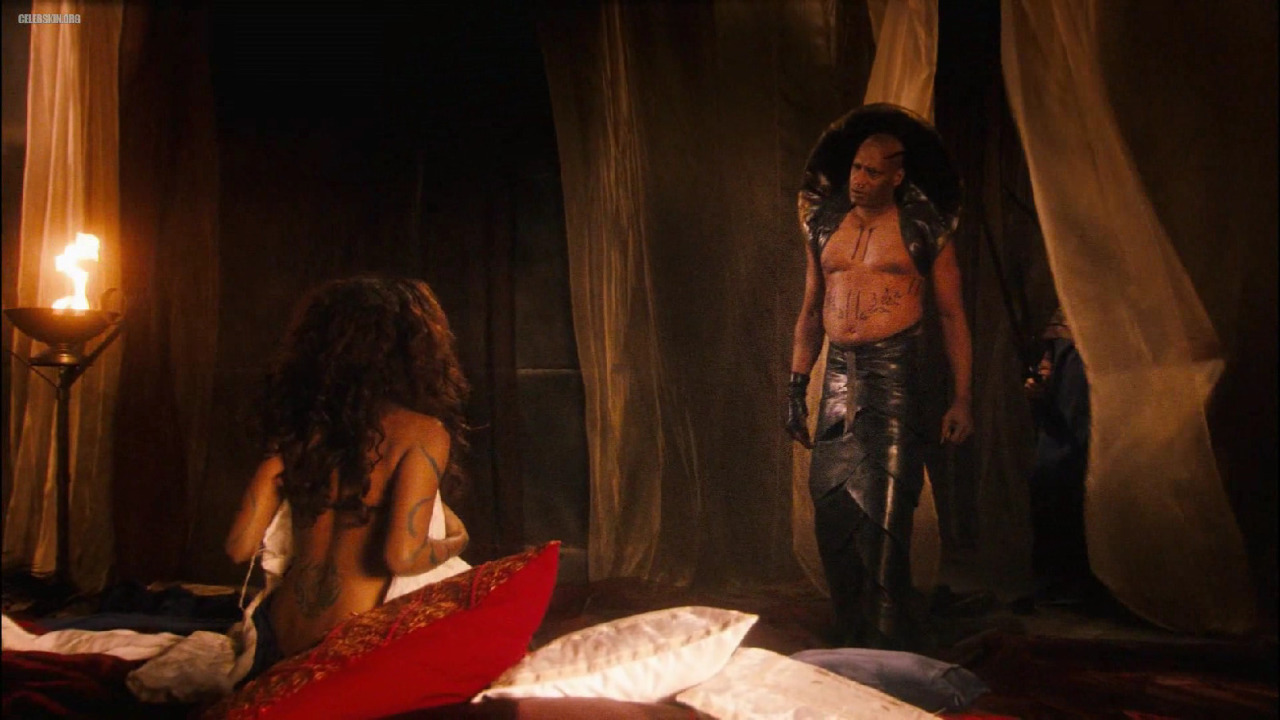
Tony Todd is best known for his superb (and very Dionysian) performance as the titular role in the Candyman series. However, in 2006 Todd was also in a movie called Minotaur which is loosely (very loosely) based on the ancient myth. Here is a synopsis contributed by Claudio Carvalho of Rio de Janeiro, Brazil for IMDB:

In the age of gods and spirits, the world was ruled by a dark empire from a palace on the Island of Minus. The locals worshipped the Bull, and the ambitious Queen got pregnant by their god, generating an offspring that was part human and part bull. When the Prince is killed on the island, the dwellers blame the villagers, and they are sentenced to give eight young women per year to satisfy the Minotaur. The shepherd Theo (Tom Hardy), son of the village leader Cyrnan (Rutger Hauer), misses his girlfriend that was abducted a couple of years ago. When he meets a leper seer, she tells him that his beloved Ffion (Donata Janietz) is alive, and that Theo must go to the island to kill the beast and save his love. Theo goes to the palace and faces King Deucalion (Tony Todd) and the Minotaur, supported by Deucalion’s sister, Queen Raphaella (Michelle Van Der Water), who discloses the truth about the Minotaur.

Afro-Greeks

From the back blurb:

Afro-Greeks examines the reception of Classics in the English-speaking Caribbean, from about 1920 to the beginning of the 21st century. Emily Greenwood focuses on the ways in which Greco-Roman antiquity has been put to creative use in Anglophone Caribbean literature, and relates this regional classical tradition to the educational context, specifically the way in which Classics was taught in the colonial school curriculum. Discussions of Caribbean literature tend to assume an antagonistic relationship between Classics, which is treated as a legacy of empire, and Caribbean literature. While acknowledging this imperial and colonial backstory, Greenwood argues that Caribbean writers such as Kamau Brathwaite, C. L. R. James, V. S. Naipaul, and Derek Walcott have successfully appropriated Classics and adapted it to the cultural context of the Caribbean, creating a distinctive, regional tradition.

Afro-Greeks: Dialogues between Anglophone Caribbean Literature and Classics in the Twentieth Century is available here at Amazon, as well as other online retailers. 

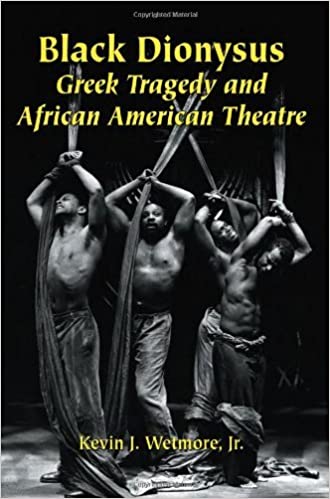
Black Dionysus

From the back blurb:

Many playwrights, authors, poets and historians have used images, metaphors and references to and from Greek tragedy, myth and epic to describe the African experience in the New World. The complex relationship between ancient Greek tragedy and modern African American theatre is primarily rooted in America, where the connection between ancient Greece and ancient Africa is explored and debated the most. The different ways in which Greek tragedy has been used by playwrights, directors and others to represent and define African American history and identity are explored in this work. Two models are offered for an Afro-Greek connection: Black Orpheus, in which the Greek connection is metaphorical, expressing the African in terms of the European; and Black Athena, in which ancient Greek culture is “reclaimed” as part of an Afrocentric tradition. African American adaptations of Greek tragedy on the continuum of these two models are then discussed, and plays by Peter Sellars, Adrienne Kennedy, Lee Breuer, Rita Dove, Jim Magnuson, Ernest Ferlita, Steve Carter, Silas Jones, Rhodessa Jones and Derek Walcott are analyzed. The concepts of colorblind and nontraditional casting and how such practices can shape the reception and meaning of Greek tragedy in modern American productions are also covered.

Available here at Amazon, and likely other online retailers.

Black Bakchai

Back in 2000 a production of The Bakchai premiered at the Virginia Commonwealth University’s Theatre as part of their celebration of Black History Month:

Directed by Theatre VCU associate professor Marvin Sims, the play takes a look at an ancient icon, breaking stereotypes of location, language, meaning, and imagery. The play centers on the god Dionysus, disguised as a charismatic young holy man, accompanied by his women, called Bacchantes, who serve as the chorus. They arrive in North Africa from Asia, intent on establishing his worship. Turned aside by the community, which rejects his divinity, Dionysus’ success is thwarted by the community’s king, Pentheus.

A signature component of the Richmond community’s celebration of Black History Month, this interpretation of “The Bacchae,” a classic tale of tyranny, vengeance and religious zealotry, is distinct in its African and Far Eastern settings. Sims chose the settings to reflect the geographic areas under the political control of Greece at the time the play was written. He relies on the imagery of masks created by Lydia Thompson, Ph.D., artist and assistant dean of VCU’s School of the Arts, as well as the use of accents, to weave these cultures together.

Joseph Kony and his toys defeat hashtag activism

A couple years ago I remember a bunch of people posting those slick KONY2012 graphics and heart-wrenching Invisible Childrens videos to stop the evil dictator Joseph Kony. I don’t use “evil” lightly but in his case it totally applies. Genocide. Torture. Rape. Forcible conscription of child soldiers. Trying to impose a theocracy based on the 10 Commandments. I didn’t need Oprah, George Clooney, Taylor Swift and Ryan Seacrest to tell me this dude was bad news, but apparently a lot of other folks did because after it started trending on Twitter and Facebook that shit was everywhere. They organized a couple rallies in Eugene and someone even put a sticker up near the train tracks I crossed every night on my way into work.

But here’s the thing; even though Kony lead the Lord’s Resistance Army and was trying to turn Uganda into a fundamentalist Christian state he’s a spirit-medium guided by the ghost of a WWI Italian soldier:

Even the most respectable experts give credence to Kony’s ‘mystical’ status, the New York Times describing him, in all seriousness, as ‘a former altar boy who became possessed by spirits’. The spirit apparently responsible for Kony’s survival is called Lakwena, the ghost of a First World War Italian army medic. Kony claims Lakwena has helped him avoid Ugandan army attacks since the spirit first possessed him in the 1980s.

And he uses toys and reptiles to plan his military campaigns:

It has been reported that Mr. Kony keeps an ample stock of snakes, turtles, and lizards, for just such mediumistic purposes. Not having the benefit of being tutored at a military academy, Mr. Kony deduces a battle’s outcome by setting toy guns, and helicopters on fire to see how the models will burn; thereby foretelling victory or defeat in an upcoming battle. LRA casualties are simply predicted by placing a finger in a glass of water. And if Joseph Kony’s spirit panel isn’t giving him good military advice, the LRA leader can always count on “angels” for divine guidance on campaign strategy. The LRA’s child soldiers are told that commands come from these angels, who commune regularly with Mr. Kony. It must have been one of these heavenly messengers who provided Mr. Kony with the holy advice to expand the Ten Commandments to Eleven Commandments–the Eleventh Commandment being “Thou shall not ride a bicycle.”

And apparently it works. He was indicted for crimes against humanity by the Hague in 2005 and yet remains at large. Obama sent peacekeeping forces into the region in 2011 and again in 2014 and they weren’t able to catch him either. Even more telling, the global slacktivist campaign against Kony came to an abrupt end when Jason Russell was filmed rampaging through the streets of San Diego naked, pounding the pavement, screaming obscenities and claiming to be under attack from a devil.

Divided No More

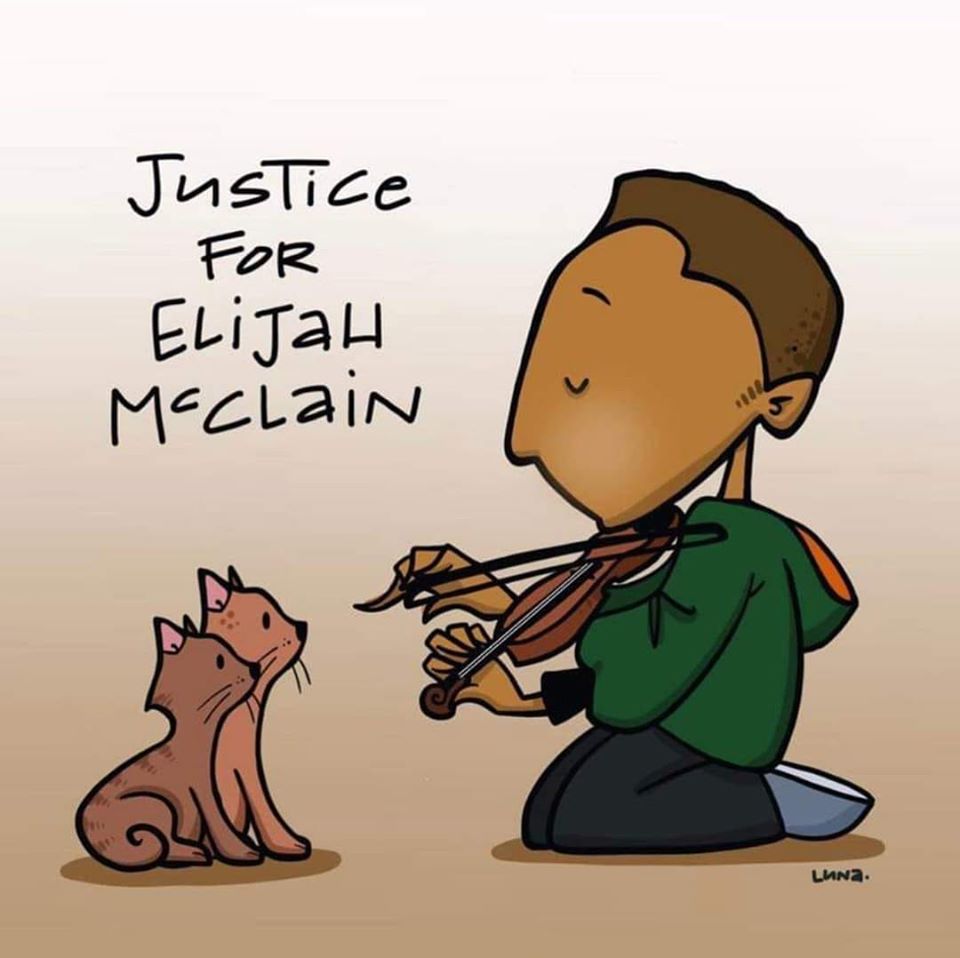
Eijah mcclain

Here is the story of Elijah McClain from The Colorado Sentinel:

By his teenage years, he’d taught himself to play guitar and violin. On his lunch breaks, McClain would hoof his instruments to animal shelters to perform for abandoned creatures, believing the music put them at ease.

He’d become a vegetarian, considering carnivorous diets a form of cannibalism and eschewing meat for “food from the fields and the trees,” as Sheneen said. She said he cared about animals so much that he would chase off flies rather than kill them.

[…]

“He had a child-like spirit,” she said. “Elijah McClain was not conditioned to the norms of America… He lived in his own little world. He was never into, like, fitting in. He just was who he was.”

Which is evident in the final words Elijah spoke:

Screenshot_20200630-171508_Instagram

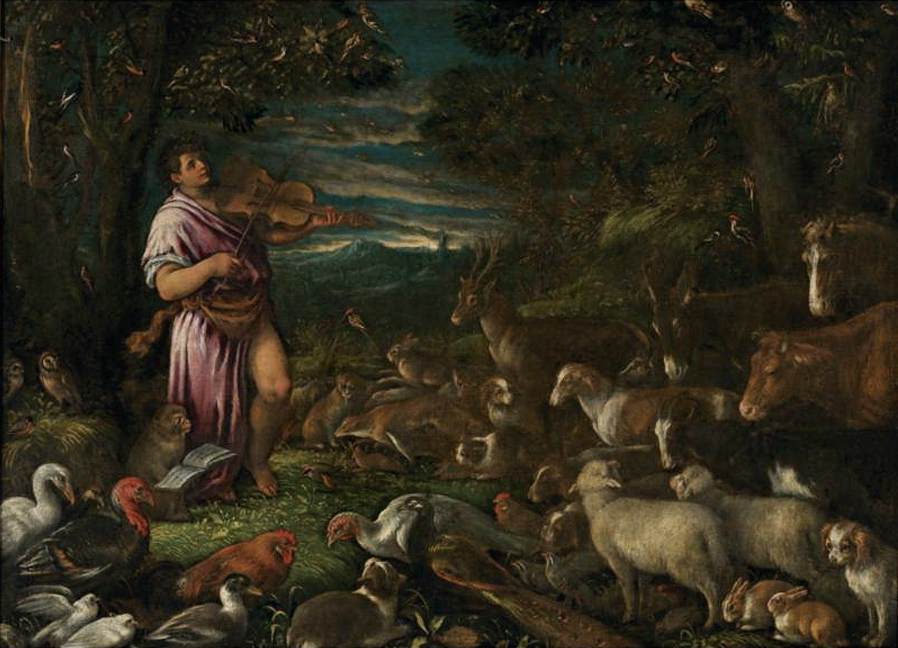
What could this Orpheus redivivus have accomplished had his divine breath not been snuffed out by the jackboot of a tyrannical stooge?

orpheus

No, this was no accident. This was an act willed by the force of uncreation and those who are allied with it. 

Something Elijah’s mother clearly knew:

Screenshot_20200630-171608_Instagram

As did Saint Paul, who once wrote:

For we struggle not against flesh and blood, but against principalities, against powers, against the rulers of the darkness of this world, against spiritual wickedness in high places. (Ephesians 6:12)

Remember who the true enemy is, and be divided no more.

Uncle Bacchus

In 1852 Mary Henderson Eastman wrote Aunt Phillis’s Cabin as a response to the abolitionist novel Uncle Tom’s Cabin by Harriet Beecher Stowe. According to Wikipedia:

The story is set in unnamed rural town in Virginia, which is frequented by several plantation owners living around it. The town relies on trade from the cotton plantations for its economy. Understanding this, the plantation owners, in contrast to their neighbors in surrounding towns, have adopted a benign approach toward their slaves to keep them peaceful and assure the safety of the town. Several characters in and around the town are introduced throughout the story, demonstrating how this process works and the delicate balance of such a process in action.

In contrast to this is Aunt Phillis’ husband, who despite his kindly exterior seethes with rage at his unfortunate condition, turning to alcohol to combat his feelings of frustration and hopelessness – hence his name, Uncle Bacchus. This was an interesting choice on Eastman’s part, as devotees of Dionysos were behind several slave revolts in ancient Rome:

Dionysus was left to the powerless of Italy and they embraced him. In 185-184, the slave shepherds of Apulia – the heel of the Italian “boot” – revolted and sources hint they claimed Dionysus as their patron. Between 135 and 101 B.C., two slave revolts in Sicily and one slave revolt in western Anatolia all invoked Dionysus. The god appeared again in the rebellion of Rome’s Italian allies known as the Social War (91-88 B.C.): rebel coins showed Bacchus as a symbol of liberation. (Barry Strauss, The Spartacus War pgs 34-35)

The most famous of these was led by the Thracian gladiator Spartacus and his wife, a Bacchic prophetess:

It is said that when he was first brought to Rome to be sold, a serpent was seen coiled about his face as he slept, and his wife, who was of the same tribe as Spartacus, a prophetess, and subject to visitations of the Dionysiac frenzy, declared it the sign of a great and formidable power which would attend him to a fortunate issue. This woman shared in his escape and was then living with him. (Plutarch, Life of Crassus 9.3)

Mary Henderson Eastman’s novel sold 20,000–30,000 copies, far less than Stowe’s novel but still a strong commercial success and bestseller by the standards of the day.

Here are some selections from the novel:

“Here comes Uncle Bacchus now, Mr. Barbour,” said Alice; “do look at him walk. Is he not a curiosity? He has as much pretension in his manner as if he were really doing us a favor in paying us a visit.”

“The old scamp,” said Mr. Barbour, “he has a frolic in view; he wants to go off to-morrow either to a campmeeting, or a barbecue. He looks as if he were hooked together, and could be taken apart limb by limb.”

Bacchus had commenced bowing some time before he reached the piazza, but on ascending the steps he made a particularly low bow to his master, and then in the same manner, though with much less reverence, paid his respects to the others.

“Well, Bacchus?” said Mr. Weston.

“How is yer health dis evenin, master? You aint been so well latterly. We’ll soon have green corn though, and that helps dispepsy wonderful.”

“It may be good for dyspepsia, Bacchus,” said Mr. Weston, “but it sometimes gives old people cholera morbus, when they eat it raw; so I advise you to remember last year’s experience, and roast it before you eat it.”

“I shall, indeed,” replied Bacchus; “’twas an awful time I had last summer. My blessed grief! but I thought my time was done come. But de Lord was mighty good to me, he brought me up again—Miss Janet’s physic done me more good though than any thing, only it put me to sleep, and I never slept so much in my born days.”

“You were always something of a sleeper, I am told, Bacchus,” said Cousin Janet; “though I have no doubt the laudanum had that effect; you must be more prudent; old people cannot take such liberties with themselves.”

“Lor, Miss Janet, I aint so mighty ole now; besure I aint no chicken nother; but thar’s Aunt Peggy; she’s what I call a raal ole nigger; she’s an African. Miss Alice, aint she never told you bout de time she seed an elerphant drink a river dry?”

“Yes,” said Alice, “but she dreamed that.”

“I am afraid to give you permission,” said Mr. Weston; “this habit of drinking, that is growing upon you, is a disgrace to your old age. You remember you were picked up and brought home in a cart from campmeeting this summer, and I am surprised that you should so soon ask a favor of me.”

“I feels mighty shamed o’ that, sir,” said Bacchus, “but I hope you will ‘scuse it. Niggers aint like white people, no how; they can’t ‘sist temptation. I’ve repented wid tears for dat business, and ‘twont happen agin, if it please the Lord not to lead me into temptation.”

“You led yourself into temptation,” said Mr. Weston; “you took pains to cross two or three fences, and to go round by Norris’s tavern, when, if you had chosen, you could have come home by the other road.”

“True as gospel, ma’am,” said Bacchus, “I don’t deny de furst word of it; the Lord forgive me for backsliding; but master’s mighty good to us, and if he’ll overlook that little misfortune of mine, it shan’t happen agin.”

“You call it a misfortune, do you, Bacchus?” said Mr. Barbour; “why, it seems to me such a great Christian as you are, would have given the right name to it, and called it a sin. I am told you are turned preacher?”

“No, sir,” said Bacchus, “I aint no preacher, I warn’t called to be; I leads in prayer sometimes, and in general I rises de tunes.”

“Well, I suppose I can’t refuse you,” said Mr. Weston; “but come home sober, or ask no more permissions.”

“God bless you, master; don’t be afeard: you’ll see you can trust me. I aint gwine to disgrace our family no more. I has to have a little change sometimes, for Miss Janet knows my wife keeps me mighty straight at home. She ‘lows me no privileges, and if I didn’t go off sometimes for a little fun, I shouldn’t have no health, nor sperrets nother.”

“You wouldn’t have any sperrits, that’s certain,” said Alice, laughing; “I should like to see a bottle of whisky in Aunt Phillis’s cabin.”

Bacchus laughed outright, infinitely overcome at the suggestion. “My blessed grief! Miss Alice,” said he, “she’d make me eat de bottle, chaw up all de glass, swaller it arter dat. I aint ever tried dat yet—best not to, I reckon. No, master, I intends to keep sober from this time forrurd, till young master comes back; den I shall git high, spite of Phillis, and ‘scuse me, sir, spite of de devil hisself. When is he comin, any how, sir?”

from Chapter I.

And oh! what a figure had Aunt Peggy; or rather, what a face. Which was the blacker, her eyes or her visage; or whiter, her eyeballs or her hair? The latter, unconfined by her bandanna handkerchief as she generally wore it, standing off from her head in masses, like snow. And who that had seen her, could forget that one tooth projecting over her thick underlip, and in constant motion as she talked.

“It’s no use, Mister Bacchus,” said she, addressing the old man, who looked rather the worse for wear, “it’s no use to be flinging yer imperence in my face. I’se worked my time; I’se cooked many a grand dinner, and eat ’em too. You’se a lazy wagabond yerself.”

“Peggy,” interposed Mr. Weston.

“A good-for-nothing, lazy wagabond, yerself,” continued Peggy, not noticing Mr. Weston, “you’se not worth de hommony you eats.”

“Does you hear that, master?” said Bacchus, appealing to Mr. Weston; “she’s such an old fool.”

“Hold your tongue, sir,” said Mr. Weston; while Mark, ready to strangle his fellow-servant for his impertinence, was endeavoring to drag him out of the room.

“Ha, ha,” said Peggy, “so much for Mr. Bacchus going to barbecues. A nice waiter he makes.”

“Do you not see me before you, Peggy?” said Mr. Weston, “and do you continue this disputing in my presence? If you were not so old, and had not been so faithful for many years, I would not excuse such conduct. You are very ungrateful, when you are so well cared for; and from this time forward, if you cannot be quiet and set a good example in the kitchen, do not come into it.”

“Don’t be afeard, master, I can stay in my own cabin. If I has been well treated, it’s no more den I desarves. I’se done nuff for you and yours, in my day; slaved myself for you and your father before you. De Lord above knows I dont want ter stay whar dat ole drunken nigger is, no how. Hand me my cane, dar, Nancy, I ain’t gwine to ‘trude my ‘siety on nobody.” And Peggy hobbled off, not without a most contemptuous look at Bacchus, who was making unsuccessful efforts to rise in compliment to his master.

“As for you, Bacchus,” said Mr. Weston, “never let this happen again. I will not allow you to wait at barbecues, in future.”

“Don’t say so, master, if you please; dat ox, if you could a smelled him roastin, and de whiskey-punch,” and Bacchus snapped his finger, as the only way of concluding the sentence to his own satisfaction.

“Take him off, Mark,” said Mr. Weston, “the drunken old rascal.”

“Master,” said Bacchus, pushing Mark off, “I don’t like de way you speak to me; t’aint ‘spectful.”

“Carry him off,” said Mr. Weston, again. “John, help Mark.”

“Be off wid yourselves, both of ye,” said Bacchus; “if ye don’t, I’ll give you de devil, afore I quits.”

“I’ll shut your mouth for you,” said Mark, “talking so before master; knock him over, John, and push him out.”

Bacchus was not so easily overcome. The god whose namesake he was, stood by him for a time. Suddenly the old fellow’s mood changed; with a patronizing smile he turned to Mr. Weston, and said, “Master, you must ‘scuse me: I aint well dis evening. I has the dyspepsy; my suggestion aint as good as common. I think dat ox was done too much.”

Mr. Weston could not restrain a smile at his grotesque appearance, and ridiculous language. Mark and John took advantage of the melting mood which had come over him, and led him off without difficulty. On leaving the kitchen, he went into a pious fit, and sung out

“When I can read my title clar.”

Mr. Weston heard him say, “Don’t, Mark; don’t squeeze an ole nigger so; do you ‘spose you’ll ever get to Heaven, if you got no more feelins than that?”

“I hope,” said Mr. Weston, addressing the other servants, “that you will all take warning by this scene. An honest and respectable servant like Bacchus, to degrade himself in this way—it gives me great pain to see it.” said he, addressing a son of Bacchus, who stood by the window

from Chapter III.

A Communion Rite

In 1973, Nigerian playwright, novelist, poet, and essayist Akínwándé Olúwo̩lé Babátúndé S̩óyíinká – better known in the West as Wole Soyinka – adapted Euripides’ Bakchai to explore contemporary African themes, both political and cultural. As part of these changes he introduced a second chorus of slaves and a blend of Yoruba and Christian elements, which made the play more ceremonial – and closer to how ancient Greek theater was done. If you get the chance, definitely check out a live production. It’s quite the experience. 

In the meantime, here’s a selection from the play:

CHORUS: Come, come Dionysos …
LEADER: Oh Thebes, Thebes, flatten your walls.
Raise your puny sights
To where the heights of Kithairon await you.
CHORUS: Yes, yes …
LEADER: On the slopes where Dionysos will come
Run free with you in your labour of song
Your dancing drudgery, your chores of dreaming —
In the truth of night descends his secret —
Hold, embrace it.
CHORUS: Yes, yes … set me free … set me free.
LEADER: The sun touches the vines on the slopes
And that is godhead. Dew falls on the grass
And that is godhead. The sap awakens —
A birth
A dawn
A spring
Pure dewdrops down the mountain
That is godhead. And you
Nestled in earth’s womb are
Green leaves in winter, woodsap in snow
You are the eternal ivy on the wand of life
Emerald pines that defy the winter
Dates of the oases in drought of deserts.
BACCHANTES: Bromius … Bromius …
LEADER: Seek him in your breasts with love, within
Your hidden veins, in the quiet murmur of your blood
Seek him in the marrow, in the wombstone, he is fount
Of Life. He makes an anvil of the mountain-peaks
Hammers forth a thunderous will, he farms the slopes
And the vine tempers his will. In plains and valleys
Nest his joyful Bacchae, his mesh of elements
Reconciles a warring universe.
BACCHANTES: Come Bromius, come …
LEADER: He is the new life, the new breath, creative flint
Flood earth with his blood, let your shabby streets
Flow with his life, his light, drum him into the heart
Like thunder. He is the storehouse of life
His bull horns empower him
A bud on the autumn bough, he blossoms in you
His green essence fills your womb of earth …
BACCHANTES: Bromius … Bromius …
LEADER: There is power in his thyrsus, feel!
It pulses. Feel! It quivers and races with sap.
Throat, tongue, breast, calling forth the powers of life
Hold him, embrace him. His dance covers you
His drums envelop you, your skin os one with his drum
Tuning and straining tight. Spindle and shuttle
In your hand — behold — the wand of god
The hearthstone his thyrsus, thrusting from earth
The fire is tamed in new greenery of life,
In fawn-skin and ivy, and the thorn of life comes
Piercing your blood …!

this idea had a pagan origin

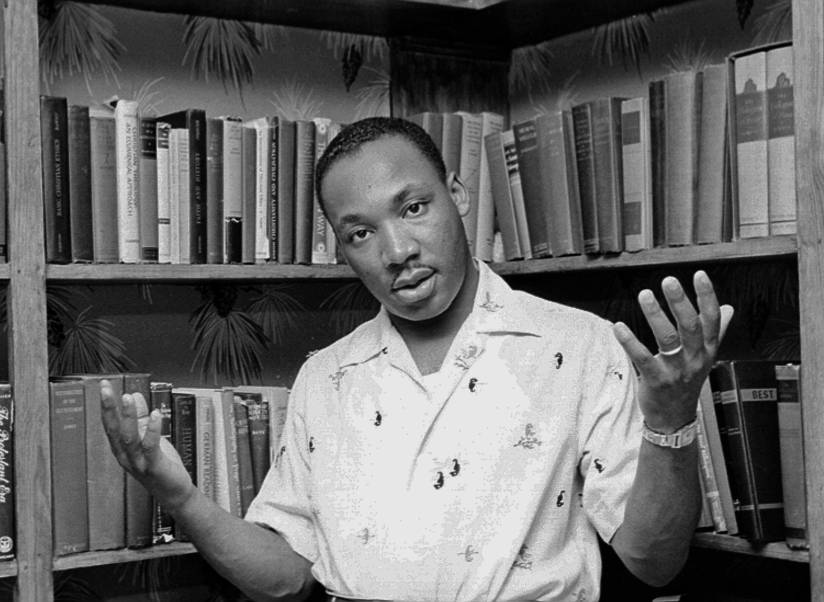
Although Martin Luther King Jr. is primarily remembered for his oratory many of the papers he wrote while attending Crozer Theological Seminary have been preserved, including this one he wrote for the course Development of Christian Ideas entitled “The Influence of the Mystery Religions on Christianity” for which he received an A.

However when we come to the idea of Jesus’ decent into hell it seems that we have a direct borrow from the Adonis religion, and in fact from other religions also. Both the Apostles Creed and the Athanasian {Creed} say that between the Friday night and Sunday morning Jesus was in Hades. Now this idea has no scriptural foundation except in those difficult passages in the First Epistle of Peter [Footnote: I Peter 3:19–4:6.] which many scholars have designated as the most ambiguous passages of the New Testament. In fact the idea did not appear in the church as a tenet of Christianity until late in the Fourth Century.[Footnote: Weigall, op. cit., p. 113.] Such facts led almost inevitably to the view that this idea had a pagan origin, since it appears not only in the legend of Adonis, but also in those of Herakles, Dionyses, Orpheus, Osiris, Hermes, Balder, and other deities.

The Purple One

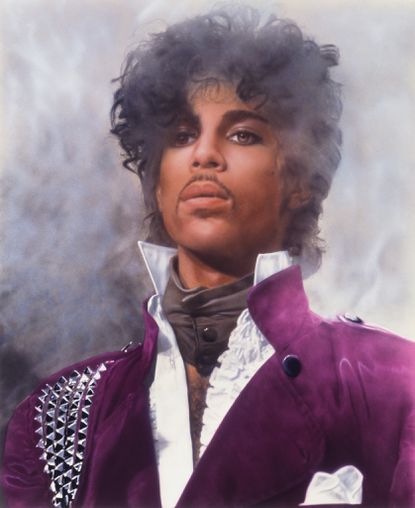
The artist formerly known as [Symbol] embodied the traits of the God so deeply I’d suspect he might have been a Neos Dionysos if not for his deep devotion and adherence to the teachings of the Jehovah’s Witnesses.

Still, I’m not the only one to notice these themes in Prince’s work; Katy Waldmam writes in an article for Slate entitled The Surreal, Dionysian Poetry of Prince’s Lyrics:

“All art aspires to the condition of music,” wrote Walter Pater, and Prince’s lyrics are as hot and dreamlike and weird as his sound. Saturated in color, wild with bizarre imagery, they overload the senses and short-circuit the brain. Rolling Stone described the Purple One’s aesthetic as “sensual anarchy,” a phrase that helps capture the intoxicating drive of his poetry. (What if not poetry would you call these lines from “Raspberry Beret”: “Now, overcast days never turned me on/ But something about the clouds and her mixed.”) Prince told us to move and dance and fuck our way to utopia, to grind “until the castle started spinning/ or maybe it was just my brain.”

He was our Dionysus, and his lyrics were full of beasts. “You’re just as soft as a lion tamed,” he crooned. “Take me to the place where your horses run free,” he begged. And he saw in color: red corvettes, pink cashmere, purple rain, purple everything. Prince understood T.S. Eliot’s notion of the objective correlative, the concrete object that stands for a chaotic, vibrant mass of emotions. “She wore a raspberry beret,” he sang, and once it was worn he didn’t say much more.

Pop songs aren’t often surrealist paintings, but Prince knew how to create a hallucinatory scene. His lyrics invite you into an altered state of consciousness: “Dream if you can a courtyard.” “I was dreaming when I wrote this.” Consider that courtyard for a second, “an ocean of violets in bloom,” in which “animals strike curious poses.” Even before the doves start shedding human tears, you’re on a rocket ship to the Martian version of Versailles.

His music (which I listened to on cassette and MTV over and over again) provided some of my first entries to the realm of Dionysos, before I even knew what that was. It hit me hard when Prince died back in 2016, especially hearing about the chronic pain condition that dogged his final days. (For reasons I’m sure I don’t have to explain.) May he find a peace in the beyond which the fentanyl never gave him.

Happy Black history month from the House of Vines!

In Euripides’ famous play The Bakchai, the exceptionally wise prophet Teiresias gives the following speech (lines 200-209) to his ivied comrade Kadmos, the former king of Thebes and an émigré from far-off Phoenicia:

To the Gods we mortals are all ignorant.                                       
Those old traditions from our ancestors,
the ones we’ve had as long as time itself,
no argument will ever overthrow,
in spite of subtleties sharp minds invent.
Will someone say I disrespect old age,
if I intend to dance with ivy on my head?
Not so, for the God makes no distinctions—                         
whether the dancing is for young or old.
He wants to gather honours from us all,
to be praised communally, without division.

These are such important words, for they remind us that all the categories which are so important to humans – age, sex, race, physical ability, etc. – mean nothing to Dionysos, who welcomes all into his wild revels. This radical inclusivity is true not only of his worship in antiquity but can be found in thiasoi and other Bacchic communities today.

And so in that spirit I would like to share some of the contributions that Africans and Black Americans have made over the centuries to the Dionysian tradition. It was difficult to limit myself to just 10 figures or events, but hopefully that will be enough to inspire my readers to dig deeper and uncover other examples, of which there are many.

The symbol

The symbol is greater than visible substance… Unhappy the land that has no symbols, or that chooses their meaning without great care. (Freya Stark, East Is West)

Mr. Dionysos Goes to Washington

Here’s a play I wrote for the Dionysia in 2003. I actually had the pleasure of seeing it performed by a Wiccan coven I briefly worked with in Las Vegas; what’s more, I got to play the part of Dionysos.

The Bacchae 2005 or The Burning Bush

Dramatis Personae
George W. Bush

Dick Cheney
Chorus
White House Page
Secret Service Agents (3)
Dionysos
Anchorwoman

Interior of the Oval Office: indicated by a chair, a table, and a flag. George W. Bush is sitting in the chair, Dick Cheney is at his side, and behind them stand the Chorus.

George W. Bush: So how is the invasion going?

Dick Cheney: Very well, Mr. President. Our troops have already taken Paris, and two-thirds of France has been liberated. Things are still a little shaky in Bordeaux where we met with some unexpected resistance, but that should be mopped up by night’s end.

Bush: Have we found any Weapons of Mass Destruction yet?

Cheney: Uh … unfortunately not, Mr. President. And there was some minor protest of our unilateral strike by the international community. But not much. It was France, after all.

Bush: It’s truly a shame that France became a rogue nation. Nice people, the French – though that whole Jerry Lewis thing is a little odd. But I like their bread. And their fries!

Cheney: Yes, well now they’ll be able to enjoy their baguettes with a side of Freedom and Liberty. Once Haliburton has finished rebuilding France’s infrastructure that is.

Chorus: Zeus’ pet eagle no longer sits tamely at the side of the Heavenly Father,
Symbol of justice and far-reaching equanimity.
But now is perched upon the shoulder of dread Ares,
who has burst his brazen bonds and strides through the land,
his dark shadow insighting men to madness and war.
The eagle calls out for blood and vengeance,
Its shrill cry echoed in that of weeping brides and fatherless sons.
Dark days behind us, and darker days to come.

Bush: So how are the other points on our agenda coming along? I’ve got a State of the Union address to prepare.

Cheney: Well, there’s been a slight bump in the road to progress up in Alaska.

Bush: A bump, you say?

Cheney: Yes. It seems that there was a little spill in the Natural Preserve where we’ve been drilling. Nothing major, mind you. Won’t even be a drop in oil prices. But there are a few dead animals and some black beaches now.

Bush: Just great! This is going to look horrible when it hits the news. My ratings are going to plummet.

Cheney: It won’t reach the news, Mr. President. Our trained puppies in the Media say what we tell them to. And as far as they’re concerned, nothing’s happened up there – and nothing will. We’ve already got our men picking up the seal and bird carcasses, and who’s going to notice a few oily rocks?

Bush: I don’t like this. What if all those hippies were right?

Cheney: Mr. President, don’t get all emotional on me. Besides, you can’t make an omelet without a few cracked eggs: progress and financial stability require sacrifice.

Bush: I suppose. Give me some good news, please!

Cheney: Our ‘Defense of Marriage’ Act has passed both Houses – without so much as a peep – and is just waiting for your signature to be made Law, Sir.

Bush: That’s great news! Such a holy and universally esteemed institution must be protected. Why, if we granted equal recognition to those homos, who knows what would be next. I once saw a man on Jerry Springer who made love to his dog. Should they be allowed to get married too?

Cheney: No Sir, they should not. And nothing, not even the Constitution, will stand in our way of upholding decency and God’s own morality.

Bush: Amen! Speaking of which, how are things going on the religious front? What was the response to my declaration to recognize Christianity as our State religion?

Cheney: Well, Sir, it looks promising – I mean, during the elections we did pretty much fill both Houses with loyal men who’ll grant you whatever you ask – but there has been some pretty strong opposition to your proposal. In fact, for the first time in centuries, Jews and Moslems are getting along, peacefully united in their hatred for you.

Bush: What do you mean? Aren’t they Christian too?

Cheney: Uh … no Sir.

Bush: But Jesus was a Jew. It doesn’t matter if they wear those silly little beanies when they do it, we all pray to the same God.

Cheney: They don’t seem to see it that way, Mr. President.

Bush: Well, they had better. We’re in a time of war, fighting for the future of our country. We need all the support we can get – especially from Almighty God himself. Anybody who disagrees with me is clearly un-American, un-Christian, and siding with the terrorists. If they’re not careful, they’ll end up being tried as enemy combatants.

Chorus: O beautiful for spacious skies,
For amber waves of grain,
For purple mountain majesties
Above the fruited plain!
America! America!
God shed his grace on thee
And crown thy good with brotherhood
From sea to shining sea!

White House Page enters, breathless.

White House Page: Excuse me, Mr. President. I hope I’m not disturbing you, but I’ve got urgent news.

Bush: No, ma’am. We were just finishing up here, right Mr. Cheney?

Cheney: Well, there were a few more things I wanted to address – like my proposal to transfer funds from Medicare to Homeland Security so that we can better spy on those pinkos in Hollywood – but it can wait.

Bush: Very well. So what’s this urgent news you’ve brought me?

Page: Well, Sir … it seems like your daughters are up to it again.

Bush(holds his head, as if he’s got a headache) What is it this time?

Page: Well, Sir …. (The page looks at the desk, the wall, down at her feet, anywhere but the President.)

Cheney: Out with it now!

Page: Well, Sir … it seems that your daughters are drunk.

Bush: So what’s new?

Page: They’re drunk, and running around the streets of Washington … uh … topless, Sir.

Bush and Cheney: What?!?

Page: Yes. It’s like something out of one of those Girls Gone Wild videos. They’re wearing these odd animal-skin capes and headbands made of ivy and grape-leaves, and other than that, there’s not a stitch of clothing on their bodies.

Bush: But it’s February, for God’s sake! They must be freezing.

Page: They don’t appear to be Sir. But maybe the frenzied dancing and singing are keeping them warm.

Bush: Where are they doing this? Please tell me it’s somewhere out of sight. Some secluded club, where we can go in and make sure that this story never reaches the light of day.

Page: I wish that were the case, Sir. Your daughters are dancing in the streets down below, right in front of the White House gates for all to see.

Bush and Cheney: What?!?

Page: I’m afraid so, Sir. Mixed in with all the protestors and rabble that usually gather out front.

Bush: Oh Jesus Christ, I can’t believe this! How could they do this to me? My enemies are just going to love this. It’s going to be all over the papers. Can you imagine what the headlines will be?

Cheney: This is bad.

Page: It gets worse.

Bush: (bangs his fist on the table) How? How can it get worse than this?

Page: It seems your daughters have joined some kind of free love hippie cult. They’re dancing down there naked at the instigation of a long-haired, bearded cult leader, dressed in strange flowing Arab robes.

Bush: This is too much! I can’t believe this. It has to be some kind of joke. It really isn’t very funny to say things like that, you know. I’ll have your job for this.

Page: Mr. President, I’m telling you the truth. I wish it weren’t true. I wish I wasn’t the one who had to carry this news to you. But it’s my job, and it’s not fair to punish the bearer of bad news.

Cheney: You’ve said enough, now get out of here before we decide to do exactly that.

White House Page exits.

Bush: What are we going to do? I simply can’t believe this. My daughters, daughters sprung from my very own flesh … hippies. This is an outrage!

Cheney: I’ll take care of this for you, Mr. President. We’ll send the Secret Service down there and bust heads until we get your daughters back. They aren’t in their right minds: they’ve been brainwashed by this strange cult leader. We’ll paint the streets red with their spilled blood and brains if we have to, to get your daughters back – and to take this man into custody.

Dick Cheney exits.

Chorus: Down from the Mountain have we come,
To the banks of the Potomac,
And the shining marble of the Nation’s Capitol,
Come out of your homes, o people,
Dawn the fawnskin and lift high the ivied wand,
and sing with us praises to Bromios, the beautiful and boisterous One,
whose simple worship gladdens the heart.
Sweet it is to lose yourself in the dance,
To feel the juice of the grape course through your body,
Stirring your spirit until you toss back your head
And give the ecstatic cry Euoi! Euoi! Io Euoi!
Drunk on the God, we have no care for empty possessions,
And the foolish rantings of angry Kings,
For with Dionysos, we know ourselves free,
And have the Earth’s rich bounty as our inheritance.
Ie ie Bacchos! Io io Bromios!

Bush: Oh, shut up.

Dick Cheney enters, followed by several Secret Service Agents who are holding, between them, the Stranger, his hands bound.

Cheney: We caught the rogue, and he didn’t even put up a fight. He was standing down there, amid a throng of his followers decked out like it was Mardis Gras. They were singing and dancing, some of them playing tambourines, others pipes, and others still plaiting garlands of flowers for the spectators to wear. It was like a party was going on down there – not a protest. But when they saw the Secret Service Agents come near, a change came over the crowd. They began screaming for blood, and hurled the foulest of insults at us. They rushed the gates, and would have broken through, but this one just lifted his hands, and said, “Let them pass unharmed. I have business with the President.” And the wild, raging crowd quieted, lions become lambs as the gates parted and our men walked up to him. He simply held out his hands, and let us cuff him, then let us escort him away, stopping only to say, “Remain still, my Bacchae, and keep your faith. I will soon return.”

Secret Service Agent 1: That’s the power of the gun. It turns even the bravest man into a craven coward.

The Stranger: I am no coward: had I wished, your throat would have been torn out, and you’d be choking on your own black blood, and not your stupid words.

SS Agent 1: (lifts his hand to strike him) Why I ought to!

Stranger: But you won’t.

Bush: Stop! There’ll be plenty of time for that later. First I want to find out what this man’s done to my daughters.

Stranger: I freed them. I helped them discover who they truly were, and brought that out for the world to see.

Bush: You brainwashed them. You corrupted them. You made them do dirty things.

Stranger: I made them do nothing: that was already in their hearts. I simply removed the restrictions. Had your daughters been truly chaste and modest, then that’s what would have come out. But then, you know better than I how your daughters resent the yoke, how wild and sensual their spirits are.

Bush: I don’t need you to tell me about my daughters!

Stranger: (wryly) No, I imagine you don’t.

Bush: Leave us. I want to interrogate this man alone.

SS Agents: Are you sure, Mr. President? What if he …?

Bush: You heard me!

The Secret Service Agents reluctantly leave.

Dick Cheney prepares to leave as well.

Bush: No, not you. You’re my right-hand man.

Cheney: I’m considerably more than that.

Bush: That’s why I need you to stay.

George W. Bush gets up from his chair, and stands in front of the Stranger trying to look intimidating.

Bush: Who are you?

Stranger: I am a Mystery.

Cheney: Don’t get smart with us, what’s your name?

Stranger: I have many names in many lands.

Bush: Then how shall we call you?

Stranger: You may call me Dionysos.

Bush: Do you lead that cult down there?

Dionysos: I lead them from their homes and dreary lives, lead them to the distant mountain, lead them in their sacred songs, lead them as they dance their holy dances, lead them as they celebrate the ineffable mysteries by moonlight. Yes, I am their leader.

Bush: What sort of mysteries are these?

Dionysos: Something only the initiate may know.

Cheney: This is some strange New Age cult, right?

Dionysos: No. My worship is as old as time.

Bush: It’s a scheme. Something you thought up to make yourself rich, and to ruin people’s lives.

Dionysos: Only one as venal as you would think such thoughts. No, my worship is what enriches people’s lives, not your endless chasing after money.

Cheney: Commie!

Bush: (touching Dionysos’ robes) Look at how’s he’s dressed. These soft, flowing robes. Why, these are the clothes of a Moslem terrorist. And look at this beard! (grabs the ends of his beard) What’s he hiding under this beard? An evil heart? A sinister nature? A mind plotting against America? No decent man wears a beard. Rasputin, Osama, Saddam: all the villains have got beards.

Dionysos: But you’re clean-shaven.

Bush: What’s that supposed to mean?

Dionysos: You heard me.

Cheney: How dare you say that to the President of the United States of America?

Dionysos: (stands fully upright) How dare he? How dare he claim what is not rightfully his? How dare he parade as a just and upright man, while his nature is base and his heart full of sin? How dare he use deception to enflame the lust for unrighteous war in his people? How dare he trample on the rights of the free individual man, censuring his words, policing his thoughts? How dare he show such contempt for his people, letting the poor languish in destitution and sickness, while bestowing even greater wealth upon his friends? How dare he despoil and exploit the resources of the Earth, generous mother of us all? How dare he flout the laws of his land, bending them to his own corrupt uses? How dare he, indeed!

Cheney: Enough! Stifle yourself, or I’ll do it for you!

Dionysos: Raise a finger against me, and you’ll regret it.

Cheney: What can you do? You’re locked in chains.

Dionysos: I remain in chains only because I consent to.

Bush: Oh yeah?

Dionysos: Yeah.

Dionysos raises his hands and the manacles fall off.

Cheney: (stepping between Dionysos and George W. Bush) Don’t you dare harm the President. You’ll regret it!

Dionysos: I’m not going to harm him. Yet. First he must be given a chance to see the error of his ways and repent. I am a just God, after all.

Bush: There is only one God!

Dionysos: I have met considerably more than that walking through the gilded halls of my Father’s palace on Mount Olympos.

Bush: The only true God is Jesus Christ. In his name, I rebuke this insanity of yours.

Dionysos: (laughs) You would rebuke me by myself?

Bush: You truly are insane! You think you’re Jesus?

Dionysos: I don’t think: I know. For I, Dionysos, am the True Vine. It was I who turned the water to wine; I who healed the sick in spirit; I who bade the women leave their homes to follow me no matter the strictures of family and society; I who purified the temple and made the triumphant procession amid ivy and palms into Jerusalem; I who gave the Apostles the gift of prophecy; I who was hung upon the tree for the remission of sins; and I who rose again; I, whose blood is the wine. I, Dionysos, did all this!

Bush: Blasphemy! I won’t stand here listening to that. Guards! Guards!

The Secret Service Agents come running in. They circle around Dionysos menacingly.

Bush: Get this man out of here! Take him down to the basement for interrogation. Summon John Ashcroft. He’ll know what to do with a man like this.

Cheney: Not so brave now, are you?

Dionysos: Nothing can happen to me at your hands that I do not allow. I go now, humbly, to make my return all the more conspicuous. Soon it shall be you trembling before my might. Fighting against the Gods is as futile as kicking against a stone: you shall see.

Dionysos puts up his hands, and lets the Secret Service Agents lead him away.

Cheney: Did you hear that man? How foolish and audacious he was. The very nerve, speaking to you like that, Mr. President!

Bush: Ashcroft will bring about a change of attitude in him, I’m sure: he has his ways.

Cheney: Even I’m a little squeamish around that man. He raises torture to an art form. He has tools that can remove a man’s tongue without even leaving a mark. I wouldn’t want to be that foolish Dionysos right now.

Chorus: Rise up, O Lord!

No longer suffer the inequities of this unrighteous King with mildness and restraint,
But like boiling lava flowing down the side of a mountain, come, come!
Mad and raving, to inflict terrible destruction upon this fool and lay him low!

Rise up, O Lord!

As you rose up against Pentheus, who vainly sought to oppose your worship in the city of your birth. You drove him into a frenzy of madness, and beneath a pine-tree, his own mother tore him to pieces.

Rise up, O Lord!

As you rose up against Lykourgos, who put your women to flight. You blinded him, and made him think that his son was made of vines, then opened his eyes that he might witness the bloody spectacle he had wrought.

Rise up, O Lord!

As you rose up against the daughters of Minyas, who shunned your sacred rites. You inflicted such hunger upon them that they cast lots to see which of their children they would boil in a pot.

Come, come night-roving Bacchos, terrible to look upon, roaring like thunder, like a bull in frenzy, shake the earth to its core, and topple this arrogant bastard!

The lights suddenly flicker and go out.

Cheney: Ah! The floor is shaking! We’re under attack!

The lights come back on. George W. Bush is cowering under the table.

Cheney: Mr. President! Mr. President! Are you okay?

George W. Bush climbs out from under the table, brushing off his jacket.

Bush: I … I think so. What happened?

Cheney: I don’t know, Mr. President. The whole room shook and then the lights went out. An earthquake, perhaps? Or a bomb going off? Your guess is as good as mine. But at least we’ve got power back.

The Secret Service Agents bust through the door.

SS Agent 1: Oh, thank Heavens, the President is alright!

SS Agent 2: Yes, we got here before he did. Quick! Take up your positions!

The Secret Service Agents spread out around the room, taking up defensive postures.

Cheney: What in the hell is going on here?

SS Agent 3: The prisoner got loose!

Cheney: He’s just one man. Why all the commotion?

SS Agent 2: He’s not a man. Had you seen what we saw, you’d be convinced of that.

Bush: What was the loud boom, and why’d the power go out?

SS Agent 2: The whole earth trembled when he broke his bonds: in death and madness his divinity was made manifest.

SS Agent 3: Shut up, you superstitious fool. It was just a coincidence. There was an earthquake, and in the confusion the prisoner got free. That’s all.

SS Agent 2: How can you deny what you saw with your own eyes? You saw the ivy suddenly appear, covering the walls and twining itself around the table on which the stranger sat. You heard the ghostly sound of drums and cymbals and shrill pipes that came from nowhere and everywhere at once. Saw the floor washed with red wine. Smelled the sweet, cloying incense. Heard things walking about the room that were not there. And finally, you saw the fierce beasts fall upon Ashcroft, tearing him to shreds as we fled in fear. How can you deny what we all saw and heard?

SS Agent 3: Hallucinations; nothing more than hallucinations. When the earthquake happened it must have broken open some of Ashcroft’s nerve gas, and we all started to hallucinate.

Bush: What’s going on? I don’t understand. Where’s the prisoner?

SS Agent 2: He’s on his way here. He’s coming for you, Mr. President.

Cheney: Enough of that! Now tell us what happened. How’d you let him escape: he was just one prisoner!

Secret Service Agent 1: We had no trouble bringing him down to Ashcroft’s interrogation chamber. Like a lamb being led to the slaughter, he meekly let us take him without complaint. In fact, he didn’t say a thing the whole time: he just stood there in eerie silence, his face like an unseeing mask. Even when Ashcroft strapped him to the table and brought out his tools, he uttered not a word. Now Ashcroft’s needles and knives have reduced the hardest men to tears: Saddam he had blubbering like a baby in minutes. But this one, he could not reach, no matter what atrocities he performed on his flesh. We would have thought him dead – there was enough blood on the floor to prove it – but his chest still rose, and his eyes continued to stare, and all the while, that hateful, mocking smile remained on his lips. It drove Ashcroft insane! He began stabbing the prisoner, screaming, ‘Do something, do something!’ And then, the prisoner did something.

Bush: What? What did he do?

SS Agent 1: The earth shook. He sat bolt upright, the straps on the table splitting apart. Ivy, and wine, and music filled the room. And suddenly, we were not alone. Swirling around him as if he were the calm center of a devastating tornado were … things. I can’t say what exactly they were. Now they had one shape, and now another. But they were fierce, and bestial, and I, I who have served my country my whole life, who have faced death in the deserts of Iraq, turned and fled, fear clutching at my heart with it’s black claws.

Cheney: Your story is preposterous! It’s too much to be believed.

SS Agents 1 & 2: Soon, you shall see – and you will believe.

Dionysos enters. The Chorus screams.

Dionysos: I have come! I am Dionysos, the son of Zeus, Lord of the fruitful Earth, who has given man sweet wine for the enjoyment of life, and blessed mysteries to purify his care-worn soul. Down from the Mountain have I come, snowy Nysa where dance the lovely-ankled nymphs and the shaggy-haired satyrs, my dear companions. I have come to Washington because you are an arrogant King, who hates my ways, and would rather send young men to kill and die in gold-hungry conquest than see them lay in loving embrace, their hair soaked in sweat after long hours of honoring me with their bodies. Many times have I come to you, and you did not recognize me. Even when the voice of your people rose up and pleaded for you to put off this crazy bloodthirstiness of yours, and welcome the Goddess Peace once more into your land – you would not listen. And so now I have come, I who am most gentle and most fierce, and now you will listen to me!

Cheney: Don’t just stand there! Get him.

Secret Service Agent 3 steps forward, as if to charge the intruder – but then notices that the other Agents are holding back. He loses courage, and falls back.

SS Agents 1 & 2: No, we won’t fight against a God. Listen to him: what he says makes a lot of sense. You are ruining our country: put on the ivy-crown and dance with us in joyful celebration. Great is the God Dionysos! And great his worship! Io euoi!

Chorus: Io euoi! Io io euoi!

Cheney: Cowards and fools! No, I will never honor this liar, falsely claiming to be a God. I fear no one! Aaaarrrgghh!

Dick Cheney lunges for Dionysos but manages only two steps. Dionysos holds up his hand.

Dionysos: I know how to make a dick go soft.

Dick Cheney clutches his heart, convulses.

Cheney: No! Not again! Aaaaaggghh!

And collapses to the floor, dead.

Dionysos turns toGeorge W. Bush.

Dionysos: O puppet, what will you do, now that your strings have been cut, and your puppet master lies broken?

Bush: I’m not a puppet! I made all the decisions around here.

Dionysos: Then you have a lot to answer for, little man.

Dionysos advances on George W. Bush, who backs up until he bumps into the table.

Bush: I have nothing to answer for. I made all the right decisions. America was attacked! We had to defend ourselves!

Dionysos: Then you should have gone after those who harmed you. When you spill innocent blood, it calls out to heaven. And how do you answer to the crime of stealing from the coffers, while the poor die in the streets from want?

Bush: Being President is hard work: I deserve some reward. The poor will always be with us.

Dionysos: And the law: you claim it is your sacred duty to uphold it, yet you have corrupted its spirit, and used it as a bludgeon against your enemies. You have overstepped your bounds: you have tried to impose your will in places it has no right to go.

Bush: The State is the father of the people: and I am the State. Like any father, it is my duty to protect and guide my children, to correct them when they do wrong.

Dionysos: And so you answer, and stand condemned by your words. You are hateful to me, and I will not allow your arrogance to go unpunished.

Dionysos raises his hands, as if to strike him, and George W. Bush falls to his knees, clutching his head, and weeping.

Dionysos: In times past, I would have brought you down like a stag felled by hounds. I would have torn you to pieces, and took pleasure in your flesh parting beneath my fingers, your warm, red blood gushing out to stain the black earth. I would have delighted in your piteous yelps of pain, would have smiled as you shrieked out your last breath. But these are different times, crueler times, and there are bitches more fierce than my maenads now. I will give you over to them!

The stage clears, replaced by a News Anchorwoman, seated at the desk.

Anchorwoman: And in a stunning turn of events today, President George W. Bush called a halt to all foreign involvement by American troops. He called the invasions of France and other countries, ‘Grossly unjust and uncalled for’ and said that ‘he sincerely apologized for any inconvenience the Imperialistic Military Industrial Complex had caused’. He also disbanded the ‘Patriot Act’, the ‘Defense of Marriage Act’, and the ‘Affirmation of the Christian Religion’ Act – saying that this legislature was ‘insane’ and ‘everything that decent Americans should stand against.’ He has also promised that he will bring about universal healthcare and give tax breaks to the working poor. And, perhaps most shocking of all, President Bush announced today that he will be seeking a divorce from his wife, and replacing her with his new lover, Raoul Hernandez, a Cuban refugee and exotic dancer, who some sources claim, has also worked as a male prostitute. These sudden, sweeping, and drastic changes have met with almost universal condemnation. For special commentary, we now turn to conservative columnist ….

The End