One of my favorite devotional pieces to Dionysos from antiquity is P.Ross.Georg. I 11 otherwise known as the Tbilisi hymn to Dionysos. The best line: π⟨ε⟩ίρῃ παθέων θεὸν ἔγνω. (“He recognized the God through the experience of suffering.”) What makes it so beautiful is that, contrary to modern expectations, recognition does not end his suffering. That makes the line utterly tragic: Lykourgos finally knows whose presence he is in— and the vine continues to tighten.
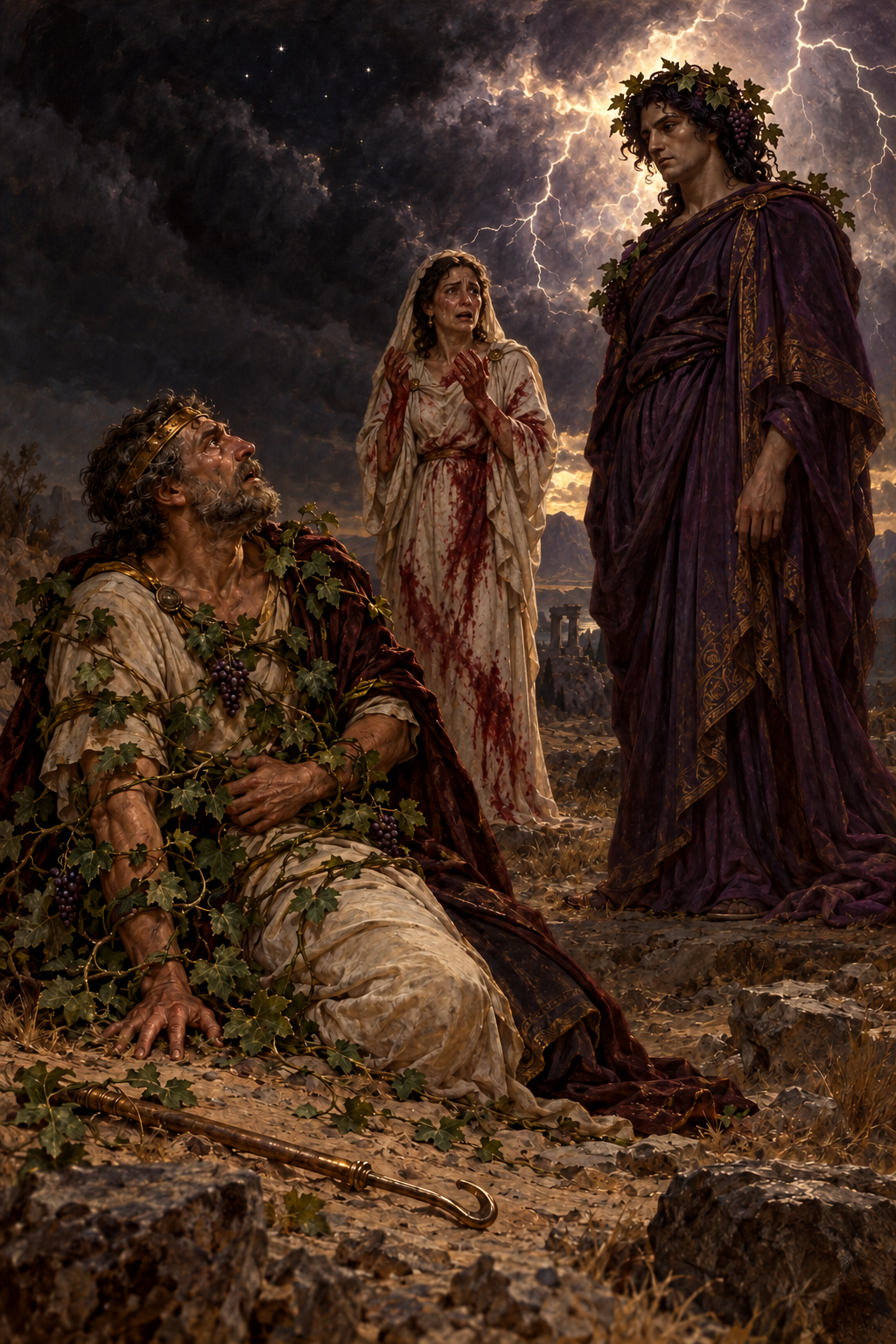
Tbilisi hymn to Dionysos (P.Ross.Georg. I 11)
(1–19)
- … σάτ]υροι φιλοπ[α]ί[γμονε]ς ἐξεγένοντο
- …]ην κρήνη νάεν οὐδ᾿ ἔσαν ἀρδμοί,
- … θρι]γκοί, οὐ δένδρεα, πάντα δ᾿ ἄϊσ[τ]α,
- … πλ]αταμὼν λ[εῖ]ος πάλιν ἐξεφαάν[θη.
- …]εσκε παρῆν ἆσσον Λυκόοργος
- …]ει βεβολημένος ἀμφασίῃ τε·
- …]α πάντα καὶ ἀνδ[ρ]άσιν οὐκ ἐπι⟨ε⟩ικτὰ
- … μ]ετατράπετ᾿ ἀμφα[δὸν] ἔργα.
- …] . Διὸς [γό]νον ἀγλ[αὸν ὄ]ντα,
- …] . ῷ χλω[ρ]ὸν δέος […] πονεῖ[το
- …] βουπλ[ὴξ] χερὸς ἄντα ποδοῖιν
- …]αι ἔπος [ἤ]θελεν οὐδ᾿ ἐρέεσθ[αι.]
- …]χα δειλὸς ὑπέκφυγε κῆρα κελαινὴ[ν]
- …]δέησε θεὸν μήνιμα μεθεῖναι.
- …]εουσαν ἑῷ [π]ροτ[ιό]σσατο θυμῷ,
- … ἐλ]θόντα μετ᾿ ἀσ[τε]ροπ[αῖ]ς Διόνυσον,
- … σ]ελάγιζον ὑπ[ὸ] βρ[ον]τῇσι θαμείαις
- … ἔργ᾿ ἀ]ΐδηλα Δι[ὸ]ς μέγα κυδαίνοντος.
- … Διόν]υσος ὀπάονας, οἱ δ᾿ ἄρ᾿ ὁμαρτῇ
(20–39) - θ]ύσθλοισιν χλοεροῖσιν ἐπαΐσσοντες ἔθεινον.
- ἔστη δ᾿ ἀστε[μ]φὴς πέτρῃ ἴσος, ἥ ῥά τε προ[βλὴ]ς
- εἰ]ς ἅλα μαρμαρέην στεναχίζεται, ἤν τις ἀη[τ]ῶν
- ὀρ]νύμενος πνεύσῃ, θείνοντά ⟨τε⟩ κύματα μίμ[νει.
- ὣ]ς ὅγε θεινόμενος μέ[νε]ν ἔμπεδον οὐ[δ᾿ ἀ]λέγισσ[εν.
- μ]ᾶλλον δ᾿ ἀ[ζη]χὴς ἐνε[δύ]ετο παῖδα Θυ[ώνη]ς
- μ]ηνιθμὸς κραδίην, κραιπνῷ δέ μιν οὔ τ[ι] μενοίν[α]
- αἱρήσειν θανάτῳ, δο[λιχ]α[ῖς] δ᾿ ἄταισιν ἐρ[εί]κει[ν,]
- ἀργαλέην ἵνα τῖσιν ἔτι ζώων ἀποτίσῃ.
- ὦρ[σ]ε δ[έ] ο[ἱ] [μα]νίην, ὀφίων δ᾿ ἰνδαλμὸν [ἔ]χ[ε]υ[ε]ν,
- ὄφρ᾿ ἀπαλεξή[σ]ων τρίβῃ χρόνον ἄχρις [ὀλο]ιὴ
- φήμη τ[ῆ]ς μα[ν]ίης πτηνὴ Θήβην ἀφίκ[η]ται,
- Ἄρδυν τ᾿ Ἀσ[τ]άκιόν τε δύω π[αῖ]δα[ς] καλέουσα
- καὶ Κύτιν ἥ οἱ γή⟨μ⟩ατ᾿ ἐν ἀγκοίνῃσι δαμεῖσ[α.]
- οἳ δ᾿ ἐπεὶ οὖν ἀφίκοντο πολυγλώσσου διὰ φήμη[ς,
- ἄρτι νέον λήγοντα πόνου κιχέτην [Λυ]κ[ό]οργον
- τρυόμενον μα[νίῃ], περὶ δ᾿ αὐτῷ χεῖρ᾿ ἐβ[ά]λοντο,
- κείμενο[ν] ἐν κ[ο]νίῃ, μέγα νήπι[οι·] ἦ γὰρ ἔ[με]λλον
- φθίσεσθ[αι] ὑπὸ πατρὸς ἐναντίον ὄμμασι μητρός.
- οὐ γὰρ δὴν πάλι Λύσσα κελεύοντος Διονύσου
(40–59) - ὀρθῇσ[ιν μ]ανίῃσιν ἀνήγειρεν Λυκόοργον.
- φῆ δ᾿ ὄφ[ια]ς θείνειν, τεκέων δ᾿ ἐξείλατο θυμόν.
- κ]αί νύ κ[εν] ἀμφ᾿ αὐτοῖσι Κύτις πέσεν, ἀλλ᾿ ἐλε[α]ίρων
- ἥ]ρπαξε[ν] Διόνυσος, ἔθηκε δὲ νόσφιν ὀλ[έ]θρ[ου,
- οὕ]νεκα [μ]αργαίνοντι παραίφασις ἐμμενὲς ἦ[ε]ν.
- ἀλλ᾿ οὐ π[αῦ]εν ἄθελκτο[ν] ἑὸν πόσιν, ὃς [ῥα λυ]θεί[ση]ς
- λα]ιψ[ηρῆς] μανίης π⟨ε⟩ίρῃ παθέων θεὸν ἔ[γν]ω.
- ἀλλ᾿ [οὔ] θ[η]ν Διόνυσος ἐ[παύε]το μηνιθμ[οῖο,
- ἀ]τ[ρέ]μα δ᾿ ἑ]στειῶτι δυη[πα]θίῃ τ᾿ ἀλύοντι
- ἄ]μπ[ελον] ἀμφὶ[ς] ἔχευε καὶ ἅψεα πάντ᾿ ἐπ[έδη]σ[ε.
- στεινό[με]νος δὲ δέρην [δο]ιοὺς θ᾿ ἑκάτερθε τ[ένοντας
- οἴκτιστ[ο]ν κάμεν οἶτον ἐπιχθονίων ἀ[ν]θ[ρώπων.
- καὶ νῦν ἂγ χῶρον τὸν δυσ[σ]εβέων εἴδωλον
- ὀ]τλε[ύ]ε[ι] κ[ά]ματον τὸν ἀνήνυτον ἐς πίθον ἀν[τλ]ῶν
- ῥω]γαλέο[ν], τὸ δὲ πολλὸν ἐς Ἄϊδος ἔκχυται ὕδ[ω]ρ.
- τοίην [οὖν] ἐρίδ[ου]πος ἐπεκράανε Κρονίων
- ἀνδρ[άσ]ι θ[ε]ιομάχοισι δίκην, ἵνα τῖσις [ἕ]πητ[αι
- ἀ[μ]φότερον ζωοῖσιν ἀτὰρ πάλι τεθνηῶσι.
- α[ὐ]τοῦ τοῦ σχέο· τῆσδε καλέσ⟨σ⟩αι θεοῦ ἐπ᾿ ἀοιδῆς,
- ἧς κ]ύρει τόδ[ε ἦμ]αρ ἐπιπλομένων λυκαβάντων.
(60–64: writing in the margin) - λείβειν αιθ[…]
- ..νης.ν[…]
- τὰ πρὸ τούτων […]
- ἵνα τὸ ποίημ[α …]
- ……λεως […]
(1)
… playful Satyroi sprang forth.
(2–8)
… no spring flowed, nor were there channels of water;
… no walls, no trees: all had vanished from sight,
and the smooth bare ground appeared again.
… where once … had been, Lykourgos drew near,
struck by […] and speechlessness.
For everything […] beyond what mortal men could withstand;
… the works were openly overturned.
(9–18)
… the glorious son of Zeus …
… pale fear […] as he labored …
… the ox-goad [fell] from his hand before his feet.
… he wished neither to speak a word nor to ask a question.
[Then perhaps] the wretched man might have escaped his dark fate,
[but he did not] beg the God to release his wrath.
In his own heart he foresaw […] coming upon him,
[when he saw] Dionysos advancing amid lightning-flashes
that blazed beneath repeated thunderclaps,
as Zeus greatly honored [his son’s] destructive deeds.
(19–28)
[Dionysos urged on] his attendants. Together
they rushed upon him and struck him with fresh green ritual wands.
But he stood unshaken, like a rock thrust out
into the glittering sea: when a rising wind
blows upon it, it groans, yet withstands the battering waves.
So he remained steadfast beneath their blows and paid no heed.
All the more did unceasing wrath enter
the heart of Thyōnē’s son. He had no intention
of taking him with a swift death, but of crushing him with prolonged calamities,
so that, while still alive, he would pay a grievous penalty.
(29–38)
He roused madness in him and poured out a vision of serpents,
so that he would spend his time fighting them off, until deadly,
winged Rumor of his madness reached Thēbē,
summoning his two sons, Ardys and Astakios,
and Kytis, who had married him, subdued in his embrace.
When they arrived through many-tongued Rumor,
they found Lykourgos only just ceasing from his torment,
worn away by madness. They threw their arms around him
where he lay in the dust—great fools! For they were destined
to perish at their father’s hands, before their mother’s eyes.
(39–46)
For soon, at Dionysos’ command, Lyssa
roused Lykourgos again with madness in full force.
He thought he was striking serpents, but took the life from his children.
Kytis too would have fallen beside them; but Dionysos,
in pity, snatched her away and set her beyond destruction,
because she had continually sought to dissuade the raging man.
Yet she could not stop her unyielding husband.
When the swift madness loosened its hold,
he recognized the God through the experience of suffering.
(47–54)
But Dionysos did not cease from his wrath.
As Lykourgos stood motionless, distraught with misery,
he spread a vine around him and bound every joint.
Constricted about the neck and the two sinews on either side,
he suffered the most pitiable death of any mortal upon earth.
And now, in the place of the impious, his eidōlon
endures unending toil, drawing water into a cracked pithos;
but the plentiful water pours away into Haidēs.
(55–59)
Such, then, was the judgment loud-thundering Kroniōn fulfilled
upon men who fight the Gods, so that retribution would follow them
both while alive and again when dead.
Hold fast to this very thing: call the God to this song,
to which this day belongs as the years come round.
(60–64: marginal remnants)
To pour a libation … [αιθ-: incomplete word]
… [untranslatable remnants]
the things before these …
so that the poem …
… [untranslatable word-ending]

