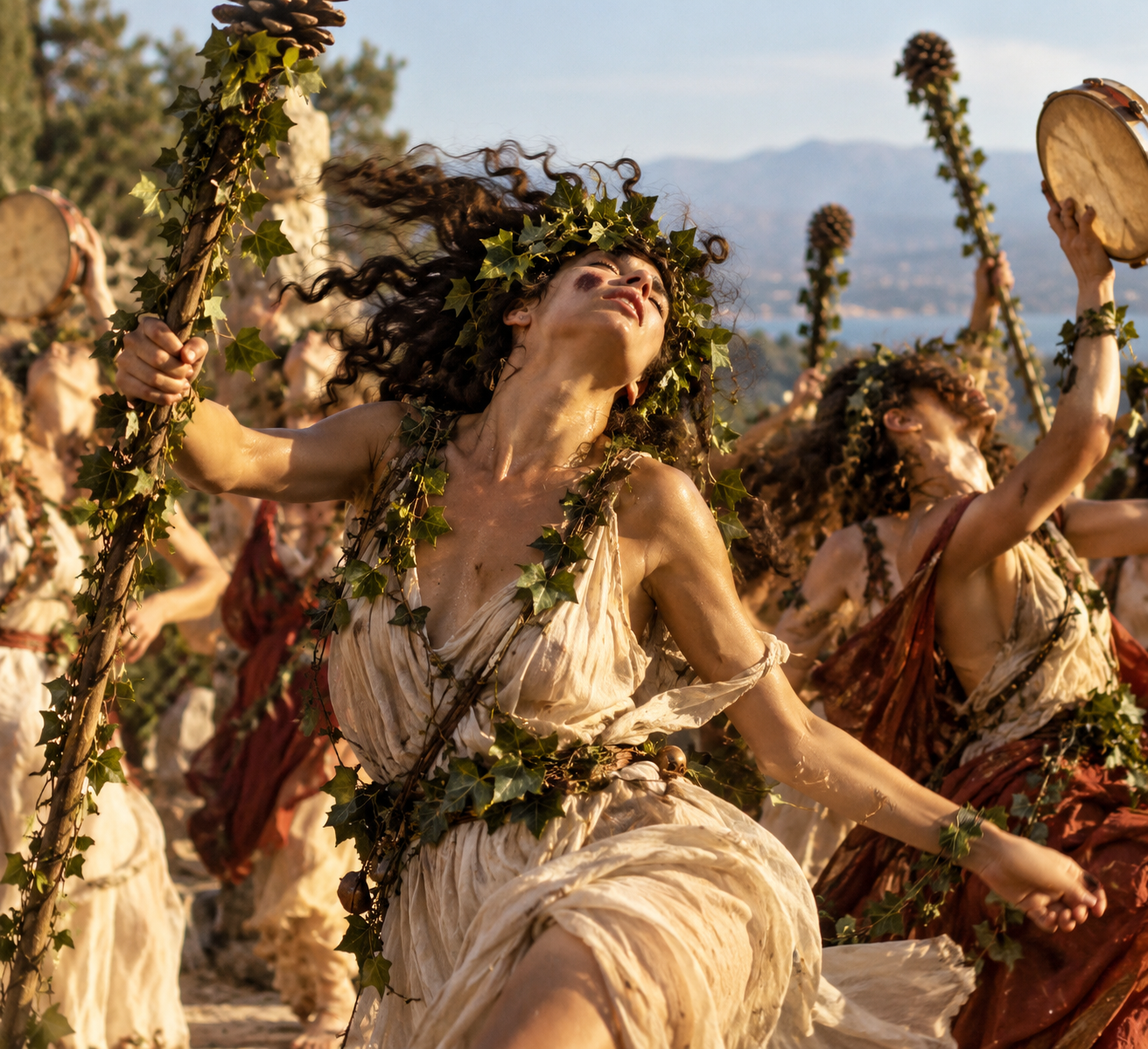
I was working on Diodoros Sikeliōtēs’ Library of History 4.3.3 when I noticed something important:
διόπερ ἐν πολλαῖς τῶν Ἑλληνίδων πόλεων διὰ τριετηρίδος Βάκχειά τε γυναικῶν ἀθροίζεσθαι, καὶ ταῖς παρθένοις νόμιμον εἶναι θυρσοφορεῖν καὶ συνενθουσιάζειν εὐαζούσας καὶ τιμώσας τὸν θεόν· τὰς δὲ γυναῖκας κατὰ συστήματα θυσιάζειν τῷ θεῷ καὶ βακχεύειν καὶ καθόλου τὴν παρουσίαν ὑμνεῖν τοῦ Διονύσου, μιμουμένας τὰς ἱστορουμένας τὸ παλαιὸν παρεδρεύειν τῷ θεῷ Μαινάδας.
For this reason, in many Hellenic cities, at the trieteric festival Bakcheiai of women assemble, and it is lawful for the maidens to bear the thyrsos and participate together in enthousiasmos, crying “Euai!” and honoring the God. The women, meanwhile, in organized groups, sacrifice to the God and bakcheuein, and in general hymn the parousia of Dionysos, imitating the Mainades who are recorded as having attended upon the God in ancient times.
There’s bakcheuein again! If I had a drachma for every time I’ve encountered this term as I’ve been working on Labyrinth of Words…
These are texts that I am intimately familiar with.
Primarily through English translations.
And thus I had not noticed the lexical promiscuity of βακχεύω / βακχεύειν until just a couple years ago. That’s one of the things that’s going to make Labyrinth of Words such a valuable devotional tool. It’s a collection of lore for the Starry Bull tradition, with the texts appearing in the original Greek, Latin, Italian, French, German and Russian with opensource English translations that I have edited to highlight the technical language employed by our respective authors— be they ancient, modern, or in between.
This is a very different approach than most translators who render βακχεύω / βακχεύειν according to whatever they think is happening in context:
- “celebrate the mysteries”
- “revel”
- “act the Bacchant”
- “engage in Bacchic revelry”
- “be inspired”
- “prophetic inspiration”
- “Bacchically inspired”
- “frenzy”
- “rage”
- “perform Bacchic rites”
- “play the Bacchant”
- occasionally simply “bacchanal”
So an English-text search makes the verb look much less recurrent than it actually is.
And as I make my way through the Labyrinth with a red pen instead of a ball of woolen thread I am now encountering it across quite different contexts, which is precisely why I increasingly think the decision to retain bakcheuein was the correct one. Plutarch’s sick soldiers at Gomphoi βακχεύειν along the road; Diodoros’ respectable matrons at the trieteric rites βακχεύειν; elsewhere it can describe ritual specialists, initiatory activity, possession, performance, or behavior perceived as Bacchic. Translating each occurrence only according to context destroys the lexical thread connecting them.
More importantly, the breadth may be part of the word’s meaning rather than evidence that it is hopelessly vague. Βακχεύειν seems capable of denoting entering into —or enacting— a recognizably Bacchic mode whose particular manifestation depends upon circumstances: ritual action, procession, ecstatic behavior, possession, imitation of the Bakchai of old, and so forth.
That’s quite different from saying it means six unrelated things.
And Diodoros 4.3.3 is an especially good example because he stacks related but non-identical vocabulary:
Βάκχεια … θυρσοφορεῖν … συνενθουσιάζειν … εὐαζούσας … θυσιάζειν … βακχεύειν … παρουσίαν … Μαινάδας
If βακχεύειν simply meant “celebrate his mysteries,” Diodoros has plenty of more precise mystery vocabulary available— in other texts I’ve worked on he’s used everything from τελεταί to μυστήρια to ὄργια. Diodoros isn’t some kid on Reddit; he actually knows his shit, especially when it comes to Dionysos. And if βακχεύειν just meant “be possessed,” Diodoros used συνενθουσιάζειν earlier that paragraph!
So βακχεύειν is doing some serious work.
Which begs the question:
Πότε τελευταῖον ἐβάκχευσας;
“When was the last time you bakcheued?”

