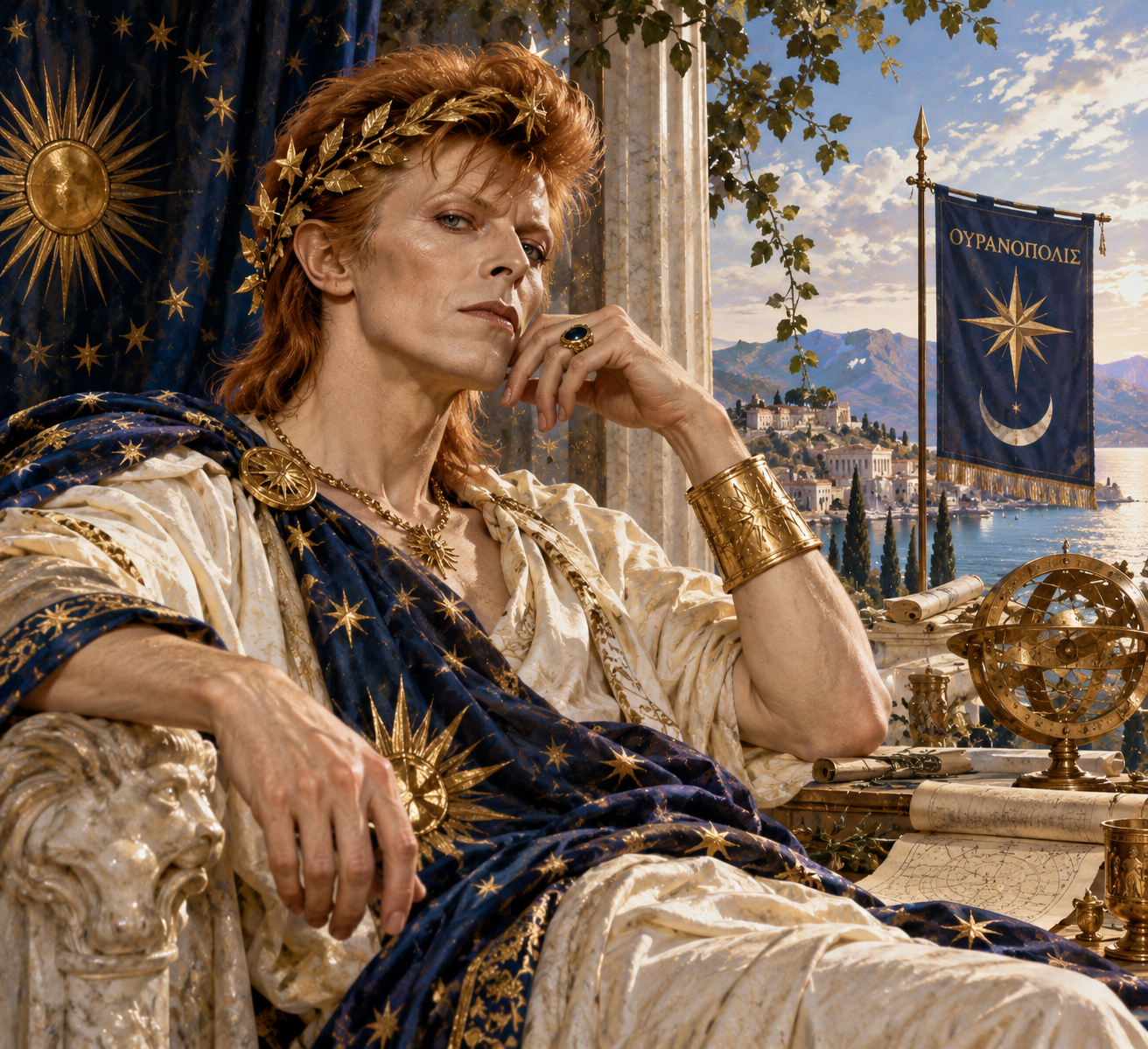
Answering a question on another post, I wrote the following:
I know another Roman father God: Liber Pater, of course.
But otherwise your point holds, and I think there’s even evidence to back it up.
One of the Emperors had a brother or cousin or something that got entangled with a bunch of philosophers and hippies. They decided to start a commune, which is a hell of a lot easier when you’ve got a relative of the Emperor in your cult. So instead of a cult compound they actually got a city that was depopulated/abandoned during a war for them to resettle. They renamed the city Ouranopolis “Heaven City” and its inhabitants Ouranopolites or Ouranopolitans; wrote a constitution; attracted a fairly large following, and then the Emperor dies and you don’t really hear from the commune again. I’m assuming it went something like this:
upkeep on the property caused tensions → the group schismed → they were even less able to maintain Ouranopolis so they abandoned it and dispersed → a core group probably remained with the cult leader while others found new charismatic masters to follow → if the relative of the Emperor wasn’t already dead the new Emperor either killed him so there wouldn’t be any pretenders or rivals; but in all probability he was a feckless, head-in-the-clouds sort of guy that nobody, including brainwashed cultists, would follow which is why you don’t hear of him succeeding as leader of the Ouranopolitans, so the new Emperor either didn’t seem him worthy of bothering with, or was too busy solidifying his rule and by the time things had calmed down the problem had solved itself.
There are also poets who identify Zeus with Heaven and cult-titles that reinforce that (both Οὐράνιος and Αἰθέριος as well as other Ouran- and Aither-words, not to mention ὕψιστος “highest”) so I suspect you’re onto something.
I mean, I would be surprised if it was otherwise since there’s a very ancient inclination (possibly going back to P-I-E days, if not earlier) where “up = reassuring or good” and “down = scary or bad.”
Also note that there are variant accounts in which Ouranos is portrayed in a favorable light, or isn’t part of the generational and typological skirmishes for the throne. There are even some who claim that this was an Orphic idea that got inserted into Hesiod and similar poets. But I think that’s bullshit.
Unfortunately, this requires a little clarification. To begin with Alexarchos of Macedon is our man— he wasn’t a Roman imperial relative but the brother of Kassandros, king of Macedon, and therefore a son of Antipatros.
Our principal literary witness is Athenaios, Deipnosophistai 3.98d–f, quoting Herakleides Lembos, which begins:
Ἀλέξαρχος ὁ Κασσάνδρου τοῦ Μακεδονίας βασιλεύσαντος ἀδελφός
Athenaios’ source then goes on to identify him as the man who founded/built Ouranopolis. Herakleides then describes his extraordinary linguistic reforms. He renamed ordinary things with his own compounds: the rooster became an orthroboas, roughly “dawn-crier”; the barber a brotokertēs, “mortal-cutter”; a drachma an argyris; a day’s ration a hēmerotrophis; and a herald an apytēs. He even sent an official letter in his invented language to the authorities of neighboring Kassandreia, which Athenaios jokes was so incomprehensible that even Pythian Apollon couldn’t understand it. That actually makes me feel better about my middling to shitty Greek. I mean, you have to be pretty bad to have Apollon scratch his head and go, “the fuck is this? Hermes, are you joking again? Because it ain’t funny.”
Alexarchos founded Ouranopolis (“Heaven-City”) around the late fourth century BCE in Chalkidike. Recent scholarship discusses the hypothesis that Ouranopolis occupied or reorganized Sane, where Antipatros had previously settled exiles; the archaeological/numismatic reconstruction puts Ouranopolis after about 316 BCE, and the settlement seems to have been short-lived and abandoned early in the third century.
However, during that brief period when they were occupants they didn’t merely call themselves Ouranopolitai: the coinage actually gives ΟΥΡΑΝΙΔΩΝ and ΟΥΡΑΝΙΔΩΝ ΠΟΛΕΩΣ—Ouranidai, effectively “Children/Sons of Ouranos/Heaven.” The coins employ celestial imagery, including Aphrodite Ourania and the Sun, Moon, and Stars; the Archaeological Museum of Thessaloniki identifies Helios as the city’s principal God.
Which sounds pretty Orphic to me, especially when you have the following inscribed on gold lamellae:
Γῆς παῖς εἰμι καὶ Οὐρανοῦ ἀστερόεντος· αὐτὰρ ἐμοὶ γένος οὐράνιον.
I am a child of Earth and starry Ouranos; but my genos is heavenly.
Alexarchos’ citizens call themselves: Οὐρανίδαι which can mean not merely “people of Ouranopolis” but carries the completely transparent sense “Children/Descendants of Ouranos.” That’s where it gets interesting. The lamella does something that becomes easy to miss when οὐράνιον gets rendered blandly as “heavenly.” Its speaker first establishes parentage: Γῆ + Οὐρανός → παῖς and then characterizes genos with the adjective formed from Οὐρανός: γένος οὐράνιον. Alexarchos’ community has effectively turned the same semantic complex into a civic ethnonym: Οὐρανός → Οὐρανίδαι. And the -ίδης/-ίδαι formation is genealogical language par excellence: Atreidai, Aiakidai, Herakleidai, etc. So Ouranidai inevitably sounds like a genos-name as well as a demonym. That becomes considerably more suggestive in comparison with the gold lamellae: humanity sharing common parents in Ouranos and Gaia.
Now there’s nothing to suggest that Alexarchos knew the mystery formula, belonged to an Orphic/Bakchic group, or founded Ouranopolis on Orphic or Pythagorean principles. The celestial coinage makes his choice of terminology unquestionably meaningful, but doesn’t tell us precisely what doctrine stood behind it.
But for the original question about whether Ouranos was uniformly regarded as a sinister figure? This is becoming much stronger evidence. The mystery initiate can proclaim “I am a child of Earth and starry Ouranos” as a privileged identity and immediately declare “my genos is Ouranian.” Alexarchos can found a City of Ouranos/Heaven populated by Ouranidai. And traditions can conceptualize Ouranos and Gaia as the common parents of humanity, or as Diodoros does rulers of a peaceful kingdom comparable to the Roman attitude towards Saturn/Kronos’ golden reign. Whatever Hesiod is doing with the castration myth, that is clearly not the entirety of Greek religious imagination concerning Ouranos. And I think there’s an especially important methodological point here: we shouldn’t allow narrative mythology to swallow cultic and religious language. “What happens to Ouranos in Hesiod?” and “What does Ouranos mean as a source of divine/human identity?” are entirely different questions.
Also: the word γένος can mean “nature,” “kind,” or a vague poetic “race” but it can also signify a group constituted by descent— lineage, stock, ancestry. In my translation I emphasized γένος in the sense of “descent group” because that gives us “I descended from Heaven” which is amusing, especially with the strong David “the Man Who Fell to Earth” Bowie vibes it gives off.
Wild Eyed Boy from Freecloud would make the perfect anthem for the Ouranidai.


That there are words “race” which do not translate as we have lost touch with our own to be endlessly erstwhile (Who speaks of Kith and Kin in suchlike ways?)
Λαός
Γένος
Έθνος
Your concept of the Child of Starry Heaven being a metropolitan of a doomed commune is bittersweet. I can see the logic, and grant it. My gut tells me Eleusis goes deeper than that. But many things can be equally true without betraying each other.
LikeLike