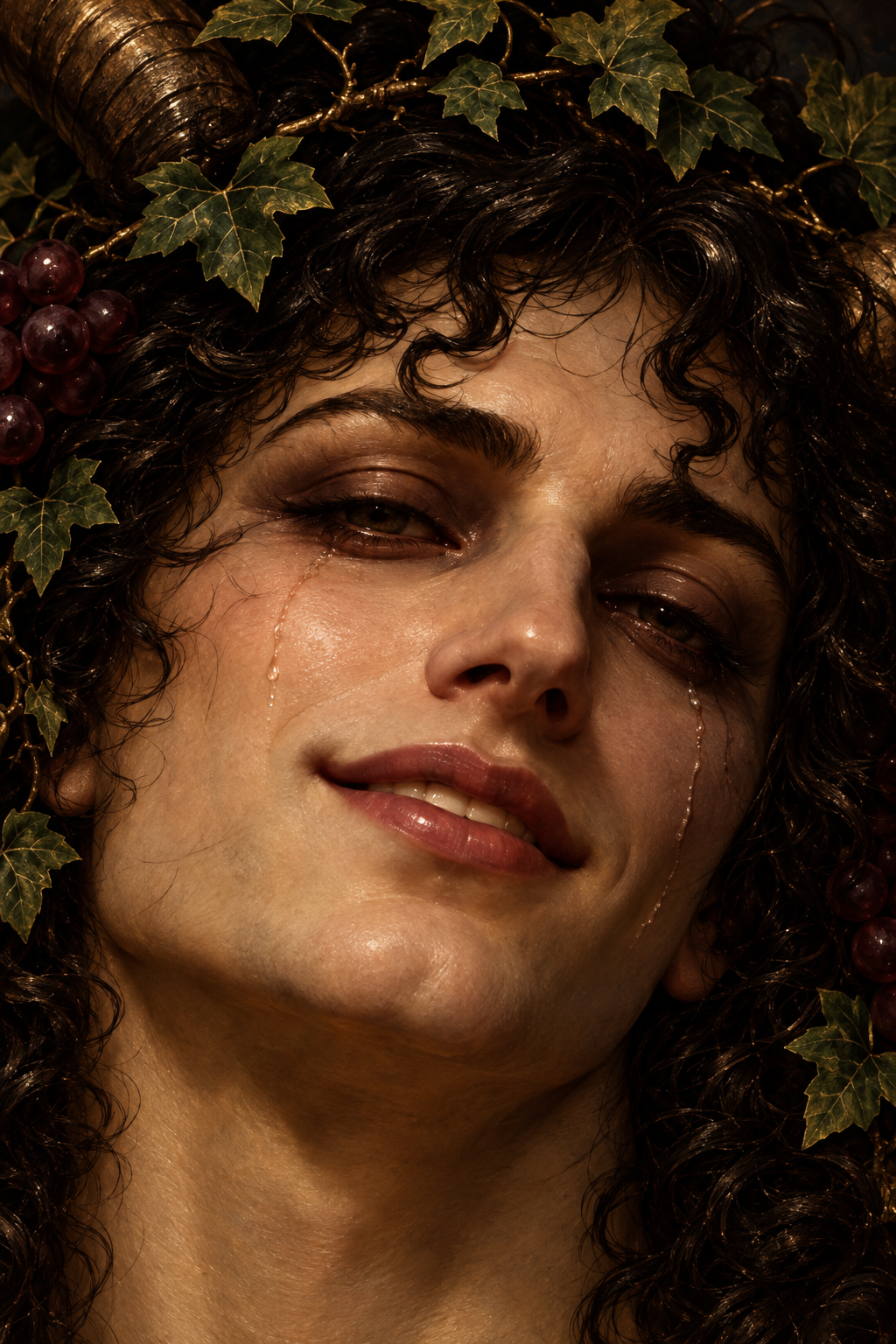
We are Dionysiakē— those who belong to Dionysos.
We have spoken the words. Now let us discover what they cost.
For the God approaches with gifts that alter the hands receiving them. Wine, ivy, phallos, the mask, the strange companion at the door: through these he makes his presence known, and the house that welcomes him becomes larger than its walls.
We affirm the world in its terrible abundance. Birth spends itself in living; living feeds the Earth; from the Earth rises another mouth, another flower, another cry. The vine draws sweetness out of a grave. We will drink with knowledge of its roots.
Our joy shall have the depth of that knowledge.
There are Gods. There are the Dead. There are powers abroad whose purposes exceed our capacity to understand, and beauties before which our explanations fall silent. All we can do is approach them bearing offerings, and in doing so we learn the difficult courtesy of encountering what has no obligation to resemble us.
Dionysos stands among them, crowned and laughing.
He has been torn apart. His presence gathers a chorus.
Each voice enters with its own wound, its own breath, its own necessity. Together they accomplish something none could accomplish alone. The God passes through the interval between them. We will cultivate that interval: the charged space in which another being becomes present and understanding opens.
This is how a company (σπεῖρα) becomes sacred.
Starry Bull has a country of memory: Crete, Magna Graecia, the shores of the Black Sea. We return to these places through study, prayer, and ritual. Their names must acquire weight in our mouths. Their dead must receive more from us than admiration. We take up a particular inheritance and accept the labor of making it fruitful.
A tradition lives dangerously whenever it lives at all. Each generation must give it a body, and the body is mortal.
We offer ours, as Dionysos offers himself to us.
We delight in krasis, the sacred mixture. Pour the water into the wine and watch the gift increase. Let distinct, contrary powers (fire and water) meet and merge without surrendering their uniqueness. Let the bowl teach us an abundance that careful calculation could never produce.
We have suffered enough from the clenched hand, the miser’s curse, the soul that spends its whole life preserving itself for an occasion that never comes.
We will learn to receive him.
We will learn to accept his tragic blessings
We will learn to give back.
There shall be feasts whose splendor exceeds calculation. Hymns into which we pour the strength of our whole being. Hours given entirely to the Gods. Beauty made with care and offered without bargaining over its return.
The sacred makes a claim upon our surplus. It asks what we can bear to release.
Let our generosity become formidable.
And let us understand what is being offered. Our own labor. Our own wealth. Our own time. We will answer for these expenditures ourselves.
In our worship of Dionysos we will center xenia, reciprocal hospitality. The person entering our rites must be able to say yes, and able to withdraw it. The threshold must remain intelligible even when what lies beyond it is strange. Those entrusted with another’s vulnerability assume a debt of care. Ecstasy demands an exacting discipline from its attendants.
Someone must wash the cups after the God has departed.
We honor that person.
There are myriads of ways to pray, and care for the things of the God (including his fellow devotees) is among the most profound expressions of that loving reciprocity.
We will train ourselves to keep vigil, to listen, to discern, to carry what we have summoned. We will learn the prayers until they can rise through exhaustion. We will tend the shrine through seasons in which no revelation comes. We will discover whether our devotion can survive an ordinary morning, a cold and barren winter, times when all we hear from the God is silence.
And we take seriously the God’s passage through mortal flesh. The Neoi Dionysoi walk beneath the burden of his myths. In their lives the ancient drama takes on the grain of history. Their kingdoms are upon the earth. Therefore let kingship answer to the earth. Let the fields bear witness. Let the hungry speak. Let the frightened judge the protection they have received. A crown is heavy with the lives beneath it; whoever reaches for one reaches also for that weight. May wisdom find them equal to it. May justice be stronger than their delight in being obeyed.
And all of us, regardless of our vocation, seek the sovereignty required to make a gift of ourselves freely. We must know what moves us: the hunger wearing a noble mask, the fear calling itself prudence, the resentment rehearsing its little apocalypse. We will bring these things into the light and learn their names.
There is freedom in such knowledge. There is laughter after the confession.
Dionysos has laughter enough for us.
He has tears also.
We will follow him into the chamber of mourning and remain there as long as hospitality requires. The bereaved owe us no performance of renewal. We can keep the lamp burning. We can prepare food. We can be silent witnesses to their suffering, until it is time to speak words of consolation, and words of praise to the God who bears the beloved name Σπουδαιογέλοιον. Like the Chorus in Aristophanes’ Frogs let us proclaim: καὶ πολλὰ μὲν γελοῖά μ’ εἰπεῖν, πολλὰ δὲ σπουδαῖα, καὶ τὴς σὴς ἑορτὴς ἁείως παίσαντα καὶ σκώψαντα νικήσαντα ταινιούσθαι. (“Allow me to say many things in jest and many things in seriousness, and, having sported and lampooned in a manner worthy of your feast, let me, victorious, win the victor’s wreath.”)
Our dead shall have names. They shall be crowned with unfading remembrance.
Memory shall give them a place at the feast. Their gifts circulate through our hands; their unfinished labors trouble our sleep. We receive this troubling as part of our inheritance. In time, others will inherit what we have done, and must complete what we leave unfinished.
Let us give them something that can sustain their devotion.
A calendar with holy days worth observing. Songs strong enough to transform grief. Teachers worthy of confidence. Rites approached with knowledge and desire. Friendships capable of radical authenticity. A table around which the living can become more generous, and benefit from the wisdom of the ancestors.
Such things demand years.
We pledge years.
We will study the fragments and make offerings among the ruins. We will compose, rehearse, plant, repair. We will endure the embarrassment of beginning and the severity of becoming skilled. Our devotion will acquire hands.
And when the hour of celebration comes, we will celebrate with everything this labor has made possible.
Let the drums sound, and the pipes trill.
Let the doors open upon the limitless possibilities of Night.
Let Earth feel the measure of our dancing, and starry Heaven receive our breath.
We belong to Dionysos.
May we become capable of bearing the gift of his love.
Let there be incense on the altar, bread on the table, justice in our dealings, and courage in our hearts.
Let the dead be remembered.
Let the living flourish.
Let the cup go round again and again, and each time may we pour out more of ourselves to the God who celebrates along with us.

