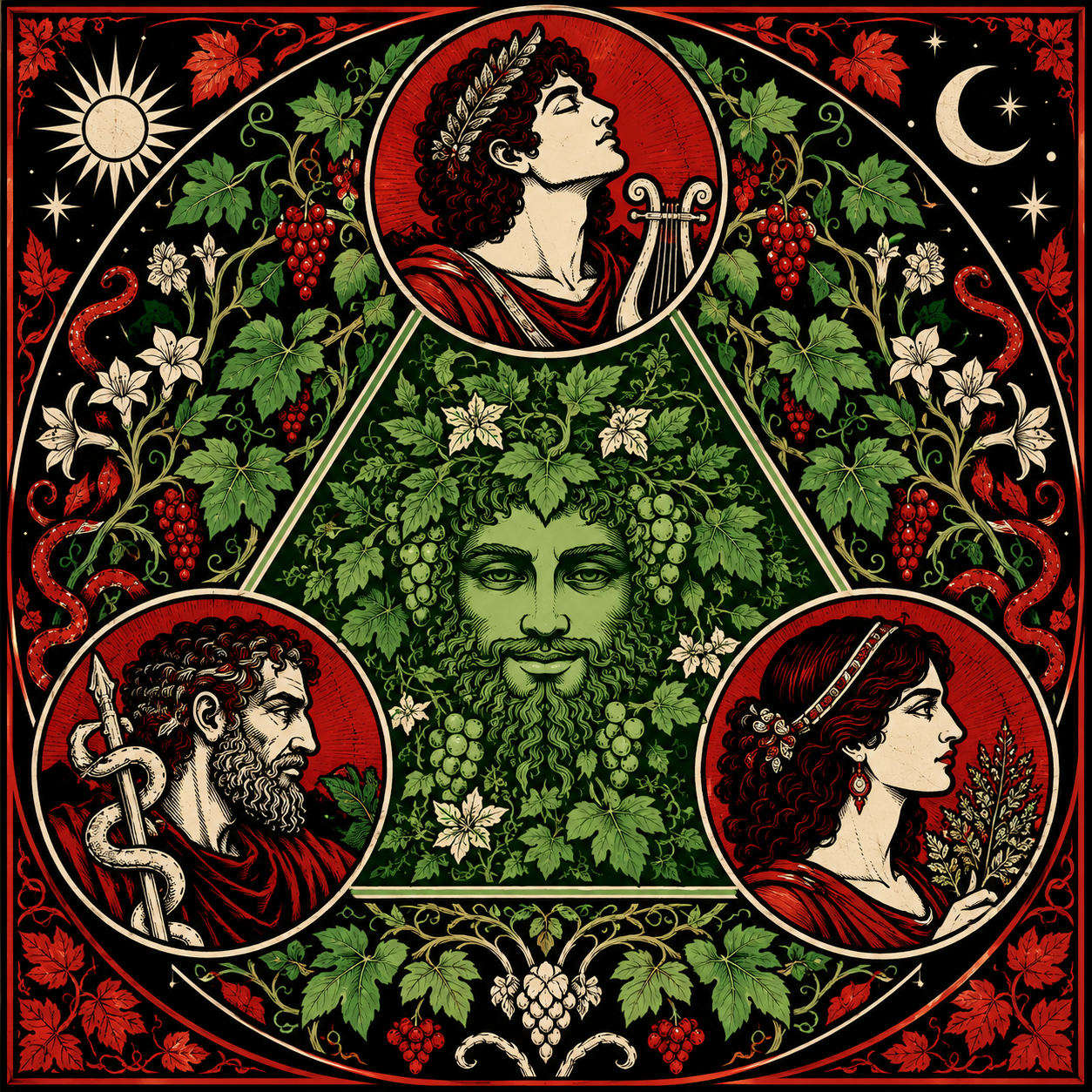
I’ve discussed Orpheus and Medeia and Melampos before, the three Patrons of the Green Way— but I don’t think I’ve discussed what that latter part really means.
These three create a remarkably coherent tripartition, provided we treat them as overlapping competencies rather than three sealed departments. All three heal, purify, cross boundaries, possess unusual knowledge, and have relationships with altered states. But each seems to have a different center of gravity.
Orpheus: the Word and the Way. His distinctive instrument is logos in its strongest ritual sense: song, hymn, incantation, sacred narrative, names, instructions, and the knowledge by which one crosses boundaries correctly. In the Orphic Argonautika scene, he constructs and conducts the rite and addresses the Powers. Elsewhere he enchants animals, trees, stones, Argonauts, Gods, and the dead. And of course he is the paradigmatic katabatic specialist. Thus he presides over Green Way initiation, liturgy, sacred speech, eschatological instruction, and navigation between worlds. He knows the road and the words that open it.
Medeia: the Substance and the Transformation. Her characteristic knowledge is pharmaka: plants, poisons, medicines, ointments, compounds, sacrificial substances—the powers inherent in material things and how those powers can be combined. But “herbalism” is much too small a category. Medeia transforms states of being. Old → young. Vulnerable → fireproof. Living → dead. Fertile → sterile or vice versa in some traditions. Sane → mad. Hidden → manifest. Her material art changes what bodies can do. The Second Vatican Mythographer’s herbae quarum virtutem noverat is almost a perfect motto: she knows the powers of plants. And because those powers are distributed geographically, her wandering itself becomes a mode of acquiring knowledge.
Melampos: the Affliction and the Cure. His great competency is diagnostic and therapeutic mediation. He understands what is wrong— with a person, household, community, relationship with the Gods —and knows how to restore right relations. His divination matters enormously here. He understands animals; receives extraordinary knowledge; interprets signs; identifies divine causation; heals madness; conducts purification; and resolves collective crises. With the Proitides especially, the sequence is almost clinical in the old religious sense: diagnosis → negotiation → purification → altered-state/ritual treatment → reintegration. He knows what has gone wrong and what must be done about it.
That produces a very elegant shorthand:
Orpheus knows the Way.
Medeia knows the Powers.
Melampos knows the Cure.
Or, in terms of their characteristic media:
Orpheus — logos.
Medeia — pharmakon.
Melampos — mantikē/katharmos.
And I think the Orphic Argonautika shows why those shouldn’t become rigid offices. Orpheus certainly knows plants and pharmaka; Medeia certainly knows invocation and ritual; Melampos certainly knows ecstatic states and Dionysian rites. What distinguishes them is where authority concentrates, not what they’re permitted or forbidden to do.
There’s also a second tripartition underneath it which is a big part of how the Green Way conceptualizes the complimentary relationships between the three:
Orpheus mediates axes of power — living/dead, mortal/Divine, upper/lower worlds.
Medeia mediates materially — the hidden powers distributed through plants, animals, minerals, blood, bodies, poisons, medicines.
Melampos mediates relationally — human/God, human/animal, individual/community, sickness/order.
So if I imagine a crisis brought before all three: Melampos discovers what is happening; Medeia prepares what is needed; Orpheus performs the crossing.
Now consider that in light of the Argonautika: Medeia opens the chest. Orpheus opens the Underworld.
Of course for Bacchic heroes, all three deal with mania but from different sides. Orpheus uses language magic to heal and guide; Medeia can induce or materially manipulate extraordinary states; Melampos cures or channels it through a combination of ritual and drugs.
And finally, the three represent different types of sacred movement. The geometry is wonderfully clean:
Orpheus: ↕ vertical movement. He crosses the most absolute cosmological boundary: living world → Underworld → living world. His expertise consequently concerns passage between levels of reality: katabasis, return, initiation, the dead, divine revelation. Even his music works vertically in a sense: it reaches Powers ordinarily inaccessible to mortals, and can excite or calm emotions.
Medeia: ↔ horizontal movement. Her knowledge is acquired and exercised across the surface of the world. Colchis is crucial: she comes from the edge of the known world, travels west with the Argonauts, and keeps moving. And diversis regionibus quaesitas takes on greater significance: the plants are “sought from different regions.” Her geography and her pharmakeia mirror one another. The world contains powers scattered across space; Medeia traverses space to gather them.
Melampos: ⚡ zigzag movement. This one may actually be the richest. He doesn’t simply travel horizontally like Medeia. His trajectory repeatedly changes direction—geographically, socially, professionally. As an agyrtēs-like itinerant specialist, his knowledge is exercised precisely by going wherever the disorder requiring his intervention occurs. His path is neither a descent-and-return nor an expedition across the world’s material diversity. It is responsive movement: crisis here, revelation there, purification somewhere else. Which means our sacred zigzag isn’t merely a symbol attached afterward: Melampos lives it.
There’s an elegant relationship between their movement and their knowledge:
- Orpheus crosses worlds and therefore knows what lies beyond.
- Medeia crosses lands and therefore knows what the world contains.
- Melampos crosses conditions and therefore knows how one state becomes another.
That last one encompasses his social trajectory as well as his religious function. He doesn’t merely cure transformation; he undergoes it. Prince, wanderer, specialist, King. His authority isn’t static or institutionally guaranteed. It survives displacement and is ultimately vindicated through demonstrated sacred competence.


Would it be fair to say, Orpheus is the ultimate Hymnōdos?
LikeLike
He is both the prototypical Hymnōdos and Orpheotelest.
But if you were to map the three offices of the Starry Bull onto the three Patrons of the Green Way it would probably look something like this:
Orpheotelest = Medeia
Hymnōdos = Orpheus
Boukolos = Melampos
LikeLike