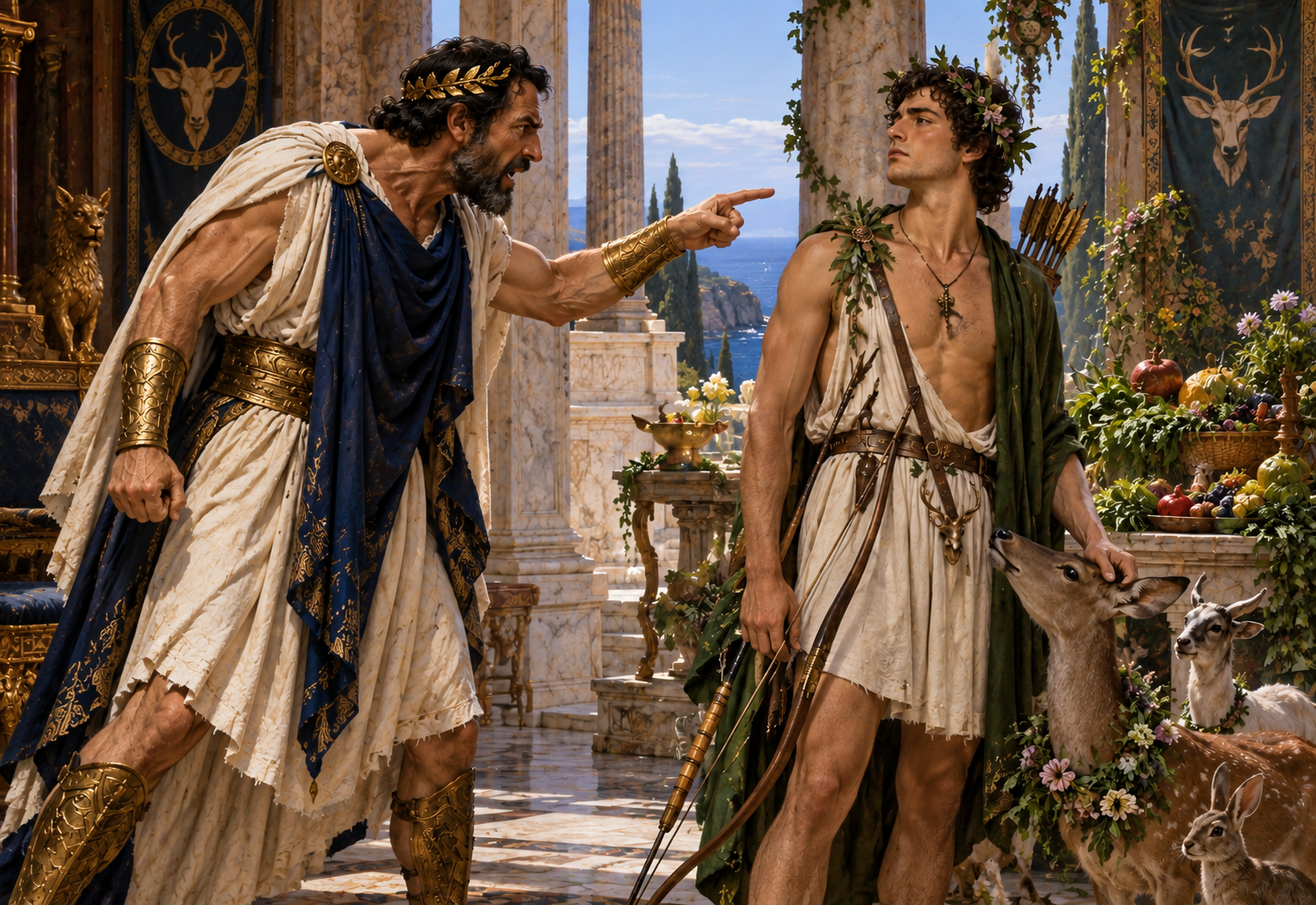
We’re having an interesting conversation prompted by the last post.
That passage is from the scene where Theseus accuses Hippolytos of having the hots for his stepmom. (Who has hung herself, and left a false note implicating the boy.) Theseus’ accusations are increasingly absurd, especially since Hippolytos got in trouble because of his henotheist bordering on monotheist devotion to the Goddess Artemis. He has no interest in sex beyond the oath of chastity he has sworn; all he cares about is running through the woods and murdering things. Which might be fine, but he goes the extra step of insulting the other Gods, including Aphrodite and that never, ever turns out well for people, especially if they suddenly find their life transformed into a tragic play. His unattainability is part of what caused Phaedra’s unholy obsession with her stepson. Even before his conversion he was kind of a meathead jock though. Which is what makes Theseus’ increasingly irrational accusations so sadly amusing. He’s throwing every insult he can think at the boy, including “you’ve gone and joined some weird hippie cult.” Extreme religiosity + extreme concern for purity = stereotypical Orphism in Classical Athens. With that comes the accusation that he has a vegetarian diet (the high concern for purity tended to look like vegetarianism to outsiders; but the specificity of Orphic taboos show that only certain animals and certain parts of animals had to be avoided, usually for a limited time only) he reads a lot of books and is constantly nattering on about bizarre religious and high-minded ethical matters. Obviously as far as the great outdoorsman and hunter is concerned, excessive devotion to Artemis aside, none of these accusations really apply to him, but his father isn’t exactly the brightest oil lamp in the room either. Without the corpse of Phaedra swinging from the rafters the scene would be pretty funny. With it, kinda depends on your feelings for Phaedra and step-parents in general. For some it adds to the humor, for others it complicates it, and some might not find that funny at all. (Since Phaedra is the sister of Ariadne, and her seduction of Theseus resulted in the latter being abandoned to die alone on the island, I kinda think the bitch got what she deserved. And I have complicated feelings about step-parents, or at least my own stepfather, so the less said about that the better.) Incidentally I hate the child-fucker Theseus even more than the other tragic characters in this story so I’m glad that in the end he’s left alone amid the ruins of his family. Circle composition and the assholes receiving just ends— this is why Tragedy is the queen of all the arts, and remains entertaining some two thousand five hundred and change years later.
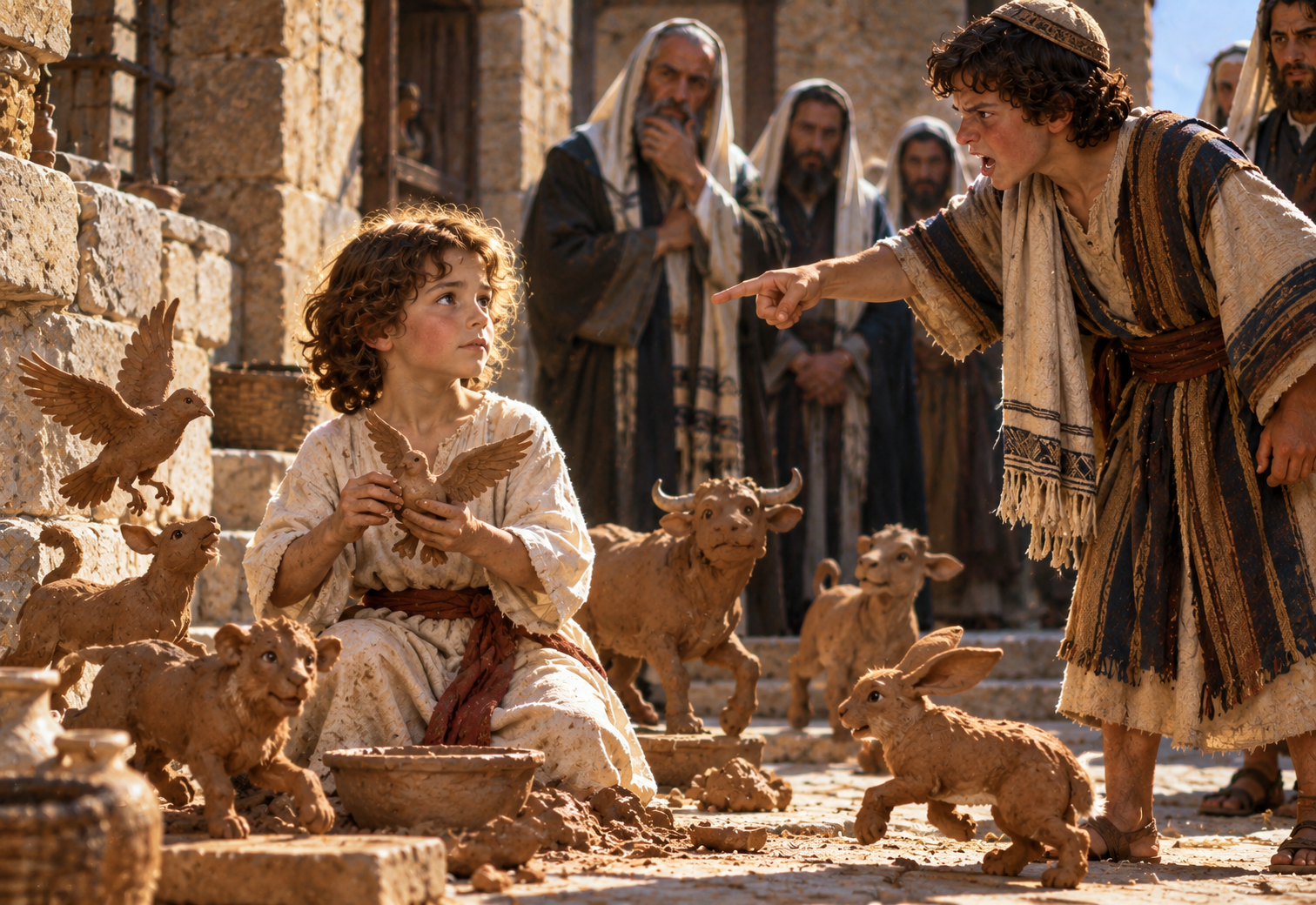
Which continued with a discussion of some of my favorite extra-canonical Abrahamic texts.
And the deeper you study it, and the more seriously you take the text, the richer the treasure you’ll find. For didactic purposes the simpler the better— which is why Aesop’s fables are so great, and not just for children. I think it’s the same with the Bible: you’ll get something if you just skim the text, especially the bits in red letters. But if you sit with it, pray for discernment and understanding, and really reflect on the passage (and even individual words) especially in conjunction with other parts of scripture, well, you’re gonna get a hell of a lot more out of it than the skimmers. (Or the folks who have verses memorized but couldn’t tell you the first thing about what those verses mean.)
As beautiful and powerful as the received canon is, I am fond of Apocryphal, Gnostic and Heretical writings— especially the Protoevangelium of James, Infancy Gospel of Thomas, and the Gospel of Nicodemus. The first contains the foreskin of the baby Jesus which has miraculous healing properties, the second has Jesus as a precocious child with the full powers of a God who doesn’t take kindly to criticism from his age-mates, and the third contains a cameo by Plouton the Lord of Haides who wants nothing to do with the squabble between Jesus and Satan, and gets pissed at Satan for provoking Jesus to perform his katabasis and set free the souls in the Kingdom Below. Clearly what you’ve got there are the remnants of a Christian community that, if not itself polytheist, sought to make the new religion comprehensible within a Greco-Roman weltanschauung. The IGoT is amusing because child Jesus makes the animals he fashioned out of mud come alive; his playmate says it’s against the Law of Moses to work on the Sabbath so Jesus kills the little brat. Later Joseph and Mary march him back to the home of the grieving family and force him to restore the boy’s life.
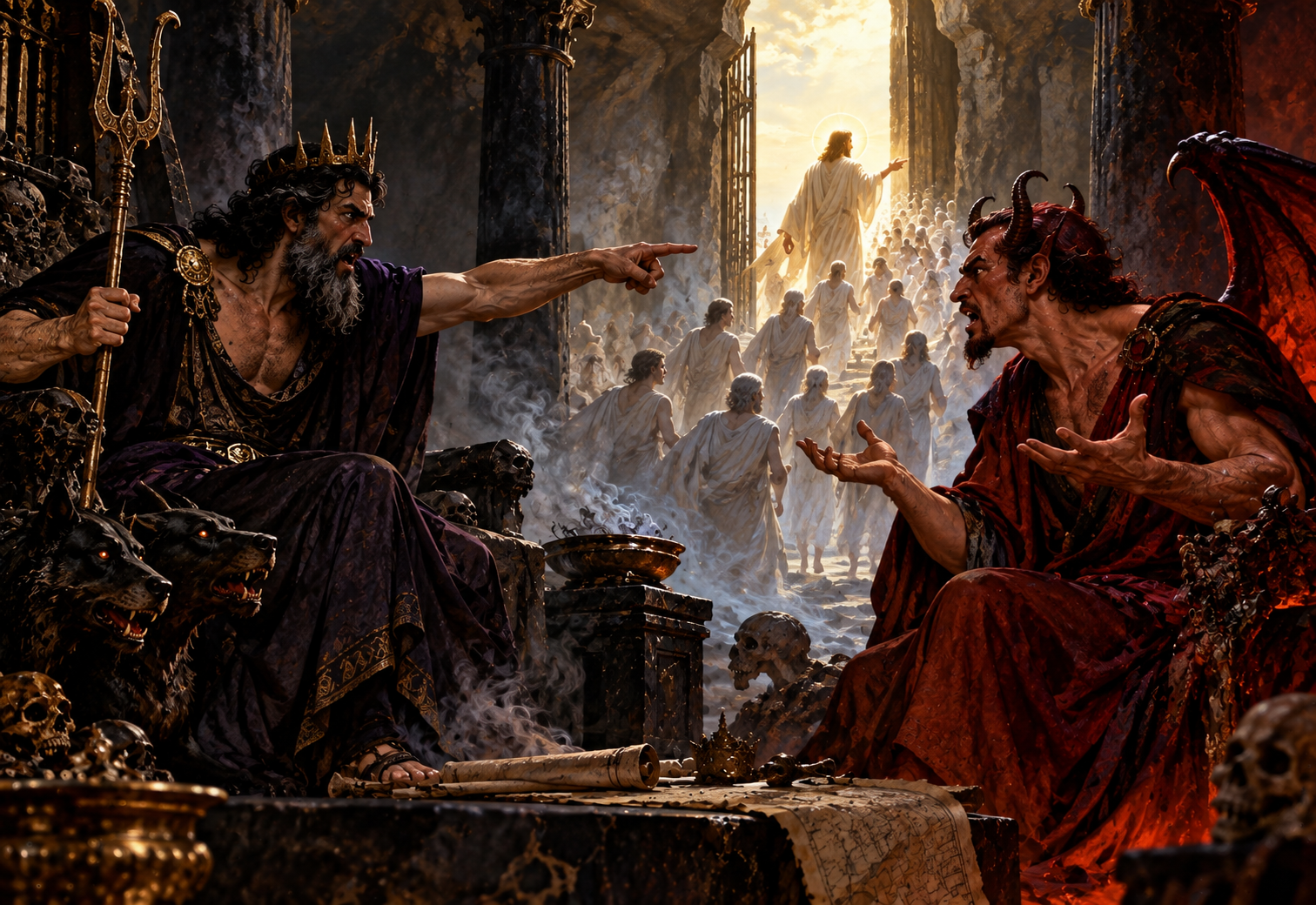


They shoulda kept Hades as a main character.
LikeLike
So much wasted potential there…
LikeLike
Yes – more on that later.
LikeLike
Speaking of wasted potential, I was wondering if Silenus (I assume) was going to become a cameo for your articles moving forward since you had him twice in a row.
LikeLike
Oh, definitely. Silenos is such an important divinity— a creature of tremendous animal appetites and yet he has mastered σωφροσύνη and was able to transmit that virtue to young Dionysos, who was no less precocious than the child Jesus. Although we’ve always honored Silenos in the Starry Bull, with the reengineering process he will have a much more prominent position in the tradition. Actually, I’ve been thinking that Akousmatikoi should pay cultus to him during their training process.
LikeLiked by 1 person
I find it a quaint irony that we use the word “animal” to describe the bestial, or what we perceive as based and carnal… When the word was stem of Anima/Animus and referred to the ensouled. Or that desire in and of itself is somehow devoid of divinity.
But that’s me.
I have come to respect the stories of Dionysus. At first I viewed his cult with great suspicion because I (wrongly) associated it with depravity. But it is so much deeper than that. The Holy Terror of an archon of the wild so married to Mother Earth that he can command catastrophe… It makes no wonder that he was the only competent potential successor or heir-apparent to Zeus – I’m told.
And as for Silenos, the relationship he had with Dionysus, his rescue and fostering of him… And how Dionysus respects and shelters him in his “dotage” warms the cockles of my heart. That image has come to inform my vision of hospitality, in a way that I reckon one cannot appreciate without having read the tales. (That and like Midas I am not above feeding my guests until they’re fit to bust and plumbing them for their wisdoms.)
LikeLike