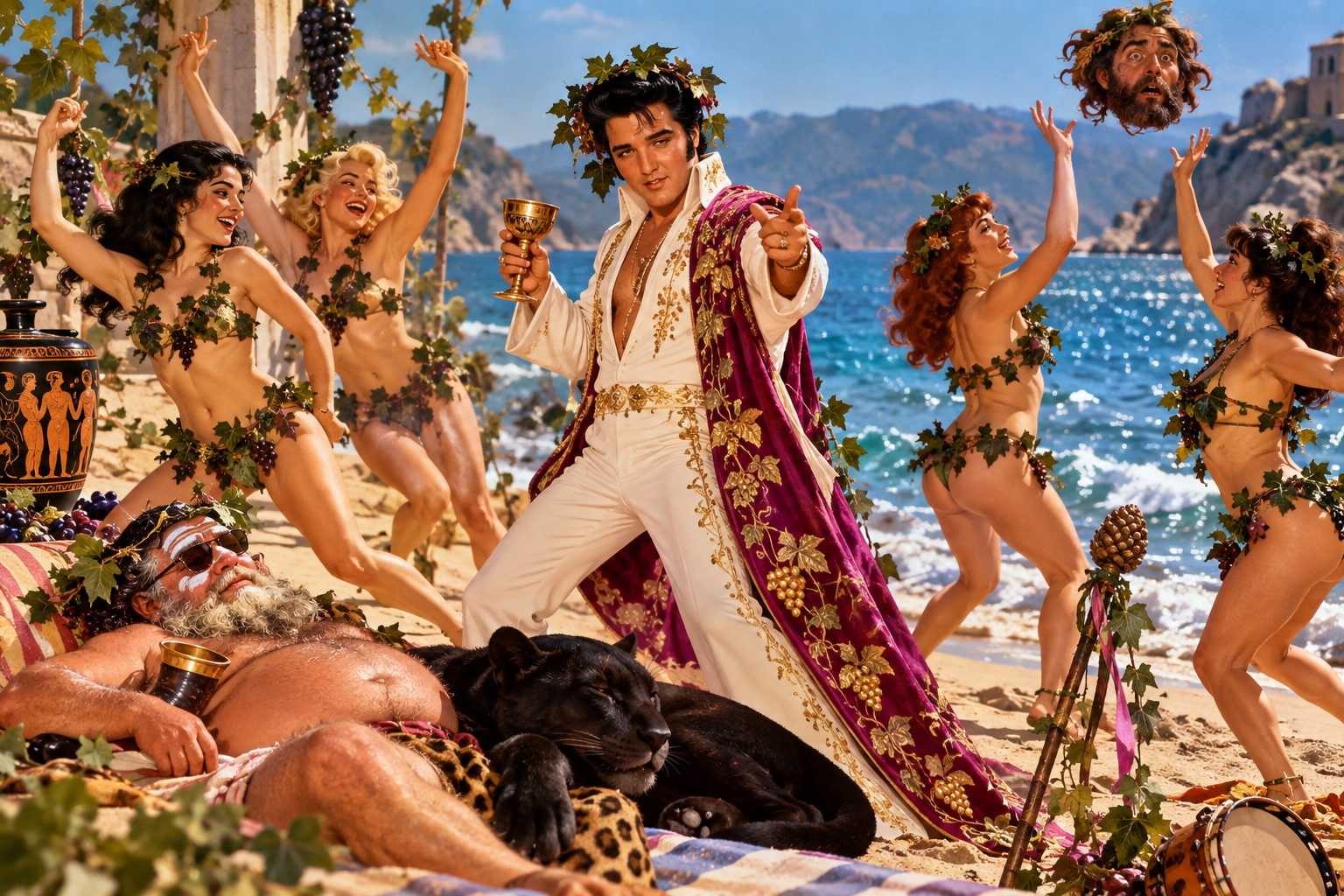
Scholiast on Euripides, Hippolytos 954.1
βάκχευε· μεγαλαύχει τὰς μωρίας πολλῶν γραμμάτων ἐπιστάμενος. τὸ γὰρ ληφθῆναί σε σκαιὰν ἐποίησέ σου τὴν ἄσκησιν· τιμῶν καπνούς· προσποιοῦ ἔνθεος εἶναι.
trans. 1
Doing the Bacchus: he boasts of knowing the foolishness of many books. For having been caught makes it become a terrible practice; ‘honoring the smoke’: this means he is possessed by the deity.
trans. 2
“Perform the Bakchic rites”: boast greatly that you know the foolishness of many writings. For your having been caught has made your practice disgraceful. “Honoring smoke”: pretend to be entheos, possessed by the God.


Those are widely divergent translations. I suppose the Eddas is little different. Still. To pretend at Enthusiasm is baneful in every context and syntax.
LikeLike
That’s from the scene where Theseus accuses Hippolytos of having the hots for his stepmom. (Who has hung herself, and left a false note implicating the boy.) Theseus’ accusations are increasingly absurd, especially since Hippolytos got in trouble because of his henotheist bordering on monotheist devotion to the Goddess Artemis. He has no interest in sex beyond the oath of chastity he has sworn; all he cares about is running through the woods and murdering things. Which might be fine, but he goes the extra step of insulting the other Gods, including Aphrodite and that never, ever turns out well for people, especially if they suddenly find their life transformed into a tragic play. His unattainability is part of what caused Phaedra’s unholy obsession with her stepson. Even before his conversion he was kind of a meathead jock though. Which is what makes Theseus’ increasingly irrational accusations so sadly amusing. He’s throwing every insult he can think at the boy, including “you’ve gone and joined some weird hippie cult.” Extreme religiosity + extreme concern for purity = stereotypical Orphism in Classical Athens. With that comes the accusation that he has a vegetarian diet (the high concern for purity tended to look like vegetarianism to outsiders; but the specificity of Orphic taboos show that only certain animals and certain parts of animals had to be avoided, usually for a limited time only) he reads a lot of books and is constantly nattering on about bizarre religious and high-minded ethical matters. Obviously as far as the great outdoorsman and hunter is concerned, excessive devotion to Artemis aside, none of these accusations really apply to him, but his father isn’t exactly the brightest oil lamp in the room either. Without the corpse of Phaedra swinging from the rafters the scene would be pretty funny. With it, kinda depends on your feelings for Phaedra and step-parents in general. For some it adds to the humor, for others it complicates it, and some might not find that funny at all. (Since Phaedra is the sister of Ariadne, and her seduction of Theseus resulted in the latter being abandoned to die alone on the island, I kinda think the bitch got what she deserved. And I have complicated feelings about step-parents, or at least my own stepfather, so the less said about that the better.) Incidentally I hate the child-fucker Theseus even more than the other tragic characters in this story so I’m glad that in the end he’s left alone amid the ruins of his family. Circle composition and the assholes receiving just ends— this is why Tragedy is the queen of all the arts, and remains entertaining some two thousand five hundred and change years later.
LikeLiked by 1 person
I can’t imagine being uninterested in the sex. I think of Saint Augustine “LORD make me chaste – but not yet.”
It’s funny to me how sanitised most of the accounts that filter down into the Anglo-Sphere are. When I teach my sons the myths it is with a hermeneutic of symbolism which doesn’t necessarily require the character scrupulosity of a more personal praxis. This is not to say I de-emphasise the persons, but that I stress that a man is meat and thought, and that the idea of a man weighs more than muscle. As in the story of Psyche & Cupid and the deeper meaning I believe it to tell. Und so weiter.
Though, I understand too that all myth contains social circumstantial navigation. The sorts of people you’ll encounter. The situations you’ll find.
Many uses to a myth.
LikeLike
And the deeper you study it, and the more seriously you take the text, the richer the treasure you’ll find. For didactic purposes the simpler the better— which is why Aesop’s fables are so great, and not just for children. I think it’s the same with the Bible: you’ll get something if you just skim the text, especially the bits in red letters. But if you sit with it, pray for discernment and understanding, and really reflect on the passage (and even individual words) especially in conjunction with other parts of scripture, well, you’re gonna get a hell of a lot more out of it than the skimmers. (Or the folks who have verses memorized but couldn’t tell you the first thing about what those verses mean.)
LikeLiked by 1 person
Absolutely! I got a lot out of Aesop as a boy – my dad read it to me, a book I think he had from his grandpa. I hope he kept it.
I’m going through the Bible now with the intention of following it up with Gnostic texts like Emerald Tablets, etc.
LikeLike
As beautiful and powerful as the received canon is, I am fond of Apocryphal, Gnostic and Heretical writings— especially the Protoevangelium of James, Infancy Gospel of Thomas, and the Gospel of Nicodemus. The first contains the foreskin of the baby Jesus which has miraculous healing properties, the second has Jesus as a precocious child with the full powers of a God who doesn’t take kindly to criticism from his age-mates, and the third contains a cameo by Plouton the Lord of Haides who wants nothing to do with the squabble between Jesus and Satan, and gets pissed at Satan for provoking Jesus to perform his katabasis and set free the souls in the Kingdom Below. Clearly what you’ve got there are the remnants of a Christian community that, if not itself polytheist, sought to make the new religion comprehensible within a Greco-Roman weltanschauung. The IGoT is amusing because child Jesus makes the animals he fashioned out of mud come alive; his playmate says it’s against the Law of Moses to work on the Sabbath so Jesus kills the little brat. Later Joseph and Mary march him back to the home of the grieving family and force him to restore the boy’s life.
LikeLike
Yes. I wanted to have the received Bible under my belt first for context. Whereas I’m passable familiar with Paganism of Greek, Roman, Celtic and Germanic Tribes I don’t feel the need to rehash that but my boys loved Greek myths for bedtime so it’s fresh
Anyways.
I had heard that recounting of the Mad Lad Christ story before from a dubitable source. It makes me smile every time. I didn’t know about Pluton coming in, that’s fantastic. It’ll be something to look forward to.
LikeLike
Nope. That’s definitely part of the Apocrypha. Infancy Gospel of Thomas rather than the Protoevangelium as I initially said.
http://www.gnosis.org/library/inftoma.htm
And the polytheistic Gospel of Nicodemus can be found here:
https://www.earlychristianwritings.com/text/gospelnicodemus.html
Note Haides and Jesus have no beef, and Haides addresses him respectfully, unlike Satan. Nor is this the only neutral-to-positive reference to the Gods in the text.
LikeLiked by 1 person
I have a lot of thoughts on the nomenclature. I’ll try to remember them later.
LikeLike
I can’t wait to hear them if you feel like sharing, either here or through email.
LikeLiked by 1 person
I will gladly share. I’m about an hour away from work’s end, after which point I’ll hit ya back.
I’ll do it here so your commenters can benefit from my mental retardation.
LikeLiked by 1 person
So. I confess my sins. Though I wax Gnostic I have yet to read all the texts. My background in Theology is Catholic, and was formed in dogmatism and traditionalism. I make no apology for this, my learning served me well – ironically – I learned to plumb the depths of Paganism (or at least scratch the surface) from Catholic scholastic application, hermeneutical training, etc.
Now I attend an Orthodox Church where the leakage of the old ways even in secular Maine is quite comforting.
In the Orthodox Liturgical language, you’ll imagine, there is no Hell. There is less Heaven, though for English speakers Heaven is non-negotiable. We have here with the Greeks Ouranous and Hades.
I have often wondered if, like with the Roman Satúrnus, Ouranous was once a more sympathetic character. That the Greeks were unable to let him go suggests to me that there is a foggy memory of a time where his reign was beneficial. He, of course, fills the womb of Mother Earth. Gaia. Mother Earth is a character you’ll recall passingly named in Revelation. In this Book she gives succour to the Woman Clothed in the Sun whose baby is to be swallowed by the dragon after her time being fed by the angels for 1000 days (yum yum). She herself hides them. This is almost embarrassingly similar to the tale of how Earth taught Zeus’ mother to hide him away. It strikes me significant that the Orthodox call upon Ouranous as an alternative to the God above God’s, much as the English speak to heaven. But the syntax is curious. Obviously the grammar slowly converts the God to a place. But one wonders if it was always thus. Same with Hades. Hades is often described as having will – Hades trembles, etc.
These are not coherent thoughts. I realise that. They’re a jumble. It’s much easier for me to make the argument that Goddesses should be fat again. But I think I’m onto something.
I contend this using Interpretatio Romana. Iove (Júpíter) and Dis (Dispiter) are almost equal opposites in some Roman schools. They are the only Fathered Gods in the Roman system. None other carry the name and title. Father of the Gods. Father of the Dead. They relate to the Odinic dyad. Dis is called the Wise Counsellor. He was once highly revered. Much as the Celts were said to worship their God of Death above most.
As above, so below. Thousands of years of pressure testing produced an (maybe) accidental diamond in the liturgy in which Iove and Dis become the ultimate polarities with all the powers and principalities between them. The names change, but one wonders if the entities aren’t exchangeable. Do not Uriel, Michael, Raphael and Gabriel combinatively satisfy the functions of the Aesir or wandering Hermes & Mercurius?
I’m not married to this, or willing to say I have something solid, but it’s a spear I can train.
LikeLike
I know another Roman father God: Liber Pater, of course.
But otherwise your point holds, and I think there’s even evidence to back it up.
One of the Emperors had a brother or cousin or something that got entangled with a bunch of philosophers and hippies. They decided to start a commune, which was a hell of a lot easier when you’ve got a relative of the Emperor in your cult. So instead of a cult compound they actually got a city that was depopulated/abandoned during a war for them to resettle. They renamed the city Ouranopolis “Heaven City” and its inhabitants Ouranopolites or Ouranopolitans; wrote a constitution; attracted a fairly large following, and then the Emperor dies and you don’t really hear from the commune again. I’m assuming it went something like this:
upkeep on the property caused tensions → the group schismed → they were even less able to maintain Ouranopolis so they abandoned it and dispersed → a core group probably remained with the cult leader while others found new charismatic masters to follow → if the relative of the Emperor wasn’t already dead the new Emperor either killed him so there wouldn’t be any pretenders or rivals; but in all probability he was a feckless, head-in-the-clouds sort of guy that nobody, including brainwashed cultists, would follow which is why you don’t hear of him succeeding as leader of the Ouranopolitans, so the new Emperor either didn’t seem him worthy of bothering with, or was too busy solidifying his rule and by the time things had calmed down the problem had solved itself.
There are also poets who identify Zeus with Heaven and cult-titles that reinforce that (both Οὐράνιος and Αἰθέριος as well as other Ouran- and Aither-words, not to mention ὕψιστος “highest”) so I suspect you’re onto something.
I mean, I would be surprised if it was otherwise since there’s a very ancient inclination (possibly going back to P-I-E days, if not earlier) where “up = reassuring or good” and “down = scary or bad.”
Also note that there are variant accounts in which Ouranos is portrayed in a favorable light, or isn’t part of the generational and typological skirmishes for the throne. There are even some who claim that this was an Orphic idea that got inserted into Hesiod and similar poets. But I think that’s bullshit.
LikeLiked by 1 person
Well now this is all very fascinating. I knew nothing of the commune, though this is no surprise given my ulterior proclivities as an Earth Firster who sees the Gods in an aspirational benefactorial light to be approached THROUGH the earthly medium. My heavenly knowledge is therefore limited.
As to Ouranous… Or Satúrnus… It galls me and grieves me how they conspiratorialise Saturn as a kind of semitic super Satan like he’s some God awful Dragon Ball Z villain. Saturn’s black cube this, true God of the Masons that.
I don’t buy it. I find the idea that our ancestors found the embodiment of heaven evil to be suspect more than it’s beneficence being a late myth… Fishy.
Now as to Dispiter. What I find truly keen is how the earlier sources do NOT demonize the Lord of the Underworld. Dis was the Wise Counselor, etc. Even Hades – I have read – was viewed dispassionately, not as an afterthought but as a mere fact of life and it’s process. That later Greeks became superstitious and hostile to the Hidden One.
When it comes to Zeus… What you say is interesting. I find it both the Greeks and Romans somewhat independently but likely more parasympathetically on behalf of the latter, are *said* to have devised a kind of henotheism in which the various “lesser” Gods are emanations of Zeus. I find it theoretically fascinating, but ultimately meaningless because like the shape of the Earth (phat, IMO) it changes nothing for my praxis or ethos.
But you should take it all with a grain of salt. I’m just a random idiot whom given the choice would threaten to drop it all to start a feeder cult on Lesvos to make nymphs and maenads, banshees and valkyries *faat* but then decide it impious and go on grumbling in existential moral torpor.
LikeLike
Although, I have to say… Your litany makes me feel better about my own moral shortcomings and overwhelming desire to feed wicked fat girls pizza in Valhalla.
LikeLike
Everything in moderation (including moderation itself.)
LikeLike
You’ve taken the words right out of my mouth, more or less. I say it often. “Especially moderation.” (Even if I myself am fairly moderate, I am for others a professional ‘good bad influence’.)
LikeLiked by 1 person