Associating the bees with Ariadne does something else, I hadn’t considered at first; it naturally conjures her other brother Glaukos, who fell into a jar of honey and was brought back to life by Polyidos, the descendant of Melampos, and prototypical Orpheotelest. That makes the Ariadne substitution much more than transferring a beautiful Persephonean image to another Dionysian woman. Honey already belongs to Ariadne’s family mythology as a medium in which death becomes reversible.
Glaukos falls into the πίθος of honey and dies —or is found dead there— and Polyidos is shut up with the body until he discovers the means of restoring him. The crucial episode with the snakes then turns the whole thing into a miniature initiation narrative: Polyidos kills the first snake; its mate arrives bearing the herb that restores it; Polyidos recognizes the sign, applies the same knowledge to Glaukos, and the dead child returns to life.
So beside Mandel’štam’s:
dead bees → honey → Sun
You can place the Cretan mythic sequence:
Glaukos → honey → death → hidden knowledge → restoration to life.
And Ariadne stands remarkably close to both structures. She belongs to the same royal house as Glaukos; she herself undergoes abandonment and a radical change of condition through Dionysos; and, depending upon which ancient tradition one follows, her mythology has its own complicated relationship between death and immortality/catasterism.
But bringing Polyidos into it makes the connection especially suited to our tradition. He isn’t merely someone who happens to know a resurrection trick. His Melampodid ancestry places the episode within precisely the kind of specialist transmission of extraordinary knowledge that defines the Orpheotelest: confinement with the dead, observation of a sign, acquisition of hidden knowledge, application of that knowledge to overcome a boundary ordinary people cannot overcome.
There’s even a lovely contrast with the Mousai and Orpheus:
Orpheus: the dismembered dead are gathered, and art preserves them beyond death.
Glaukos: the dead body is preserved in honey, and specialist knowledge restores it to life.
Mandel’štam: the dead bees leave honey behind, and poetry transforms that honey into Sun.
Those aren’t historically dependent upon one another merely because we’ve put them beside each other, of course. But poetically they form an astonishing constellation.
And honey is doing something particularly interesting throughout: it is produced by life, associated with incorruptibility/preservation, implicated in death, and capable of becoming an image of what survives death. With Glaukos it becomes almost literally the container of the interval between death and restored life.
Which means that when you put dead bees around Ariadne, someone who knows the Glaukos story can discover an entire second poem underneath the first one. The bees don’t merely invoke sweetness, poetry, Persephone, or Mandel’štam. They quietly point sideways to her dead brother lying in the honey jar waiting for the mantis-healer to discover how death can be reversed.
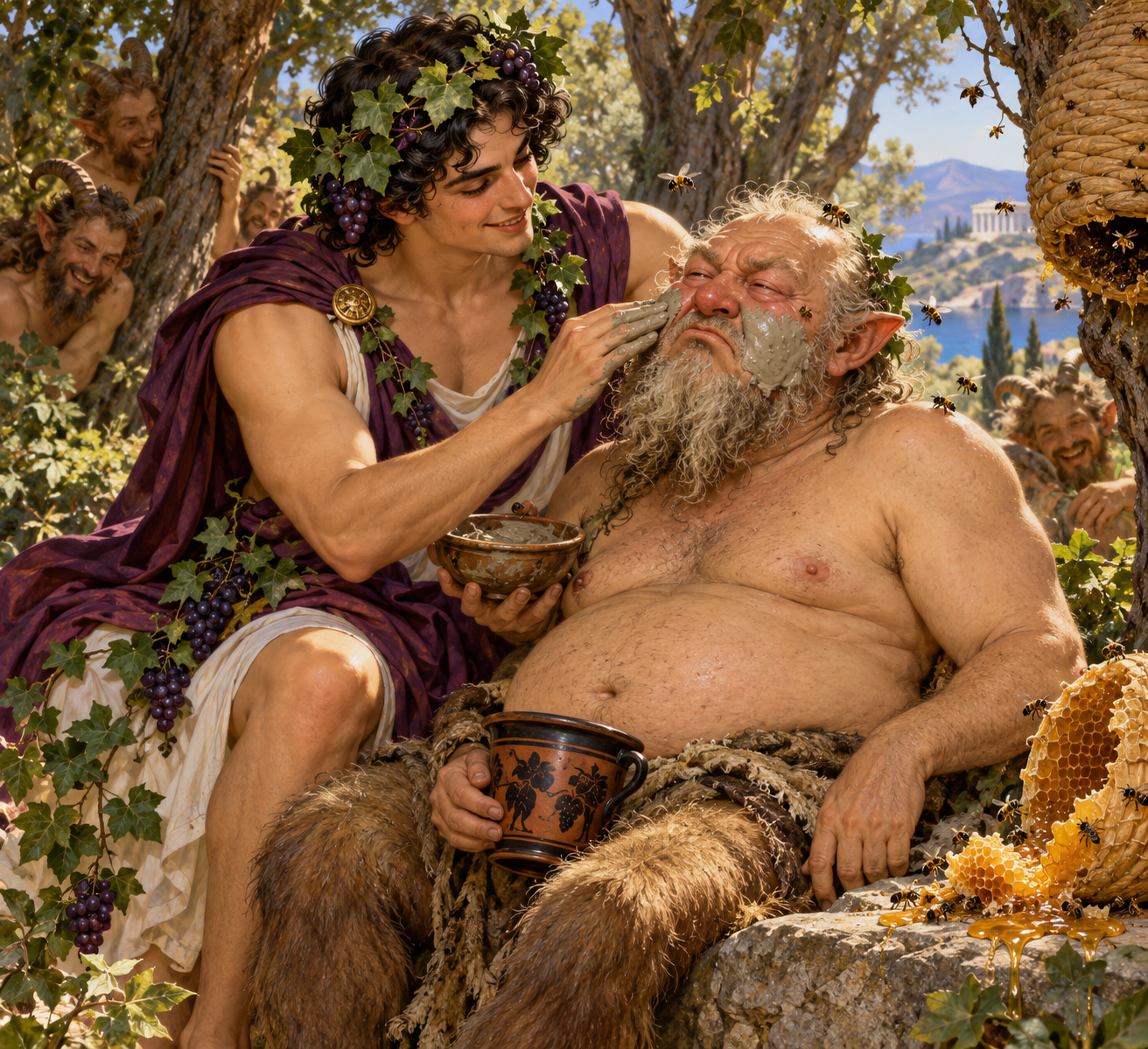
Oh, but it doesn’t stop there! With Book 3 of Ovid’s Fasti we have Liber and the Satyrs “discovering” bees. Although that is an amusing aition, part of it is even more significant than a lot of people realize. Silenus gets stung and “falls to the ground” (a reference to death that is used of Dionysos in poetry and inscription.) Liber then smears his face with mud/clay like the titanos applied in Orphic ritual, and Silenus is restored. (It also ends with the bull-dragon in the stars, which is reminiscent of Taurus dracōnem genuit et taurum dracō. [“The bull begot a dragon, and the dragon a bull.”]
Once you read the Silenos episode against the ritual vocabulary rather than merely as Ovidian slapstick, the comedy starts looking remarkably overdetermined.
The passage begins explicitly as an aition for honey: “a Baccho mella reperta ferunt”—“they say that honey was discovered by Bacchus.” Liber and the Satyrs reach Rhodope and flowering Pangaion, of all places— the very landscape we were just discussing with Orpheus —and the clashing bronze attracts the bees. Liber gathers them into a hollow tree and receives the reward of the newly discovered honey.
Then Silenos turns the discovery into comic catastrophe. This is significantly more than just “Silenos gets stung and falls over.” In a Dionysiac symbolic environment, the sequence matters enormously:
honey → Silenos → wounding/stinging → fall → earth → Dionysos/Liber → mud/clay → restoration.
And the clay is the startling element. If Liber coats the fallen Silenos with earth/mud, then regardless of whether Ovid himself intends an Orphic allusion, a reader acquainted with τίτανος / titanos traditions gets a remarkably suggestive visual analogue: a Dionysiac figure fallen to earth, his body/face covered with an earthy substance in connection with Dionysos, followed by recovery. That’s exactly the sort of detail that disappears when the episode is read only as “ha ha, drunken Silenus attacked a beehive.”
It also gives us another permutation of the pattern we’ve just been tracing:
Glaukos: honey → death → specialist knowledge → life
Mandel’štam: dead bees → honey → Sun/immortality
Ovid: bees/honey → fall → earth/clay → restoration
Orpheus: Hades → Sun → dismemberment → gathering → celestial memorial
And Pangaion occurs in both the Orpheus and Liber-bee narratives. That is particularly delicious. Eratosthenes’ Orpheus ascends Pangaion seeking the rising Helios and meets, narratively, the consequences of Dionysos; Ovid’s Liber reaches Pangaion and discovers the creature whose dead bodies Mandel’štam will eventually transform into the Sun.
And the bull/dragon brings us back to the same principle of opposites generating one another. The Latin hexameter—or rather senarius, as Arnobius calls the old Tarentine verse— is placed in his discussion of Zeus’ serpentine union with Persephone and the resulting bull-formed offspring; Clement preserves a closely related Greek formula.
That’s almost uncannily suited to what we’ve been discussing because its structure isn’t simply bull versus dragon. It’s reciprocal generation:
Bull → Dragon → Bull.
Just as the Symbolist Night Sun isn’t:
Night ≠ Sun
But something closer to:
Night contains/generates Sun; Sun passes into Night.
It blows my mind that Ovid has brought us back to Pangaion, immediately after the previous discussion. Now I’d never posit historical dependence, but as a cluster of symbols it’s very suggestive. Pangaion makes the cluster of symbols especially dense because it isn’t generic “wild country.” In these traditions it becomes a landscape where Dionysos, Orpheus, solar revelation, death, bees, honey, and transformation can all intersect. The Eratosthenes and Ovid passages don’t have to know anything about one another for their shared setting to become meaningful to a reader encountering them together.
What I particularly like is that none of these symbols has a fixed one-to-one meaning. Honey can preserve the dead Glaukos until restoration; dead bees can become Mandel’štam’s vehicle for transforming honey into Sun; Ovid’s bees lead to Silenos’ fall and earthen restoration. Sun can signify the apparent alternative to Dionysos in the Orpheus story, yet become the Night Sun precisely through Dionysian symbolism in Ivanov and Mandel’štam. Dismemberment/death can terminate a life while simultaneously initiating gathering, memory, poetry, or transformation.
That’s much closer to how mythic symbols actually behave than a dictionary saying bee = soul, honey = immortality, Sun = rebirth. They acquire meaning through their relations and transformations.
And that’s why qualifications like the one I made matters: I’m not constructing a genealogy— A influenced B influenced C.
I’m noticing a morphology:
death → preservation → transformation
descent → revelation → return
darkness → hidden light
fragmentation → gathering
mortal remains → enduring art
—with bees, honey, Sun, earth, Dionysos, Persephone, Ariadne, Glaukos, Orpheus and the Mousai repeatedly occupying different positions within it.
That is precisely the sort of cluster where I’d rather preserve the sources beside one another and let the reader experience the resonance than insert a paragraph insisting what they “mean.” The Labyrinth can do by juxtaposition what an argumentative monograph would have to spend twenty pages qualifying.


I’m wanting to draw parallels with Ra who journeys through the Underworld at night, Sobek ( I wish I had my devotional because there is mention of Sobek at night ) in connection to the Night Sun.
Also bees and honey have a connection to Astarte (Ashtart ) who I believe aided Anat in recovering Ba’al from the realm of Mot.
LikeLike