The conversation on Hera Teleia took a swerve to an analysis of patriarchal systems. My short answer can be found here.
One thing that almost never gets discussed when people invoke “patriarchy” is that patriarchal societies do not simply divide the world into privileged men and subordinate women. They establish hierarchies among men as well as between men and women, and plenty of men have historically occupied positions of very little power, wealth, or status. A patriarchal order may privilege certain men, but it does not follow that it privileges all men equally— or even that every man occupies a higher social position than every woman. (Ask Latinos about the fear of the chancla.)
Nor does the word patriarchy by itself tell us whether every feature of a particular social order is good or bad. There are patriarchal cultures in which women are subjected to restrictions, coercion, and violence that I have no interest in defending. One can point to contemporary examples in Afghanistan, Pakistan, parts of India and the Middle East without much difficulty. But condemning those abuses does not require pretending that everything associated with patriarchal family organization is therefore abusive, or that the only thing such systems ever gave men was power over women.
What gets left out of the discussion is obligation.
Traditional patriarchal authority was frequently conditional upon an enormous burden of responsibility. The man recognized as head of a household was not simply handed a collection of privileges and told to enjoy himself. He was expected to provide for the family, protect its members, preserve its property and reputation, settle disputes, assist relatives, cultivate alliances, exercise hospitality, and create opportunities for the next generation. Authority and responsibility were supposed to travel together.
That ideal was certainly violated. Human beings violate their ideals in every social system. But the existence of bad patriarchs no more tells us what patriarchal ethics demanded than the existence of corrupt judges tells us what justice demands.
At its best, the patriarch was expected to subordinate a considerable portion of his individual desires to the welfare of people who depended upon him. Men worked themselves into the ground providing for families. They took dangerous jobs. They crossed oceans and borders, sometimes going alone into countries where they knew neither the people nor the language, established themselves, sent money home, brought relatives over, and created opportunities their children and grandchildren would never otherwise have possessed. Sometimes the price of fulfilling that role was their comfort, their health, and even their lives.
That is privilege of a sort. But it is privilege inseparable from duty.
And that distinction matters because the alternative to patriarchal responsibility is not necessarily egalitarian responsibility. Sometimes the alternative is simply irresponsibility.
A society can dismantle traditional authority without successfully transferring the obligations that accompanied it. The result is not automatically liberation. It can instead mean the deadbeat father who disappears and leaves a woman raising children while holding down multiple jobs. It can mean the man who remains physically present while his partner carries the financial, domestic, and parental burdens. It can mean a sexual culture in which intimacy has been severed from obligation, and people are encouraged to regard one another as temporary sources of gratification. It can mean having fewer mechanisms of familial and communal shame capable of compelling an irresponsible man to straighten himself out.
The older model also understood wealth differently. Prosperity was not merely something an individual accumulated for his private consumption. Status brought expectations of generosity. A successful person was expected to perform favors, distribute resources, help relatives, cultivate friendships and alliances, support neighbors, and use his position to advance the fortunes of the larger kinship group. The flourishing of the family across generations mattered more than satisfying every passing desire of the individual.
There are obvious dangers in that model. Family authority can become domination. Discipline can become cruelty. Concern for reputation can conceal abuse. Loyalty can become enforced silence. Women can be denied autonomy in the name of their supposed protection. Children can be crushed beneath expectations they had no role in choosing. None of that should be romanticized.
But neither should the virtues embedded in the model be erased merely because they developed within patriarchal societies: loyalty, sacrifice, provision, protection, discipline, hospitality, intergenerational responsibility, care for dependents, stewardship of inherited resources, and the conviction that acquiring authority increases rather than diminishes one’s obligations to other people.
Perhaps that is the distinction our arguments about patriarchy most desperately need.
Power without responsibility is tyranny. Responsibility without power is exploitation. Authority worthy of respect binds the two together.
If we are going to criticize traditional systems— and there is plenty in them worth criticizing —we should at least understand what they expected of the people to whom they granted authority. Otherwise “patriarchy” stops functioning as a useful description of complicated social arrangements and becomes merely a synonym for “men having things too good.”
History is considerably messier than that.
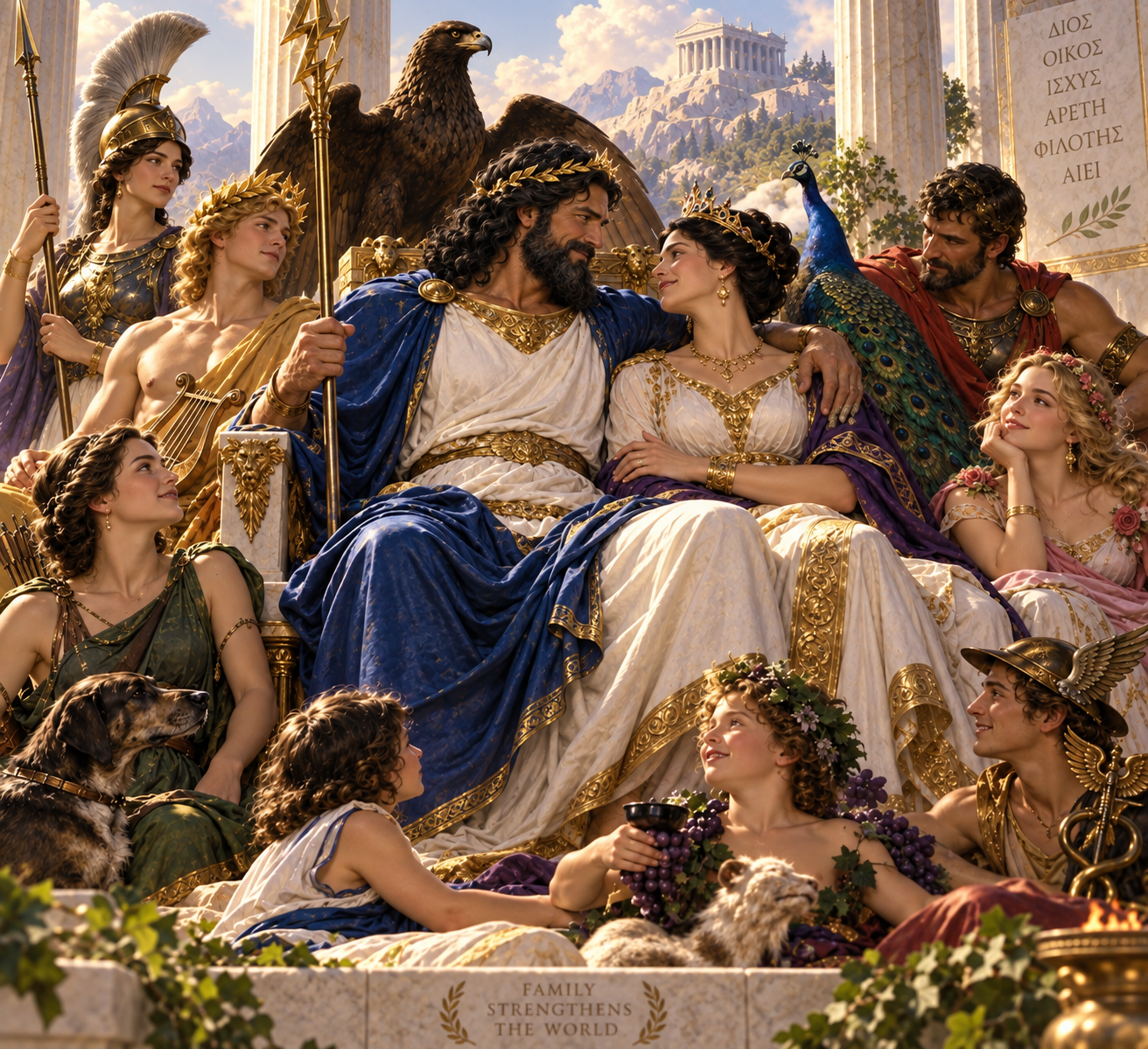
I like the inscription AI added to this image: Family Strengthens the World.


I think matriarchy and patriarchy are modern inventions by frustrated women of a certain class and age. My husband explained that the women who went to Smith and Barnard were expected to be educated to support their husbands but not outshine them. Consider Hilary Clinton. When the marriage soured in many cases or the husband had different ideas, they became frustrated. Again, consider Hilary Clinton who married an ambitious “hillbilly” from Arkansas. He kept disappointing her in important ways, but was also a vehicle for her own ambitions.
Anyway, I never subscribed to either. Families and family systems are far more complex than that.
LikeLike
A lot of historical discourse isn’t about what happened, but using history to address contemporary issues which often have little to nothing to do with the “history” under debate. The study of Orphism is a perfect example of that. Late 19th and early 20th century scholarship often focused on whether there was an official Orphic “church”, an established Orphic “Bible” and other issues that are clearly just Protestant vs Catholic rhetoric regurgitated and better addressed by the itinerant religious specialist and bricoleur model. Not only does this answer many of the issues the evidence brings up it reflects how similar phenomena from other movements in antiquity and from neighboring cultures function. (Not to mention contemporary practitioners, which I consider useful evidence even if some scholars prefer to stick to pure theory.)
And I have nothing constructive to say about those certain women of a certain class and a certain age who espouse certain beliefs and theories.
LikeLiked by 1 person
For this kind of patriarchy to work, men would have always be benevolent providers who sacrifice for their families and never use violence, threats, or coercion against them. I think we all know how well that’s been going these past few thousand years.
LikeLiked by 1 person
Exactly. A lot of this post is prescriptive rather than descriptive. I want men to be better. I want women to be better. I want humanity as a whole to be better. But I’m also pragmatic enough to realize that humans are very often disappointing, regardless of their ideologies.
LikeLiked by 1 person
Though I will ask why the model only works if all men always behave as benevolent providers? As I point out, plenty of our modern institutions — especially legal — aren’t always adhered to in an ideal manner without necessarily invalidating their legitimacy. I think they require reform rather than abolition. Assuming one wants the preservation of this society. As a tribalist who rejects modernity and the myth of progress I’m very much in favor of societal collapse and accelerationism.
LikeLike
As John Michael Greer says, “Collapse Now and avoid the rush!”
LikeLike
I like it!
LikeLike
Because when violent and abusive men rule the nation and the household, those below them suffer. Women, as well as men below the men at the top of the social structure. Being a slave to a benevolent dictator is still being a slave.
LikeLike
I do not consider belligerent and abusive men to be any better than weak and conniving ones. Nor are they in any way inferior to shrewish and murderous women, or dull and uncreative women. The whole lot of them ought to end their days on a sacrificial table to the Sun.
LikeLike
It’s funny. Maybe. Life has made of me an accidental patriarch. It began almost involuntarily. I grew up wanting to be like Grandpa. When he died – there was a collapse. It was as if his mere act of living, held the Morses together. When he died? Drift. Only now many years later do we begin to coalesce.
By no means do I govern or speak for the wholeness of my family… Bit I have my circle. And those in my care look to me. The pressure felt is palpable, it robs sleep. I don’t want to let my family down. So. I have to do and be better, to keep them all fed and in gifts. To feel safe to speak and think as freedom leads. To have a place to go, unconditionally.
It’s a lot of work when some days I just want to jerk about or be a dick in traffick.
LikeLike
I don’t think that fatherhood/manhood/patriarchy has to look a single, particular way in order to be legitimate. The question is: are you responsible for your people? And do you take your responsibilities seriously? How is up to you and yours to sort out.
LikeLike
I agree. Things aren’t as they were. I don’t know as I’d want them to be. Am I responsible? Objectively? No. But I take responsibility for those that come into my fold. How, indeed.
LikeLiked by 1 person