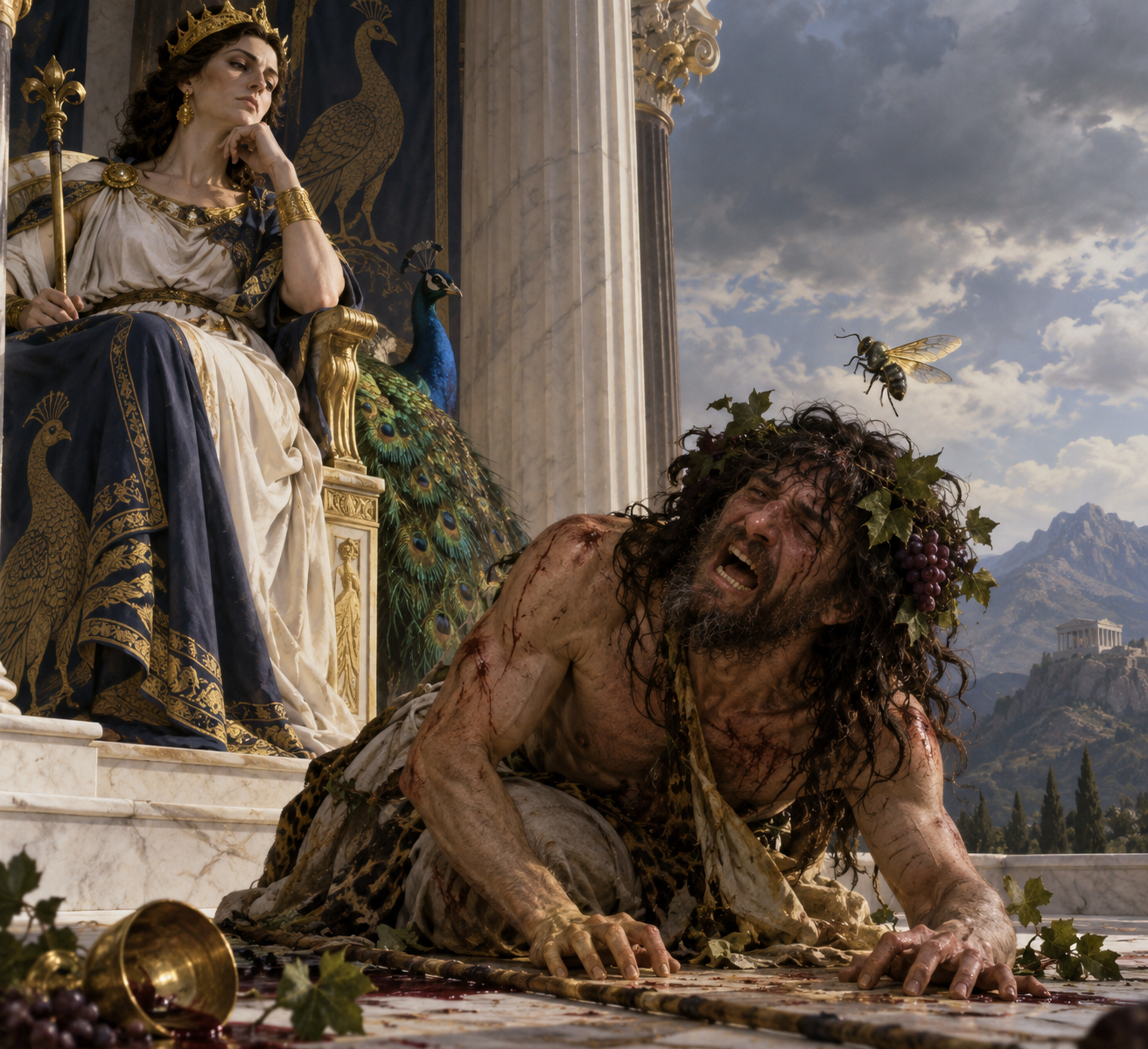
Hera is so much more than just the Goddess of marriage, though that is perhaps the most profound expression of her powers and nature. The true key to understanding who she is is change, growth and transformation. Hera is a catalyst, an outside force which sets things in motion, which nurtures growth and the transition from one state to another.
Her very name itself is said to be connected etymologically with the Horai or Seasons, in whose company she is frequently depicted. She is the embodiment of this seasonal change: the Argives said that each spring, Hera would bathe in the river Kanathos to regain her virginity, and at Stamphylos she was gifted with the names Pais, Teleia, and Chera, representing the lifecycle of the human female. Yet it is significant that one step is left out— mother.
And that is because she is not a manifestation of the nurturing, fruitful earth out of which all material substance arises and to which it must inevitably return, as scholars and philosophers would have it. No, Hera is the force that acts upon that substance, which causes the lilies to bloom, young girls to grow into women, cows to give birth in the proper season. But none of these happen within her, from her, but rather she is the force that acts upon them from outside, like a potter shaping clay at his wheel, or a maiden plaiting a garland of flowers she intends to offer on Hera’s altar at her marriage.
And in the lives of most women in antiquity, this was the single biggest transition that they would make, for without it, they could not become women. In ancient Greek, the word for bride and woman is the same. So, in that sense, Hera watches over them as they transition into fullness, as they pass from girlhood into womanhood, like Artemis, with whom she shared the epithet Kourotrophos.
Similarly, marriage itself is transition, bringing two separate lives, two separate families and households together into one— thus Hera was also called Zygia, the “Uniter”. This requires constant change as one alters everything about their lives: how they act, how they eat, how they sleep, new responsibilities, when and where they may come and go, who they may associate with, and how they may associate with them. Marriage is never a static thing, and two people can spend a lifetime getting to know each other and becoming comfortable with the person who emerges.
Also, this role applies to the role of heroes, whose name also has been linked with that of Hera. Consider the greatest hero known to the Greek world, Herakles, whose name means either “glory of Hera” or “one made famous through Hera”. And indeed that was the case, because at every step of the road Hera was there, driving him on, throwing obstacles in his path, challenging him, forcing him to become stronger, wiser, and more courageous – or else to become destroyed by the Goddess, like an impure piece of metal bursting under the pressure and fire of the forge.
But Herakles was worthy of the challenge, and at the end of his trials, ascended to Olympos and was met by Hera who gave him her daughter Hebe as his immortal bride. We see this too in her interactions with Dionysos— who is the force of life upon which Hera acts.
And that action, when experienced personally, and especially by those who are resistant to the process, may seem like persecution, madness, suffering— but it is really transformation and growth into fullness, a testing of the will. And those who come out the other end, pure and full, are truly worthy of being called Teleia and Hero.


Hail Hera Teleia!
LikeLike
What do you think of the Goddess tradition and others who portray Hera as a victim of the Patriarchy? That She was supreme until supplanted by Zeus.
LikeLike
Oh, that’s bullshit. Ignore the preposterous notion of Pan-Europeanism— there wasn’t even Pan-Hellenism until Alexander (who was himself Makedonian, not Greek*.) Each region (which could be a vast territory or a tiny isolated village) had its own local pantheons, dialects, rituals, social customs, etc. I think Hera had a very elevated position in many parts of pre-Classical Greece, especially in certain places where her cult retained its prominence up to the end of institutional polytheism and after, but she had even more powerful and popular rivals in Rhea, Eileithyia, the various Potnia Goddesses and “Pelasgian” divinities whose names had been lost before the arrival of the Hellenic tribes, or became incomprehensible and thus their identities substituted with those of a more familiar Goddess. Polytheist thinking is complex, messy, resistant to categorization and especially universalizing theories.
* This is a highly contentious issue, and was even in antiquity. Some argue that the Makedonians were simply Greeks, full stop. Others a distinct but related population. Still more Barbarians who mimicked (poorly) Greek language and customs in order to acquire an elevated status.
LikeLiked by 2 people
Interesting about Pan-Europeanism. I wonder if it has to do with how people of the present think – mushing everything together into a homogenous whole. There are differences that matter. I wonder if universalizing is a part of the Monotheistic filter of Western Culture.
LikeLiked by 1 person
There are definitely broad commonalities among the Indo-European family of religions, and I wouldn’t dismiss them out of hand. But the differences matter too.
LikeLiked by 1 person
About Alexander and all that. I think the Macedonians of modern times tend to separate themselves. But I can see how people would want to mimic civilized folks for status in the past. I remember learning about Australia, where a certain class of people raised their children to have British accents instead of the nasal Australian one.
LikeLike
This is a super controversial issue, but FYROM’s attempt to lay claim to Alexander and their own “Greekness” is even more contentious than any debates on the subject from antiquity, because during the Medieval period large swaths of Hellas and its neighbors were depopulated, so the Byzantines moved a bunch of Slavic tribes in, then the Ottomans fucked and killed their way through the Mediterranean, further altering demographics. I stick to FYROM (Former Yugoslavian Republican of Makedonia) since a large part of what in antiquity was Makedonia is currently Northern Hellas, including the ancestral home of the Argead dynasty. From the breakup of Yugoslavia until fairly recently there was a huge diplomatic dispute between Hellas and FYROM, which even the United Nations couldn’t fix. Eventually they came to some kind of peaceful resolution, but plenty of Hellenes still refuse to change what they call their neighbor, and I tend to side with them— even if FYROM has a cool statue of Alexander in their main airport.
LikeLiked by 1 person
I think it’s utter bullshit. It’s reductio ad monotheismum, in a dress and not a flattering one. Also, “patriarchy”…you lose me right away when that term gets thrown around everyhwere but in places that actually have one. Also, patriarchy isn’t necessarily a bad thing.
LikeLike
What never gets discussed is that patriarchy is not a system that benefits all men; in fact many men have even lower status under the system than women. And as you say, patriarchy is not automatically a bad thing. In places like India, Pakistan, Afghanistan and the Middle East I’ll concede that point, no argument. But patriarchy places demands on the men whom it bestows privileges, making them responsible for the flourishing of the family, the protection and well-being of its members, holding them to a standard of behavior which is much higher than anything you’ll find in more “liberal” and “egalitarian” societies. Often those patriarchs sacrifice everything (including their health and lives) to provide for their dependents, immigrating to foreign lands where they don’t know anyone or even the language to establish roots, bring the rest of the family over, and create opportunities for their family members which they wouldn’t have in their homelands, etc. Now compare that to hook-up culture, dead-beat dads which shift all the responsibility onto single mothers holding down three jobs just to scrape by or who sit on their asses while the women do everything if they don’t disappear, abusers and alcoholics who would be shamed in such a system, no loyalty or obligations, no performing favors and distributing wealth among kinship groups, friends and neighbors in order to increase the status and eventual affluence of the family, the sense that the collective and generational well-being of the family is more important than the fleeting and selfish desires of the individual, maintaining order, discipline and ensuring that others in the family fulfill their obligations, etc.
LikeLiked by 1 person
From my limited experience with the Goddess folks and others, I think they believe that pre-historic Europe was a Matriarchy or at least one where women ruled. Then the Indo-Europeans arrived, and changed all that. They point to how various pantheons of Gods of particular cultures changed – like the Vanir and the Aesir as proof.
I actually knew people who subscribed to the idea that the Indo-Europeans had the men kill off their uppity women – wives, sisters, etc, and leave the submissive ones. It was called the domestication of women. The upshot of the belief for these people was they were the uppity women who escaped and procreated.
I believe the Matriarchy believers that I have encountered were frustrated upper class, well-educated white women of a certain age.
As for the Patriarchy etc, the Romans were patriarchal but the Capitoline Triad consisted of two females and one male. The Aventine Triad the same. So, I don’t think that the shift in pantheons have to with patriarchy vrs matriarchy.
It is hard to parse out the past from the present and our needs to rewrite the past or reinterpret different from how the past folks saw things.
LikeLike
And that’s just a handful of examples. Every place the Indo-Europeans settled had strong female divinities, and clearly ones they brought with them, not indigenous survivals. (Though those are clearly present too.) I also love how advocates of the theory ignore that there were societies that clearly came from that Indo-European migratory process who not only venerated female divinities but had social structures that were matriarchal, matrilocal, or matrilineal. There were several important city-states in Italy arranged like that before their absorption by Rome. Also patriarchal societies that gave women legal rights, the ability to attain divorces, own and sell businesses, control of personal wealth, acquirement of literacy, attainment of high status because of their intellectual or political achievements, etc. History is messy, and resists easy reduction.
LikeLike
What a lively discussion of how history is regarded by those in the present. It reminds me of Thomas Jefferson. In the 1930s, the image of the greater liberator and composer of the Declaration of Independence was heavily promoted as something for people to believe in. America needed uplifting at the time, and it seemed that this version of Jefferson fit the bill.
When in the 1990s and 2000s, the dark side of Jefferson came out in spades, people had a hard time reconciling the two into a human being full of contradictions.
LikeLike
That’s why my favorite founding father is Benjamin Franklin. Not only are all of his accomplishments and folksy wisdom on the table, so is his fondness for French whores, decadent feasts and entertainments, and involvement with occult groups. Not only was he transparent, but he was consistent. The man opposed slavery, didn’t believe America should have a monarchy, favored the turkey rather than the eagle as our national bird, and was among the faction that opposed even having political parties because of the division they produce. Plus he invented electricity!
LikeLike
And despite being Native American I have a fondness for Andrew Jackson. Forget the Louisiana Purchase, which he orchestrated, do you know how many duels that guy participated in? (Including while in the White House.)
LikeLike
They called him “Old Hickory” for good reason.
LikeLike