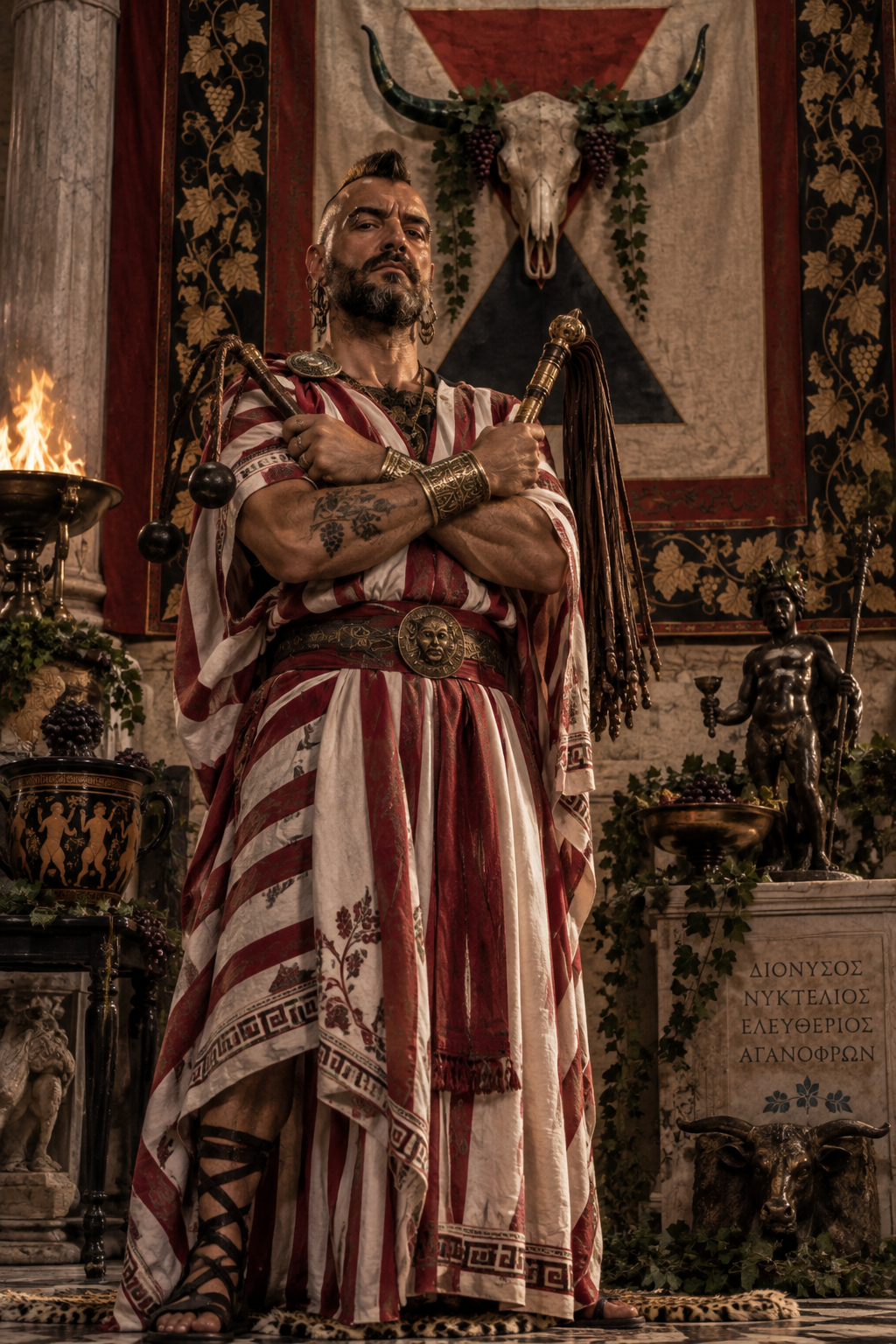
Another verse from Ὁ Καινὸς Οἶνος (“The New Wine”) is:
Οὐ τοῦ τέλους κύριος εἶ, ἀλλὰ τῆς παρασκευῆς.
You are not master of the outcome, but of the preparation.
I like this one because it could apply to ritual, teaching, healing, cultivation, art, leadership, and probably most of life.
And τέλους κύριος is doing some heavy lifting. It can mean not only “ruler of the outcome,” but “lord of the completion,” and even “master of the telos.”
That opens the aphorism beyond simple cause-and-effect into vocation and destiny: you may govern your preparation, your discipline, your craft, your readiness— but you are not sovereign over where the whole thing ultimately arrives.
Which makes the contrast with τῆς παρασκευῆς even better. Preparation is concrete, immediate, yours to tend. τέλος is what emerges, culminates, fulfills, or proves to have been the goal. With κύριος between παρασκευή and τέλος the aphorism becomes a statement about the boundary of agency itself.
So it can read as:
- You do not control whether the rite “works”; you control how well you prepared it.
- You do not control whether the student matures; you control the quality of formation you provide.
- You do not control the harvest; you tend the field.
- You do not control whether inspiration arrives; you prepare the vessel.
- You do not control destiny or fulfillment; you govern your readiness.
Οὐ τοῦ τέλους κύριος εἶ is not just a warning about limited human agency. For a Boukolos it is almost a statement of office: you are steward, not sovereign. The rite, the thiasos, the people, the tradition, the fruit of your labor—none of it terminates in you. It has an actual referent:
Εἷς Διόνυσος.
One Dionysos.
And you are there to serve him, to tend his herd.
The title can get longer, the vestments fancier, the responsibilities broader— but that only increases the obligation to remember whose work it is. Authority does not move you closer to being the κύριος τοῦ τέλους; it makes you more accountable to him. The greater the office, the greater the responsibility. There is one Dionysos, and you are not him.
Something more to keep in mind: the one Dionysos wears many masks. So the Xenos may not merely be “someone we should be welcoming toward.” Xenia becomes a test of recognition. The apparently peripheral person may be the point at which Dionysos has entered his own rite under a mask. If the Boukolos is attentive only to the impressive initiate, the charismatic ecstatic, the wealthy patron, or the people already inside the social circle, he may quite literally miss the God he claims to serve. The Boukolos tends Dionysos’ cattle, but the Bull is not necessarily standing outside the herd wearing a crown and announcing himself. The Bull God may be hiding among his cattle. So the Boukolos should treat the entire herd— Xenos included —as potential Dionysoi. Not because every stranger is an epiphany, and not because discernment disappears— dangerous people remain dangerous people.
And that is why historically Boukoloi were often represented by a staff/crook, a lagobolon, and/or a whip.
It is to protect against the wolves without— and within.
The Boukolos’ hospitality is not passivity.
Xenia is reciprocal and bounded by the safety of the herd. The Xenos is received because they may be under divine protection— or even, in the strongest Dionysian reading, an epiphany of the God himself as Stranger— but the Xenos also incurs obligations by entering into the xenia-relationship. Once they prey upon, endanger, exploit, or deliberately destabilize those entrusted to the Boukolos, the pastoral obligation changes.
And that makes the staff, lagobolon, and whip more than picturesque insignia. They symbolize the whole office: guide the herd, retrieve the wandering, set boundaries, and drive off predators. Crucially, the wolf may already be inside the enclosure. A Boukolos who is welcoming but incapable of exclusion is failing just as certainly as one who treats every Xenos as an enemy.
Which leads to another aphorism from New Wine:
Ὁ καλαῦροψ συνάγει, ἡ μάστιξ ἀμύνει· τὸν βουκόλον εἰδέναι χρὴ πότε ἑκατέρου δεῖ.
“The crook gathers; the whip defends. The Boukolos must know when each is needed.”
It isn’t just intended for Boukoloi. Outside the pastoral imagery it becomes: know when your responsibility is to gather and when it is to defend. Something all of us should discern.

