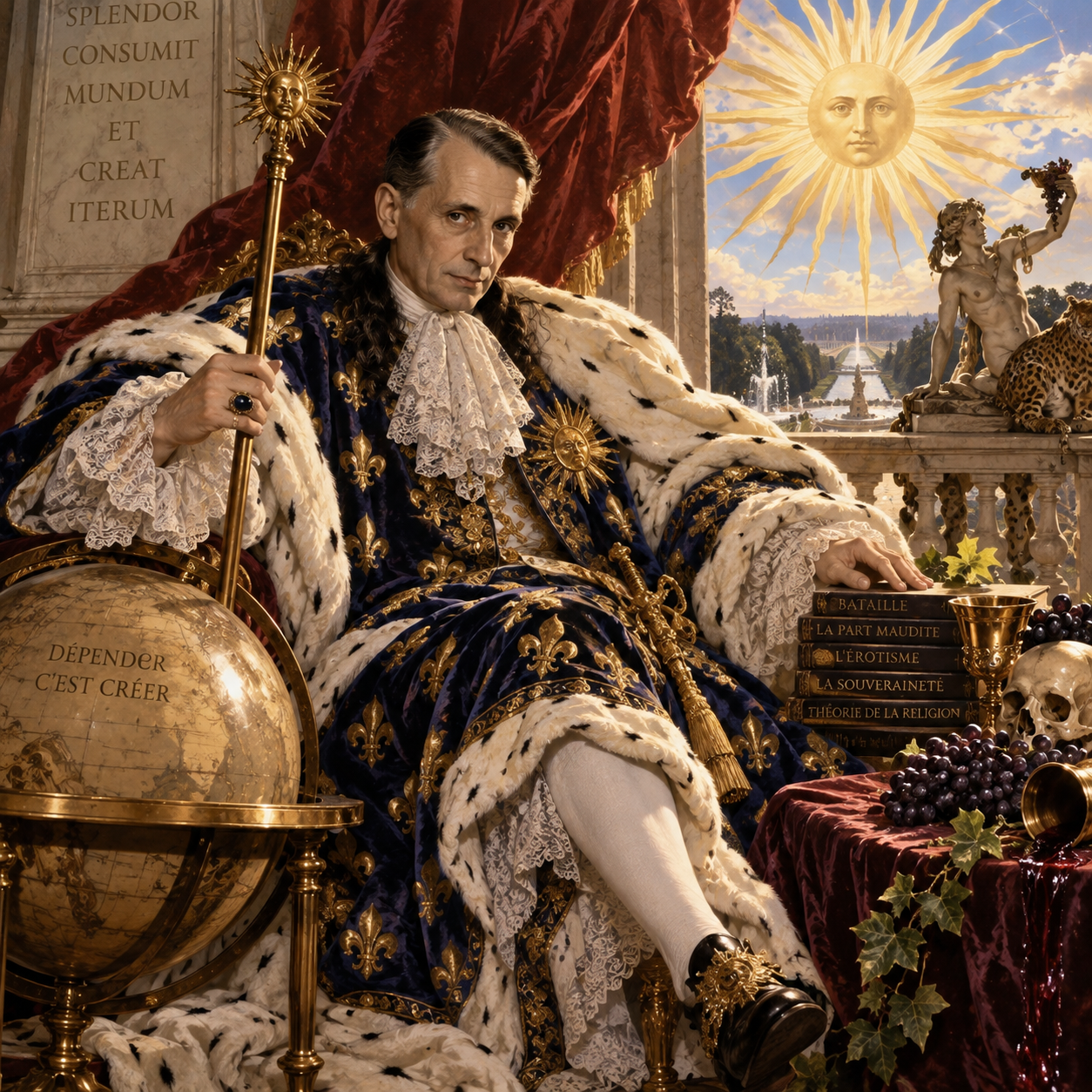
The discussion of wealth distribution in the last post reminded me of Georges Bataille’s writings, particularly in his three-volume The Accursed Share.
The Sun is prodigal.
Every moment it pours out an almost inconceivable quantity of energy, without bargaining, without saving, without asking what return it will receive. Only the smallest fraction of that radiance falls upon the Earth, and only a fraction of that is captured by living things. From the standpoint of an accountant, the Sun is catastrophically inefficient. It squanders itself across empty space.
Life responds to this gift with extravagance of its own.
A tree produces more seeds than can possibly become trees. Fish release thousands or millions of eggs so that a handful may survive. Flowers scatter pollen promiscuously upon the wind. Animals produce ornamentation far beyond the minimum necessary for survival: antlers, plumage, songs, dances, colors, scents. Forests grow until they choke one another for sunlight. Vines climb over vines. Life occupies every available niche and, wherever sufficient energy exists, produces not merely enough but too much.
Nature is extraordinarily wasteful.
This observation stands at the beginning of one of the strangest economic theories of the twentieth century: Georges Bataille’s theory of the accursed share.
Bataille believed that most economics begins by asking the wrong question. We ordinarily begin from scarcity. There are limited resources and unlimited wants, so the economic problem is how to acquire, conserve, allocate, and efficiently employ what we possess.
Bataille asked us to look at the problem from the opposite direction.
Before there is scarcity, there is the Sun.
The biosphere receives an immense influx of solar energy. Living organisms use that energy first to survive and then to grow. A plant extends its roots and branches. An animal grows to maturity. A population expands. A society builds houses, roads, farms, temples, workshops, ships, and cities.
But growth cannot continue forever.
Eventually an organism reaches maturity. Eventually a forest fills the available ground. Eventually a society encounters limits to profitable expansion. And yet energy continues arriving.
At that point the fundamental economic problem changes. The question is no longer simply How do we obtain enough?
It becomes:
What do we do with the excess?
That excess is Bataille’s part maudite—the accursed share.
It must be spent.
If a society cannot expend its surplus deliberately, Bataille argues, the surplus will eventually expend itself catastrophically. Wealth can disappear through festivals, monuments, luxury, gifts, sacrifices, games, spectacles, religious foundations, enormous public works, and other forms of conspicuous expenditure. Or it can disappear through warfare and destruction.
But disappear it will.
This is why Bataille was fascinated by societies that modern economic thought often regards as irrational. A king gives away enormous quantities of wealth. A community sacrifices valuable animals to the Gods. An aristocrat bankrupts himself entertaining guests. A civilization devotes generations of labor to constructing a temple whose economic “return” cannot possibly justify its cost. People cover sacred images with gold, burn incense, pour wine onto the Earth, sponsor games, feast strangers, and bury precious objects with the dead.
From the standpoint of accumulation, these things look wasteful.
That is precisely the point.
They transform surplus into meaning.
The Splendor of the Ptolemies
This provides an interesting way of approaching the Ptolemaic ideal of τρυφή (tryphē).
Tryphē can mean softness, luxury, delicacy, sumptuous living, even extravagance. In hostile moralizing sources it can become practically an accusation: decadence, self-indulgence, the softness produced by excessive wealth.
But in the political and religious world of the Ptolemies, royal tryphē could signify something considerably more complicated.
The king’s abundance demonstrated the abundance of his kingdom. His table overflowed because Egypt overflowed. Gold, perfume, wine, exotic animals, elaborate processions, monumental architecture, lavish festivals, and spectacular generosity made prosperity visible. Royal wealth was not supposed to remain invisible in a treasury. It radiated outward.
That is important.
The miser possesses wealth, but nobody flourishes because he possesses it. Wealth hidden away establishes only the owner’s capacity not to spend.
The magnificent ruler does something different. He converts wealth into feasts, temples, patronage, gifts, employment, festivals, monuments, and spectacle. His abundance becomes public.
In that respect tryphē has something solar about it.
The Sun does not demonstrate its power by hoarding light.
It demonstrates its power by shining.
And the wealthy household operates according to a similar logic when it understands prosperity as obligation rather than private consumption.
Wealth Creates Obligations
This brings us back to family.
We tend to imagine wealth individualistically. I earn money; therefore it belongs to me. If I accumulate enough of it, I become successful. The ultimate proof of success is that I possess things other people cannot possess.
But older systems of kinship frequently made wealth much more socially dangerous than that.
To become wealthy was to become somebody from whom things could be expected.
You helped a nephew establish himself. You found employment for a cousin. You supported an elderly relative. You lent money when somebody’s harvest failed. You provided hospitality. You paid for weddings and funerals. You gave gifts. You sponsored religious observances. You entertained guests. You cultivated friendships through generosity. You used your connections to advance people attached to your household.
The greater your fortune became, the larger the network of obligation surrounding you.
This could certainly become corrupt. Patronage becomes nepotism; generosity becomes bribery; dependents become sycophants; gifts become instruments of domination.
But beneath those corruptions lies an important principle:
Surplus creates responsibility.
If your household has ten times what it needs while your brother’s children are starving, something has gone wrong.
Bataille helps us understand why at an even deeper level. Wealth cannot merely accumulate indefinitely. Surplus demands an outlet. The question is not ultimately whether we will expend it, but how.
And different forms of expenditure create different worlds.
The Feast and the Hoard
Imagine two wealthy men.
The first accumulates. Every transaction is evaluated according to whether it increases his holdings. His fortune grows, but its movement increasingly terminates in himself.
The second also accumulates—but partly so that he may distribute. His table is crowded. Relatives find employment through him. Travelers sleep beneath his roof. The Gods receive sacrifices. Festivals are sponsored. Young people are helped into marriages and trades. Friends know that when disaster comes there is somewhere to turn.
Both men are wealthy.
But only one has converted wealth into a world.
That is the deeper meaning of hospitality, patronage, almsgiving, sacrifice, and the feast. They are methods by which private surplus becomes communal abundance.
And this is where Bataille’s seemingly bizarre economics intersects with something traditional societies understood intuitively.
Prestige comes not merely from what you can acquire but from what you can afford to give away.
The great man is the man whose abundance spills over.
Dionysian Economics
There is, naturally, something profoundly Dionysian about all of this.
Wine itself is surplus transformed.
The vine produces grapes; human beings crush them; fermentation transforms their sugars; and the resulting substance exceeds simple nutrition. One does not need wine merely to remain alive. Wine belongs to another category of existence: celebration, intoxication, sacrifice, hospitality, poetry, fellowship.
The symposium is economically irrational if survival is our only measure.
So is the festival.
So is the procession.
So is the sacrifice.
So is covering the image of a God in gold.
So is pouring perfectly drinkable wine onto the ground.
Yet civilizations have repeatedly judged such expenditures indispensable.
Why?
Because human beings do not merely need resources.
We need ways of spending ourselves.
We need occasions on which accumulated wealth, labor, emotion, food, drink, music, sexuality, grief, and joy can overflow the narrow boundaries of individual utility and become something shared.
Dionysos presides precisely over such overflow.
The wine jar is opened. The animal is sacrificed. The procession fills the street. Ordinary work stops. Masks come out. Music begins. Food passes from hand to hand. Social boundaries loosen. The accumulated energies of ordinary existence are released.
The festival consumes resources.
But what it produces cannot adequately be entered into an accountant’s ledger.
It produces memory.
It produces solidarity.
It produces beauty.
It produces contact with the Gods.
It produces the experience of belonging to something larger than oneself.
The Accursed Share
This is why Bataille called the surplus accursed.
Excess is dangerous.
Possessing more than we require does not merely give us freedom. It presents us with a problem. We must decide what deserves the expenditure of that excess.
And perhaps this is where Bataille can correct both the miser and the consumer.
The miser says:
Keep it.
The consumer says:
Spend it on yourself.
The older household ethic says:
Make it fruitful.
Feed people. Honor the Gods. Beautify the world. Strengthen your household. Help establish the next generation. Reward loyalty. Practice hospitality. Create occasions people will remember after you are dead.
Build something unnecessary and magnificent.
Throw a feast.
Give something away.
The point is not reckless consumption. Bataille himself was interested in expenditure far stranger and more dangerous than anything I am recommending here, and there are aspects of his thought I would emphatically not turn into an economic program.
The useful insight is simpler.
Human flourishing cannot be understood entirely through conservation and accumulation.
There must also be expenditure.
The household that only accumulates eventually becomes a tomb for its possessions. The household that cannot conserve anything collapses. Flourishing requires both movements: gathering and dispersal, discipline and generosity, harvest and feast.
Or, to put it in terms the Ptolemies might have understood:
Abundance reaches its perfection when it becomes splendor.
The Sun gives.
The Earth receives.
Life multiplies.
The harvest exceeds hunger.
The wine exceeds thirst.
And the household, when fortune smiles upon it, should become like the Sun: not extinguishing itself through foolishness, but possessing enough strength that some portion of its abundance can radiate beyond itself.
Family strengthens the world.
But abundance, rightly spent, makes that strengthening visible.

