2 = Beta
1 = Alpha
20 = Kappa
600 = Chi
70 = Omicron
200 = Sigma
A riddle

The Etruscan trembled before the Stranger, saying “Who are you? How are you called?”
And he replied:
Who I am is a mystery, but how I am called is easy enough to discern.
Begin with the bountiful dyad, the union of male and female.
And add another one in the shape of a bull’s head or tripod.
Kindly, then, place ten and ten more rods in the bundle.
CHoicest hekatombs offer six times over, giving back to the givers.
Of gleaming honey-wine seven measures should be poured out, ten times.
See the sacrificial blade, that resembles the number two hundred.
Put these all together and you have 893, the value of my name.
I want to be ready

PALACE OF EXILE
by Jim Morrison
For seven years I dwelt in the loose palace of exile
Playing strange games with the girls of the island
Now I have come again to the land of the fair
And the strong, and the wise
Brothers and sisters of the pale forest, children of night
Who among you will run with the hunt?
Now night arrives with her purple legion
Retire now to your tents and to your dreams
Tomorrow we enter the town of my birth
I want to be ready
Polyvalent
If a fawn-skin can be so polyvalent, why assume that an earthquake or a viral pandemic can mean just one thing and one thing only?
The stories we share, and what we believe about them, matter.
Be careful, folks. The China virus isn’t the only one circulating.
Deerly beloved
While I dig the cosmic connotations the Orphics gave the nebris, it can mean many different things to different people.
For instance, it can be a symbol of personal liberation:
Edith and I are Maenads now with a “longing for the hills & ecstasy.” Let Frances expect to see me at the midland station with cone-pointed thyrsos & fawn-skin. Tell him I shall walk to Lindelhurst in this array. He need not think of hiding my originality in a fly! (Katherine Harris Bradley to the family of Frances Brooks in a letter dated 1882)
Of jubilant procession:
That Osiris is identical with Dionysos who could more fittingly know than yourself, Klea? For you lead the Thyiadic dances at Delphi and have been consecrated by your father and mother in the holy rites of Osiris. If, however, for the benefit of others it is needful to adduce proofs of this identity, let us leave undisturbed what may not be told, but the public ceremonies which the priests perform in the burial of the Apis, when they convey his body on an improvised bier, do not in any way come short of a Bacchic procession; for they fasten skins of fawns about themselves, and carry Bacchic wands and indulge in shoutings and movements exactly as do those who are under the spell of the Dionysiac ecstasies. (Plutarch, On Isis and Osiris 35)
Or of destructive transformation:
On the road from Megara there is a spring on the right, and a little farther on a rock. It is called the bed of Aktaion, for it is said that he slept thereon when weary with hunting, and that into this spring he looked while Artemis was bathing with her nymphs. Stesichoros of Himera says that the Goddess cast a deer-skin round Aktaion to make sure that his hounds would kill him, so as to prevent his taking Semele to wife. (Pausanias, Description Greece 9.2.3)
The bit from Stesichoros is interesting, and not just for the crime he ascribes to Pentheus’ cousin Aktaion. (I’ll let that one settle in for a moment.)
Himera is not far from Syracuse and Tyndaris, which held interesting celebrations for the Huntress, according to the Anonymous Life of Theokritos 1b:
Others says that bucolic poetry was first performed at Tyndaris in Sicily. When Orestes took the image of Artemis away from Tauris in Scythia, he received an oracle, that he should wash himself in seven rivers flowing from one source. Therefore Orestes went to Rhegium in Italy, and washed away the curse in the so-called “separated” rivers. Then he crossed over to Tyndaris in Sicily, where the inhabitants sang their local songs in honour of the Goddess, and this was the origin of the tradition. They say that when the men sang, they prepared a loaf with many images of wild animals on it, a pouch full of all kinds of seeds, and wine in a goatskin, to pour out as an offering for those they met. They wore a garland, with the antlers of a deer on their head, and a staff in their hands. The victor in the contest received the loaf of the man he had vanquished; and the victor remained in the city of Syracuse, while the losers went out to the surrounding villages to collect food for themselves. They sang songs full of fun and laughter, and added the following propitious words:
Receive good fortune,
Receive good health,
Which we bring from the Goddess,
Which she has commanded.
Neat!
Here’s a fun site while you are socially isolating:
Did you know that there have been:
136 earthquakes in the past 24 hours
1,027 earthquakes in the past 7 days
4,802 earthquakes in the past 30 days
63,829 earthquakes in the past 365 days
Neat!
Moonlight reverie
Last night I went out for a cigarette and there was a deer in our front yard. Its beautiful, stupid eyes met mine for a moment and then it blithely resumed munching leaves until I said, “My, you’d make a lovely nebris.” Then it trotted off, feigning indifference. The street was empty and misty and otherworldly as I watched it head down towards the old oak near the school, site of so many past rituals. I gazed heavenward until I spotted the barest sliver of the Moon, surrounded by a flickering chorus of stars dancing in the dark.
Now I’m listening to Kamienie by Modlitwa and wondering what the month holds in store for us.
beneath the beast skin
Oppian, Cynergetica 4.354‑424
Leopards are overcome also by the gifts of Dionysos, when crafty hunters pour for them the crafty draught, shunning not the anger of holy Dionysos. Leopards are now a race of wild beasts, but aforetime they were not fierce wild beasts but bright-eyed women, wine-drinking, carriers of the vine branch, celebrators of the triennial festival, flower-crowned, nurses of frenzied Bacchus who rouses the dance.
For Ino, scion of Agenor, reared the infant Bacchus and first gave her breast to the son of Zeus, and Autonoe likewise and Agave joined in nursing him, but not in the baleful halls of Athamas, but on the mountain which at that time men called by the name of the Thigh (Μηρός). For greatly fearing the mighty spouse of Zeus and dreading the tyrant Pentheus, son of Echion, they laid the holy child in a coffer of pine and covered it with fawn-skins and wreathed it with clusters of the vine, in a grotto where round the child they danced the mystic dance and beat drums and clashed cymbals in their hands, to veil the cries of the infant. It was around that hidden ark that they first showed forth their mysteries, and with them the Aonian women secretly took paint rites. And they arrayed a gathering of their faithful companions to journey from that mountain out of the Boeotian land. For now, now was it fated that a land, which before was wild, should cultivate the vine at the instance of Dionysos who delivers from sorrow. Then the holy choir took up secret coffer and wreathed it and set it on the back of an ass.
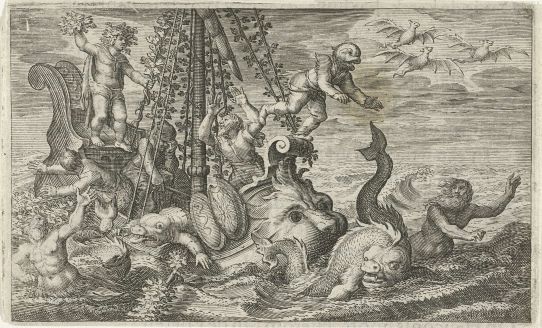
And they came unto the shores of the Euripus, where they found a seafaring old man with his sons, and all together they besought the fishermen that they might cross the water in their boats. Then the old man had compassion on them and received on board the holy women. And lo! on the benches of his boat flowered the lush bindweed and blooming vine and ivy wreathed the stern. Now would the fishermen, cowering in God-sent terror, have dived into the sea, but ere that the boat came to land. And to Euboea the women came, carrying the God, and to the abode of Aristaeus, who dwelt in a cave on the top of a mountain at Caryae and who instructed the life of country-dwelling men in countless things; he was the first to establish a flock of sheep; he first pressed the fruit of the oily wild olive, first curdled milk with rennet, and brought the gentle bees from the oak and shut them up in hives. He at that time received the infant Dionysos from coffer of Ino and reared him in his cave and nursed him with the help of the Dryads and the Nymphs that have the bees in their keeping and the maidens of Euboea and the Aonian women.
And, when Dionysos was now come to boyhood, he played with the other children; he would cut a fennel stalk and smite the hard rocks, and from their wounds they poured for the God sweet liquor. Otherwhiles he rent rams, skins and all, and clove them piecemeal and cast the dead bodies on the ground; and again with his hands he neatly put the limbs together, and immediately they were alive and browsed on the green pasture. And now he was attended by holy companies, and over all the earth were spread the gifts of Dionysos, son of Thyone, and everywhere he went about showing his excellence to men.
Late and at last he set foot in Thebes, and all the daughters of Cadmus am to meet the son of fire. But rash Pentheus bound the hands of Dionysos that should not be bound and threatened with his own murderous hands to rend the God. He had not regard unto the white hair of Tyrian Cadmus nor to Agave grovelling at his feet, but called to his ill-fated companions to hale away the God — to hale him away and shut him up — and he drave away the choir of women. Now the guards of Pentheus thought to carry away Bromius in bonds of iron, and so thought the other Cadmeans; but the bonds touched not the God. And the heart of the women worshippers was chilled, and they cast on the ground all the garlands for and the holy emblems of their hands, and the cheeks of all the worshippers of Bromius flowed with tears. And straightway they cried: “Io! blessed one, O Dionysos, kindle thou the flaming lightning of thy faith and shake the earth and give us speedy vengeance on the evil tyrant. And, O son of fire, make Pentheus a bull upon the hills, make Pentheus of evil name a bull and make us ravenous wild beasts, armed with deadly claws, that, O Dionysos, we may rend him in our mouths.” So spake they praying and the lord of Nysa speedily hearkened to their prayer. Pentheus he made a bull of deadly eye and arched his neck and made the horns spring from his forehead. But to the women he gave the grey eyes of a wild beast and armed their jaws and on their backs put a spotted hide like that of fawns and made them a savage race. And, by the devising of the God having changed their fair flesh, in the form of Leopards they rent Pentheus among the rocks. Such things let us sing, such things let us believe in our hearts!

Happy Noumenia folks!
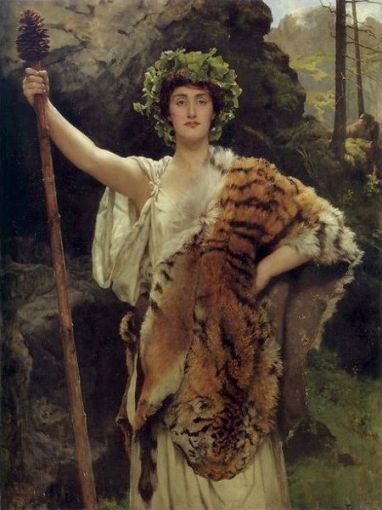
According to the Bakcheion calendar today is the Noumenia of the month Νεβρίς (Nebris) which is named after the sacred cape or sash of fur worn by Dionysos and his frenzied devotees. Most often this came from young deer who were hunted during savage nocturnal rites:
He’s welcome in the mountains,
when he sinks down to the ground,
after the running dance,
wrapped in holy deerskin,
hunting the blood of the slain beast,
devouring its raw flesh with joy,
rushing off into the mountains,
in Phrygia, in Lydia,
leading the dance—
Bromios—Evoë!
(Euripides, The Bakchai 172-180)
But we also find them wearing the pelts of goats, leopards, foxes and other animals belonging to the God’s menagerie. The last of these is called a bassaris rather than nebris and it tended to include the head as well as just the skin; those who wore it were called Bassarai, a particular expression of Mainadism originating in Makedonia and Thrake though during the Hellenistic period it spread to Egypt and Asia Minor too.
To put on the nebris is to enter the domain of Dionysos, marking one off as belonging to his Retinue at least for the duration of the revels. Thus we find even divinities like Pan, Kybele, Herakles, Artemis and various Nymphs and River-Gods depicted wearing it when their more Bacchic aspects are being emphasized.
Perhaps the most dramatic representation of how this simple change of clothing can affect an alteration of consciousness is to be found in Euripides’ The Bakchai, where the adversarial Pentheus finally succumbs to the seductive force of Dionysos and allows the God to dress him up in his regalia.
This regalia was given added significance by the Orphics, as Macrobius notes in Saturnalia 1.18:
In the line, “The sun, which men also call by name Dionysos,” Orpheus manifestly declares that Liber is the Sun. And in riddling verse he also says, “One Zeus, one Hades, one Helios, one Dionysos.” And concerning the ornaments and vestments worn by Liber at the ceremonies performed in his honor, Orpheus says:
Let the worshiper first throw around him a crimson robe,
like flowing rays resembling fire.
Moreover from above the broad all-variegated skin of a wild fawn
thickly spotted should hang down from the right shoulder,
a representation of the wondrously-wrought stars
and of the vault of heaven.
And then over the fawn-skin a golden belt should be thrown,
all-gleaming to wear around the breast a mighty sign
that immediately from the end of the earth
the Beaming-one springing up
darts his golden rays on the flowing of ocean.
Which is appropriate as we shall be entering the Gold Season on April 1st.
The new normal
From the Mercury News: coronavirus is bringing a plague of dangerous doomsday predictions.
From Inquisitr: two asteroids nearly collided with our planet today, one coming within 437,100 miles of us.
From The Charlotte Observer: five earthquakes rattle the Carolinas and Tennessee.
From The Guardian: Croatian capital Zagreb hit by its biggest quake in 140 years.
From Yahoo!Lifestyle: coronavirus has encouraged a quarter of adults to talk to neighbours for first time.
From the Niagara Gazette: Harvey Weinstein put in isolation after “contracting virus” – totes not planning to kill self early next week. ($20 says the editor already has the headline prepared)
And finally, here’s some footage of the nearly 500 lions President Putin released to keep the Russian streets empty during the coronavirus quarantine.
That last one was fake news by the way, but it was hard to tell because everything’s gotten so fucking crazy, right?
But wait. There’s more!
If, like me, you have been thinking “what this situation really needs is the eruption of a supervolcano,” then we may not have long to wait — according to National Geographic a chunk of Yellowstone the size of Chicago has begun ‘pulsing.’
Of course that’s nothing compared to the plight of America’s celebrities, confined to their mansions without crowds of adoring fans to feed their voracious egos. Some of them are clearly starting to crack from the pressure.
I bet all those refugees caught up in the border conflict between Greece and Turkey feel real bad for them – I mean, when they’re not dodging tear gas and lasers (yes, actual lasers) that is.
But the true victim of the coronavirus isn’t celebrities or immigrants, nor even the 800 Italians a day who are dying from it – it’s … feminism. Mind you this isn’t someone upset over Ohio using the crisis to curtail access to abortion; no, they feel that being asked to pitch in with household chores and childcare during the apocalypse is “oppressive.” Or some shit – I had to rage-quit the article a couple paragraphs in so I’m not entirely sure.
Anywho … when is Old Faithful gonna blow its top again? Cause I’m thinking it’s well past time.
Tick tock. Tick tock. Tick …
Haec sine dubio familia Herlichini est

Relevant to the last post, here are some selections from Robert Lima’s Stages of Evil: Occultism in Western Theater and Drama on the Northern roots of Harlequin.
The ancestral lineage of Arlecchino is both ancient and exotic. There are two principal veins in his bloodline, the first being the Central and Northern European barbaric culture, the second the Classical tradition of the Mediterranean. Each contributed disparate elements to the evolution of the complex figure that ultimately established itself in the forefront of the commedia dell’arte scenarios.
Belief in nature deities in pagan times often became transformed in the Christian era. There are numerous instances in which such gods and goddesses became transmogrified, being given the role of purveyors of evil in the new faith. Among these is the figure that has come to be known as Harlequin.
The oldest known references that relate to Arlecchino’s barbaric lineage clearly show his ancestors to be daemonic. The Historiae ecclesiasticae libri XIII, a Norman manuscript by Ordericus Vitalis (1075-1143?), is the earliest extant written reference in this context. The Anglo-Norman monk who is its author narrates a legend – perhaps based on a real-life incident – centering on a supernatural encounter experienced by a certain Gauchelin, a French monk, when he was returning late at night to his abode in Bonneval, near Chartres. The text refers to his being accosted by a hellish band: “Haec sine dubio familia Herlichini est” (3.376). Clearly, the monk in the narrative had been beset by the “family of Herlichin” a “spectral host of relentless demons who marauded the countryside on certain winter nights, at the same time of year as the Carnival celebrations, rampaging through forests and valleys, destroying everything in their path” (Husband, 152-53). Gauchelin recognizes his assailants as the nefarious group that had come to be known among the populace as the Wild Horde, infamous beings out of a very widespread European folkloric tradition. The procession of damned souls is led by a gigantic figure with a club whose proper name is given as “Hellekins.” This will prove to be the earliest-known written version of the name that would ultimately become Arlecchino.
The fact that this episode, narrated in the twelfth century, is so well delineated indicated that the belief in the Wild Horde and its daemonic leader had currency much earlier. Ordericus Vitalis’s account is surely not an isolated one, only the earliest found to date. It is followed by others, narratives that show how deeply embedded was the belief in the Wild Horde and its leader in the imagination of the Middle Ages, particularly in France.
The continuity of the topos can be seen in the thirteenth century, which provides further folkloric and literary references to Hellekin and his cohorts in the works of several church and secular authorities. For one, Wilhelm of Auvergne, bishop of Paris at his death in 1248, verifies the wide range of the belief in the daemonic figures when he refers to the tradition in Spain in his Tractatus de universo: “De equitibus vero nocturnis qui vulgari gallicano ‘Hellequin’ et vulgari hispanico ‘exercitus antiquus’ vocantur, nondum tibi satisfeci, quia nondum declarare intend qui sint; nectamen certum est eos malignos spiritus esse” (par. 2. Chap. 12). That the folkloric figure crossed over into literature proper is also evident in the same century. The Norman poet Bourdet narrates in the verse Lay de Luque la Maudite the tale of a lascivious old witch of Rouen who on her deathbed calls on “Hellequin” to marry her. In response, the daemon leads three thousand of his hellish kin to the wedding feast and, ultimately, takes her soul into his realm, hell. In this text, as elsewhere, Hellequin has an obvious appeal as a sexual being to a dying woman; in being tied to the lure of death, he also represents the daemon-lover, which is what Hades is in the Persephone myth.
Another telling identification of Arlecchino with the daemonic in the thirteenth century is found in Le jeu de la feuillée (Play of the Bower) ascribed to Adam de la Halle, in which “Herlequin”, the ruler of the underworld, seeks to woo the fairy Morgue through the agency of the daemon Crokesot (Croquesot in later texts) rather than in person. Unfortunately, Harlequin himself does not appear onstage, choosing to remain invisibly ensconced in his nether kingdom.
The ascendant of the medieval French daemon evolved out of Norse and Teutonic mythological beings who came to be known in Germany and adjacent areas as the “Teufel Herlekin” or Hellekin (i.e. “Kin of Hel”), Hel or Hela being the goddess of the Norse underworld. As Hel’s consort Ellerkonge (variant Elverkonge) was the male deity of the sacred alder (elder) tree and of the land of the dead. The mistranslation of the Danish Ellerkonge gave Erlkönig, king of the elves in a Germanic saga. As Erl King, yet another variant, he was a German and Scandinavian spirit or personified natural power akin to Odin who led a band of ghostly riders across the night sky. In Middle English he is Herleking, while King Herla is the name of another mythical manifestation of the deity in England.
Herlekin is the probable source of Herne the Hunter, the phallic horned god variously known in the British Isles under such names as the Green Man, Jack-in-the-Green, Robin-of-the-Wood, Robin Goodfellow and Robin Hood. These are all manifestations of the King of the May, the ancient fertility deity whose phallus became the symbolic maypole featured in May Day celebrations held throughout Europe to welcome the rebirth (and impregnation) of Mother Earth in spring. The magical season of nature’s fecundity was emulated in rituals of sympathetic magic that culminated in sexual coupling.
Such fertility figures in the British Isles and on the Continent derive from a very early, perhaps Paleolithic, being known as the Wild Man, a larger-than-life, often gigantic creature covered in hair, fur, lichen, twigs or leaves whose primal identity was tied to woodlands, symbolized by the uprooted tree he carried, usually over his shoulder or in his hand. Later, in Carnival celebrations, in the wedding-night pandemonium called a charivari (chivaree), and in rites known as the Wild Man Hunt, a massive studded club was often substituted for the traditional tree. Paraphrasing Chrétien de Troyes, Husband describes this elemental being as “an ogrish wild man, black like a Moor, large and hideous, sitting on a tree stump and holding a large club in his hand” while Bernheimer cites the anonymous medieval French Renaud de Montaubon for its description of such marginal beings as noir et velu com ours enchainé (“black and hairy like a chained bear”).
In one of the strange symbioses that sometimes occur in folklore, the Wild Man came to be associated with mythological beings and himself was held to be daemonic. One of the identities of the savage is Orcus (literally, Wild Man), a telluric deity out of the Gallo-Roman era who led the processions of the dead and who, as a daemon of death, had an association with Pluto or Hades, the lord of the underworld in classical mythology. In the Tyrolean Virginal the epic gives the variant Orkise as the name of a cannibalistic hunter in the form of an ogre. The functions of Orcus as leader of the Wild Horde came to be preempted by the daemon Hellekin, and Herlequin or Harlequin in medieval France. Similarly in the second vein, the complex world of classical and Eastern mythologies, there are several figures who are clearly antecedents of Arlecchino’s earliest relative, the Wild Man.
arrière-scène
A lot of folks who are working from home during the present pandemic have been complaining on social media about the increased amount of time they’re being forced to spend with loved ones and family.
Personally, I’ve enjoyed it.
Yesterday, for instance, our household spent the morning doing light ecstatic work while listening to songs about the Wild Hunt and Crossroads Spirits and intermittently having conversations on the Odinic traits of Harlequin, the various forms of Loki, Northern European and Asiatic Bear-cults, Mumming and how we want to do more of it, the overlap and differences between Fairies and the Dead, how Orphism has a World-Tree though conventional Greco-Roman religion does not, the important role that ‘zines played in the development of contemporary Heathenry and Hellenismos back in the early ’80s and ’90s and how this history is in danger of being lost, as well as our plans for the next couple festivals on our respective calendars.
The key is finding the right sort of people to socially isolate with.
So many, many cocks.
“Now as to the rites of Liber, whom they have set over liquid seeds, and therefore not only over the liquors of fruits, among which wine holds, so to speak, the primacy, but also over the seeds of animals:— as to these rites, I am unwilling to undertake to show to what excess of turpitude they had reached, because that would entail a lengthened discourse, though I am not unwilling to do so as a demonstration of the proud stupidity of those who practice them. Varro says that certain rites of Liber were celebrated in Italy which were of such unrestrained wickedness that the shameful parts of the male were worshipped at crossroads in his honour. Nor was this abomination transacted in secret that some regard at least might be paid to modesty, but was openly and wantonly displayed. For during the festival of Liber this obscene member, placed on a little trolley, was first exhibited with great honour at the crossroads in the countryside, and then conveyed into the city itself. But in the town of Lavinium a whole month was devoted to Liber alone, during the days of which all the people gave themselves up to the must dissolute conversation, until that member had been carried through the forum and brought to rest in its own place; on which unseemly member it was necessary that the most honorable matron should place a wreath in the presence of all the people. Thus, forsooth, was the god Liber to be appeased in order for the growth of seeds. Thus was enchantment (fascinatio) to be driven away from fields, even by a matron’s being compelled to do in public what not even a harlot ought to be permitted to do in a theatre, if there were matrons among the spectators.” – Augustine, De Civitate Dei 7.21
The title of phallophoros was listed among the priestly offices of the religious association led by Pompeiia Agrippinilla. (IGUR 160)
“They shall leave the precincts which have been set apart as they are and shall not consecrate others. And they shall bring a cow and a panoply to the Great Panathenaia and a phallos to the Dionysia.” – IG I 46
“In other carts, also, were carried a Bacchic wand of gold, one hundred and thirty-five feet long, and a silver spear ninety feet long; in another was a gold phallus one hundred and eighty feet long, painted in various colors and bound with fillets of gold; it had at the extremity a gold star, the perimeter of which was nine feet.” – Athenaios, Deipnosophistai 5.201
“Our traditional festival of the Dionysia was in former times a homely and merry procession. First came a jug of wine and a vine branch, then one celebrant dragged a he‑goat along, another followed with a basket of dry figs, and the phallos-bearer came last.” – Plutarch, De Cupiditate Divitiarum 8
“Phalloi are consecrated to Dionysos, and this is the origin of those phalloi. Dionysos was anxious to descend into Haides, but did not know the way. Thereupon a certain man, Prosymnos by name, promises to tell him; though not without reward. The rewards was not a seemly one, though to Dionysos it was seemly enough. It was a favour of lust, this reward which Dionysos was asked for. The god is willing to grant the request; and so he promises, in the event of his return, to fulfil the wish of Prosymnos, confirming the promise with an oath. Having learnt the way he set out, and came back again. He does not find Prosymnos, for he was dead. In fulfilment of the vow to his lover Dionysos hastens to the tomb and indulges his unnatural lust. Cutting off a branch from a fig-tree which was at hand, he shaped it into the likeness of a phallos, and then made a show of fulfilling his promise to the dead man. As a mystic memorial of this passion phalloi are set up to Dionysos in cities. ‘For if it were not to Dionysos that hey held solemn procession and sang the phallic hymn, they would be acting most shamefully,’ says Herakleitos.” – Clement of Alexandria, Exhortation to the Greeks 2.30
“The rest of the festival of Dionysos is observed by the Egyptians much as it is by the Greeks, except for the dances; but in place of the phallus, they have invented the use of puppets two feet high moved by strings, the male member nodding and nearly as big as the rest of the body, which are carried about the villages by women; a flute-player goes ahead, the women follow behind singing of Dionysos. Why the male member is so large and is the only part of the body that moves, there is a sacred legend that explains. Now then, it seems to me that Melampos son of Amytheon was not ignorant of but was familiar with this sacrifice. Melampos was the one who taught the Greeks the name of Dionysos and the way of sacrificing to him and the phallic procession; he did not exactly unveil the subject taking all its details into consideration, for the teachers who came after him made a fuller revelation; but it was from him that the Greeks learned to bear the phallus along in honor of Dionysos, and they got their present practice from his teaching. I say, then, that Melampos acquired the prophetic art, being a discerning man, and that, besides many other things which he learned from Egypt, he also taught the Greeks things concerning Dionysos, altering few of them; for I will not say that what is done in Egypt in connection with the god and what is done among the Greeks originated independently: for they would then be of an Hellenic character and not recently introduced. Nor again will I say that the Egyptians took either this or any other custom from the Greeks. But I believe that Melampos learned the worship of Dionysos chiefly from Kadmos of Tyre and those who came with Kadmos from Phoenicia to the land now called Boiotia.” – Herodotos, The Histories 2.49
“I approve of the remarks about the temple made by those who in the main accept the theories of the Greeks: according to these the goddess is Hera, but the work was carried out by Dionysos, the son of Semele: Dionysos visited Syria on his journey to Aethiopia. There are in the temple many tokens that Dionysos was its actual founder: for instance, barbaric raiment, Indian precious stones, and elephants’ tusks brought by Dionysos from the Aethiopians. Further, a pair of phalli of great size are seen standing in the vestibule, bearing the inscription, ‘I, Dionysos, dedicated these phalli to Hera my stepmother.’ This proof satisfies me. And I will describe another curiosity to be found in this temple, a sacred symbol of Dionysos. The Greeks erect phalli in honour of Dionysos, and on these they carry, singular to say, mannikins made of wood, with enormous pudenda; they call these puppets. There is this further curiosity in the temple: as you enter, on the right hand, a small brazen statue meets your eye of a man in a sitting posture, with parts of monstrous size.” – Lucian, De Dea Syria 15-16
“In it is the house of Poulytion which in my time was devoted to the worship of Dionysos. This Dionysos they call Melpomenos (Minstrel), on the same principle as they call Apollon Mousegetes. After the precinct of Apollon is a building that contains earthen ware images, Amphiktyon, king of Athens, Dionysos Hestios (Of the Hearth) and other gods. Here also is Pegasos of Eleutherai, who introduced the god to the Athenians. Herein he was helped by the oracle at Delphoi, which called to mind that the god once dwelt in Athens in the days of Ikarios.” – Pausanias, Description of Greece 1.2.5
“It seems safe to look upon Pegasos as a missionary of this cult. According to the tradition it was this arrival that first led to the institution in Attica of the processions in which phalli were carried. (Scholium on Aristophanes’ Acharnians 243) The men did not wish to accept the god in this form and consequently were punished — a repeated motif. Although the punishment did not affect the fertility of the country or fertility in general, it did affect the phalli of the men, who fell sick in this organ. Their ailment was not impotence, but satyriasis. (Scholium on Lucian’s Deorum concilium 5) It may be assumed that the missionary brought to Athens not only the cult image, which we are told was a seated statue, but also the prototype of the phalli that were carried about.” – Carl Kerényi, Dionysos Archetypal Image of Indestructible Life page 164
“Among the people of Lampsakos Priapos is held in honour and has the by-name Dionysos as well as Thriambos and Dithyrambos.” – Athenaios, Deipnosophistai 1.30b
“We shall at this point discuss Priapos and the myths related about him, realizing that an account of him is appropriate in connection with the history of Dionysos … This god is also called by some Ithyphallos, by others Tychon. Honours are accorded him not only in the city, in the temples, but also throughout the countryside, where men set up his statue to watch over their vineyards and gardens, and introduce him as one who punishes any who cast a spell over some fair thing which they possess. And in the sacred rites, not only of Dionysos but of practically all other gods as well, this god received honour to some extent, being introduced in the sacrifices to the accompaniment of laughter and sport. Now the ancients record in their myths that Priapos was the son of Dionysos and Aphrodite and they present a plausible argument for this lineage; for men when under the influence of wine find the members of their bodies tense and inclined to the pleasures of love. But certain writers say that when the ancients wished to speak in their myths of the sexual organ of males they called it Priapos. Some, however, relate that the generative member, since it is the cause of the reproduction of human beings and of their continued existence through all time, became the object of immortal honour.” – Diodoros Sikeliotes, Library of History 4.6.1
He swallowed the phallus of […], who sprang from the aither first.
Since in his [i.e. Orpheus] whole poetry he speaks about facts enigmatically, one has to speak about each word in turn. Seeing that people consider that generation is dependent upon the genitalia, and that without genitals there is no becoming, he used this (word), likening the sun to a phallus. For without the sun the things that are could not have become such … things that are … the sun everything ….
It has been made clear above [that] he called the sun a phallus. Since the beings that are now came to be from the already subsistent he says:
[with?] the phallus of the first-born king, onto which all
the immortals grew (or: clung fast), blessed gods and goddesses
And rivers and lovely springs and everything else
That had been born then; and he himself became solitary
In these (verses) he indicates that the beings always subsisted, and the beings that are now came to be from (or: out of) subsisting things. And as to (the phrase): ‘and he himself became solitary’, by saying this, he makes clear that the Mind [Nous] itself, being alone, is worth everything, as if the others were nothing. For it would not be possible for the subsisting things to be such without the Mind. And in the following verse after this he said that Mind is worth everything:
Now he is king of all and will always be
…. Mind and …
– Derveni Papyrus COL. 13 & 16
“If you would like a vision of the Korybantian orgies also, this is the story. Two of the Korybantes slew a third one, who was their brother, covered the head of the corpse with a purple cloak, and then wreathed and buried it, bearing it upon a brazen shield to the skirts of Olympos. Here we see what the mysteria are, in one word, murders and burials! The priests of these mysteries, whom such as are interested in them call ‘Anaktotelestes’ (Presidents of the Princes’ rites), add a portent to the dismal tale. They forbid wild celery, root and all, to be placed on the table, for they actually believe that wild celery grows out of the blood that flowed from the murdered brother … The Korybantes are also called by the name Kabeiroi, which proclaims the Rite of the Kabeiroi. For this very pair of fratricides got possession of the chest in which the virilia of Dionysos were deposited, and brought it to Tyrrhenia, traders in glorious wares! There they sojourned, being exiles, and communicated their precious teaching of piety, the virilia and the chest, to Tyrrhenoi for purposes of worship. For this reason, not unnaturally some wish to call Dionysos Attis, because he was mutilated.” – Clement of Alexandria, Exhortation to the Greeks 2.16
“And this woman offered for you on behalf of the city the unspeakably holy rites, and she saw what it was inappropriate for her, being a foreigner, to see; and being a foreigner she entered where no other of all the Athenians except the wife of the king enters; she administered the oath to the gerarai who serve at the rites, and she was given to Dionysos as his bride, and she performed on behalf of the city the traditional acts, many sacred and ineffable ones, towards the gods. In ancient times, Athenians, there was a monarchy in our city, and the kingship belonged to those who in turn were outstanding because of being indigenous. The king used to make all of the sacrifices, and his wife used to perform those which were most holy and ineffable – and appropriately since she was queen. But when Theseus centralized the city and created a democracy, and the city became populace, the people continued no less than before to select the king, electing him from among the most distinguished in noble qualities. And they passed a law that his wife should be an Athenian who has never had intercourse with another man, but that he should marry a virgin, in order that according to ancestral custom she might offer the ineffably holy rites on behalf of the city, and that the customary observances might be done for the gods piously, and that nothing might be neglected or altered. They inscribed this law on a stele and set it beside the altar in the sanctuary of Dionysos En Limnais. This stele is still standing today, displaying the inscription in worn Attic letters. Thus the people bore witness about their own piety toward the god and left a testament for their successors that we require her who will be given to the god as his bride and will perform the sacred rites to be that kind of woman. For these reasons they set in the most ancient and holy temple of Dionysos in Limnai, so that most people could not see the inscription. For it is opened once each year, on the twelfth of the month Anthesterion. These sacred and holy rites for the celebration of which your ancestors provided so well and so magnificently, it is your duty, men of Athens, to maintain with devotion, and likewise to punish those who insolently defy your laws and have been guilty of shameless impiety toward the gods; and this for two reasons: first, that they may pay the penalty for their crimes; and, secondly, that others may take warning, and may fear to commit any sin against the gods and against the state. I wish now to call before you the sacred herald who waits upon the wife of the king, when she administers the oath to the venerable priestesses as they carry their baskets in front of the altar before they touch the victims, in order that you may hear the oath and the words that are pronounced, at least as far as it is permitted you to hear them; and that you may understand how august and holy and ancient the rites are. I live a holy life and am pure and unstained by all else that pollutes and by commerce with man and I will celebrate the feast of the wine god and the Iobacchic feast in honor of Dionysos in accordance with custom and at the appointed times. You have heard the oath and the accepted rites handed down by our fathers, as far as it is permitted to speak of them, and how this woman, whom Stephanos betrothed to Theogenes when the latter was king, as his own daughter, performed these rites, and administered the oath to the venerable priestesses; and you know that even the women who behold these rites are not permitted to speak of them to anyone else. Let me now bring before you a piece of evidence which was, to be sure, given in secret, but which I shall show by the facts themselves to be clear and true.” – Demosthenes, Against Neaira 73; 74-79
LEADER OF THE CHORUS
Come, let us seek the rascal; let us look everywhere, carrying our stones in our hands; let us hunt him from place to place until we trap him; could never, never tire of the delight of stoning him.
DICAEOPOLIS from within
Peace! profane men!
LEADER OF THE CHORUS
Silence all! Friends, do you hear the sacred formula? Here is he, whom we seek! This way, all! Get out of his way, surely he comes to offer an oblation.
The CHORUS withdraws to one side.
DICAEOPOLIS comes out with a pot in his hand; he is followed by his wife, his daughter, who carries a basket, and two slaves, who carry the phallus.
Peace, profane men! Let the basket-bearer come forward, and thou Xanthias, hold the phallus well upright. Daughter, set down the basket and let us begin the sacrifice.
DAUGHTER OF DICAEOPOLIS putting down the basket and taking out the sacred cake
Mother, hand me the ladle, that I may spread the sauce on the cake.
DICAEOPOLIS
It is well! Oh, mighty Bacchus, it is with joy that, freed from military duty, I and all mine perform this solemn rite and offer thee this sacrifice; grant that I may keep the rural Dionysia without hindrance and that this truce of thirty years may be propitious for me. Come, my child, carry the basket gracefully and with a grave, demure face. Happy he who shall be your possessor and embrace you so firmly at dawn, that you fart like a weasel. Go forward, and have a care they don’t snatch your jewels in the crowd. Xanthias, walk behind the basket-bearer and hold the phallus well erect; I will follow, singing the Phallic hymn; thou, wife, look on from the top of the terrace. Forward!
He sings
Oh, Phales, companion of the orgies of Bacchus, night reveller, god of adultery and of pederasty, these past six years I have not been able to invoke thee. With what joy I return to my farmstead, thanks to the truce I have concluded, freed from cares, from fighting and from Lamachuses! How much sweeter, oh Phales, Phales, is it to surprise Thratta, the pretty woodmaid, Strymodorus’ slave, stealing wood from Mount Phelleus, to catch her under the arms, to throw her, on the ground and lay her, Oh, Phales, Phales! If thou wilt drink and bemuse thyself with me, we shall to-morrow consume some good dish in honour of the peace, and I will hang up my buckler over the smoking hearth.
The procession reaches the place where the CHORUS is hiding.
LEADER OF THE CHORUS
That’s the man himself. Stone him, stone him, stone him, strike the wretch. All, all of you, pelt him, pelt him!
DICAEOPOLIS using his pot for a shield
What is this? By Heracles, you will smash my pot.
– Aristophanes, Acharnians
“To answer your question, the erection of phallic images is a symbol of generative power and we consider that this is directed towards the fecundating of the world; this is the reason, indeed, why most of these images are consecrated in the spring, since this is just when the world as a whole receives from the gods the power of generating all creation. And as for the obscene utterances (aiskhrorrêmosunai), my view is that they have the role of expressing the absence of beauty in matter and the previous ugliness of those things that are going to be brought to order, which, since they lack ordering, yearn for it in the same degree as they spurn the unseemliness that was previously their lot. So then, once again, one is prompted to seek after the causes of form and beauty when one learns the nature of obscenity from the utterance of obscenities; one rejects the practice of obscenities, while by means of uttering them one makes clear one’s knowledge of them, and thus directs one’s striving towards the opposite. And there is another explanation too. When the power of human emotions in us is everywhere confined, it becomes stronger. But when it is brought to exercise briefly and to a moderate extent, it rejoices moderately and is satisfied. By that means it is purged and ceases by persuasion, and not in response to force. It is by this means that, when we see the emotions of others in comedy and in tragedy, we still our own emotions, and make them more moderate and purge them. And in sacred rites, through the sight and sound of the obscenities, we are freed from harm that comes from actual indulgence in them. So things of this sort are embraced for the therapy of our souls and to moderate the evils which come to us through the generative process, to free us from our chains and give us riddance.” – Iamblichos, On the Mysteries 37.3-6; 38.13-40
“The chous found near Brindisi shows Dionysos and his companion on their couch. On the disc Dionysos himself is carrying the vessel as he rides heavenward with Ariadne after their marriage at the Choës festival. Around them the cosmos unfolds, surrounded by the outermost zone of the zodiac. The upper segment of the relief shows the background of the ascension, the firmament, characterized by the two Atlantes which support it, by the sheaf of lightnings, by sun, moon, and stars, by the star on the caps of the Dioskouroi, and the distaff of the Moirai. The symbols of the lower segment indicate the deities and cults relating to existence on the earth and sea: the wheel of Tyche, the crosstorch of Demeter and Persephone, a cornucopia, a covered liknon and its contents, three cakes and a phallus set down in a particular way, Hekate’s torch, a thyrsos with band, the sickle of Kronos, Poseidon’s trident, and a sign that is not clear. The ladder, obviously leading to the upper sphere (which the chariot bearing the bridal pair has already reached), points to the cult of Adonis. It was in this cult that the women went out on the roof terraces to celebrate the god of youth. By this combination of divine attributes, the dischi sacri of Magna Graecia bear witness to a tendency to universalism, a cult of pantes theoi, all the gods. This feature is stressed by the use of the zodiac. It points to a Dionysos-dominated universalism rising above all ties with any particular deity or state, a universalism latent in the pre-Greek and extra-Greek Dionysian religion and in a very special way inherent in it. The widespread use of Dionysian images in tombs, as disclosed in vase paintings and sarcophagus reliefs, implies such a tendency, for it was in connection with the burial of the dead that the need to celebrate indestructible life was most absolute and universal. This is as true of the Dionysian religion as it is of Christianity. The amplification of the Dionysos cult in late antiquity to a cosmic, cosmopolitan religion was a very natural development, but such a development was possible only insofar as zoë could exert a spontaneous religious influence.” – Carl Kerényi, Dionysos Archetypal Image of Indestructible Life 386-388
And I’ll close with this rather lengthy piece by Walter Burkert:
There remains the intriguing depiction in the Villa of the Mysteries of what is no doubt a flagellation scene. A kneeling girl, keeping her head in the lap of a seated woman and shutting her eyes, the seated woman grasping her hands and drawing back the garment from the kneeling girl’s bare back, while a sinister-looking female behind is raising a rod – these are all quite realistic details of caning. But the threatening figure wielding the rod had black wings; she is not from this world but rather an allegorical personality. Some allusions to flogging in Bacchic contexts have been collected, from Plautus to late sarcophagi. On these we find Pan or satyr-boys being disciplined with a sandal, but the situation and the iconography are quite different. On the other hand, madness is described as feeling the strokes of a whip as early as in Attic tragedy; Lyssa, as ‘frenzy’ personified, appears with a whip in vasepainting, and in any event mania is the special province of Dionysus. Not even Aphrodite would disdain a sublime flagellum to make an arrogant girl move to her command, as Horace suggests. This would dissolve the flagellation scene into pure symbolism; at the critical moment, with a stroke, divine madness will take possession of the initiate, and the kneeling girl, changed into a true bacchant, will rise and move freely in frenzied dance just like the other dancer next to this scene. Yet symbolism does not exclude ritual practice, and there are suggestions that one form of purification, catharsis, could in fact be flogging. Once more art has succeeded in remaining intentionally ambiguous as to what actually occurred in the mysteries.
The modern use of the word ‘orgies,’ from orgia, reflects the puritan’s worst suspicions about secret nocturnal rites. There is no doubt that sexuality was prominent in mysteries. We have the word of Diodorus that Priapos Ithyphallos played a role in nearly all the mysteries, though it was “with laughter and in a playful mood” that he was introduced, and this was hardly the core of the mystery. Processions with a huge phallus were the most public form of Dionysus festivals, the great Dionysia themselves. In puberty initiations, of course, the encounter with sexuality is normal and necessary. The change from childhood through puberty to maturity and marriage is the natural, archetypal model for change of status, and elements of this sequence may well be preserved in mysteries, especially in Dionysiac mysteries. There are indications that only married women, not virgins, could be bakchai in the full sense. Plutarch, in the consolation to his wife, refers to their common initiation into the mysteries of Dionysus. The frescoes in the Villa of the Mysteries have also been interpreted as preparations for marriage or a form of Roman Matronalia; the encounter with the phallus unveiled, so prominent in the initiation scenes, perfectly fits such a perspective. The Apulian vases of the fourth century, mainly destined for a funerary use and hence most probably related to mysteries of Dionysus, usually depict the encounter of male and female in a Bacchic environment. This type of iconography has been interpreted as referring to the hope for ‘eschatogamy’ in Elysium, the final bliss in the beyond; but these pictures, which have no indications of Hades, may just as well hint at initiations, or at both initiations and afterlife, since the festival of the initiates is going on after death.
Direct and coarse, by contrast, is Livy’s testimony regarding the Bacchanalia of 186 B.C.: with as much explicitness as Augustan prudery would allow, he says that the initiands suffered homosexual rape, simillimi feminis mares. Scholars at one time gave advice not to believe slander of this sort, but we can hardly be sure. Parallels from initiations elsewhere are not difficult to find. One might be tempted to make some associations with curious fact that markedly androgynous representations of Eros become quite prominent in late Apulian vase painting, toward 300 B.C. But if homosexual practice of this kind ever came to exist in closed circles of Italiote mysteries, it evidently could not endure. What we find after the catastrophe of the Bacchanalia is definitely not symbolism – sexual symbolism, no doubt, but in a form that could not violate the bodily integrity of any of the participants, and hardly the integrity of their fantasy either, even if there was some emotional response to the phallus in the liknon. It is symbolism that shapes the more durable forms of ritual, not the ‘real’ orgies.
One special form of initiation with significant sexual symbolism is reported in connection with the mysteries of Sabazius: a snake made of metal was made to pass beneath the initiand’s clothes. This is the ‘God through the lap,’ Theos dia kolpou. Scholars agree that this is a form of sexual union with the god; in the myth Persephone is impregnated by Zeus in the form of a snake, and legend has associated the snakes of Dionysus’ orgia with the impregnation of Olympias, mother of Alexander, by a god. But in the Sabazius ritual this is transformed through double symbolism – snake for phallus, and artifact for snake. The ritual must have remained impressive enough, not so much from sexual associations as from the anticipation of touching a snake, especially since the initiand by the light of flickering torches could hardly know for certain what was real and what was artifact. Even here sexuality in itself is not the secret in question.
– Walter Burkert, Ancient Mystery Cults 103-107
 The House of Vines