Open the Jars! Crown your head with flowers, and feast your dead! Anthesteria has begun, so let us welcome back the God of Life, Abundance, and Ecstasy! Io! Io evohe! Io io Dionysos!
Author: thehouseofvines
Thoughts on the Olbian calendar
Assuming that we’re given the months in their proper order the Olbian calendar breaks down as follows:
Taureon: April/May
Thargelion: May/June
Kalamaion: June/July
Panemos: July/August
Metageitnion: August/September
Boedromion: September/October
Kuanepsion: October/November
Apatourion: November/December
Poseideon: December/January
Leneon: January/February
Anthesterion: February/March
Artemision: March/April
Andokides does not provide a name for the intercalary month; if I were going to use this instead of the Bakcheion calendar I’d call it “Lykeion.”
My reasoning for this:
- Since there is a Bull Month (Taureon) it’s only fitting to have a Wolf Month.
- Apollon doesn’t have as much representation on the calendar as he probably should, considering his prominence in the Olbian pantheon. He appears on the city’s coinage, he’s mentioned in city treaties, the majority of the temples that have been uncovered thus far belong to him, he had several distinct forms i.e. Apollo Delphinios (of Delphi), Apollo Ietros (Healer), Apollo Neomenios (he who Opens the Month), Apollo Boreas (of the North Wind) etc, and there were several private religious associations dedicated to him – including one with possible Orphic ties.
- It just feels right.
Most of the names are familiar from other Greek calendars, but Kalamaion and Kúanepsion were new to me; I’m uncertain of their meaning.
There is a Púanepsion in the Attic calendar, from the Púanopsia (Bean-stewing) festival Theseus instituted in fulfillment of a vow he swore to Apollon should he prove victorious against the Minotaur. It is the seventh month.
However, I checked the Greek and it is clearly a Kappa heading that word. Assuming that the person chiseling the inscription didn’t just fuck things up Kúanepsion could come from kúanos (κῠᾰνος) “dark blue” which, ironically enough, Robert Beekes’ Etymological Dictionary of Greek says probably derives from Hittite kuwannan (precious stone, copper, blue), likely from Proto-Indo-European *ḱwey- (to shine, white, light; compare *ḱweytós, white.) Ironic because there’s that whole debate about whether the ancients could even see blue.
This begs the question of why they’d name one of their months Dark Blue – unless it’s from Kyanê (Κυανη), one of the Sicilian Nymphs who were part of Kore’s maiden companions that were out collecting flowers with her when the abduction occured:
A great fountain was made sacred to Persephone in the territory of Syrakousa and given the name Kyane or ‘Azure Font.’ For the myth relates that it was near Syrakousa that Plouton effected the rape of Kore and took her away in his chariot, and that after cleaving the earth asunder he himself descended into Haides, taking along with him the bride whom he had seized, and that he caused the fountain named Kyane to gush forth, near which the Syrakousans each year hold a notable festive gathering; and private individuals offer the lesser victims, but when the ceremony is on behalf of the community, bulls are plunged in the pool, this manner of sacrifice having been commanded by Herakles on the occasion when he made the circuit of all Sicily, while driving off the cattle of Geryones. (Diodoros Sikeliotes, Library of History 5.2.3)
While Herakles as the progenitor of the Skythians was certainly popular in the region and there was a temple to the Eleusinian deities at Olbia, the Azure Font is a local Syracusan addition to Persephone’s story. Olbia had extensive trade relations with a number of cities in Magna Graecia so it’s entirely possible that they were aware of the myth, but why enshrine it in their calendar?
I’m not sure what else it could be though.
As for Kalamaion only a couple things occur to me.
Perhaps it honors the Epiriote River God Kalamas who flows into the Ionian Sea – but what significance would that have to a Milesian colony all the way over in the Ukraine?
Now the Kala- part could come from kalós (καλός) meaning:
- beautiful, lovely
- good, quality, useful
- right, moral, virtuous, noble
I don’t know all the rules of declension and word formation so I’m not sure if that’s sufficient to explain the name, but the second half reminds me of Μαῖα the mother of Hermes as well as μαία meaning nurse or midwife.
Comparing the Olbian calendar to others in the Greek world it probably comes the closest to the Attic, despite beginning shortly after the Spring Equinox whereas in Athens this happened post Summer Solstice.
Taureon = Mounichion*
Thargelion = Thargelion
Kalamaion = Skiraphorion
Panemos = Hekatombaion
Metageitnion = Metageitnion
Boedromion = Boidromion
Kuanepsion = Puanepsion
Apatourion = Maimakterion
Poseideon = Poseideon
Leneon = Gamelion*
Anthesterion = Anthesterion
Artemision = Elaphebolion*
I’ve bolded matching months and put asterisks on ones with possible equivalences.
Mounichion, for instance, is the month in which the Mounichia took place. The festival takes its name from an epiklesis of Artemis associated with a temple in the Piraeus, Athens’ famous harbour district. The festival both celebrated the birthday of the Goddess and commemorated the Battle of Salamis, during which she favorably intervened on behalf of the Athenians. There was a procession in which young girls who played the part of Bears and served the Goddess at her sanctuary in Brauron took part. Cakes encircled with candles and other sacrifices were given on this occasion.
While Taureon most likely means the Month of the Bull (as it does in other calendars) and honors Dionysos whose bull form was especially prominent in Asia Minor (and the Pontic region in particular) it could also refer to the Taurike, a region along the southern coast of the Crimean peninsula whose capital Tauris was home to a particularly savage form of Artemis (or her Skythian equivalent) which engaged in human sacrifice. Iphigéneia became her high priestess, after nearly being sacrificed herself at Aulis. Orestes rescues his sister, and is directed to steal the xoanon or primitive wooden idol of Artemis and take it to the town of Halae, where he is to build a temple for Artemis Tauropolos (Bull-slayer.) The xoanon either ends up in Sparta where it is worshiped with rites of bloody flagellation as Artemis Orthia or Italy where the Rex Nemorensis or King of the Grove served her until his successor came along and murdered him. Iphigéneia ended her days at the Brauron sanctuary where she taught the maidens the mysteries of the Bear Dance.
Although in Attica the seventh month is Gamelion, after the hieros gamos (sacred marriage) of Zeus and Hera, in other parts of Greece the period of January/February (particularly in Asia Minor) is called some variation of Lenaeon from the Lenaia festival.
Although not called Artemision as in Olbia, the Attic Elaphebolion honors Artemis the Deer Slayer at whose festival the Elaphebolia cakes in the shape of deer were offered. This either celebrated her hunting prowess, the transformation of Iphigéneia into a deer to save her from Agamemnon’s blade or the defeat of the Thessalians by Athens and Phokis thanks to another miraculous intervention by Artemis.
Panemos and its dialectical variations are found on the calendars of Aetolia, Argolis, Boiotia, Epidauris, Laconia, Rhodes. Sicily, Thessaly and the Makedonian-derived systems, among others.
Apatourion has two possible origins. Either from the Apatouria festival, which the Wiley Online Library describes as follows:
The Apatouria, an important festival celebrated by Ionians, including Athenians, was for Herodotus one of two criteria of Ionian identity (Hdt. 1.147). In Athens the Apatouria was the central element in the ritual calendar of the phratries, the kinship organizations crucial for determining Athenian citizenship. The three‐day festival occurred in the autumn in the month Pyanepsion and was celebrated at the separate phratry shrines throughout Attica. There was a feast on the first day, and a sacrifice to Zeus Phratrios and Athena Phratria on the second. On the third day, fathers would introduce their sons for admission to the phratry (and, in effect, to Athenian citizenship). In the normal course of events this occurred during a child’s first few years. Our sources suggest that there were various athletic and intellectual literary competitions over the three days in which the children of the phrateres could demonstrate their merit. Ancient scholarship links the Apatouria to the myth of the ritual combat between the Athenian Melanthos (the “dark one”) and the Boiotian Xanthos (the “fair one”) for the kingship of Attica, which Melanthos won through a trick (apate) (Hellanikos FGrH 4 F23). Although some modern scholars have therefore seen a connection to the ephebes and to rites of passage involving social inversion, the rituals of the festival have no apparent connection to the narrative of the myth, and most modern scholars now link the Apatouria to “the control, maintenance, and affirmation of kinship and of membership in society at every level” (Lambert 1993: 151).
This trick or apate was played by none other than Dionysos:
The Athenians had a war on against the Boiotians over Kelainai, which was a place in their borderlands. Xanthios, a Boiotian, challenged the Athenian king, Thymoites to a fight. When he did not accept, Melanthos, an expatriate Messenian from the stock of Periklymenos the son of Neleus, stood up to fight for the kingdom. While they were engaged in single combat, someone wearing a black goat-skin cape appeared to Melanthos from behind Xanthios. So Melanthos said that it was not right to come two against one. Xanthios turned round and Melanthos smote and killed him. And from this was generated both the festival Apatouria and ‘of the Black Aigis’ as an epithet of Dionysos. (Suidas s.v. Apatouria)
However, it’s equally possible that the name comes from the epiklesis Mistress of Apatouron borne by Aphrodite Ourania in the Bosporus, for which Strabo gives the following aition:
There is also in Phanagoreia a notable temple of Aphrodite Apaturus. Critics derive the etymology of the epithet of the Goddess by adducing a certain myth, according to which the Giants attacked the Goddess there; but she called upon Herakles for help and hid him in a cave, and then, admitting the Giants one by one, gave them over to Herakles to be murdered through “treachery.” (11.2.10)
For more on this Goddess, check out Yulia Ustinova’s Aphrodite Ourania of the Bosporus: The Great Goddess of a Frontier Pantheon.
A discovery
Excited noises and flailing of limbs
I just found a complete list of the month-names for the polis of Olbia – and unsurprisingly there’s a strong Dionysian presence:
To Apollo Delphinios, Ietros, Thargilios, Lykeios
Andokides made offerings through the months
Taureon, Thargelion, Kalamaion, Panemos, Metageitnion,
Boedromion, Kuanepsion, Apatourion, Poseideon,
Leneon, Anthesterion, Artemision. (SEG 30.977)
Even if you’re not a calendar nerd like I am there’s a lot of interesting stuff to unpack here. Many of these are familiar from my study of calendars from different Greek city-states, but a couple of the names are new to me and I’ll need to parse out their meanings. And why there seems to be a blend of Ionian, Doric and Makedonian month-names when these tend not to mix. I wonder if this is because Olbia was an emporion, and also what its ethnic make-up was, especially after it outgrew its status as a colony of … Miletos, I think? I’ll need to check and confirm that, so don’t quote me. I also wonder how closely these synch up to their correlates in other calendars; if they do that means Anthesterion (generally around February/March) came towards the end of their year, rather than its beginning. And a month devoted to Artemis immediately following it has some intriguing implications, especially considering the relationship between Ariadne and Apollo’s sister. Speaking of which, did you catch the final epiklesis Andokides addresses him by? Lykeios – the Wolf God.
Score another victory for slacktivism
Speaking of empty declarations, it looks as if Hellenismos has solved it’s neo-Nazi problem – there have been no new tweets from XD since December 2nd and no retweets since December 27th – and if you’re looking for content relevant to their stated mission you’ve got to wade much further back.
So the totality of their accomplishments was “outing” me as someone who uses verboten symbols (which I’ve never hidden; I also take strange drugs and practice sorcery) and bringing attention to the fact that Pyrokanthos is a pretty sketchy dude. (While ignoring repeated warnings that another one of their signatories – who’s still on there BTW – is a sexual predator, no allegedly about it.)
Those 230 individuals and over 40 groups should be so fucking proud. I can almost hear their resounding collective ree of “No Trump, No KKK, No Fascist USA!”
Actually, that’s an unfair comparison. At least those people are out in the streets, carrying signs, milkshaking people and causing property damage rather than just keyboard crusading and posting woke AF memes.
Alexander of Wolf City Against the Christian heretics
 I found this interesting passage Roger Pearse posted, thanks to Edward Butler. With a couple minor changes (like substituting virtue signalling for ethical exhortation) Alexander could be speaking about Neopagans and Polytheists.
P.W. van der Horst & J. Mansfeld, An Alexandrian Platonist against Dualism: Alexander of Lycopolis’ Treatise ‘Critique of the Doctrines of Manichaeus’, Leiden, 1974.
The philosophy of the Christians is a simple philosophy. It is chiefly devoted to ethical instruction, while in so far as relatively precise statements of the Christians about God are concerned it remains ambiguous. The endeavours in this direction amount to the assumption that the productive cause is the most honourable, the most important and the cause of all beings, an idea to which, in all fairness, no one will take exception. In ethics too they avoid the more difficult problems such as what is ethical and what is intellectual virtue and the whole subject of dispositions and affections. Hence they merely devote themselves to ethical exhortation, without laying down the principles according to which each individual virtue should be acquired, but indiscriminately heaping up precepts of a rather ponderous nature. Ordinary people listen to these precepts and, as you can see with your own eyes, make great progress in virtue, and a stamp of piety is imprinted on their characters, stimulating the moral disposition which grows from this sort of habituation and leading them by degrees towards the desire of the good.
Since this simple philosophy has been split up into numerous factions by its later adherents, the number of issues has increased just as in sophistry, with the result that some of these men became even more skilful and, so to speak, more prone to creating issues than others. Indeed some of them, in the long run, became leaders of sects. Consequently, ethical instruction declined and grew dim, since none of those who wanted to be leaders of sects was able to attain theoretical precision and since the common people became more inclined to internal strife. For there was no norm or laws on the basis of which issues could be decided.
Edward also tweeted We Should Probably Talk About That Time Susan and Lucy Attended a Bacchanal in Narnia.
.
Saving The Galaxy One Drunken Nerd at a Time…
Behold Chewbacchus:

There is even an Intergalactic Krewe of Chewbacchus – gives a whole new meaning to “Starry Bear.”
Incidentally, I bet he could totally kick that child-abusing piece of shit Gritty’s ass.
Three articles you should probably read
- The Three-Headed One at the Crossroad: A Comparative Study of the Slavic God Triglav by Jiří Dynda
- Odin and Mithras : religious acculturation during the Roman Iron Age and the Migration Period by Olof Sundqvist
- Penance, Power, and Pursuit: On the Trail of the Wild Hunt by Ari Berk and Willliam Spytma
- The Symbolism of the Hornet in the Greek World by Marianna Scapini
Yes, you.
a bear is a wolf that goes after bees (or more accurately, their hives)

A while back Tetra of the Stone Pillar and I were discussing Starry Bear mysteries, which he eloquently stitched together like so:
So I just learned something pretty crazy which I’m sure you already knew: ARKAS WAS THE KID THAT LYCAON SACRIFICED!!!
In my quest to understand Hermes better I decided to look into the great Bear King Arkas who appears to be a chthonic form of Hermes considering that his name is one of Hermes’ epithets (which is corraborated further by Maia being Arkas’ wet nurse thus making the two children brothers). I did some reading and found out that Arkas was the kid Lycaon either sacrificed to Zeus or gives to Zeus to eat which leads to Lycaon becoming the first werewolf.
Which totally made me realize a deeper connection between Hermes and Tarantism. The symptoms of Tarantism as you have noted resemble Lycanthropy and there is a whole lot of wolf symbolism in the lore surrounding the phenomenon. You have alluded in your poetry to Tarantism having parallels to Maenadism. If we take into consideration how one of the major roles in Maenadism is to be both nurturer and slayer of Dionysos and that this parallels that slaying of the divine child we see in the cult of Zeus Lykaios (if we go with Burkert’s hypothesis that the lycanthropy lore surrounding the sacrifices and feasts in the cult were initiatory rites for ephebes which then of course gives Hermes and Dionysos further syncretic links in that both follow a “Bull begets a serpent and serpent begets a bull” schema in regards to the divine child being killed which leads to union with that child). The association of the snakes on the Kerykion with Zeus’ relationship with Rhea Cybele which then leads to the relationships of Zeus and Persephone and Dionysos and Ariadne thus is even now less of a coincidence. This leads me to think that Tarantism could be the bisexual Bacchic-Hermaic intersection between forms of initiatory ecstasy connected to the respective deities.
Now, what I’m going to write next is just pure speculation but what if the Bear King is the intersection between the Bull and Wolf Kings? If memory serves, some have suggested that the name of the Geatish hero Beowulf could be a kenning “bee-wolf” which as you know means bear. So a bear is a wolf that goes after bees (or more accurately, their hives). The bear is a predator like a wolf but is a game animal like a bull. And hibernation is certainly connected to dying and rising. So many threads to follow…
And I just realized something else – Ursa Major and Ursa Minor never set over the horizon. If Apollo is the Sun in the Sky and Dionysos is the Sun in the Underworld then it only makes sense that the constellation who used to be Hermes’ heroic form is a constellation who is always in between these realms since the Hermaic sphere is the intersection between the Apollonian and Dionysian spheres.
I would arrange some of the details a little differently, and there are some important pieces missing (particularly in the shoulder area) but I’ll say this, he’s pretty damn astute.
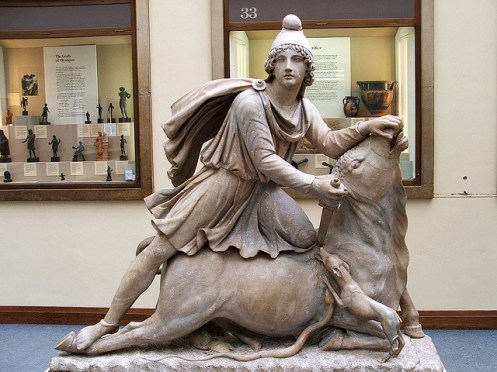
a bastard passion for the strange country
Asterios conceived a bastard passion for the strange country, being hard of heart. He was not again to see his native land and the cave of the Idaian mount shimmering with helmets; he preferred a life of exile, and instead of Dikte he became a Knossian settler in Skythia. He left greyheaded Minos and his wife; the civilized one joined the barbaric tribes of guest-murdering Colchians, called them Asterians, they whose nature provided them with outlandish customs. (Nonnos, Dionysiaka 13.238-252)
μολὼν λαβέ

Apparently some jackanape is attempting to trademark “Heathen” and related terms (including, it would seem, Shieldmaiden, Einherjar, Vanadís, etc.) As laughable as this shit is, it’s happened before – with Hermes, the God of fucking commerce no less! – so do what you can before it’s too late.
That said, I don’t intend to stop using “Bacchic Orphic Heathenry” as an allonym for the Starry Bear tradition, and anyone who doesn’t like that can fight me.
Anthesteria on the Black Sea

One of the most detailed studies of Northern Bakcheia is Katerina Amanatidou’s The cult of Dionysos in the Black Sea region (which I discovered only after I had already done a significant amount of my own research.) With Anthesteria coming up I was curious to see if I could find anything on how the festival was celebrated among the Greek and indigenous populations of the area, to supplement what I’ve already written here and here. This is what I found. While not all of it can be taken as direct evidence of Anthesteria observances, these passages do speak to the milieu of the festival.
Odessos
In the area of city’s necropolis was unearthed the remains of a coroplastic workshop, dated from the 3rd century BC, which produced a variety of terracotta statuettes intended for the decoration of sarcophagi. Among the produced types were representations of Dionysos, of Satyrs and Maenads. A miniature mask of a smiling Silen wreathed with ivy leaves was found in the debris of the building.
Furthermore, clay figurines of Dionysos and his wife Ariadne came to light at excavations in other parts of the city. Likewise, votive reliefs made of lead and shaped as bull heads were found at the site. Those reliefs that were encircled with a decoration of grapes functioned, probably, as offerings to the god. An imported amphora neck of the Hellenistic period bearing the relief image of a Satyr’s head was also discovered. Finally, the excavations yielded an almost life-size marble statue of a Satyr and two attic red figure bell craters bearing Dionysian scenes with Satyrs and Maenads.
Nikonion
In the filling of a “thaviss” (a special pit where the worn out utensils of sacred premises were kept instead of being discarded) were found two statuettes that represent Silens in a squatting posture dated to the end of the 6th century B.C. The scholars correlate those finds with analogues found in the sanctuaries of Demeter and Kabeiroi which are also chthonic deities and gods functioning as protectors of farming. Finally in the same pit was discovered, beside the statuettes of various female deities, a skyphos who had on its outer surface inscribed the phrase “ΕΚΠΙΝΩΣΤΑΧΟ”, which means “drink it fast”. That phrase and the fact that the particular drinking vessel had about 2.5 liters capacity allude to the existence of the Dionysian feast of Anthesteria in which was held a wine drinking contest.
Olbia
Olbia is the best archaeologically searched site in the northern Black Sea area. Dionysos was among the primary deities that were venerated in the city of Olbia as well as in its rural territory. Taking into account the epigraphic data it is assumed that a theatre functioned in Olbia despite the fact it has not yet been discovered. According to an inscription a person named Anthesterios was rewarded by the polis of Olbia with a golden wreath annually, during the celebrations of the Dionysia festival held in the city’s theatre. This corroborates the existence of the theatre and the significance of festivals in honour of Dionysos.
***
During the excavation of Olbia was found a bronze mirror dated around 500 BC that was possibly a grave good. In the mirror, which is decorated with bucranium and labrys, is engraved a Bacchic inscription: “Demonassa, daughter of Lenaios euai, and Lenaios, son of Demokles eiai.” Both the decoration and the inscription are elements denoting a mystic aspect of Dionysos’ cult in the context of a blessed afterlife.
Poljanka
Some of the terracotta figurines and miniature clay masks that were discovered in this domestic sanctuary are connected with Dionysos’ worship. These include figurines of a bearded bull, a Silen on a goat, a Satyr with goat hooves wearing a cloak and a round hat, and the masks of a bearded Dionysos and a young Dionysos.
***
To the west of the Poljanka settlement is located the General’skoye fortified site in which was excavated a sacred complex consisting of two structures with two rooms each. The complex functioned as a sanctuary or even a “rural” modest temple. Among the terracotta finds that were unearthed in the rooms belong two fragments of masks depicting, with high possibility, young Dionysos. The first one, which was found near an altar, preserves the lower part of the face. The other one, found in a different room, preserves the upper part of the face with lush hair and small horns, probably depicting Dionysos “the bull”. This fragment has, also, an aperture for suspension. The researchers date the series of the so-called votive masks of Dionysos in his youth found in the Cimmerian Bosporus from the 1st century BC to the 2nd century AD.
Porthmion
Porthmion was a small city situated near the shore of the Kerch Straits. Although the sanctuary has not been found a monumental altar was discovered with possibly related chthonic deities. Furthermore, excavations yielded among a variety of figurines representing mainly female deities, a head of great artistry portraying Dionysos in his youth. He is adorned with a wreath of vine leaves and bears an imperceptible smile.
Panticapaion
The excavations in the second terrace of the city unearthed a cult building of the 3rd century BC, which was interpreted as a temple of Dionysos, without excluding the possibility that other deities were worshiped there too, including Aphrodite. Owing to its proximity with the central edifice of the Panticapaion rulers’ palace complex the building was identified as a temple that served the residents of the palace. The temple had a roof of tiles, its floor was covered by mortar in which were embedded black polished pebbles and the internal surface of the walls was coated with plaster and painted with a variety of colours. Most probably it was destroyed due to an earthquake in 63 BC. The bulk of the terracotta figurines discovered in the destruction layer of the sanctuary’s area is connected with Dionysian iconography such as bunches of grapes. The most remarkable is a mask of Dionysos wreathed with a band of ivy and leaves from other flowers.
Kytaia
The excavations in the ash hill, which covers the continental rock landscape in the center of the city, unearthed the religious area and the sanctuary of Kytaia. In the remains of a building with an altar, in a sacrificial bothros pit and in the natural and artificial clefts of the hill a great number of objects were discovered and identified as religious offerings. Those votive findings consist of pottery fragments, a lot of which bear incised dedications to Dionysos, terracotta statuettes depicting him and his companions, and clay models of bread and phalli, along with animal bones of pigs, sheep and goat.
The researchers assume that, initially, the sanctuary was devoted more generally to deities of a chthonic nature that were associated with fertility, which was also a basic characteristic of the god Dionysos. A group of terracotta figurines and small votive clay masks representing Dionysos and Silenoi, Maenads and Satyrs, the members of his entourage, testifies its worship in the sanctuary. Most notable are a small mask portraying Dionysos with beard and a diadem on his head and a figurine of an actor wearing a Silens’ mask.
As witnessed by the above mentioned archaeological data discovered in different Bosporan settlements, namely the terracotta figurines and the masks representing Dionysos and his companions, rituals in honor of Dionysos were being practiced from the 2nd- 1st century BC to the 2nd century AD in the Kerch peninsula and at the northeastern part of the Crimean Azov coast. From the 2nd – 1st centuries BC Dionysos’ chthonic functions and connection with mysteries made his cult popular in the Bosporus region. People, who were facing difficult conditions due to the natural disasters, war and economic crisis had pinned their hopes on the god’s assistance in overcoming their problems.
Vani
The inland site of Vani situated on three terraces on the slopes of a hill to the south of Rioni river is one of the most intensively researched and studied settlements of the Colchian coast. In the Hellenistic period Dionysos’ cult was especially popular and widespread among the inhabitants of Vani. That popularity is attributed by the researchers to the fact that the city and the whole region was closely linked with the cultivation of vines and wine production. During this period began the local production of fairly sizable amphorae for wine transportation that have been discovered to the north of the Black Sea area. In addition, during the early Hellenistic period a new burial practice was introduced in Vani, which was inhumation inside a large storage vessel, mainly for wine, the so-called pithos, which can be interpreted as a reflection of wine’s great significance in the life of the inhabitants.
Amisos
A bronze plaque in high relief with the depiction of Dionysos Tauromorphos was found in a grave. The plaque, which is dated in the late 2nd century BC, presumably functioned as a decoration of a wooden sarcophagus. Furthermore, among the grave goods from another burial was discovered a bronze bust depicting Dionysos Botrys. Dionysos is rendered with long hair and a beard while wreathed with grape leaves and corymbs. Noteworthy in the case of Amisos is the abundance of terracotta statuettes and clay masks of Dionysos Botrys and Tauromorphos along with that of Silens, Satyrs and actors that were found in the excavations in various contexts. The figurines, which are of fine craftsmanship and quality, were being manufactured in local coroplastic workshops. The same also applies for the rather unique large sized tragedy and comedy masks, and masks representing Satyrs and Dionysos. In particular, the characteristic elements of the Dionysos Tauromorphos type of mask was two bull horns protruding out of the forehead, while in the Botrys type, the hair and the beard are rendered as bunches of grapes. In both of the types the god is depicted either young or elderly.
Sinope
Apart from the terracotta figurines, the excavations brought to light a marble statue of Dionysos and coins bearing his image. The statue, which is based on an altar, is dated to the Roman period and depicts the god naked, but not barefoot, crowned with a garland made of ivy leaves and flower buds and accompanied most probably by a panther. Additionally, in some figurines Dionysos is depicted wearing a diadem of ivy leafs and flowers and a band, tainia, on his forehead. Lastly, his function as the patron deity especially of viticulture and of fertility of nature generally is also evident in Sinopean numismatics. In several coins is represented the head of Dionysos in his youth along with some of his attributes such as the thyrsos and the cista mystica.
 The House of Vines