Orpheus’ connections with Hermes are not as direct as the ones he has with Apollon and Dionysos, but they are strong and persistent. To begin with, there’s the tortoise-shell lyre that the infant Hermes invents shortly after crawling out of his nymph-mother’s cave, which he then trades to Apollon in return for pebble-divination and the Thriai or bee-nymphs of Korykia. This lyre was then given to Orpheus by Apollon, who in some traditions is regarded as his father, having begotten him through the mountain-haunting nymph of prophetic verse Kalliope.
This leads into the next point of contact between them, their use of language to persuade and control:
This name ‘Hermes’ seems to me to have to do with speech; he is an interpreter (hêrmêneus) and a messenger, is wily and deceptive in speech, and is oratorical. All this activity is concerned with the power of speech. Now, as I said before, eirein denotes the use of speech; moreover, Homer often uses the wordemêsato, which means ‘contrive.’ From these two words, then, the lawgiver imposes upon us the name of this god who contrived speech and the use of speech–eirein means ‘speak’–and tells us : ‘Ye human beings, he who contrived speech (eirein emêsato) ought to be called Eiremes by you.’ We, however, have beautified the name, as we imagine, and call him Hermes. Iris also seems to have got her name from eirein, because she is a messenger. (Plato, Kratylos 408a)
The invention of language was also credited to Orpheus by some; others associated his poems with the earliest written form of Greek:
And in the same manner use was made of these Pelasgic letters by Orpheus and Pronapides who was the teacher of Homer and a gifted writer of songs; and also by Thymoetes, the son of Thymoetes, the son of Laomedon, who lived at the same time as Orpheus, wandered over many regions of the inhabited world, and penetrated to the western part of Libya as far as the ocean. He also visited Nysa, where the ancient natives of the city relate that Dionysos was reared there, and, after he had learned from the Nysaeans of the deeds of this god one and all, he composed the “Phrygian poem,” as it is called, wherein he made use of the archaic manner both of speech and of letters. (Diodoros Sikeleiotes, Library of History 3.67.5)
This is important when you consider that literacy came fairly late to the Greeks who had largely been a nomadic and then pastoral people until that point. It likewise precipitated a massive cultural and technological revolution which left a deep ambivalence in the population that remained well into the Classical period, with Sokrates and others expressing concern over the written word’s effect on memory and character. These sorts of objections were specifically lobbed at Orpheus:
People are wrong to think that Orpheus did not compose a hymn that says wholesome and lawful things; for they say that he utters riddles by means of his composition, and it is impossible to state the solution to his words even though they have been spoken. But his composition is strange and riddling for human beings. Orpheus did not wish to say in it disputable riddles, but important things in riddles. For he tells a holy tale even from the first word right through to the last, as he shows even in the well-known verse: for by bidding them ‘put doors on their ears’ he is saying that he is not legislating for the many, (but is addressing) those who are pure in hearing … (Derveni Papyrus col. 7)
Those who knew how to use language well were often seen as tricksters, thieves, con-men and wizards:
Fearful shuddering and tearful pity and sorrowful longing come upon those who hear it, and the soul experiences a peculiar feeling, on account of the words, at the good and bad fortunes of other people’s affairs and bodies. But come, let me proceed from one section to another. By means of words, inspired incantations serve as bringers-on of pleasure and takers-off of pain. For the incantation’s power, communicating with the soul’s opinion, enchants and persuades and changes it, by trickery. Two distinct methods of trickery and magic are to be found: errors of soul, and deceptions of opinion. (Gorgias, Encomium of Helen)
Which is no doubt how Hermes came to become patron of all of these professions, along with commerce, travel and messengers. In some accounts this is precisely what led to the death of Orpheus:
At the base of Olympus is the city of Dium, near which lies the village of Pimpleia. Here lived Orpheus, the Ciconian, it is said — a wizard who at first collected money from his music, together with his soothsaying and his celebration of the orgies connected with the mystic initiatory rites, but soon afterwards thought himself worthy of still greater things and procured for himself a throng of followers and power. Some, of course, received him willingly, but others, since they suspected a plot and violence, combined against him and killed him. And near here, also, is Leibethra. (Strabo, Geography 7.7)
This is almost the story told of Hermes in the Homeric Hymn in miniature, except that Hermes manages to broker a truce with his enemies and integrate himself into the Olympian system instead of getting killed. Nor is this the only instance where Orpheus is called a magician – Orphic rites are frequently compared to those of the magoi, even by evident insiders:
… prayers and sacrifices appease the souls, and the enchanting song of the magician is able to remove the daimones when they impede. Impeding daimones are revenging souls. This is why the magicians perform the sacrifice as if they were paying a penalty. On the offerings they pour water and milk, from which they make the libations, too. They sacrifice innumerable and many-knobbed cakes, because the souls, too, are innumerable. (Derveni Papyrus col. 6.1-11)
It’s worth noting that the specific domain where magicians and Orpheotelestai intersect is the dead. Although Hermes presided over all forms of magic, as a psychopomp he specialized in necromancy:
Chorus of Evocators: We, the race that lives around the lake, do honor to Hermes our ancestor … Come now, guest-friend, take up your stance on the grassy sacred enclosure of the fearful lake. Slash the gullet of the neck, and let the blood of this sacrificial victim flow into the murky depths of the reeds as a drink offering for the lifeless. Call upon primeval Earth and chthonic Hermes, escort of the dead, and ask chthonic Zeus to send up the swarm of night-wanderers from the mouth of this melancholy river, unfit for washing hands, sent up by Stygian springs. (Aischylos, Psuchahogoi fragment 273)
The ability to travel between worlds and guide the souls up to earth was another trait Hermes and Orpheus shared:
But if I had had the voice and music of Orpheus, so that, by bewitching the daughter of Demeter or her husband by my songs, I could lead you out of Hades, I would have descended, and neither the hound of Pluto, nor Charon at his oar, the transporter of souls, would have stopped me from bringing your life back to the light. (Euripides, Alcestis 357-62)
Indeed, all of the early sources – Phanocles included, who gives the name of Orpheus’ spouse as Agriope (wild-faced) or Argiope (shining-faced) not Eurydike (wide-ruling; a title belonging to Persephone and several Makedonian queens) – seem to indicate that Orpheus was successful in his task. The sudden madness and backwards glance costing him his lady love is found sporadically in the Classical period (Plato makes derisive allusion to it) and only becomes the dominant tradition with the Hellenistic poets, who always try to strike the most tragic chord possible. (One of them, Eratosthenes, is also responsible for introducing a note of tension between Dionysos and Orpheus, likely for political reasons.) In this variant tradition it is Hermes who either leads the forlorn poet out of the underworld once he has failed or imposes the taboo against looking back in the first place.
In one tradition Orpheus is actually responsible for introducing the worship of Hermes into Greece along with founding the mysteries of Dionysos – both of which he discovered during his travels in Egypt, as Diodoros Sikeliotes (Library of History 96.4-9) described:
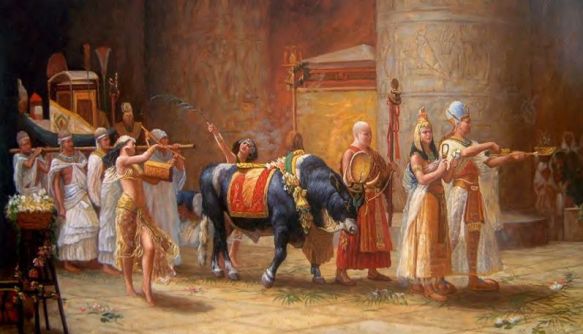
Orpheus, for instance, brought from Egypt most of his mystic ceremonies, the orgiastic rites that accompanied his wanderings, and his fabulous account of his experiences in Hades. For the rite of Osiris is the same as that of Dionysos and that of Isis very similar to that of Demeter, the names alone having been interchanged; and the punishments in Hades of the unrighteous, the Fields of the Righteous, and the fantastic conceptions, current among the many, which are figments of the imagination — all these were introduced by Orpheus in imitation of the Egyptian funeral customs. Hermes, for instance, the Conductor of Souls, according to the ancient Egyptian custom, brings up the body of the Apis to a certain point and then gives it over to one who wears the mask of Cerberus. And after Orpheus had introduced this notion among the Greeks, Homer followed it when he wrote:
Cyllenian Hermes then did summon forth
The suitors’s souls, holding his wand in hand.
And again a little further on he says:
They passed Okeanos’ streams, the Gleaming Rock,
The Portals of the Sun, the Land of Dreams;
And now they reached the Meadow of Asphodel,
Where dwell the Souls, the shades of men outworn.
Now he calls the river “Okeanos” because in their language the Egyptians speak of the Nile as Okeanos; the “Portals of the Sun” (heliopulai) is his name for the city of Heliopolis; and “Meadows,” the mythical dwelling of the dead, is his term for the place near the lake which is called Acherousia, which is near Memphis, and around it are fairest meadows, of a marsh-land and lotus and reeds. The same explanation also serves for the statement that the dwelling of the dead is in these regions, since the most and the largest tombs of the Egyptians are situated there, the dead being ferried across both the river and Lake Acherousia and their bodies laid in the vaults situated there. The other myths about Hades, current among the Greeks, also agree with the customs which are practised even now in Egypt. For the boat which receives the bodies is called baris, and the passenger’s fee is given to the boatman, who in the Egyptian tongue is called charon. And near these regions, they say, are also the “Shades,” which is a temple of Hekate, and “portals” of Kokytos and Lethe, which are covered at intervals with bands of bronze. There are, moreover, other portals, namely, those of Truth, and near them stands a headless statue of Justice.
Despite this Hermes doesn’t figure much in the standard Orphic cosmogonies – though he does show up in a variant Italian form in the golden lamellae, something a lot of people may not realize.
A: I come from the pure, o Pure Queen of the earthly ones, Eukles, Eubouleos, and You other Immortal Gods! I too claim to be of your blessed race, but Fate and other Immortal Gods conquered me, the star-smiting thunder. And I flew out from the hard and deeply-grievous circle, and stepped onto the crown with my swift feet, and slipped into the bosom of the Mistress, the Queen of the Underworld. And I stepped out from the crown with my swift feet.
B: Happy and blessed one! You shall be a god instead of a mortal.
A: I have fallen as a kid into milk.
The name Euklui Paterei is found in a number of Samnite inscriptions; Hesychius describes him as a cross between Mercury and Dis Pater (Hesychius s.v. Eukolos). It’s interesting that he’s partnered with Eubouleos (the Good Counselor) who is either, in Eleusinian sources, the swineherd that got swallowed up along with his pigs when Aidoneus abducted Kore and was thereafter venerated as a hero or, in Orphic sources, a chthonic Dionysos who mediates between the living, the dead and the underworld powers and brings soothing release to them through his words.
Although the mainstream Hellenic tradition represented Hermes as the elder brother of Dionysos who shelters and safely conducts the infant god to the nymphs and satyrs who raise him on Mount Nysa after his foster-parents Ino and Athamas are driven insane and massacre their children, the private religious association in 1st or 2nd century Anatolia which wrote the corpus of texts we now call the Orphic Hymns knew a different tradition, whereby the chthonic Hermes was the son of Dionysos and Aphrodite:
You dwell in the compelling road of no return by Kokytos.
You guide the souls of mortals to the nether gloom.
Hermes, off-spring of Dionysos who revels in dance,
And Aphrodite, the Paphian maiden of the fluttering eyelids,
You frequent the sacred house of Persephone,
As guide throughout the earth of ill-fated souls,
Which you bring to their haven when their time has come,
Charming them with your sacred wand and giving them sleep,
From which you rouse them again.
To you indeed Persephone gave the office, throughout wide Tartaros,
To lead the way for the eternal souls of men.
But, O blessed one, grant a good end for the initiate’s wok.
This is in distinction to the earlier Hymn to Hermes which gives his traditional parentage:
Hear me, Hermes, messenger of Zeus, son of Maia.
Almighty is your heart, O lord of the deceased and judge of contests.
Gentle and clever, O Argeiphontes, you are a guide whose sandals fly,
And a man-loving prophet to mortals.
You are vigorous and you delight in exercise and in deceit.
Interpreter of all, you are a profiteer who frees us of cares,
And who holds in his hands the blameless tool of peace.
Lord of Korykos, blessed,
helpful and skilled in words, you assist in work,
You are a friend of mortals in need,
And you wield the dreaded and respected weapon of speech.
Hear my prayer and grant a good end to a life of industry,
gracious talk and mindfulness.
A different group of Orphics in Olbia (modern-day Ukraine) honored Hermes and Aphrodite as romantic partners – in fact one of these Orpheotelestai, who seems to have been engaged in a magical duel with a colleague, described himself as a prophet of Hermes and worked out of a joint temple of the two deities. Interestingly we find this same pairing in Lokroi Epizephyrii, whose mysteries of Persephone strongly influenced Orphism in Magna Graecia. (This is not as random as it may seem – the two locales actually had strong trade relations in antiquity.)
Although there are many other points of connection between Hermes and Orpheus I’d be remiss if I did not mention the Golden Chain:
In the subjects belonging to theology the six great theologians join together: the first is Zoroaster, chief of Magi, the second Mercurius Trismegistus, the prince of Egyptian priests. Orpheus was successor to Mercurius; Aglaophamus was introduced into the sanctuaries by Orpheus. Pythagoras followed Aglaophamus in theology; Aglaophamus’ successor was Plato, who, in his works, summarized, improved and illustrated the wisdom of these men. They all veiled divine Mysteries with poetical shadows, so that they should not be communicated to the profane people. But it happened that their successors communicated the mysteries and everybody interpreted them in his own way. (Marcilio Facino, Theologia Platonica 17.1)




 The House of Vines