Come, O Daughter of the Sun,
devoted Priestess of the Divine Bull,
Mistress of the rites of erotic ecstasy,
Pasiphaë the root-cutter,
mushroom-gatherer,
and bather in the milk of the poppy,
Pasiphaë who leads the dance,
and weaves probability,
Pasiphaë come and be welcome
in this home that loves the Gods,
you who travel the winding ways of dream
and send airy phantoms to reveal your will
to the pious sleepers in your sacred temple,
to lunatics, and to those who are drunk
on blue-green honey.
Accept the produce of our local fields,
bread baked according to unbroken tradition,
and milk from the best of cows,
and in return we ask you to watch over the pregnant
and ensure that fine sons and daughters
are born to our people, as once Pasiphaë
you bore many extraordinary children in Crete.
Author: thehouseofvines
To Orpheus the Founder
Hail Orpheus,
robed in night,
walker in smoke,
root-cutter,
master weaver,
hunter of meaning,
singer of mysteries,
inventor of rites of releasing,
founder of our sacred tradition,
speaker for the dead
and head of unerring prophecy.
Orpheus hail!
To Orpheus
Hail to you Orpheus,
specialist in ancestral rites, you who heal
through madness, song and dance
Bacchic shaman, medium and interpreter
you who have gone below and feasted with the heroes
and come back up to your community,
a stranger inside and out.
To Nephthys
She is the Mother of Sorrows and the Mistress of Pain,
the barren Goddess who mourns the Joyful Bull unjustly slain.
She is clothed in ashes and her eyes are white as bone,
her hair is used to wrap the dead and her skin is pale as falling tears.
She comes to welcome the souls and guide them home,
to ease their suffering in those frightful moments
before they breathe their last.
Each body she holds reminds her of the one she lost,
and how she washed his flesh with her tears
and kissed those soft lips once more,
before he descended into the West, never to return.
She walks among the shadows,
hard to see unless your time is near,
though if you listen closely,
the whisper of her black wings you may just hear.
To Nanna
Hear my prayers O Far-distant One,
the beautiful, the chaste, the unflinchingly loyal
Nanna Nepsdóttir, who is so rich in blessings
that she dispenses boons to all her fellow Ásynjur,
as when she gave Frigg a finely spun robe of purest linen,
and Fulla who keeps the Queen’s secrets was gifted
a finger-ring which gleamed brightly
as the smile of Sunna with unbraided hair.
Höðr, blinded by love, sought Nanna’s hand in marriage
but what is a hand compared to a heart?
And hers belonged forever to Borr’s grandson,
the brave, the brilliant, the breathtakingly fair Baldr,
and has ever since they met as youths
in that dark elf-haunted wood.
He was hunting the boar, and she was hunting him
and from that day when they embraced
beneath the gold-green leaves with the music of gentle rain
falling down all around them to love by,
that day and every day since the two have been inseparable.
Nanna bore her man a fine son, handsome and strong,
Forseti that can reconcile feuding parties
and put to sleep grievous suits before they’re hatched,
dweller in shining Glitnir of the silver roof and golden pillars,
with a spring in Heligoland so pure its water must be collected in silence.
Oh, how you must miss him.
Nanna, I know that yours was a happy union, for you, Goddess,
were willing to follow your Baldr into the dark
when that dart of humble mistletoe sent him down
to the sunless realm of Hela and her cold and colorless denizens.
You wait with Baldr yet, and will not return
to look upon the happy face of your boy
or the deathless ones in Ásgarðr
until the world above is born anew from the ash and ruin
left by blazing Surtr and his swarthy Giant horde.
Never once do you falter or doubt your husband
nor the great destiny that is his to bear, alone but for you;
Nanna, I plead, teach me to love the people in my life
with a measure of the love you give lucky Baldr
and I will remember him in song
and the other things dear to that fathomless heart of yours.
Assorted writing updates
After the initial rush of poetic frenzy in the hospital I hit a block with the book about my experiences and insights surrounding the amputation, and despite my best efforts I haven’t been able to get through, over or around it. This has been especially annoying since I had a couple folks commission pieces for it as part of the medical bills fundraiser and I didn’t want to disappoint; also I’ve had no problem making progress on the festival book, the collection of political and philosophical essays, and the polytheist hymnal which are all nearly complete. (I’ve only gotten some editing and rearranging done on the Orphic Heathenry books, but also haven’t tried to do any new writing for them yet since I’ve been so busy with the others.) I think it’s finally time to put a bullet in the poetry book’s metaphorical head and move on, so I contacted all of the patrons and asked if they’d rather their donation go towards commissioning a hymn or get a refund instead. Most have opted for a hymn, which pleases me since I’ll get to write stuff for divinities I might not have considered on my own. My to-do list currently stands at about two and a half dozen hymns, which I’m hoping to have completed in the opening weeks of the new year if all goes according to plan. If you’d like to request a piece for your favorite Greek, Roman, Norse or Egyptian divinity shoot me an email and we’ll work out the details. It’ll end up being $20 a hymn via Paypal. (I’m too old and lazy to figure out other payment methods at this point.) I’m going to stop taking requests on Kalends, so be sure to get yours in soon!
Have you danced the Little Stag on the Kalends?

Kalends is coming up. If you’d like to know more about how to celebrate click here, here and here.
My favorite bit of Kalends lore has to be this:
“Unhappy me! What wickedness did I let loose! I think they would not have known how to play the Little Stag on the Kalends had I not by my rebuke shown them how.” – Pacianus of Barcelona, Parenesis 1.13
Oopsies!
To the Sicilian Muse
Ditto.
O Muse of Sicily with strong Doric voice
sing to me a song of the land of my people,
the thrice–holy island of the Maid who weaves an image of the world
as she waits for the embrace of her serpent–tongued father,
the land which saw the gentle one–eyed shepherd go mad
for love of the white–armed Nymph of the windswept waves
so that he, with sharp rock, dashed out the brains
of the unkissed youth whose blood became a lovely river,
the land which saw the flowering of fair Naxos rich in grapes,
first colony of the wandering Greeks,
land which saw Bacchic women dance spider–mad
in forests nourished by the ash of Etna,
land to which the doves of Venus always return,
land of flame–haired Adranos and his hundred dogs
who was driven out by Vulcan when he fell
howling in rage from Olympos,
land of the Palikoi, testers of men’s heart and word,
whose breath smells of sulfur, whose hair drips with lake–water,
land where Daidalos fled, seeking asylum with just Kokalos,
who had his daughters drown the pursuing Cretan king in his bath
so that the rites of hospitality might duly be observed,
land of these and a thousand other fables and tragedies—
O Ivy–crowned Muse of Sicily, sing to me a new song,
a song worthy of my ancestors, my audience.
A Prayer to the Greco-Egyptian Gods
This one’s in the Polytheist Hymnal too.
Hear my prayers, O Gods, for I am one who has burned incense for you,
and adored your image in its shrine, and set out bread and meat
to nourish your body, and poured cool water and sweet wine
to quench your thirst. I have kept the memory of you alive in my heart,
and I have walked upright in your ways and shunned all those deeds
that are hateful before your eyes. You are the mighty ones,
who hear all prayers and have the power to grant them,
and never turn aside a supplicant.
Hear my words, O Gods, for this is what I pray!
King Ptolemy, grant me strength of arm, nobility of spirit,
and pious reverence for all the Gods, such as you possess in abundance.
Zeus-Ammon, make clear my sight that I may behold the way
that is right for me, and walk always in truth, and justice, and balance,
a friend of the Gods and one who upholds Ma’at daily.
Thoth, may all my words be chosen properly, may you grant
my thoughts swift flight to soar above whatever is placed in my way,
and establish in my mind a knowledge
of the presence and blessings of the Gods,
remaining forever like the divine monuments of holy Egypt and Greece.
Hathor and Aphrodite, Golden Ladies of love and joy,
share your blessings with me! Kindle the flames of passion within my breast,
fill me with an aching longing for others,
delight my eyes with the awesome beauty of all creation,
make me melt with unimagined ecstasy.
Lady Hera, grant that I remain faithful to all of my responsibilities,
never shirking those duties to family, friend, and city
which are your special concern. May I treat my loved ones with respect
and always demonstrate concern for them,
never violating the commitments I have sworn or causing another to do likewise.
Hestia, help me to keep your flame burning eternally,
to see my home as a temple to the Gods,
and everything done in it as a holy service.
May my life be clean, and orderly, and all of my interactions
with people filled with kindness, understanding, respect, and righteousness.
Bast, do not let me forget that men are not the only creatures on this planet,
but that all life is sacred and deserves to be cared for, most especially the life of cats.
Help me to remember that there is more to existence
than just work and social duties, but that we must also take time out
to play and enjoy the sensual pleasures of our animal existence.
Imouthes-Asklepios, make my body whole, free of every infirmity
and disease, that I may experience the fullness of life.
But if by grim necessity I should be afflicted with some ailment,
do not let this stop me from seeing the beauty and joy around me,
and make my spirit strong enough to endure whatever I must.
Horus, grant me courage to stand up for the things I believe are just,
fierceness in the face of my enemies, and the means necessary
to protect those who cannot defend themselves.
Apollo burn away every sign of weakness and impurity within me:
make me to shine as brilliant and purely as Ra upon the horizon.
Fill my ears with the harmonious music of the heavens;
make my speech ring with prophetic truth.
Sobek and Seth, may you stand at my side and protect me
from those who would do me harm.
When I grow too attached to something,
and don’t even realize that I am smothering my soul in
addiction, comfortable complacency, and stagnant stasis,
tear me apart and destroy whatever is holding me back,
that I might be reborn into freedom.
Sekhmet, drive back my enemies as fiercely as you fight
the forces of Isfet, and make me pure in body and soul,
that I might conduct the holy services of the Blessed Immortals rightly.
O grain-discovering Goddess of many names, if I must wander
across great distances and lonely paths, watch over me
and help me to find what my soul most desires.
Teach me the way of transforming suffering into joy
and never let me lose heart.
Hermes, be with me too as I journey, show me the way,
and if I should need it, don’t be averse to making the road twist
in strange directions beneath my feet.
Yours is the realm of chance and unpredictability –
help me to see adversity as an opportunity,
obstacles as a way to hone and demonstrate my cunning,
and never let me become so serious and committed
to my path that I cannot stop to roar with laughter at life’s absurdity.
Dionysos, make me drunk on the wine of life!
Open me up to every experience
so that when it is time to stand before the judges in the West
I will be able to say that I wasted not a second of life
and that I ended my days without a single regret.
Cause my spirit to overflow its bounds,
like the Nile spilling over its banks,
and may this inundation make the soil fertile
so that every type of crop and plant can take root in it.
Osiris, nurture the seed that I plant
and guide it until it reaches fruition.
Be just as gentle to me, Lord, as I undergo the journey into wholeness.
Show me the source of true being, which survives every transformation,
even that of death, so that I might see
just how small and powerless my fears are.
Anoubis and Hekate, you who stand
at the beginning and the end of all things,
meet me at the wild places,
when I cross the threshold into unfamiliar territory.
Challenge me to grow and change,
to be more doglike, unconcerned with society’s conventions,
fiercely loyal to my own nature, hunting out what is good and true
with a single-minded intensity.
And when my days have reached their end
welcome me into the land of the dead,
reveal to me the path of becoming
one of the imperishable stars in the night sky.
And all of the other Gods – far too numerous to count –
do not think that I have forgotten you!
You are dear to my heart, and your names shine brilliantly before me,
as radiant as Sothis who makes the Nile to flood.
I seek the blessings of all of you,
and will honor you so long as the breath remains within my body
– and even after that!
To the Gods of Hellas and Beyond
Also from the Polytheist Hymnal.
Sing to me, clear-voiced daughters of heavenly Zeus,
of the whole company of the Immortal Gods, and
do not let me forget any of the august divinities,
nor let my voice falter as I praise them, dear Muses.
I will begin with Zeus, King of Gods and men,
who thunders from the top of Olympos, and his dear wife and sister,
queenly Hera, mistress of wide-pastured Argos.
And of the Earth-shaker Poseidon I will sing, who loves horses,
and waves that break upon the shores,
and makes his home deep beneath the waters, where there is no wine.
Next there is Aegis-bearing Athene, protector of high-walled cities,
who is pleased by wise speech and gave man the olive-tree as a boon.
Golden-haired Demeter I sing, mistress of our fields and of blessed Mysteries,
and her slim-ankled daughter Persephone,
who spends two portions of the year above ground
with the Blessed Immortals, and one portion below
with the spirits of the dead, and her dark husband, Haides,
who accepts no sacrifices, for in time, all things come into his hands.
I sing of the light now, of Phoebos, the Lord of Delphi,
Far-shooting Apollon, the light of the sun, and of holy inspiration,
averter of plagues, and player on the kithara.
His sister I will sing, the lovely virgin Artemis,
who runs through the forest, delighting in the hunt,
and who watches over women in childbirth,
and our young daughters.
Ares I sing, very strong, who hates the tyrant,
and leads our sons in battle against the enemies of walled cities.
Love, they say, is also a conqueror – so I shall sing of Aphrodite now,
loveliest of all the Goddesses, fair Kytheria, born of the foam on the waves.
And her son, who stands by her side and sends out his darts
to pierce the hearts of mortals and Gods alike with love,
Eros who has wings and many shapes.
Hephaistos I sing, a stranger to Olympos,
who spends his time beneath the waves,
working metal and making wonders for the Gods and men.
Hermes frequently wanders the earth, on errands for Zeus,
or guiding the souls of the dead to Haides’ dark house.
A thief, and a protector of those who travel – Hermes is a very busy God!
I sing of Hekate, who stands amid the cross-roads,
clad in saffron, a great protector against witches and their evil charms.
Triple-formed, she has power over the sky, the earth, and waves.
I will sing of the virgin Hestia, sitting by the hearth,
tending her sacred fire now.
All the Gods and mortals honor her,
for she brings sweet concord into the home.
Dionysos I sing, wild God of the fields and mountains,
who gave as a boon to man wine, which banishes sorrows,
and sacred Mysteries, which purify the soul.
Arcadian Pan I sing, the shepherd’s God who plays haunting songs
upon his flute, and chases after the lovely-breasted Nymphs.
I sing of horned Selene, who comes out by night
and sheds her gentle light upon the sleeping world,
and Helios, whose fiery chariot is drawn by four swift steeds.
The Mountain Mother Rhea I sing, who delights in drums
and lions, she who is called the Mother of Gods and men,
an ancient and revered Goddess.
Ge I sing, the very earth upon which we live.
Broad-bosomed and sustaining life –
every blessing we have, we have through her.
Ouranus, the starry vault of heaven I sing,
who reaches down to touch Ge his love,
just as in mountains, she reaches up to embrace him.
I sing of all the Nymphs now –
those who call the mountains their home,
or haunt the shaded forests.
Those who live in rivers and springs
and all running waters,
and the Nymphs in trees and rocks and sacred precincts.
Herakles I sing, lion-hearted son of Zeus,
strongest of mortals, who ascended to heaven
by his own might and virtue,
perfect protector of those who kindly beseech him.
And the twin sons of Zeus I sing,
Kastor who tames horses, and blameless Polydeukes,
the Dioskouri, a great help to sailors.
I sing the Epidauran, Asklepios, who is son of Phoebos,
and like his father, a wise Physician to Gods and men.
Asklepios takes away the pains of mortal men,
and stands between us and every disease.
He even has power to call back mortals from Haides’ house,
though Zeus forbids him to use it.
The Phrygian shepherd boy, I sing,
Ganymede whom Zeus, in the form of an eagle,
snatched up and carried to Olympos to be cupbearer for the Gods.
The lovely Ariadne I sing, Queen of the Bacchantes
with her husband Dionysos, a mortal who became a Goddess,
and now has a share in the power of Aphrodite.
Semele I sing, who in pains of birth,
was struck by the lightning of Zeus,
and cast down into Haides,
where she awaited the coming of her child Dionysos,
who raised her up to the company of Immortals.
I sing of Leukothea, who protects sailors
from waves and jagged rocks,
and Orpheus, founder of Mysteries,
who made the trees and rocks
and animals dance by his playing.
I sing of Adonis, the sad youth
whom Aphrodite loved and lost.
Eris I sing, of the Golden Apple,
who brings discord among the Immortals, but also laughter,
and Tyche, who causes what we least expect to happen.
Necessity I sing, who no man can escape,
and Philosophy, gentle Goddess who teaches us
how to meet life’s afflictions heroically.
I sing of the drunken Satyrs in the forest, honoring Dionysos,
and the Korybantes, performing their dances with swords
for the Great Mother of Mount Ida.
I sing of the Kytherian’s attendants,
the Graces and Charities, those lovely maidens swathed in silks.
I sing of the Blessed Ones, on whose graves we leave flowers
and libations of milk and honey, our ancestors,
who have power yet to affect the living world.
And I sing of you, dear Goddesses,
who have helped me with this hymn,
the Nine Maidens of Mount Helicon.
You are the ones who pour out beautiful speech,
and make us proficient at singing and dancing.
Playing upon your harps, you fill the world with harmonious sounds,
and make things enchanted, beautiful, and wonderful.
You are very dear to my heart,
you daughters of Zeus and Mnemosyne.
I sing also of the Gods known outside of Hellas –
of Isis, who has many names,
and Mithras who slays bulls.
Of Bellona who gnashes her teeth,
and Agdistis, both male and female.
Of double-headed Janus
and Priapus who must carry his penis in a cart.
Of the Thracian Hero who rides horses
and the snake-God Glykon.
Of the Celtic Brigid who likes wells and beautiful songs
and Hadad the Thunderer.
Of shining Melqart and Astarte of the night sky.
Of Nuit, and Hadit, and Ra Hoor Khuit
and even Iao who is worshipped with no image.
I sing of all the many Gods I have not mentioned by name –
but who are no less honored by me.
May the whole Divine Assembly remember me,
and bless me for this song I have sung for them.
Morning Prayer
A piece from my Polytheist Hymnal.
I greet the day in joy, my heart in awe at the beauty of the cosmos.
Hail to you Gods of the heavens, and the earth, and those below.
Hail Gods of the mountains and the forest,
Gods of the mighty rivers and the towering trees.
Hail Gods of the desert and the ocean,
Gods of the fertile fields and the bustling cities.
Hail to the Gods of love and ecstasy,
of song and dance,
of justice and beauty,
of strength and protection,
of health and prosperity,
of wisdom and creativity,
of all the virtues and blessings that make life rich and worth living.
Hail to the mothers and fathers who came before me,
and the honored dead of all nations.
Hail to the Gods who guide my heart,
and the helper spirits who show me the way.
Hail to the whole divine assembly – I rejoice in your presence
on this beautiful day of manifestation,
the world refreshed as it was upon the first day.
Let today be the first day of all creation,
full of limitless possibility.
All the bad things
and the failures of yesterday
are no more. I have forgotten them.
Today I begin anew and shoulder my responsibilities
with a joyous heart.
Today I shall do everything in my power
to establish Ma’at and make the world a better place
for those who come after me.
Today let every word that I speak be true.
Today let justice guide every action that I perform.
Today may I offer comfort to those in need,
and show kindness to every stranger that I meet.
Today I shall be temperate and disciplined
and do the good things necessary to make my life prosper.
Today I shall set aside all grudges
and refuse to let anger or violence
take root in my heart.
Today I shall remain ever mindful of the Gods
and seek them out in the world around me.
This is the vow I bind myself to for today and today only.
And lastly, I pray to all the Gods of my people,
my family, my tribe, my fellow polytheists.
May you walk with them today, O Gods,
and grant them life, health, and stability.
May you make their hearts joyous and fill their souls
with love, beauty, wisdom, and creativity.
May all obstacles be removed from their path
and may any enemies who come against them
be smited and trodden under foot.
May the Kingdom of Dionysos and its people prosper
and grow and continue to do the work of the Gods
for all time, χαίρετε!
Hymn to Angrboða
For redeseeker
To Angrboða
Hail Angrboða, O mother of monsters
and guileful mate of Laufey’s son, dreadful one
who knows all the ways that a heart may grieve,
and how to afflict measureless suffering on mortal men,
regardless of how high they were born, or what luck
the Norns have spun for them. Mistress of the Ironwood,
queen of the trollwives who dwell therein, hard and cruel
did you come into the world, prophesied to be the cause
of great mischief and harm to the Gods in far off, gleaming Ásgarðr.
Lachrymose Giantess with eyes that can turn mountains
to smoldering rubble, sharp teeth to tear flesh and crush bone,
fingers stained with gore and the poison plants
you use in your witcheries, whose beauty stirs lust
to the point of madness though you yourself are never desire’s subject,
potent one who bows the head to no one, she who protects what is hers
with terrifying savagery, schemer and spitter of venomous words,
I pray, fill me with fortitude for the facing of life’s hardships,
help me to learn the lessons I must, and overcome every fear
and calumny flung my way, that I may grow strong and fiercer
and become a cause of great woe for my enemies.
For this I will ever remember you,
and keep your shrine full of offerings.
Hymn to Sif
For Johanna
To Sif
Hail to you Sif, who brings the golden ale round at the feast of the Gods,
and can quench the quarrelsome coal with but a touch
of your sun-kissed hand, and a gentle word whispered
in the ear of your hot-blooded guests, before it blazes forth
causing untold misery to one and all in attendance.
You, Goddess, have eyes pale as the pristine snow
beloved by your son Ullr, and hair that gleams
as bright as Allfather’s dwarf-crafted spear Gungnir,
though neither is as radiant as your grin
when you glimpse your husband Þórr returning
from slaying some ferocious Jötunn or a pestilential serpent
afflicted with Fáfnir’s disease.
Though you are desirable as Freyja
to Hrungnir who would have you as his lawful bride,
and Loki who would make you his bed-mate
and breed more monstrous brood,
and Njörðr who would ride with you on the gently rocking, foamy sea
in his swift skiff the equal of Skíðblaðnir,
you Sif, desire most to show clever little Þrúðr
how to keep a well-managed household,
how to spin the finest thread with which to work the tireless loom,
and how to bake sweet-smelling bread the color of bee-wealth.
Far beyond the domestic sphere ranges
your unconquerable curiosity, so that in knowledge
you are second only to the Ásynjur Queen Frigga;
thus men call you Sibyl, and consult you
on sundry matters past, present and those yet to come.
Though learned skálds call you rival-of-Járnsaxa —
I believe it not, for never should the lesser
be compared to the greater (even for the sake of meter)
and you, helpmeet of Hlóðyn’s son,
are her superior in every way that matters
and then some. If these praises prove pleasing to you
look kindly upon me in future days,
and in return I shall heap up plenty more
until they reach high as the walls
which Svaðilfari’s master built,
and higher still,
and I shall consider it no labor at all.
Hail Óðinn! Hail Wōdan! Hail *Wōðanaz!
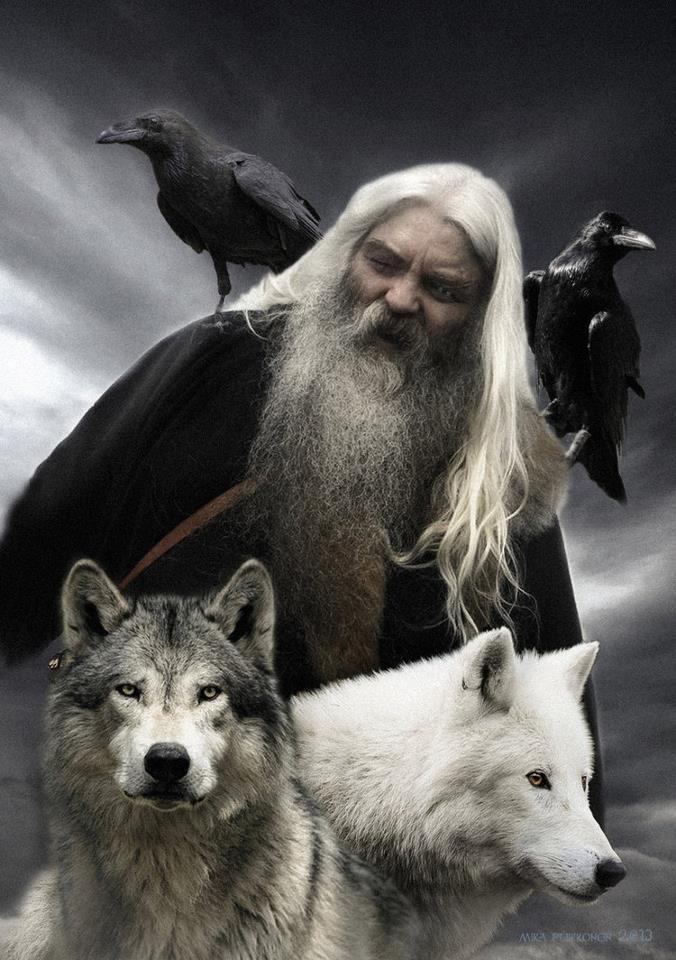

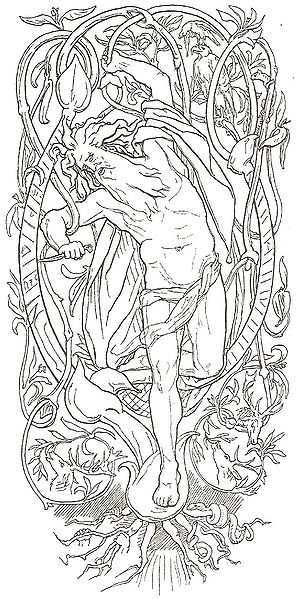
Hail Óðinn! Hail Wōdan! Hail *Wōðanaz!
Nine Offerings for the Gallows God
I am a poor man, with little of worth to offer beyond my words. May they be pleasing to you.
“But some occasions for these names arose in his wanderings; and that matter is recorded in tales. Nor canst thou ever be called a wise man if thou shalt not be able to tell of those great events.” — Gylfaginning, XX
Gangleri
Black the forest,
black the evening sky overhead
and black the clouds that hung low,
promising a storm was near.
Once the traveler’s cloak had been black too,
finely spun and chased along the border
with marvelous designs in thread of gold
as befits a cloak worn by a high-born king.
But the road wearies and wears down;
filthy with dust, patched in many places,
frayed and color leeched to grey
– such was the cloak of the wanderer,
that strange, one-eyed man who came from the woods
amid the cries of a murder of crows
the night the city fell to the spears of the invaders
and its walls burned to smoky rubble.
Grímnir
The head in the well
whose water feeds the roots of the tree
from which the nine worlds grow
that bore the weight of a god making the ultimate sacrifice
for power and for wisdom
– oh the things that head has seen,
the mysteries it contains.
The head is a mask
that must be worn to speak words of true prophecy.
Bölverkr
He rides out on a steed with eight legs
like a black spider weaving sinister plots,
like a coffin carried on four men’s backs,
like a hideous nightmare that has hold of you,
and will not let go.
Its hooves are claps of thunder,
rolling across the heavens.
Its panting the gusts of wind
that strike your cheek
and fills your bones with icy dread.
And if you hear the sound of the rider’s horn
calling the restless ghosts to the hunt
they say that you will never laugh again.
Hjarrandi
A voice in the darkness
swirling through the trees
like the smoke of a traveler’s fire
lit to keep the cold at bay.
Whispering weird words,
myths of a distant time and land
and birth amid fire and blood.
Eyes uplifted,
soul roaming abroad frenzied and drunken,
body trembling from the weight of revelation
– this is how real poetry is made,
the wine of the god and his raven’s bread.
Biflindi
Sharp as desire,
strong as a will tested in flame,
piercing hearts and rending flesh,
cruel and uncaring
– the only thing that brings peace
and keeps utter chaos from descending.
Would you expect the god of the spear to be any other way?
Njótr
His face is harsh
from battles and scheming
and endless wandering of roads.
You don’t come back from death unmarked
and his body is a map of the ordeals that have made him mighty.
But when he smiles and lifts his cup in silent salute
she sees none of that.
He is handsome in the fading light,
and her bed is cold and oh so empty.
She wants the warmth this vagabond king offers
and he wants to give her everything she needs.
It is good to have allies in all the realms.
Rúnatýr
The runes are screams
born of blood and madness
and a need for knowledge at any price.
They are spirits hungry for use,
old and dark and wise.
They will show you what lies hidden to your sight
– but sacrifices must first be made
before the runes can be taken up.
Jolfr
The king of the forest,
hairy and savage,
feasts on golden honey,
the tribute of the lesser beasts,
and slumbers in the cave of death,
dreaming of the shining realms
during the cold, barren months of winter.
But he comes forth with the flowers of spring
to revel with the trooping hosts
amid songs of joy and gay feasting.
Óski
Be careful what you want,
choose your words carefully;
for the old man hears all
and even grants wishes from time to time.
Like King Harald who longed more than anything
for the glory of the battlefield,
for his name to echo down through the ages
like the clash of arms, the shriek of a broadsword
splintering a wooden shield.
Pleased with his offerings the fruit of the gallows came with his bear-shirt on
and tutored Harald in the ways of war,
made him a mighty fighter and leader of men.
He trampled many a foe into the ground,
sacked and plundered all his neighbors’ lands.
His name inspired fear in all who heard it
for he seemed invincible,
like one of the gods of old and hardly a man any longer.
But no matter how strong we mortals become,
there are those stronger still
and they scheme in ways we will never fully comprehend.
Óski lifted Harald high
so that his fall would seem all the more splendid.
He had no clue when his time came
– he did not notice that the man who drove his chariot that fateful day
had but one eye.
Still, Harald received everything he had been promised,
and then some.
Men still remember his name to this day
on account of what the grey god did for him.
A Yuletide Tale
Mike glanced up at the digital clock hanging over the register. Mockingly it read 8:49, only seven minutes ahead from the last time he checked. He threw his rag (filthy from cleaning the chili cheese dispenser) into the bucket of brackish grey water and swore under his breath. This night was taking forever. Normally the graveyard shift whizzed by. You had all those chores the day crew inevitably failed to take care of to keep you busy, and few distracting customers except for the drunks who went straight back to the molt liquor shelf and then were on their way. He normally enjoyed the solitude, as it gave him time to think and sometimes when he finished his duties early he was even able to sneak in a little writing on the boss’ dime.
But tonight was different. To start with he shouldn’t even have been here. He was supposed to be with his Kindred keeping vigil on the longest night of the year and listening for the Wild Hunt as it passed overhead on its ghostly way. He’d even asked for the time off two weeks in advance, explaining that he had prior religious commitments. The manager had agreed until yesterday when she asked him to cover for the Mexican kid who was out with the flu. Apparently nobody else was available and since his wasn’t a real religious holiday anyway she needed him there. Though she hadn’t actually said it the implication was that if he didn’t show he could start looking for a new job the following day. It was awfully tempting to tell her where she could shove her job, but in this economy that’d be a damnably stupid thing to do. So Mike had just sucked it up and come in, even though that meant missing out on Thorvald’s justly-famed mead. The Kindred had promised to save him some, but he knew the chances of that actually happening were pretty much nil. By this time they were probably already on their third or fourth bottle – and the night was still young.
The electronic bell sounded and Mike pushed the mop and bucket into the closet and headed up front to greet the customer.
No one was there.
“Must have been the wind,” he muttered to himself, glowering at the clock. Another three minutes down, thank the gods.
“Right breezy it is,” a voice came to him from behind the Doritos stand, harsh and phlegmy. “Cold as a witch’s tit, too.”
Fucking great, Mike thought, his lip curling up in disgust. This is just what I needed tonight.
The bum looked to be about fifty or sixty, but could have been considerably younger for all that Mike could tell. The streets had clearly not been kind to him. He was wrapped in several coats and sweaters that stank of old sweat, stale beer and things best not imagined. He had a grizzled beard halfway down his chest and stringy, unwashed white hair. He might actually have been handsome, beneath the grime and the wrinkles and the sunburn, but it was even harder to tell than his age because the rheumy mess of his blind left eye was so distracting.
“Can I help you?” Mike asked, though it came out sounding more like, “Get the hell out of my store, you revolting monstrosity.” For a moment he was embarrassed by his tone, then the vagrant started a wet, tubercular cough that rattled his frail frame and Mike considered saying just that.
“I hope so, son.” The vagrant managed, once he got control of himself again. “As you can see, I’m a bit down on my luck and could use a helpful hand.”
“This is a business, not a charity.”
“I don’t mean to impose, and I don’t need much. The use of your restroom. A bit to eat. Some spare change, maybe.”
“Sorry, no can do.” Mike said brusquely, wondering how long it’d take the cops to get here.
“Come on, son. It’s the holidays. Don’t you know the Lord helps those that help the needy at this time of year?”
“You got the wrong guy, mister. Your Lord ain’t my Lord. Now get your sorry ass out of here before I reach for the bat behind the counter and throw you out.”
“Very well. It’s your loss, son. But remember that you had a chance to do something decent here tonight and passed it up.”
“I’m okay with that.” Mike laughed as he watched the old man shuffle through the door into the chill winter night.
* * *
The clock now read 11:08. At least that was something. Only a few more hours to go, then Mike was home free. Thankfully it had been pretty uneventful in the interim. There had been a couple high school chicks trying to buy a six-pack with an ID so bad he wondered if a younger sibling had made it for them. When he refused to sell them the beer they offered to flash him their tits. He might have taken them up on the offer if it wasn’t for the omnipresent cameras. The store had gotten busted in a surprise sting on underage sales just a couple weeks before, so they were hyper-sensitive about that sort of thing now, and he doubted his manager would look kindly on his bending the rules, even for such a noble purpose. A couple minutes later a shady guy who’d been hanging out in front of the store for a while came in to, coincidentally enough, purchase his own six-pack of the same brand. Mike had smiled as he counted back the man’s change. Lucky bastard.
Other than that it had been pretty quiet. He’d managed to clean all of the equipment and restock the cooler, which meant that he was ahead of schedule. The only major thing he had left was mopping the floors, which he planned to do around 3:00. Now he just had to get through the rest of this never-ending night.
Normally he had no problem keeping vigil on Yule, unlike the rest of the Kindred who were usually starting to succumb to the warm alcohol by midnight. Frequent graveyard shifts helped, but it was also the fun and excitement of the evening. Yule was probably his favorite of all the holy tides. It always seemed so magical and otherworldly to him. A time of great power and transition as the sinister host took to the skies and strange things walked about in man-shape. He knew that for others in the Kindred that was just the stuff of myth and folklore. They said they believed in that kind of thing, but Mike could tell that they didn’t really feel it deep in their blood and soul. They went through the motions, did all the proper ritual acts, but none of them genuinely feared that the ghostly riders of the Hunt might claim them. It was mostly a time to gather round the fire with friends and family, to eat lots of food, drink lots of mead, exchange presents, stories and oaths for the new year. It might as well have been Heathen Christmas for all they were concerned.
It was different for him, however. It was real and he felt it with a depth of his being that was hard to share with the others. Unsurprising, he supposed, seeing as Mike was a dedicated Odin’s man and generally inclined towards the woo spectrum of Heathenry. That’s what annoyed him the most about having to work on Yule. This was probably the single most important festival on the calendar as far as he was concerned – certainly the most important for Odin – and here he was, stuck waiting on idiot customers and cleaning up after his brain-dead co-workers. It just wasn’t fair, damn it. Come the new year he really needed to start looking for a better job. It was something he’d vowed numerous times over the last five years, but somehow he never quite got around to it. This time it’d be different, though. His manager asking him to miss Yule was the last straw. He was still fuming over the way she’d dismissed his religious observance as irrelevant. And to drive the point home she’d given him Christmas off, acting like he ought to be grateful for the scrap she’d tossed him, it being a real holiday and all. He’d been tempted to threaten her with a religious discrimination lawsuit, but instead he just kept his mouth shut.
That had pretty much been his normal response of late, and not just at work. There, at least, he had the justification of a shitty economy. Bad as this job was, he couldn’t afford to lose it. But a dead-end job was the least of the things making him feel like an impotent failure.
Six years ago he’d come to the city with big dreams, leaving the wreckage of his old life behind. He wanted to start over, to accomplish the great things he knew were inside of him. Find the woman of his dreams, become a famous writer, make a lot of money and devote himself fully to his religious practice.
At first it really looked like he was going to do it, too. Shortly after arriving here he found a thriving Kindred, much larger and more active than anything that had existed back home. He met and fell madly in love with a pretty girl named Kimmy through the Kindred and before the year was out they were an item. He’d gotten several things published in major national magazines and started work on the Great American Pagan Novel. He found this job at a 7-Eleven to pay the bills until he started making some real money through his writing. For the first time in his life things were starting to look up for Mike.
Then his luck reverted to form. The hours at the convenience store were long and grueling. Most of the time he’d come home after work too exhausted and demoralized to do anything more than sit in front of the TV and chug beers until he passed out. Months went by without him so much as picking up a pen to write and when he did it was all shitty and uninspired. His religious practice had suffered even more than his writing. Most of the time his shrines were covered in dust and he barely remembered to pray or thank the gods on the rare occasion that something good actually happened to him. The only ritual he regularly did was with the Kindred and even then he was mostly a passive witness. It had gotten so bad that the gythia had asked him if he wanted out. He didn’t. The Kindred was the only decent thing left in his life. He just found it difficult to “get it up” spiritually because everything else in his world had become so small and meaningless. It was like there was this sucking emptiness in his soul and no matter what he did he couldn’t fill the void.
After a while problems developed in his relationship with Kimmy. They fought constantly, or worse just sat there ignoring each other. Most of the time what they fought about was him. At first she tried to help him get out of his rut and break through the depression that seemed to have a strangle-hold on him. And when that didn’t work she came to resent him. She said it was like he had given up on life, abandoned his dreams and everything that had once made him seem so special, and she was sick of it. She didn’t want him to drag her down with him. And so eventually she just left, shacking up with another member of the Kindred after a couple months.
That should have been his wake-up call, the thing that kicked him in the butt and motivated him to actually start working on improving his life. It wasn’t. If anything it made matters worse because it confirmed all of his fears and insecurities and self-loathing. It was hard to see Kimmy in the arms of Erik at Kindred events, especially because she appeared so happy and vibrant in contrast to those last few months together, but he got used to it, and so did everyone else. They tried not to show it, tried not to treat him like a whipped dog, but when it came down to it that’s exactly what he was. Life had been cruel to him. All his hopes and dreams proved fleeting, illusionary, beyond his reach. He was stuck in a rut and a rut is just a grave waiting to be filled in.
It was especially difficult to bear his status as abject failure since he prided himself on being an Odin’s man. Oathing himself to the Lord of the Gallows had been his greatest moment. But sometimes, hell, most of the time he wondered if he’d made a huge mistake. Shouldn’t an Odin’s man have done better than this? Faced life’s obstacles with courage and fortitude and triumphed against all odds? He knew that that oath came with a responsibility to do great things, things he knew deep down he was capable of, but he just couldn’t find the strength of will to succeed. He was lost and alone and he didn’t know what to do with himself anymore.
“Hey there, mate. You sleeping on the job?”
Holy shit! Where had the customer come from? Mike had been so sunk in his brooding that he must have missed it when the man came in. Mike lifted his head from the cradle of his arms on the counter and took in the stranger.
He was a strange one, indeed. Dressed in black from head to toe, with shiny combat boots, jeans, a t-shirt, a trench coat and a cowboy hat tilted to one side. The t-shirt had a fiery red 8-point chaos star in the center and he wore a unicursal hexagram hanging from a black silk cord, as well as a large black enamel raven belt-buckle around his middle. His fingernails had black paint and he was heavily tattooed with occult sigils and other strange designs, as well as sporting several very prominent piercings. His face was thin and angular with a strong beak-like nose and deep-set blue eyes. Or at least one of them was, since the whole left half of his face was concealed in shadow from the cowboy hat. He cut quite an imposing figure and from the looks of him he was probably some sort of Chaos magician. Mike recognized the star and hexagram from the couple of Pagan Pride events he had attended in the past. But whereas those guys had all been pretentious poseurs given to armchair pontification this guy seemed like the real deal. Mike couldn’t have said why, there was just something about him that gave the impression he was into some serious shit. He had an intensity and animal magnetism and there was also something a bit mad and dangerous about him. Mike’s suspicions were only confirmed when he flashed a Charlie Manson grin.
“Uh … can I help you?”
“I bloody well hope so.” The accent was thick enough that Mike had to listen closely to make out the words. He didn’t know enough about British dialects to place it, his exposure to the Queen’s English coming primarily from episodes of Doctor Who. They didn’t get many foreigners around these parts, certainly not Limey ones. “I’ve been all over looking for some place what sells some mead. I knew you yanks aren’t much for the civilized drink, judging from your piss-thin beer, but I figure one of these stores has got to carry some, right? Course, most places aren’t even open at this hour, but you was, so I figured I’d try my luck, it being the Solstice and all.”
“Sorry, man. The closest we’ve got is some Mike’s Hard Lemonade. And Guinness in a can.”
Technically, that wasn’t true. Mike had a bottle of Chaucer’s in the trunk of his car. Probably the worst store-bought mead you could get, but it’s all the grocery store had had. He’d meant to bring it as his contribution to the Yule feast since Thorvald’s homebrew wouldn’t last the night and by that point everyone would be too drunk to care how bad it tasted anyway.
“You’ve got to be kidding me. In a can? That ain’t right. What’s wrong with you bleeding yanks?”
For a moment Mike considered giving the stranger his bottle of Chaucer’s. It’d be a nice thing to do, especially since his Yule was already shot. But then resentment got the better of him. Fuck it. Fuck the whole damned world. Why should he be nice to anyone when everyone was always taking a steaming crap on him?
“You sure you don’t have any mead back there? Looks like you got everything else in that ice box of yours.”
“Nope. No mead. We’re a 7-Eleven, not an alcohol superstore.”
“Damn it all to hell. Guess my alcohol-witchery ain’t what it used to be. Could’ve sworn there was some mead around here.”
“Not a drop. Now, can I help you with anything else?”
“This pack of crisps will do.” He handed Mike a bag of Lays and some change then left.
What a seriously weird dude, Mike mused. I mean what the hell. Who comes to a 7-Eleven at this hour looking for mead?
* * *
Fucking finally! Mike thought triumphantly as his replacement finished counting out the till. This godforsaken never-ending night is finally over. Now to get my ass home for some much needed relaxation and then the sweet oblivion of sleep.
Originally he had planned to do some simple ritual to welcome Sunna back on his own, even if there was no point in trying to make it over to the Kindred. But after the night he’d had all he was up for was some quality time in front of the boob tube. Maybe he’d do something tomorrow. Probably not.
Mike rushed through the rest of his duties, clocked out and changed, then headed to the parking lot and his old beater. He was fumbling with the keys when the roar of a motorcycle pulling into the lot startled him. He bent down to pick up the keys he’d dropped and when he rose he found himself staring at a Hell’s Angel’s nightmare come to life. The biker was huge: thickly muscled and broad-shouldered with a square, bearded jaw and a wild, lion’s golden mane that spilled most of the way down his considerable back. Mirrored shades hid his eyes and his jacket was covered in ominous patches and images of violence. He was raw sex and raw power, more animal than man. His massive gloved hands could crush Mike’s throat as easily as the clerk could fold an empty beer can in his. When he dismounted from his bike he towered above Mike, who didn’t normally think of himself as a small man. When he smiled it was with a wolf’s cold, predatory grin. Mike was afraid. Very, very afraid.
“Pardon me, but you wouldn’t happen to know the way to Anaheim, would you?” The man’s voice sounded like his machine, full of thunder and the grit of the road. Mike found his politeness deeply unsettling.
“Sorry, I don’t. I’m new here.” He lied. “You might ask the clerk inside. Bye.” He quickly opened the door and slid inside, slamming it shut and locking it. He gunned the engine and sped out of the parking lot, desperate to get away from the imposing figure of the biker who watched him depart with a bemused grin.
Mike was too busy looking in the rearview mirror, making sure he wasn’t being followed, to notice the truck swerve into his lane to avoid a dog that had darted into the street. By the time he did it was too late.
A screech of breaks. A crash of metal. An explosion of glass as he was thrown through the windshield. The excruciating pain of impact as he landed twenty feet away. Bones pulverized. Flesh and muscle left behind on the rough asphalt. The copper taste of blood in his mouth.
Darkness.
Nothing.
Then a voice. Soft and distant, like the sound of a black wing parting the night sky.
“Michael Owens,” the voice said. His name.
He tried to move, but couldn’t. He tried to open his eyes, but he didn’t have any.
“Michael Owens,” the voice repeated.
“Allfather, is that you?” Mike said, though he could not hear his own voice.
“Ah. Now you recognize me.” A laugh, like cold steel biting into bone.
“Have you finally come for me, my Lord? Come to take me to your great mead-hall to await the fighting on the day of the world’s doom?”
“Why would I do any such thing, Michael Owens? You are not one of mine.”
“But I am, Odin! I oathed myself to you. I have your valknut tattooed on my skin!”
“Mere words and ink, Michael Owens. If you were truly one of mine you would have recognized me when I came to you this night. Three times I showed myself to you in feigned form and three times you failed to see the truth. Three times I asked a boon of you, and three times you turned me away empty-handed. I asked for hospitality and you had none for me. I asked for mead and you would not share yours. I asked for directions and you ran from me. Even so I might have overlooked such ungraciousness had you shown yourself to be one of mine in other ways, but where was your strength, your courage, your lust for living? Long before this day you gave yourself up for dead. Better it would have been to end your existence by your own hand than to linger on weak and defeated. And even better than that to face your hardships like a man on your feet instead of a worm on your belly. No, Michael Owens, you are not one of mine and you have no place in my great mead-hall. What happens to you now is no concern of mine. None shall come to claim you or remember your name, for you are a shame to your ancestors. Darkness and oblivion are all you shall know until the doom of the world. Then … none can say with certainty, not even I.”
Mike heard the howl of a wolf, the flap of ravens’ wings and then the sound of hooves in the distant heavens.
Then he heard nothing.
Do you, guest, enter my Hall to worship the Father of Yule?
Happy Yule, everyone! This video does a good job of reminding us what the true reason for the season is.
And while I’ve got the blog up
In addition to the political and philosophical pieces I’ve harvested from my dead books I’d like to include a dozen or twenty or so new essays and rants in the collection I mentioned here.
Comment below with any topics you’d like to see me address.
This one’s free of charge, folks, though you still get to call yourself a patron of the arts for making a helpful suggestion. Or suggestions, plural, if you’d like to get my take on multiple issues. The more controversial, the better! Keep in mind that I will be discussing these things from a polytheist (and specifically Bacchic) point of view.
Before I forget — the number of projects I’m working on has gone from five to six, as I realized my Dionysian festivals book is pretty much done, once I move a couple of essays back from the Orphic Heathenry book. (Which I’d only inserted to provide context and because I wanted the essays to see publication even if I scrapped the festival book.)
Forgot to add
If you’d like to commission a piece for the Polytheist Hymnal Paypal me $20 with the name of the God or Goddess in the notes. It’s alright if they’re already on this list, as several divinities have multiple hymns. If there’s something particular you’d like included – for instance a prayer for a certain occasion or invoking the deity under a specific epiklesis or heiti – shoot me an email and we can discuss it. Although I’m trying to keep this predominantly to the Greek, Roman, Egyptian and Norse pantheons (as those are the ones I’ve got the most familiarity with) contact me if you’d like to branch out further, and we’ll see if that’s possible.

