Author: thehouseofvines

many saw these prophecies coming true

The catastrophes at Byzantium

So, I’m reading Karen Høilund Nielsen’s most excellent study Endzeiterwartung – expecting the End of the World from Neue Studien zur Sachsenforschung 5, 2015 when I’m struck by how shitty things were after the Romans turned their backs on their ancestral Gods and Spirits. 

Lactantius (c. 240 – 320) collected all the apocalyptic omens of the end of the world from sacred and profane literature (KÖTTING 1958, 134) in order to prove the fast approaching end. Wars, kin fighting kin, the decline of morals, famine, plague, cosmic episodes and natural catastrophes could be such omens (BRANDES 1990; 1997, 40–42;KÖTTING 1958, 135). During the decades around the turn of the century at AD 400 many saw these prophecies coming true. They saw various incidents of war and natural catastrophes as signs of the coming of the end of the world (BLECKMANN 2008,13). These catastrophes are listed in contemporary chronicles such as Marcellinus Comes’s Chronicon (quoted and translated from KÖTTING 1958, 137):

389: Two days of hail; comet visible to the North
390: Column of fire in the sky for thirty days
393: Darkness of the sun
394: From September to November earthquakes
396: Frequent earthquakes and fire symbol in the sky
402: Earthquake in Constantinople
404: Enormous fire in Constantinople
407: Enormous damages due to bad weather
408: Seven days of loud rumbling (mugitus terrae) in the Forum Pacis in Rome. Severe weather
409: Famine and revolt in Constantinople
417: Earthquake and darkness
419: Christ appeared on the Mount of Olives. He showed himself in a cloud. Many neighbouring tribes, who witnessed the incident, converted in fear and were baptised; with divine assent all the baptised wore the cross of the Redeemer on their clothes

On top of that came Alarich’s conquest of Rome in AD 410, which spread anxiety among Christians as well as pagans. And at least a further nine earthquakes were recorded for Constantinople and its surroundings by the end of the fifth century (DOWNEY 1955, 596–597)

Some context

In the previous post I mentioned that there would likely have been a bunch of professing Christians in the crowd celebrating the Bacchic orgia at Antioch. Although this city is where members of the nascent Jesus-movement were first given the name Χριστιανοι (Acts 11:26) and it remained one of the strongest and most intellectually vibrant centers of Christendom in the East, the Antiochenes always had a very heterodox character and were frequently lambasted for their love of pleasure and sensuality on the one hand and their attachment to old Pagan customs, especially the Maiuma, on the other. The Maiuma was a joyous celebration of Spring and the union of Dionysos and Aphrodite, during which people would throw lavish banquets, go down to the beach, spend time at the public baths and the theater, and festoon themselves with flowers. And of course have lots and lots of sex.

Here are some quotes I’ve collected on the festival.

Codex Theodosianus 15.6.1-2
It has pleased Our Clemency to restore to the provincials the enjoyment of the Maiuma, provided, however, that decency and modesty and chaste manners shall be preserved (25 April 396).

We permit the theatrical arts to be practiced, lest, by excessive restriction thereof, sadness may be produced. But we forbid that foul and indecent spectacle which under the name Maiuma a shameless license claims for its own (2 October 399).

Diodoros Sikeleiotes, Library of History 4.6.1
Now the ancients record in their myths that Priapos was the son of Dionysos and Aphrodite and they present a plausible argument for this lineage; for men when under the influence of wine find the members of their bodies tense and inclined to the pleasures of love.

Homeric Hymn 6 to Aphrodite
To Sea-set Kypros the moist breath of Zephyros the western wind wafted her over the waves of the loud-moaning sea in soft foam, and there the gold-filleted Horai welcomed her joyously. They clothed her with heavenly garments: on her head they put a fine, well-wrought crown of gold, and in her pierced ears they hung ornaments of orichalc and precious gold, and adorned her with golden necklaces over her soft neck and snow-white breasts, jewels which the gold-filleted Horai wear themselves whenever they go to their father’s house to join the lovely dances of the gods. And when they had fully decked her, they brought her to the gods, who welcomed her when they saw her, giving her their hands. Each one of them prayed that he might lead her home to be his wedded wife, so greatly were they amazed at the beauty of violet-crowned Kythereia.

John Chrysostom, In Matthaeum Homiliae 7
For tell me, if anyone offered to introduce you into a palace, and show you the king sitting (there), would you indeed choose to see the theatre instead of these things? And you leave this and run to the theatre to see women swimming, and nature put to open dishonour, leaving Christ sitting by the well? But you, leaving the fountain of blood, the awful cup, go your way to the fountain of the devil, to see a harlot swim, and to endure shipwreck of the soul. For that water is a sea of lasciviousness, not drowning bodies, but working shipwreck of souls. And while she swims naked, you, as you behold, are plunged into the depths of lasciviousness. For in the first place, through a whole night the devil takes over their souls with the expectation of it; then having shown them the expected object, he has at once bound them and made them captives. If now you are ashamed, and blush at the comparison, rise up to your nobility and flee the sea of hell and the river of fire, I mean the pool in the theatre. And you, when there is a question of precedence, claim to have priority over the whole world, since our city first crowned itself with the name of Christian; but in the competition of chastity, are you not ashamed to be behind the ruder cities?

John the Lydian, De Mensibus 4.76-80
Those theologians who inquire into the nature of things wish May to be water. That is what it is called in the Syrian language and even today they call aqueducts meiouri. Also, they call feasting ‘to do the Maiuma’, from which we get the term Maiuma. The festival was held in Rome in the month of May. The leading men of the city went down to the shore and the city of Ostia to enjoy themselves by throwing one another into the waters of the sea. And so all festivals of this sort are traditionally called Maiuma.

Emperor Julian, Misopogon 362D
Yet all of you Antiochenes delights to spend money privately on dinners and feasts; and I know very well that many of you squandered very large sums of money on dinners during the Maiuma.

Ioannes Malalas, Chronicle 284-5
Likewise Commodus set aside a specific quantity of gold for torches, lights, and other expenses for the celebration of the nocturnal dramatic festival, held every three years and known as Orgies or the Mysteries of Dionysos and Aphrodite, which some call Maioumas because it is celebrated in the month of May or Artemisios.

Plutarch, Life of Antony 24
At any rate, when Antony made his entry into Ephesos, women arrayed like Bacchanals and men and boys like Satyrs and Pans, led the way before him, and the city was full of ivy and thyrsos-wands and harps and pipes and flutes, the people hailing him as Dionysos Carnivorous and Savage.

Severus of Antioch, Homily 95
But those who have gone up to Daphne in pagan fashion have had no regard for the truth, which is so terrible and on account of which everything moves and trembles. But in the dark moments of the night they even lit lamps of wax in the stadium and added incense, stealthily bringing about their own destruction; and it was certain strangers, take good note, who informed me of this while trembling and crying. Do you not see the nets of the Calumnator, and his hidden traps, which on the one hand have as a pretext the joy and pleasure at first sight and lead on the other hand to idolatry and the celebration of festivals in some ways criminal and harmful? And are you not ashamed, when we call ourselves Christians, we who were born on high for the purification which comes from the water and the Spirit and call ourselves children of God, to run equally to the solemnities of Satan, which we have renounced by divine baptism? For whenever you change your clothing and afterwards go up to the spactacle, dressed in a tiny linen tunic, which hides the arms but not the hands, waving about a wooden stick and with all skin shaved with a razor, so to speak – look, is it not quite clear that you have made the procession and participated in the celebration?

 Sokrates the Rhodian, History of the Civil War Book 3 [Quoted in Athenaios, 4.29]
But Cleopatra having met Antony in Cilicia, prepared a royal entertainment, in which every dish was golden and inlaid with precious stones, wonderfully chased and embossed. And the walls were hung with cloths embroidered in gold and purple. And she had twelve triclinia laid; and invited Antony to a banquet, and desired him to bring with him whatever companions he pleased. And he being astonished at the magnificence of the sight, expressed his surprise; and she, smiling, said that she made him a present of everything which he saw, and invited him to sup with her again the next day, and to bring his friends and captains with him. And then she prepared a banquet by far more splendid than the former one, so as to make that first one appear contemptible; and again she presented to him everything that there was on the table; and she desired each of his captains to take for his own the couch on which he lay, and the goblets which were set before each couch. And when they were departing she gave to all those of the highest rank palanquins, with the slaves for palanquin bearers; and to the rest she gave horses, adorned with golden furniture: and to every one she gave Ethiopian boys, to bear torches before them. And on the fourth day she paid more than a talent for roses; and the floor of the chamber for the men was strewed a cubit deep, nets being spread over the blooms.

Extrapolations

I’ve been thinking about the final line of Theodoret’s anecdote about the reign of Emperor Valens:

and votaries initiated in the orgies of Dionysos ran about in goatskins, mangling dogs in Bacchic frenzy. (Ecclesiastical History 5.20)

Let us assume that this is not a slur invented by our good Christian historian whole-cloth — and there are solid reasons for doing so since we find isolated pockets of Bacchic worship surviving into the 7th century, and then a couple hundred years after that spontaneous revivals start breaking out all over the place, culminating in the Renaissance whose guiding lights were obsessed with all things Dionysian (especially the more Neoplatonic take on them) and Regency England which coined the term “Bacchomania” to describe the prevalence of Dionysian motifs in the arts, architecture and popular culture of the period; this is also when you start seeing secret societies devoted to Dionysos (and usually Aphrodite or Pan) such as the Hellfire Club, which no less than Benjamin Franklin was a member of. 

What can we infer about this group of Dionysos-worshipers during the twilight of Classical Paganism? If they were a survival it is likely because they were a θίασος (“private association”) unattached to a particular temple or locale such as a sacred mountain, cave, grove or even artificial grotto which would allow them to survive independent of the fluctuating degree of state support which the civic cults were dependent on. They either met in the homes of the cult-leaders, had a private club-house, or met in different locales depending on the occasion.

They may have possessed a lineage stretching back before the family of Constantine rose to power (and established Christianity as Rome’s state religion) or they could have started up during the brief interlude of Julian’s reign when many cults or traditions underwent a process of revival and reconstruction; since Theodoret mentions initiations we are probably looking at an intergenerational and closed group rather than an expression of civic religion, though it’s also possible that there’s an inner court of initiates, and a wider community (which may even have included professing Christians) who took part in the drunken revels. It’s possible that we’re dealing with some degree of survival of Antioch’s civic cultus since Dionysos was immensely popular there well up through late antiquity, but in all probability the core was a closed group of initiates.

What’s particularly interesting is that they have revived the sacrament of σπαραγμός (“rending, tearing to pieces”) and most likely ὠμοφαγία (“the eating of raw flesh”) too, which had largely been phased out during the Hellenistic period. Different, however, is their choice of victim — during the Archaic and Classical periods, and even with the tamer versions of the Hellenistic the animal is most often αγριος (“wild”) i.e. deer, hare, foxes, wolves, etc. as opposed to domestic. The two most notable exceptions to this are goats and cattle, though other domesticated animals such as sheep, swine, fish and fowl were not generally sparagmósed even when they are sacrificial animals offered to Dionysos as part of civic cultus. And we see that here with this group which rent goats and dogs as part of their rites.

Two things can be inferred from this: the group probably conducted its rites within the confines of Antioch rather than venturing out into the χώρα (“surrounding land”) as most (though certainly not all) previous Dionysian thiasoi had done, and they were also unconventional in their choice of dogs. While the dog is certainly a Dionysian animal, it is almost never a sacrificial animal. Indeed, only very non-mainstream deities like Hekate and Ares (both originating on the Hellenic periphery) or mainstream Gods during unusual occasions (such as Pan at the Lupercalia; but also note that he’s Arcadian) ever received dog-sacrifices in Greek and Roman religion. Very interesting indeed.   

the prize of the hunt

The mention of the νεβρίς in the last post reminded me of Semachos and his daughters, eponyms of the Attic deme Σημαχίδαι who were the first to receive the prize of the hunt from the God. I wish we had more of the story, especially since it forms a triptych with the other great Attic receiver-heroes Ikarios, who was given a vine-branch and taught wine-making by Dionysos (and also had a myth involving a goatskin) and Amphiktyon the son of Deukalion, who was taught by Dionysos the proper proportion for mixing water and wine when the God came to visit the kingdom under his reign (Eustathius, On Homer, p. 1815.) Not to mention that the Attic deme Ἀλωπεκή takes its name from a foxskin, making me wonder if there’s a lost legend lurking there involving a visitation by Dionysos Βασσαρεύς. 

mangling dogs in Bacchic frenzy

I’m high, and listening to some good tunes, and thinking about how life is full of all kinds of ups and downs and how that is superbly exemplified in the life of Flavius Valentinianus who, despite the humiliation of being discharged from the army for incompetence by Emperor Julian, upon rising to the purple restored Christianity’s status as state religion of the Roman Empire, and finally shat himself to death while screaming at a barbarian envoy.

Panta chorei, as Herakleitos said. (“Everything dances.”)

Despite the whole making Christianity the state religion again thing you don’t hear a lot about Emperor Valentinian these days, which is too bad as he was a pretty interesting guy. He was frequently at odds with the clergy, denouncing their venality and political aspirations while they decried his generally tolerant, hands off approach to religion and in particular his refusal to allow them to use the apparatus of the imperium to persecute Pagans, Jews and Christian heretics. The bastard! This laissez-faire attitude was shared by his brother and Co-Emperor in the East Valens, who provoked the ire of the Christian historian Theodoret:

At Antioch Valens spent considerable time, and gave complete license to all who under cover of the Christian name, Pagans, Jews, and the rest preached doctrines contrary to those of the Gospel. The slaves of this error even went so far as to perform Pagan rites, and thus the deceitful fire which after Julian had been quenched by Jovian, was now rekindled by permission of Valens. The rites of the Jews, of Dionysos and Demeter were no longer performed in a corner as they would have been in a pious reign, but by revellers running wild in the forum. Valens was a foe to none but to them that held the apostolic doctrine. Against the champions of the apostolic decrees alone he persisted in waging war. Accordingly, during the whole period of his reign the altar fire was lit, libations and sacrifices were offered to idols, public feasts were celebrated in the forum, and votaries initiated in the orgies of Dionysos ran about in goatskins, mangling dogs in Bacchic frenzy. (Ecclesiastical History 4.21; 5.20)

There was also a lot of “up and down” in Valentinian’s life because of the changes he introduced into the Roman legal code regarding marriages:

Justina became known to Marina Severa, wife of the emperor Valentinian, and had frequent dialogue with the empress, until their intimacy at length grew to such an extent that they were accustomed to bathe together. When Severa saw Justina in the bath she was greatly struck with the beauty of the virgin, and spoke of her to the emperor; saying that the daughter of Justus was so lovely a creature, and possessed of such symmetry of form, that she herself, though a woman, was altogether charmed with her. The emperor, treasuring this description by his wife in his own mind, considered with himself how he could espouse Justina, without repudiating Severa, as she had borne him Gratian, whom he had created Augustus a little while before. He accordingly framed a law, and caused it to be published throughout all the cities, by which any man was permitted to have two lawful wives. The law was promulgated and he married Justina, by whom he had Valentinian the younger. (Socrates Scholasticus, Historia Ecclesiastica IV.31)

Unless Socrates is slandering the Emperor — there’s certainly no trace of this in Roman jurisprudence or the other biographical sources on Valentinian, plus Justina was a fervent Arian, so she might have been the target of the Constantinopolitan’s inky barbs. But I want to believe that it’s true.

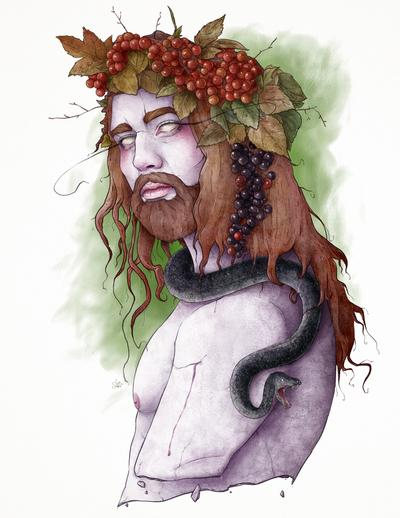
Amazing image of Dionysos

Image by schmoo15, which Petros found on Deviant Art and sent to me. It reminds me of one of my favorite lines from Euripides’ Bakchai (which is saying something as there’s a lot of great lines in that play) where Dionysos is described as θεὸς δεινότατος, ἀνθρώποισι δ’ ἠπιώτατος (861) [to mortals the most terrifying and most benign God.]

Coincidentally

Coincidentally it is also the second day (out of seven) of the Hudson Valley Bakcheion’s observance of the Dionysia, and the start of the Gold Season (April through June) during which the face that the God shows to us is that of the Sacred King, and we honor him alongside the Fairies & Goblins of his Retinue. Check that first link for movie recommendations and other tips on how to celebrate the Dionysia, our festival of the ars dramatica. In addition to the Dionysian Artists and legendary figures of the stage, this is also a good time to pay your respects to the Heroes and Heroines of the Bakcheion by reflecting on their stories, and works, and the virtues (and vices) that they embodied as well as making offerings (particularly libations) to them. You can either venerate them collectively or pick a different recipient for each day of the festival. In particular reflect on their association with Dionysos and how they, consciously or subconsciously, acted out his myths, drives and (often contradictory) traits through their lives in both positive and negative ways. Remember, an hero isn’t necessarily a salutary model to emulate but rather is honored for being exceptional. And the exceptional is often dangerous and destructive, especially when Dionysos is involved. Finally, you can organize your movie-watching thematically, devoting one day to tragedies, one day to comedies and since Satyr-plays are not generally produced anymore (especially not in Hollywood) you can swap them out with another appropriate Dionysian genre such as horror, dark fantasy or rom-coms. If you have any questions about any of this please do not hesitate to ask your humble ἱεροποιός. 

surprisingly decent

We just got back from the first public meet-up hosted by the Kindred of the Well and Tree. Although a couple people who RSVPed didn’t show turnout was surprisingly decent, and we had a wonderful time talking about Loki and his family (since today is his feast day in several Heathen denominations) as well as numerous community and other pagany and magical topics. We ended up chatting for close to three hours, and might have gone longer if management hadn’t started giving us the stink-eye. We left a considerable tip because we’re Heathen and not Neopagans, and so understand the virtue of hospitality. And being on time. (Well, most of us.) Having helped organize these events a number of times before in various places (Washington, Nevada, Oregon and here in New York several years back) I can honestly say I’m impressed with how well things went, and am very much looking forward to future meet-ups, and through them, Gods willing, finding the sort of people we want to do ritual with and invite to join our small but growing Kindred. Trust me, considering some of the folks I’ve had show up to past events — you want to perform as much vetting as possible if you’re doing anything even remotely involving the public and the sacred.

The ethics of mantike

One of the most important lessons I’ve learned as a mantis or diviner is a bit of wisdom that was inscribed at the temple of Apollon at Delphi, one of the holiest and most important oracular sites in the ancient world. Thales is generally credited with first giving this sage advice, though it was also attributed to Chilon, Bias, Cleoboulos, Periander, Pittacus and a variety of other ancient wise men. (And at least one wise woman as well, the poet Phemonoe!) All of these men had a strong connection to the God Apollon, so you wouldn’t be far off the mark if you were to claim divine inspiration for the words. They are, after all, essential for anyone who seeks to live a wise, pious and successful life. I mean, of course, the famous admonition γνῶθι σεαυτόν (gnōthi seauton) which can be rendered into English as “Know Thyself.”

Historically there have been two primary ways to interpret the injunction, both of which are relevant to those seeking to take up this divine craft. (There are, as I’m sure you’re aware, many other equally valid ways to interpret the phrase, but one would need to devote a whole essay – at the least! – to exploring all of them. There’s a reason why Apollon was granted the epiklesis Loxias.) The most familiar of the two, thanks to the Socratics, is as an encouragement towards introspection and authentic self-discovery and expression. The founder of that school so aptly observed that the unexamined life was not worth living and through the process of dialectic he challenged people to critically examine their basic assumptions about who they were, how the world worked and what concepts such as love, truth, wisdom, piety, beauty, courage, etc. actually meant to them as opposed to the definition insisted upon by unthinking society or convention.

The second interpretation – which is probably more in line with the original intent of its author, even if it isn’t as well known – is that we should know ourselves in the sense of knowing our proper place in the world, observing respectable boundaries of thought and deed, avoiding overreaching pride, arrogance and impious aspiration. Similar Delphic maxims include “nothing too much,” “observe the limit,” “think mortal thoughts,” and so forth.

Both ways of reading this admonition have relevance for those who would pass on the sage counsel of the Gods to their communities, regardless of the tradition within which they work.

To begin with the mantis must have a proper understanding of exactly what it is they are doing. They must know where the information is coming from, be able to carefully distinguish the messages of the Gods from their own thoughts and emotional responses to the issue and must accurately report everything that comes through and limit what they say only to what was communicated without subtraction, embellishment or unasked for interpretation and commentary. After the message has been given, the querent may ask the mantis for their opinion or further clarification on an obscure point of the message, but in doing so the mantis should make it perfectly transparent what came from the Gods and what is their own private interpretation. They should be especially careful not to force their opinion on the querent since it is often part of the process for the person to figure out what the oracle means to them personally and one should also avoid idle conjecture or in other words, if you have no idea what an oracle means don’t guess or you’re liable to be wrong and unhelpful.

Now to offer further clarification on some of these points.

I am a trained mantis with over two decades worth of experience under my belt. That does not, however, mean that I am a therapist or possess the necessary knowledge, training or certification to diagnose mental problems or offer practical, emotional or spiritual counseling. Anyone who comes to me seeking that sort of thing gets redirected to qualified personnel – in fact I’m reluctant even to offer friendly advice because, to put it mildly, I’m shitty at handling my own problems and I’d undoubtedly be much worse at sifting through other people’s crap.

Unfortunately a lot of folks in this line of work don’t share my misgivings and I’ve seen them royally fuck people over as a result. They didn’t mean to, of course – they went about their advice-giving with the best of intentions. But when it came down to it they just didn’t know enough about the situation or the workings of the human psyche to be truly helpful. Even if their advice was excellent and exactly what the person needed to hear at that precise moment, it can be extremely difficult to remove one’s ego from the equation. A lot of people just aren’t prepared to be ignored or misunderstood, which happens the majority of the time that advice is given. You may see with perfect clarity that your friend is in a dysfunctional and abusive relationship and needs to drop that bitch and start his life fresh as far away from there as possible – but your friend may not be ready to do that just yet, even if he’d agree 100% with you. He may be worried about the economic consequences of leaving his wife, he may still be making all sorts of excuses about why it happens (she didn’t really mean it, she only does it when she’s had too much to drink, I brought it on myself by provoking her) or he may be in denial or ashamed to admit that things have actually gotten that bad and so on and so forth. The only thing you can be certain of in a situation like that is that the person won’t leave or seek the necessary help until they are good and ready to – and even then it may require several frustrating abortive attempts before it finally sticks.

It can be maddening to watch the cycle of abuse play itself out over and over again, but you can’t force a person to change against their will. Often their anger and impotence will become directed at you if you try and push them since you are a safe target for their venting or else they might perceive you as a threat to the status quo. Your actions may inadvertently heighten their sense of shame and isolation, which only serves to ensconce them deeper in the dysfunctional situation. You, yourself, may become frustrated that they aren’t listening to your wise advice or are hellbent on a path of despair and self-destruction. You may, in turn, lose all respect for them or no longer wish to associate with them lest you become culpable in their abuse by knowing about it and not being able to stop it.

This is, of course, a fairly radical situation but I’ve seen plenty of friendships destroyed over things of far less consequence as a result of indiscriminate advice-giving. I feel it best to avoid this altogether – or least not to proffer until asked for – but if you feel that you absolutely must give your opinion, make sure that you do so devoid of any expectation. Once your words have been spoken, leave it at that, granting them the freedom to act on it or not as they see fit. You should be willing to stand by your friend regardless of how they choose to put your advice into action, and if you cannot withhold judgment either keep your feelings to yourself or end the friendship without making a huge deal of it. You do not want to get embroiled in unnecessary drama and transform the person you once considered a bosom companion into a mortal enemy.

There are many ways, in fact, that we need to keep ego in check when it comes to serving as a mantis. Related to the above principle it is incumbent upon you to remove any personal investment or consideration from your oracles. Your job is to transmit a message from the Gods to the querent. Once you have successfully done that your obligation ceases. How the person accepts it and what they do with that information is entirely up to them. It should be no concern of yours whether they misinterpret the message, incompletely or incorrectly implement what was asked of them or ignore it outright. Honestly this can be one of the hardest parts of the job, especially when the oracle comes through unambiguously or you see the person still struggling or complaining about a situation months or years later, all of which could have been swiftly and satisfactorily resolved had they only done what they were told. It’s even more frustrating when the person comes back to you later on with the same question, seemingly hoping for a different answer. You come to feel annoyed, ignored, disrespected – and this can have unpleasant consequences for your friendship if you’re not careful.

The best thing that you can do is to know your place. Your place is to give the oracle not to lead the person’s life for them. That is their responsibility and they – and only they! – will suffer the consequences of their insolence, indolence and ignorance. You also need to understand that everyone responds to situations differently. Maybe it’s going to take this person longer to overcome an obstacle than it would have for you. Maybe they have important lessons to be learned which can only come about through repeated failures. Maybe the God never intended for them to do what the oracle said but rather was subtly urging them on to a different path which they could only discover through attempting something and then realizing that it wasn’t right for them. And maybe what you see so clearly in the oracle isn’t what the God wished to communicate to them, so even though they may be interpreting it “wrong” from your perspective, they are actually doing what is pleasing in the eyes of the God. Regardless, even if you are right and they aren’t it’s their oracle to do with as they please.

Another reason not to take it personally is because if you’re doing your job as a mantis properly then the message was never yours to begin with. It originates from the God and you are nothing more than a messenger passing it on to its intended recipient. And at that point the matter rests entirely between them and their God. Or to think of it in another way: you are just a vessel into which the Gods pour their blessings. A cup has no feelings and no purpose other than to be a receptacle for fluids. It has no say and indeed it hardly matters whether wine or water or milk or anything else is dumped into it. It doesn’t matter whether the person drains the cup in a single draught, takes only a tiny sip and then walks away never to taste it again or even if they dump it out or just let it sit there growing mold. The cup’s sole purpose is to hold what’s poured into it without leaking, to serve the needs of the one pouring something into it and the one that is going to drink out of it. Thus, like the cup the sole desire of the mantis ought to be for utility without any concern for how they are being used and what follows after. In keeping with this I feel that is the supreme obligation of the mantis to get themselves out of the way as much as possible. You are facilitating communication between the Gods and their people and your job is to transmit those messages as clearly and carefully as you possibly can. Always remember your place and stay mindful of its humble position in the grand scheme of things.

The people are not coming to you to hear your wisdom or gain your valuable opinion on important matters. If you want to send your own message out into the world then take up the noble craft of the writer or become an orator, a therapist, a teacher, a philosopher, some crazy drunken dude on the street corner or something else along those lines. But when you take up the calling of the mantis then you must always be conscious that you are a servant of the Gods and faithfully report exactly what they tell or show you. Nothing more and nothing less than that should ever pass your lips or fingertips when you are engaged in this sacred vocation.

Long before the aspirant mantis begins offering their services to the public they must cultivate the spiritual faculty of discernment, the ability to listen for the voice of the Gods (however that is expressed to them, and this can indeed come through in many different ways depending on the Gods and the person involved) the ability to identify who and where it’s coming from (since there are so many Gods, spirits and assorted divine beings out there) as well as being able to recognize how this differs from one’s own thoughts, feelings, personal convictions and the detritus floating about in one’s brain. This can be incredibly challenging especially when one is first starting off on the path or when the issue is one that directly involves the mantis or those close to them.

It’s even trickier when you do the sort of direct trance-possession oracles that I’ve been specializing in with Dionysos for a number of years now. After all, if you’re employing some form of external, mechanical divination such as Tarot, Runes, I Ching, augury or the like there’s a measure of control and corroboration that you can rely on. This is what the tools turned up, this is the traditional meaning and here’s how I interpret the symbolism. Even if that is just the starting point and you rely on inspiration and free association there’s still a degree of concreteness to the process that’s generally lacking when you are shown visions, hear the words of a God or some other form of intimate, often internal communication takes place. You have to be constantly on guard that the message is coming through clearly, that it isn’t getting distorted by errant thoughts and astral junk, or that you accidentally and perhaps even without being aware of it are twisting things to conform to your own biased expectations. This is not a perfect science no matter how diligent and disciplined we are or what added precautions we take. Furthermore we are faulty human beings. The Gods exist on a level far beyond us with an understanding of the world and the things in it which is radically different from and dwarfs our own. The act of transmitting this through an imperfect human vessel, translating transcendent understanding into finite human speech and thought is a process fraught with peril. It’s like representing a multi-dimensional construct using only length and width. Much, inevitably, is going to be lost in the process. But it’s your job to ensure that things run as smoothly as possible, that the wires don’t get crossed, the information corrupted and contaminated as little as possible and that you don’t interject your own take on things.

One of the most important elements of this is communicating the message as it was given, regardless of what you personally feel about the issue. Many times over the years I’ve received messages that didn’t make much sense to me or quite frankly were a complete one-eighty from what I would have told the person had they come to me seeking advice. Sometimes the message is uncomfortably direct and harsh. In those instances you’ve really got to struggle against the tendency to impose order on it, make it more sensible and directly relevant, or to sugar-coat it. You have to trust that the Gods are far wiser than you, that they are seeing a fuller picture or referencing something that will be intelligible to the person receiving it even if it’s incomprehensible to you, that if it means nothing to the person now it may in time when more of the puzzle pieces have fallen into place and that the Gods have a reason for saying what they do and in the manner that they have chosen regardless of how you feel about all of it. Even if they aren’t as polite as you would like, you have to consider that that brusqueness may be there because that is exactly what the person needs to hear in order for the message to get through their defenses. And if they take it out on you, suggest the message came from you and accuse you of being too harsh and judgmental, well, that’s the risk you’ve got to take if you want to be a messenger of the Gods. You’re not in this to win friends and accolades, and it’s not your business to adulterate the words of the Gods or soften the blow. Conversely there have been times when I was expecting a forceful reply and the oracle came across gentle and somewhat coddling to my complete surprise. Clearly that’s what the person needed to hear in that instance and the Gods recognized that bashing them over the head with it wouldn’t have done any good. The more you encounter oracles like these the more you come to realize how little a role you play in all of it and how clearly they originate from somewhere outside of yourself.

For these and many other reasons I try to go into an oracular session knowing as little about the circumstances of the question as humanly possible. I do not ask for background details or clarification unless it’s absolutely necessary, I only skim the requests when I receive them to determine if there are other matters that need to be addressed, I keep the requests in a folder and transcribe them early in the evening hours before I start my preparation, I try to avoid thinking about the question or discussing it with the person beforehand and I go through an elaborate series of preliminary ritual actions which are not only highly devotional in nature but also help to clear my mind and focus my attention on the sacred work before me so that I won’t have any room for mundane concerns or dwelling on the details of the request. And on the rare occasions when none of that works because I’m too involved or close to the situation and person I’ve straight-up told them that I couldn’t do it and they should seek assistance from a different source. I’ve only had to do this a handful of times over the years but I feel that it is a necessary step to take to preserve the integrity of my calling and ensure that I am providing the best possible oracular service that I can.

Likewise when an oracle that I receive is too jumbled and incomprehensible and all further attempts to gain clarity prove fruitless, or I just can’t get into the proper oracular state I admit as much to the person and either offer to try a different divination method or advise them to seek an answer elsewhere or accept that this is not something that they are going to gain insight on at this time. Some may find it uncomfortable to admit fallibility but I’d rather the person think me a failure than to know myself to be a fraud, manufacturing messages when none are forthcoming or twisting the details so that they appear more sensible. To distort things in that way is a violation of the sacred trust that both the Gods and my community have placed in me. This work is difficult and demanding and it requires integrity, courage, dedication, discipline and all of the other virtues upon which character is based. If I compromise even a little, give less than my absolute best – even if no one else is aware or likely to ever find out about it – it is going to undermine my confidence in myself and cause me to doubt my ability to hear what the Gods are saying and communicate that to others. So even setting aside the considerable moral obligation I have to those that approach me with their questions, it is in my own best interest if I intend to continue in this vocation to be as honest and uncompromising as possible. I’ve got to live with myself and look myself in the mirror – how could I possibly do that knowing that I had deceived and cheated someone?

As an extension of that I feel that a mantis should always be conscious of what their office means to those who seek their assistance, the importance and dignity and sacredness of it. We help bridge the gap between the mortal and divine realms. People come to us to learn about the Gods and to hear their messages. While I agree with the general principle that no one needs an intermediary between themselves and the Gods, that the Gods can hear our prayers, accept our offerings and make their will known to us in a multitude of ways – practically speaking there are often circumstances that make things much more complicated than that. Perhaps the person is full of doubt or too close to the situation to gain any kind of useful clarity. Perhaps they are in a state of impurity, do not know the proper methods of communicating with the divine or how to recognize such communication in the first place. Perhaps they are new to all of this, lack proficiency in divination, are spiritually blocked or deaf and blind to the invisible world. Maybe they’re in over their heads, facing a situation they could never have conceived of before or are just looking for an outside perspective or confirmation of things they have already intuited. There are a thousand and more reasons why a person might consult a mantis and it is our job to be there to lend our assistance where and in whatever way we can.

This is both an immense honor and an incredible responsibility because when we take up this office we become the representative of our Gods. Everything that we say and do – whether in our capacity as a mantis or outside of it – reflects back on the Gods. We must be diligent in our execution of our religious duties, must conduct ourselves with integrity, character and proper decorum and never do anything that would cast aspersions on our holy office or cause others to doubt the existence, wisdom and benevolence of the Gods. And note that morality is relative and in this context largely determined by the Gods you are working for. The qualities favored by a God like Dionysos or Hermes are very different from the standards insisted upon by Apollon or Athene, to the point where I’m strongly hesitant to have anything to do with the latter pair.

When people see someone who claims to be a mouthpiece for the Gods acting in a haughty, shameful, cruel or unnecessarily contentious fashion it is natural for them to wonder how such a person could have an intimate communion with the Gods or if it’s all just empty hokum and vain posturing. Doubt that begins in the person spreads to the Gods: how wise and moral could they possibly be if they would entrust their message to such an undeserving person?

We may feel that this is unfair since we are all fallible human beings and virtue is not an easy path as evidenced by how few truly good men there are in the world. Further, spiritual aptitude is not always dependent on or even consistent with conventional morality as evidenced by the deplorable lives led by many visionaries, religious figures and artists down through the centuries. Regardless this is still the common perception and fair or not we are held to this standard with grave consequences for those who fail to measure up. The thought that one’s careless actions might drive people away from the Gods ought to fill any mantis worthy of the title with abject horror.

And finally, I’d like to include a word on asking and receiving. Remember, always, that a God is talking to you. It’s not the same as checking your horoscope in the paper or seeing what weird shapes your coffee grounds have formed. (Though these, too, can convey the will of the Gods to those who are properly paying attention.) Ask questions that suit the dignity of the occasion, not something you can figure out on your own with a little critical thinking. Don’t do it as a lark, because you’re bored or to try and test the Gods. And above all else, show respect by taking the answer you get seriously. That means spend some time really thinking about it and how it applies to your life. Don’t jump to the most obvious conclusion, especially when the oracle has been phrased enigmatically. History is littered with those who failed to see clearly what the Gods had indicated and brought untold suffering on themselves and their communities as a result. The Gods gave us rational faculties with the intent that we’d use them. That may require you to do a bit of digging and meditation before the ultimate meaning reveals itself to you, but as with all things in life you get out of stuff what you put into it. Likewise, when an answer is clearly and unequivocally presented to you you should strongly consider doing what it says. Why ask the advice of the Gods in the first place if you’re just going to ignore what they’ve got to say? Now, obviously, choice comes into play here. You’re not a robot and you can very well disagree with what a God is telling you to do. Maybe the sort of life you want for yourself isn’t what they’ve got in mind for you, or maybe the risks and consequences just don’t add up. I tend to think the Gods are wiser than us, more aware of the things that lurk beneath the surface or the chains of reaction that simple acts can set into motion – but hey, it’s your life, so do as you please. But on the other hand, don’t keep asking the same question over and over again hoping for a different result and don’t expect your situation to change if you’re not willing to act in a manner which they indicated will have a favorable outcome. Sometimes, a lot of the time actually, you’ve got to put in the work first before things will make sense to you. This is where trust comes into play. Don’t demand understanding and desirable results before you’ve done your part. If you’ve done everything asked of you and there’s still been no change, then perhaps you’re justified in getting upset and demanding an answer. But be careful about deluding yourself. Often we may think we’ve done everything in our power when we’ve really just skimmed the surface.
Some remarks on spiritual discernment

In one of the more curious anecdotes from Eunapius’ Lives of the Philosophers and Sophists, a group of gullible students were attending a theurgic seance wherein an Egyptian priest conjured a visible apparition of what purported to be the God Apollon, but when the Neoplatonic holyman Iamblichos inspected it he laughed and (I’m paraphrasing here) proclaimed, “Why are you falling to your knees filled with reverent terror – this is just the ghost of a humble gladiator!” 

Man may well be the measure of all things, as Protagoras averred, but we’re not very high up on the food chain when one considers the profuse array of divine and spiritual entities who inhabit this world alongside us. Not only do they vastly outstrip us in knowledge, power and access to other planes of existence but they are not constrained by any kind of universal moral code. There are dangerous and deceptive forces out there who want nothing more than to see the human race wiped from this planet – and they aren’t even necessarily what one would consider “evil” beings. Those exist too, in their plenitude, as well as things that are hurt, confused, scared, lonely or trapped.

So how can you tell that the entity you are encountering is who they claim to be?

You can’t. Not with 100% accuracy, 100% of the time. But there are questions you can ask, and things you can do that can certainly help.

Such as, how do we know any of the things that we think we know?

Inference.
Other people’s testimony.
The direct experience of our senses.

If you have prior experience with the entity use that, along with the known lore concerning them and the accounts of contemporaneous devotees as your basis for evaluation. 

Is the entity behaving in a manner that is consistent with the above? Do they “feel” like they normally do? Are they employing recognizable speech patterns? Are the appropriate signs and symptoms present? 

By signs and symptoms I mean the type of phenomena described in Proklos, On the Signs of Divine Possession as quoted in Psellus’ Accusation against Michael Cerularius before the Synod:

He speaks first about the differences which separate the so-called Divine Powers, how some are more material and others more immaterial, some joyous (hilarai) and others solemn (embritheis), some arrive along with daemons and others arrive pure. Straight afterwards he goes on to the proper conditions for invocation: the places in which it occurs, about those men and women who see the Divine Light, and about the divine gestures (schêmatôn) and signs (sunthêmatôn) they display. In this way he gets around to the Theagogies of divine inspiration (tas entheastikas theagôgias)[a theagôgia is a drawing in or drawing down of the divine]. “Of which, ” he says “some act on inanimate objects and others on animate beings: some on those which are rational, others on the irrational ones. Inanimate objects, ” he continues “are often filled with Divine Light, like the statues which give oracles under the inspiration (epipnoias) of one of the Gods or Good Daemons. So too, there are men who are possessed and who receive a Divine Spirit (pneuma theion). Some receive it spontaneously, like those who are said to be ‘seized by God’ (theolêptoi), either at particular times, or intermittently and on occasion. There are others who work themselves up into a state of inspiration (entheasmôn) by deliberate actions, like the prophetess at Delphi when she sits over the chasm, and others who drink from divinatory water”. Next, after having said what they have to do [i. e. to gain divine inspiration], he continues “When these things occur, then in order for a Theagogy and an inspiration (epipnoian) to take effect, they must be accompanied by a change in consciousness (parallaxia tês dianoias). When divine inspiration (entheasmôn) comes there are some cases where the possessed (tôn katochôn) become completely besides themselves and unconscious of themselves (existamenôn…kai oudamôs heautois parakolouthountôn). But there are others where, in some remarkable manner, they maintain consciousness. In these cases it is possible for the subject to work the Theagogy on himself, and when he receives the inspiration (epipnoian), is aware of what it [i.e. the Divine Power] does and what it says, and what he has to do release the mechanism [of possession](pothen dei apoluein to kinoun). However, when the loss of consciousness (ekstaseôs) is total, it is essential that someone in full command of his faculties assists the possessed”. Then, after many details about the different kinds of Theagogy, he finally concludes: “It is necessary to begin by removing all the obstacles blocking the arrival of the Gods and to impose an absolute calm around ourselves in order that the manifestation of the Spirits (pneumata) we invoke takes place without tumult and in peace (atarachos kai meta galênês)”. He adds further “The manifestations of the Gods are often accompanied by material Spirits which arrive and move with a certain degree of violence, and which the weaker mediums cannot withstand.”

If all that does not jive, what is different and how might this be accounted for? 

After all, Gods and Spirits often have a plurality of forms and the situation might require them to be more or less formal than they ordinarily would be. 

But sometimes you can tell that something is off and what you’re encountering is just a bad drag routine. 

At which point, ask for confirmation. I have set up codewords with all of the core Gods and Spirits that I work with, and if the being cannot provide them it’s a dead giveaway that they are not who they seem to be. (This is also an excellent means of verification when a third party comes forward claiming to have messages for you. If the God or Spirit doesn’t provide authentication it either means the message is not of utmost urgency or the person is not as perceptive as they are presenting themselves to be.)  

Another method is to make reference to past encounters with the entity but include false information; if you are not corrected, that can be a red flag. 

Thirdly, you may intone their epithets and project a sigil or charged mental representation of the God or  Spirit which will either empower or pass straight through them if they are that being (or very closely aligned to them) but will cause distortion and disruption if it is something merely pretending. 

There are, of course, many other methods for discerning the identity of a spiritual entity but it is not my intent to cover all of them; rather I am trying to get the conversation started. 

And so we’re going to move on to how to evaluate messages communicated by spiritual entities. 

Begin by asking yourself the following questions. 

What has been communicated to you? At this stage, keep it just to the facts. Don’t fill in the gaps, make inferences, analyze what the message personally means to you or any of the other interpretive methods we regularly employ. You want the message as clear and concise as possible. 

How has this been communicated to you? Did the encounter happen face to face or through indirect means such as divination? Was it the result of a dream, vision, or out of body experience? Was it something you observed, something you heard, something you intuited or arrived at through other means? Did it involve external perception or was the communication internalized? 

How reliable is your perception at the moment? What is your current mental, emotional and physical status and how might this be influencing what you receive? Is there a lot of internal chatter or stress that could be compromising your signal clarity? Are you suffering a depressive, hypermanic or delusional episode? How is your sleep routine and nutrition? Are you on any medications or drugs? Note that none of these are sufficient to rule out a message received, but all of them can and will influence your perception. 

How do you feel about the message being communicated? Is it challenging or upsetting, completely novel or exactly what you expect, what sorts of emotional responses does it stir in you and so forth. None of these speak to the accuracy of the message, but it’s definitely something you’ll want to be aware of lest you fall into a series of errors one need only survey the majority of polytheist and neopagan communities to find amply on display. 

possible explanations

We’ve all encountered people in the community who get divination results or channeled oracles that perfectly line up with the views they normally express on social media via memes; here are some possible explanations for why that might happen.

The closer we get to a divinity the more our values and choices come to reflect theirs, often on an unconscious level. Thus, without even necessarily thinking about it we may find ourselves parroting our Gods and Spirits.

Like calls to like. Thus devotees are naturally drawn to divinities who possess similar character traits and values as their own.

The divinity may be communicating with their devotee outside divinatory or oracular channels and so the person already knows what the divinity wants before the question is formally posed.

Divinities may communicate different things to different devotees, either because their agendas are large and complicated enough to encompass both positions, because they have specific tasks for each party, because they feel that devotee A is not emotionally capable of handling what is communicated to devotee B, because the divinity is playing both sides against each other, and so forth.

People see only what they want to. Meaning, that message may be there but is just an isolated scene in a larger tapestry and they’re not able or willing to take in the whole or they may extrapolate beyond what was said. For instance a divinity might advise one simply to “care for the suffering” which is then interpreted as promoting a specific political ideology or movement.

Either the devotee is willfully twisting the message to suit their ideology and agenda or else the fault lies with the oracle or diviner, who may be confused, biased or deceitful. Not all who present themselves as mouthpieces of the Gods are as competent or ethical as they should be.

Sort of an extension of the above, but the person may be in contact with something that isn’t what it’s presenting itself as – either a mental sock puppet, or a deceitful and possibly malign Spirit or God that’s masquerading as someone else. Spiritual discernment is decidedly rare in our communities.

People lie. To themselves and to others. It happens all the time, and religious communities are certainly not immune to this, especially not those on the pagan/polytheist spectrum.

Mental illness is also prevalent in our communities. While madness has many blessings it can also make “reality” a little fuzzy.

The Oration of Aristides

A few years ago I was looking for λεγόμενα (“things said”) which I could incorporate into the ritual and meditation practices of the Starry Bull tradition, and this led to one of the most potent tools for cleansing in our arsenal — the Oration of Aristides.

The Aristides in question is Aelius Aristides, a second century Roman lawyer, hypochondriac and initiate of Asklepios, Serapis and Dionysos. He kept exhaustive records of his illnesses, dreams, spiritual encounters and visits to various healing and oracular shrines, and the unconventional cures he was prescribed – by doctors, priests and his various Gods and Spirits. This work – the Hieroi Logoi or “Sacred Tales” – give a fascinating glimpse into the interior life of what we’d consider today a slightly neurotic spirit-worker. Some of his dream encounters come off really shamanic. Like at one point he gets cut into pieces by a flaming sword and in another Asklepios reaches into his chest and scoops out the pollution/illness. There were a bunch more but it’s been ages since I’ve read him.

The Orations are less autobiographical; they’re rhetorical exercises praising cities and institutions, and salutary hymns in honor of various divinities. The passage we use in the Starry Bull tradition – II.331k – comes from an Oration to Dionysos written on the occasion of Aristides’ initiation, if memory serves.

οὐδὲν ἄρα οὕτως βεβαίως δεδήσεται, οὐ νόσῳ, οὐκ ὀργῇ, οὐ τύχῃ οὐδεμιᾷ, ὃ μὴ οἷόν τ᾽ ἔσται λῦσαι τῷ Διονύσῳ.

Oudèn árâ hoútos bebaíos dedésetai ou nóso ouk orgê ou týkhe oudemía, ho mé hoîon t’estai lýsai tô Dionýso.

Nothing can be so firmly bound – by illness, wrath or fortune – that cannot be released by [the Lord] Dionysos.

Comparisons

Even more than Herakleitos or Empedokles I believe that the Olbian bone tablets:

SEG 28.659:
Life. Death. Life. Truth. Zagreus. Dionysos. Orphikoi.

SEG 28.660:
Peace. War. Truth. Lie. Dionysos

SEG 28.661:
Dionysos. Truth. Body. Soul

Can best be compared with the Pythagorean Table of Opposites, which circulated in a variety of forms though it was first recorded by Aristotle thusly:

Finite – Infinite
Odd – Even
One – Many
Right – Left
Male – Female
Rest – Motion
Straight – Curved
Light – Darkness
Good – Evil
Square – Oblong

Taken from here, with useful commentary and links. If you’re interested in taking a deep dive into the subject I recommend starting with Owen Goldin’s The Pythagorean Table of Opposites, Symbolic Classification, and Aristotle. This is where Pythagorean Orphism and Bacchic Orphism depart though they share common roots and practices. In Pythagoreanism these polarities take on a dualistic antipathy, while among the Bakchoi it’s more about alternating cycles and coincidentia oppositorum.

What do they mean? What do they mean?!?

The alphas that creep up throughout the famous bone tablets – often via very inventive ways such as hiding in the sail of a ship, which I’ve always taken to be a representation of the Black Ship of Dionysos, or as part of a sketch of a horse – make me curious.

I’ve considered the possibility that it’s an abbreviation for Apollon, who is featured on a bone tablet of his own excavated at nearby Berezan Island which is located at the intersection of the Black Sea and the river Borysthenes or the modern Dneiper (there’s also the thiasitai Boreikoi inscription from Olbia itself mentioning Apollon) – however the Olbian bone tablets are solidly within a Bacchic Orphic milieu, and this one obviously is not. (Though it’s possible its creator was an Orpheotelest, just working in a different strain of the tradition.) 

So I wondered if it was an allusion to a Dionysian allonym (other name) or epiklesis (descriptive title) such as Agrios (Wild), Antheus (Flowering), or Anthesterios (of the Festival of Flowers), which were all popular in the (mostly) Ionian apoikia (colonies) scattered throughout present-day Turkey, Ukraine and southern Muscovy.

I’ve pondered the possibility that the Α stood for Ἀριάδνη or even Αστεριος, which would have fascinating implications but isn’t terribly likely. Keeping with the bull-theme of the latter I also entertained the improbable but not impossible notion that it represented the Phoenician letter ʾālep (𐤀 meaning “ox”) which Dionysos’ grandfather Kadmos brought to Greece whilst searching for his sister Europa.

I also thought it might be something along the lines of the Ἄλφα καὶ Ωμέγα of Christian mysticism, particularly with the Pythagorean Orphic interest in isopsephy and other codes, riddles and puzzles, as well as the general orientation of Orphism towards the τέλος, which requires a beginning.

But I suspect that all of these speculations missed the mark. (Arrowheads, perhaps?) Clearly all the scholars are wrong too and they’re actually upside-down uppercase lambdes for Λυσιος, the Loosener or Releaser. 

Or something.

Truthfully, I haven’t a clue. But I find them enchanting nonetheless. (Aha! Definitely charaktêres then!)

According to the Starry Bull Alphabet Oracle alpha signifies:

Aeiro (άείρω) to lift, raise up, rise above.
Aigle (αἵγλη) radiance, glory, splendor.
Aparchê (άπαρχή) dues, first-fruits, preliminary offerings.
Aphiemi (άφίημι) discharge, loose, set free.
Aoton (ἅωτον) the flower of its kind, prime, fairest.

And comes with the following prescription:

Get up (άνεγείρω) at dawn, go to the highest place (άνίημι) you can and hang (άρταω) a star. Then count the number (άριθμός) of times you see stars throughout the day; if it is odd, your luck will shine (αἵγλη) through the [next] Kalends. If even, then make a batch of goat-shaped (αἴξ) cookies and offer them to the Winds (Ἄνεμοι) that they may snatch away (άρπάζω) your misfortune.

interesting to think about

One point on which I disagree with Nicola Mureddu is his comparison of the paradoxical pairings on the Olbian bone tablets with some of the more enigmatic phrases found in the fragments of the Ephesian philosopher Herakleitos, whom he feels has little to do with Dionysos. I feel that this is mistaken for two reasons; first, Herakleitos’ logoi are incredibly Dionysian and not just when he’s commenting on Bacchic cult practice, using mystery terminology, a couple of his fragments circulated under the name of Orpheus, etc. and secondly I think a more fruitful comparison can be made with Empedokles of Akragas who (like the probable author of the bone tablets, Pharnabazos) was an itinerant religious specialist (an agyrtes or Orpheotelest in the words of Plato) who practiced divination and the healing arts. His central conception was that there were four “roots” (ῥιζώματα) or generative substances (i.e. Air, Earth, Fire and Water) out of which all things arise and have their being through an admixture and subtraction of these primal elemental powers (identified with Hera, Haides, Zeus and Nestis, a local form of the Goddess Persephone) which are acted upon by Love (φιλότης, the force of attraction) and Strife (νεῖκος, the cause of separation.) Empedokles goes on to elaborate a complex cosmology seemingly full of drug-fueled hallucinations including cyclical births and deaths of the world, creatures that are half-human and half-beast as well as others that are hermaphrodites, and daimones from an alien realm trapped in mortal flesh like some kind of Philip K. Dick novel. It’s cool shit, and I sense a similar mind at work behind the bone tablets; though I also detect the coincidentia oppositorum of Herakleitos and the Sol Niger, so who knows? It’s certainly interesting to think about. 

The sacred zigzag

Speaking of the Bacchic Orphic bone tablets from Olbia, Nicola Mureddu sums up the different scholarly interpretations of the zigzag and other symbols found interspersed among the enigmatic phrases inscribed on them in his Truth carved on Bones – Studying the mythological and cultic meaning of the Orphic Bone Plaques of the Black Sea

The zigzag has however been interpreted in many different ways: Rusyaeva had initially thought to see a letter sigma in it, standing for Zagreus, another incarnation of the Orphic Dionysus. But she soon realized that at the time of its carving that letter was identical with the Phoenician zayin shaped as an I. West interprets it as both a snake, a well known symbol of rebirth, and a lightning bolt, the divine power which both generated Dionysus and killed Orpheus. Bilde offers a more imaginative solution: according to her the zigzag may be the symbol of a key, a divine key that only a god possesses, as indicated by Pausanias’ description: “What is called Hades has been locked up by Plouton.” So if the zigzag is Plouton’s key, it symbolizes the mastering of life and death. The A can be the initial of another name, but West’s vision of a stylized boukranion symbolizing then a horned figure is remarkable. The second plaque shows a symbol similar to a ship, a ship of which the sail resembles, as noticed by Rusyaeva, a disguised A. The third has again a drawing, this time of a horse; again Rusyaeva sees hidden in its mane a letter A, this time no names are written beside the figure. The fourth plaque carries again Greek words, once more expressed by opposites: Eirene, Polemos and Aletheia, Pseudos, again signed Dion accompanied by the usual A. This plaque has an inscribed verso; it shows the zigzag figure in a more detailed manner, another similar figure and a rectangular field divided into seven compartments in which oval figures are placed at different heights. The zigzag here is read as a combination of I, A and X, an abbreviation for Iakchos. In the seven compartments Rusyaeva recognizes the seven parts into which Dionysus was dismembered according to one of the myths. West on the other hand comments that such a schematic design had way too many possible interpretations among which he envisages a cultic offer of eggs or a musical instrument.

Some notes I’ve collected on abortion and Dionysos

I know that I’ve come across a couple more sources in the course of my studies not mentioned here, but that was before the shift in my views took place and I didn’t bother keeping records. I’m presenting this information to explain, not to persuade. I’m not trying to change anyone’s minds.

ISmyrna 728 (LSAM 84; SEG XIV.752)

… son of Menandros, the revealer of the god (theophantēs), set this up…  All you (?) … who enter the sanctuary and shrines of Bromios (“Thunderer”) should refrain from the exposure of new–born infants for forty days, so that blood guilt does not ensue.  Likewise refrain from contact with a woman’s miscarriage (or: abortion) for the same number of days.  Now if death and fate descends on someone in the household, perform the rites outside the gateway of the household after one–third of the month (i.e. ten days), and if some defilement comes from other households, stay away three days after encountering a decaying corpse.  (10) Nor should those wearing black clothing approach the altars of the Lord, nor should anyone lay hands on sacred offerings not yet sacrificed, nor … bring (?) … an egg into the Bacchic festivities, especially during the banquets, nor offer a heart on the sacred altars … also abstain from mint, which Demeter scattered (?) … most hateful root of beans from … make a proclamation about the Titans to the initiates (mystai) … and it is not lawful to rattle the reeds … thrown, by whom the initiates … sacrifices … nor carry …

[. . . .]της Μενάνδρου ὁ θεοφάντης ἀνέθηκεν. | [πάν]τ̣ες ὅσοι τέμενος Βρομίου ναούς τε περᾶτε, | τ̣εσσαράκοντα μὲν ἤματα ἀπ’ ἐχθέσεως (ἐκθέσεως) πεφύλαχθε | νηπιάχοιο βρέφους, μὴ δὴ μήνειμα γένηται, || ἔκτρωσίν τε γυναικὸς ὁμοίως ἤματα τόσσα· | ἢν δέ τιν’ οἰκείων θάνατος καὶ μοῖρα καλύψῃ, | εἴργεσθαι μηνὸς τρίτατον μέρος ἐκ προπύλοιο· | ἢν δ’ ἂρ’ ἀπ’ ἀλλοτρίων οἴκων τι μίασμα γένηται, | ἠελίους τρισσοὺς μεῖναι νέκυος φθιμένοιο, || μηδὲ μελανφάρους προσίναι βωμοῖσι ἄνακ̣τ̣[ος, —] | μηδ’ ἀθύτοις θυσίαις ἱερῶν ἐπὶ χῖρας ἰάλ[λειν, —] | μηδ’ ἐν Βακχείοις ᾠὸν ποτὶ δαῖτα τ[ίθεσθαι (?) —] | καὶ κραδίην καρποῦν ἱεροῖς βωμοῖς̣ [— — — —] | ἡδεόσμου τ’ ἀπέχεσθαι, ὃν Δη̣μ̣[ήτηρ ἀμάθυνεν (?)·] || ἐχθροτάτην ῥίζαν κυάμων ἐκ σπέ̣[— — — —] | Τειτάνων προλέγειν μύσταις̣ [— — — — — ] | καὶ καλάμοισι κροτεῖν οὐ θέσ̣[μιον εἶναι — —] | ἤμασιν, οἷς μύσται θυσί̣[ας — — — — —] | [μηδ]ὲ̣ φορ̣ε̣ῖν Σ̣Υ̣ (?) [— — — — — — — —]

Translation by Philip P. Harland

ISmyrna 728 (LSAM 84; SEG XIV.752)

_____tes, the son of Menander, the theophant, has dedicated (this): All those who set foot in the temenos and temples of Bromios, be careful to wait 40 days after the exposure of a newborn baby, so that divine wrath may not be aroused; likewise so many days after a woman’s abortion (or miscarriage). But if fateful death cover any relative, be excluded from the propylon a third part of a month; but if a pollution comes from other people’s families, wait three suns after the corpse perishes. Do not go near the altars of the lord if you are wearing black clothing; nor lay hands on sacrifices of sacrificial victims not to be offered (or: unoffered sacrifices of sacrificial victims), nor even set (?) an egg as a meal in the Bakcheia, and it is not lawful to burn heart on the sacred altars, and stay away from mint, which (?) …………. which is the most hateful root from the seed of beans …….. proclaim to the mystai (about) the Titans …….. and it is not lawful for them to make rattling noises with reeds, on the days, on which the mystai ……. sacrifices …….. and do not wear (?) ……….

Translation by Susan Guettel Cole

Notes

For exposure of a child, forty days. A lex sacra from Ptolemais requires 14 days in some cases and may have required 40 days in others; LSCG Suppl. 119, first century B.C. (the text is corrupt). Nilsson attributes the requirement at Smyrna to the concern for children in Bacchic cults. Cameron, CR 46 (1932) 109-10, argues that in spite of the widespread practice of exposure of unwanted children in antiquity, a special concern for children who died shortly after birth appears as early as Plato, and suggests that this was an Orphic concern. A child who died too soon [1a)/wroS1]1 was assigned a special place of suffering in the underworld (Verg. Aen. 6.426; Plut. De Gen.Soc. 590f; Luc. Kat. 5; Tert. De Anima 55). Exposure of children was also a concern of one branch of the Stoics (Mus. Ruf. 15). The divinity for whom the text from Ptolemais was inscribed is not known, and it is therefore impossible to conclude that a concern for an exposed child was a feature of Bacchic cult. Children seem to have played an important role in Dionysiac cult in the Imperial period. They appear often in representations of Dionysaic cult activity; see F. Matz, DIONUSIAKH TELETH [1Wiesbaden 1963]1 pl. 8.1, the initiation of a young boy. Dionysiac motifs decorate the sarcophagoi of children who died young; see F. Matz, Die dionysischen Sarkophage (Berlin 1968-75) nos. 16, 78, 156, 199-202, 214, 230, 236. Dionysiac themes, howver, appear infrequently in the epitaphs for children who died young; see A-M. Vé.rilhac, PAIDES AWROI (ATHENS 1978) I nos. 47, 79, 80, 190, 196.

For a miscarriage or abortion, 40 days. Greek vocabulary does not distinguish between voluntary and involuntary abortion; see J. and L. Robert, BE 1955.189. A waiting period of forty days after miscarriage or abortion is customary in other cults; see E. Nardi, Eranion in honorem G. S. Maridakis I (Athens 1963) 432-85 and Studi in onore di Edoardo Volterra I (Milan 1971) 141-48; R. Parker, Miasma (Oxford 1983) 354-56. In addition to the inscription from Ptolemais (which gives 40 days for miscarrage or abortion), cf. LSCG Suppl. 54 (Delos), 91 (Lindos); LSCG 55 (Laurion), 139 (Lindos). LSCG 171 (Isthmos) gives a ten day waiting period; BCH 102 (1978) 325 (Megalopolis) gives 44 days. LSCG 124 (Eresos) requires a waiting period of 40 days in the case of a stillbirth. Forty days at Smyrna, therefore, is not excessive.

The wearing of white was a requirement in some Orphic or Pythagorean groups; see Hdt. 2.81; Eur. Cret. 79 (Austin); Diog. Laert. 8.19; Iamb. VP 100, 149, 155.

Pythagoreans did not eat the heart of any animal. According to Aulus Gellius (4.11), Plutarch (fr. 122 Sandbach) attributed this fact to Aristotle (frag. 194 Rose; see also Plut. Quaes. Conv. 635c; cf. Porph. VP 42 (=DK 58 C 6: mh\ kardi/an e)sqi/ein). The Pythagoreans did not eat heart because they believed that the heart was the source of life and strength (Clem. Al. Str. 2.17.2, 2.22.5; see M. Tierney, Mé.langes E. Boisacq [Brussels 1935] 317-21; W. Burkert, Weisheit und Wissenschaft [Nüaut.rnberg 1962] 166-67=Lore and Science in Ancient Pythagoreanism [Cambridge MA 1972] 180-85). Such a restriction could be operative here. It is almost certain that the restriction here is explained by the myth of the dismemberment of Dionysos by the Titans, where Athena preserves the heart of Dionysos (Firm. Mat. De Err. Prof. Relig. 6 p.15,2 Ziegler=Kern, OF 214). The myth, in its essentials, may be as old as the fifth century B.C. (Pind. frag. 133; cf. W. Burkert, Homo Necans, 225 n.43.). The Titans themselves are .cm this is the american ed mentioned in this inscription (see line 16); for reservations about this connection, however, see Henrichs, Lollianos, 70 n.6. M. Tierney, CQ 16 (1922) 77-88, argues that the Gurob papyrus (=Kern, OF 31) describes a sacrifice of a ram and goat to Dionysos Zagreus, where the heart was not eaten, but taken away, reading in line 3 [kar]dioforeiaS1 teleth/n and arguing on the basis of Clem. Al. Protr. 2.22, that kardi/ai were part of the secret objects in the Dionysiac cista mystica.

Cf. OP. Hal. 3.488-97: kli/nato d) ei)S1 eu)nh\n *)Ai+dwne/oS1: a)ll) o(\te kou/rhn &bar; Persefo/nhn h(/rpacen a)p) Ai)tnai/oio pa/goio, &bar; dh\ to/te min kla/zousan u(perfia/loiS1 e)pe/essi,&bar; zh/lw| margai/nousan a)ta/sqala, mhni/sasa &bar; Dhmh/thr a)ma/qunen e)pembai/nousa pedi/loiS1:&bar;…poi/h d) ou)tidanh\ kai) e)pw/numoS1 e)/kqore gai/hS1. Ovid knew the story of Minthe, daughter of Peitho, changed by Persephone into a plant (Met 10.728-30; cf. schol. Nic. Alex. 374; Lobeck, Aglaophamus (1829) II 833-34). .cm this is Nicander, Alexipharmaca- Demeter and Persephone find Minthe an abominable rival, but Demeter herself once accepted a drink made with mint, barley and water. This mint was pennyroyal [1blh/xwn or glh/xwn: glh/xwni terei/nh|, Hymn. Hom. 2.209). For the medicinal uses of blh/xwn/glh/xwn, see A. Delatte, Le cycé.on (Paris 1955) 726 (BAB:Ecit. 40 [1954]).

There were various forms of mint, some beneficial, others harmful. An Orphic poem explains why kala/minqoS1, a wild form of h(du/osmon, once “a great and fruitful (fere/karpon]1 plant upon the earth” became a plant sterile and without fruit (a)/karpon]1: Demeter, in her grief changed its nature (Etym. Gud. s.v. mi/nqh; Kern, OF 44). The mythical character Minthe and the plant she represents seem to be associated with the cult of Demeter. Strabo gives the myth of Persephone and Minthe as aetiology for the mountain named for Minthe, located in the area of Pylos, near a temenos of Hades and a grove of Demeter; Strab. 8.3.14, 344c.

The issue here, however, is why such a plant should have meaning for Dionysiac cult. The Orphic poet, who explains the transformation of wild mint from fruitful to barren is perhaps the clue. Dionysos, like Demeter is a god of plant and human fertility. Like Demeter he is known by the epithet Karpofo/roS1; see SEG 19.481-83, 24.1122, 1124; For Kallika/rpoS1, see below nos. &oma (Mopsuestia), &qma, &rma (Aigeai). For Poluka/rpoS1, see IGBR I&S’&sub2;. 195.1-2, apparatus (Odessos). For Eu)ka/rpoS1, see IGBR:Ecit. I&S’&sub2;. 351 (Messambria). Dionysos is associated with forces that make the earth and humans fruitful. For his epithet Fleu/S1, “one who makes to swell or teem with abundance,” see IEphesos 902, 1257, 1270, 1595 (=nos. &nga., &sga., &qga., &rga.); IErythrai 207 (=no. ifa.); IPriene 174 (=no.pha.). For a discussion of the meaning of the epithet, see no. nga. (Ephesos), on lines 6-7. For these characteristics as especially characteristic of Dionysos in Ionia and Ionian colonies on the Black Sea, see N. Ehrhardt, Milet und seine Kolonien (Frankfurt 1983) 169-70. Dionysos himself is described by Fere/karpoS1 (Hymn. Orph. 50.10), the same epithet used by the Orphic poet to describe mint before Demeter’s attack made it sterile. It is Dionysos’ power as a god of fertility that would be directly threatened by a plant associated with sterility. It is important to note that Dionysos was thought to have influence not only on the fertility of the earth, but on the potency and fertility of humans, males in particular. This aspect of Dionysiac frenzy is best represented in cult by the Phallephoria, the processions at the Dionysia where reprentations of the phallos were carried around the theater. This aspect of Dionysos is not restricted to fertility rituals, but seems to have been part of the worship of Dionysos as god of the theater. For evidence from Delos for the celebration of the phallephoria as part of the Dionysia, see P. Bruneau, Recherches sur les cultes de Dé.los (Paris 1970) 312-321, texts dating from 304 to 169 B.C.; see no.tta, Delos). For Dionysos as the god of the fallhfo/ria, see Herter, RE XXXVIII (1938) 1673-81. When Dioscorides describes the negative effects of a surfeit of mint on the sexual capacity of the male, he describes a reaction that would threaten the role of Dionysos as a god of male potency and sexual activity. It is this aspect of Dionysiac fertility that the prohibition against mint at Smyrna must have been designed to protect.

CGRN 144 (SB I 3451; AGRW 16232)

Those entering into the … temple (?) … are to be pure in accordance with the following: from death of one’s own family member or … of another (?) … on the 7th day; from death at child–birth, having taken part in a miscarriage (or: abortion), on the 40th day; from having given birth and nursed, on the … xth day; and if it is exposed, on the 14th day; from having sex with a woman on the 2nd day, and the same holds for women having sex with men; responsibility for a miscarriage (or: abortion) on the 40th day, … on account of encountering death (?) … ; and giving birth and nursing on the … xth day; and if the infant is exposed on the 14th day; from a woman’s monthly period on the 7th day; … the woman from (?) having sex with a man on the 2nd day; and from contact with (?) myrtle on the 2nd day.

τοὺς εἰσιόντας εἰς τὸ̣ [ἱερὸν] ǀ ἁγνεύειν κατὰ ὑποκε̣[ίμενα]· ǀ ἀπὸ πάθους ἰδίου καὶ [ἀλλοτρίου] ǀ ἡμέρας ζʹ, ἀπ̣’ ἀπαλλ[αγῇ ἡ γο]ǀǀ[ν]ή, ἐκτρωσμοῦ συν[ελθόντος, μʹ]. ǀ τετοκυαίας καὶ τρεφούσης ․ʹ· ǀ καὶ ἐὰν ἐχθῇ ιδʹ· τοὺς δὲ ἄ[νδρας] ǀ [ἀ]πὸ γυναικὸς βʹ, τὰς δὲ γ[υναῖκας] ǀ ἀκολούθως τοῖς ἀνδρά[σιν· τὴν μὲν αἰτί]ǀǀαν ἐκτρωσμοῦ μʹ, [ἀπαλλαγῆς ἔνεκα]· ǀ τὴν δὲ τεκοῦσαν καὶ τρέ̣[φουσαν ․ʹ]· ǀ [ἐ]ὰν δὲ ἐχθῇ τὸ βρέφος [ιδʹ]· ǀ ἀπὸ καταμηνίων ζʹ· [τὰς δὲ γυναῖκας ἀπ’] ǀ ἀνδρὸς βʹ, μυρσίνην δὲ [βʹ].

Translation by Philip P. Harland

Notes

Regulations for Entry into a Temple (I BCE)

Ptolemais Hermiou (Upper Egypt)

Although no association is mentioned here, this regulation for entrance sheds light on similar temple-regulations connected to associations, such as the Dionysiac initiates at Smyrna (see GRA 140 = ISmyrna 728).

NGSL 7 (CGRN 155)

Monument (stelē) of Isis and Sarapis.  May the god bring good fortune.  This is a holy temple of Isis, Sarapis, and Anubis.  Anyone who wants to sacrifice may enter into the temple, being purified from childbirth on the 9th day, from miscarriage (or: abortion) on the 44th day, from menstruation on the 7th day, from contact with death on the 7th day, (10) from goat or lamb meat on the 3rd day, from other meats (or: foods) on the same day after washing from head to foot, from sexual intercourse on the same day after washing… (remaining four lines largely lost).

Translation by: Philip P. Harland

στάλα Ἴσιος Σαράπιος. ǀ Θεός, τύχα ἀγαθά. ἱερὸν ἅγιον Ἴσιος ǀ Σαράπιος Ἀνούβιος. vac. εἰσπορεύεσǀθαι εἰς τὸ ἱερὸν τὸν βουλόμενον ǀǀ θύειν καθαρίζοντα ἀπὸ μὲν ǀ λέχ[ο]υς ἐναταίαν, ἀπὸ δὲ διǀαφθέρματος vac. τεσσαράκοντα ǀ καὶ τέσσαρας ἁμέρας, ἀπὸ δὲ τῶ[ν] ǀ φυσικῶν ἑβδομαίαν, ἀπὸ φό[ν]ου ǀǀ ἑπτὰ ἁμέρας, ἀπὸ δὲ αἰγέου καὶ ǀ προβατέου τριταῖον, ἀπὸ δὲ τῶν ǀ λοιπῶν βρωμάτων ἐκ κεφαλᾶς ǀ λουσάμενον αὐθημερί. ἀπὸ δὲ ǀ ἀφροδισίων αὐθημερί vac. λουσάǀǀμενον, ἀπὸ ΠΑΘΙΝ[—]ΙΑΜΕΙΙΓΑΝ ǀ ΜΟΑΝ αὐθημερὶ λουσἀμε[ν]ον Υǀ[— — —]νεσθαι ΜΗΔΕΜ[— — —] ǀ [— — —] εἰσπορεύεσθα[ι — — —] ǀ [— — —]ΜΕΩΝΠΟ[— — —] ǀǀ [— — —]ΣΘΕ[— — —].

Translation by Philip P. Harland

Notes

Regulations of the Temple of Isis, Sarapis, and Anubis (200 BCE)

Megalopolis (Peloponnesos)

Slab of limestone found in 1975 700 metres northeast of the theatre at Megalopolis (64 x 54.5-57.2 x 14.0-15.4 cm). Now in Megalopolis archaeological museum (inv. 133; see Lupu in NGSL 7). There is no mention of an association in the inscription but we do know (from the Delos evidence) that sanctuaries for Egyptian deities could be frequented by such groups. Other regulations for entry into sanctuaries for other deities do mention groups of initiates, including the sanctuary for Bromios at Smyrna (see ISmyrna 728 on this site).

Well, this is going to piss a bunch of people off…

Neptunesdolphins wrote the following:

You know that is one definition for impiety – the presumption that the Gods are always on your side, because you said so.

Beckett tries to couch his writing in terms of well this is the Gods, and this is me, which is fine. But getting into the weeds and writing about Pagans in general, he links the two such as the Gods are for a woman’s right to choose (i.e., abortion). Well, I can think of several Gods who might baulk at that such as the Gods of Childbirth and Fertility. I can be pro-choice, but I cannot assume any of the Gods I follow are.

A God may tell me to do something political since that may be what They do, which is fine. But as you state there is a difference between me and Them.

What I find interesting is when Beckett rails about Christian Nationalists (and others) who do the same thing – assume that God and they think exactly the same.

BTW, nice tea cozy.

To which I replied:

Much appreciated. I think the cozy is rather stylish myself.

And precisely. Although Dionysos is very much about choice and bodily autonomy I’ve found a number of instances where abortion is discouraged or carefully regulated within his cults. I can think of a number of reasons for this – uniquely among the Gods Dionysos is represented as a fetus or premature child; he also has a strong concern for life in general, and young life in particular; as a God of luxuriant vitality, and growth and fertility more generally, abortion is the antithesis of that. I also strongly suspect that the purification rites imposed weren’t punitive but designed to help the woman process what happened and deal with grief and other unresolved emotions which might not otherwise have been addressed within their society before undergoing a process of reintegration and resuming their religious obligations.

So it’s complicated, especially since we’re left with the prescription in isolation. And interestingly the word used can either refer to the intentional termination of a pregnancy or an accidental miscarriage – not only is no context provided to help determine which is meant (assuming they saw a distinction between them) – but most sacred laws don’t even touch on this, so you can’t look to other sources for clarification either. (I will note that in the instances where this regulation shows up we’re either dealing with a Dionysiac cult interested in promoting fertility or else there’s a strong Orphic and Pythagorean influence which means we’re dealing with a non-normative form of the God; in other Dionysiac cults, as with Greco-Roman religion generally, abortion/miscarriage tends to be overlooked.)

Unsurprisingly this is something that’s gone unnoticed and uncommented on by the majority of contemporary Dionysians, most of whom are left-leaning and take it for granted that Dionysos shares their liberal viewpoint. I generally don’t bring it up because I don’t want contemporary politics to get in the way of them having a rich and satisfying relationship with Dionysos. However reflecting on this has definitely shifted my views on the subject – to the point that I’m no longer in favor of abortion, though I don’t want to see restrictive laws imposed since I have an inherent mistrust of the government and history has shown that such legislation just makes a bad situation many, many times worse. I’d rather see effort put into education, moral and societal reform, access to contraception and the morning after pill as well as sterilization procedures, eliminating some of the bureaucracy and hoops around adoption and surrogacy, providing support and resources both during and after pregnancy, and whatever else it takes to make sure that every child born is wanted, loved, healthy and properly cared for as well as ensuring the health and wellbeing of the mother – not to mention a bunch of needs and services I’m not aware of because I’m a dude, and early on made the decision to remain child-free.

And I think everyone needs to step up to make this happen – the nuclear family is unnatural and ineffective. In any properly functioning society you’ve got the grandparents, and older children, a pack of aunties and uncles, friends and neighbors, etc. etc. etc. all willing to pitch in and help the young couple out. It truly does take a village to raise a child. But today everything is so atomized and disconnected it’s no wonder we’re producing Millennials and Gen Zers, with all of their defects, dysfunction, and degeneracy. It’s not their fault they are so entirely lacking in virtue and functionality – that’s a failure of society at large. No wonder millions of mothers would rather murder their babies than raise them in the world we have collectively created. We can do better.

And that’s my Ted Talk, folks.

And just to be clear: I think abortion is wrong, not the women who get them. I don’t consider it my place to pass judgment on an individual’s decisions about their body, especially when they find themselves in such a personal and desperate situation. My place is to help create a society where abortion isn’t considered necessary except in the case of medical emergencies. And that, I think, can only be done on the tribal level.

And I have no idea what Dionysos thinks on the subject, as it’s never come up. And if I did I wouldn’t mention it, because I believe that my arguments are morally correct, logically consistent, humane, and capable of standing on their own.

Everything is number

According to isopsephy (basically Greek gematria, a favorite practice of the Pythagorean Orphics) Dionysos’ allonym Βάκχος has the numerical value of 893 (which is the solution to my Riddle, in case you missed the acrostic.)

893 is a number with some interesting properties, especially when applied to the text of the Bible. For instance “wilderness” (Num 14:2; Exo 7:16), “transgressor” (Pro 21:18), αναγγέλω (“to call; announce” = Joh 16:25) as well as μεθυσκεσθε (“to make drunk” = Eph 5:18) all add up to 893. Also, I chose the verses carefully as these words crop up in a number of places. 

And the sum of the following verses (taken from here since I don’t do math) is also 893:

  • Of fowls also of the air by sevens, the male and the female; to keep seed alive upon the face of all the earth. (Gen 7:3)
  • And it came to pass at midnight, that the man was afraid, and turned himself: and, behold, a woman lay at his feet. (Rut 3:8)
  • And thine age shall be clearer than the noonday; thou shalt shine forth, thou shalt be as the morning. (Job 11:17)
  • And as they did eat, Jesus took bread, and blessed, and brake it, and gave to them, and said, Take, eat: this is my body. (Mar 14:22)
  • How that by revelation he made known unto me the mystery (as I wrote afore in few words) (Eph 3:3)

All very interesting and Dionysian, but I’m curious how 893 turns up in inspired texts such as Homer’s Iliás or Odússeia, the fragments of Empedokles and Herakleitos, the Orphika, and Nonnos’ Dionysiaká say. I chose “inspired” rather than “sacred” since only Empedokles and the Orphika would technically count, despite the depth and meaning to be found in the rest since it’s important to recognize the distinctions in this type of literature and evaluate them properly.

Of course, now that I’ve brought it to your attention you’re going to start seeing 893 (or 8/93) everywhere, in meaningful and meaningless ways. You’re welcome. Io evohe! Io io Bakchos!