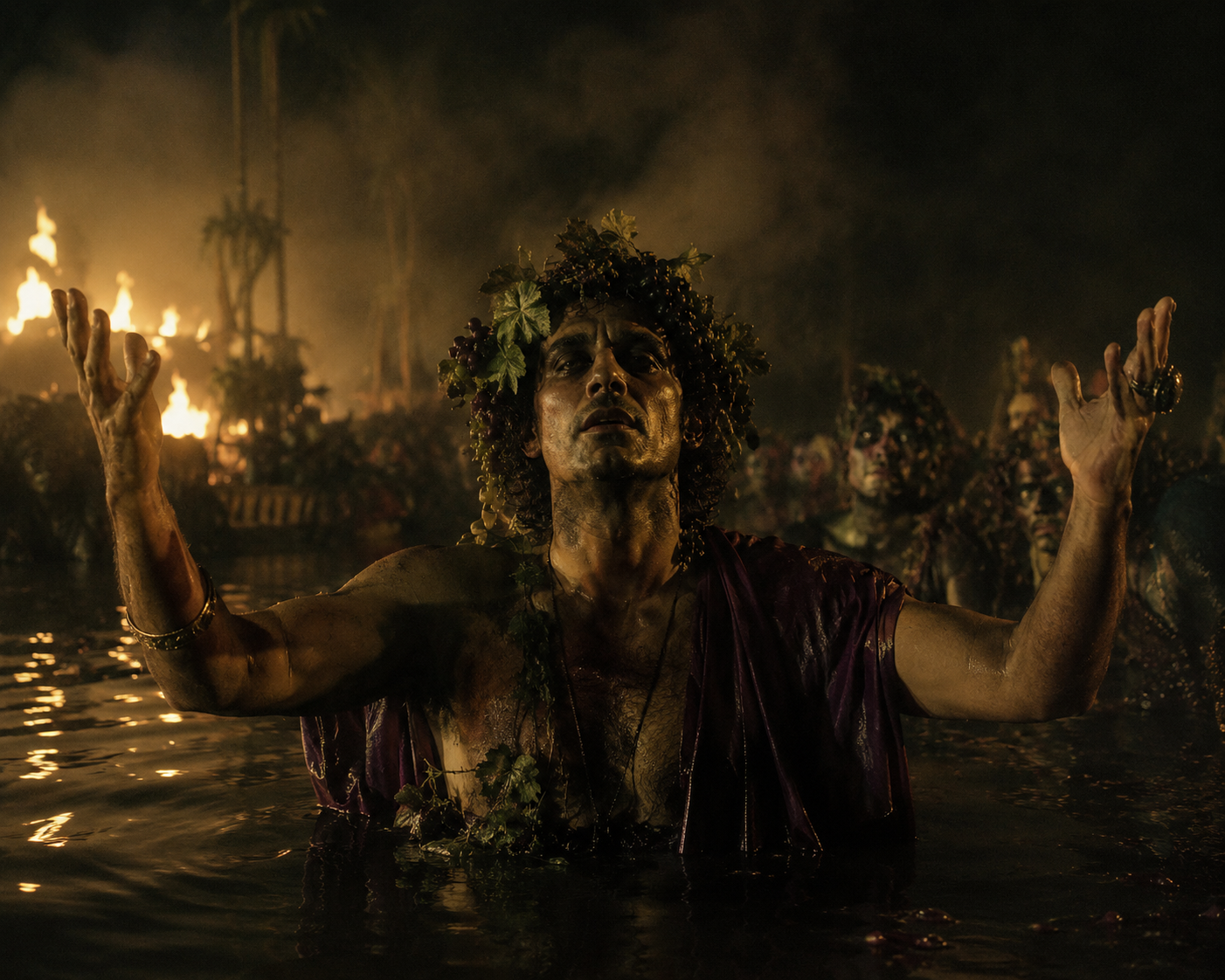
All this talk of horror reminds me of Colonel Kurtz in the jungle, to the point that I’m thinking Apocalypse Now is useful Starry Bull teaching material.
Coppola doesn’t give us a fool who merely thinks he’s penetrated beneath civilization’s illusions. Kurtz has encountered things that destroyed the moral categories he previously inhabited. His famous meditation on horror is about precisely this: he witnesses an atrocity and discovers, horrifyingly, that it possesses an internally coherent logic. Kurtz’s argument is horrifying because the episode about the children’s arms isn’t presented simply as “look how evil these people are.” What overwhelms him is their will: they are prepared to perform an act he regards as monstrous without hesitation because they believe it necessary. Kurtz realizes that soldiers constrained by one moral universe may be incapable of defeating people prepared to operate according to another. The moment he accepts that logic, and becomes a creature with monstrous will, is when his thread breaks, and he will never leave the Labyrinth and return to society. He has become Asterion.
That is a part of the mysteries, but initiation doesn’t end with sparagmos. Along with solve there is coagula. There is recombination, and you have to come back.
And now I’m picturing an Orpheotelest entering Kurtz’s compound, surrounded by severed heads, feverish devotees, drums, sacrifice and madness, and thinking, “Well, somebody has clearly misplaced their thread.”
But beneath the joke lies something significant: Kurtz is almost a perfect negative image of the Orpheotelest. Kurtz has charisma, insight, courage, experience of horror, freedom from conventional assumptions, the capacity to inspire followers, and willingness to go where respectable society won’t. And none of those things make him wise. In fact, those capacities without virtue and accountability make him vastly more dangerous without wisdom to guide him.
In the Starry Bull tradition we have the saying:
Διόνυσος σοφός ἐστιν.
Dionysos is wise.
Not merely wild.
Kurtz didn’t fail to encounter the Minotaur. He became Asterion, but then he forgot how to be Kurtz.
He went farther and farther inward until the categories of the outside world ceased to possess authority for him. And instead of carrying what he discovered back into civilization, he constructed a world in which the logic of the Labyrinth could operate permanently.
That makes Willard’s role remarkably Thesean.
He’s sent from the ordered world into a space increasingly outside ordinary geography and morality. The journey upriver is effectively a katabasis. Each stage strips away another layer of civilization until eventually there isn’t really a war anymore. There is jungle, river, darkness, ritual, death, madness— and Kurtz at the center.
Coppola deliberately intercuts Kurtz’s killing with the ritual slaughter of the water buffalo. So Kurtz becomes simultaneously man, sacrificial victim, and bull. Willard’s assassination ceases to be merely the execution of a renegade officer and becomes instead sacrificial slaughter.
But there’s a wonderful complication. Willard has read Kurtz’s story. He has listened to him. He has traveled Kurtz’s road. He has reached the center and understood enough of Kurtz that he could potentially become him.
That makes the really important action occur after the killing.
Willard leaves.
He doesn’t take Kurtz’s throne.
That’s the return from the Labyrinth that Kurtz could no longer accomplish.
For the Orpheotelest the defining competence isn’t simply the ability to enter horror. Plenty of people can enter. Kurtz demonstrates that magnificently. The difficult skill is retaining the thread that permits you to leave.
Which shows how important the role Ariadnē performs is. The thread isn’t there to prevent Theseus from encountering the monster. It doesn’t make the Labyrinth less dangerous. It doesn’t tell him that what he encounters at the center isn’t real. It preserves a relationship between the person inside the Labyrinth and the world outside it.
That red thread is woven through the character formation, virtue, accountability, community, and discernment that one recieves during training. It is essential for someone whose religious vocation repeatedly takes them into extreme states or encounters. They’re not there to make the practitioner respectable. They’re how you find your way back.
And this gives a much darker interpretation to something we’ve discussed before: formation before authority.
The danger isn’t merely that an inadequately formed person will be incompetent.
They might be extremely competent.
Kurtz is.
That’s what makes him horrifying.
He is intelligent, disciplined, charismatic, courageous, perceptive, spiritually formidable, capable of inspiring extraordinary loyalty, and willing to go farther than everyone around him. He has the virtues of an Orpheotelest.
What he has lost is the route home.
So what we learn from Apocalypse Now is that the Orpheotelest’s question isn’t merely, “Can you enter the Labyrinth?” but “Can you meet Asterion, understand Asterion, perhaps even recognize Asterion within yourself— and still remember the way out?”
Because otherwise, sooner or later, another Theseus gets sent in after you.

